

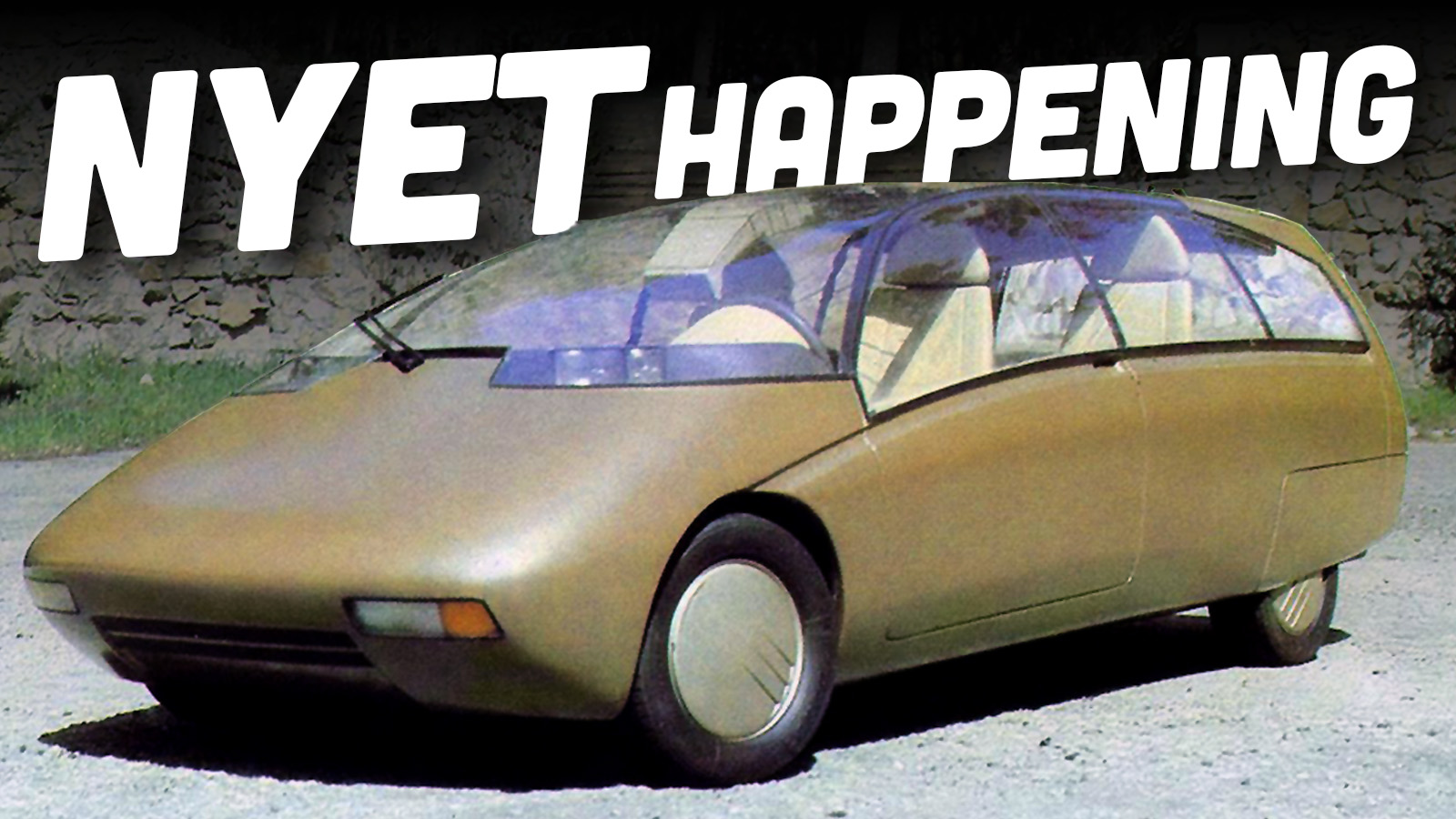
Sometimes you can’t help but feel for Soviet car designers and the cars they were working on. It’s true that some completely fine vehicles made it to production during those times, including the Lada Niva and … yeah, the Lada Niva is the only one I can think of.
In any case, some absolutely wild designs have survived, showing that VAZ (Lada) and AZLK (Moskvich) designers really did try to push the envelope, but the envelope was forfeited. The VAZ-2110 (Lada 110) concept featured a Subaru SVX-style glasshouse, the ’70s AZLK-2141 concepts were closer to a Saab than the Talbot Alpine copy that emerged, and the 1986 GAZ Volga 3105 concept had windows that matched the Chevrolet Volt show car 20 years later.


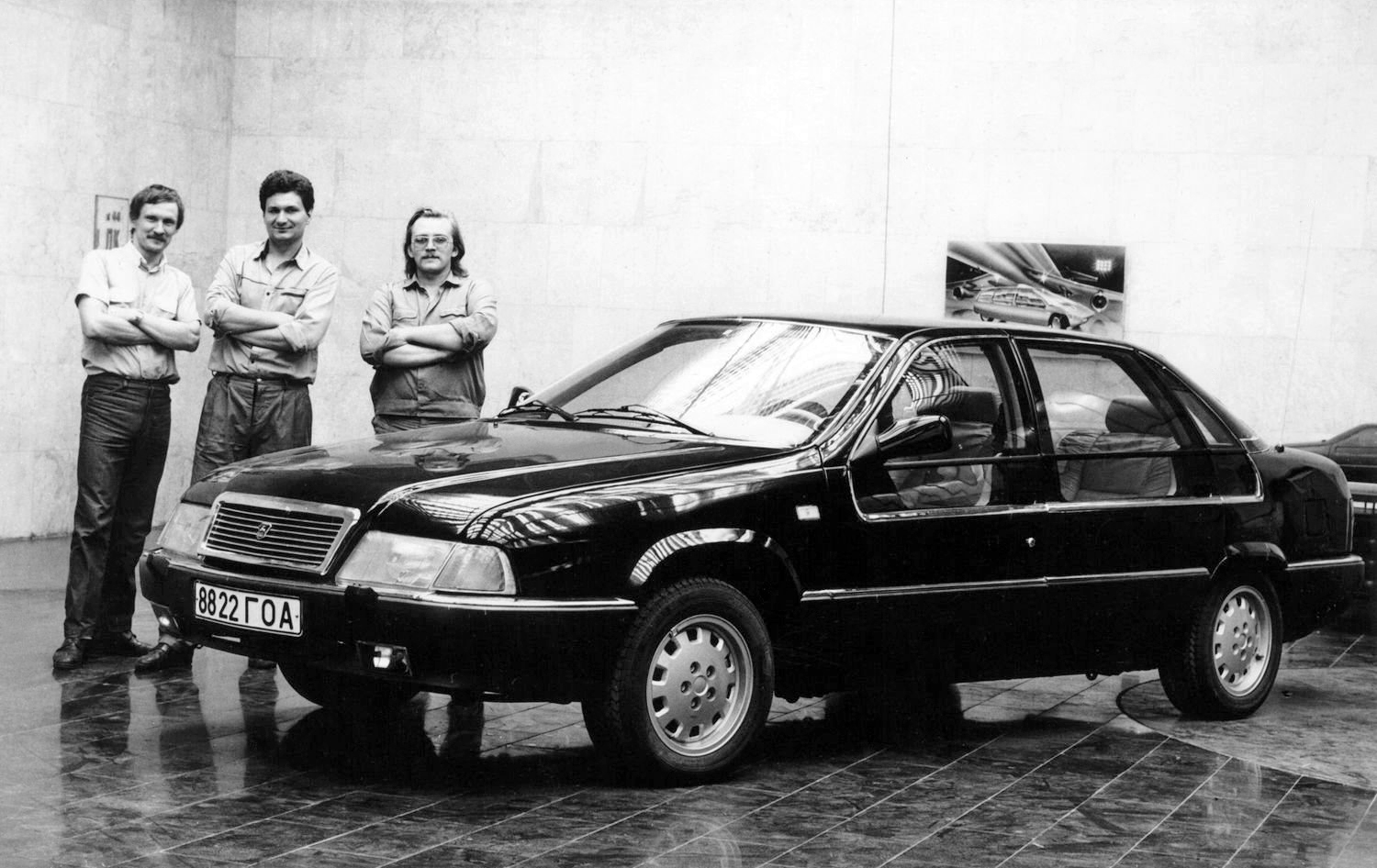
A case in point is the VAZ-X and X2 concepts, dating back to the early 1980s, and visible on the wall in the GAZ-3105 shot above with some really proud-looking Soviet designers. Is that a Tupolev plane in the airbrushed poster, too?
Those were the days of the imaginative minivan, as Renault guided Matra’s groundbreaking and plastic Espace to production, Chrysler made the Voyager, Ford the Aerostar, and later GM its dustbuster Trans Sport and Lumina APV vans. Why not, then, would the Soviet automotive industry also try to create a multi-purpose vehicle of the future?
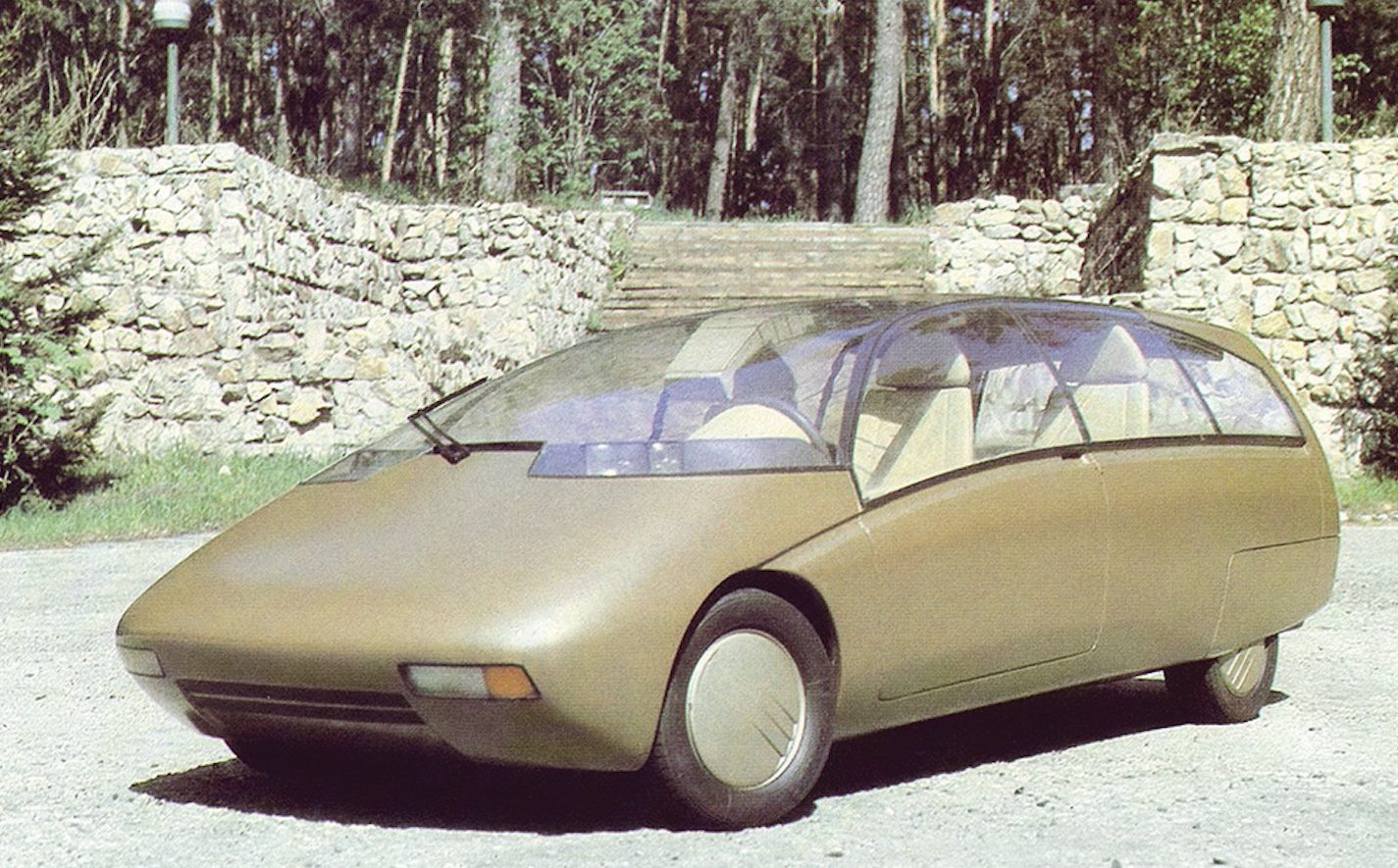
Lada displayed its first X concept in 1981. It was a swoopy, curvaceous affair with plastic panels and a cowling over a spaceframe structure. Because this was the 1980s Soviet Union, the concept car was nicotine brown, which does not really suit its shape all that well.
Headlights were mounted just beneath the curving windshield, which was cleaned with a single wiper, TGV style. The entire front end seems to consist of a removable cowling.
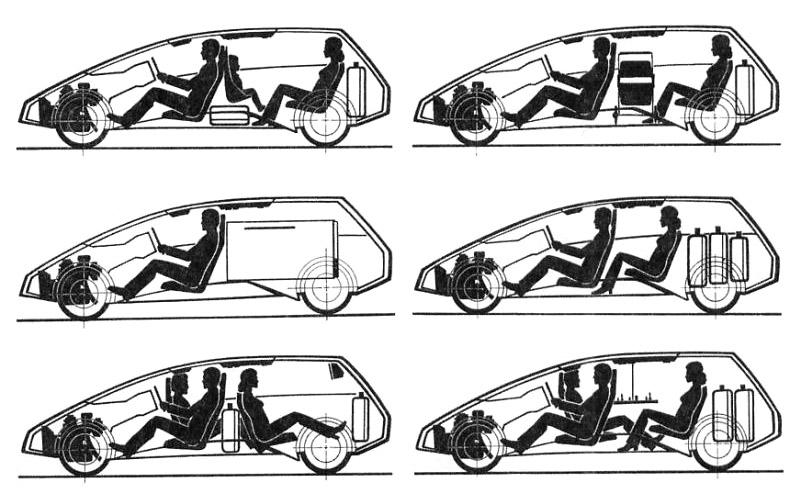
Surviving sketches show seating as completely configurable in different variations, ranging from a regular front-rear setup to jump seats and turning passenger seats around.
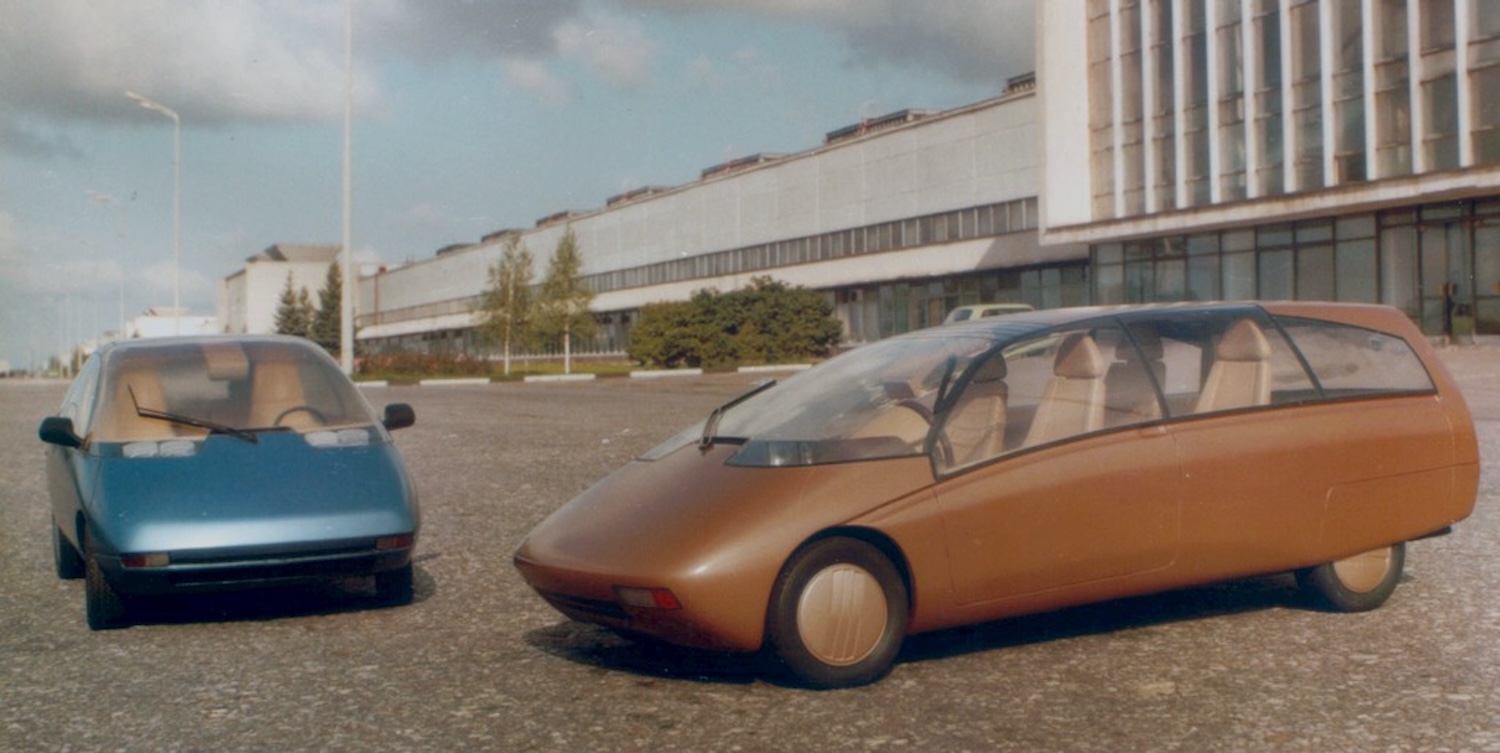
The entire vehicle was less than 14 feet long, the size of a regular hatchback, despite looking larger. Here it is with an early VAZ-2112 mockup, which is the size and shape of a Ford Escort.
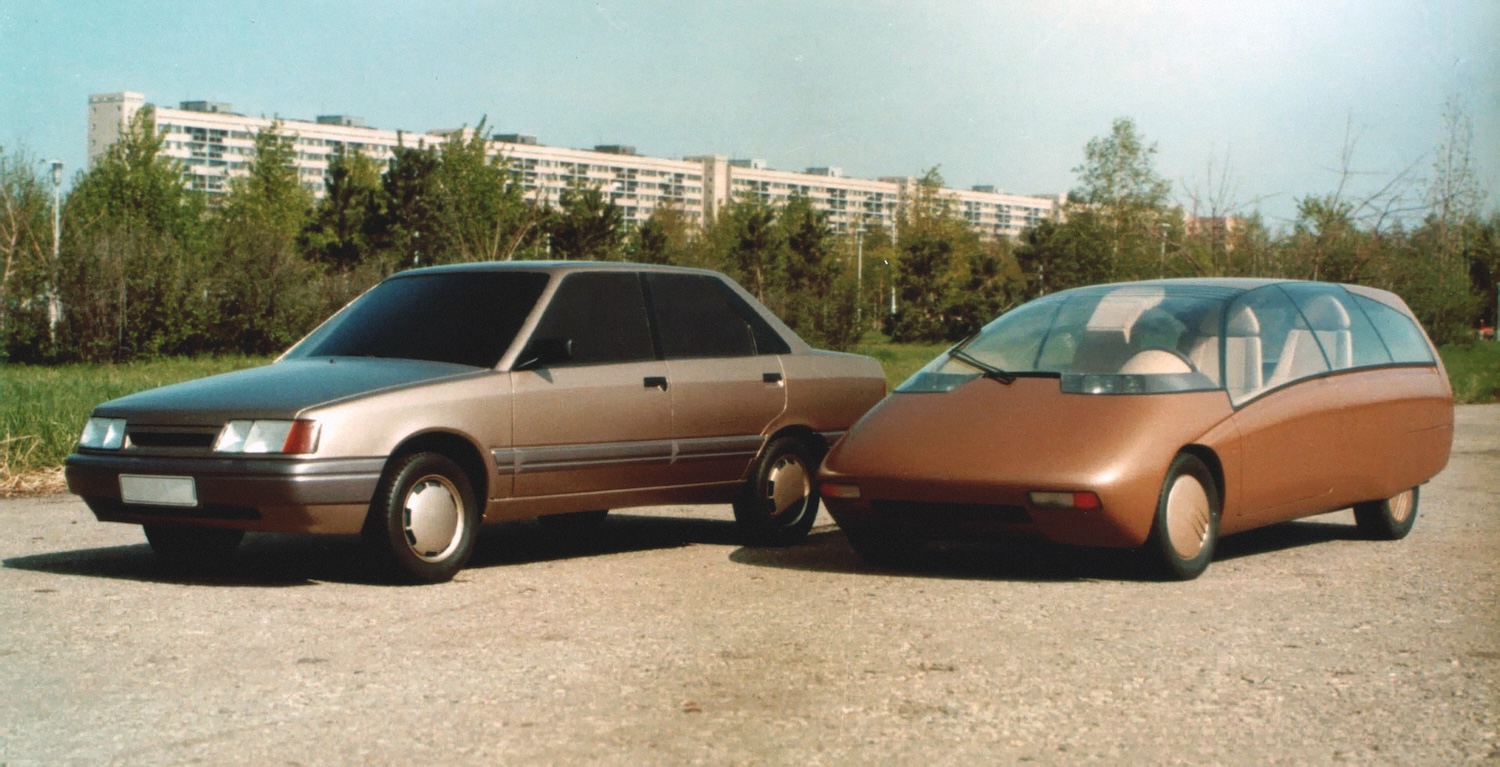
The X was followed by a smaller X2 concept a year later. It shared parts of the X’s design, including headlight placement and the single wiper, but it was shorter and smaller as well as finished in blue.
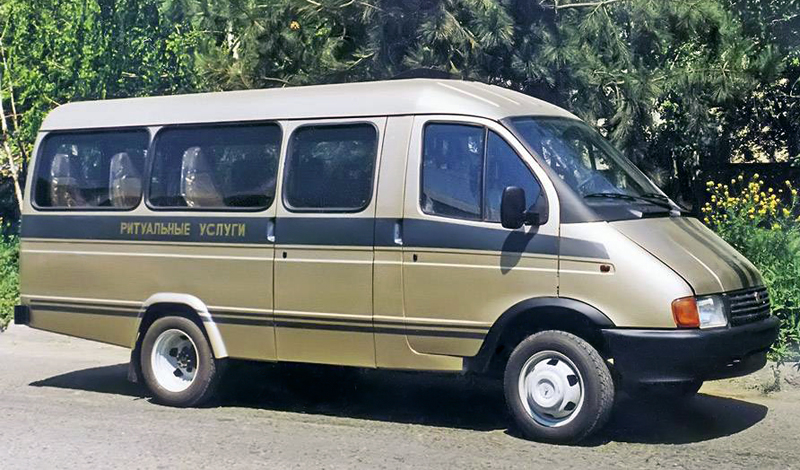
Neither of these vehicles was developed to a drivable stage, and the actual Soviet Russian people carrier of the future turned out to be the 1990s GAZ Gazelle minibus that looks like a Ford Transit knock-off.
These days, AutoVAZ makes decontented front-drive compact Ladas that share parts with old Renaults and Dacias, and their styling harks back to the halcyon days of the second-generation Ford Focus sedan.
The only thing worth remembering is the Lada Niva, one of the least aerodynamic vehicles ever produced there, yet one of the most capable. For what it’s worth, the Niva is still built – as is the Gazelle.
All photos by the respective manufacturers
Top graphic image: Lada


The X looks like an Oscar Meijer weiner mobile, facelift.
I want to know what the CIA got in trade for those Dodge Shadow wheels on the LADA 110.
“Comrade! I have great news! The politiburo wants us to make a new family car to showcase the strength of Soviet production!”
“Wonderful! How many are we making?”
“One. Maybe two.”
“How will just two cars move any families at all?”
“Oh, It’s not for them, it’s for our glorious leadership to display to the world the advanced state of Soviet industry!”
“…Alright. Pass me the Vodka…”
The lower-left drawing of a seating configuration with adults facing backwards?
Yeah, I get nauseous just looking at them.
Anyone who thinks the Niva is a good car has not driven or sat in one.
It is terrible, uncomfortable and unreliable.
I might be a bit late to comment, but this, so much this.
As much as I despise Soviet cars, there’s much more underneath these prototypes than our amused eyes are willing to find.
99% of these were enthusiast projects, made by the designers on their own time. They never had a snowflake in hell’s chance to be put in production, and the designers knew it very well.
The impossibility of these projects to see serial production doesn’t hit our Western eyes, because our brains are wired differently and we simply don’t have the background knowledge to realize HOW impossible it was for this to be built at scale and HOW difficult it was for these guys to build even these prototypes.
All parts used in Soviet cars were from a common parts bin. There was like one glass factory, a few engine factories, etc, etc, etc.
One factory to build brake systems – which were a few references, one to build ignitions, carburators, and so on.
And they were all overbooked with the existing orders. Say the glass factory had another 300000 Buhanka windshields to make, staggered for the next five years. Should the general secretary of the party himself have decided to have this built and ordered its mass production – just implementing the lines for molding the new glass would have taken years. And it was like that for pretty much every single part and module.
I enjoyed reading Za Rulem – a not too bad official Soviet automotive magazine (where most of these prototypes were presented by the way) in the late 80s. The Perestroika had already hit, and things were discussed mostly openly.
I still remember an article about the Izh motorcycle factory having a mostly finished prototype of a 125cc motorcycle with liquid cooled engine, a front disk brake and a central rear shock – like every offroad Japanese bike of the time.
The article mentioned that even if production was approved immediately, the earliest the brake factory could come with a disk brake was late 90s or very early 2000s. More optimism from the suspension factory, who could build a monoshock rear shock in just a few years.
At that time, even East Germany’s MZ had managed to buy a Brembo license for their front disk brake. Mounted on spaghetti-rigid front forks, it is true.
The East Germans were ages behind the West and ages ahead of the Soviets. That’s how bad it was. Even within the system discrepancies were ginormous.
In a strange twist of fate, the US might have copied Russia in this case. Here’s a GM concept from 10 years later:
https://www.reddit.com/r/WeirdWheels/s/ZvjWmM4fYI
Turd brown, turd shape.
Cop motor, cop brakes.
I am just curious how the FIat 124 became the darling vehicle for the eastern block nations to copy. Though it was kind of a stroke of WTF to have placed the 124 body on a range rover or whatever they copied for the 4wd setup.
The Italians were willing to do a deal with them, that’s pretty much it. And it was a fairly modern, well-packaged car for the mid 1960s, with engineering that was considered robust enough to handle Soviet conditions
Yep, they had deal where soviets sold steel cheaply for tooling of the 124. And not good quality steel, hence the hydrophobic Italian cars back in the 70’s and 80’s.
That’s another key factor, the Soviets preferred using the barter system for international trade, Fiat was willing to take part of their payment in steel (that they didn’t really need and just dumped on the commodity market), other automakers probably wouldn’t have bothered. Fiat made very little money off the deal, but it guaranteed VAZ couldn’t export to any country where Fiat was selling the 124, so they saw it as a way to make a little extra and temporarily block some new competition in Europe
Also, Gianni Agnelli ran the company almost like a dictator, the Soviets generally liked dealing with foreign businesses that had only one, key decision maker who could get things done quickly. This usually meant smaller, privately held companies, but a large publicly traded corporation that retained one, string, centralized family leader was just as good
That reminds me of Pepsi’s navy.
In 1989, PepsiCo entered a barter agreement with the Soviet Union, briefly acquiring a fleet of 17 decommissioned submarines, a cruiser, a frigate, and a destroyer.
Unfortunately CocaCola was relatively land locked, and Pepsi’s dominance as a sea power was not effective in the Cola wars.
This is an urban legend (which was promoted also here or at the old site if memory serves). Italians didn’t need any outside help to make fast-rusting cars – they had the science perfected and proudly promoted to a national sport.
There was little, if any, anticorrosion treatment on italian cars in the seventies. The paint was slapped on bare metal. The wet salty Mediteranean air in most of Italy didn’t help. I’ve seen this air eat through a Lada in 18 months in Algeria (a batch of 7-years old Italian Fiats at the same parking were all falling apart from rust).
The original Ladas/Zhigulis rusted less than the matching Fiat 124. They were not identical vehicles. The Russian bodies had thicker sheet and were gusseted at critical junctions where the 124 was not.
I had an ’81 X-1/9 that had spent a couple of years in Hawaii. It had no rust issues.
British Leyland were quite capable of matching 1970’s Italian rust proofing without needing any Soviet steel.
Italy had a very powerful bona fide Communist communist party, which was very cosy with the USSR. The new city built for the factories in the USSR was named after Togliatti, an Italian communist.
That Lada X1 would have been the perfect brown manual wagon.
And slow!
SlowBrownWagon — how long have you been waiting for this day?
A sight for Soyuz eyes!
Those three engineers: “Da! We really nailed it!!”
“Can you believe they let us build this?!”
“This is how we ended in the gulag, until it all fell apart the following month and we became taxi drivers”.
For our embrace of Western Decadence which caused great harm to the spirit of the Soviet Worker.
Isn’t vodka the spirit of the Soviet Worker? Did they spoiled the year’s production?
Isn’t vodka the spirit of the Soviet Worker?
What was Lada’s design brief, take a swoopy minivan and make it look like a potato to honor soviet agriculture?
Great article! It’s impressive that this looks like it could have been a Western concept car from the same era without being a blatant copy of one. And it’s not like wild concepts resembled production cars over here either.
I don’t know, I see a lot of LeBaron GTS in that Volga 3105.
Ironic since the last Volga car was based on the gen 2 Chrysler Cirrus. Not a copy but the actual tooling GAZ bought from Chrysler after they were done with it.
I see that. I was mostly referring to the X.
Even if they had built one of these designs, it would have been powered by a poorly rebuilt Soviet tank starter motor.
and you’d wait 12 years for the privilege of buying one!
Everytime I read “Lada”, my brain wants it to be “Lady”.
When you’re with me I’m smiling.
(Now that song is going to be stuck in your head as well! 😉 )
Great. Now I have the song stuck in my head and it’s not even the one you’re talking about. Get out of my head, Kenny Rogers!
Try replacing it with Lionel Richie.
Great. Now Dancing on the Ceiling is stuck in my head.
Most people don’t understand that the Soviets made a lot of design studies of aircraft, busses, trolley busses, trucks and cars. Sometimes the design was approved for production once it was simplified if it made sense. But most of the time it was to keep the designers busy working towards a product they would mass produce when they could afford too…
It is disappointing that in the workers paradise they weren’t making more high quality, affordable stuff for those workers to enjoy.
One thing that gets overlooked: Soviet planners at least accounted for an imbalance of supply and demand, plus there was no motivation for planned obsolesce. The products were primitive and ugly, but they were built to last. I remember reading that Soviet-era fridges are still going strong (undoubtedly noisy as hell, incredibly inefficient, and filled with the most toxic/polluting refrigerant ever made).
EDIT: maybe it wasn’t even intentional planning. It takes a lot of work to figure out how to make something with not a gram more material than needed to meet its target lifespan. Easier to just use a bunch of surplus tank parts since the factory is overproducing those anyway.
We used to make durable refrigerators here too. My fridge from the 80s finally conked out just a couple of months ago! Now it’s in Fridge Heaven. The new fridge is already making weird noises.
Yeah but could it connect to wifi?
Dial up.
embarrassing. What’s a fridge gonna do with 56Kbps?
Honestly not much less than the silly things smart fridges do now.
“noisy as hell, incredibly inefficient, and filled with the most toxic/polluting refrigerant ever made”
So not so different from many American cars made during the Soviet era except without the planned obsolescence and less toxic.
In the Cold War we thought of the Soviets as our equal rivals but they were about 50 years behind us in industrialization, as of the Bolshevik revolution. The czars didn’t want it because they felt a merchant class would rival their power and they didn’t want to reign in name only like the British and Scandinavian monarchies.
We know how that worked out for them…
I remember talking to a family member who was a nuclear physicist and spent some time over there on some sort of collaboration. He said their primary equipment was on par with the US, but they were perpetually short on stupid stuff like lightbulbs and pens.
In the 1960s my dad worked with an Eastern block nuclear engineer in Sweden, I think from Romania. The guy eventually had a nervous breakdown because in Sweden, unlike back home he couldn’t see the watchdogs watching him.
I worked with a programmer from Belarus, who had started his career in the Soviet Union.
He would write his code with a ballpoint pen on a legal pad, then he’d type it in, and it would run without changes.
There weren’t enough terminals there for all the programmers to use so there was a typist to type them in.
Actually I did sort of the same thing on punch cards and a pdp11 in school in 1973, but he was doing that in 2000 with a laptop on his desk. He said he couldn’t write code unless he was using a ballpoint.
I feel like we’re about to see how the other approach worked out for us.
It didn’t help that the Soviets were constantly terrified that the Americans would invade and/or nuke them, so they spent a huge (and eventually unsustainable) amount of resources on their military, rather than (eg) consumer cars.
There was a very long wait for a car, and you probably had to be well connected to even get the honor of waiting for your new Trabant with a body made of the finest used undergarments.
The X looks like a first gen Olds Silhouette and a Vector W8 had a baby with the help of Dr Luigi Colani.
The cool thing about the X is if you ever burnt out a headlamp bulb and you had a passenger – you wouldn’t even need to stop to have them change the bulb.
Just direct your passenger to remove a dashpanel and do the swap while underway!