


The past few weekends have been hard to find time to work on my 2CV project car, but it’s never far from my mind. I have many waking dreams about trundling around town in my 2CV, taking turns at idiotically high speeds as that tin snail leans so far into the corners I can file my nails on the asphalt by just dangling them out the window. I want to drive this thing! But there’s still plenty yet to do.
This weekend I had a bit of time, so I tried to take care of the next big step – removing and cleaning the carburetor – only to be stymied by one cruel nut, which was placed in the sort of location where you’d have to be some sort of mollusk to actually access. Every time, right? There’s always one stubborn, cruel something, sent by the nefarious and brutal forces that just want to see every one of my car projects fail. But I won’t give the bastards the satisfaction!


Some progress has been made, though. The wiring is all sorted now and all of the electrical stuff works, even the horn, which my 2CV mentor Til gave me. I even got one of those braided wiring loom cover things to make it look nice and tidy!
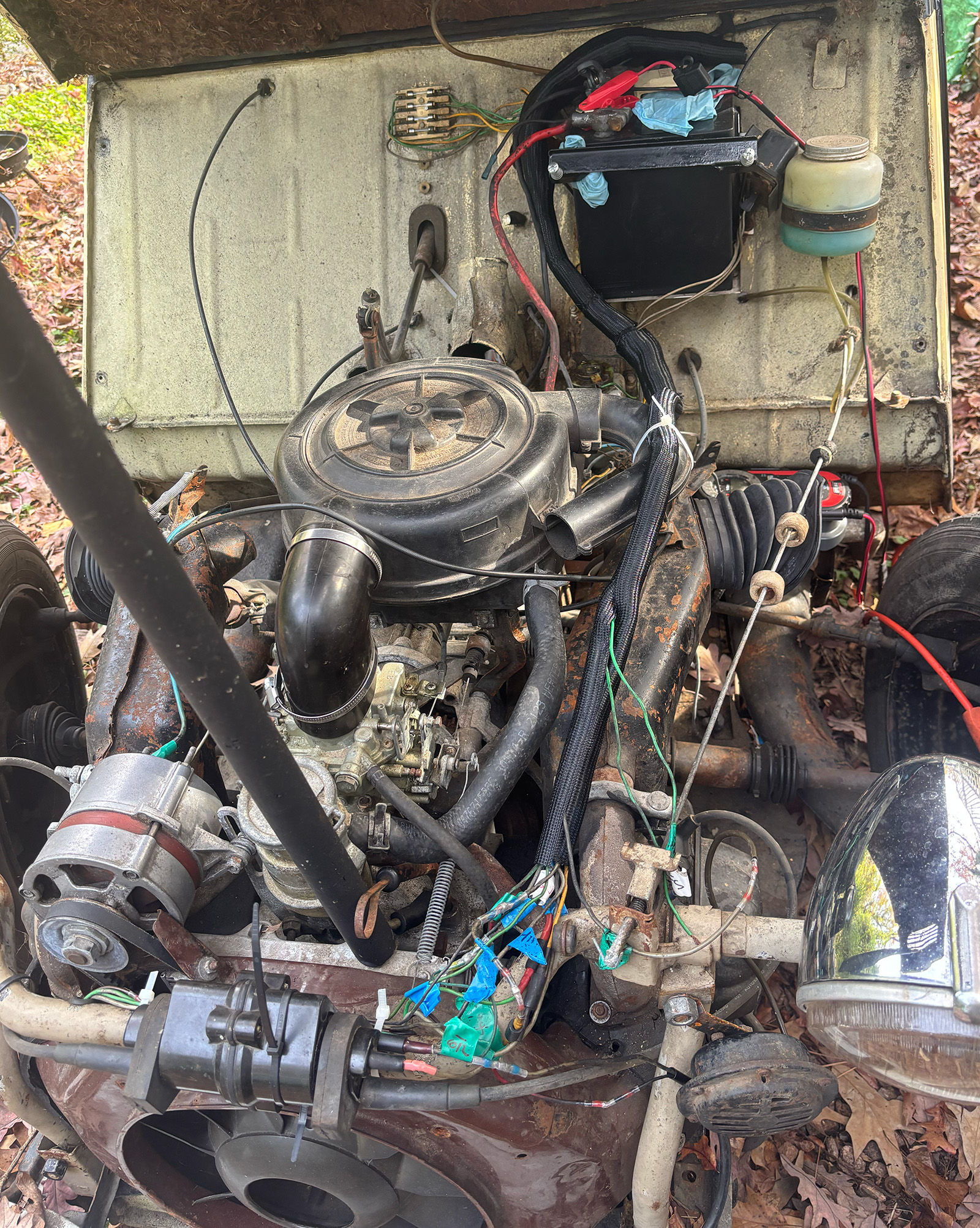
Look at that! No more green tangled mane of wires! The shame is hidden!
Okay, but let’s get to the bane of my weekend here: this one bolt on the carb. Here’s the carb itself for reference:
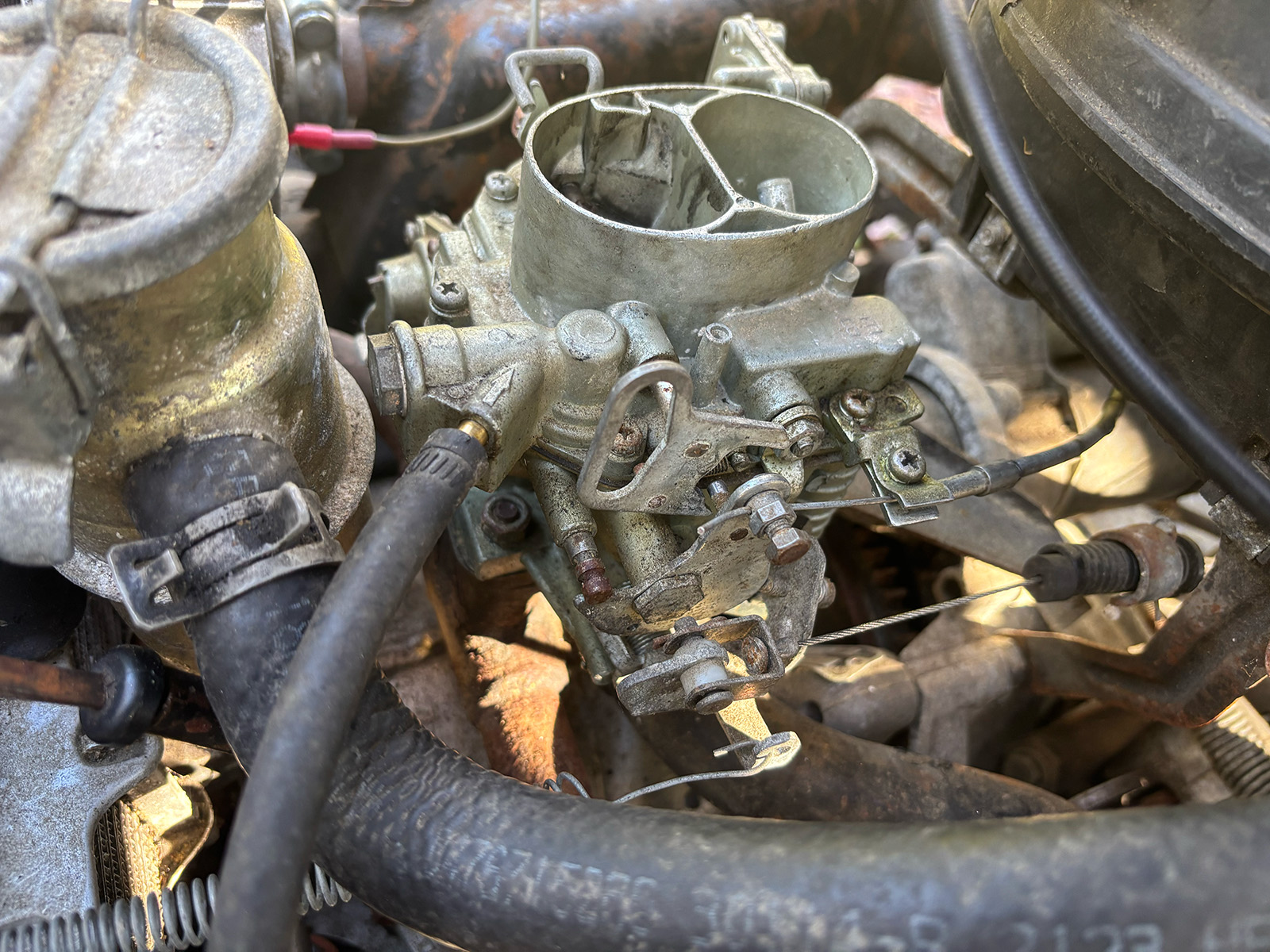
Three of those four bolts are easy to remove. Delightfully easy! But that one last bolt, oy, is it a monster:
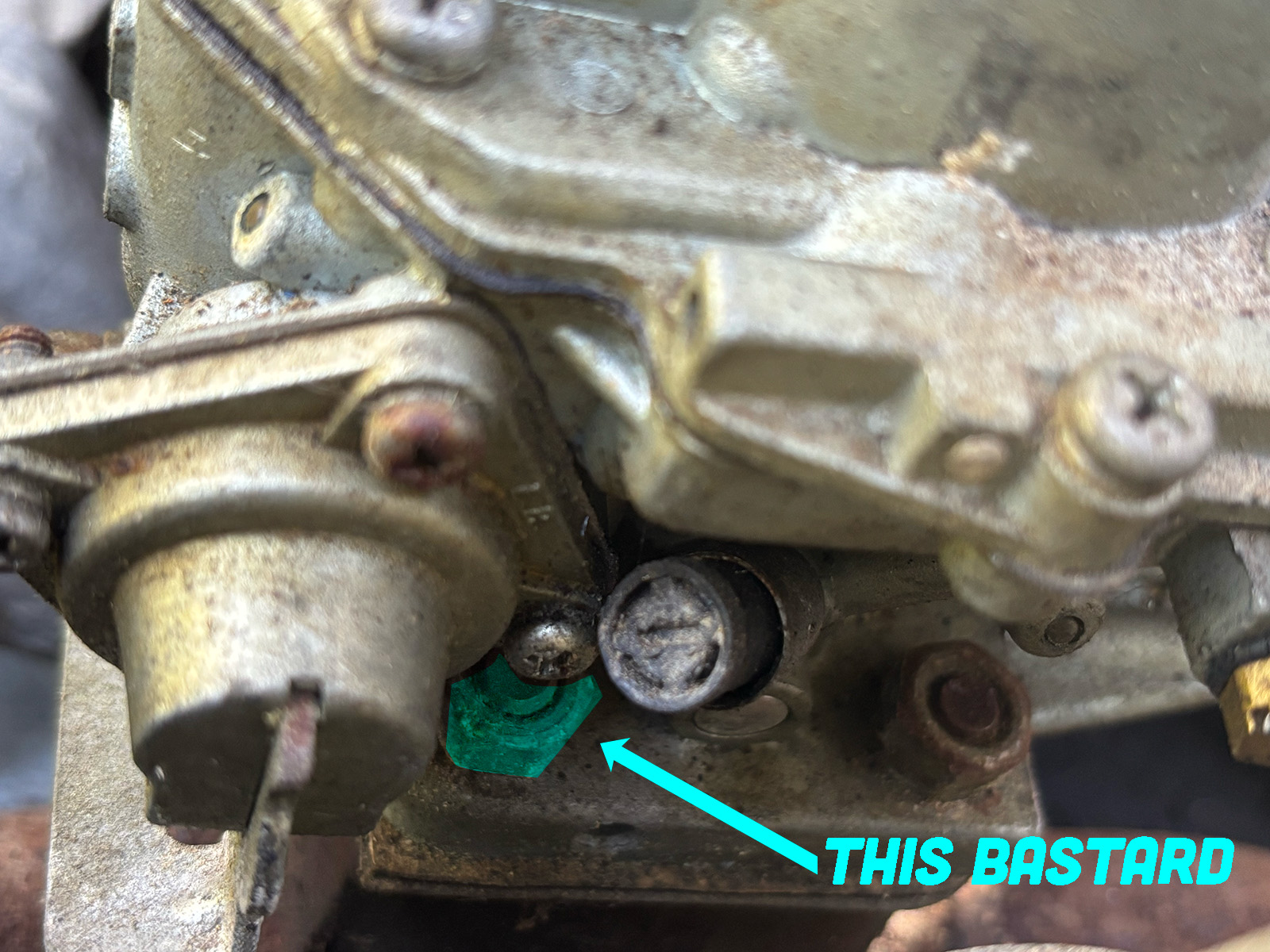
It’s in precisely the wrong place for everything: tucked in a little divot under that pump thing on the carb, and with pretty much zero space for any wrench in there; I got a wrench on it, with much contorting, but then found I couldn’t move it at all, because of all the other stuff around it.
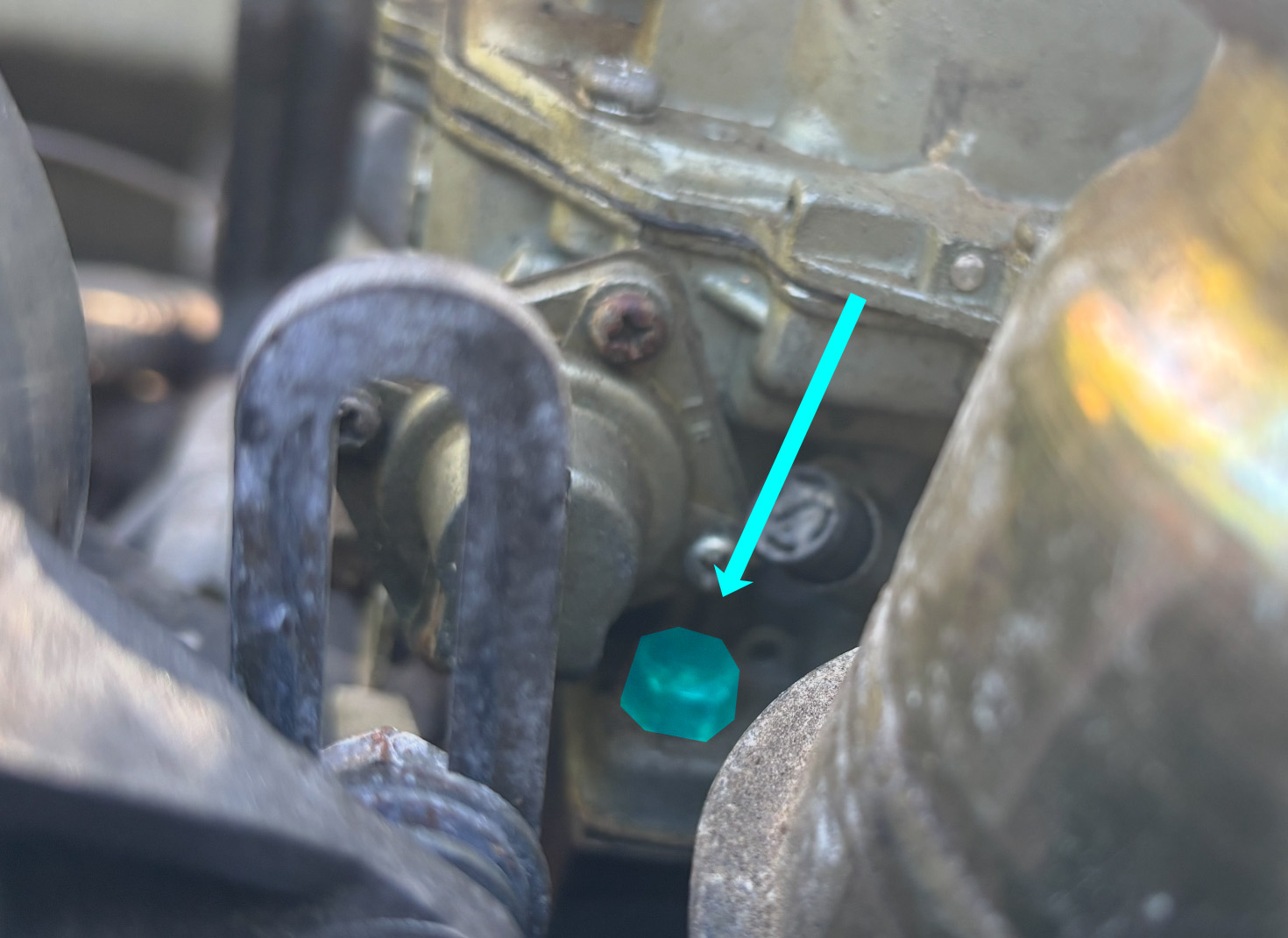
I wasted so much time trying to get the thing out: I removed one of the alternator bolts to move the bracket out of the way, I started to take the pump part off the carb – everything. It was especially maddening because everything else about this car is so easy and accessible, too! Why did Citroën’s clever engineers decide that this one bolt didn’t need to be something a human with bones could access?
Finally, I decided to look up some videos to see if anyone had a special trick to get it off; nothing in the written descriptions in books or online seemed to even acknowledge this was an issue! So, I watched one of these videos and noticed something (the link goes right to the moment):
Did you see what I saw? It’s this:
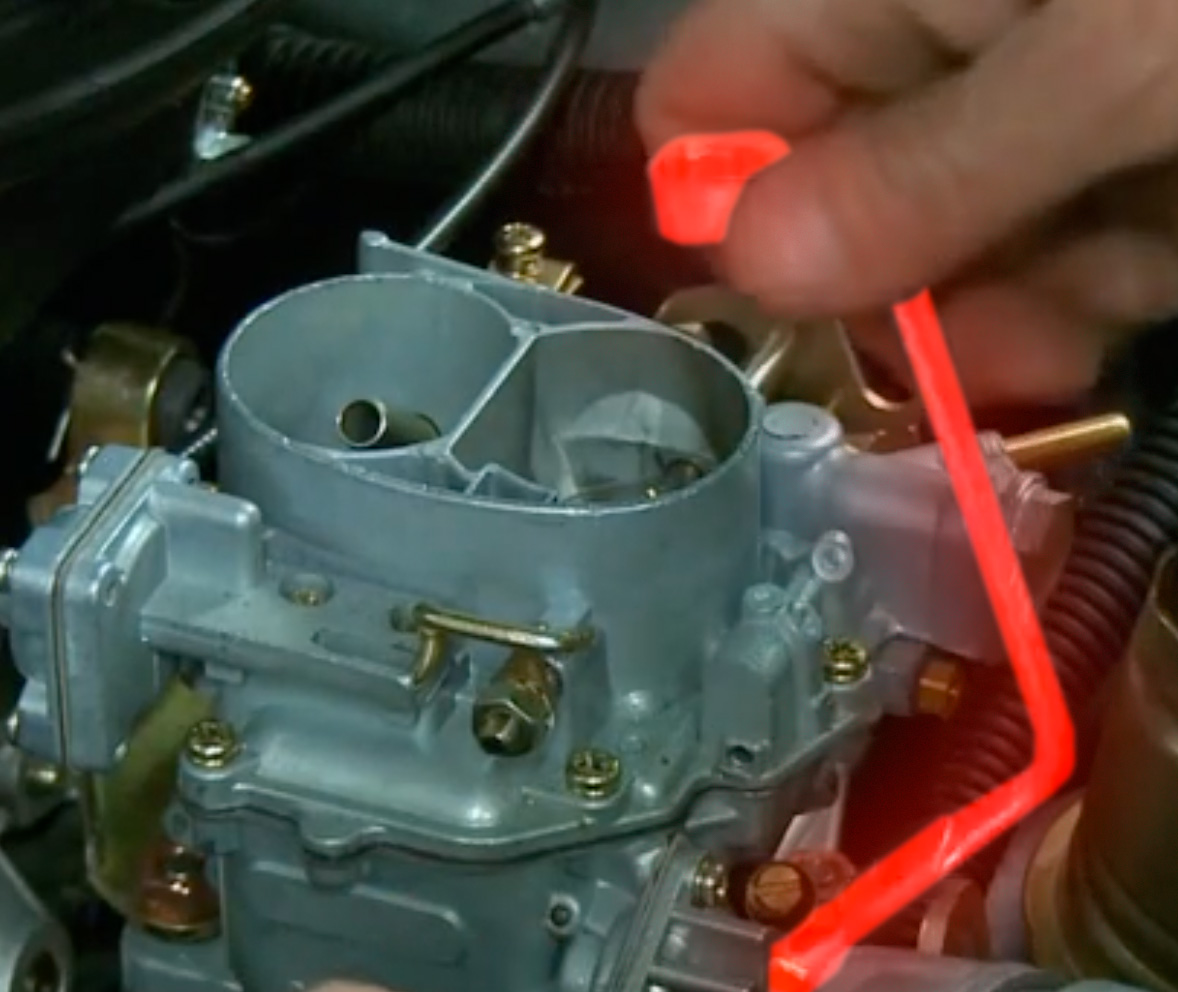
WHAT THE HELL IS THAT WRENCH?
That’s cheating! How did the guy in the video decide it wasn’t important to mention that he’s using some sort of C-shaped wrench to get to that nut? Did he buy that wrench? Did he heat up a wrench and bend it?
I guess I need a wrench like that? Or I need to bend one of my 12mm into that shape? No one could have mentioned this before? Neither of the two workshop manuals I was looking at thought it was important to mention you need a funhouse wrench to make this work.
Ugh. I guess I’ll try and find or make a wrench like that and keep it in a glass case with a sign that says IN CASE OF 2CV CARB ISSUES, BREAK GLASS or something like that.
Then I’ll probably lose the little glass-breaking hammer.

Oh, just to end this on a high note, Til brought this amazing Mehari out to our local French car owners meetup. It’s a charming little kook, and you have to respect Til for driving this open plastic tub in non-balmy weather!




Funny enough, there’s a special tool for Ferrari cylinder head bolts that’s very similar (bigger but same idea).I needed to borrow one to tear down a 360 engine. It’s not cheap for what it is, but it was under. $100 for the tool.
A crowfoot wrench looks like it might work.
No problem Jason you spend years in France studying under a 2CV master tech. When you are ready and snatch the funky wrench from his hand it is time for you to go grasshopper.
Wow. It’s been a long time since I have thought about that show. That’s a 50-year-old reference.
What are you trying to tell me ????
That’s a line from Kung Fu, a TV show starring David Carradine that aired back in 1972. But I am guessing you already knew that. 🙂
Kung Fu (1972 TV series) – Wikipedia
I was more thinking that you were saying I was older than dirt
So am I. Obviously. I was early on in high school when that show aired. But anyway, no offense or judgement intended.
None taken the original comment was supposed to feature a laughing emoji, but that appears to come out as a bunch of questions marks
This site, while its members and even non-members are polite and intelligent, has its flaws on the software side.
I have called the managers out on what I think is broken in the comments section, but the software still misbehaves. C’est la vie. I can live with it.
Clearly there is a 2CV “carb wrench” that has your name on it. Every mechanic eventually collects a set of “Specialty Tools”. The “Rambler wrench” is another such tool that you WILL need if you ever hope to remove the starter on that car. My Fiat has a special tool just to replace the wheel hub bearings. Consider it your mechanics initiation.
You just have to find an old mechanic who worked on Japanese carburetor cars from the 70’s as a similarly bent 12mm was needed for one nut on many of those cars.
That looks a lot like a distributor wrench, which reaches around the distributor on more normal cars to set timing. It’s a little odd that the the nut is 12mm which is JIS rather than the more normal 13mm DIN. Perhaps they didn’t want to use Le Boche’s hardware standard.
I saw a newish Morgan out here in Maynard MA yesterday! It ain’t exactly warm, but at least it was…partly sunny! I was walking my dog so I couldn’t take a picture. I did get to give the guy a thumbs up and thanks for driving something like that on a day like today!
You need a crow foot socket.
Yes
I’ll second this, and add my recommendation for the flare nut style crowfoot wrenches. Usually a little less bulky, which matters because you only really use these in odd places. I have a Sunex set which has been great for me
This article title sounds like a chapter in a sex-ed book for teens.
subtitle: Congrats, you’re now a parent whether or not you wanted to be
Jason, is your ’73 Beetle carburetted or fuel-injected? Off the top of my head VW did a switchover to fuel injection on the Beetle & the bus around ’73-’74.
Asking because the nut behind the carburetor on my 1969 single-port bus is also a real bear to access. There are specialty wrenches shaped like a C for that specific application though I found a stubby 13mm Craftsman combination wrench would work just as well and for a lot less $$ (this was some decades ago when Sears would have sales on the reg for Craftsman tools and I couldn’t afford the bespoke C-shaped wrench.) Probably not applicable to the 2CV, though…
Just get this: https://www.burton2cvparts.com/en/carburettor-ring-spanner-12mm-2cv6
You are probably going to need one of these soon, although a picture and a piece of metal rod will probably suffice.
https://www.burton2cvparts.com/en/ignition-timing-pen
Changing the Weber carb on my MGB, and it has a tight hidden nut like that. linkage and carb stuff in the way. I ended up grinding the sides of a crows foot wrench to get to it. An hour later and was still cussing at it’s design.
We’d like to introduce “Torchin’ Tuesdays” a fun new segment thats more fun than a wheelbarrow of shrimp, and maybe less dangerous?
Less dangerous than chainsawing batteries feels like a more generous metric.
Well I’m late to the party but these are cheap and might work.
https://www.harborfreight.com/flex-head-metric-ratcheting-combination-wrench-set-5-piece-60592.html
I would just cut a cheap 12 point and weld a piece of rod to it.
Make the tool is the right answer, but I don’t think it’s on Torch’s dance card. Also, beware of welding chrome. Bad for your lungs, but boy, it welds nice
The Americans have deployed capitalism!
The Swiss have perfected chocolate!
The Germans have served the perfect beer!
The Italians have innovated pasta!
The Chinese have revolutionized stir-fry!
The French have created and tightened a carburetor nut that you somehow cannot reach!
“There is a nut, but no wrench can turn it. Is impossible, like life, mais non? It is up to you to define your own existence.” [Takes long drag on Gauloise.] – French car designer/existential philosopher.
I know child labour is dreadful, but they do have small hands and fingers. There have been a couple of occasions when I have “borrowed” a child to retrieve dropped nuts and the like.
Tell them it is a game, and they might succeed where thick fingers fail….
Wait… There’s a local French car owner’s meetup?
A nut in the wrong place has lead a great many to financial ruin.
I have a wrench similar to that one, but I bent it to set the valve lash on a Mercedes OM617.
Phrasing…
I thought the one nut was Jason 🙂
It’s a distributor wrench. Has no one at The Autopian ever worked on a small block chevy?
Thanks! I knew I had seen something like that in the distant past.
Ding ding ding ding ding, we have a wiener!
Please don’t park that poor thing on wet grass and leaves, the frame will rot out so quick on these.
French engineering can be “interesting” – and they are definitely not afraid of using special tools. My favorite being the belt adjusters on Peugeot 504s. They had a separate belt for ever accessory on the engine, and the adjusters were buried way down in between the belts with seemingly no way to get hold of them to actually adjust them. Then one day I realized that they had a square hole in them. And the oil drain plug is also square drive. And that the funny tool that came with the car to take the oil drain plug out that had 80 degree bends on each end of oddly differing lengths fits perfectly down amongst the belts to get in those holes in the adjusters to rotating them to tension the belts. Sacre Bleu! Brilliante!
But of course, a 504 was an expensive car. Citroen was not going to be so kind as to include the needed tool with the car, that would cost a franc or two. Time for Torch to torch a wrench – or cough up the $54 to buy one.
If you inherit a cheap Peugeot 306 diesel from your brother, and you try to change the oil, only to be stymied by the above mentioned square socket in the drain plug, never fear! The square bar in a normal domestic door handle will fit neatly in the hole, and as long as no one over-tightened it before, you should be able to remove the drain plug without twisting the bar too much to put it back in the door.
Or a 1/4″ drive on a socket might fit.
I don’t think the door handle trick will work on this side of the pond – those are “C” shaped over here generally. 1/4In drive didn’t fit. But I had the tool, once I went rooting around in the trunk\boot. 🙂
Guessing the age of Jason’s house I think it has round door knobs.
So does pretty much every house in the US other than mine. Replaced all the knobs with handles in both my houses years ago (I find knobs hateful devices on doors). But I still can’t recall seeing a door handle shaft here that was square.
I changed all the levers to knobs at my house. The dog figured out how to open levers. Plus I prefer the look. Old school I guess
One of my mom’s cats figured out how to open lever doors. It would open a door, chase the other cats into another room, then lock them in.
Clever pup! My cat would NEVER deign to open a door herself – she yells loudly until her servant opens it for her, as any Queen would.
You ever walk through a door carrying an aquarium and get your belt loop caught on one of those lever door handles?
Nope, can’t say I have. Never caught a belt loop on them period. Seems like that would take a special sort of special skill to accomplish.
Won’t be a problem in my new house – all interior doors are pocket doors, though the exterior doors will have handles.
Well, first of all, you have to be just the right height and sort of pushing the door open with your hip because your hands are full and you are walking backwards through the door, and there you are.
I’ve torn more than one belt loop on a door handle. I’m lucky to have just the right leg length
The nice thing about handles is you can use the edge of whatever you are holding to trip them, then just push the door open and walk through forwards.
“Old” American homes I think from about 1880s – 1920s had pretty round door knobs and the knobs were attached to metal square rods that went in to the latch/lock mechanism.
I don’t know the dimensions of the metal rods though 1/4″(or approx 6.5 mm) does seem like it could be right.
You just have to have an old enough house. The ones used ~100 years ago had the 1/4″ square rod. There are still a couple of that style on the interior doors in the house I own that was built in 1914.
My house in Maine is 200 years old. Not a square rod in it.
Just because your 200 yo house doesn’t have one doesn’t mean it didn’t in the past or that other old houses in the US didn’t use them. There are apparently enough still out there that you can buy new replacements in Lowe’s cheap line of hardware. https://www.lowes.com/pd/Prime-Line-Brass-Universal-Passage-Door-Handle/5014402793?user=shopping&feed=yes and of course there are lots of actual vintage ones on E-bay. https://www.ebay.com/itm/336277875288?_trksid=p4481478.c101506.m1851
No doubt. Doesn’t make them common on this side of the pond, just available.
NYC is full of them.
And two styles, the one that screws together in the center and the solid ones. Boy are you screwed if you get them mixed up, or put the screw style in backwards.
Couldn’t you use a crows foot socket there?