

A few days ago I replied to the Autopian Asks question, What Is The Quintessential ‘80s Car?, with the DeLorean DMC-12. It is one of the defining designs of the era, all sharp edges, penned by the Italian designer Giorgetto Giugiaro way back in the ‘70s. Giugiaro, born 1938 in Piedmont, Italy, is also one of the most well-known Italian car designers and it’s easy to associate him with the same sharpness that defines the era.
On his website, browsing his ‘70s portfolio, it’s easy to take a look at some of the best car designs from half a century away: you have the original VW Golf/Rabbit, the Lancia Delta, the BMW M1, the Fiat Panda, the deck-of-cards concept car pack that gave birth to the Volkswagen Scirocco and Isuzu Impulse alike. These are all 1970s designs despite easily looking ‘80s to our eyes, and by the mid-1980s he was already thinking ahead, incorporating a smooth, organic shape to his work. The Bugatti EB112 of the early 1990s was possibly the rounded peak of that approach.


Bugatti’s Yuppie Era Awakening

Bugatti was afforded a rebirth in the ’80s. The French luxury brand, whose heyday took place in the early decades of the 20th century, hadn’t quite survived the Second World War intact. Its founder Ettore Bugatti died forlorn in Paris in 1947, having already lost his son Jean behind the wheel of the company’s Le Mans endurance race winning Type 57C “Tank” in 1939 near Molsheim and the company premises. With both the founder and his heir long gone, Bugatti was shuttered in 1952 and the legacy laid to rest for decades.
The Italian businessman, Romano Artioli revived the brand in 1987, and with history of running Ferrari dealerships and ties to Ferruccio Lamborghini, he was certainly the man to do it. Autoexpo, Artioli’s company that imported Suzuki cars to Italy, paid just 7500 French francs to use the name Bugatti. The sum was paid to Messier-Hispano-Bugatti, an aerospace company that had also incorporated the remains of carmaker Hispano-Suiza for its landing gear know-how and Bugatti for wheels and brakes. Today that business trades under the name of Safran, an immense improvement from its earlier Snecma name.
The Bugatti EB 110: A Dream Supercar

The now-Italian Bugatti Automobili SpA was formed near Modena, the heartland of Italian supercars. For Bugatti of the ‘80s and ‘90s, producing a car that made the desired impact first meant making a mid-engined supercar, a world removed from the long-hooded luxury cars that gave the name its original provenance. Bugatti hired Marcello Gandini, famously the designer of the Lamborghini Miura and Countach, to pen the V12-engined EB110 supercar that first brought the brand back to life – EB standing for Ettore Bugatti. The initials weren’t the only link to the brand’s glorious past, as the front end also incorporated the horseshoe shaped air intake that served as a hat-tip to old Bugattis and their horseshoe radiator grilles, albeit in tiny, actual horseshoe size.
It’s one of the core supercar designs of the era, absolute bedroom poster stuff along with the Ferrari F40, the Porsche 959, the Jaguar XJ220, and the McLaren F1. This was the time period when teenage petrolheads would spend hours dreaming about any of these cars and learning their top speeds by heart. For the record, I still remember the 959 being capable of 317 km/h. The EB110 did 336.
The EB112: True 1990s Luxury
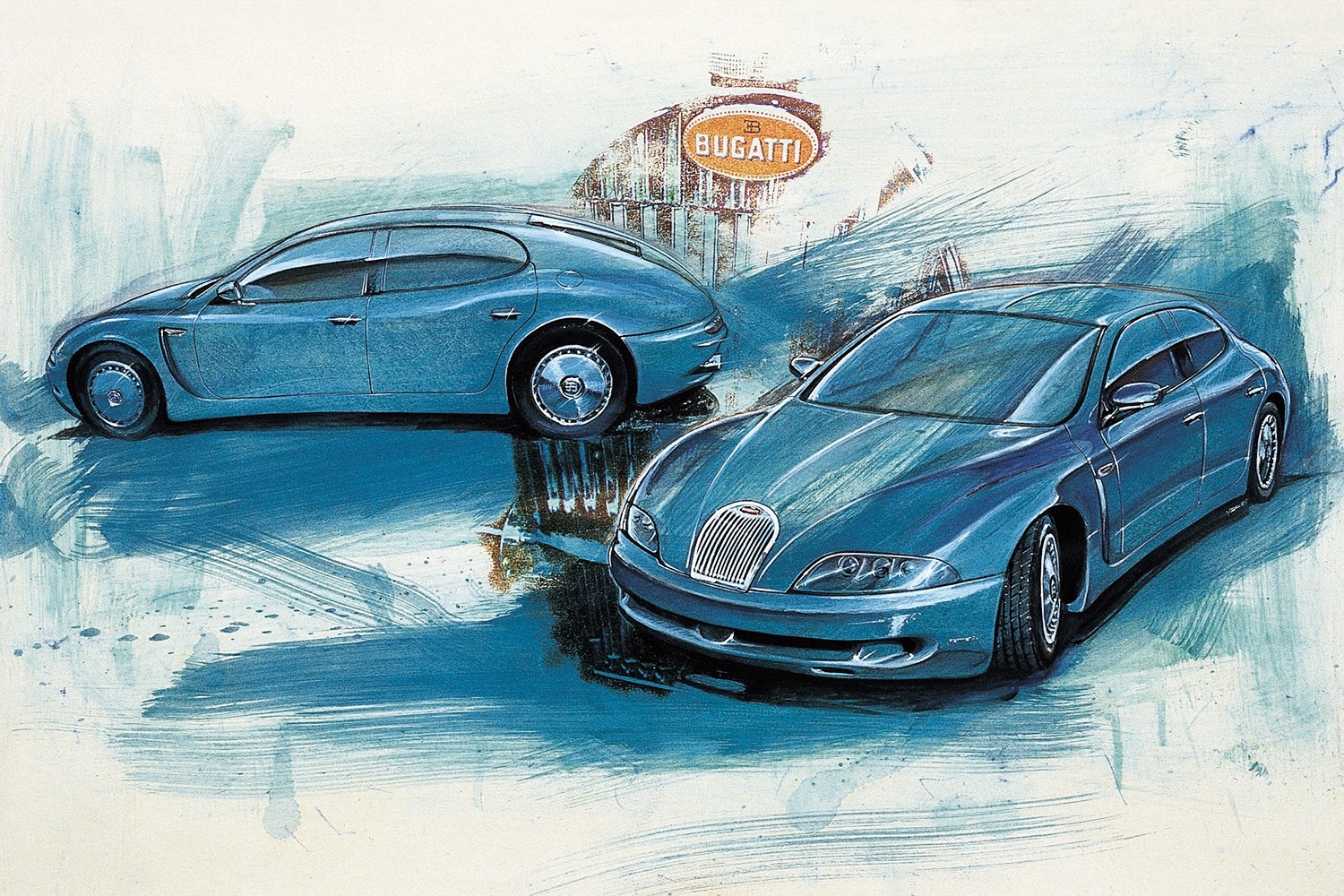
But Bugatti also had bigger plans than just the EB110, no matter how impressive it was. While a mid-engined supercar was undeniably top-tier carmaking, Bugatti also needed a true luxury car in its portfolio. That role befell to the EB112 super sedan.
This time, it needed to be front-engine. This time, it needed to be a four-door. This time, it needed to make the kind of design impact only Giorgetto Giugiaro could deliver, so the job went to Giugiaro’s Italdesign.

To be able to do that, Giugiaro took a deep dive to Bugatti’s history and set his sights on the 1932 Type 55 and the 1936 Type 57 S Atlantic, considering them the pinnacles of Bugatti’s luxury car creation.
From these cars, Giugiaro brought the swoopiness and art deco touch that Jean Bugatti had so strived to put to metal 50 years earlier. In an interview with the Italian automotive YouTuber, Davide Cironi, Romano Artioli remembers directing Giugiaro towards the classic Bugatti shapes for inspiration. It’s a great video and it luckily has subtitles.
Especially the soft curves of the Atlantic coupe’s fenders look like a lady’s dress in the wind, and they’re such breathtaking cars even today one can only imagine what sort of presence they must have had in the 1930s. There were only less than 40 Type 55 built, but Bugatti made over 700 Type 57 cars by 1940. Some Type 57s were able to break the 100 mph barrier and the original 1934 car even introduced hydraulic brakes, a significant feature for a car that early.
Giugiaro’s Shape-Shifting
By then, Giugiaro’s pen had also gotten used to making round shapes other than the wheels. While a comparable super sedan concept, the Maserati Medici wasn’t much more than a four door DeLorean, the changing of his signature style had begun. The Lotus Etna and the Ford Maya from the mid-‘80s were still wedge-shaped, but the 1988 Aztec was already a sort of ‘80s double-bubble, cyberpunk Batmobile, that brought an advancing roundness to the table.
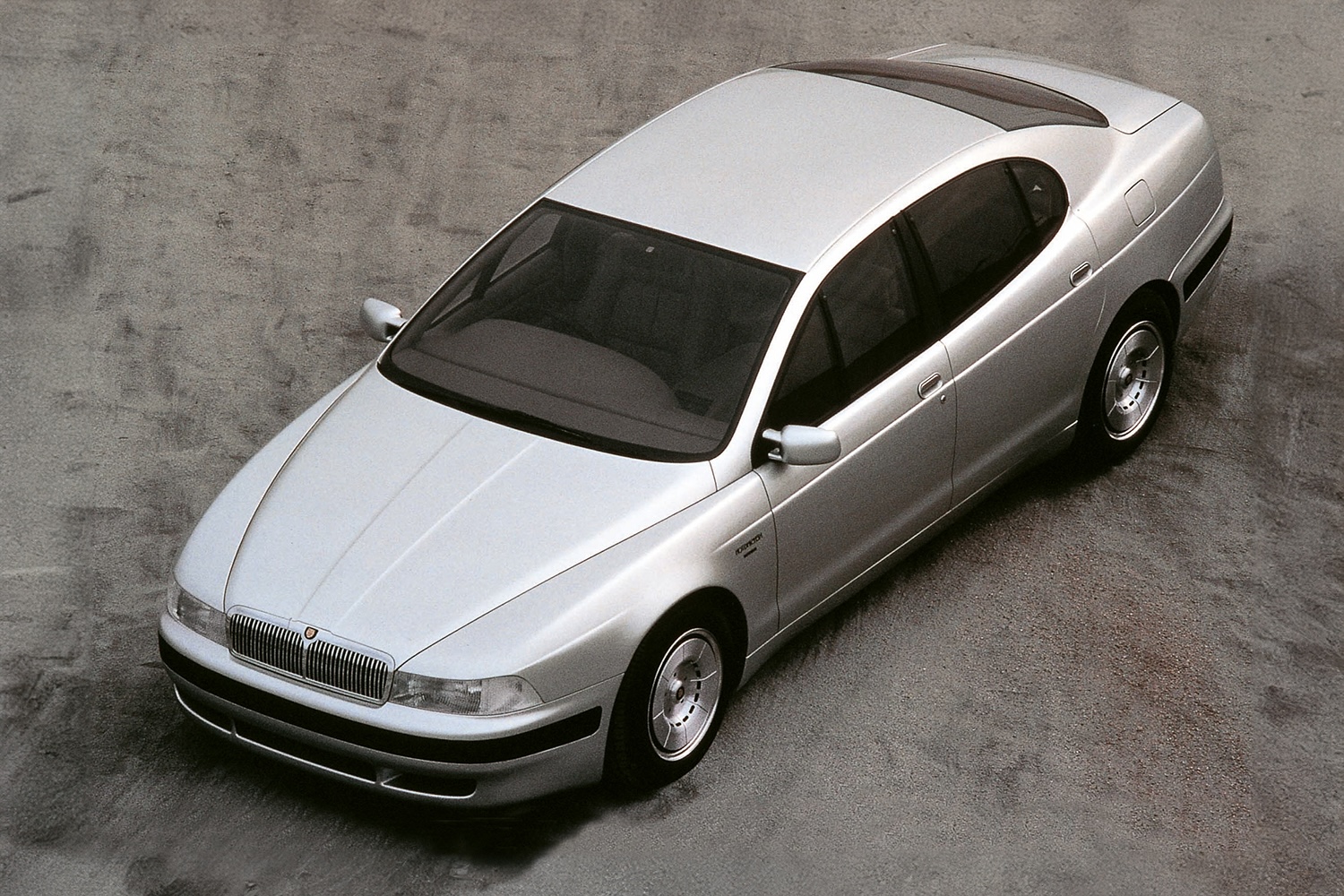
At the Geneva Motor Show in 1990, Italdesign presented the Jaguar Kensington, a car that in further developed form spawned the designs for both the Daewoo Leganza and the Lexus GS300.
Giugiaro was free from the constraints of the folded paper envelope, and the 1993 Bugatti EB112, taking inspiration from classic Bugattis, was as organically round as the ‘90s Toyota Soarer/Lexus SC300, which famously was shaped at Toyota’s Calty studios using plaster in balloons. In the interview above, Artioli remembers the EB112 having been a real show stopper at Geneva. It did what it was designed to do.
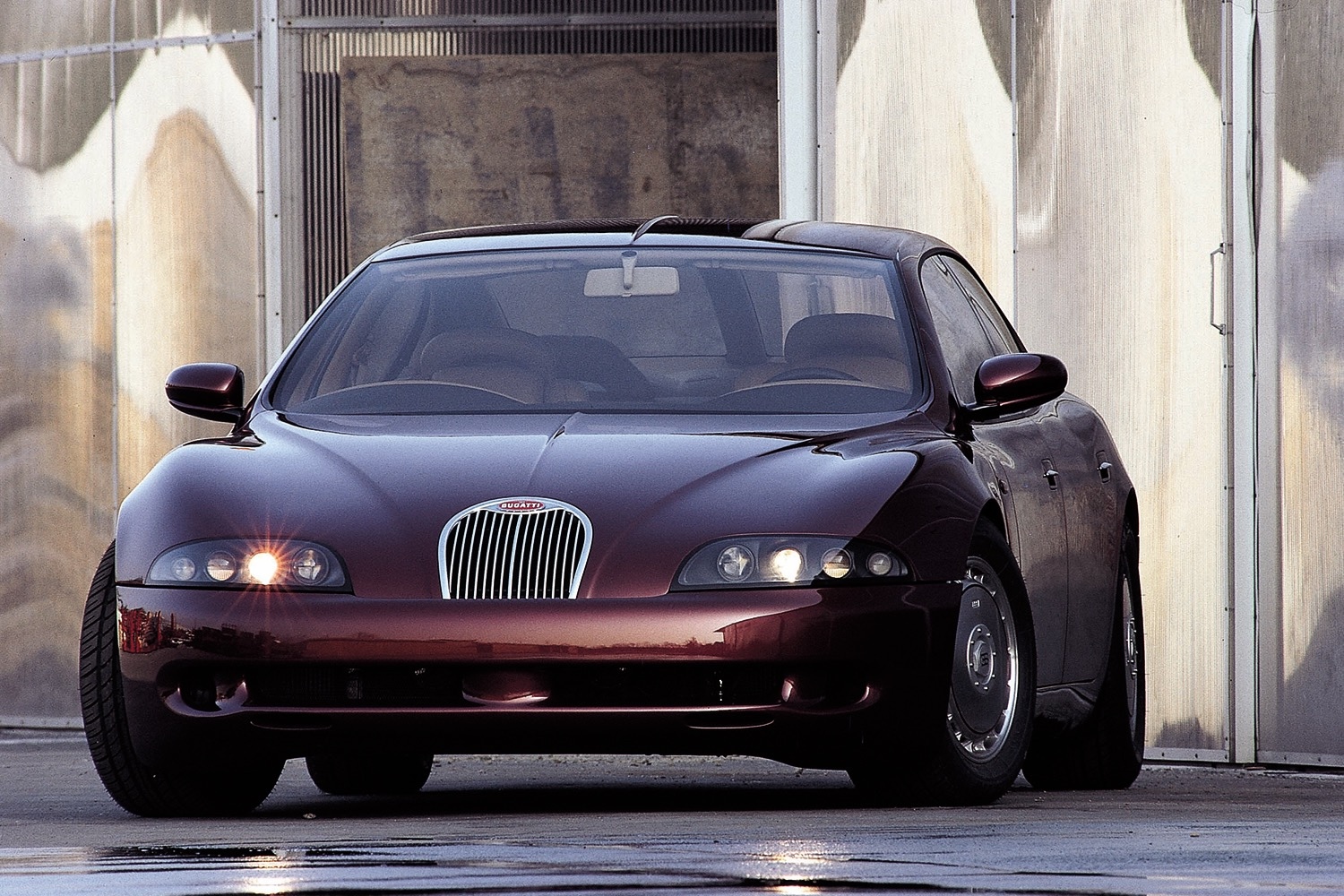
The EB112 combined a carbon-fiber chassis with aluminum bodywork and the EB110’s V12, now a full six liters in displacement. It had a six-speed manual gearshift and all-wheel-drive. The horseshoe grille was more than a body-coloured air intake, now a prominent feature complete with chrome, on a hood that flipped up completely to reveal the huge engine. The tail lights look like they are from the Toyota Supra MkIV, but they’re not the same.
The Ragnarök of the Kamakiri
On his 1993 solo album Kamakiriad, Steely Dan’s Donald Fagen sings:
I was born yesterday when they brought my Kamakiri
When they handed me the keys
It’s a steam-power 10
The frame is out of Glasgow, the tech is Balinese
It’s not a freeway bullet
Or a bug with monster wheels
It’s a total biosphere
Whenever I think of a car that Trans-Island Skyway could depict, my mind goes back to the EB112. Sure, it’s not a Glasgow-built steam car with Balinese engine technology, but it’s definitely a cool rolling bubble that’s all set to samba.
(The dashboard on the album cover belongs to a Morgan roadster).
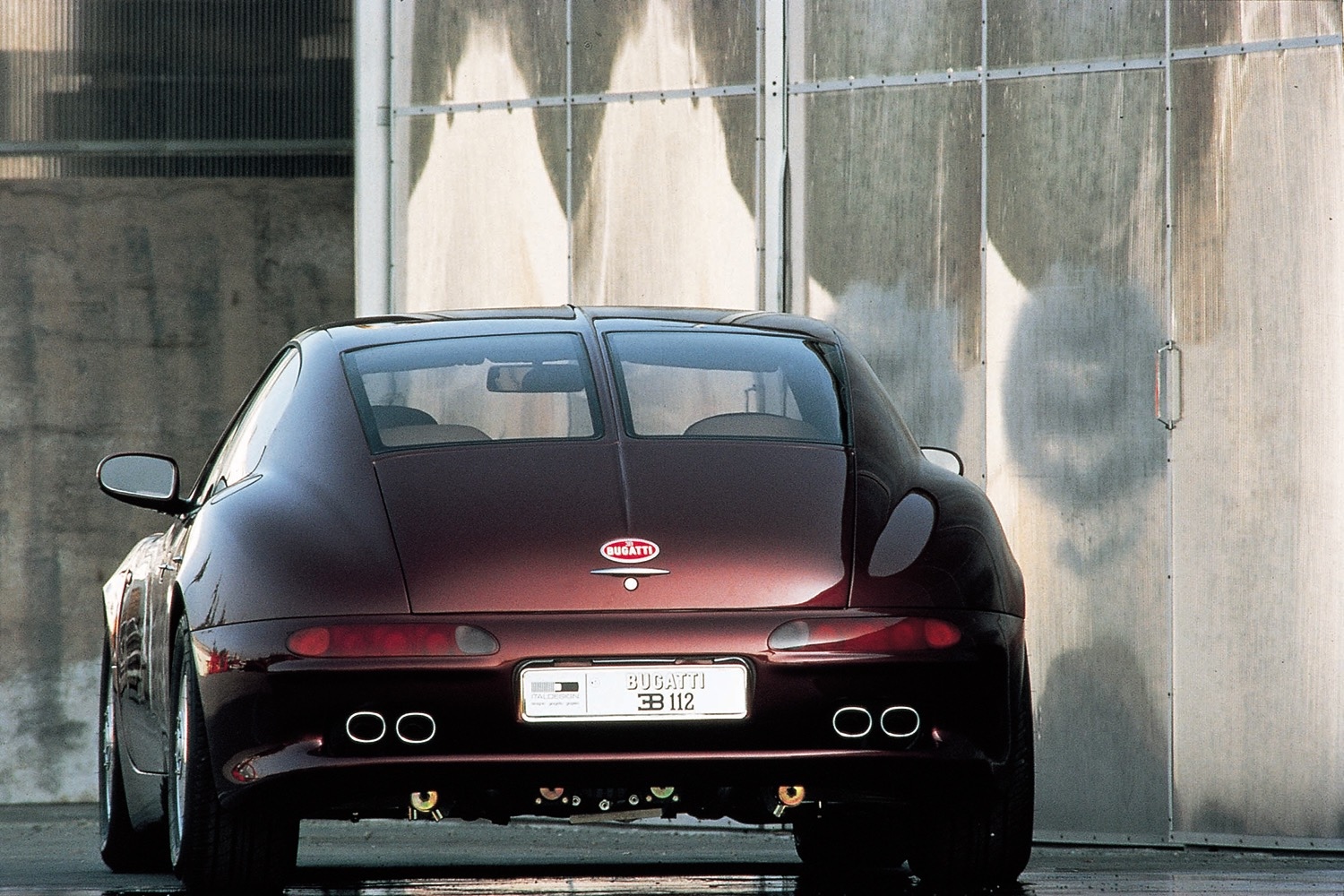
There’s a sort of early ‘90s techno-optimism to both Fagen’s lyrics and the Bugatti EB112, which sadly arrived just in time for Bugatti to hit dire straits. The early ‘90s economic downturn and depression, hot enough to burst the Japanese asset bubble in 1992, also struck Bugatti hard enough to force it to cease operations by 1995.
Part of the problem stemmed from Artioli’s purchase of Lotus Cars in August 1993 from General Motors, through his holding company. Artioli only owned Lotus long enough to introduce the Lotus Elise mid-engined sports car in 1995, named after his granddaughter Elisa. Lotus was sold to the Malaysian company, Proton, in 1996, by which time Bugatti was again bankrupt. The current iteration of Bugatti, known for the Veyron and Chiron, was formed as a Volkswagen subsidiary in 1998 and is again based in Molsheim, Alsace, France, like the original Bugatti a hundred years ago. “The Blue Factory,” as the plant in Campogalliano, Modena was called, is now in ruins. An illegal rave took place there last year, and somehow that’s immensely cool to my eyes.
A Dream Goes On Forever
Bugatti Automobili SpA was able to produce 139 EB110 supercars before the end came, with a handful completed later from spare parts by different companies such as Dauer, which was known from its Porsche 962 chassis. The EB112 had a similar fate, but at a much smaller scale: Bugatti built a single driveable EB112 prototype in metallic red for its introduction and that was that. Gildo Pallanca Pastor, a businessman from Monaco who also raced an EB110, later contacted Bugatti to source spare parts for his race car. As a result, he not only got his parts, but also two incomplete EB112s and enough parts to complete them. Presumably he had the contacts and wherewithal to make the dream happen.

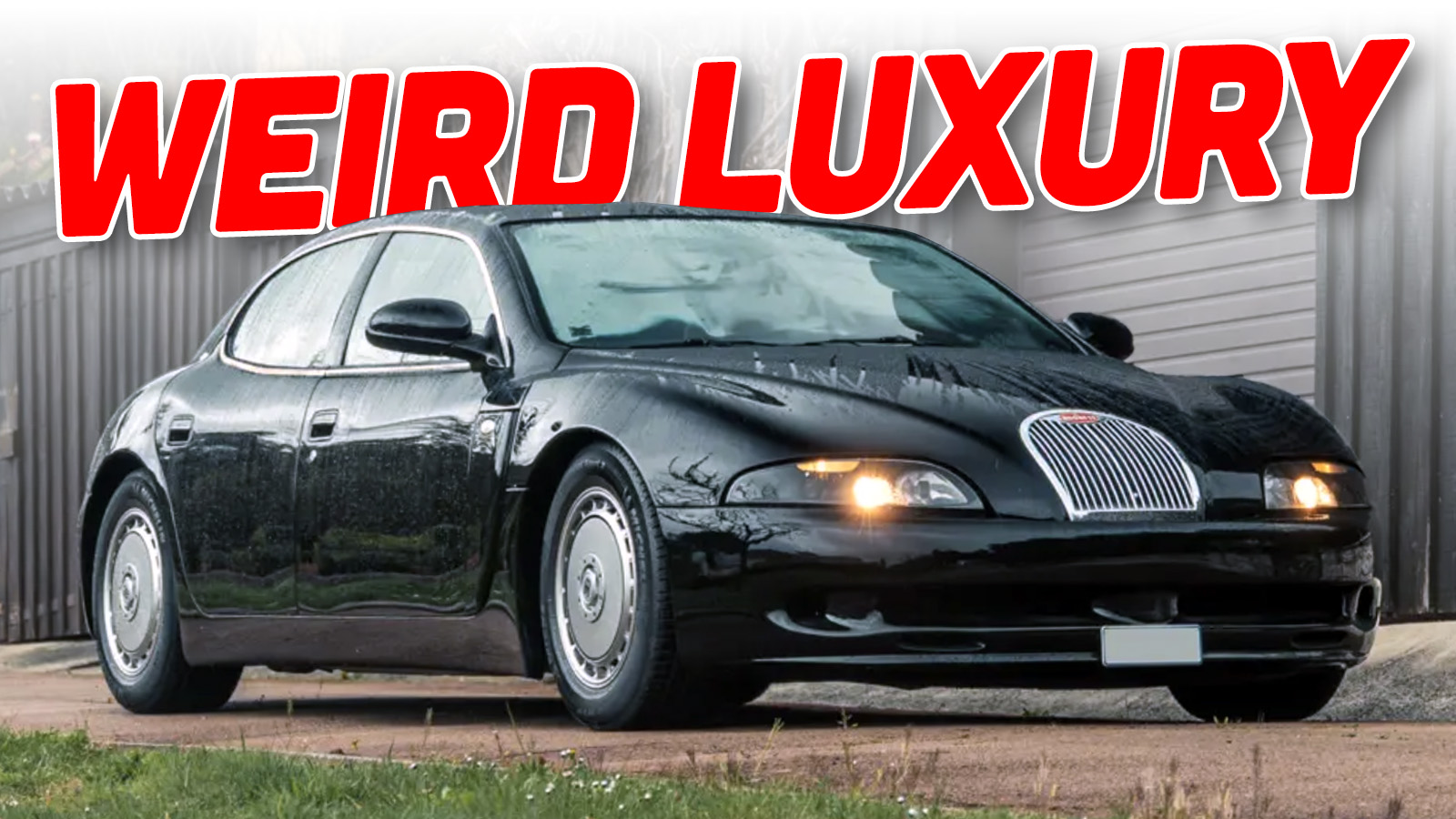
This particular car offered by RM Sotheby’s in its Monaco sale is one of those two, the last one completed by 1999. Pastor sold this car in 2015 and it was also registered in road use in Monaco, making it one of the few Monegasque-built cars (the VIN plate says Italy, as well as marks the car as a Bugatti SpA prototype).
During all of this time, it has only accumulated 388 kilometers on the clock, which is a little over 240 miles. The accompanying paperwork shows specialist work ranging from brake and suspension work to catalytic converters and tires. The $42k in receipts might be a lot for a car that has only covered a handful of miles, but when dealing with such a rarity, that seems like an acceptable sum. It also appears brand new in every respect.

The Volkswagen era Bugatti has never built a comparable car, mainly because it took the EB110 as a yardstick (and because it also controls Bentley and spent a fortune on making the Phaeton). In 2009, a sedan concept called the Galibier was shown, but the project was reportedly cancelled due to influence from Ferdinand Piëch. The Galibier was the 2010s equivalent of the EB112: it also had a split rear window and never reached production.By 2026, we’ve seen a number of cars that have toed a similar line: it’s not completely outrageous to think of the Porsche Panamera’s spiritual kinship as a very rounded sports sedan equivalent, even if the Panamera is largely a continuation of Porsche’s 989 concept from the same era as the EB112.

RM Sotheby’s is estimating a cool two million Euros for the EB112, which, again, is not a lot for a dream on four wheels. I wish it had been a produceable reality at the time when it was first unveiled.
Photos: RM Sotheby’s unless otherwise mentioned


What’s wrong with the société nationale d’étude et de construction de moteurs d’aviation ? (aka SNECMA, ye’s it’s an acronym and the full name say it all : national company of avioation engines study and building… it has drifted far away from that)
As for the modern name… a Safran is the piece of metal/whatever used to make a ship turn.
And honestly, it’s not a bad name seeing that it’s the result of a merging between SNECMA and SAGEM, SAGEM had also gobbled SAT and SILEC a few years before [ for reference Sagem real name : Société d’applications générales d’électricité et de mécanique, SILEC : Société Industrielle de Liaisons ÉLectriques, and SAT : Société Anonyme de Télécommunications.
Does anyone remember the couple of Bugatti Concept cars VW released in the late 90s? The used W18 engines. I think one was a sedan and another was a concept for the Veyron. If I recall the sedan was also kind of awkwardly styled like this one. The Veyron concept quietly went to 16 cylinders upon production (as we all know).
While I appreciate this from a historical perspective… it’s just not an attractive car. Rear is interesting,but that’s about it.
from the rear it’s like a split window panamera
They’re crazy if they think this is only going to go for 2mm
I’d love an Adrian design deep dive on this.
Yeah – the thing is pig ugly. Sorry pigs!
It’s Mr. Potato Head. The front grill and lighting looks like they were slapped on. Hopefully, when you open the butt end, there’s a new set of grill pieces, and some angry eyes.
“The horseshoe grille” – that’s the actual term?
Genuinely didn’t know, always thought of it as the top down view of a toilet.
I’m getting a bit of a 1950 Packard feel.
The Romano Artioli version of Bugatti was so much cooler that the Ferdinand Piëch version.
The EB112 is where Bugatti belonged. Imagine a two door variant to put the MB CL, BMW 8-series, and Bentley Continental coupes to shame. One the other hand, we got the Elise. I know which I’m more likely to be the caretaker of with the rest of my lifetime.
The Jaguar Kensington breaks my heart. JLR could bring this out today and I’d be first in line for one in BRG, natural leather, and BRG piping with all the burl walnut I can spec. Plus a naming convention naming neighborhoods in the UK like Kensington would have suited their target market. – UK gentlemen turning up their noses while the Americans can buy up their assets along with gaudy gangster cars named after such places without a whiff of irony on the British part.
Bugattis with Donald Fagen and followed by what I’m pretty sure is a sly Todd Rundgren reference? Now that’s what I’m talking about.
Back to Fagen, when it comes to his solo stuff I’m partial to The Nightfly.
Haha, thanks! I keep going back to Todd’s stuff again and again, as well as anything Dan related. The Nightfly is arguably Fagen’s best.
Now if only you could get some money for nothing, you’d have this Bugatti on every street (another musical reference a few lines later?)
Kamakiriad! I’m looking at that tape as we speak! I found it in the freebie bin at the thrift shop! Worth every penny.
I love Giugiaro, but this one is not in the success column for me. TBF, I think the idea of taking the vertically oriented, narrow, and very cab rearward proportions of prewar designs and adapting them to work with the postwar opposite is an impossible feat and this car is all the argument I need as Giugiaro is one of the best of all time. I think the only hope to bring back an old marque is to explore the evolution of their peers over the eras. I’d even (roughly) design different cars from each era to help work my way to a present concept. Unfortunately, and especially with the luxury French marques, there aren’t good comparable peers as they all struggled and died shortly after the war due in no small part to the government. You could go to another country, but the styles were pretty distinct and even comparable marques are tough as most of them didn’t make it, moved to a different price range, or offered a very different product (Rolls-Royce, for example).
Indeed. My idea for Duesenberg J would to stick as stubbornly to straight-eights on a cab rearward, giant chassis, as the 911 as stuck to its layout. Build best of class around it to force it to work.
But I’d around now be pushing out as lightweight a supercar built around a Pratt & Whitney PT6 feeding the most lightweight, capacitor- powered powertrain as I could manage.
I was thinking of US marques like Duesenberg, as well. I think the key fot the latter that attempted revival designs have missed would be in using the final Rollston-bodied Duesenberg built from spares after the company’s demise and the Cord 810/2 as that was originally proposed as a Duesenberg. The more horizontal styling cues would be a good starting point for a postwar grille design that ties into the past without awkward and obviously retro call backs. After all, these companies became legends through innovation, so anchoring too much to the past defeats the purpose, but I do agree that there needs to be a visual connection.
Design is one thing, but perhaps a bigger part of the issue with revivals is the people. Usually, the great dream-type cars come from an individual or a small team’s vision. Company reputations are often forged by an individual/team that achieved greatness, which is a difficult thing to continue after the individual/team of vision leaves—change too much and turn away fans, don’t change enough and fall into irrelevancy. Without the vision and confidence of the former greats, the new leadership often stumbles. To add to it, the great teams often build the company or turn a small enterprise into a much larger concern, so when they leave, there’s likely a board stepping in and they appoint a conservative successor that will try to continue BAU, so irrelevancy is the most often end until desperation results in someone of vision being brought in and given the freedom to make big changes, hopefully successfully and hopefully not too late. Some companies end up with multiple notable eras with their own distinct identities, but that’s usually because they never made it big profit-wise and float above insolvency so that a visionary can swoop in (I’m specifically thinking of TVR). A revival with no direct ties to the original company and almost never involving the original people* makes success an extremely difficult task. To further compound it, the ideas for revival tend to come from passionate fans of the old stuff and the past is not a way forward. The visionaries they need aren’t really the types to look to the past and want to forge their own path—they want to create something fully new, not dig up the dead. It’s tough enough to follow greatness when the company is still going, never mind bring back one that’s been dead, often for decades.
*I can only think of a few instances, but the original people I can think of weren’t any better than passionate fans at revivals because both groups get hung up on the past. The old people are not the trailblazers generating new and exciting ideas like they did when they were young, so they go back to the old well. Maybe they have a better idea than your average fan revival, but a retread is a retread. That’s not meant as a criticism of any individuals (which is why I don’t name any), it’s just human nature and aging.
I did not know this crazy thing had a manual, haha! But I guess performance autos still didn’t really exist yet in the mid 90s.
Yes, but….
That Clio Sport V6! 2001 so 25 years old.. giggity..
2001 Renault Clio Sport V6 | Private Sales | RM Private Sales
Calling it a horseshoe grille is generous, it’s much more tombstone shaped. And man is it ugly. It works okay on their 50’s designs, but nothing past that in my opinion. On the EB112 it looks like a hairlip, or a mustache with unfortunate implications.
To tell the truth, the EB 112 looks more like an Allard P1 or an L-type
Hmmm…looking at the backside you can see where Porsche might have found the inspiration for the first gen Panamera. As a big fan of the EB110, this is a VERY cool car.
The only part I recognize here is the steering wheel, which appears to be that of a Porsche 993 or 968 with a custom “airbag” cover.
Who knows what would have happened if this car had gone into production. When Volkswagen acquired Bugatti, my understanding is that it only acquired the naming rights and branding IP, and so relaunched the car brand under a whole new company (not unlike BMW did with Rolls-Royce, sort of against Volkswagen).
Would Volkswagen have wanted the rights to this particular car, or would it have wanted to do what it did and just engineer something new from the ground up? Volkswagen loves to be a German Daddy and put its corporate engineering on a high-end car (Veyron, Continental GT/Flying Spur, Urus, etc)…but its various brands also had models that were allowed to be pretty independent from the corporate works, ost of them using inherited engineering (Murcielago, Arnage, Brooklands/Azure, etc…)
The whole point was for Bugatti to be an ego trip for Ferdinand Piëch, and probably prove something to his cousins, so it had to be a clean sheet.
Concepts like this are always so interesting to see the influence of the design trends of the time. This car is so of the era. I don’t think I would like it or that it would have ever made production like that, but so many cars in the era had this look.
Anyone else remember the Mustang Mach 3?
I like big butts and I cannot lie.
But his car’s got a serious case of butterface.
One of the unusual case of it looking better going than arriving..
I still think it looks like a shoe
It’s odd, because I don’t like the massive grill view that BMW has right now, but in this case, I don’t think the grill is large enough, and just looks awkward to me. So a happy balance must be somewhere in the middle.
Yeah, bits of it look great, and I’m all over the basic concept of an AWD, V12 GT, but all the parts just don’t go together, sadly.
there was so much retro bar of soap style concepts around this time that are the same way. Cool ideas and some designs that fall apart as a whole.
Aye, true, but this one in particular reeks of ‘rich people have no taste; they’ll buy it anyway’. The interior is nice tho.
I agree. I think it also leans too hard into too many references to the Type 57 without the balance of that design.
There wasn’t an AWD V12 sedan at all until the G11/12 BMW M760Li and the gen-2 Rolls-Royce Ghost, both of which debuted within the last decade or so.
VW Group of course had 12-cylinder AWD sedans (Phaeton, A8, Flying Spur), but those used the Audi layout and W12 engines, rather than V12 ones. In fact, the Audi layout is probably a big reason why VW utilized its narrow-angle V architecture to create W engines. The typical Audi layout shoves the engine pretty far ahead of, or entirely past, the front axle; a regular V12 wouldn’t fit…and if it did, it would have horrendous F/R weight distribution. The W architecure probably also helped the Veyron because it meant the length of the engine was shorter and thus the Veyron’s W16 could be moved more toward the longitudinal center of the car than could a traditional V16.
It’s definitely of-the-times, but the awkwardness of it suggests that even the esteemed Giugiaro didn’t quite know what to do with Bugatti’s horseshoe grille in a 90s context. With the benefit of hindsight, I don’t think the grille necessarily needed to be larger, but it should have been taken off the surface of the hood and made more low-set, existing mostly on the front of the car and extending from the leading edge of the hood to almost the bottom of the bumper cover. That would have also made it more vertical and more powerful, probably with minimal adverse affect to its top speed.
That feels like a bargain to me, another person who memorized top speeds as a pre-teen. Although IIRC, the 959 could reach 315km/h, while the F40 did 324 and then the original Diablo claimed to have pipped it with 325km/h…