

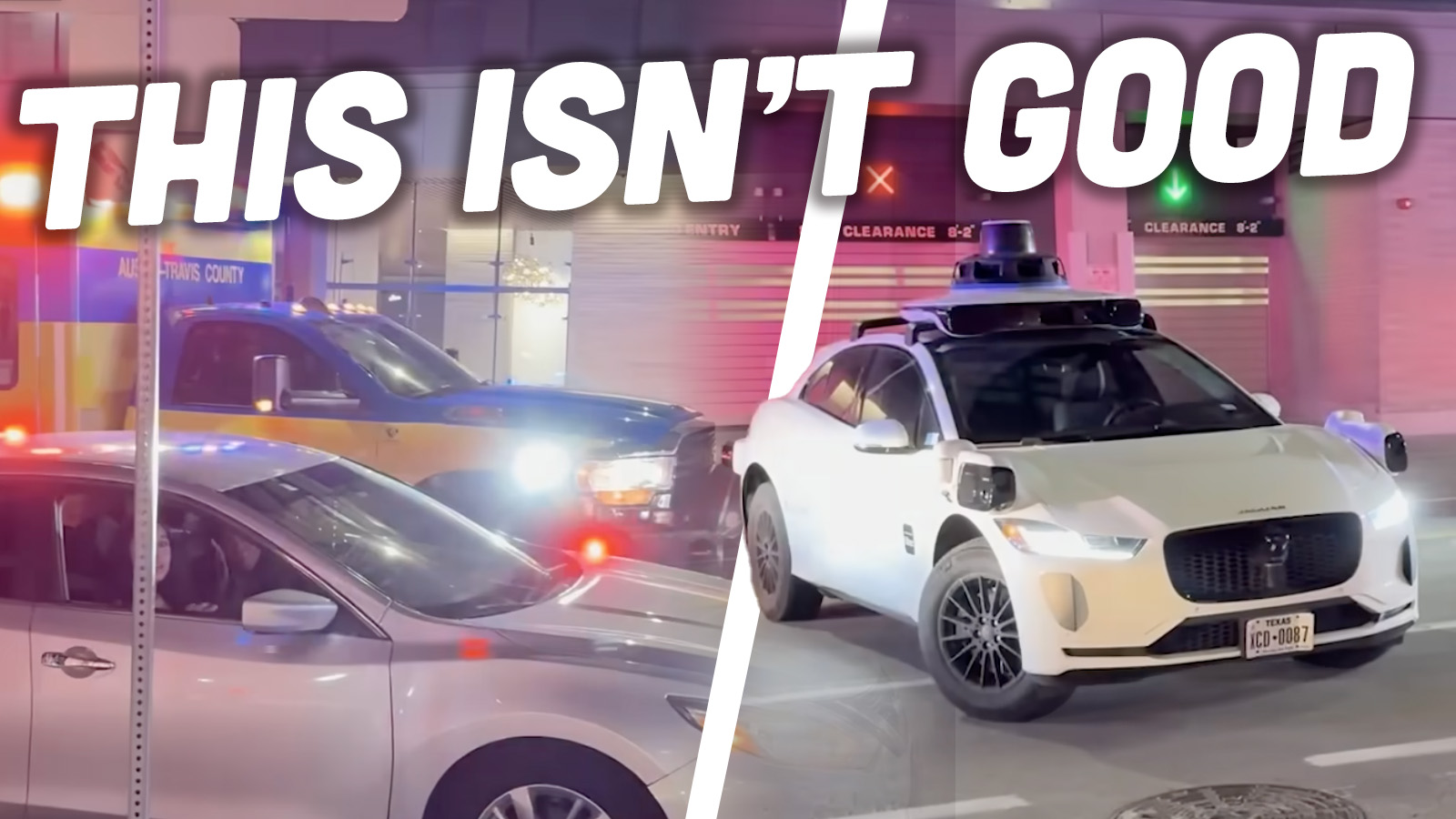
Driving is not as simple as it seems. It’s not just about the physical control of a car and understanding what signs and road markings mean; there’s an entire other dimension to driving that requires some sort of basic understanding of how human culture works. That’s because cars aren’t driven on neat grids of roads populated with tidy buildings and surrounded by other vehicles piloted by careful, attentive beings dedicated to following rules; cars are driven in the messy real world, which is a colorful, fragrant minestrone of chaos and madness, and this sort of disorder doesn’t constitute “edge cases,” it’s just how reality works. And it’s up to the automated vehicles (AV) to adapt to it, not the other way around. There was a sobering example of this just yesterday, when a Waymo robotaxi blocked an ambulance during an active shooter situation.
The incident happened about 2 am on Sunday, when a 53-year old man shot at patrons at an outdoor bar in Austin, Texas, resulting in 14 people injured and two killed, including the shooter. It’s all tragic, and the investigation is ongoing, and this isn’t the place to discuss that. We can discuss the behavior of a Waymo robotaxi that arrived in the area of the attack.


A group of people at a nearby club ordered the Waymo to take them home, unaware of what was going on at the nearby bar where the shooting was taking place. When the Waymo arrived in the area, it identified a road blockage, and began to execute a U-turn. While in mid-U-turn, an ambulance approached, which seemed to confuse the Waymo and left it blocking the road perpendicularly, as can be seen in this video of the incident:
There’s no way around it, this is pretty unacceptable behavior from an AV. It’s hard to get much worse than blocking an ambulance (and an entire road) in an actively dangerous area. In the video you can see that a police officer had to actually get into the car and drive it away manually, which is both good that it was possible to do so (this process generally requires the car to contact an overseer to get permission and unlock, which seems to have happened) and also terrible that this was what was required to move the robotaxi out of the way.
View this post on Instagram
I’m confused by a lot of what happened here that led the Waymo to be flustered and block the whole road; as we have discussed before, Waymo does monitor their cars with human beings at remote locations, and these humans are supposed to step in to help when the car becomes confused. Where were those “fleet response agents” during this event? This seems like a textbook case for the need to reach out for immediate human assistance.
The fact that the Waymo robotaxi ended up in this area at all should be a very loud message that we are not doing enough – and by “we” I don’t just mean Waymo and other automated vehicle robotaxi companies, I mean emergency service agencies, local governments, and national government, and everyone. There needs to be clear procedures and expectations of what AVs should do around emergency vehicles enforced from above, not left to individual companies.
In a case like this, not only should the robotaxi be able to identify emergency vehicle lights and audio cues, but there should be cooperation between emergency services and police and the robotaxi companies so a signal can be sent to all AVs on the road identifying what streets are on police or other sort of lockdown, and then those vehicles should simply not be able to go to such areas.
I describe situations like this in my book, Robot Take the Wheel, if you’re curious, and how it should be up to us to decide how we want these AVs to behave in situations like this. We, as a culture and society, should decide the rules, and it’s up to the AV companies to follow those parameters.
In this case, why are there not modes of behavior for robotaxis? When an emergency is detected, either via audio-visual cues or direct information broadcast to the car or whatever, there should be a special set of emergency situation rules that are then followed – an emergency mode – which would prioritize getting the hell out of the way of other vehicles as quickly as possible, being able to listen and act upon verbal commands from law enforcement officers or other emergency workers, and, of course, contact a live human to help manage the situation and be on call to communicate with people on the scene.
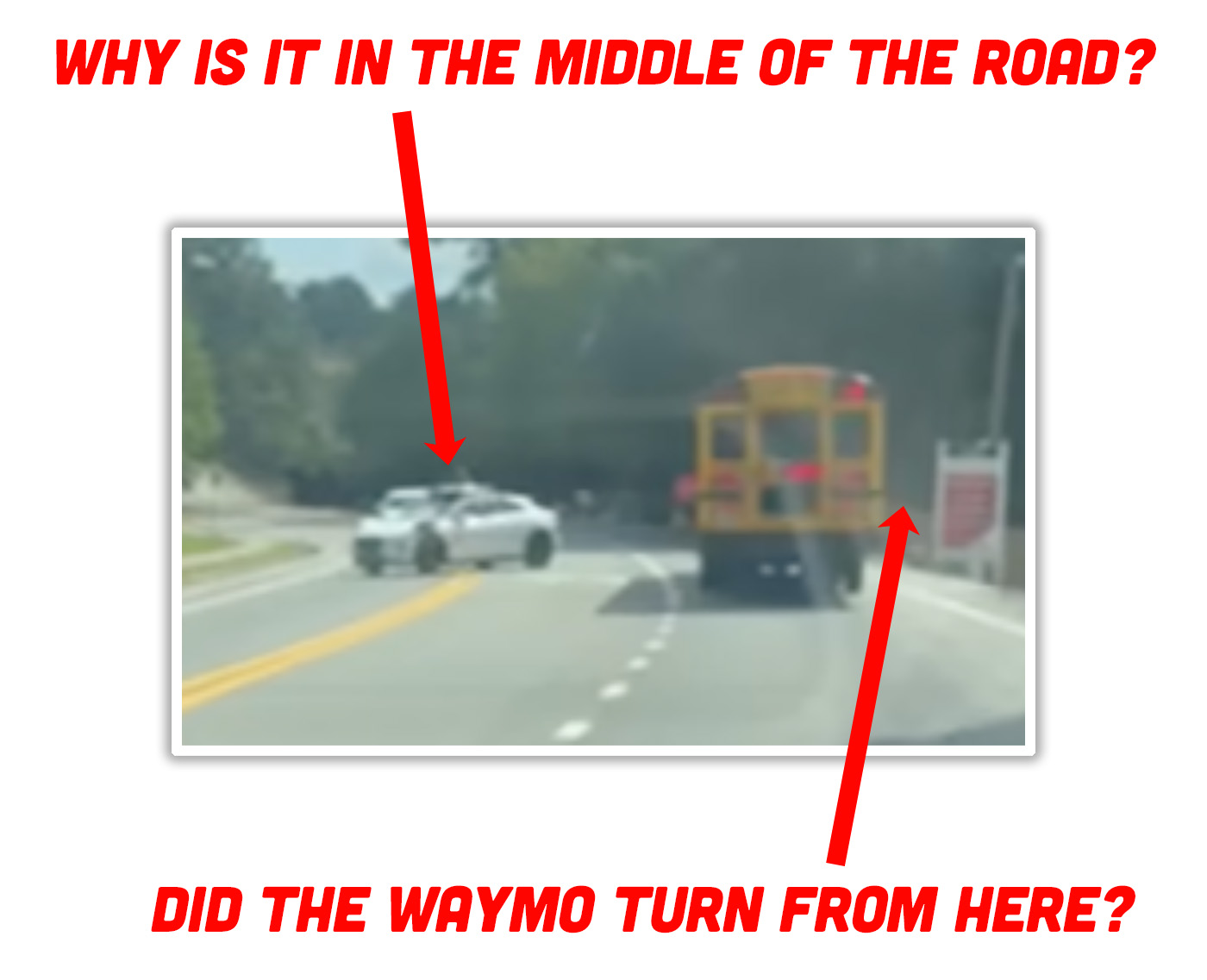
I don’t really understand why these types of situations don’t seem to be a bigger priority? We’ve seen other dangerous and seemingly easy-to-avoid mistakes from Waymo AVs before: in one case, a Waymo not understanding how to behave around a school bus, and another case where a Waymo hit a kid (they were not seriously hurt, luckily) in a school zone. Both of these situations involved very specific circumstances that should be relatively easy to detect – when in a school zone, an extra cautious mode should be employed, and when around a visually distinct school bus, the rules that define how to drive around one should take priority.
Maybe something like this is happening, and I just can’t perceive it? Whatever is happening, I think we can safely say it’s not enough, and if we are serious about having self-driving vehicles on public roads, standards for behavior during emergency situations should be defined, deployed, and understood by any company wishing to operate AVs in public and emergency responders who may have to deal with these vehicles in difficult and dangerous situations.
It’s also worth investigating how AVs can not just get out of the way, but could also possibly be used to actively help. An organized emergency policy for AVs could include the ability to take control of any AVs in the area to use for blocking off roads or helping to corral other vehicles away from dangerous areas; if these machines are going to exist on public roads, we can at least get them to help when we need them, right?
It does not seem like the Waymo, in this case, contributed to any significant harm or delays, thanks to the quick thinking of both the ambulance driver and the police officer who eventually moved the Waymo out of the way. But that doesn’t mean every time will be as forgiving. This is a real issue that demands serious attention.
I reached out to Waymo for comment, but they declined to give a statement at this point.
Top graphic image: KXAN on YouTube



Recent precedent suggests a couple of ICE agents would have made quick work of the situation. /s
Or we could just ban the damn things and move on.
Clear Procedure: Use the Bash Bar on the front of the emergency vehicle to move the fucker out of the way.
Once it starts costing these companies monetarily to have freezer temp iq level “autonomous” heavy machinery then they’ll do better.
Yeah another reason why I think autonomous vehicles will NOT replace privately owned vehicles.
But having said that, there’s a lot of stupidity going on in that scene.
The car to the right of the ambulance could back up or move out of the way and then the ambulance should be able to squeeze by on the right.
Or the cop on the other side of the road behind that waymo could have gotten his stupid ass out of the way and the ambulance could have squeezed by behind the waymo.
There needs to be clear procedures and expectations of what AVs should do around emergency vehicles enforced from above, not left to individual companies OTHERWISE THEY SHOULD NOT BE PERMITTED TO OPERATE.
FIFY.
“In-The-Way-mo” was just screaming to be in the header graphic here.
Careful, this all sounds far too rational and thought out to appeal the tech bro cohort damn the torpedoes ship it and debug into existence approach to engineering.
Are Waymos programmed to stop moving when they detect emergency vehicles nearby?
Seems like a likely possibility – the car thought it was staying out of the way of the ambulance but something made it freeze before it got to the shoulder.
I don’t want AVs to be making UTurns. I don’t even trust 99% of humans with this maneuver. I (naively) thought AVs COULDN’T make illegal turns. What good are the three laws of robotics if we program them be overridden BY THE ROBOTS?
I can’t wait for the canned corporate response in two days saying ‘We’ve looked into this incident and are deeply sorry for what happened. We’ll be doing everything in our power to make sure it doesn’t happen again!’ while changing absolutely nothing about their internal operations.
God help the human driver that makes this sort of stupid move. But, since it’s a huge corporation behind this “autonomous” vehicle, it’s just a bit of bad publicity for a couple of news cycles.
Any human driven without the wherewithal to move out of an ambulance’s way in such a situation rather than remain frozen blocking multiple lanes of traffic should lose their license.
Human drivers block emergency vehicles all the time.
Yeah, but usually a loudspeaker saying ‘You in the white Buick Enclave, move over!’ tends to solve the problem.
I expect this will be solved soon, in, um, 50 years or so. Maybe.
Also, I am fully in my old man phase, and still don’t see how the whole AV thing will ever be settled software.
This feels like weird offline racing game AI behavior. Like when they have an off and then start going in circles.
But I don’t see anything changing politically soon. Big Tech has big money, and a lot of pride. They’ll do everything they can to keep the government from interfering with regulation, until they trip up so badly that they no longer possess the goodwill nor the money to lobby in Washington.
In the meantime they have the knee pads and shiny trinkets firmly in play for the -ahem, leadership in order to buy favor and exclusions.
EMS should send out a signal that forces Waymos to pull over asap. The 911 central command center should have a button that grounds all autonomous vehicles in the city in case of an emergency like this so they can’t interfere out of sheer stupidity.
It would probably be a wet dream of EMS to force ALL DRIVERS to pull over.
They already send out a signal that clearly translates as “get out of the way”: the lights and the siren.
Which mostly works, on humans.
There are a ton of edge cases where AVs or humans can’t really get out of the way. I hate the times when I’m stopped in the #1 lane at a stoplight of a multi lane street, and hear a siren. Even if I have enough room to change lanes w/o the car in front of me moving, there’s no place to go. The other 1,2,or 3 lanes are jammed w/cars, so the emergency vehicles have to take to the opposing lanes to go around the stopped cars.
Also, in our podunk town where a lot of the roads appear to be slightly widened and paved cow paths, there’s often no shoulder to pull over to.
I always like when there’s a coordinate wave to “make room” between two lanes for EMS to go by squishing to both edges. It feels good to be a part of a movement.
“so a signal can be sent to all AVs on the road identifying what streets are on police or other sort of lockdown, and then those vehicles should simply not be able to go to such areas.”
This is actually a very risky approach. At any point if you have an area that has a critical mass of AVs, this could/would be leveraged to disrupt the environment.
Police are terrible with data security. Any backdoor built for such a purpose and shared with authorities may as well be co-published on Reddit.
then we shouldn’t have AV’s period.
Why? They are safer than human drivers
Particularly when they prevent ambulances from getting to shooting scenes.
How many ambulances are held up by human drivers every day?
It’s one thing to wander in as a shill. It’s another entirely to make claims this site repeatedly and accurately disproves.
Last I looked Waymo’s accident rate was way lower than a human.
The emergency vehicle lights flash and video camera images flash and LED lights flash. I wonder if these flash rates sync and the Waymo simply can not “see” the ambo?
Waymos are coming to Baltimore. I wonder how they will deal with our idiocies
Cyber attacks are one of Iran’s favored methods to harass western countries. Maybe they hacked Waymo.
Never associate to malice what can be attributed to incompetence.
Police car AND ambulance were equipped with push-bumpers. Give that thing a shove already!
Honestly, I’d be fine with this. Highway Patrol in my state has the legal authority to clear the road using all means necessary during emergency events (usually big storms where somebody who slid into a median can block big chunks of the road, or where people with bald tires block a lane), and the bull bars on their cars are not simply for decoration. So the solution is simple:
1) We (public safety agency) will have an API that is publicly accessible and will give you coordinates of emergencies and a defined radius. Anything within that radius needs to exit it immediately or pull over and stop
2) If necessary, use remote control to pilot vehicles through stoppages
3) If that doesn’t work (IE, cell signals jammed), your vehicle will be pushed to the side of the road forcibly.
4) If your autonomous vehicles become a problem (IE, in the same way people who interfere with emergency responders can be cited), then the operator gets dinged with a substantial ticket.
From the video – the Waymo was slowly completing the u-turn until the cop got involved.
As to the kid that stepped out directly in front of a Waymo in a school zone – it is good for the kid that it was a Waymo and not a human driver. The Waymo was already driving below the speed limit and reacted way faster than any human could.
I think AVs have a lot of very useful potential, but “slowly completing the U-Turn” while blocking an ambulance is in no way a good thing. If we’re serious about using these, we need to design them behave in ways that make the most sense for us, period.
Sure the Waymo could have done better but it seems people expect perfection instead of just better than the average human.
The school zone is an excellent example. The Waymo did way better than a human but it made national news that a Waymo hit a kid in a school zone. Had a human been driving and hit the kid, killed the kid, it would have been local news for a day.
Sounds like these autonomous cars can cause Way-Mo problems for first responders.
Waymo execs need to be charged with involuntary manslaughter.
Also, those cops should’ve pushed the car aside. That’s what those bars are for 😀
Wait until they show in Arkansas. The ASP will love pitting them.
Those taxis should be required to have an emergency stop button within easy reach of the passengers. When they’re unoccupied, there should be a bumper sticker with a phone number or something so the police or other first responders can command it to stop and pull over.