

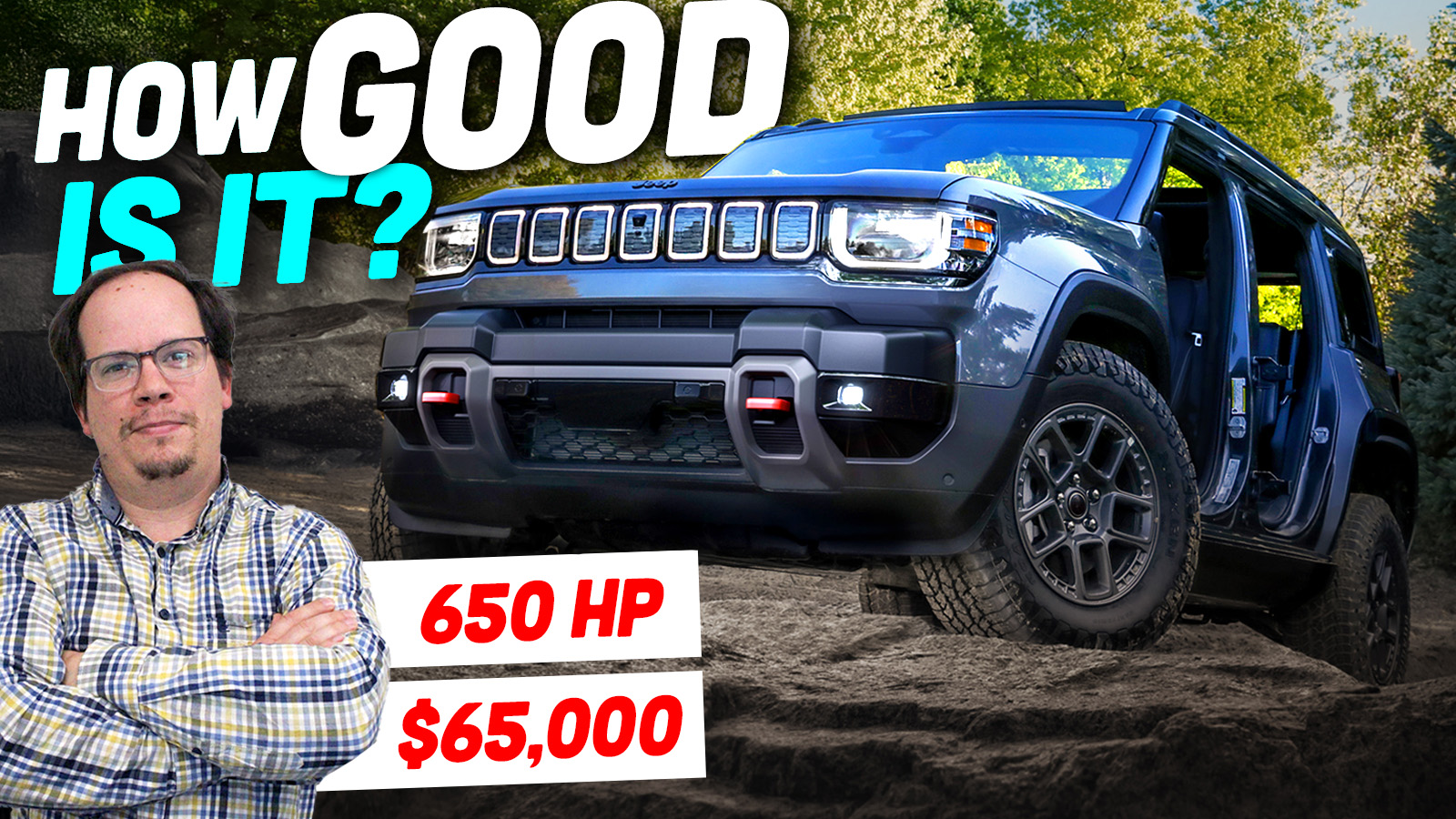
Some people are calling the 2026 Jeep Recon the “Electric Wrangler,” and with press photos showing a doorless Jeep bashing through tough off-road trails, I understand why. The reality is that the new Jeep Recon will not be as good off-road as the Wrangler, but that doesn’t mean it’s going to suck. In fact, I think the 650 HP EV is going to be a formidable off-road machine. Here’s why.
“The Wrangler stays the Wrangler — the icon of the brand…. the best of the best of the best is the Wrangler. Most capable” said Jeep brand CEO Christian Meunier at a press conference three years ago, in response to my question of whether the new Recon would be replacing the Wrangler. The STLA platform-based Recon, Meunier told me, would be inspired by the Wrangler, with a squared-off “tophat,” a rear-mounted spare, and removable doors, but it wouldn’t replace it.


In my 2022 piece, I mentioned that I was skeptical that an all-electric vehicle like the Recon could fill the Wrangler’s shoes, namely because its independent suspension would limit it severely. Still, Jeep claims the vehicle can cross the Rubicon Trail, and while I think it would almost certainly be beaten to a pulp by the end of it, I think it could pull it off. Here’s why.
The New Jeep Recon Is Going To Be Good Off-Road, Not Amazing
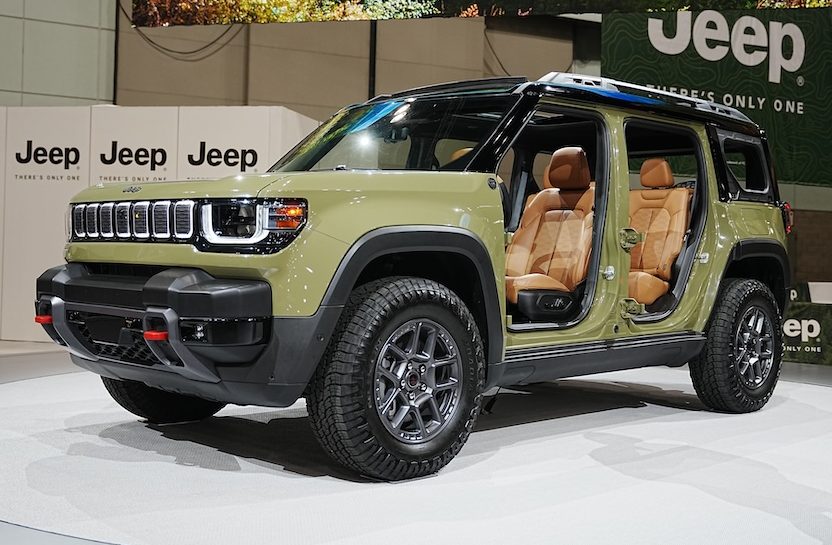
As a general rule, I don’t like to make claims like the above until I’ve driven a vehicle, but with many years of recreational off-roading, engineering, and off-road evaluating under my belt, there are some things I can glean by just looking at pictures and a spec sheet.
And now that the LA Auto Show is here, Jeep released the 400V, 650 horsepower EV’s production specs, and though the $65,000 price tag and 230 mile range spec (from a 100.5 kWh battery) don’t look particularly good, the off-road specs do.
Let’s start by talking geometry.
The Jeep Recon Has Favorable Geometry

I start pretty much every off-road evaluation the same way: by reminding everyone that the single most important attribute a good off-road vehicle needs is favorable geometry. This means more than just ground clearance, it means short overhangs and small overall dimensions. It doesn’t matter how much fancy gadgetry a vehicle has onboard if it can’t get its front tires onto an obstacle because its long front bumper gets in the way.
As you can see in the image above, the Jeep Recon’s approach angle and departure angles are 33.8 degrees and 33.1 degrees, respectively. These are fantastic, and the 23.3 degree breakover angle isn’t bad, either.
For context, the Ford Bronco, Jeep Wrangler, Land Rover Defender 90, and Suzuki Jimny offer approach and departure angles in the 40-degree range, but nobody thought the new Recon would be among the top-dogs of the off-road world. Go down half a tier, though, and the Recon is right there, geometry wise, with the likes of the Mercedes G-Class, Toyota Land Cruiser, and Rivian R1S.
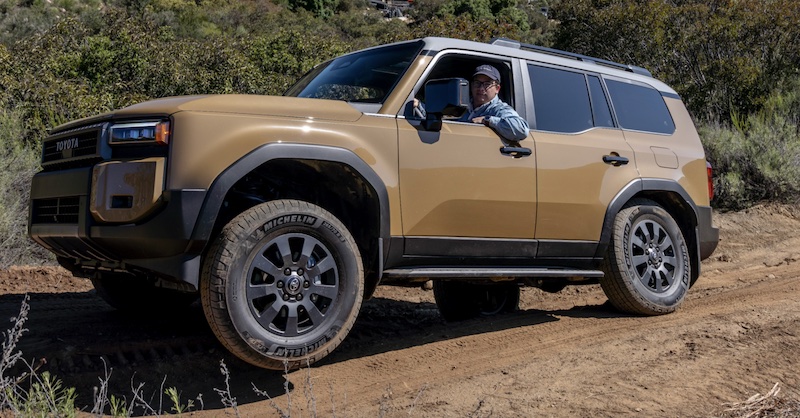
The Toyota Land Cruiser’s approach angle is 31 degrees, its departure angle is a downright weak 22 degrees, and the breakover angle is 25 degrees. The Recon may drag its belly a bit more than the Land Cruiser, but those extra two degrees of approach angle and the extra 11 degrees of departure angle will definitely outweigh the breakover angle deficiency.

The Mercedes G-Wagon, historically an absolute off-road monster, isn’t what it used to be on the rocks, but it’s still no slouch, with an approach angle of 30.9 degrees, a departure angle of 29.9 degrees, and a breakover angle of 23.5 degrees. The new Jeep Recon has it beat by a few degrees at the front and rear end, but overall, these two are fairly evenly matched.
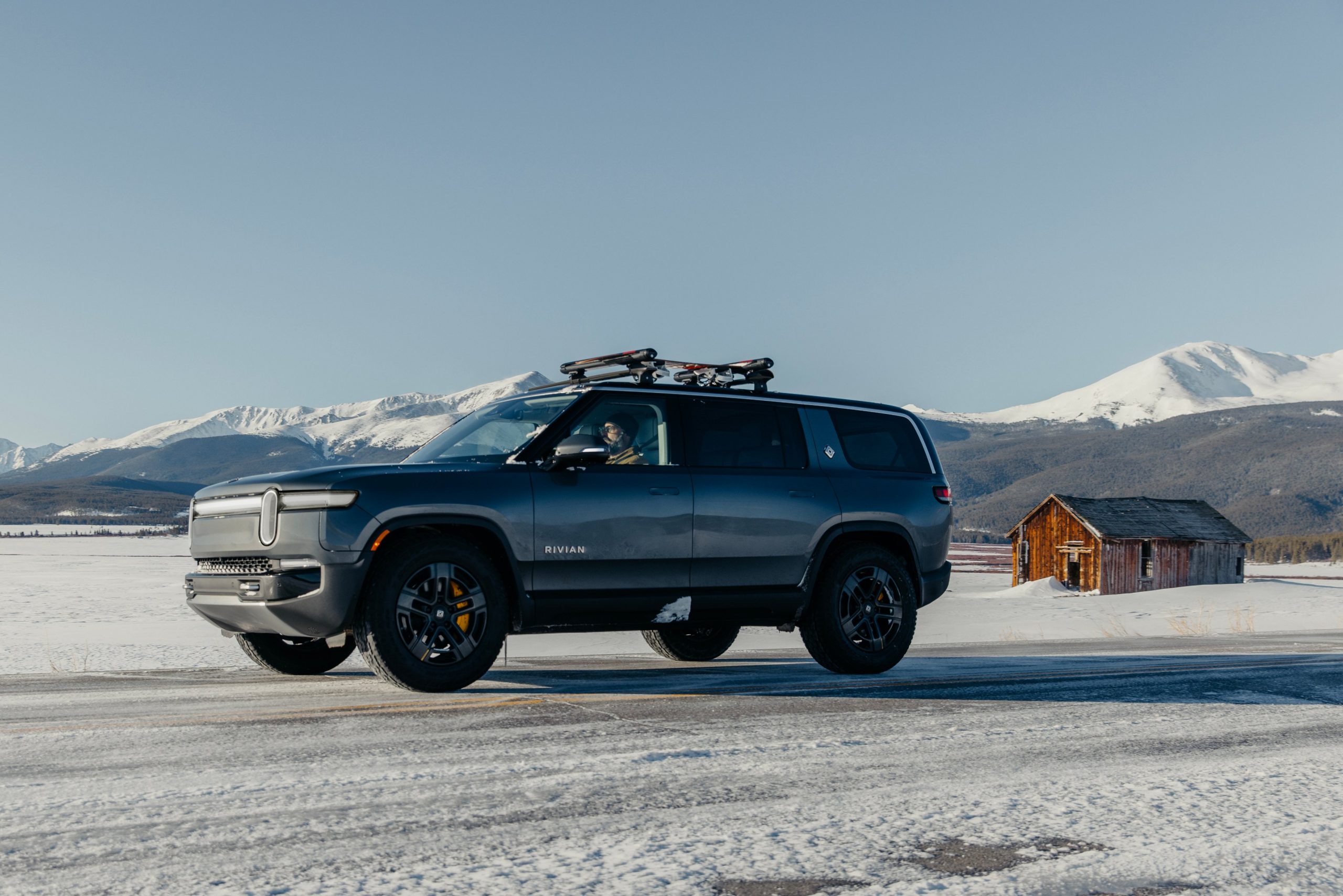
The Rivian R1S’s short front overhang gives it an approach angle of 35.8 degrees, the rear end yields a good 34.4 degree departure angle, and the breakover angle is a great 29.7 degrees. Rivian is leveraging air suspension to pull this off, jacking the car up to 14.9 inches of ground clearance. The Recon, by comparison, uses fixed-height coil springs, which offer a decent 9.1 inches of clearance.
Let’s Talk Ground Clearance
Let’s talk about that ground clearance a bit, because not all ground clearance is created equal. If a vehicle has components that sit low between the wheels on the same axle (for example, a differential pumpkin on a solid axle), that’s usually not a huge deal, as off-roading typical involves placing tires on top of obstacles and not straddling them (though sometimes that is necessary). 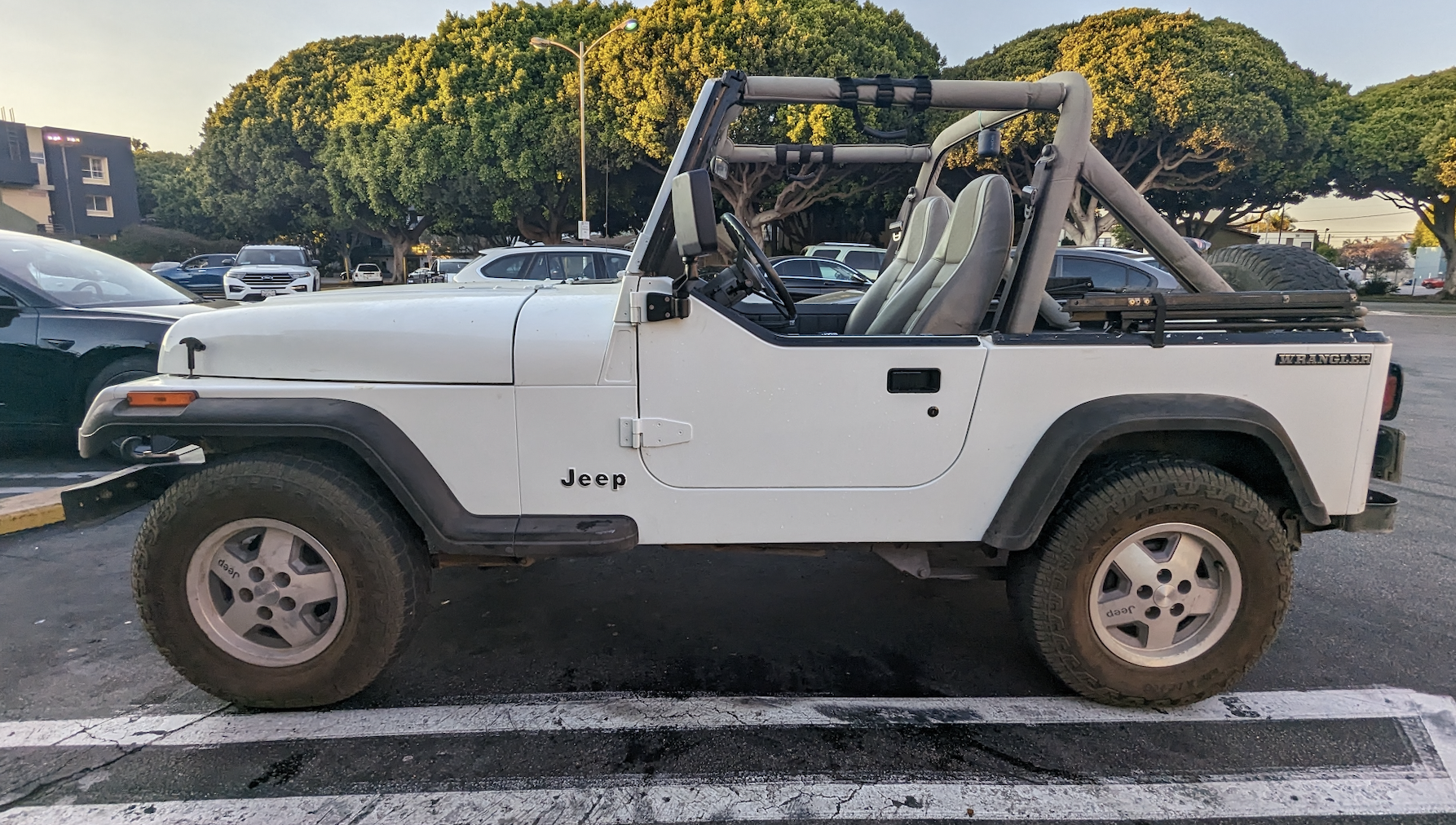
For example, my Jeep Wrangler YJ (above) has less than 9.1 inches of ground clearance at the differentials, but it just doesn’t matter, because the differentials are always pulled way up high by the tires, which are climbing the rocks that pose the biggest risk to the diffs. Notice how the rest of the body — the front and rear overhangs, and especially the rocker panels that are just aft of the front tires that will be coming down off rocks or logs or whatever — is way up high.
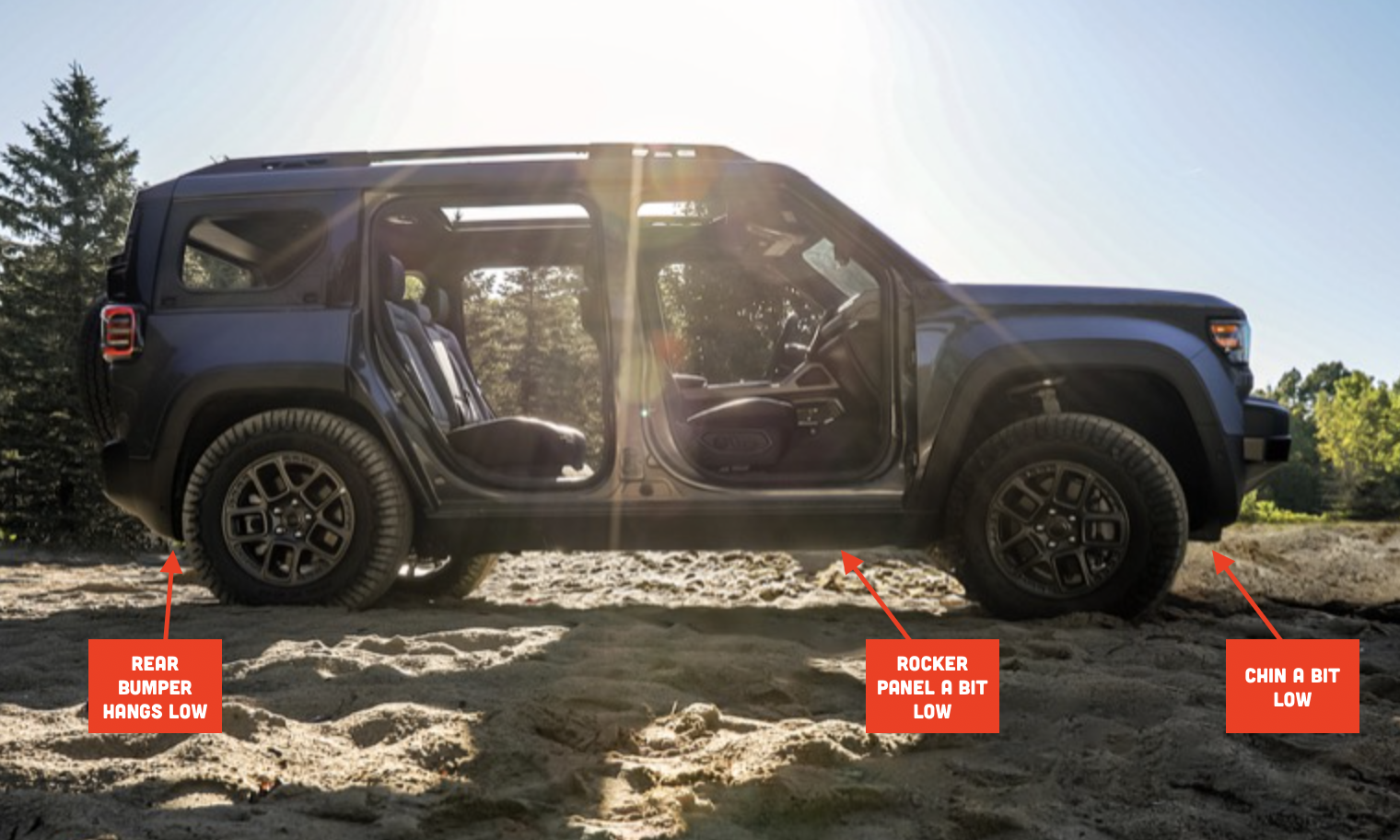
The Recon’s ground clearance doesn’t appear as well optimized as my YJ’s (or the current Bronco’s or Wranglers), with rocker panels, a front chin, and a rear overhang that look very much like rock-bait. The clearance is still decent compared to many modern 4x4s (which have to meet stricter aerodynamic targets than my YJ ever did), but without air suspension, there’s absolutely zero chance that this vehicle could get through the Rubicon trail without a ton of scraped black plastic.
Traction & Articulation
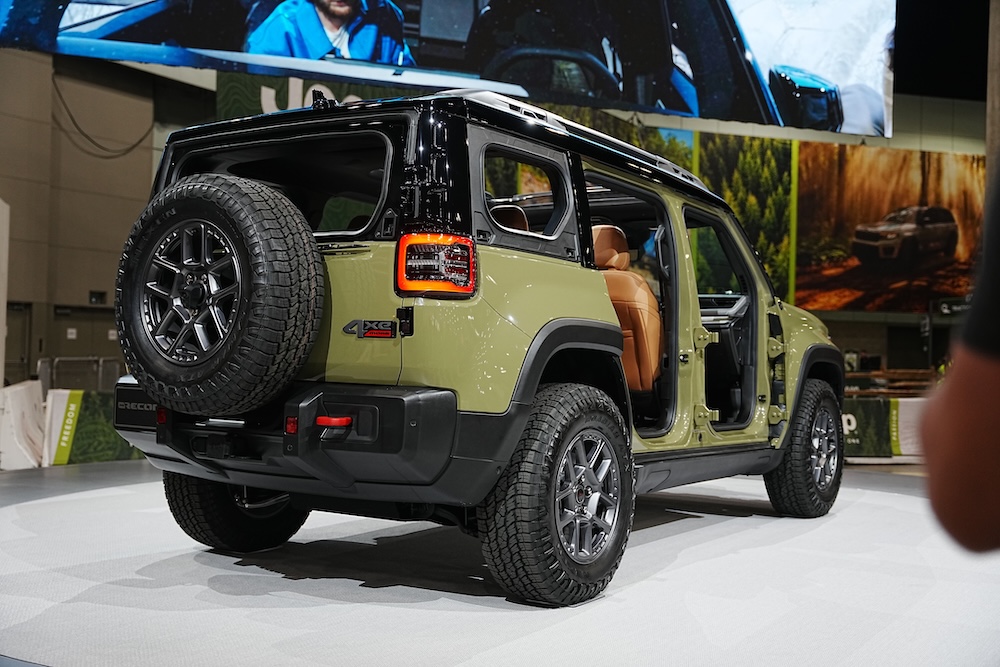
Another important attribute of a good off-road vehicle is traction, which is related to articulation (the ability to keep all four tires on the ground on uneven terrain).
The Jeep Recon comes with 33-inch (265 70R18 — so just under 33″) Nexen Roadian ATX all-terrain tires, which are generally regarded as great overall on-road/off-road tires — not too loud or knobby like mud-terrain, but not going to leave you stuck in a moist front yard like a low-rolling resistance street tire.
Those tires are connected to spindles that bolt to a Short-Long Arm independent front suspension and an multi-link independent rear suspension. This is the same type of suspension you’d find in, say, a Dodge Charger, and not some of history’s biggest off-road icons, though, to be fair, a number of modern off-road vehicles have fully independent designs.
There are plenty of benefits to such a suspension, with better steering precision (a solid front axle pretty much requires a steering box, which is a lot less precise than a rack) and improved ride (thanks in part to reduced unsprung weight) being chief among them (see our deep-dive into solid-axle vs independent suspension off-road). On high-speed terrain, independent suspension reigns supreme, though on technical off-road courses, they usually result in significant tire-lifting, which is a huge traction issue and can be a safety/tipping concern.
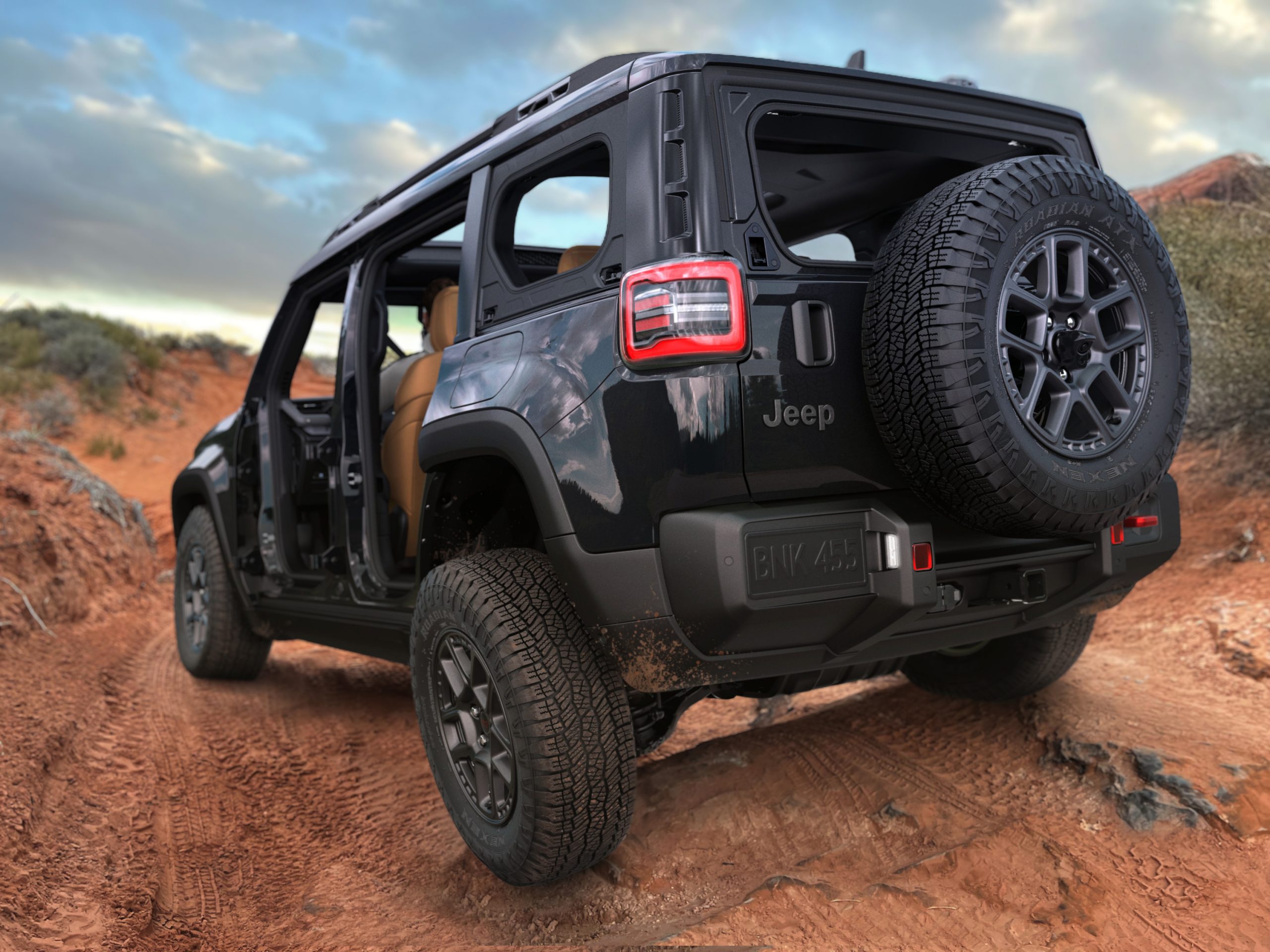
The image above shows what looks like fairly decent flex for an independent suspension setup. But it’s no comparison to a solid axle like this:
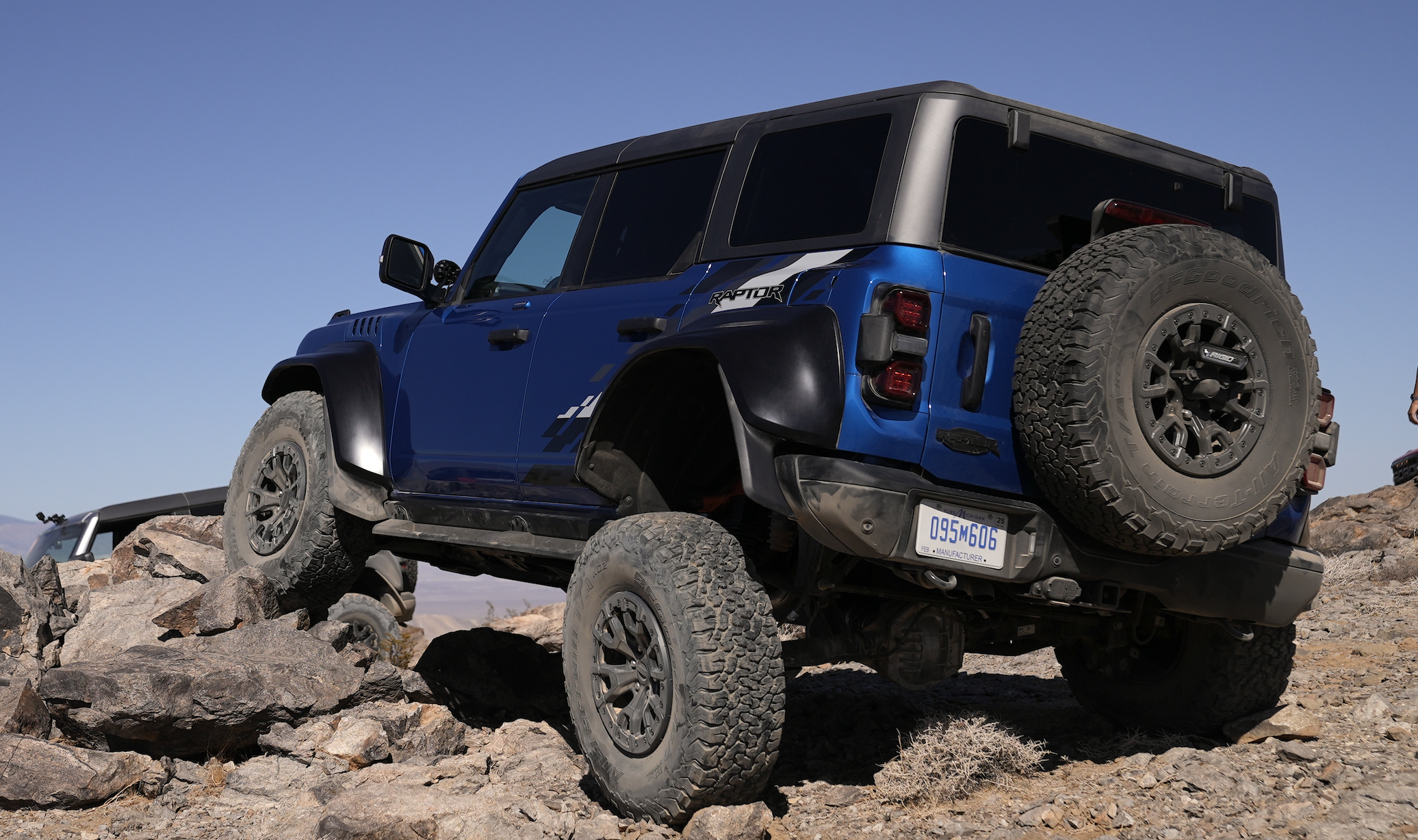
Still, when articulation is limited, the (rather effective) bandaid to the problem is a traction-aide, and the new Jeep Recon has the ultimate: a locking differential.
No, it’s not two locking diffs like some of the most hard-core off-roaders out there, but a rear locker goes a long way, and the Recon’s is a legitimate electronic locking differential integrated into the Stellantis-developed rear Electric Drive Module. It’s there to keep both rear wheels spinning at the same rate by mechanically connecting their angular velocities; this means that, if one rear wheel lifts off the ground, the other can keep the vehicle moving forward, whereas with an open differential, lifting one wheel off the ground will render the other wheel on that same axle useless (at least in terms of propulsion).
I still have some concerns about the off-road traction capabilities of EVs in general. Since the front and rear axles are not mechanically connected, Jeep is going to have to use software to figure out how much current to send each Electric Drive Module’s motor (there’s one on each axle) to ensure the vehicle moves ahead smoothly despite traction conditions under each tire that can very second-by-second. I mentioned this concern back when I reviewed the Rivian R1T years ago and noticed quite a bit of “flaring” (i.e. wheelspin) happening as the computer tried to figure out what was going on at each wheel.

But a mechanically locked rear axle goes a long way, and the Recon’s 15:1 rear axle ratio (and 11:1 up front) should help, too. This is a shorter ratio than most EV, and as our resident EV enginerd, Zero Entropy, wrote recently in his excellent article How The Electric Motor Killed The Transmission, shorter gearing could help even a torquey EV when it comes to off-roading. From Zero Entropy:
We’ve established that EVs make tons of torque at zero or low speeds, so shouldn’t they be perfect for an off-road adventure through Moab? Yes, but the extreme cases still pose a challenge.
Imagine you are trekking over some boulders at an extremely steep angle. You’re inching over an obstacle, and the electric drive motors (presumably two or even four motors) are effectively twisting against gravity in a stall condition. They can make this torque, but heat can build quickly.
[…]
Back to the EV; This is a case where a special crawl gear could be handy. Not because the motor isn’t capable of making the required wheel torque without it, but because it would run a lot cooler if it was geared down more. A greater reduction means the motor can be at a lower torque to make the same wheel torque. Lower torque means less current and less heat.
Underbody Protection
The last thing I’ll mention is underbody protection. Jeep hasn’t provided any photos of the Recon’s belly, but as it’s an EV, I bet the battery between the axles is just a big flat surface with a nice metal shield that will make it easy to slide over boulders when that moderate breakover angle gets tested.
I’ll see if I can get a closer look at the LA Auto Show.
The Jeep Recon Will Be Good Off-Road, Just As The KL Cherokee Was
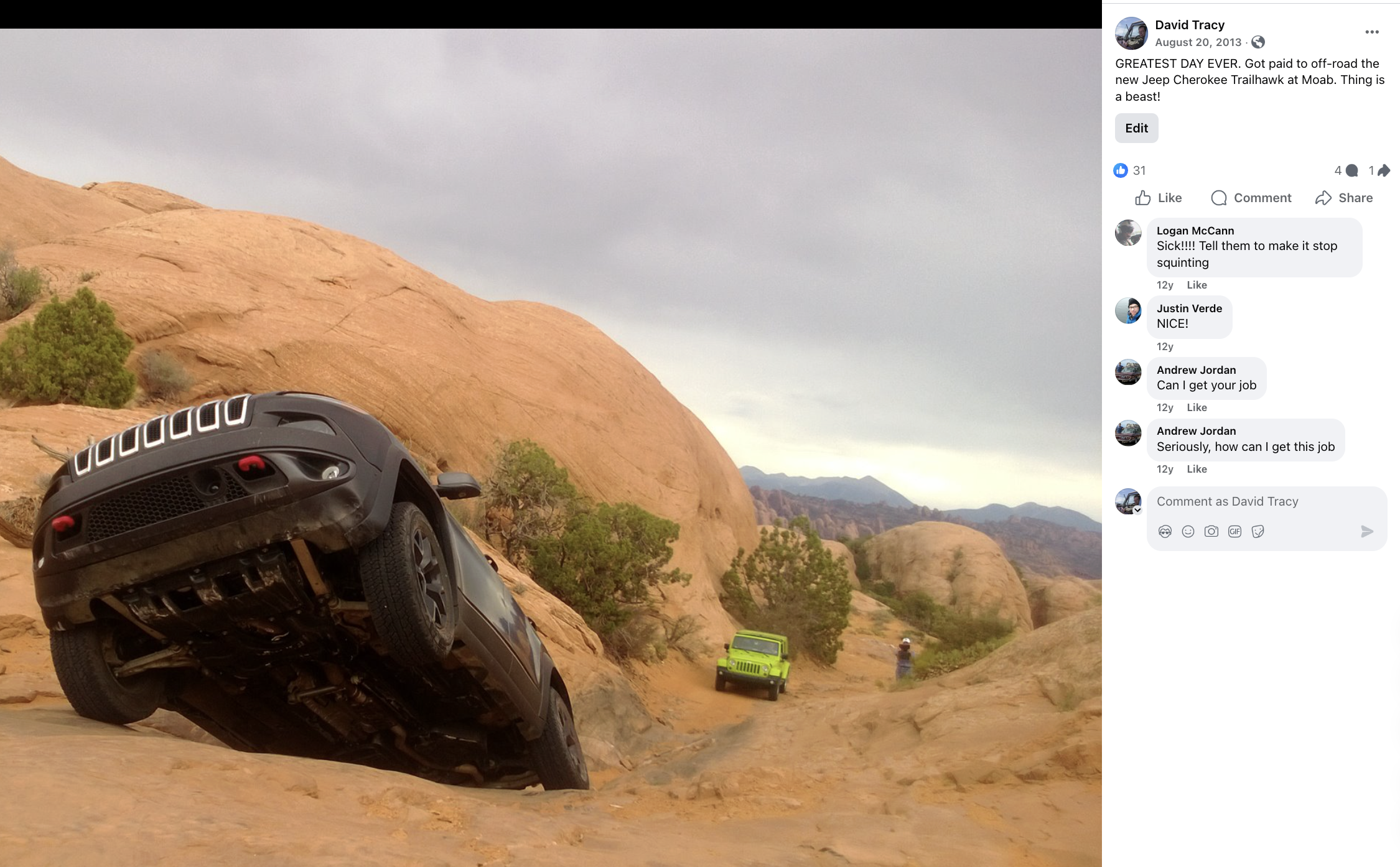
The very first vehicle I ever off-road tested back when I was a Jeep engineer was the Jeep Cherokee KL. As a diehard Jeep XJ guy, I thought the KL would be hot garbage. It looked hideous, the fully independent suspension couldn’t flex, and though the geometry looked good on paper, in reality the rockers and fascias were too low to the ground.
But when I went out west on a “hot trip” to see how the KL could do on the rocks of Moab, I was legitimately impressed. Thanks to that rear locker, that decent geometry, and the underbody skid plates, the thing was an absolute billygoat on even the steepest grades.
Sure, by the time we were done testing, the plastic on the rockers and front/rear fascias had loads of gouges in them, just as I’m sure the Recon will if I get a chance to off-road it, but the KL got the job done, and to this day I respect it. It’s not nearly the off-road platform that the XJ was, but especially compared to the other modern crossovers out there, the thing took care of business.
I have no doubt the Recon will, too. Though I am a bit concerned about the 6,100 pound curb weight — literally a ton more than the KL. Gulp.


I would say the question should have been could it be a good offroader but will it? And the answer will most likely be no because it will be at the dealership getting fixed 95% of the time.
Found off road dead?
Ah, the range is only 230 miles because it doesn’t need more range than it can use between software failures.
The range, that number defining all electric vehicles…250 miles.
I’m not complaining. I am a fierce advocate of lower ranges on electric vehicles. On a vehicle that’s designed with practicality, economy, or sportiness as a priority, moderating the size of the battery makes sense. Lower cost, lower weight by reducing the most expensive, heavy part of the vehicle. That’s good for offroad too, of course.
But this is a $65k vehicle that’s got a big leathery, techy interior, accelerates 0-60 in under 4 seconds, and weighs >6000 lbs.
Are the people buying this not going to demand >300 mile range for their money?
Would they see it as their money being spent on things they care more about, like the interior? As a weight-saving choice that makes it a slightly better offroad choice?
I guess I can’t actually imagine the mind of anyone with money in 2025, so it’s possible they did their research and absolutely nailed it…but with Stellantis, it feels like “ah yeah, they got real confused about who this was for” is most likely.
Still, I see “you can take the doors off” and automatically read it as “that’s a real Jeep and not a Dodge with a funny mustache”, so that much is working in their favor.
EV batteries are best preserved if they are used from 80%-20%. So the real range of this truck isn’t the 230 miles as stated. That’s for 100%-0 use. But instead just 60% of that or about 130 miles.
I can’t say you’re wrong, but it sounds so much like a myth that I’m not prepared to believe it. I feel like if it was really that bad, we’d see “they say it’s rated for this much range, but of course you only get 60% of that, so it’s this with an emergency 40%” whenever there’s coverage of new EVs.
Charging from 80% to 100% is slow. I’m not an EE but there are reasons for it. Also they say that it damages the battery. So when you plug in at home or at a charger, you’re instructed to charge it up to 80%. At chargers, they actually charge an additional fee if you want to exceed 80%. The under 20% thing is similar. I think with any battery you’re not supposed to run it empty all the time. On mine, I’m usually under 20 by the time I get home. I try to not go below 10. Kind of a pain.
I thought the 80-100 slowdown was only for level 3 charging.
(Edited for phrasing.)
I don’t think so. Well – the slower chargers are already slowed I guess. Something with how batteries work and that last 20%. No different than your phone. My iphone now tells me how quick it will be at 80% when I first plus it in.
I would hope the battery on a car would be designed for better longevity than the one on a phone, if only because I don’t believe for a second that longevity is a serious consideration on modern smartphones.
I have the 80% limit set on my Samsung, though that’s mostly because I don’t need the battery at all.
When I go out, it’s plugged in for Android Auto most of the time.
I checked, it says “[time] until full” whether or not I have battery protection on. I don’t have a strong opinion on which notification is better. I suppose the best thing would be to have an option to display time to 80%, 100%, or both.
The best layman’s way I’ve heard it described is that as the battery ‘fills up’ it is like as a car park fills. Once above 80% charged, each electron has to move slower to find an available spot to park.
Technically this slow down above 80% occurs for all lithium-Ion batteries at all charging speeds. It is most noticeable at level 3 chargers bc the ramp down is so significant + if you’re at a level 3, you are likely sitting there waiting for your car to finish charging.
This is why on road trips it is faster to only charge to 80%
Great analogy that makes perfect sense with charging lithium batteries. Thanks.
It doesn’t look like the doors were meant to be removed. It looks like it was street parked overnight in a rough section of Brooklyn.
To the good:
To the bad:
I remember a day when you could get your Wrangler (offroading first), Cherokee (economical, more comfortable than a Wrangler, also competent offroad), or Grand Cherokee (high end, lux-ish, V8, could go offroad), and… that was it. I have no idea who is buying what from Jeep these days or how effective it is, because anyone I still see on the trail with a Jeep is driving a Wrangler or 20+ year old Cherokee of some flavor and they don’t know either.
For everyone complaining about the price – have you looked at the Wrangler lineup recently? One of the models has a starting price over $100k. Add a hardtop, the V6 and the popular equipment package to the Sahara and you’re over $55k. It’s nuts.
the $100k model literally has a Hemi, and is specifically designed for wah-hoos bound and determined to spend their money. Wrangler hybrids are taking up space on dealer lots because of recall issues, poor execution and most of all, the Stellantis miscalculation of the market of users who want a hybrid off road vehicle.
This is a monumentally bad idea, and DT can smear lipstick all over this pig. It still oinks.
Right, which is why I also provided the example of the mildly optioned $55k Sahara. I did a quick search of new Wranglers on the lot near me – I’m 100 miles from Moab, so we’re definitely in Jeep territory – and the least expensive was a Sport S that was $54k before the $7k in incentives piled upon the hood. The most common one was a 4 door Rubicon, and all of them had MSRPs in the $63k range, just like this thing.
I was only commenting on the price, not on if the market actually wants an electric Jeep.
It was reported recently that the base 392 would drop $20k in base price to about $80k so a six figure price may be for an old model or one spec’d out the wazoo. Which, yeah, is still a crazy price but makes the Recon’s price even more outlandish.
It’s impossibly heavy and it doesn’t articulate worth a damn. Taking the doors off isn’t what makes a Wrangler a Wrangler – solid front and rear axles is the key ingredient. And the KL was not capable, it’s a glorified Dodge Dart that lifts tires on the mildest of obstacles and becomes unstable quickly.
A Wrangler isn’t the same thing to everyone. Think about all of the people who’s four did wranglers have never seen anything more aggressive than a gravel driveway. If it looks the part with knobby tires (and removable doors) that will fill their needs. Those types will benefit from fully independent suspension.
Besides, Jeep explicitly says this is not a wrangler. I think the bigger question is, will it canabalize wrangler sales, or attract people that would have bought a Land Cruiser, or Rivian, because it’s electric, or because of those removable doors.
The KL was reasonably capable.
Reasonably is a perfect word. What’s the saying? Any tool can be the right tool if you use it wrong enough.
I’ll have to remember that saying, describes most things I do quite well
Compared to what, a Civic?
Putting all 6000+ lbs of weight on 2 wheels will be great at digging holes in loose surfaces though, could be great for gardening. Should also be quite effective at further tearing up 4wd roads.
They should cut the crap. Half the power for half the price and someone might care for this
In my understanding, power is almost a side effect of a long range EV. A big battery can dump a lot more energy in a hurry than a small one can. Efficient motors also make lots of torque. So yes, Jeep could make it cheaper and slower by using a smaller battery – a big chunk of the cost of the vehicle – but you’d lose range at the same time. Are you suggesting half the power, half the price and half the range?
Okay, I would want to see this argument explored, because “the 3.6 0-60 is basically a free side-effect” is a heck of an idea.
If nothing else, it must be encouraging “stickier” tires with higher rolling resistance and faster wear, right?
Yup, and strangely (at least up to a point) more powerful motors = better efficiency in EV’s, which is upside-down compared to what we’re used to in ICE vehicles. The more powerful the motor/battery combo, the greater fraction of the overall braking energy of the vehicle can be recovered vs. using the friction brakes. It is a very diminishing returns kind of thing, but it is real.
The other thing to keep in mind is that the quoted power for EV’s is ‘instantaneous’ power, so they can keep that up for maybe 5-10 seconds from stone cold, then they have to derate to keep the windings and magnets cool. But if you’re using all 650 hp for 10 seconds straight in a light duty vehicle, what the devil are you up to, anyway?
About 150 mph…
Ever wonder why you don’t see long range, low power EVs? It’s not just a reflection of the perceived market. Electric motor torque is, in large part, a result of how much energy you can deliver. Batteries are rated in terms of their “discharge rate”, or C. A battery with a C of 1 can basically fully discharge in an hour. So if you have a 100 Ah battery and a 10 Ah battery, the big one can deliver 10x the power if all else is equal.
Also, larger electric motors are more efficient than smaller ones – unlike an ICE. So if you’re building for maximum range, you hook up some big motors to a big battery and whoops, all of sudden you have the ability to actually do something with that big slug of electricity.
Now, putting it to the ground. Traction control on an ICE is a little crude – there’s some time lag between changing what’s going on inside the engine and the actual power delivery to the wheels. Less so with an electric motor, so EV traction control can be spooky good. Now we have a way to deliver that instant slam of torque.
And voila, accidental high performance when all you wanted to do was make a long range EV…
That’s frustrating.
Why would it be frustrating? There’s no added cost to it. You still get the efficiency, and you don’t HAVE to go around at full throttle (well, maximum torque request) all the time. EVs are not like ICE vehicles in some ways, compromises you’re used to don’t necessarily work the same.
The new cheaper Lucid illustrates this pretty well. The battery size is 75% of the higher model. Range goes down by just about the exact same, and the rated horsepower is down to 70%.
It’s frustrating because that means there is more “tipping the scales” away from what I’d like EVs to look like. Smaller, lighter, less powerful, less expensive. The bias is already to make bigger and more expensive vehicles, and this is another source of positive feedback.
Ignore “more powerful”. You’re equating that with some sort of virtue. It’s not like an ICE where “more powerful” usually means better economy and lighter weight, etc.
The rest is all in the pursuit of range. If you’ll accept less range, the battery can be smaller. Then it will be less expensive. It will weigh less. It will physically be smaller so you don’t need as big a car to carry it. A 100 mile EV will satisfy most people’s needs, but everyone seems to be convinced they need to cannonball across the US several times a month while never stopping for more than 5 minutes every four hours – which means huge batteries and everything that follows.
Yes, I generally want less range on EVs.
It’s probably wrong to think of power as one of the “negatives”…I’m thinking of it as something that requires more “support” to actually deliver, tires and such…but that’s probably more influenced by the range-associated weight anyways.
“More power” is also a result of dual-motor AWD though.
From the comments on “How Electric Motors Killed The Transmission” by the author (Zero Entropy):
So, that indicates to me that “more power” is still being chosen over other parameters on many mainstream EVs.
I’ll acknowledge the article itself offers an argument in favor of front+rear motor configuration in that the front/rear can be geared differently to maintain acceleration at higher speeds.
Given that a very large percentage of new vehicles are AWD, there may be other reasons why we see dual motor EVs. I specifically chose the dual motor variant of the EV in my garage because I live in Colorado. You are right that the dual motor variant does show an efficiency hit of right about 10% according to fuel economy.gov.
After living with an EV for six years including doing multi-state road trips, I’m firmly convinced that lower range EVs would happily cover many use cases. But until everyone stops getting freaked out about charging times and the idea they need to run 250 miles without stopping, they just won’t get a foothold in the market.
Heck, I’d sign up for a quarter of the power and three quarters of the price. 650 horses with instant torque sounds like a recipe for disaster, even (or perhaps especially?) if the thing does weigh 3 tons. And I feel like even the demographics that were willing to pony up $50-60k on a new car are maybe starting to feel like that’s not a sound investment.
Batteries. Also all the electric motors are quite heavy to say the least. Magnets B… (Breaking Bad quote from Jesse)
The weight is insane and a deal breaker for off-roading. The 2007 FJ Cruiser, new Defender 110 etc are heavy lumbering vehicles that will strand you whenever water meets soil. There’s no tire invented yet to overcome that much weight.
I hope this will do well for the sake of the Jeep house. It’s well designed, upscale and pleasant looking. I am not sure though with R2 and scout on the horizon in this income bracket.
I mean, there is. But They’re normally reserved for Arctic exploration. Cause it’s wildly impractical to drive on regular roads.
Or you could get a Sherp and just slowly drive over nearly any surface.
Oh man, they must have been really deep into this thing not to have cancelled it. I’m very pro EV and this just doesn’t seem to have a market anywhere near that price. You can buy a lightly used R1S Quad for that money. Thanks for trying Jeep but I just don’t think this is going to cut it.
Does it have NACS?
If so I may end up replacing my Leaf sooner than I thought I would. I’m getting aftermarket doors on it ASAP though
I’ll stand corrected if there’s ever a large enough base of these for any company to care to make parts for them
Eh, fabric doors are still doors, and they’re easy to make.
I’m not running electric door handles ever on any car of mine. Better no doors than electric only doors
I want to like this…I really do. It looks cool, likely has some offroad chops per David, and is a great size. But…
Same vibes with the id.Buzz. I thought “Cool! This is an awesome vehicle with a ton of personality for like 40k”. And then they released the pricing.
I know someone with a leased 4xe currently street parked because it has both the battery and engine recalls. So completely undrivable anyway, which is a good thing I guess because he hates it.
For sale – low mileage like new…
BEVs tend to have a lot fewer problems than PHEVs like the 4xes, but yeah, Stellantis.
And those are the lucky ones. The unlucky folks got stranded on the side of the road. 😉
Not that it necessarily matters, but is there a cheaper way to get 100kWh in an EV in the US market today?
Yes.
Hyundai Ioniq 9: 110kWh ~$60k
Kia EV9: 99.8kWh ~$60k
Audi Q6 e-tron: 100kWh ~$65k
Polestar 3: 111kWh ~$59k
Ford F-150 Lightning: 123kWh ~$57k
Caddy Lyriq: 102kWh ~ $61K
What’s the Model 3 have? They start at $39k
The 3 maxes out at 79.7kWh. The larger Model S is probably close to 100kWh but costs much more.
This is probably all the off-roader that anyone needs. So it’s a pass for me.
As an owner of KL Trailhawk with 285k, is this a reasonable replacement? I actually have a 130-150 mile round trip commute, so range might be an issue. I want more way-back volume, and similar on and off-road capabilities. Any other suggestions for a replacement in the next 2-5 years?
286K? On the 2.4 or 3.2?
Range will be an issue. That is 100%-0% EPA est range. You only use 80%-20% for daily driving to save the battery life. Add in that the est range is never realized as the car uses power for everything from HVAC, headlights, wipers, etc that all drains the battery some too. Wind, hills, driving too quickly also eat away at the range. If they are saying 230, I’d say you get 100 on a good day. You’ll have to hit up a charger on the road for more range or make it home, plug it in and use another car for anything the rest of the night. I drive a model 3 and commute about 160 a day. With a long range battery at 80% it says I have 250 miles of range. There are too many days I have to stop for a quick 5-10 minute charge to make it home with about 10% left on my battery.
Keep in mind that EPA range is an average of the city and highway cycles, and the highway cycle is only 55-60mph average, so it highly underestimates range of draggier vehicles since drag squares with speed. The Recon’s range will likely be a problem for your commute if you don’t strictly keep your top speed (not average speed) within 60mph, assuming most of your miles are on the highway.
Off-road packages like the Trailhawk usually add a ton of drag, since good angles and A/T tires ruin aero. In the EV space, the only current option that might work for your range needs is the Rivian R1S, which is probably not in the price class you’re looking for. In the near future, the only upcoming options I can think of are the Rivian R2 and the Scouts.
The new Cherokee hybrid coming next year might suit you, size inflation may give it the larger trunk space you want. However, it uses the infamous Prince 1.6T…
The scary part is that a 25-26 year old Jeep Grand Cherokee 5.9 Limited will probably go farther in range than the Recon will on its battery pack, and that 5.9 Limited swills premium fuel until the cows come home!lol
I wouldn’t worry too much about the range, unless the 150 mile commute is something like middle of Wyoming in winter during a cold snap with a stiff headwind. I’ve had a Bolt with similar range for almost 8 years, and it takes a pretty special set of circumstances with below 0F temps to drop the range significantly below 200 miles. Since everyone’s circumstances are different though, best thing would be to demo one for your typical drive. If you have any sort of L2 charging ability at work, that would make it a complete non-issue.
After my 4xe experience, there’s absolutely no way I’d take a chance on this.
Care to elaborate? Stellantis has a dreadful quality reputation right now, and probably well-earned, but sometimes companies actually do turn their quality around and it takes forever to learn because the bad reputation becomes a meme (in the classical sense – A Thing Everyone Just Knows) that won’t die.
For instance, I drove a rental Hornet PHEV, and really quite liked it, and they are currently rebated into the basement so that they’re kind of an attractive proposition, but I still wouldn’t dare take a risk on one until I’ve heard a few dozen “I’ve had mine for 100k miles and loved it! The problems were fixed after the first year…” kind of stories. But of course that’ll take 3-5 years to happen (if it happens at all).
OTOH, if you had a 4xe (which has been around for that 3-5 years) and it was still a disaster, that goes in the ‘yep, they still deserve their bad wrap’ column. So, what issues did you experience your 4xe Jeep?
If this was a new company I’d agree, but the house of Chrysler has had the entire latter quarter of the 20th century and the 1st quarter of the 21st to address their quality issues and yet the horror stories persist. I hope they figure things out, but at this point you are taking a massive gamble buying one of their products.
I believe there have been two major recalls for 4xe vehicles lately, both fire risks. Objectively, that’s a pretty bad start.
Subjectively, the scuttlebutt is that these things are in the shop for electronic gremlins constantly, and in many cases Jeep doesn’t seem to have a clue how to fix them. Which matches my experience with non-4xe Stellantis vehicles too.
I tend to forgive recalls, since 1) they don’t cost owners anything but time and inconvenience, and 2) that means they’re actually trying to fix stuff. I also personally weight things like ‘the infotainment is buggy’ much lower than ‘the damned thing stalled and wouldn’t restart’ or ‘the transmission went out after only 30,000 miles’.
Unfortunately, it seems like Stellantis products have problems that fall into the latter category, even on components that have been in production for quite a while, so you can’t even blame new product intro bugginess. That’s a serious problem.
Oy, where to start….Part of the issue is that I was super pumped to own it. I bought it a little over a year ago and on paper it was exactly the car I wanted. Good looking, off road capable, partially electrified for in town driving; but in practice it’s been a total pain. After maybe 2 months owning it, it spent a 2-3 weeks off and on at the dealer to diagnose and fix an unknown, 12v electrical issue. A couple of months after that, it started PUKING oil. That took multiple trips to the dealer to fix and they were really shitty about it. They didn’t take me seriously until I captured the oil under the car and brought them photos. Turned out the oil line to the turbo was faulty from the factory. After getting this stuff sorted out, and breaking it in a bit, I took it for some light off roading in the mountains. The battery drained while I was out and it was NOT fun. I was on a moderate incline and it just stopped moving forward. It simply could not drive up it. The thing has absolutely no torque if you don’t have battery power. I had to reverse down a narrow trail and ultimately do a sketchy 100pt turn to get facing down again. Then a couple of months ago I’m told that the batteries are catching fire and to not charge it anymore. And then just a few days ago I’m told that material from the casting process may still be in the engine and I shouldn’t operate it at all. I’m actively exploring my options under my state lemon law. I won’t be buying another new Jeep.
Thanks for the reply! Seems like the poor quality reputation is well earned. Drat. I keep rooting for CDJR, as I’ve owned and loved some of their products, but I was either very lucky or they’ve slid way downhill since they built the ones I owned.
This should have been the new Cherokee (because it’s boxy) it should have had the hurricane inline six and solid front and rear axles, this thing is as dead as the electric charger.
I saw a new ev Charger on the road last week. They really did well with the exterior design it looked beautiful.
I’m sad to hear as a functional vehicle it is a complete pile of poo
Recon? Oughta be pecan because you’d have to be nuts to pay 65k for one of these.
Maybe they will take the dreaded EV depreciation dive and us normies can get one in a few years at a reasonable price.
Don’t tell first adopters, though, as we still need them to go out and lease these.
Thanks first adopters! We love you.
First adopters are going to get $200 a month leases like the chargers
Not that I think it’s worth paying stellantis $200 a month for a vehicle that will be spending most of its time at the dealer waiting for parts or engineering to figure out why it’s broken this time
I approve of this cringey, yet witty, pun
I want this line in my obituary when I die. Cringey, yet witty. RIP.
I’d imagine wheeling this would take some getting used to.
No center locker, no low range, maybe no or very different two-footing.
I still think a true electric offroader should retain a transfer case and lockers.
At least there is a rear locker.
I’m hopeful that the various drive modes will adjust throttle input greatly, reducing a need for a low gear.
Re: two footing. Since you have torque at zero, you may be able to bump up obstacles with just the one pedal.
I’d rather have two (or more) separate motors in front and back and save the space from driveshafts vs a transfer case and a single motor.
I agree with you on diff lockers over fancy traction control. Even the best ones allow some slip, and I’d rather minimize slip to zero or as little as possible.
I want to see a dedicated off-road EV that has stick axles with integrated motors in the pumpkin. No driveshaft, you could articulate that thing out the wazoo. Magna has an axle assembly like this called the “eBeam”.
Same here. An E-axle moon buggy rock crawler EREV would be awesome where heavy axles and a tiny body with a small engine are the norm. Or even swappable batteries since courses are typically not longer than five minutes.
Edison motors is doing neat things with E-axles in mid-size trucks but it’s very very early stages. YT Link
Apparently they love to advertise how easy it is to steal the doors.
Also the rear side glass if I take the promo photos right.
You can’t take the doors off if they are closed and locked.
Road&Track just offered their initial review of the Recon, and pointed out the purse storage in front – thus, covering the needs of both Male and Female Jeep owners.
I appreciate the deep dives David! I’m not an off-roader by any stretch of the imagination but your knowledge and engineering know-how always make for a neat read.
…with that out of the way, this thing is DOA and that’s putting it politely. The range sucks mondo ass, the price is absolutely hilarious, and the market for something like this in the US literally doesn’t exist. I’m honestly shocked that they didn’t cancel it a while ago.
The Rivian R2 is almost here and it’s going to start at $20,000 less than this and offer 300 miles of range. The Scouts will be here soon enough and offer a range extender. They will also undercut this. If you don’t want an EV but do want an off-roader this is closing in on Bronco Raptor territory price wise.
Who is this for? Who is going to pay $65,000 for a Stellantis EV with 250 or less miles of range? These things will be bricked on buy here pay here lots by the time the initial leases are up. It’s just a profoundly unserious product, and not in a good way…
^^^ This is correct. Make this with 150 miles of EV range with a range extender, and maybe you’ve got something. But, as Nsane stated, it’s DOA.
Yeah, this is a tough sell.
There’s already a variety of competitors to this in China, most of which are EREVs or PHEVs with 100mi of EV range. None really get attention in western media other than the Bronco EV/EREV, the swimming Yangwang U9, and that one Chery that failed a stunt the other day.
Deep dive or Jeep Jive? Brand it!
nobody wants a $65k vehicle with 250 miles of range
VW would like to second this statement.
100 kWh battery for 250 miles! I didn’t realize Jeep was competing with the GMC Hummer for least efficient EV.
Isn’t the Mercedes-Benz G 580 the current least efficient BEV at 294 Wh/km?
So… this is ~249 Wh/km.
The Hummer EV1 3X SUV with off-road tires (least efficient config) is 215 Wh/km.
The only things less efficient than this Jeep are giant BEV vans, and the G-Wagen.
Even the Mercedes-Benz EQS SUV Maybach 680 is slightly more efficient.
The EQS SUV is shaped/styled like an aero blob, so if they’re in the same efficency ballpark that’s arguably a win for the Recon’s styling to aero ratio.
$65,000? Sure, it looks like it could be a fun suv, but $65,000 is insane.
I’ll do the Autopian thing and pick one up off-lease in ten recalls’ time.
Someone is going to have to buy one new and take a $25,000 depreciation hit over 3 years.
$25,000 somehow seems optimistic.
Not if there’s ten recalls in three years’ time!
I think he meant to say: $25,000 after depreciation hit.
Came here to say this, knew in my heart that someone would have beat me to it. 🙂
True. Very true. Here’s hoping for a solid lease deal.
Stellantis has nailed the concept of “build a laughably overpriced and underbaked product that I will nevertheless find weirdly desirable when it has depreciated 65% after two years.”
I’m not into off-roading so this particular car isn’t my thing, but you’ll absolutely find me browsing off-lease Charger EVs in 2027.
I saw a Charger EV in person the other day. It was going the other way on the highway, but I thought it looked good!
They offer 6 month leases?
I was assuming 36 months.
At least Stellantis eliminated one source of spontaneous combustion on this one!
Lease duration depends on your state’s lemon law.