

Seemingly every day for the past five months, there has been at least one new part of a World War II Jeep in front of my door as I’ve worked tirelessly in my driveway to build an entire, new reproduction 1942 Willys MB using parts purchased through eBay. My mailman keeps making comments, my wife is tired of tripping over boxes at our front door, and I? Well, for me it’s Christmas every day. But keeping it all organized was a huge challenge; here’s how I’ve handled it.
Boxes and boxes and boxes. They’re everywhere, and they’re coming from every part of the globe. From Texas to Georgia to Oregon to New York to Britain to France to India, these many WWII Jeep components have all been honing in on one home in eastern LA, where a former Jeep engineer has set aside some of his duties as editor-in-chief of this fine website (and to some degree as a husband/father) to focus on a great opportunity. An opportunity to use his Jeep obsession for good, building a relationship with a great brand beloved by car enthusiasts, while simultaneously strengthening The Autopian and above all serving its readership.


In a future update I’ll tell you how far along I am only one month from this opportunity’s denouement — the Easter Jeep Safari. But for now, let’s talk about how I’ve managed all those boxes.

I actually had to go out and buy a box cutter because my keys were just not cutting it anymore, but you know what has been cutting it? My method of organization, which has made keeping track of everything a breeze. It starts with a spreadsheet created by my friend Brandon, whom I worked with at Chrysler, a company whose engineering team often organized its work using the term BICEEPR, which stands for:
- Body
- Interior
- Chassis
- Electrical
- Engine Systems
- Powertrain
- Restraints
That’s how our “Parts Inventory MB Project” spreadsheet started, though obviously there are no “restraints” on a WWII Jeep, and some of the subsystems were worth breaking out on their own, so our tabs deviated quite a bit from BICEEPR. Here’s a look:
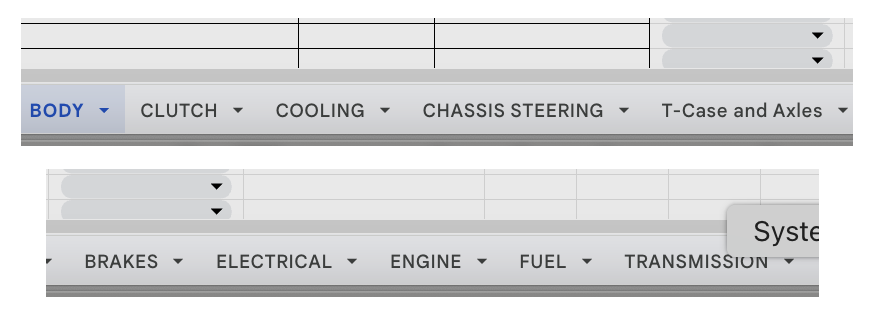
I’m lucky my good friend Brandon — who, like me, had moved to Michigan to work for Jeep, as he was also a Jeep diehard as a kid — is a World War II Jeep expert, having painstakingly restored his own by himself in his garage over six years ago. He’s intimately familiar with all the parts that make up a Willys MB, and he’s even written some fiction about the Toledo Willys plant — now that’s obsession!
Brandon was able to put together the list of every major part on a WWII Jeep in an almost unreasonably short amount of time. Here’s my “body” tab:

As you can see, I still need mirrors, reflectors, and some smaller ancillary items that aren’t really necessary before my big Easter date with Moab, Utah. Here’s the “clutch” tab:

I have most of the parts I need, though I do have some improved bits coming, as I ordered the cheapest possible reproduction pedal components; after noticing dimensional issues, I’ve since splurged a bit for nicer ones from a more reputable eBay seller. Those parts should be in soon.
The level of detail in Brandon’s mind when it comes to WWII Jeeps is truly absurd. How does he remember the pedal draft pads? Those are just tiny pieces of felt meant to keep air from blowing through the holes for the pedals! Anyway, here’s the “cooling system” tab:

Looking good. The radiator is something I received with that old Ford GPW that I bought for $85; the seller assured me he had bought the radiator from eBay, so it would feel a bit wasteful for me to just buy another one. I don’t have any idea which seller he bought the radiator from, but it looks great, and I’m planning on running it. Everything else, besides some pieces of rubber for mounting the radiator, I bought recently from various eBay sellers.
Here’s the “chassis steering” tab:

We’re going without the Torque Reaction Spring, which is fine, because it was a modification that came after my April, 1942 Jeep was built (I had to choose an imaginary build date, as the Willys MB changed a lot during the course of WWII and I wanted to make sure I had things correct so that my vehicle looks as much like a factory MB as possible). The Torque Reaction Spring modification was there to counteract the Jeep’s inherent tendency to turn under braking — a design flaw that I’ve written about extensively.
Here’s my “T-case and axles” tab:

I got much of this from Ron Fitzpatrick in Oregon and from that eBay seller in Washington, both of whom I visited in-person with my Jeep Comanche a few months back.
Here’s my “Brakes” tab:

My “engine” tab is a long one, but I’m seeing lots of green:

And my “fuel” tab is looking good, too.

There are no issues with my “transmission” tab:

My least complete tab is my “electrical” one; I still have many parts to order, but until the body is mounted to the frame properly, none of this is going on the vehicle anyway:

By and large, I’ve purchased most everything from eBay. I did ask a few sellers to list some things on eBay (for example, since the goal was to build a new Jeep around the new body I had bought, instead of easily just finding a used frame and engine already on eBay, I asked sellers to list my new frame and new engine on the platform; they were happy to do it). But otherwise, most everything was already there.


All the brake and clutch parts, the transmission case, the transfer case housing, the axles, the paint, the tires, technically the frame and engine and on and on — whether it’s a brand new steering shaft from a seller in India, a new-old stock shifter from a guy in New York, or just a used brake pedal arm, the number of WWII Jeep parts one can buy from eBay is staggering.
View this post on Instagram
And that’s why organizing it all was so important; I received boxes — lots of them. And I needed a place to put them.

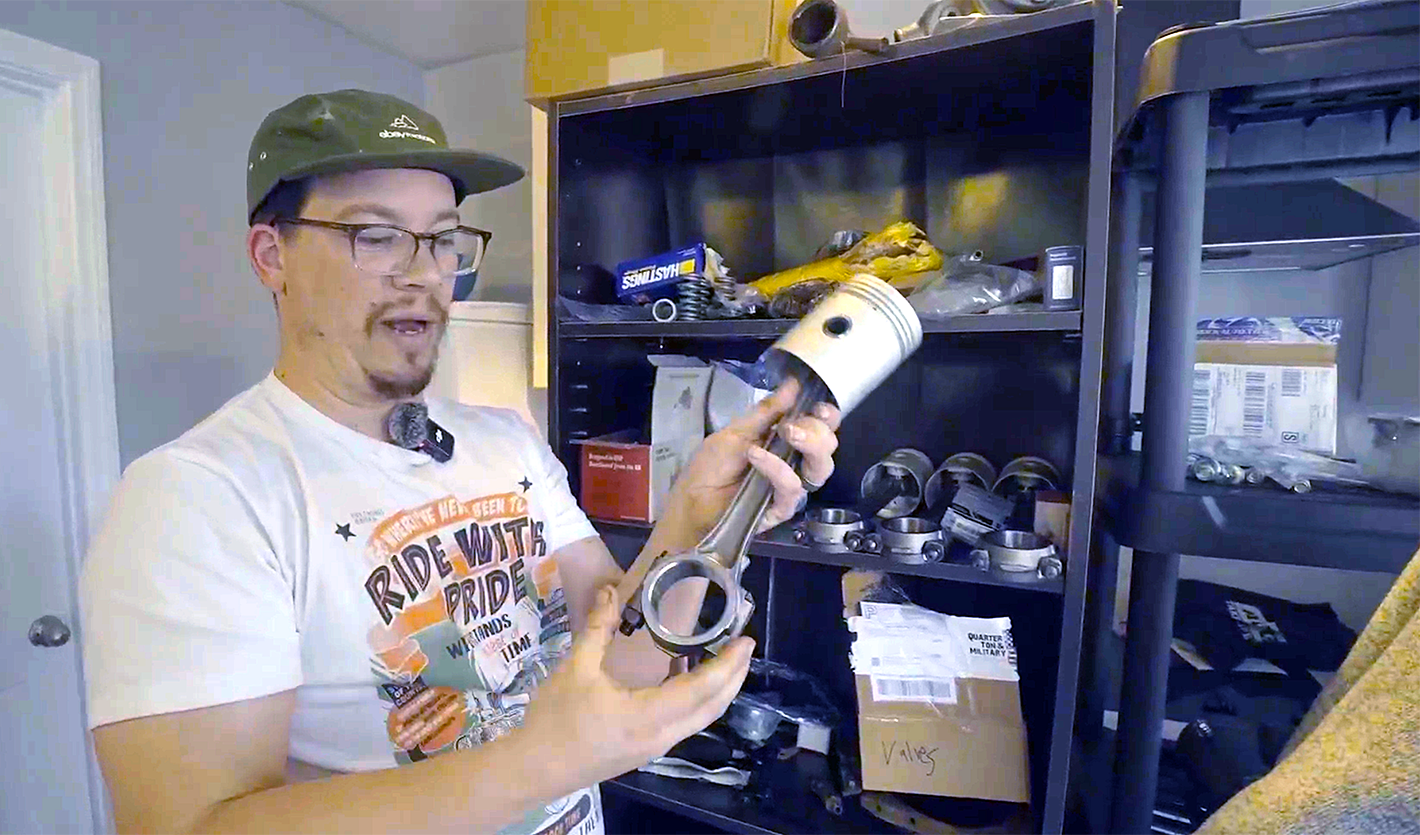
Early in the project, I purchased two shelves — a big one to put in my shed, and a smaller one to put into my workshop (shown here). Then I moved an old bookshelf that my wife and I were planning to throw out into the workshop, and I organized components into groups. The workshop shelves got all the engine bits — pistons, rods, bearings, valves, intake and exhaust manifolds, the oil pan, the timing chain — everything was on these two shelves:

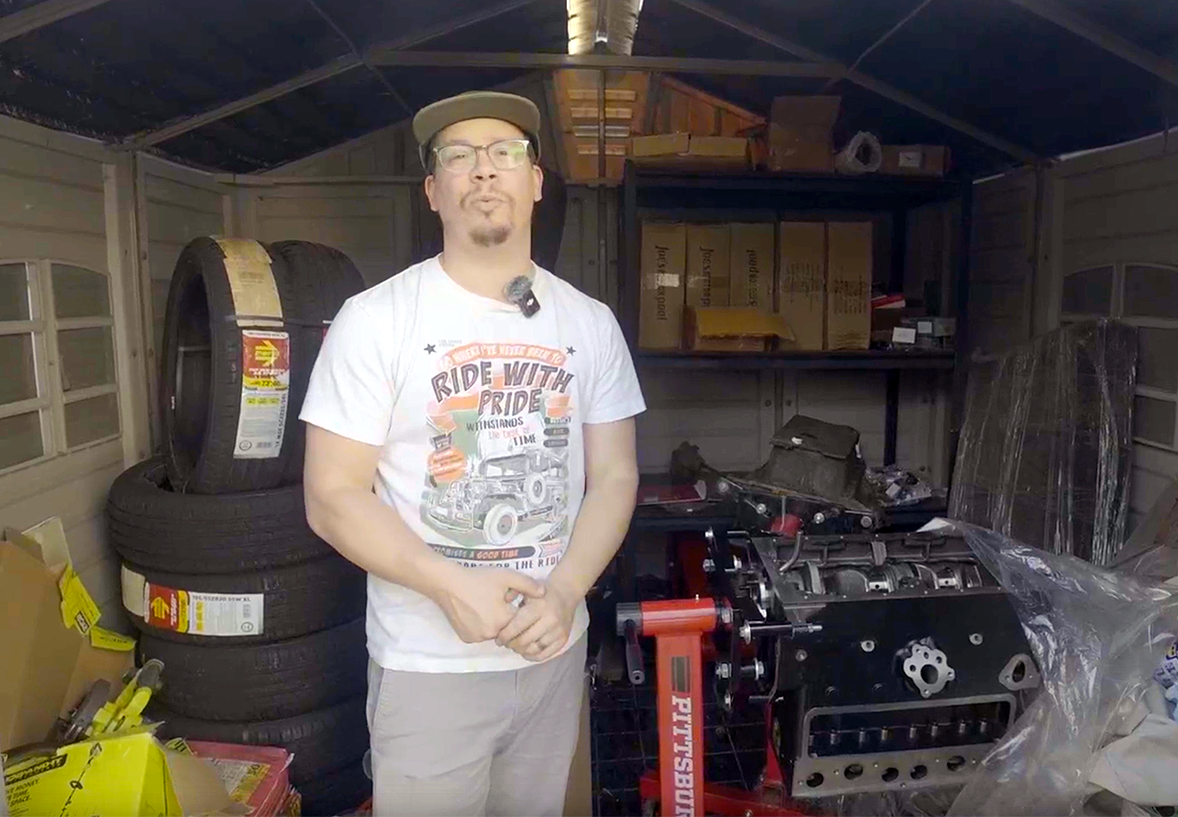
All the brake, chassis, and steering stuff (including the wheels) were in my shed, as were my engines. Having that shed in my driveway has been clutch, as my workshop doesn’t have a garage door, so the shed allowed me to just roll out the the new engine I was building as well as an old one I bought for reference, and work on everything outside, near the frame.
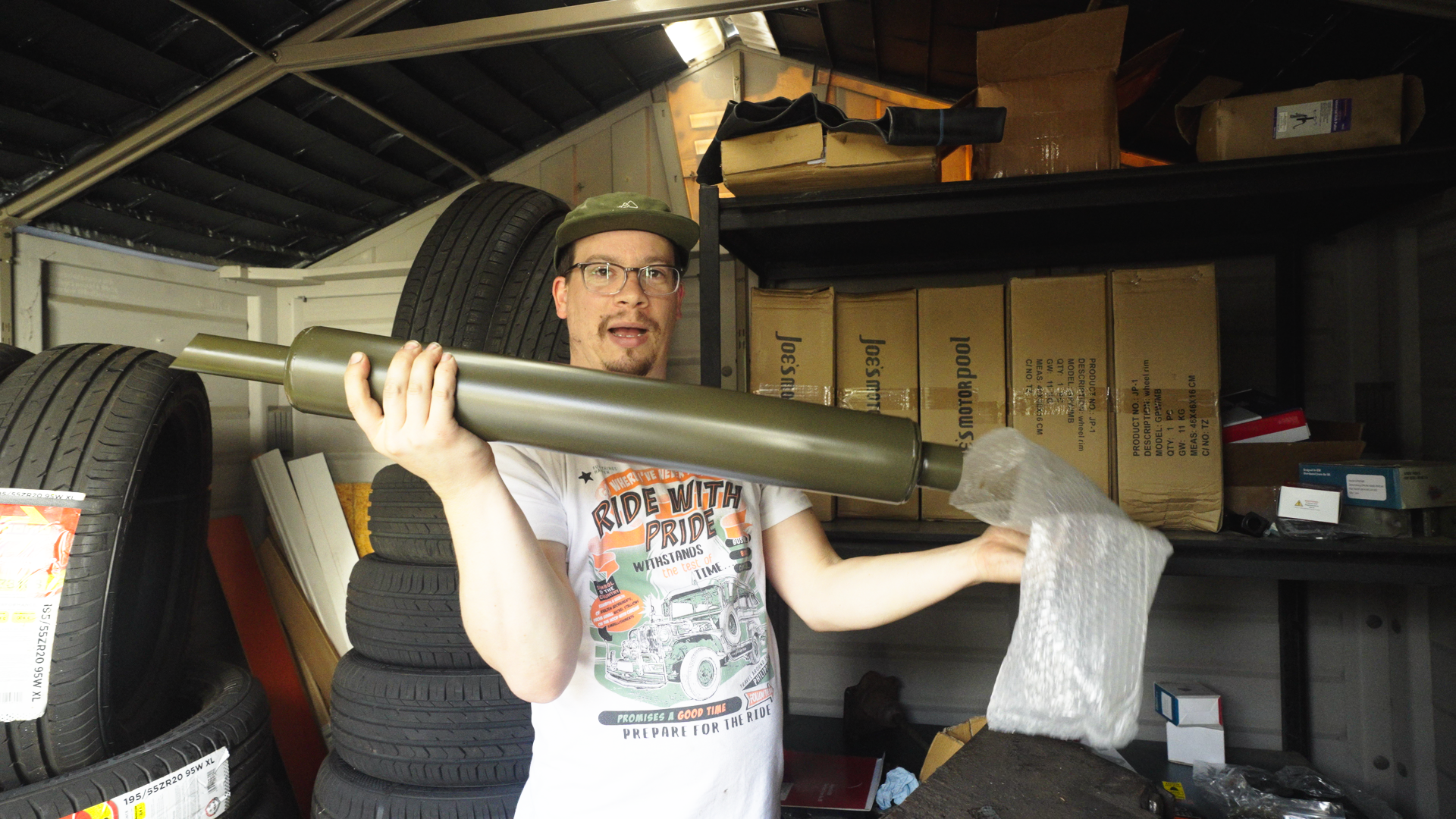
I basically have a giant outdoor workshop set up, with a folding table and a tool cart. I walk between this outdoor area, my shed, and my workshop. Recently, I had to erect a huge tent. I’ll give you all the lowdown of the ridiculous wrenching setup in a future article, but for now, the point is: Between that spreadsheet, the two shelves in my workshop, the shelf in my shed, and the shed itself, organizing those hundreds of Jeep parts has been easy. And when I’m confused about what’s what, I can just log in to eBay and deduce what the part is based on either the sender’s address or the other parts in the box/packaging.

To me, the parts organization seemed like a huge risk to this project, given just how many bits I had to keep track of. We’re talkin’ tiny washers, tiny bushings, little horn buttons, and fasteners — it’s a lot of little fiddly bits. But by grouping everything together on the shelves, all it has taken is a quick look at the spreadsheet and maybe at my eBay purchase history to figure out what’s what.
So the parts have been organized. The actual wrenching area? Not always. Honestly, sometimes it looks like a tornado blew through my driveway. I’ve been told I’m a bit of a chaotic wrencher, and I generally agree with that, though it’s all well organized in my head, and every now and then, I do have to clean up the workplace because even I have limits.
More exciting updates on the eBay WWII Jeep build soon.
Top graphic images: David Tracy


I was expecting something more elaborate than a single inventory location of ‘Here’.
Incredible!
Impressive!
Inspiring!
Enough alliteration, lol.
Looks like you might be able to use that organization system to get a pretty close if perhaps even pretty precise approximation of the percentage of parts ordered from eBay? (After all, it seems like you’ve had to go off eBay only a few times so kudos on achieving the objective of the project.)
So… deliberately leaving off a safety improvement just to backdate to a specific month and year of manufacture. Old David is not dead (yet) folks.
You have family and we all love you. Rethink this.
You don’t realize how complex even a car as simple as a Willy’s MB is until you see the prints and BOM.
On my 67 Camaro, someone had secured and republished the assembly line work instructions (Illustrations with parts listed by sequence) . That was a huge help with the restoration. I wonder if such exists for Jeep?
Building a WWII Jeep from scratch is not for sissy’s.