

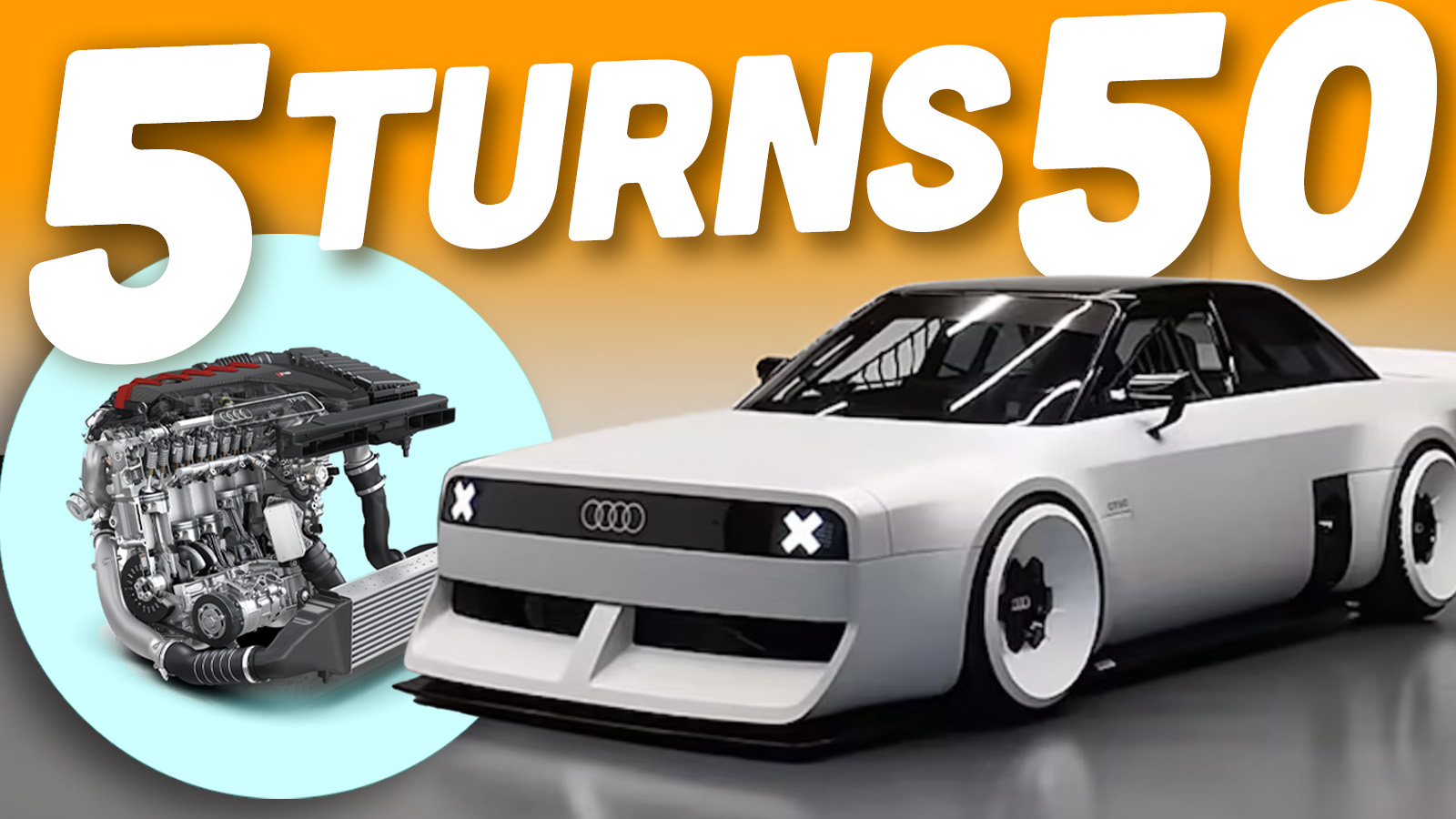
When I think about Audi in racing, only one thing comes to mind: Group B rally, where the company’s Quattro all-wheel drive system and turbo five-cylinder engine revolutionized the sport with its incredible traction advantages, leading to 24 victories and four WRC titles.
It wasn’t just on dirt where that powertrain humbled competitors. Once Group B was banned, Audi turned its sights to racing in America—specifically, the Trans Am series with 200 Quattro, and the IMSA GTO category with the Audi 90.


Both cars famously used turbocharged five-cylinders, going up against bigger, louder V8 competitors. But thanks to Quattro, the 200 was able to absolutely sweep the field in 1988, nailing eight victories in the Trans Am series and securing the manufacturer’s title. The even more extreme, 720-horsepower, tube-frame Audi 90 was nearly as successful, winning seven races in the 1989 IMSA season, but failing to even run at Sebring at Daytona that year meant it couldn’t snag an overall title.
Audi’s five-cylinder engine, which is forever-intertwined with the brand and its legacy, is now 50 years old. The company is paying tribute with a new concept that harkens back to those two cars, complete with the boxy design and deep-dish wheel covers.
The Inline-Five’s Strange History

The first five-cylinder Audi appeared in 1976 in upper-trim versions of the 100 sedan, the first mass-production car to use an inline-five. Originally, Audi was considering inline five- and six-cylinder engines, but ultimately went the weird route. From Audi:
The four-cylinder engines of the time were not sufficient for the developers’ plans. Audi engineers therefore discussed using inline five-cylinder and six-cylinder engines in the early 1970s. The latter were ruled out due to space constraints and the unfavorable weight distribution. As a result, those responsible opted for the inline five-cylinder engine, which was based on the EA 827 engine concept, still in its infancy at the time. This inline four-cylinder engine was used throughout the Volkswagen Group in the 1970s, including in the Audi 80 and Audi 100. The five-cylinder engine derived from it, with a displacement of 2,144 cc, delivered 100 kW (136 PS).
A diesel version followed shortly after, in 1978, before the first turbocharged five-cylinder appeared in 1979, found in the Audi 200 5T. From there, the engine made its way to the legendary Quattro coupe in 1980, forming the basis for the company’s dominance in Group B. Watch:
The Quattro was an immediate racing success, taking the world championship and laying the ground for what is arguably one of the most desirable Audis ever: The Sport Quattro.
After Audi secured the World Rally Championship title in 1982 with this car, Finnish driver Hannu Mikkola won the drivers’ title in the World Rally Championship a year later. Also in 1983, Audi introduced the Sport quattro, which was 24 centimeters shorter and had a wider track. It was powered by a newly developed four-valve, five-cylinder light-alloy engine with 225 kW (306 PS). This made the Sport quattro the most powerful car ever offered by a German company for use on public roads up to that time. The model formed the basis for a new Group B rally car, in which the four-valve engine delivered 450 PS right from the start (331 kW).

In addition to the IMSA GTO category and Trans Am, Audi used the inline-five to win the Pikes Peak hillclimb in 1987, utilizing a Sport quattro S1 with Walter Röhrl at the wheel. Later, in the mid-1990s, the five-cylinder made another splash with the Porsche-built RS2 Avant, kicking off Audi’s run of incredible performance wagons—a run that continues to this day.

MotorTrend got to drive an RS2 in 2010, and found out just how turbocharged its inline-five felt first-hand:
You know that smooth and linear powerband of newer turbochaged Audis, the kind of thrust that leaves you wondering if there’s a big block under the hood? The RS2 is nothing like that. Nothing really happens until the tach tickles 4000 rpm. In the old days this was known as “turbo lag.” And when this beast wakes up, you’d best be ready for it. “Explosive” best describes its accelerative properties.
[…]
But say you manage to keep the engine on the boil, get that wastegate working overtime. Few cars are as rewarding as the RS2. There’s a fantastic mechanical feel to this Audi, a pure unfiltered savagery. The harder you drive it, the better it becomes. Ultimately that leaves this Audi with a fairly narrow performance window-but a window with an awesome view.

After the RS2, something strange happened: Audi started to abandon the inline-five, replacing it throughout the 1990s with V6s. By 1997, the last inline-fives, found in the C4-generation A6 and the S6, were dead. The inline-five concept would lie dormant in the minds of Audi engineers for 12 whole years before the company revived the layout in 2009. This time, instead of being mounted longitudinally, it was mounted transversely in the nose of the much-loved TT RS and the Euro-only RS3 Sportback.

The new five-cylinder, known as the 2.5 TFSI, is a pretty modern engine, with stuff like direct injection, an aluminum crank case, and a hollow crankshaft. Audi went the extra mile to make sure this wasn’t a dud, implementing a ton of modern tech to squeeze out as much performance and efficiency as possible:
Extensive measures reduce internal friction, wear, and fuel consumption, thereby optimizing power output. These include plasma-coated cylinder liners and special oil channels in the base of the aluminum pistons to improve cooling.
The innovative thermal management system with a switchable coolant pump also reduces friction and increases fuel economy: during the short warm-up phase after a cold start, the switchable water pump does not circulate the coolant in the cylinder head, allowing the 2.5 TFSI engine to reach its operating temperature more quickly. The demand-controlled aluminum oil pump – in conjunction with the Audi valvelift control system – also contributes to increased efficiency.

The oil pump adjusts the oil pressure to the prevailing requirements, while the Audi valvelift system on the exhaust side varies the duration of valve opening in two stages depending on load and speed – for moderate consumption at low and partial load, and for direct responsiveness and excellent mid-range acceleration at full load.
In a world where every car seems to be gravitating towards the same 2.0-liter turbocharged inline-four, the inline-five persists—for now, anyway. Back in September, company CEO Gernot Döllner told the media the engine layout would die with the EU’s Euro 7 emissions regulations. Though since that news, there’s been a lot of buzz about those regulations softening to allow more engines to exist. So we’ll see!
Since the VR6 died, the Volkswagen Group’s lineup of engines—excluding wild stuff from Porsche and Lamborghini—has been mostly a sea of forgettable inline-fours and V6s, with the occasional twin-turbo V8. So personally, I think Audi should do anything and everything to keep the inline-five alive.
Having driven a few RS3s, the inline-five is absolutely the star of the show. The slug of low-down torque that carries through the rev range is not dissimilar from a BMW inline-six, but Audi’s motor is far more interesting because of the sound it makes. There’s a cliché about inline-fives sounding like half a V10, which, after hearing it in person, I’d say is half true. Yes, there are hints of raspy V10 in these inline-fives, but they definitely have their own, distinct tone.
A Very Boxy Tribute
Every year, apprentices from Audi’s plant in Neckarsulm, Germany, come together to build a concept car. Last year, it was the RS6 GTO, which ended up in production as the very cool RS6 GT. Before that, it was a concept called the EP4, which was a reborn EV styled after an NSU Prinz. This one’s called the GT50, and it’s a tribute both to Audi’s American racing dominance in the late ’80s and the 50th anniversary of the five-cylinder.
View this post on Instagram
According to Autocar, the GT50 is based on a modern RS3, using that car’s turbocharged inline-five. But the classic three-box silhouette design itself is very much a callback to those 200 Trans Am and 90 IMSA GTO cars. This concept even has the iconic deep-dish turbofan wheels, which were used in-period to improve aero and manage brake temps.
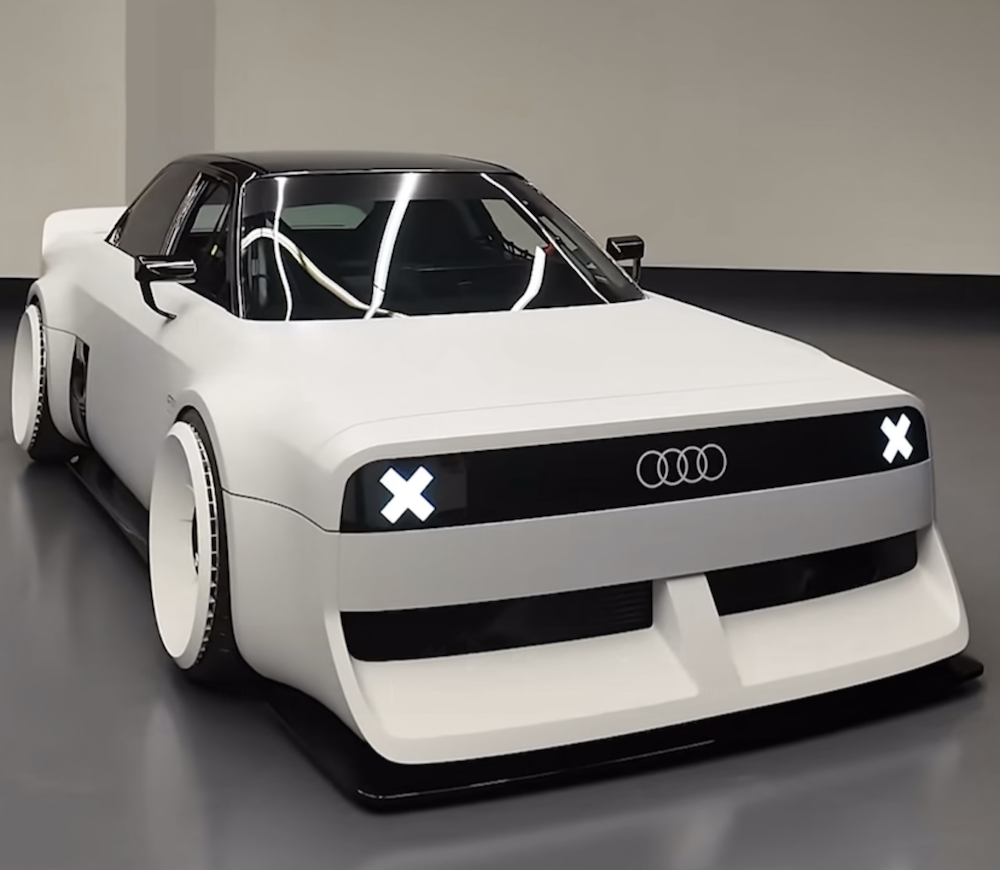
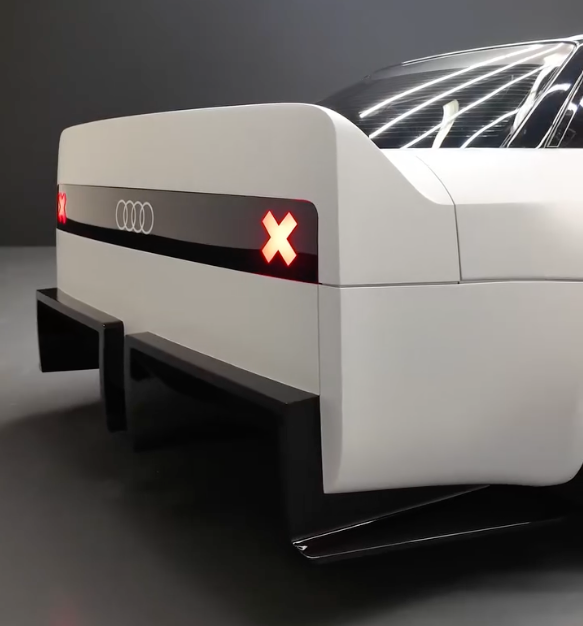
There are places where the GT50 differs greatly from those race cars, namely the front and rear fascias. There are big X-shaped lights on each corner, and a massive splitter that outshines even the original design from the 90 GTO car. The rear, meanwhile, is totally flat-faced save for the blocky splitter pieces. It’s all very simple, which is nice.
While the RS6 GTO managed to get green-lit for production, I’m not sure the GT50 will be that lucky. Such a car would be too close, conceptually, to Audi’s all-electric Concept C that debuted back in September, which is set to go into production.
At least the inline-five won’t go out with a whimper as it did in the late ’90s, at least according to Autocar. The publication claims Audi is planning a new, more hardcore version of the RS3 to send off the model. While I’m excited for such a car, it’ll be a dark day for fans of weird engines everywhere when the inline-five finally dies. So I’m not exactly looking forward to it.
Top graphic image: Audi



I remember when the TT RS was announced in 2009, in a magazine interview, Audi‘s engineer said they decided it needed an inline 5, and were actually a bit surprised that the only one they still had in production went into US market Jettas. That was the starting point, but as the article notes it got quite the overhaul.
It’s odd that 5‘s are usually turbos; it’s a notably difficult layout to set up turbos for (twice as much exhaust gas on every 4th crank rotation).
The first mass produced inline-five was not an Audi, but the OM 617 Diesel engine that Mercedes put into the W115-generation 240D 3.0, which was introduced in 1974.
That engine was initially developed in 1972 by the engineering company of one Ferdinand Piëch by the way, who had left Porsche and hadn’t joined Audi yet, where he would later spread the concept further.
The old fives had a distinctive sound, a sort of off beat and noticeable valve clatter. My father had a 4000 Quattro (80 Quattro elsewhere) and it sounded totally unlike the Honda Accord we also had, but a bit like my Scirocco.
Instead of a Honda Accord, he should have had a first-generation Acura TL, then he would have had two cars with inline fives. It’s always cool to me to hear that Honda made I5’s
This was in the 80s so Accords only came with a 4, and an Acura Vigor would have been more of the time. An all I-5 car collection would be very Autopian.
As the owner of one of those (2013 TTRS) yes to all of that.
Always liked them! Curious: how’s the maintenance and repair stuff?
So far it’s been a peach, but of course I don’t throw a lot of miles on it either and I don’t plan on tracking it either.
Audi 5cyl Enthusiast Rant mode incoming:
It’s a real shame an article like this gets written and COMPLETLY SKIPS OVER THE C4 based URS4/S6 and just jumps right to the RS2. Yes, I get the RS2 is epic… BUT. The C4 S4/S6 is so close to the same thing in a slightly bigger wrapper and arguably better/nicer interior.
SAME engine. SAME head. SAME transmission. SAME differential. Same almost everything! Slightly smaller turbo, and more restrictive exhaust manifold, which you can swap out easily. Here’s me putting RS2 bits on my 95 S6 Avant.
It seems like just every article on 5 cylinder Audis completely skips out on this stuff and I have no idea why. Auto journalists LOVE to write about how incredible the first BMW M car was, or the first M5, but the first Audi S-Car? If it’s about the 5 cylinderi, they usually discuss origins, touch on WRC and IMSA, and they always mention the RS2, BUT THEY NEVER MENTION YOU CAN GET THIS CAR IN AMERICA, AND STILL FAIRLY CHEAP!
Why?!?!?!?!
I think you got the piece about the pikes peak hill climb wrong. The first appearance of the Audi quattro was 1984 when Michelle Mouton made her first go at the race. She then won the next year in 1985 before (I think she is still the only woman to win the race/break the record in the history of the race). Then the Unser family used it to beat her record in 1986; all before the 1987 race you mentioned. The history of the pikes peak hill climb and the Audi quattro is pretty extensive tbh.
We didn’t get the 5000 (100) in the US with the 5 cyl engines till 1978 – I bought one right off the transport truck in dark blue metallic with light blue cloth, 4 speed manual gearbox and manual pretty much everything else too! It did come std with A/C and power steering and disc brakes tho. Compared to today’s cars the fuel mileage was only so-so – at best 20 mpg – but they were light and handled well, especially in snowy Colorado winters where I lived then. They were super quiet and comfortable on long hiway runs too…..
We got the turbo gas 5000 and turbo diesel starting in 1980…..at first both were only available with the automatic gearbox.
Similarly, the EA827 from which this engine was based had a long and varied life in different VAG products, lasting until 2013 in China. The 2.slow in my Golf III was very stout, unlike its transmission or anything made of rubber… http://www.curbsideclassic.com/blog/engines/engine-history-audis-ea827-engine-the-inline-four-that-could/
I vaguely remember reading something a while back about how it was impossible to build an I-5 with a carburetor. Something about engine pulses backfeeding a commoned intake manifold, if I recall. So it makes sense that the engine didn’t exist before MPFI.
That didn’t make sense to me so I looked it up, it’s due to the intake imbalance. Obviously in a 4 cylinder engine, one piston is in each part of he cycle so only one is pulling on the carb, same with a three cylinder actually, in a six cylinder they will pull in pairs, same with other even sets (8, 10, 12). But with 5, 7 and I guess 9, at one point 2 cylinders are pulling fuel, and at other points only 1. That would be impossible to mix, either the pair would be lean or the single one rich.
Crazy, I never would have realized that.
Oh! actually you could do it without MPFI, because even a single injector could adjust time (which equals amount of fuel) based on a pair or a single cylinder. That could be defined by crank position.
I love 5s, but what they don’t love is changing revs up and down. They’d rather stay at one RPM, happily chugging down the highway. Not the best choice for city driving, but when paired with a manual transmission, a 5 is sublime on the super slab.
Also, that’s one of the ugliest cars I’ve ever seen.
I agree on the looks of the Audi in this article, I don’t agree that they were lazy engines……mine revv’d like mad going thru the gears.
It almost looks like an old A3 or something, with the white body just draped over it.
Who puts rear window defroster lines in a concept car?
If you want a boxy car with an inline 5 get a Volvo. Preferably in red with a prancing moose.
That’s what I did!
With the moose?
Nope, Moose is sold separately as a Vinyl applique’ . 😉
Outside the US, you could buy an I-5 Volvo 240 in the 1980s. And it used the same engine as an Audi 5000!
The US 240s got an I-6 Diesel (just like the I-5, but with an additional cylinder). Volvo called it the D24. It was the same engine used in a medium-duty Volkswagen van, called the LT Transporter.
But in other world markets (places where 60-ish HP was enough) Volvo sold the 240 with an engine called the D20. It was the same 2.0 liter I-5 used in the Audi cars.
Make mine a charging moose in Polestar blue.
Why not both?
Polestar blue is actually Swedish Racing Green!
LOL
Those X shaped lights are awesome. Those need to make it into something.
I seem to remember those meaning something from my cartoon education.
Oh yeah! DEAD!
I think they’re meant to be reminiscent of taped-over lights to prevent shattering into a million pieces all over a track, but they definitely look like dead/drunk eyes in old cartoons.
The cowards won’t give cars anime eyes.
Or at least unconscious after being delivered a knock-out blow. My first thought as well when I saw the concept. And no, I do not wish to see anything resembling this thing anywhere.
I want to like a project like this, but… it just looks like a toy. Even for a concept, it comes off looking silly.
It’s the matte white, it messes with the scale, that and the ridiculous wheel fitment.
Yeah, those wheels for sure! I think there’s an aspect too where the simple flat shapes seem like a cool idea but at this scale, you need to break it up more with curved surfaces or details. This would look awesome on my desk but feels cartoonish at human scale.
That’s a great analogy! Or is it a simile?
This would look awesome on my desk but feels cartoonish at human scale.
It’s actually kind of hilarious to see the amount of interchange there is between, say, the modern exotic RS3 I-5 and the vanilla 07K inline-5 previously used in the Jetta and Beetle. Lambo-derived heads gonna do Lambo derived stopf.
With all due credit to GM, who does this a lot, there’s nobody who can parts-bin interchange like the incestuous bros at VW-AUDI-Porsche-Bentley-Lambo. Even that goofy layout of the old VR6 head flow lives on in certain places high in the VAG echelon of motors.
Does it have doors? “Maybe”
I read two different reviews of the RS3 and both mentioned comparing it to a Group B rally car. If you’re trying to convince me to buy an Audi sedan, that’s how you would do it.
Keeping the I5 around would be great. More important, IMO, would be bringing back cars that actually look good. The RS3 is just awful
I believe you’re referring to the EA855 EVO
2.5 TFSI badging is used for both the EA855 and EA855 EVO, with the EA855 (non EVO) still having a cast iron block.
As far as I know, the EA855 (non EVO) is also the same block used in the American-market VW Mk5/Mk6 Golf & Jetta (and Beetle & Passat). Though I’m sure internals aren’t going to be nearly as refined.
The tribute seems unfinished, like someone in the back office looked at a calendar and went “oh no! There’s a big event next week, we need a car for it!” and the design team was given a vague description of what they’re making a tribute to.
It seems like the lower half and the greenhouse belong to two different vehicles altogether, because they probably do, and the X’s, a motif I normally really like, feel cynical, like someone said “my nephew has some photos of old race cars with an X on the lights, can we do that?” without ever checking if any of those race cars were Audis. I can’t find any photos of Audi racing cars, 5-cylinder or otherwise, with tape on their headlights.
The fenders flares are a bit of everything, but a lot of nothing, as they vaguely resemble the shape of the stuck-on flares from the road cars, but at a totally different proportion and execution, where the racing cars had bit boxed flares.
The cut-off front and rear are fairly neat, but only insofar as they resist the urge to break them up with dozens of big slashes. But the fascias, as a sum of their parts, are, um, challenging.
I use to own a UrS4 with the 20V turbo 5. That was a great motor, too bad the rest of the car had solid 90s Audi maintenance issues.
I ended up selling the motor, in a easy to use rusty steal carrying case, commonly known as the rest of the car.
It was towed away, with promises that the motor was going in a 90 series. That was 20 years ago. I hope it worked out!
I do love the Audi 5 cyl. It is worth mentioning that the aftermarket is getting crazy power out of the DAZA engine in the RS3 and TTRS
It’s worth mentioning. it’s also worth a shout-out to how much bolt-on interchange there is between these “exotic” motors and the down-market Jetta-Beetle 07k I-5 VW used in the aughts.
That was a seriously overbuilt block.
There’s way more “volume VW thinking” in that TTRS motor than there is “old-school AUDI nutter-ism from 1982”.
Looks like a car that belongs in Roblox
I would adopt it.
-if Roblox existed back when consoles were 16-bit.
It would be a lot cooler if they actually put it in things rather than only use it for the RS3….
I always thought a slightly smaller version (or detuned) would’ve been a better way to differentiate the S3 from the Golf R, or the upper engine of the A4/A5/Passat. The EA888 all the things just didn’t wow me for how big VAG is, although Dieselgate crushed a lot of these would’ve beens.
Also the 2.5 used in the Rabbit/Jetta/Passat was such a turd initially with only 150hp. The extra 20HP they found with the update should’ve been there at the beginning.
Agreed. Give it 500hp and put it in the RS4!