

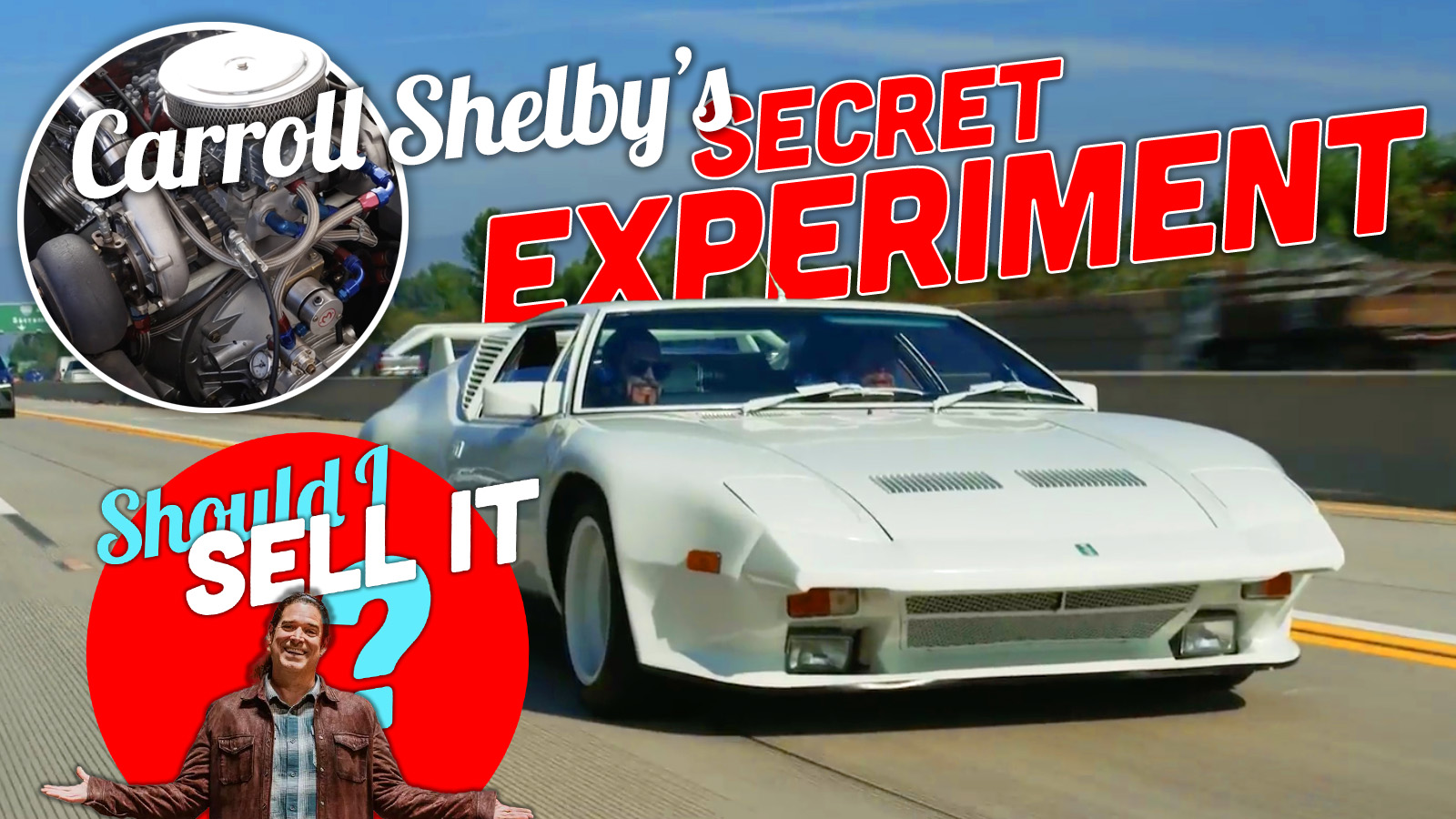
Eight years ago I took a risk by buying a car without an engine. The car was Carroll Shelby’s own De Tomaso Pantera, an out-of-this-world supercar that he built in the 1980s, in secret. Buying this mysterious machine ended up leading to one of my life’s greatest automotive adventures, involving discovering the car’s original twin-turbo V8 engine in a junkyard, and then bringing it back to life with the help of the man who had originally tuned it almost 40 years ago: Gale Banks.
Running Galpin Ford means my family has had the fortune of getting to know some seriously cool car-people, including Carroll Shelby and Lee Iacocca. The two were everything you think they were and more — charming, dynamic car guys who appreciated things that go fast.


One Iacocca story that my dad used to like telling people was about a compliment the Father Of The Ford Mustang paid our dealership:
Bert loved to retell the story of how one particular porter used to line up all the cars so that the bumpers and radio antennas were in perfect rows. On one Galpin visit, legendary Ford Executive Lee Iacocca noticed the perfectly aligned rows of cars with their evenly extended radio antennas. He stopped in his tracks and exclaimed, “I feel like I should salute!”
When Lee decided he wanted an Iacocca Edition Ford Mustang (expect an article on that soon enough), we raised our hand to handle the mechanical work and to be the exclusive distributor for the 45 cars. I have a few of these, so expect to see a whole article on it soon:
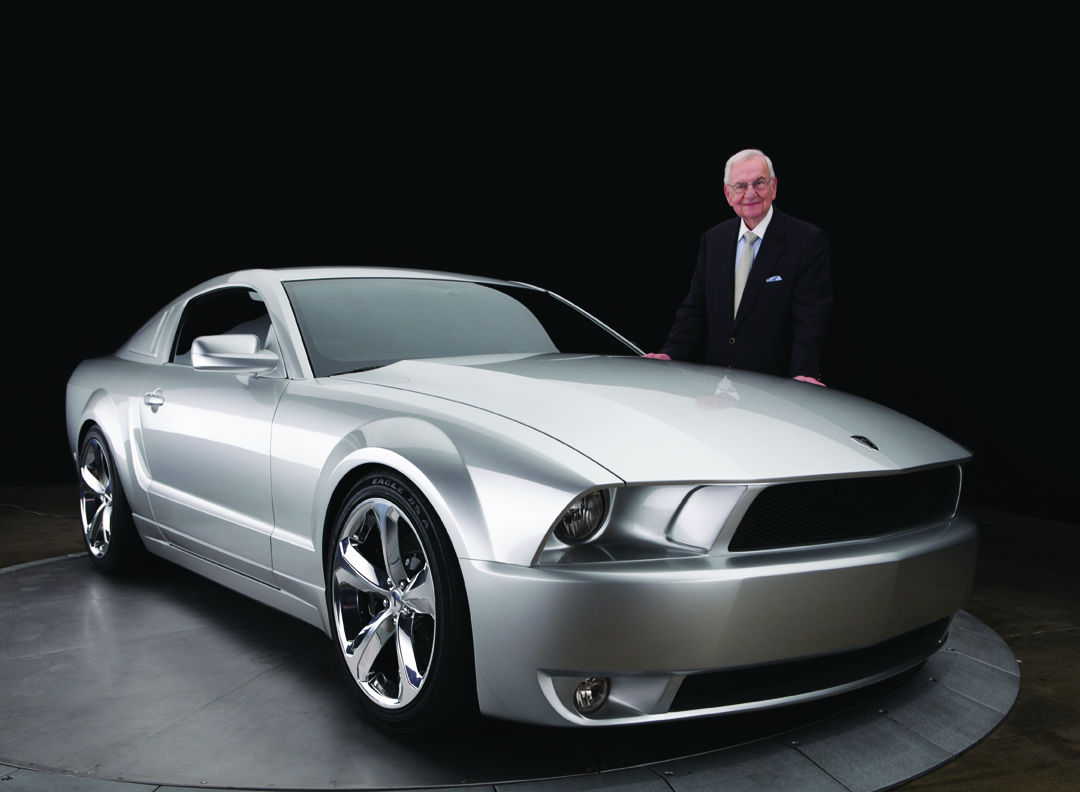
Here’s a photo of my dad next to Lee, whom we had to make feel welcome with our sign (Lee was President at the time; to the right is VP Philip Caldwell):

And this is Lee and me in front of the Scythe custom car we built at Galpin (I’ll be showing you the Scythe in a future article/video; it’s nuts). This was at the Galpin Auto Sports grand opening:

As for Carroll, Galpin’s relationship with him goes way back. He visited us in 1965 and was first directed to our in-house racing champion Ron Hornaday Sr., who asked Carroll to meet with my dad. This led to a nearly 60-year friendship, and ultimately made Galpin a critical cornerstone in the success of the Shelby Cobra Roadster, Mustang GT350/GT500 and others. Here’s a little quote from our upcoming book:
A Shelby American franchise agreement was quickly reached, and it wasn’t long before a Shelby car carrier brought the first of 10 1965 GT350s, including serial numbers 5S492 (the Barn Find on page 60) and 5S537. The batch was delivered on Tuesday, March 16, 1965, three months before other Los Angeles-area Ford dealers received theirs (both Mel Burns Ford and Warren-Anderson Ford received their first 1965 in June). When the Shelby car carrier arrived at Galpin, Carroll was there in person during the delivery to meet with Bert and Ron. Just a month later, on April 15, 1965, Galpin’s first 289 Cobra (#CSX2556) was delivered to the dealership.

We actually became the first Shelby dealer in California, with Carroll later saying: “It was Galpin Motors and Tasca Ford that were the two Ford dealers that really got me up and running with selling Shelbys.”

These relationships represented one of the reasons why I was so charmed by this 1987 DeTomaso Pantera. I was also drawn in by the car’s mysterious history; the story I heard is that this vehicle was being used as a bit of a test-bed for the Dodge Viper, with then-Chrysler CEO Lee Iacocca working with Carroll (who was already partnering with Chrysler in the 1980s) to hotrod an existing supercar by Italian company De Tomaso.
Iacocca had already worked with De Tomaso back when he was with Ford. Back around 1970, Ford Motor Company purchased a majority stake in the Italian sports car company, which is why Panteras have Ford V8s and why they were sold stateside at Lincoln-Mercury dealerships. My dad was actually pretty amped about the prospect of selling Panteras. “I really wanted that car…I knew we could sell a ton of them in the Southern California marketplace,” he said about the Italian-American supercar. “I could already see them on our showroom floor, and I figured we could steal our share of Ferrari and Corvette sales.”
We didn’t have a Lincoln store back then, so we never did sell Panteras, but now — over a half century later — we’re selling The Pantera. I bought it from Carroll Shelby’s personal collection after he passed, then I miraculously found the original Chrysler V8 in a junkyard:

Discovering that motor was a rush. I knew, once I had the car, that I wanted to at least try to track down Shelby’s turbocharged V8 (I’m not entirely sure what I would have done had I not found it; maybe I’d have kept the car engineless, or maybe I’d have replicated the engine for our show, Car Kings — either way, I would have kept looking for that motor). I got in touch with my cousin Steve McCord and told him “Let’s try to find this engine.” Steve had a great relationship with Shelby Enterprises, which wasn’t located too far from our dealership; he called everyone there, and after a while one employee pointed to a junkyard here in California and said something to the effect of: “If we took it out, it’s probably in this junkyard. They used to buy stuff when they were done.”
So we headed to that yard, and I can’t tell you how excited I was to find the heart of this Italian-American Holy Grail. This was the greatest automotive find of my life — a needle in a haystack, and, at least when I’d first bought the car, I truly hadn’t even known which haystack to look in.
One we had the motor, I had our in-house Hot Rod Hall-of-Famer, Dave Shuten, lead our restoration shop, Galpin Auto Sports, to bring Shelby’s DeTomaso back to its former glory, even bringing the vehicle to the man who had tuned in decades prior: Gale Banks. Here’s a clip showing our trip to Gale Banks to tune the Pantera:
Here’s how Banks’ company described the Pantera when getting the word out about the episode of DRIVEN (later called Car Kings):
Shelby built a De Tomaso Pantera as a secret project with Lee Iacocca. It was powered by a Banks Twin-Turbo liquid-intercooled Chrysler engine. With Gale Banks’ help the car was restored to its original glory and will make its TV debut Monday, March 30 at 9pm on the premiere episode of Discovery’s DRIVEN. Round of applause to Beau Boeckmann and the Galpin Auto Sports – G.A.S. crew.
Anyway, you’re probably wondering how the thing actually drives. Well, David Tracy got behind the wheel (see the video at the top of this article). I’ll let him tell you.
The Shelby De Tomaso Pantera Blew My Mind
I had just come back from driving the 815 horsepower Ford Mustang GTD around Thermal Race Track, and I was a bit concerned. I hadn’t had enough time to recalibrate my butt-dyno to its “vintage car” setting, and this De Tomaso Pantera I was set to drive was a 1970s/1980s era performance car. In other words, I was hopping from a fast, modern race car to what was almost certainly going to be a smog-era slowpoke.
Going into driving Carroll Shelby’s old De Tomaso Pantera with this mentality set my mind up to be completely and totally blown.

I met Beau in the Galpin Auto Sports parking lot, and he walked me around the car, which clearly meant a lot to him given that he had revived it with its original, 600+ horsepower V8 heart. In person, the car is shockingly gorgeous. The successor to the De Tomaso Mangusta, the Pantera was the design-brainchild of Detroit-born Ghia designer Tom Tjaarda, and he absolutely nailed it. This specific car Shelby bought was the GT5-S variant, which came out for 1985 as the integrated widebody (not fiberglass), big-winged version of an already beautiful machine.

Hopping inside, I was greeted by a very 1970s-era Italian interior, with gorgeous white leather everywhere, and a nice gated shifter in the center. That shifter, by the way felt a bit stiff going between gears, and what was also stiff was the steering wheel, as the car has no power steering to help rotate those absurdly wide front tires.

Turning the key quickly fired up the twin-turbo V8 Chrysler engine; I was surprised by how fast the engine sprung to life, and I was loving the exhaust burbles. But as I cranked at that steering wheel with all my might, muscled the shifter into gear, and slowly crept down the traffic-filled streets of Van Nuys, listening to that burbling exhaust, I couldn’t help but get the feeling that I was experiencing a calm before the storm. That that motor squeezed tightly between the Pantera’s aluminum body-sides just wanted to go.
And so after dealing with traffic and complimenting the car’s surprisingly compliant ride, Beau and I reached an open road, I moved my right foot off the brake and onto the gas, lifted off the clutch, and experienced one of the greatest automotive nirvanas I’ve ever felt.
VROOOOOM!!! The engine behind me pushed my back with prodigious force, propelling me to what felt like warpspeed, all the while feeding the most incredible symphony of turbocharged V8 glory into my cochleas.

“David you’re kinda freaking me out I gotta close my eyes. David, you’re scaring me dude!“, Beau yelled!
Wow!
Having just come from an 815 horsepower Ford Mustang GTD, I was not expecting this from a 40 year-old car. My brain had been conditioned to think 1980s performance cars are usually slow and unrefined, and that when someone says an old car has 600 horsepower it usually has maybe 2/3 that.

But then I realized something very obvious: Yes, this car is 40 years old, but in what world was I going to be unimpressed by a car developed by Lee Iacocca, Carroll Shelby, and Gale Banks? These are the greatest automotive titans ever, and I should have known: If they were going to create a car, that car was going to be epic. Credit, too, goes to Galpin Auto Sports and Hot Rod Hall-of-Famer Dave Shuten, because this engine and the chassis both felt remarkably tight and smooth.
The car weirdly reminded me of the Ford Mustang GTD I had just driven, and certainly not something with a one-off old 1980s carbureted motor.

It’s so strange having gone into this expecting a modesty-quick (but relatively slow) vintage car, but then getting an absolute monster that also feels weirdly refined. On the highway, the Shelby Pantera felt like it could cruise comfortably for ages. But when my big toe touched the gas pedal to making a passing maneuver, that amazing symphony and that insane thrust from that engine behind my head — it was so remarkable that I can comfortably say Carroll Shelby’s De Tomaso Pantera is one of the most fun cars I’ve ever driven.
Some say that it was somehow involved in the development of the Dodge Viper, and while I’m unsure how true that is, what I am sure of is that, when you’re on the throttle, this car feels like it has the soul of a Viper. It’s an absolute jackhammer — a loud, violent, but smooth-revving jackhammer that just forces the world ahead of you right down your throat, whether you’re ready for it or not. And yet, perhaps unlike the Viper, this thing can cruise for days.
And so, for today’s installment of Should I Sell It, what do you think? Beau seems to be leaning one direction, but he’s not 100% made up his mind yet.
[Ed Note: This is part of The Autopian’s new series Should I Sell It, in which Galpin’s CEO Beau Boeckmann decides which of his 100 amazing Holy Grail cars to sell at his RM Sotheby’s auction in November. Expect to learn more about these amazing machines weekly here at The Autopian and on YouTube. -DT].


Wonderful job getting that car put back together with the original engine.
If it were mine, I’d want to keep it, but that’s a piece of automotive history that needs to be shared. I like the idea of selling it to Leno. It’s a museum piece, but at least he exercises them.
Biggest issue with Leno is that he’s probably 20 years older than Beau, and what happens when he’s headlining at the Big Lounge in the Sky?
Leno has said, that when he passes, his cars will be auctioned so other people can enjoy them.
I think Beau could take on a Leno-style stewardship to his collection as a way to justify keeping anything he wants. I am not mad at someone with a collection that they use and appreciate; but I am always disheartened by a collection forced to languish hidden from the public’s view.
Fantastic story, and I voted keep – it combines seemingly everything about the Shelby ethos and history into a single, real-world-usable and, importantly, visible package!
(as in, I’m guessing none of the Daytona coupes are being driven on highways, ever, where the rest of us can vicariously enjoy them. Won’t someone think of the autopians?!)
Beau, I think that one’s a keeper!
I’m not into supercar porn, so I have no opinion on the car, but I do vote yes on continuing the Should I sell It series.
Owning and restoring a car like this is a relationship. You will always have the memories, the pictures, and the stories. When you don’t see yourself making any more, it is time to let it go.
I voted keep it, with the caveat that it needs to be driven. I think this is a great car to have on the lot for people to look at and the Lee Iacoca/ Carol Shelby tie-in is awesome, but I don’t really believe in museum pieces.
All this and you only say a Chrysler engine, what are the details, I thought this was a car site!
Complete minutiae BUT why did they pixelate the turbos (?) on top of the engine at 2:07 in the video above. AND why is it completely missing from YouTube video. Not starting a conspiracy or anything, but that sort of thing is so interesting to me.
I’d keep it. This is a one-of-one. It’s probably one of the only Chrysler-powered Panteras in existence, and almost certainly the only twin-turbo Chrysler Pantera. Plus it was built by Carroll Shelby himself for and with Lee Iacocca? You don’t come across a legend like that every day. Plus Beau found the original engine in a junkyard and restored it with the guy who tuned it originally! That’s a really special personal connection.
This is a really cool series – I can’t help thinking what an achievement/thrill it must be for David to have this connection and be involved in such a rarefied corner of the automotive landscape (though something tells me he still sees his Jeep grails as more exciting). True automotive passion on display from multiple angles here at the Autopian.
Anyway, I voted to keep it, but suspect that my reasoning won’t hold up as this series goes on. It seems like such a personal, meaningful story to Beau and involves such a rare and historic car that to the average person it comes across as once-in-a-lifetime. But something tells me Beau’s got a lot of car stories that are just as impactful, and at the end of the day he still wants to sell at least a few…
Beau has already said that all of his cars have a story, and he has other cars associated with Carroll Shelby and Lee Iaococca. My gut says to sell this one. It’s unique, but not quirky-enough.
Beau – keep it. It’s too special and too tied to your family history to let go of.
I find it hard to believe this was a viper development car. The viper is completely different, V10, naturally aspirated, front engine.
How would making a mid engine turbo car help with Viper engineering?
The Viper was originally slated to have a V8 – the original test mule had a 360 v8 that probably shared some design/parts with the one in this.
But either way, I think this was likely a very early “development” car, meaning that Iacocca and Shelby had it and used it as a benchmark for different ideas when considering the Viper. It’s likely that driving this may have led them to decide they wanted a different character out of the Viper.
This matches with my understanding of the Viper’s early development as well; which was that they had a power target they wanted to hit to make sure the rest of the development work for the car’s chassis and suspension work could be mapped out properly and worked backwards from there to make the most feasible implementation of that target for production.
I can easily see twin turbo 360 being something they considered just like they had the hotted up normally aspirated 360 that the white test mule had, before deciding that Lamborghini working on a V10 in parallel with the development of the truck V10 was the easiest option. It’s a complete guess on my part here, but there might have even some cross town rivalry at play because of what GM was doing with the Corvette (official B2K option being phased out by GM in favor of the ZR-1).
My assumption, based on timelines, was that this engine concept might have been what they were going to try out for the Viper when it was first kicking around the company as an idea, before deciding to have Lamborghini work on the V10 engine for it. As noted, the original development mule had a heavily hotted up 360 V8 initially already. Shelby and Chrysler had tons of experience with turbos by 1988 and were still officially together at the time.
I say sell it but this needs to go to a specific buyer. Either someone who will put miles on it or someone who will have it in a museum where its historical significance can be appreciated
The question that I have is what did they do to beef up the ZF transaxle? That was the problem with the original Panteras. They were fine with a smogged out 351, but once you had a proper small or big block in them, they started breaking.
I’ve got complicated feelings for this whole should I sell it thing. First, I think this is an awesome series and will look forward to each article. The tricky thing is, it feels like “sell it” = “make it disappear.”
Does Galpin have their own museum? Or somewhere that they display a number of cars from family collections? Or am I just thinking of the Lane Motor Museum? I guess I’m asking: if you keep it, does it mean it might get displayed to the public somewhere from time to time?
Figure 99% of the time, selling a car at auction means it will go into a private collection and more or less disappear. Which is a bummer when it comes to historically significant cars. All the better that each one of these gets an article like this as a treatment before it faces the music!
It sounds like his thinking is that he wants to do something like that (a TV show that would get the stories out to the public) and is realizing that with as much as he has on his plate that it’s not really happening and these cars are doing a lot of sitting around in a private collection with no visibility for the public as it is.
But it does seem that even if he has intentions that aren’t being fully implemented and the cars are just sitting in private, that’s a better situation than being auctioned into a collection where the owner’s entire intent is to keep them warehoused somewhere out of sight.
Deleted.
Your personal involvement in this car’s history makes it worth more in your hands than in anybody else’s. If I saw this car on the road, I’d be looking for your face behind the windshield, and if I saw it at a show, I’d start looking around for you so I could hear more about the story.
Kind of makes ones wish he had done more like this versus doctoring up lots of Mustangs. What a cool looking car!
Is there any way Beau can put a stipulation in the sale, that the buyer of this (or any of his cars), has to show it in public at least once per year?
I had the same sort of thought – can they somehow give museums or people who are known for exhibiting their collections first dibs with a private auction? Then if it fails to meet reserve, go to open auction or whatever.
I think he should sell it just based on what he said. He’s gotten all the enjoyment out of it he can. I believe he wants to pass it on to another enthusiast. I sure hope whoever buys it takes it out for exercise. Stunning car.
I’m leaning towards keep as a true exotic that somehow seems actually drivable in our modern world.
Because of the family history and the happy memories, I say keep it.
Now I’m wondering if Lee ever tried to get Bert Boeckmann to switch to Mopar. I suppose it would’ve pissed off too many people, not just at Ford but among the existing Chryco dealers in SoCal.
I voted keep with the caveat that you HAVE to drive it!
Seems like an amazing car, especially as David pointed out, most 1980s cars are really not as great as we think but this one really seems to be special.
I am really surprised and confused that we don’t have more concrete details of why those automotive greats even built this thing (viper development seems plausible but is that confirmed?), or any details on the engine/powertrain. Displacement? Turbo size? Is it the same transmission the regular Panteras used? Fuel system? Making that much power in the 80s would most likely involved some interesting solutions.
I read the piece a couple of times thinking I’d missed which Chrysler engine it was (I was distracted by how cool the entire thing looks and sounds).
The picture where he found it will give us some hints– if we assume the thermostat goes in the front nearish the radiator (not a guarantee– the radiator’s nowhere near there in a Pantera, and it’s not like Shelby was restricted to off-the-shelf parts, they could certainly have designed their own intake), then the distributor’s in the back. That means it’s probably not a big block– Chrysler big blocks mounted distributors up front.
Plus, it’s sometimes tough to tell scale, but a big ol’ RB block doesn’t look like it’d fit in a Pantera. So I’m going with small-block.
It’s too early to be even a prototype Magnum, so we’re probably looking at an LA small block. If it had 340 heads on it, it would be long gone from any junkyard, so my guess is we’re looking something that started life as a 318 or a 360. The 318 had smaller crank journals so the thing would be able to spin faster, but the 360’s got thicker journals that can handle more torque from the turbos. Your guess is as good as mine on that front.
Now, what it wound up as after Mr. Shelby got his hands on it? Could be _anything_.
By the 80s, Chrysler V8s were pretty much only in its trucks, right?
Virtually. The M-bodies (Diplomat, Gran Fury, Fifth Ave/New Yorker, and the early ’80s Imperial) still had them too, but mainly the 318. Though some got 360’s.
Good sleuthing. I am not a Mopar expert but do know the basics of the engines you are describing. Its why I would really like for The Autopian to have given us a bit more info here. As you mentioned, Shelby didnt need to use off the shelf parts, and since we seemingly dont know why it was even built, it may not have any production parts in it. It could be a nearly completely aftermarket affair (and I assume it was) outside of the block itself as 1980s OEM cranks, rods, pistons etc probably couldnt take much power, while the drag racing world already had found ways to make mountains of power from these things.
David Tracy, we must know!
Keep it.
To quote Henry “Indiana” Jones, Jr., “It belongs in a museum!” Well, after you put a few more miles on it, anyway.
Two exciting articles so far, this new contributor might make it!
I can imagine the eventual OnlyFanbelts – what does Beau do when not working at the Autopian? “Oh, just running one of the world’s largest Ford dealerships. And I cleaned the grout in my shower and binge-watched K-Pop Demon Hunters.”