

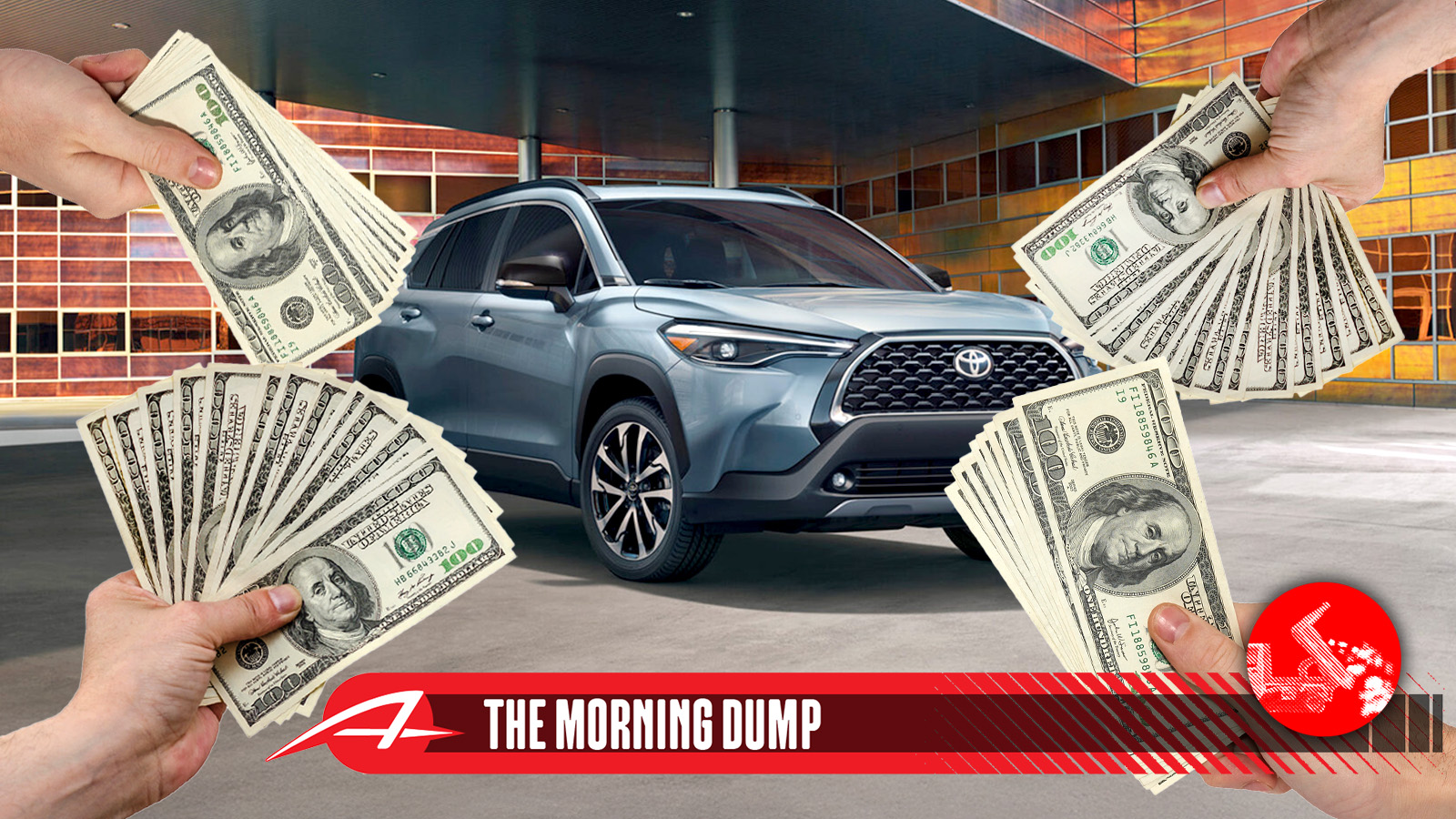
In reviewing all the trends from 2025, the one standout factor is affordability. The one predictable factor in an unpredictable year is that the so-called K-shaped economy is playing out as you’d expect, with the wealthiest Americans mostly unaffected by new car costs and financing. The not-wealthiest Americans? It’s a slightly different story.
Data is grist for The Morning Dump’s hamster-powered mill, and a new bit of data about how fast cheap cars are selling is yet another reminder of the opportunity that exists for brands that can serve this market.


The affordable EVs that are popular in Europe and China haven’t quite made it here, and the projected slowdown in the electric car market is one reason that Ford and its battery partner SK On are splitting up their plants. Hybrids are likely coming, and Europe is considering letting hybrids pass as a gap technology towards eventual electrification.
Let’s end on a weird one, eh? An American company bought Italdesign, and it’s not the American company you’re probably thinking.
Cheap Cars Are Moving Fast, But There Aren’t Enough Of Them

For all the talk of people wanting affordable cars, what’s been lacking in the universe are great cheap cars. Even though there are plenty of automakers that build affordable cars, those aren’t necessarily easy to find on dealer lots, which is one reason why the average transaction price rose above $50,000 this year.
Do you want some proof of this? Courtesy of Automotive News comes this wild stat:
New-vehicle inventory in the U.S. fell 1.6 percent in November to 3.09 million at month’s end, with vehicles priced less than $25,000 spending just 1.5 days on dealership lots.
But supplies rose to 73 days’ worth from 70 the previous month, according to an estimate by Lotlinx.
A year earlier, new-vehicle inventory was 3.17 million, representing a 69-day supply, Lotlinx said.
Sales days can be looked at in two ways. If something has an extremely low number (anything under, say, 40 is low), it can be because it’s extremely popular. It can also mean that there just aren’t enough of them in dealer inventory. In the case of affordable used cars, it’s probably both. There are cheap cars out there if you want them, but keeping them cheap is going to be a challenge, as 92% of cars under $30,000 are built in foreign countries. With tariffs up, that’s putting pressure on prices.
Looking at what’s available from Cars.com, many of the cheapest cars are sedans and hatchbacks from Nissan and Mitsubishi, with many of them 2024 or 2023 models that have been stuck on lots. This is not just an MSRP problem; it’s a financing problem. If you find a $24,000 car you like and have even average credit, you could be looking at paying more than $400 a month for 72 months with a $1,000 down payment. That’s rough.
I still think this is an incredible opportunity for automakers with plants in the United States to make the math work and pick up volume with something good and affordable. Is there a way to get the Toyota Corolla Cross down to a better price? According to Cars.com, there are exactly three Corolla Crosses and two Corolla hatchbacks for sale in the United States. More!
SK On And Ford Break Up Their Partnership

Ford has been somewhat aggressively rethinking its partnerships this year as it tries to pivot into whatever the future will bring. The latest move impacts Korean battery partner SK On, which planned to operate three battery plants jointly with Ford under the BlueOval SK umbrella.
Instead, SK On will take over full ownership of the Tennessee plant under construction, while Ford takes the two Kentucky plants (one of which is operational). Why is this happening?
The Korea Herald has some insight here:
Industry officials say the split may ultimately work in SK On’s favor. Ford has slowed elements of its electrification road map, delaying several next-generation battery models and adjusting production plans. BlueOval originally projected that both the Kentucky and Tennessee plants would begin operations in 2025, but only the first Kentucky site has come online.
“Ford has steadily scaled back its EV rollout and is showing increased interest in internalizing battery technologies,” an industry source said. “For SK On, the separation provides flexibility to direct capacity toward clearer demand — whether EV or ESS.”
Relying on an American automaker to be your main client for batteries doesn’t seem like a safe bet right now, and if SK On can redirect some production towards energy storage systems (the ESS referenced above), that might be the easiest way to go.
The Tennessee plant is still a part of Ford’s campus in Tennessee, so it’s not a complete breakup.
The EU Is Considering Becoming Super Pro-Hybrid, But There’s A Catch

The European Union has slowly realized that its plan to ban all combustion-powered cars by 2035 probably isn’t going to work, especially if it wants to keep Germany as a going concern. It’s why the European Commission is reportedly planning to add plug-in hybrids and EREVs to an extension, sort of.
The commission’s strategy is to allow a five-year extension of the use of the combustion engine until 2040 in plug-in hybrids and range-extended vehicles. That will be based on the condition that they will run on advanced biofuels and so-called e-fuels — made using captured CO2 and renewable electricity — as well as use green steel in their manufacturing, according to people familiar with the matter.
Such a design will enable the EU to still aim for zero emissions in new passenger cars by 2035, depending on the exact parameters of the proposal, the people said. It will also address the concerns of several car and parts producing nations, which called for clean technologies other than pure electric vehicles to be used after that date.
Having spent the last years trying to make hydrogen happen, a lot of companies are switching focus to eFuels.
Wait, Who Bought Italdesign?

Famed Italian design firm Italdesign (great name!) was purchased by Audi during its last spending spree, but now Audi is short on cash. It’s been known for some time that Italdesign was on the list of assets up for sale, and now there’s confirmation that the company has been sold to a United States firm called UST.
Do I know or understand what UST does? I do not. The company’s homepage claims that it does technology consulting services, and there’s a lot of AI talk. Why did it buy Italdesign? From the company’s press release:
The majority takeover of Italdesign by UST creates a strong partnership that combines UST’s expertise in automotive engineering, artificial intelligence, software-defined vehicle development, and digital ecosystem design with Italdesign’s deep knowledge in vehicle and product design, engineering, prototyping, small series production, and automotive electronics. Together, the companies will be able to offer a comprehensive and integrated range of services – from early concept and design to hardware and software development through to production systems. This combined capability is designed to support the development of fully modern, digitally enabled vehicles.
In addition, UST and Italdesign intend to extend this integrated approach to a global scale. UST will enable Italdesign to expand their international presence across UST’s global footprint in over 30 countries. As the new majority owner, UST will assume operational responsibility while honoring and building on Italdesign’s Italian heritage, design culture, and the talent of its employees.
So long as this means we’re getting another Italdesign Columbus, I’m cool with it.
What I’m Listening To While Writing TMD
It would be too sad dad of me to play Yo La Tengo’s “Autumn Sweater” right? Here’s Palehound’s excellent cover from 2022.
The Big Question
Go on your favorite new car sales site and tell me what you’d buy under $25,000. Show me the link to the exact car.
Top graphic images: Toyota; DepositPhotos.com



I have bought several new and certified VW’s in the last decade around the $25k price point including a MK6 GTI and GLI, along with a MK7 GTI. The same cars are nearly $40k now, and I can’t stomach paying that even though I can. My strategy now is to buy depreciated Audis with good service histories and keep a robust maintenance budget for things that come up. That way I can drive a twin-turbo V8 for way less money than a used Corolla.
If you have average credit, you shouldn’t be buying a new car. You should be acquiring a vehicle of average age – which right now, is roughly 12 years for cars on US roads.
I won’t quibble with the notion of the US having an affordability crisis, but there’s absolutely no reason people with average income and average credit need to buy brand-new; if I were average income and wanted to do the responsible thing, it’s not too hard to find CPO or near-CPO (3 to 5 year old) Toyota sedans for 15k.
That’s totally sensible advice so the average American will summarily ignore.
My Equinox EV was $25k in July with the tax credit and discounts
At first I was searching any new car under $25,000, but that wasn’t the question. You said, “what you’d buy.” That puts me at the Chevy Trax, which is a vehicle I actually like.
“Go on your favorite new car sales site and tell me what you’d buy under $25,000. Show me the link to the exact car.”
I’m assuming you mean US$25K… so that’s CAD$34,429.00.
Hmm… so let’s see what the options are:
Buick… Encore and Envista
Chevy… Trax or Trailblazer.
Chrysler… nothing
Dodge… nothing
Fiat… nothing
Ford… Nothing
Honda… Civic Sedan, HRV
Hyundai… Venue, Kona, Elantra (including the hybrid)
Jeep… nothing
Kia… K4 (including the turbo GT line), Seltos, Niro (including the hybrid)
Mazda… 3, CX-5, CX-30
Nissan… Kicks, Versa, Sentra
Subaru… Crosstrek, Imprezza
Toyota… Corolla hatchback, Corolla Sedan (Including the Corolla Hybrid!!!), Corolla Cross
VW… Taos, Jetta
Tesla… not up for consideration due to Musk being a Trump cock sucker.
So if I had to pick one of these, I think I’d go with this Corolla hybrid:
https://www.toyota.ca/en/build-price/corolla/?year=2026&model=BCMFEC&package=A&exterior=01K3
If I’m paying new-car prices, then I’d want it to last me a long time. And because I drive a decent amount (at least 25,000km/year), fuel economy matters:
And then install a receiver hitch for a utility trailer for the odd time I need to transport something bulky.
But in reality, I would want to spend more money on a Plug-in hybrid like the Prius or Escape… or a BEV… Possibly a Kia EV6.
If I were buying new, I’d be looking at either Honda or Toyota. Nothing I’d buy new under $25k. The closest is maybe the Corolla hatcback. All of their options at that price point are base models. It’s been a while since I last looked, but I’ve been seeing used TLXs for sale in the ~30k range with not a ton of miles. Considering the cheapest Toyota I found was $22k for a Corolla, and $24k for the hatchback, I’m spending a few more thousand to get a used TLX.
Honda’s situation wasn’t much better, with a Civic coming in at just under $25k for a base model. Again, I’m going to spend a few more thousand at that point and buy that used TLX.
Base models are nicer than you might think, Japanese makes anyway.
It’s almost as if we need a system where the consumer can decide the vehicle they want to buy, not a middleman that decides what the consumer wants…
And where someone could pick what options they wanted and not have to go all or nothing in two or three trim levels…
I highly support this. Maybe then I can buy a loaded manual transmissions cars again.
Didn’t pick a car, but I did couple of searches and came away a bit bummed out. On AutoTrader I did a nationwide search for new cars under $25k. 73,664 results. Then I clicked the box to filter for manual transmissions–1 car (a Toyota Corolla). Same search on CarGuru–79,615 cars, one manual–a VW Jetta. Two cars. Nationwide.
Man that sucks.
Also, get off my lawn!
I’ll go yell at some clouds now.
“Then I clicked the box to filter for manual transmissions–1 car (a Toyota Corolla). Same search on CarGuru–79,615 cars, one manual–a VW Jetta. Two cars. Nationwide.”
And to make you even more bummed out, that manual Corolla is a GR Corolla hatch which you’ll have to pay a big premium for to get. And that Jetta is probably a Jetta GLI… which I think is the only new VW left that has a manual. And you’ll have to pay a premium for that one too.
Not even the GTI or Golf R has a manual anymore.
Last I heard, e-fuels were a pretty blatant con.
I think, like hydrogen, they’re just preying off people’s attraction to familiarity/aversion to change.
“Look, it’s just like fueling cars the way you’re used to, except with none of the problems! Nothing needs to change!”
+1
It totally is a scam that enables the anti-bev crowd in the auto industry to lamely claim that we don’t need to migrate to BEVs for emissions reasons.
And not only are they are pandering to those opposed to change, they are also doing it to fool/scam politicians who don’t know any better.
Make no mistake… there is a big political element behind e-fuels and hydrogen… mainly backed by big oil to delay the migration to BEVs as much as possible.
Hydrogen, specifically, is also a natural gas thing, since it can be made (uncleanly) through natural gas in some way and uses similar infrastructure.
Yes, the DELICIOUS CLEAN NATURAL GAS that will save everyone we’ve heard so much about. If natural gas even seemed like a legitimately good choice, at this point I would still viciously oppose it because of how aggressively and shadily it’s been lobbied for.
I’m going with what I know, so bumping right up against the budget limit for a 2026 Honda Civic LX, in Red because I already have Civics in Black and White:
https://www.cars.com/vehicledetail/742948f6-adbf-4932-a241-f488018e247d/
If I had to buy new, I’m getting a either a Corolla Hybrid or Subaru Impreza. The Impreza is slow but has awd and a great sized hatch while the Corolla is also slow but has crazy high mpg.
Still rocking my 2015 Impreza. Knock on wood, no major issues, but I also don’t trust it as much as when it was 100k mi newer.
My 2014 was starting to show the consequences of its life here in the salt belt but with nearly 170k miles it is what it is. If they ever do an Impreza hybrid, I will be on that list to buy one so fast
Yeah, it’s disappointing they never brought it over to the States.
Probably going to go for an Uncharted or a Leaf if I get another new car. I like the E-GMP EVs, and they’re not bad used, but they’re a pain to park because of the long wheelbase. (My wife has an Ioniq 6.)
I just got a Equinox EV (60% off msrp with only 10k miles on the clock) and it’s great but the Uncharted might be something that pick up here in a few years especially if I start working for Subaru again
Yeah, I’m curious about the new Bolt, but can’t abide the SUV shape of the Equinox/Blazer EVs. Heard good things about the Equinox from folks who have them.
I was hesitant about the size of the vehicle too. It’s definitely more a wagon than SUV though in its function and I couldn’t say no to a sub $20k car that’s less than a year old. The Bolt is the right size for me as well
If I HAD to buy new I would take this Corolla Hybrid for $22,600. In the real world I’m shopping used for a much nicer 2-4 year old car coming off lease just like I’ve done for the last 20 years.
https://www.cars.com/vehicledetail/f7bc55de-9f76-409e-9581-8965c8cc77f6/
I’m a never new (dozens of us! dozens!) guy, so car prices are simply more appalling now than they ever have been. I can’t make sense of a car payment that equals the mortgage on our compound, but that’s me and I fully understand that the cost of a reliable car is worth it to some. You can get so much more if you shop (very) used.
Applying 25k to my fleet:
My best purchases so far are a 1976 Fiat 124 Spyder for $900 (in 1993 or so), and my 2013 Focus ST for $13,000 in 2018.
My worst purchase was an IS300 wagon that I wanted as a project, bought sight unseen, and spent almost half the car’s cost just in shipping. It’s purpose was to be manual swapped, turbo’d, extensively modified into being a track weapon, etc. It showed up essentially perfect and rust free even by Arizona standards despite 180K and while I have a transmission, adapter plate, rear diff, and many other parts for starting the project, the only thing that’s been done is I installed the Ohlins coilovers. I’ve been waiting for the car to break in some way before taking it out of commission for 3-6 months. It’s now been 6 years and the damn car hasn’t broken once.
(Will definitely consider buying a Lexus as my next daily driver)
“”WORST””
Gee, how did you find a 76 spyder in 93 that hadn’t rusted?
Around then a friend was going around buying them up, mostly from junkyards, and selling them to Fiat in a buyback program. The trick was that they had to drive a hundred feet or so to qualify. He must have flipped 80 or so. He had ten or so in she woods that were wrecked and donated parts to the rusty ones to get them to drive into the scrapyard.
It was somehow really clean, maybe it had been garaged. I forget what the mileage was. The engine did need some work after a few years.
Most people do not buy new cars – look at 2024 data only 37% of car buyers are even considering a new car.
That is more than it used to be. Looking at a BLS report on actual car purchases in 1991 only 27% of people that bought a car bought a new car. That dropped to 21% in 1997, and came back up to 26% in 2000. BLS credits leasing with the increase in new car purchases.
There are actually 4,487 Corolla Crosses available in the USA. Just remove that $25K limit. Not surprising considering that the Corolla Cross has a base MSRP of $24,935.
https://www.chevrolet.com/shopping/configurator/suvs/2026/trax/trax/summary?radius=265&zipCode=50301
Chevy Trax
Yep, I priced a very nicely equipped Trax Activ at just over $27k, which is over the 25k limit stated here, but is still quite good considering what you are getting.
Gimme a Corolla Hybrid LE or Elantra Hybrid, all day long.
Silly Autopian! 😀
Don’t you know that “affordability” is a Democratic con-job and nobody really knows what it means anyway?
😉
Isn’t that a “groceries” thing? Old-fashioned word, “groceries”, it sorta means a bag with different things in it… apples? Apples are groceries, and steak? Steak is groceries too… A steak came up to me one day, big steak, tough steak… and the steak said to me “Sir, it would be an honor if you would eat me” and I ate him, I ate him right up…
You got to mention that the steak has tears in it’s eyes…
So, that would make an affordable grocery getter a… what? Maybe a Communist plot?
To your point, there was an article in Motortrend with some very wonky math:
“If you adjust for inflation, we’re spending about 80 percent more for our cars than we did in the mid-1970s“
Oh yeah, Einstein?
Well a Caddy in 1975 could be had for $8k, which works out to be roughly $50k today. And you can still buy a Caddy for that (albeit an entry level one). That’s pretty one to one.
The thing is, a Chevy selling for a little over $3k that same year works out to be $20. Those options have just dried up. And the “flex culture” has everyone spending Caddy money on Chevy salary. Everything else that followed in the industry is just greed.
Without seeing the MT article, I wonder if they included total ownership costs. Insurance and repairs/maintenance, at least, seem to have gotten proportionally more expensive recently.
They do not mention but I feel that when you factor in the malaise era gas prices and awful reliability/longevity of that period, it evens out over a 15 year span.
A 15 year period of ownership? There is no way 95% of the cars from that era were lasting that long without significant maintenance costs.
Exactly. You’re two cars in then, maybe three, when you’re only one car in today.
Haven’t had interest or looked at new cars since they started adding screens. I’ll stick to my plan of nothing newer than 2012.
There are are no new cars I want to buy today at any price. I am exceptionally not interested in anything for sale at less than $25k.
There is no universe where I would buy a $25K new car when I can, and did, buy a minty fresh 10yo low miles BMW 128i convertible for $16K that gave me zero issues in the first four years I owned it (aka the usual warranty period). And not that I am selling, but I will bet it has cost me less in depreciation than a $25K new car would have as well. I’ve put 30K miles on it, it’s easily still worth $10K or more 5.5 years on.
I’ll take this F150 for $6400.
https://www.autotrader.ca/a/ford/f-150/atholville/new%20brunswick/5_68816943_20140509144647474/
Well that can’t be right
Most certainly not. But even their dealer website has it listed for that price!
As much as I’d like a new Trax, Envista, or even one of those Elantra sedans I’ve seen in the low-20’s, my new roof still isn’t paid off so if I absolutely had to go buy a new car today, I think I’d cruise on over to Illinois and pick up this 2025 Versa for just $15,288. I’d even take them up on that advertised 72 month 0% financing.
https://www.oldorchardnissan.com/new/Nissan/2025-Nissan-Versa-af468d93ac18365e5603253dc6187a29.htm?utm_source=cars.com&utm_medium=referral&utm_campaign=cars.com_VDP_referral