

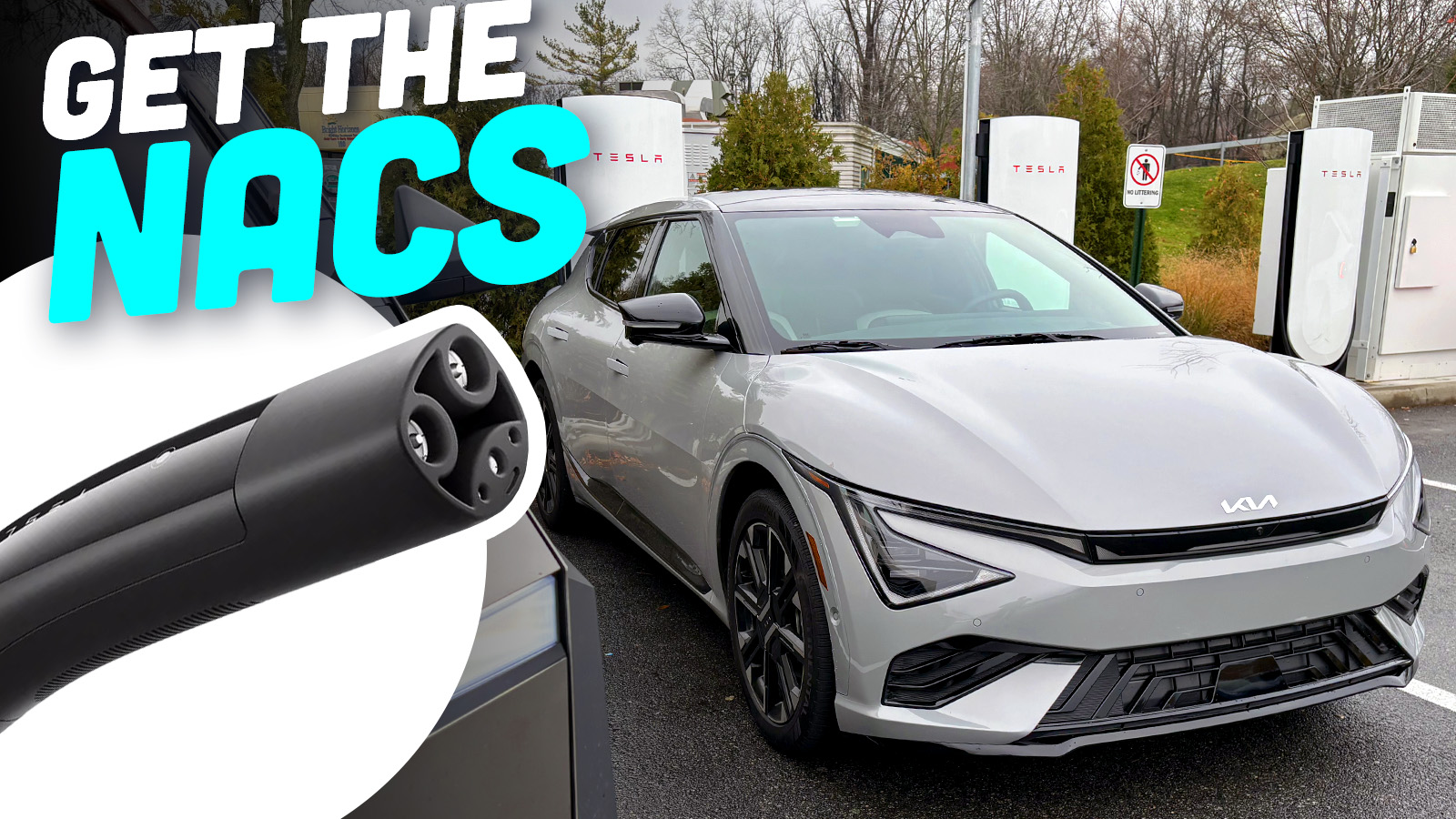
My experience driving non-Tesla EVs has come truly full circle. The last Kia EV6 I had featured the CCS port that all non-Teslas came with as recently as two years ago. Then, Kia announced, access to Tesla’s vaunted Supercharger network was here… with an adapter so the CCS cars could access the NACS-standard charger. I went to pick up the latest Kia EV6 GT-Line last week, and it now features a Tesla-style NACS port. In the center console? An NACS-to-CCS (Level 2) adapter.
This is important. There are two factors to consider when thinking about range. The first, and most obvious, is the battery size and efficiency. That’s the one everyone focuses on and causes anxiety (I am sometimes guilty of this, too), but an equally important factor if you want to travel away from your home is how close you are to a fast charger. It doesn’t really matter if you’ve got 400 miles of range if the nearest charger is 401 miles away.


Depending on the trim, a Kia EV6 can get anywhere from 270 to 319 miles on a charge, making it largely competitive with the other vehicles in its immediate class. Being limited to the CCS chargers, however, was kind of a bummer. There are many stations, and, thankfully, not all of them are Electrify America-level unreliable. However, the Tesla Supercharger network not only performs better in my experience, its chargers are also generally in more convenient areas.
View this post on Instagram
The opening of Tesla’s NACS standard and Superchargers to other automakers, starting with Ford, was a huge win for them and a curious move for Tesla. As automakers build cars that are increasingly competitive (or better than) Tesla’s own cars, the Superchargers were somewhat of a moat around the business. No matter how good a competitive EV was, I couldn’t argue with Tesla owners who said they liked the convenience of the network.
Now that argument is gone.
Using The Tesla Supercharger Was Stupidly Easy
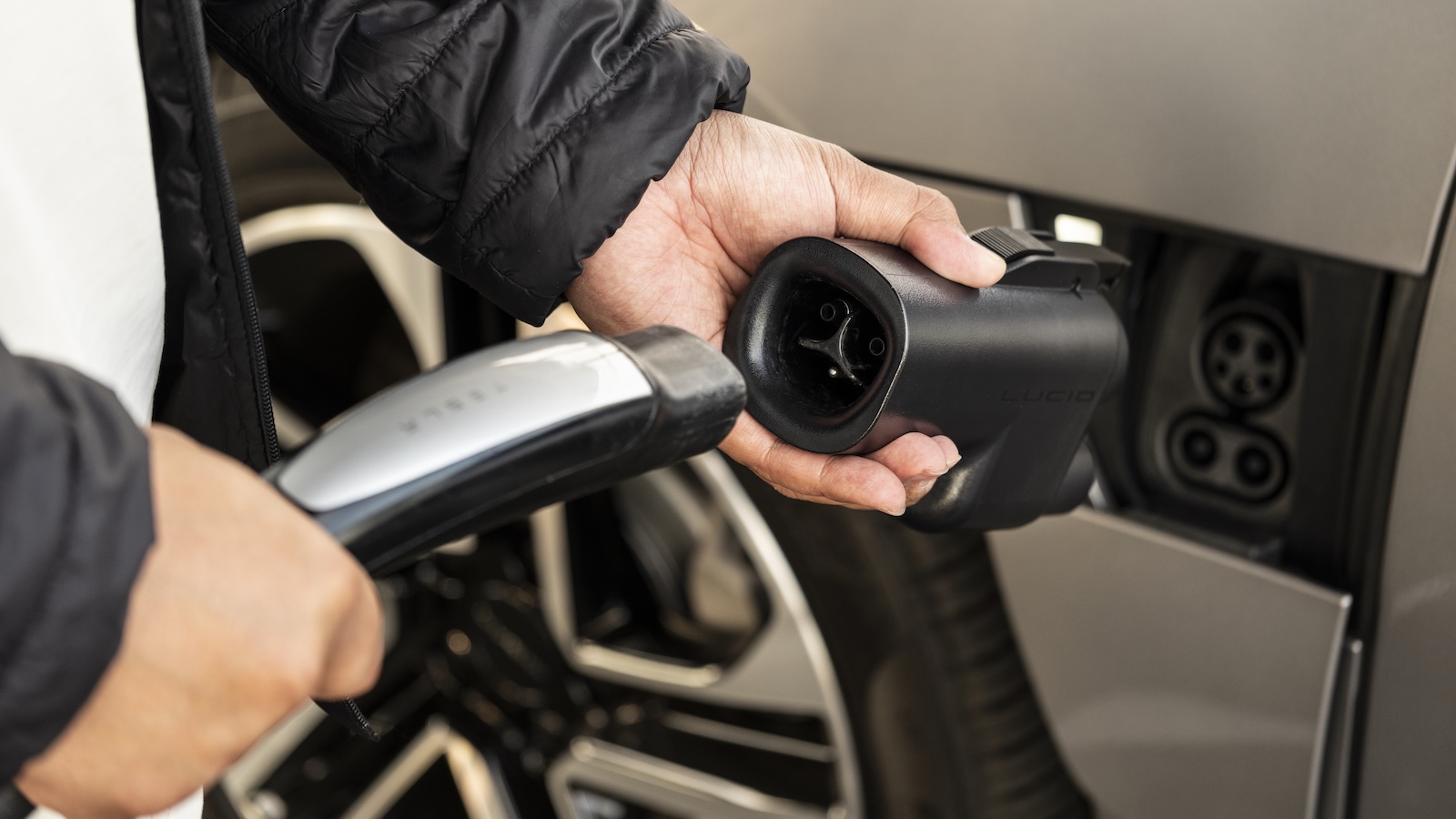
Can a charging port be elegant? The Model S was a bit of a revelation when it was revealed, offering a simpler but no less alluring version of luxury that made the S-Class somehow seem old and stodgy. As that same aesthetic has been applied to other vehicles, I think it’s lost a little bit of its punch. That’s the price of success, I suppose.
Still, the actual charger itself is cleaner and less bulky than the industrial-feeling CCS port and cable (see the above photo of a Tesla charger plugging into a CCS adapter for a Lucid). Some of this is also cabinet design, but your average CCS fast charger looks like it’s trying to imitate a gas station. The Tesla Superchargers feels like you’re plugging in your spaceship.
I mean, look at this:
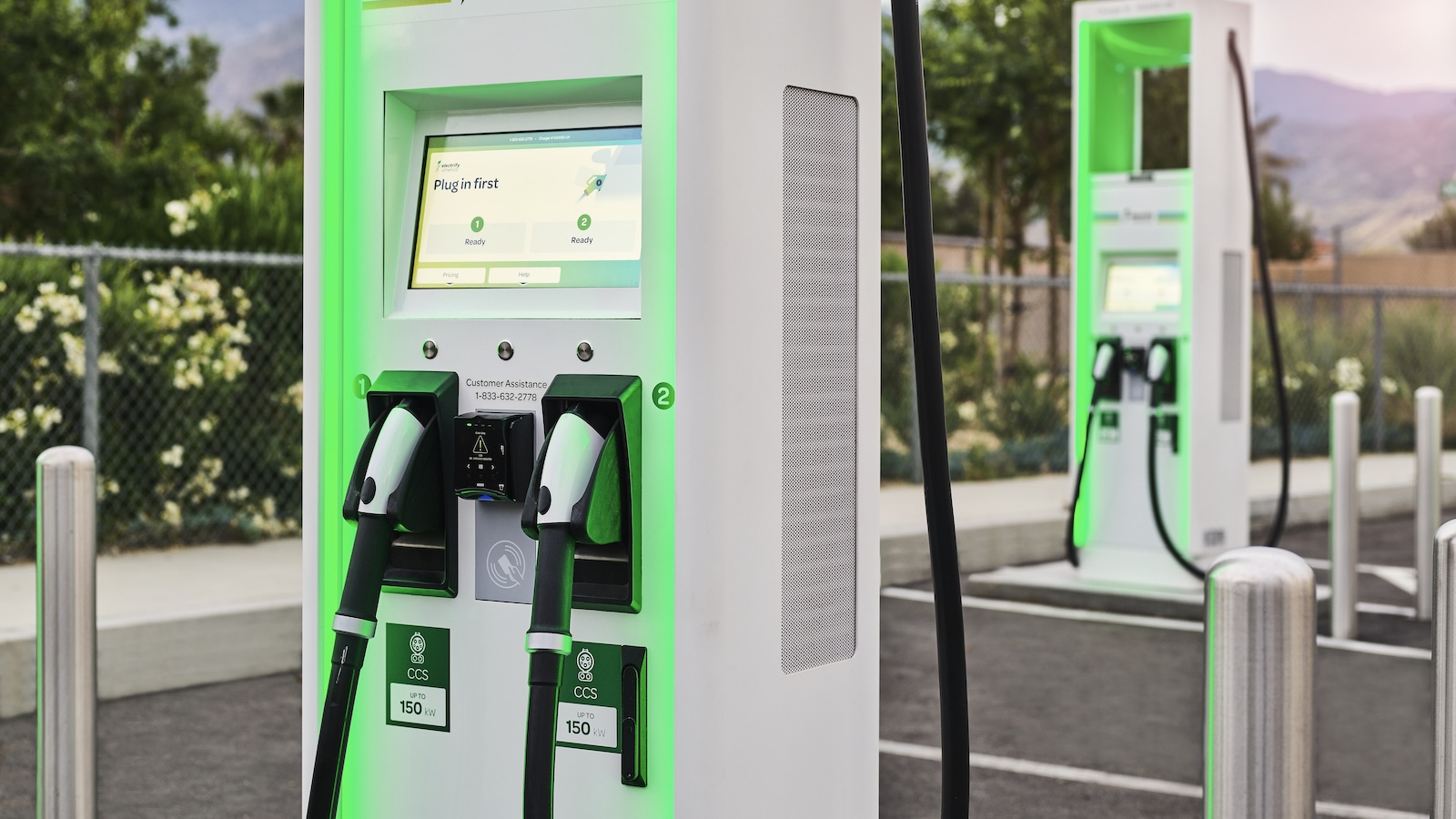
It’s attractive, and I like the lights, but it’s not as clean as this:

The designs have evolved over time, but one key is the lack of screens. Instead, you either charge directly using charge-and-go (charge-and-go is available on many CCS chargers using many different apps, though many are now being consolidated under various automaker-offered apps) or, in my case, I just activated the charger using my Tesla app. No screens necessary.
While this wasn’t as quick as charge-and-go (which Hyundai-Kia calls Plug & Charge and, as noted in the comments below, is live on most vehicles but not our press car), it’s not that onerous either. There’s even a QR code on the side if you need help.

Once I had the app open (and updated my payment method, it’s been a minute), I selected the appropriate cabinet number and plugged in. Admittedly, my experience with EV charging instinctively prepared me for some shenanigans, but none appeared.
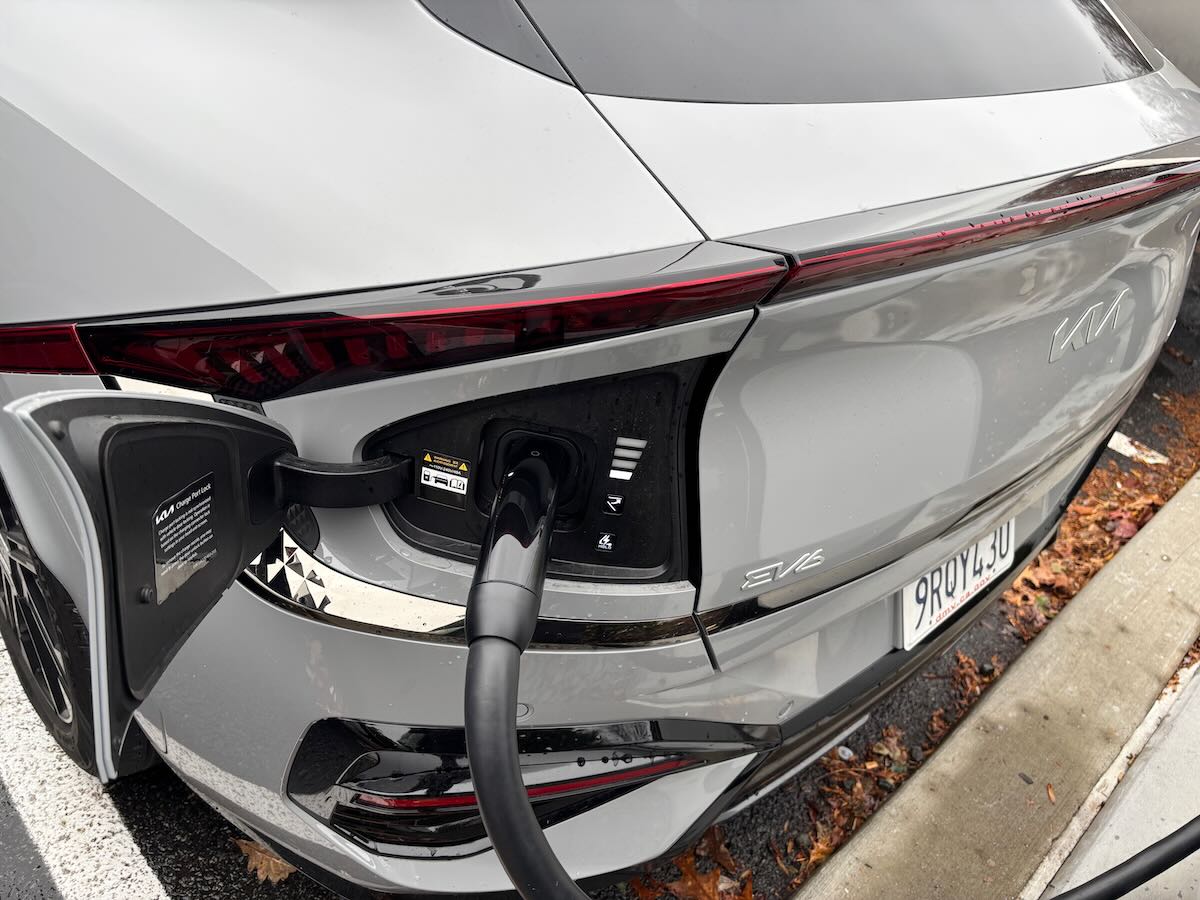
The, uh, insertion process is also much nicer on any NACS charger. There’s no risk of bending pins like Mercedes did with her motorcycle, or arc welding your car to a charger by accident. This isn’t to say that Superchargers have 100% up-time, but when I see a technician at a competitive charger, they’re usually fixing something, whereas here there was a technician in a Cybertruck doing routine maintenance.
My charge state was at about 19% when I pulled in, meaning I had about 50 miles left to go, depending on how heavy I was with my foot. It was also the day before Thanksgiving, which meant I had to make one more trip to the grocery store for the most important ingredient: Beer. Again, this is where Tesla’s Supercharger thrives, as this particular charging station is in the parking lot of a Wegmans grocery store (which has recently added a Shell charging station). By comparison, I once pulled into a charging station I found online only to discover it was the parking lot of a local prison, which I suppose is a win for equitable access, but not a place you just want to hang out.

So, off I went to get beer. Because I was returning the car, and because there are chargers at the press fleet, I didn’t need to fill up the car all the way. Whatever I added would be enough to get me there.
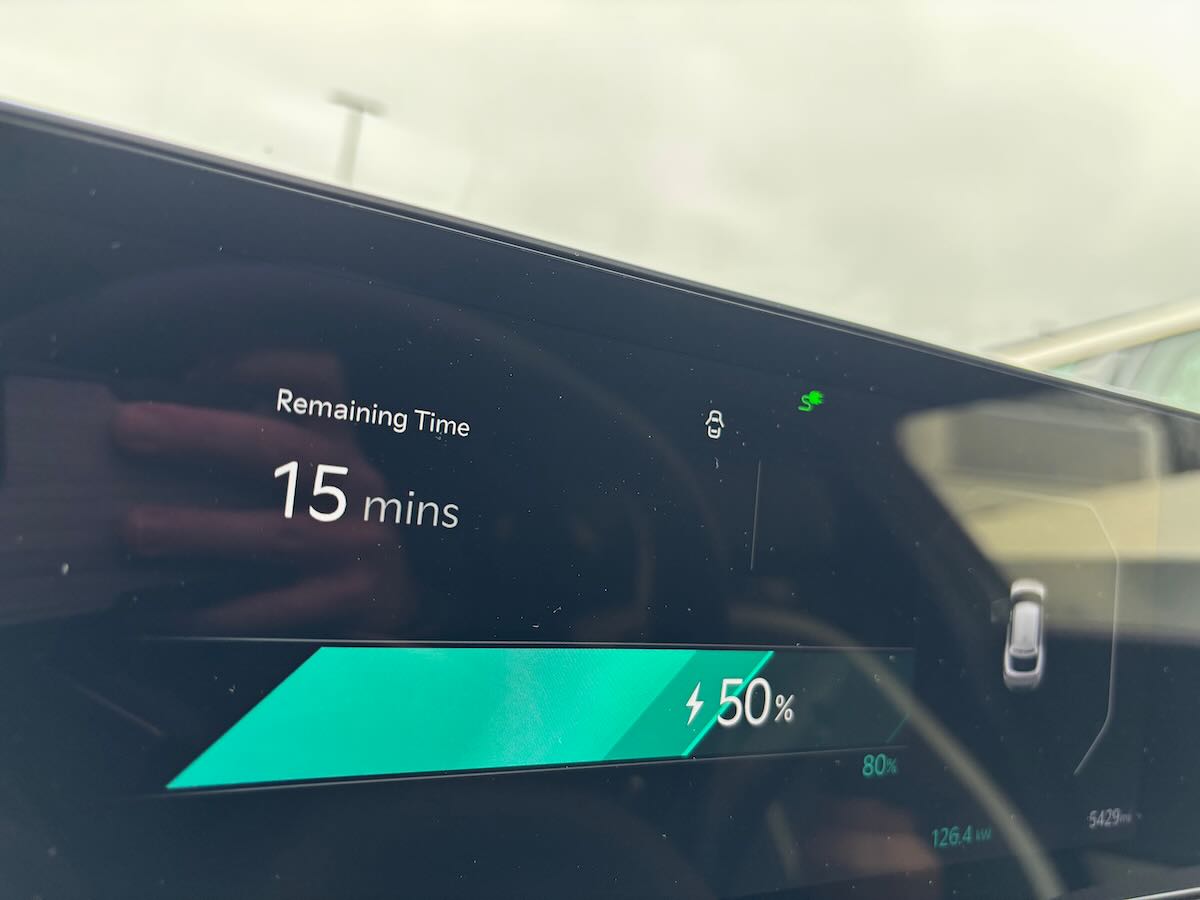
The Kia EV6 added a big chunk of range in the 18 minutes it took me to fight my way through last-minute home chefs trying to get cranberries, baking soda, and the like. In that time, the car added 37.3099 kWh of energy, for a rate of around 124 kWh. According to the car, I could get up to 80% if I waited another 15 minutes, but this was moot, and I’d already spent $18.28 (@ $0.49/kWh) and wasn’t inclined to spend any more (the financial logic of an EV makes a lot less sense if you can’t charge it home).
As noted in the comments below, there are older Tesla Superchargers that will not charge non-Teslas, just as there are newer Tesla Superchargers (V4) that will charge non-Teslas even faster.
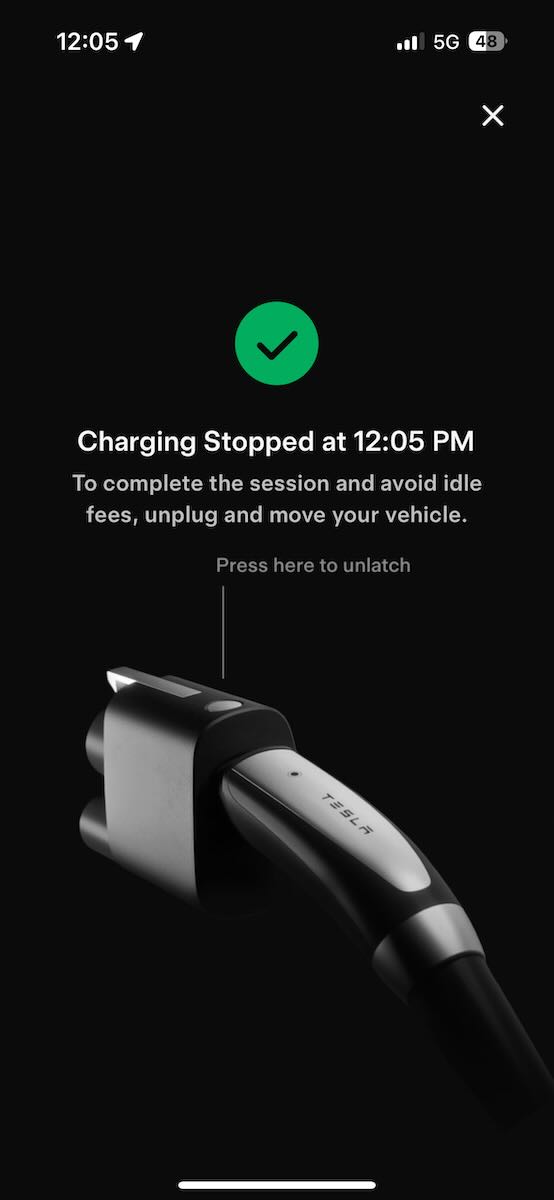
Again, this was all remarkably seamless. For some reason, one of our colleagues at InsideEVs did the same test with an EV9 at the exact same charger (must have needed beer, too) and did have a fumble, so seams do exist.
You No Longer Have To Buy A Tesla, Thanks To Tesla
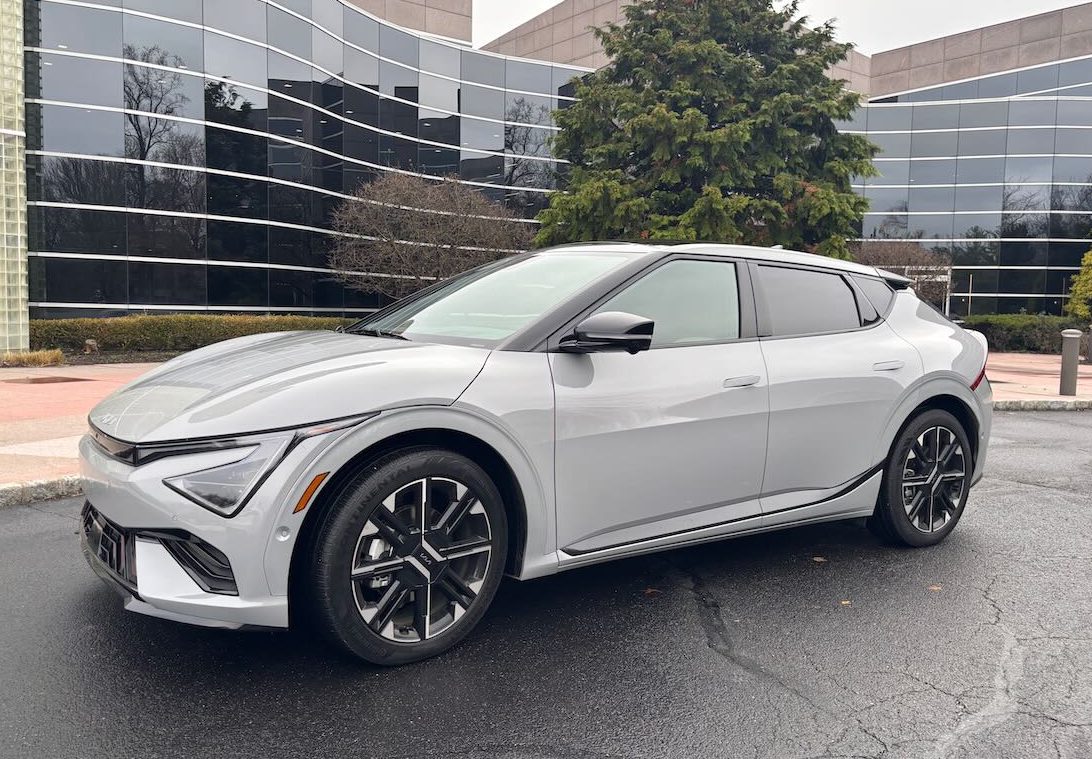
Somewhat counterintuitively, this test exposed how much less necessary it is to buy a Tesla if you’re just looking for something Model Y-sized. More and more electric cars are adopting the NACS standard and gaining access to the network, which suddenly makes them more competitive with… Tesla.
However, Tesla generates profits from its Supercharger network and, lately, it’s reportedly one of the few areas of the business that’s growing. I suspect that when Tesla started making these moves a few years ago, it wasn’t clear that car sales would take such a hit from the CEO’s foray into politics.
When you compare something like the GT-Line with the Model Y Performance, the Tesla’s longer range (307 miles vs. 270 miles) and faster acceleration (3.0 seconds to 60 vs. 5.0 seconds for the Kia) do make for a compelling argument. Additionally, my tested Kia has a higher price of $60,740 compared to $57,490 for the Tesla.
In reality, I don’t love the hyper-minimalism of Tesla’s interiors, and Kia has enough regular incentives that the average buyer has paid a lot less for an EV6. If you’re a believer in FSD, then the Kia isn’t really in the conversation, as HDA 2 is just a good advanced cruise control as opposed to something that, in theory, can drive you wherever you want.
While the outgoing Kia EV6 GT was the superior performer, the EV6 GT-Line is more about aesthetics. It’s also faster than almost any hot hatch from any era, and if performance is your main interest, then the Ioniq 5 N is what you actually want to buy. Between all the vehicles named, I think I’d just get the longest-range, smallest-wheel Hyundai Ioniq 5 I could buy and call it a day.
The key thing is you have choices. NACS is superior to CCS. The Supercharger network is better than any other network I’ve ever tried. Neither of these things is now a barrier to buying a Kia, or any number of other EVs that come with Supercharger access and, soon, will come with an NACS port.
Top graphic image: Matt Hardigree



Oddly, the link to this article on my Google News home page showed:
“Charging A Kia With At A Tesla Supercharger Is A Good Reminder Of How Nice It Is Tesla Won The Charging Wars”
Way to go, Google!
If you look at the URL, it has that as well. So it must’ve been that originally.
I think my math is right, but someone tell me if it’s not.
Vehicle started at 19% charge, stated 50 miles or so of range.
I assume that means this is the 270 mile range model.
18 minutes got it to 50% charge, which means range should also be around 135 miles. Note: I don’t have experience with EVS, is it wrong to assume a direct comparison of charge to estimated range?
So charging cost of $18.28 added estimated 85 miles of range – $.215 per mile.
If this was an ICE vehicle, that’s the equivalent of 25MPG ranged vehicle paying $5.375 per gallon of gas. That’s quite a convienience surcharge.
Couple of things:
Yes, DC fast charging is expensive. If that is the only way you are charging, owning an EV won’t be any cheaper when it comes to fuel versus an ICE vehicle. Most EV owners do the vast majority of charging at home and only use fast chargers on road trips, so the overall fuel cost is significantly lower.
Also, Tesla Superchargers are wicked expensive versus almost any other network, unless you pay $13 per month for the Tesla subscription. As a point of comparison, the Tesla Supercharger I used last week charged $0.62 per kWh, whereas the Ionna station that opened up near where I live charges $0.35 per kWh, so almost half the cost of a Supercharger.
Access to the Supercharger network is more about having more options when on road trips, but most non-Tesla drivers should still try to avoid them and use cheaper/faster chargers when possible.
Thank you, that’s why I called it a convienience surcharge. I think we’re on the same page.
Another factor that drastically swings charging costs: day/night/peak rates. Charging at home overnight is drastically cheaper than daytime rates (when you’re likely driving or using fast chargers).
My local rates in Michigan as an example: Normal $0.164/kwh, June 1 – Sept 30 $0.178/kwh except between 2pm-7pm where it’s $0.230/kwh. Commercial rates are different (higher).
I get that.
It seems like my comment on an article applauding Tesla chargers as the winning standard and the associated costs with using it is being viewed as an overall attack on EVs, and I’m not sure why.
There is a bias here towards EVs, which some being ideologs. Any negative comments about EVs get attacked. Also anything pro Tesla gets attacked these days because of Elon, despite not necessarily having anything to do with him.
BYD Megawatt charging. My body is ready.
https://insideevs.com/news/758625/byd-megawatt-charging-demo-china/
Featuring our favorite Paddy G!
Ioniq 5 owner here. A few things that I think are worth mentioning:
First, Hyundai’s version of Charge & Go, called Plug & Charge, is already working in every Hyundai/Kia EV with a NACS port and was at the time that this Kia was tested (unless this Kia was tested more than 6 months ago and the article just got written/published now). I just charged my Ioniq 5 at a Tesla Supercharger last week, and Plug & Charge worked flawlessly. It is inaccurate to state that this is “coming soon.” I think the article should be updated to reflect that, as long as Hyundai Pay is setup and Plug & Charge is enabled, this is a feature that is present right now.
I personally do not think Tesla’s model is the way to go, as having credit card readers and not requiring app setup is much more customer friendly. However, I can admit that removing the UI completely from Tesla’s chargers means that they tend to survive better in the uniquely hostile environment in which EV chargers are usually placed.
Second, it is worth mentioning that not all Tesla chargers work with non-Tesla vehicles. Version 2 superchargers are still locked to Teslas only. The Tesla app is the best way to determine whether a Supercharger station is compatible. Tesla is updating their network, so more Supercharger stations are becoming compatible every day.
Third, with the exception is a few version 4 Supercharger stations, charging a Hyundai/Kia EV with an 800 volt architecture at a Supercharger will be about 40% slower than using a charger that supports 350+ kW of power delivery. All but the absolutely newest Superchargers are capped at 200 kW. In practice, this is not a huge deal as Superchargers still charge my Ioniq 5 quite quickly, but it’s worth noting that Tesla is behind the curve, since none of their vehicles except the Cybertruck use an 800 volt architecture.
I completely agree that having access to the Supercharger network is a game changer for EV owners. I try to avoid using Superchargers because the cost per kW is higher than basically any other charger, and as aforementioned, they are slower. However, there are times when they are the only or the best option, so it is great to have that option. Now there is literally no reason for anyone to buy a Tesla, as companies like Hyundai, Ford, Polestar, Lucid, etc. have leapfrogged Tesla in every way conceivable.
Great note! I was hoping my press car was set up for it, but it wasn’t at the time and I thought it hadn’t rolled out yet. I’ve updated the post.
Oh wow, that was fast and thank you for taking feedback from the comments into consideration!
As I mentioned, I am not a huge fan of requiring Plug & Charge or an app to use a charger, but Plug & Charge is pretty cool in practice. It’s especially cool to drive up to a Supercharger and have literally the exact same experience as Tesla owners in my Hyundai.
Of course! Which 5 do you have?
2025 Ioniq 5 SEL in Digital Grey.
Owning it has been a mind-blowing experience. My other two cars are an LCI E83 with a 6-speed manual and a pre-LCI E46 with a 5 speed manual (the latter of which is now for sale). I typically buy old, neglected German cars and completely refurbish/restore them in my home garage.
As I get older, I just want to spend less time in my garage and more time with my family and friends. Being able to charge at home is a gamechanger, and the driving experience, with the excellent ADAS suite, amazing acceleration, and exceptionally smooth powertrain has me convinced I’ll never own an ICE vehicle as a DD again.
so I’m in a 400V EV that’s more compatible with Tesla superchargers, and between the off peak pricing options and for road trips, where I’ll hit the 185kwh per month break even threshold of the membership cost.. I’m using superchargers almost exclusively.
interesting that our opinions are so different about the cost of using superchargers
I don’t use DC fast chargers nearly enough to justify the $13 per month Tesla membership. If you do, then that definitely changes the cost/benefit conversation.
Even just off peak my local chargers are 25/27 cents a kwh for non members. so I go hit them in the morning before 8am or after 10pm.
but home charging.. still the best.
FWIW, the Supercharger max speeds are:
v2 150kW @400v
v3 250kW @400v
v3+ 325kW @400v
v4 250kW @400v, 500kW @ 800v
Tesla upgraded my 2018 Model 3 mid-range from 120kW to 150kW to 200kW, all for free and all with over the air updates. I’ve seen it max out at 208kW.
As a Tesla Model S owner since 2016 (before Elon went loony) I’m not thrilled that other brands can use Tesla chargers, although that’s never been a problem for us. Tesla has built so many Supercharging stations since ’16 that I’ve seldom had to wait to use one. And of course they’re free to us old-timers, although I have been dinged a few times for leaving the car connected after the charge was complete.
If I had an old Model S I’d drive it forever.
That’s the plan.
I’d still much prefer a simple RFID card (chargepoint) that is just waved in front of a charger, much easier than using a phone app. Especially since some of the public chargers in my area lack cell service, so the phone won’t necessarily work to start a charge. The phone app can be a backup, in case the card won’t read.
I’m not convinced that NACS ports are superior to CCS ports at this moment in time. Seems that the CCS port can do the full 350kwh charge at some stations in our Lyriq while still letting me charge at a supercharger with the adapter in my car. Meanwhile the NACS equipped cars are now throttle limited buy the NACS port.
Either way it’s good to have options, and opening the SC network to us was the impetus needed to get my wife an EV.
Sounds like NACS connectors can be rated to 1000v, good enough for the 800v+ cars on the market. The limitation right now is that Tesla hasn’t upgraded the stations to support higher voltages so 800v cars like the Kia have to use their internal voltage booster to charge, which limits charging performance. Once Tesla properly upgrades to v4 of the charger back end you’ll see 800v cars reach their full performance.
My boyfriend has an Ioniq 6 with CCS and my Ioniq 5 has NACS.
I can tell you unequivocally, NACS is so much better. It is way easier to plug in the connector, especially at DC fast chargers. That huge CCS connector is very unwieldy and annoying. There is an Ionna station near me with both CCS and NACS connectors, and both support 400 kW of power delivery. It is not accurate that NACS equipped cars are “throttled” to a lower power delivery limit.
While I’d rather not give money to Tesla, it’s hard to argue against having more and better charging options.
That said, I am waiting for some fool to buy a cheap, janky adapter from Amazon which will:
A. Fry the vehicle computer.
B. Fry the charging station.
C. Start an electrical fire.
D. Some other glorious destructive event I didn’t foresee.
E. All of the above.
Already happens regularly. It’s particularly difficult to program the charging controller to shut down when improper adapters are used. Most vehicles have temp sensors in the charge port, and charging station monitor circuit resistance for fault detection. The vast majority of the time the car detects over temp and shuts charging down before things get exciting. Next most common is the station losing data connection and faulting out which also stops charging before fire starts.
Thank you for this. I always wondered what (if any) fail-safes existed for this scenario.
I’m still fascinated that the infrastructure exists (or is cheap enough to create) to pull 6000+ kVA into a random supermarket parking lot.
It’s NOT cheap. That’s why the electricity rate is so high. I remember seeing somewhere that the cost of a 8 port station is tickling the $1M mark for just the hardware and utility connection. Not to mention land leasing, commercial electrical use taxes etc.
True, but at the same time it’s so inexpensive to run compared to a gas station.
The ‘extras’ at the gas station are just there to make more money on top of gas sales. The snacks, cigs, etc. are there to add to the bottom line not offset the cost of running the station. Bucees, Wawa, and Sheetz are all running on this model
Okay, fair. But if it wasn’t somehow profitable enough to get a decent ROI, nobody would do it. What I was really talking about, though, is being surprised there’s enough excess power capacity at the right spots to pull all that juice to the middle of a parking lot.
I also find this surprising. A single 350 kW DC fast charger is pulling more power than four average US homes simultaneously! It’s really insane how much power is being put into EV batteries at these stations.
Yup. When I first fast charged my EV6 I realized it was absorbing ~320 horsepower continuous (235 kw) with the fans barely turning over. Definitely a humbling moment and appreciation for how much energy the batteries are storing.
The problem with using an app to pay is that you need an app for every charger network – which is just stupid. Imagine if you had to download an app to pay for gas. Paying by credit card or tapping a phone is simple and just works for transactions we make every day.
That is why Federal regulations require a screen and tap or swipe to pay for any charger getting federal subsidies. They also require the plug to be an industry standard and the charger to be open to other brands.
The latter is why Tesla handed off control of the Tesla plug to SAE and opened their charge network. Had Musk done so a decade ago we could have avoided the how plug wars altogether but Musk saw the closed supercharger network as an advantage when he could still get free government money to build it out.
I think the best solution would be to have all of the different networks share payment with each other, and have just 1 master account for all of them. The master account could be the network any individual uses the most. Most of the public chargers I use are chargepoint, and just waving their RFID card and plugging in to start charging is really nice. If I could just use the same chargepoint card for occasional stops at other networks, and have them pull funds from my chargepoint account, that would be optimal.
You already have that with current credit card / mobile payments.
Plug in, tap, walk away. No reason to add another layer with an app or account.
Charge and Go is a standard, ISO 15118, and you can plug in and walk away. Payment data is in your vehicle. Companies suck and are not implementing it or implementing it for a single network.
It still requires an account. Which would be fine if it was actually universally accepted but it is not.
Which is why the feds required chargers to have a basic point of sale system that everyone knows how to use to get that sweet, sweet 30% federal subsidy.
Charge and go does not require an account for each charge point operator. It’s made to eliminate that.
Not for each operator but you still have to set up a Charge and Go account and load a way to pay.
That is an extra step beyond just tapping the phone or credit car that I already have in my pocket.
Charge and go account? You mean the account in your car. It’s not a separate thing and you do that once and it’s much easier than tapping a card or phone because you do it once.
I am speaking as someone who dailies an electric car and uses charge and go and taping a card and phone. I have never had charge and go blocked at an equipped charger, but I have had my cards rejected because my bank decides to block the charge to the card for some reason.
I still think they need to accept card or NFC payments but saying it’s easier than Charge and Go is a stretch for me..
The number one failure point for chargers are the payment systems.
Yes, you have to set up an account and form of payment in your car.
I’m also speaking as someone who dailies an electric car. I have a Bolt. It doesn’t have “Charge and Go” but it has a similar system set up through the myChevrolet app that allows you to plug in and walk away with participating charge networks including several in my area.
I don’t see it as any sort of game changing feature. I’ve had very few problems charging at public chargers of the last 9 years of driving an EV.
Personally I prefer paying with a credit card – after seeing what I will be charged on a screen. Just like I do when I pump gas or diesel into my other vehicles.
Where the account is nice vs. credit card is for minor charging sessions that might only be $2-4 (or free, but still need activation), but yes, just a credit card in general is easier than an app for sure. We also just leave the chargepoint card in the car, so it is always there.
“I’d already spent $18.28 (@ $0.49/kWh) and wasn’t inclined to spend any more (the financial logic of an EV makes a lot less sense if you can’t charge it home).”
A LOT less. Going by my PHEV competitor that works out to somewhere between $6.50-$7/gallon. Even in California a gallon of regular is under $4.
That part really jumped out at me as well. I was used to a nice even $0.10/kWh to charge my Volt at home for awhile, although our residential rates bumped up to $0.125/kWh last year. Still cheaper than burning gasoline.
If I had to spend $0.49/kWh I’m afraid I would quickly lose my enthusiasm for electricity as my car’s main energy source.
Very few EV drivers are using DC Fast Chargers regularly. They are great on long road trips. Otherwise, I charge at home and pay $0.11 per kWh. Overall, this leads to huge cost savings for fuel versus operating a petrol-powered car. If someone can’t charge at home and has to pay for fast charging, EVs are a lot less appealing.
Here in PG&E land our cheapest overnight residential rates are $0.30/kWh and go up to $0.62/kWh at peak. So EVs make a lot less sense here unless you have subsidized workplace charging.
WHAT!? Where the heck is PG&E land? Those rates are insane!
Most of California:
https://i.pinimg.com/736x/51/84/e7/5184e766804eea95960bc866fee5ecee–gas-and-electric-companies-electric-company.jpg
https://www.pge.com/en/account/rate-plans/electric-vehicles.html
(I should clarify PG&E is Pacific Gas & Electric, not Portland General Electric of Oregon. That’s a different kettle of fish.)
Why is PG&E so expensive? Well…
https://shunins.com/article/why-are-insurance-companies-suing-pge
I mean you can’t expect those actually responsible to be held accountable can you? At least when you can pass these costs along to your customers while reaping the benefits of the money saved.
SDGE still has some EV-specific plans at $0.10/kWh on super off-peak, but they aren’t listed with their other plans. I didn’t find similar with PGE and was baffled.
Years ago I spoke with a PG&E contractor doing some work by my home. After a few minutes he gestured to a car parked half a block away.
“See that guy sitting in his car reading the paper? He’s the site supervisor. He gets $90k just to drive out here, sit in his car and read the paper.”
I imagine that guy makes $120k now, just to sit in his car and doomscroll on his phone.
So THAT, multiple massive lawsuits, executive bonuses and I’m sure no small amount of Sacramento grift is why I think PG&E rates are so high.
I mean, they have literally zero incentive to reduce “costs” because CPUC just allows them to set rates to make a set % profit. So if their “costs” go down then their profits also go down. But, if they make arguments that their costs are going up then they can jack the rates up.
They do, constantly. It’s how we got where we are and a reason PG&E is one of the most hated utilities in America.
I feel like all the investor-owned utilities in the state are the same in that respect. We get the same down here in SDGE land, but they at least allow cheap overnight EV charging (at the expense of increasing your day rates) down here.
My dream is to own two identical BEVs and charge one at work (if free for me) while powering the entire homestead on the other.
My second dream is to have NG fueled generator with a battery backup for both power and heat.
My third dream is for PG&E to burn to the ground and be replaced by a better company.
I love this… but ugh. We are currently stuck in a friction-filled transition period where the standardization of the plug (NACS/SAE J3400) has outpaced the standardization of the port location. In the short term, infrastructure must bear the burden with longer, retracted cables (like the V4). But in the long term, OEMs must converge on a ‘driver-side rear / passenger-side front’ standard to optimize the efficiency of the charging grid. We cannot efficiently scale a network that requires a 5 meter radius of distinct copper for every stall.
This is a very good point.
I vote for behind a flip down license plate – like cars from the ’70s. No need for that hideous port on the side of the car ruining its sleek lines.
Now if I could get a landau top and some opera windows (and a color matched dash, carpet, steering column, etc) we’d really be talking.
I am intrigued by your ideas and would like to subscribe to your newsletter.
All Teslas already have hidden charge ports. When closed, you can’t tell it’s a charge port.
Problem there, Anything that’s a hatchback won’t work. If you’ve never looked at the physical size of charge port modules, they’re significantly larger than any fuel filler neck.
Regular gas door style on rear fender (pick one side) is my preference.
This was said in jest. That bumper filler was awful – you had to bend way down use it. Likewise opera windows and landau tops were awful too. Now having a whole choice of color matched interiors where the dash, steering wheel, door panels, seats, carpets, etc came in 5 or 6 choices was awesome. That was probably one of the best features of the malaise era.
As for hatchbacks, those old license plate fillers were always in the (lower part) of the bumper. Hatchbacks have bumpers. Move the license plate to the lower part of the bumper and put it there – so this would work. Also a license plate is significantly larger than any fuel filler door I’ve ever seen. I’ve not measured any charge port door, but they look smaller than North American license plates.
Note that the reason bumper fillers worked was because the (24 gallon) fuel tank was under the trunk – not in front of the rear axle line where current cars put it. However this isn’t a problem for EVs since they don’t rely on gravity to fill the “tank”
Apologies, you can’t really know if someone is joking these days since just about any opinion can be found somewhere not as a joke.
Speaking seriously, the size and cost of a charge port module means it would have to be somewhere with a fair amount of volume (front fender, C/D pillar), and you don’t want it in a low speed impact zone where it can be easily broken.
Nissan got it right with the first Leaf, front and center on the nose of the car. Tesla coulda/shoulda copied that but noooo…
Love or hate, the Supercharger network is the best US DCFC network at the moment. For road trips on I-95 and in much of the Northeast US they’re hard to beat if you drive a Tesla. CCS can work, though. Vermont has a lot of CCS chargers that work fine since they’re not EA. EA is the issue, not CCS.
But without screens on them how are they supposed to blare ads and utter slop content at us as we fill up!?
The ads will be served in your car on the giant screen inside of it.
That’s almost guaranteed.
Really it’s more efficient that way
Kia even got the charge port placement right so it works with the shorter Supercharger cables. Several EV manufacturers have not. GM, for example, has the charge port on the driver’s side front fender on the Equinox and the Bolt even though they have NACS connectors. Putting it on the front is fine, as long as it’s the passenger’s side.
And yes, we’re generally at a point where road tripping a non-Tesla EV with Supercharger access is less about “can you” and more about “should you” since DCFC stations are more expensive than gas in most places, especially if you have a fuel-efficient gas vehicle.
I don’t really understand all the whining about charger port placements. My Ioniq 5 has the port on the right side of the vehicle, and I was able to charge at a Supercharger without issue. Just use the charger that’s closest to your charge port.
Am I missing something?
If you are at a busy charging station you might get some angsty people complaining that you have damaged their calm by essentially taking two stalls.
Aha. That sort of makes sense. I’ve never been to a charging station that is any more than like 20% full. Maybe this is more of an issue in large metropolitan areas.
Are you sure that wasn’t a CCS to NACS adapter (DCFC)? Though I could see them giving you a J1772 to NACS adapter (level 1 + 2) so you could charge it at home if you had a level 1 or 2 charger.
I’m not so sure that Superchargers are more convenient, at least around here lots of Superchargers have other brand chargers in the same parking lot or the one across the street. Plus at least around here the rack rate for a Supercharger is higher than at the EA across the lot. The “member pricing” vs member pricing also is more expensive than at the Tesla station.
The other thing is not all Superchargers use the CCS communication protocol, only v3 and v4 versions, which means that non Teslas can’t charge at them, NACS port or not.
You wanna have fun charging? Come on down to the Power Barn and I’ll show you rooftop charging via pantograph for transit buses. 450kW, cause we have 650kWh packs to fill after rush hour.
Hell yeah, where is this?
You gotta cross the River Syrup and come to the Capital of Canada.
How far can those buses go on 650 kWh?
300-400km under ideal conditions. We use a diesel fired coolant heater to heat the cabin and preserve range in the winter.
Roughly 2kWh/km consumption. That’s in city stop & go.
This is why I say long haul is a longggg ways away from pure electric.
My preferred solution for long haul trucking is still primarily NG. For you too, NG is going to be a lot cleaner than those diesel heaters.
I dunno if pilot ignition with a NG/diesel mix or a NG powered Atkinson/Miller ICE is the better solution but some type of hybrid with at least 10-15 miles of pure EV mode to get through the city center
We still use diesel heaters on the diesel buses, cause HVAC demands enough BTUs to pull the engine below operating temp.
CNG is horribly inefficient compared to diesel, which is an issue when we’re already burning 1L/km in diesel units. CNG probably only stands a chance as a generator for an EREV configuration, in attempts to get maximum efficiency.
“We still use diesel heaters on the diesel buses, cause HVAC demands enough BTUs to pull the engine below operating temp”
That’s because your probably only using a tiny mount of the available waste heat. Remember only about 30% of your diesel energy (maybe less in stop and go) goes into mechanical power, the rest goes into the coolant and the exhaust. Most of that heat is dumped outside. That’s a lot of wasted BTUs.
Try dumping ALL the coolant heat into the cabin instead and see what happens. You might still need the heater on the coldest days but much less so. Add the exhaust heat and it’ll be so warm you’ll be sweating even with a bomb cyclone outside. And since its waste heat you’ll save fuel and lower your emissions too.
“CNG is horribly inefficient compared to diesel”
On a thermal efficiency basis that’s not true. NG can burn just as efficiently as gasoline or diesel in the same engine. The tests I’ve read on pilot ignition engines running mostly NG claimed they yield the same power and torque as burning pure diesel but with far lower fuel costs and emissions. Lower maintenance needs was projected too since NG burns so cleanly. I’ve long thought this tech would be the savior of worn out older diesel engines that would otherwise be scrapped for high emissions and maintenance.
On volumetric and gravimetric efficiency I agree, diesel beats the pants off NG in any form. Very little beats diesel in this regard.
NG is however more efficient in these metrics than batteries. And gas tanks can be roof mounted.
On our diesel units, there’s only one coolant loop, and the cabin is on it. It can’t keep up to the reheat cycle of the A/C in the summer, let alone the winter. Yes, the ThermoKing HVAC units we have can put out more cooling BTUs than the engine can pump into the coolant.
The exhaust needs a minimum temp for the emissions system to work. If you steal that heat, you’ll have to dose more diesel into the exhaust, killing economy more AND shortening the already short life of SCR systems in city use. Stealing it post-emissions would be difficult, as the post-treatment exhaust is essentially a 6″ dump pipe in the rear right corner of the roof.
CNG tests in OTR trucking see about 5mpg compared to a diesel truck getting 7mpg doing the same work.
We get ~3mpg, so dropping that any further becomes a fuel capacity problem. Especially because you’re dealing with pressurized tanks.
They’re already stored on the roof on currently available CNG buses.
Smaller cities use them, cause lapping the entire city would be less distance than some of our mid-length bus routes. My hometown of 45k people uses them. My employer of 1 mil people, has 5 separate districts. All of which are individually bigger than my hometown
You know your fleet and needs far better than I do, however I am under the impression there is a lot of room for improvement.
“On our diesel units, there’s only one coolant loop, and the cabin is on it. It can’t keep up to the reheat cycle of the A/C in the summer, let alone the winter.”
You’re getting ~3 mpg so I’m pretty sure the problem isn’t that there isn’t enough heat produced in the engine but that the vast majority of it is being vented to the outside. I imagine if you insulated the engine bay and relocated the engine’s radiator inside the cabin you’d find that cabin quite toasty even when its freezing outside.
“The exhaust needs a minimum temp for the emissions system to work. If you steal that heat, you’ll have to dose more diesel into the exhaust, killing economy more AND shortening the already short life of SCR systems in city use.”
Not a deal breaker. Much of that heat is carried away by the exhaust gasses so insulate the upstream as much as possible (vacuum insulated catalytic converters are apparently a thing) and focus on harvesting post emissions heat.
“Stealing it post-emissions would be difficult, as the post-treatment exhaust is essentially a 6″ dump pipe in the rear right corner of the roof.”
I can think of a couple of ideas:
1) Run the 6″ pipe inside a slightly larger pipe and circulate cabin air through it. This is the simplest solution but only if there is clearance and if there is absolutely no chance of an exhaust leak.
2) Spiral wrap a line of coolant around the post emissions exhaust to conduct heat.
3) Run the coolant INSIDE the exhaust system pipe. This assumes 6″ is gross overkill for an exhaust pipe.
4) Same as #2 but with a 6″ overall profile using a <6″ exhaust pipe. This is again assuming 6″ is gross overkill and anything bigger than 6″ won’t fit.
“CNG tests in OTR trucking see about 5mpg compared to a diesel truck getting 7mpg doing the same work”
Are they running diesel and NG in the SAME engine though? Or are they comparing diesel in a diesel cycle engine to NG in an Otto cycle engine? If it’s the latter you are comparing oranges to bananas.
It would be an interesting university engineering project to see just how thermally efficient a cold climate bus can get.
The system will literally keep the engine from reaching thermostat opening temp, so relocating the rad wouldn’t do anything. Have you noticed how diesel trucks run “winter fronts” to block off the rad in cold weather? They’re not trying to heat 40 to 60ft of interior space that’s opening 2 or 3 doors every 5 minutes in sub-zero temps.
There is already so little room in a transit bus that significant disassembly is required for even the most basic of maintenance, so no. There is no space for the systems you propose.
Once everyone went low floor design for accessibility purposes, everything had to be mounted above the floor. Literally everything other than some air lines and a few wires. This led to space constraints.
OTR is comparing whatever was spec’d for their fleet in diesel for their application, and running it against whatever [Insert OEM engine supplier] recommended for comparative performance based on that application.
So it IS an apples to apples comparison. In trucking, fuel economy rules ALL. Fleets are forever chasing the right side of the decimal point in economy gains. Fuel is the #1 cost of shipping OTR. They will run the most economical setup. They will sacrifice performance to the edge of what can perform the job asked of them.
One bulk hauler in western Canada recently had to get special approval from the axle supplier to run a lower gearset in their application, just so they could ditch 200RPM and cruise at the very bottom of the torque curve.
“The system will literally keep the engine from reaching thermostat opening temp, so relocating the rad wouldn’t do anything.”
IF the thermostat isn’t opening its because the air is so cold the engine is shedding too much heat just through its surface. Congratulations, you’ve got an air cooled engine! Insulating the engine’s surface or sealing off the engine bay to prevent air cooling will help the engine come to temp and shift the excess heat into the coolant.
“Have you noticed how diesel trucks run “winter fronts” to block off the rad in cold weather?”
I’ve noticed they block off most but not all the radiator even in the coldest conditions but only while running at high speed. City busses OTOH do a lot of stop and go at lower speeds which provides less air flowing over the radiator.
“They’re not trying to heat 40 to 60ft of interior space that’s opening 2 or 3 doors every 5 minutes in sub-zero temps.”
Agreed. City buses have unique challenges.
“There is already so little room in a transit bus that significant disassembly is required for even the most basic of maintenance, so no. There is no space for the systems you propose”
As currently designed perhaps. However I think clever engineers could implement at least some of these features in future designs without hurting serviceability too much even with a low floor.
“So it IS an apples to apples comparison”
It is absolutely not an apples to apples except in that that they are both ICE. Those NG engines being compared to diesel are spark ignited, presumably Otto cycle while the diesel are compression ignition. That puts NG at an inherent efficiency disadvantage. Even so the lower cost of NG more than makes up for the lower efficiency even in Western Canada:
https://www.fleetequipmentmag.com/run-on-less-natural-gas/
If those real world tests were revisited using pilot ignition diesel engines they’d see the best of both worlds; the efficiency of the diesel cycle with the lower fuel costs and cleaner operation of NG. Since there are such engines that can burn up to a 95/5 NG/diesel ratio you might even get away without a need for DEF and a much less complicated, more reliable emissions system. Fewer oil changes too. Hell you might even be able to economically use biodiesel, maybe even biogas to keep the hippies happy.
I don’t disagree diesel is hard to beat, however we wouldn’t be having this discussion if pure diesel was an option. You’d just be able to keep on truckin’ with the fleet you have. Since you are being forced to abandon pure diesel in the name of lower emissions the question is what is the best option that ISN’T pure diesel. Your fleet seems to be shifting to BEVs which I think we agree isn’t the best cold weather solution. Nor is a separate fleet of expensive cold weather busses that would just take up space for most of the year (although the BEVs could ideally serve as mobile emergency powerwalls in blackouts)
IMO the most promising non pure diesel solution would be an advanced NG pilot ignition or NG only Atkinson hybrid bus with every trick in the book used to put as much waste heat into the cabin as possible on demand. That doesn’t preclude the inclusion of an auxiliary heater. In your climate that’s a piece of safety equipment. The goal is to rely on that heater as little as possible and of course to run it on cheaper, cleaner, domestically sourced natural gas rather than diesel.
“CNG tests in OTR trucking see about 5mpg compared to a diesel truck getting 7mpg doing the same work”
This bus service in Pennsylvania claims the opposite:
Compressed Natural Gas (CNG):
COLTS has 13 CNG buses and six CNG vans in its Shared Ride division.
Advantages of CNG:
Better gas mileage: CNG buses get nearly 6 mpg, while diesel buses get 4 mpg
https://coltsbus.com/hybrids/
I hate to be that guy, but please, PLEASE fix that headline.
Came here to make exactly the same comment!
That headline screams “David is on a road trip right now”
I’d blame all the beer in the trunk, but it’s like 11 am here on a Tuesday.
It’s never too early for a Bell’s Two-Hearted IPA! That one is a personal favorite.
What was it before the change?
“Charging A Kia With At A Tesla Supercharger Is A Good Reminder Of How Nice It Is Tesla Won The Charging Wars”. Matt fixed it right away, but the incorrrect headline apparently stayed up on Google feeds for a while.
The Supercharger network is quite good, but the cords are frustratingly short. The pictured Kia has its port in the same place as most Teslas (behind the drivers taillight), which is why you see all Teslas backed into the Superchargers. But many non-Teslas have their charge ports in spots that make the Supercharger cables barely able to reach, or not able to reach at all. The cable length also dictates the parking pattern. So an EV which doesn’t have the port located in the Tesla spot may end up taking up two spaces just to reach the charger. Newer Superchargers are coming with longer cords, but the majority of Superchargers I’ve used force me to have a spotter to pull up close enough and take up two spaces.
The newest Gen4 Superchargers have longer cords intended to accommodate other EVs, but I think most EV trucks and large SUVs still struggle. Supercharger cords are just barely long enough to fit my Mach-E with its charging port on the driver’s left front fender as the cord must cross around the front the car with the car facing the charger. Thankfully it does fit though, and I don’t have to double-park or park at a weird angle like many of the EV trucks do.
Yeah, our Lightning just BARELY fits into a Supercharger, and takes up two spots. Makes me somewhat more inclined to go to another station where I know it’ll fit comfortably. We just used a Rivian Adventure Network station which was great.
Honestly, I don’t see the advantage of Superchargers over other networks (excepting the perpetually crappy EA network). NACS is sleeker and a bit less clunky, I guess? I’ll happily trade a longer cord and easier access for a marginally less aesthetically-pleasing plug.
I personally haven’t ever had a problem with EA, but regardless, I’ve not found the Supercharger network that amazing. I’m all for having options, but I’m not going out of my way for them.
EA has really improved recently. 3 years ago it was terrible and unreliable in almost every way. As of a year or so now I have had no problems but I have also been on mostly new equipment around me.
I stopped at an EA station last weekend, the screen didn’t work, but you could activate the charger through the app. I’ve found this kind of thing seems to happen more at EA than other networks, but maybe that’s just me.
Yeah if people see a pickup taking 2 spots at a charger I’m sure they are hating the driver!
It’s not my fault! Blame Elon!!
The older chargers with the short cords are annoying even to a Tesla driver. There are few I encountered on my last road trip that had me parking uncomfortably close to the charger. Close enough I had trouble getting to stuff in my trunk. I can see why so many of the chargers have scuff marks or impact damage.
Why is pay at the
pumpcharger not a thing for charging stations? Seriously. Why download an app when I should be able to tap my phone on the machine to pay for the electrons?It’s getting to be more of a thing, apart from Superchargers. The last few non-Tesla L3 chargers I’ve used have had a card option
Yeah for it to be convenient you need to be able to charge with a credit card if you don’t have a vehicle that is plug and charge compatible.
What’s next, suggesting that we carry around little slips of paper to exchange for goods and services? Lunacy!
Having card readers at each station was actually a requirement for public EV charging grant funding on the Biden infrastructure bill, but not sure what the status of that is today, if the funding even exists anymore.
It makes total sense to me to have that. Thankfully Ford has done a good job with “Plug-and-charge” on Electrify America and Tesla Supercharger networks, so I can just plug in the charger and the car itself sorts out the billing with the charger and I just get a receipt in my Ford app (no Electrify America or Tesla accounts/apps needed), but it would be great to have a backup in case that connection fails.
The annoying thing is that the providers don’t recognize your vehicle and the fact that your payment method is linked to a membership. Fine if you only use a public charger once in a while. However if you are going on a road trip with lots of planned charging the cost of the membership is quickly recovered, but that means using the app to activate the charger instead of plug and charge.
Like I said, the two providers that support plug-and-charge (EA and Tesla) for Ford vehicles have always worked fine for me, and there is no membership fee. I just have a credit card on file in my Ford account that is charged for the electricity used.
For road trips, I use PlugShare to plan out my route ahead of time, but there are enough EA and Tesla stations in my region that I’m not having to drive out of my way to use those networks.
Yes EA and Tesla are plug and charge compatible with Fords. However that is charged at the rack rate. IF you want the best price you need a membership and must use the app to activate the charger. In the case of EA it is a 25% discount which can quickly pay for a month of membership if you are going on a road trip. That is what my son does when he takes his Lightning on a road trip that will require multiple charges along the route. Not sure what the discount is for Tesla since my son avoids those chargers for cheaper and easier to use ones.
It is except for Tesla. EA, EVGO, and most of the others have giant screens. Tesla did not because the cars handle the transaction. The new V4 have tiny screens and card reader on the side but until they are required by law to allow CC processing on the dispenser they will require the app.
I obviously get what you’re saying here, but this juxtaposition is funny to me.
“No screens” in my world would mean putting a credit card into the charger like a gas pump. No previous relationship or download required.
But how will they collect and sell all your data that way?
Isnt the Hyundai/Kia models running 800V better/charge faster at Electrify America 350KW charging stations? Maybe the difference is not that much compared to the easy of charging at Tesla locations.
Yes. To take full advantage of 800V architecture you’re better off at a non-Tesla station.
Yup and I believe you can plug and charge at some CCS stations making it easier than using a slow Tesla Supercharger.
Hyundai Pay supports Plug & Charge at Tesla Superchargers now.
Yes, charging at any Supercharger that isn’t Gen 4 will be limited to 200 Kw, whereas my Ioniq 5 can accept 350 Kw.
In practice, this isn’t a huge limitation. The first time I needed to use a Supercharger, my friend and I walked across the road to order coffee. By the time we got our order, my car had charged enough for us to go.
Sure, if you’re waiting in the vehicle for it to complete charging, it definitely makes more sense to seek out a faster charger, but the Superchargers aren’t exactly slow. I think 10% – 80% in my Ioniq 5 would take about 35 minutes at a Supercharger vs. 18 minutes at a 350 kW charger.
I would still avoid Superchargers when possible because they are very expensive without the Tesla subscription, and I don’t enjoy giving money to Tesla, but the slower charging speed is less of a factor.
This sounds like a really odd way to say that the majority of the charging infrastructure in America is poor, or at least in need of improvement.
All infrastructure in America is poor and in need of improvement.
I have the NACS adaptor for my Bolt and on a road trip this past spring it was nice to have the option of using either system. The only trouble I had is that I always want to put the adaptor in the car and then connect the cable, then reverse the operation, but the system wants you to put the adaptor on the end of the cable and then plug into the car. Led to some struggles early on while I figured that out.
I’m supposed to have access to the Tesla L2 chargers also, but I cannot get those to activate for some reason. They don’t show in the Tesla app for me so I can’t check to see if there’s an activation needed, and they don’t automatically start charging when I plug in. Luckily, there are plenty of J-1772 L2 units around that it doesn’t matter, but it bugs me that I can’t figure out the issue.
Just wanted to make sure you know the L3 adapter does *not* work for L2 charging despite physically fitting the connection. You need a whole separate adapter, unfortunately.
Like this one: https://a2zev.com/products/nacs-j1772-stellar
Well, that’s annoying.
Extremely!
Tesla’s smartest strategy was to build out the infrastructure at a tremendous pace, giving weight to interstates and major highways to make the cars more capable of long trips. That charging infrastructure is a very significant portion of why Teslas gained so much ground so early. The way to beat other standards is to become the de facto standard that is more readily available.
https://imgs.xkcd.com/comics/standards.png
It’s too bad the company is run by a psycho and the cars are kinda crap, but it really was a big brain move to built out the network so thoroughly.
Is NACS truly an open “standard?” I use the scare quotes because I know it wasn’t developed by IEEE or another group, but can anyone else build their own network using NACS? Are we tethered to Tesla now, regardless of what make your EV is?
Yes, it has been standardized as the SAE J3400 connector since late 2023.
Thanks!
We should, collectively, be both thanking and getting angry at VW for their investment into the Electrify America network.
It’s there, but it’s nowhere near as good as it could/should.
It was basically a punitive measure after Dieselgate, VW can be expected to do the bare minimum when they’re being forced to do it.
Maybe it’s just my area, or I’m lucky, but I’ve never had a serious issue at Electrify America. Yes, there have been chargers out of order at some sites, but plenty of others in the same site that were working fine. I’ve never not been able to charge when I needed to.
I haven’t either – which makes me wonder where Matt is testing EVs.
In almost 10 years of driving EVs I’ve yet to have to leave a charger location without charging. Occasionally one charger will be down but I just move to another.
Yeah same, and we’ve been driving EVs for 8 years now. That said, we can charge both our EVs in our garage, and we do have a gas 3rd car for really long trips or if we go way into the boonies, so our reliance on public charging networks is probably a lot lower than many people.
I also primarily charge at home or work. Can’t see paying 50 cents per kWh for public charging when it is 9 cents off-peak at home.
We also have a gas car for long trips but we are using the Bolt more and more for regional trips beyond the range that require a single partial charge.
I usually don’t take the Bolt on longer trips but the one time I did I used Chargepoint and EA, and they were both perfectly fine.
Here around NY/NJ/PA EA chargers tend to be the fastest. Tesla Superchargers are typically 150-250kW, with the majority closer to the former.
Many EA chargers are 350kW.
I try my darndest best to avoid Tesla and EA tend to be the preferred option. I will admit though avoiding Tesla and heading towards a VW-backed venture seems… contradictory.
What else would you expect.of corporate court ordered community service? A job well done?
See it as a government sanctioned way to build a strong brand and have long-term profits?
And set a precedent?! Absolutely not!
A job very well done indeed.
https://en.wikipedia.org/wiki/The_Outlaws_(2021_TV_series)
Only the BBC can commission a genuine Banksy, then destroy it onscreen.
Loved that show!
Malicious compliance. Like paying your parking ticket in pennies.
Yep, with historic levels of plausibly deniable FU.