

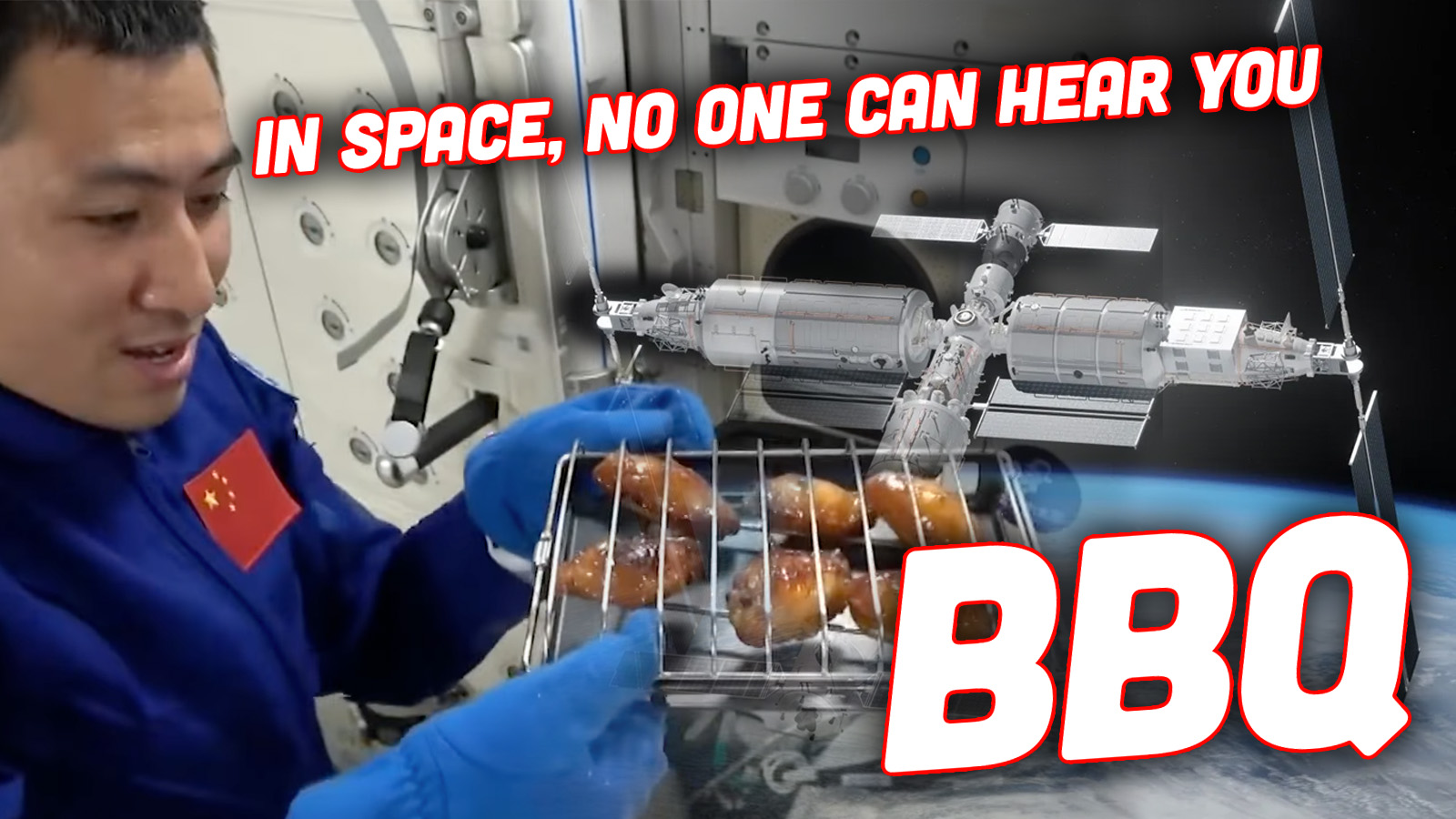
Have you been considering spending more time in Earth’s orbit, but have been putting it off because of the difficulty of getting piping-hot chicken wings while hurtling around the planet? Sure you have; it’s a valid concern! Well, boy do I have good news for you: in China’s space station, Tiangong, a new hot-air oven was just recently used for the first time, cooking up chicken wings and peppered steak for the six taikonauts currently on the station. The food looked pretty good!
This is actually the second oven that has flown in space; back in 2019, a company called Zero G Kitchen designed and built a Space Oven that was sent to the International Space Station (ISS) aboard a Cygnus cargo ship. Chocolate chip cookies were baked in the oven, one of which is currently on display at the Smithsonian’s Udvar-Hazy Center in Virginia, in case you’d like to see what a space-cookie looks like.


The oven installed in Tiangong seems somewhat similar, though details on the oven itself are somewhat hard to come by. It appears to be a hot-air-type oven, though not a convection oven in the strictest sense, as those tend not to work well in a microgravity environment. The oven is said to be oil-free and has residue collection systems and multi-layer filtration to allow it to function within the station’s pretty strict environmental parameters.
Here’s video of the oven in action, cooking up in 28 minutes (some sources describe it as “grilling” and there is a sort of wire grille used to contain the meat, though I’m not clear if this meets the strict standard of grilling, but maybe?) chicken wings and steak:
This video has some more translations, which is helpful:
I gotta hand it to the crews of Shenzou-20 and -21, those wings and steak bits look pretty damn good! The oven came up with the new three-person crew on Shenzou-21, which is why the station is currently home to six taikonauts; the usual long-term crew for the station is three, but during crew transfer periods, there’s six taikonauts on the station, so that’s the time to have a party and break out the good food.
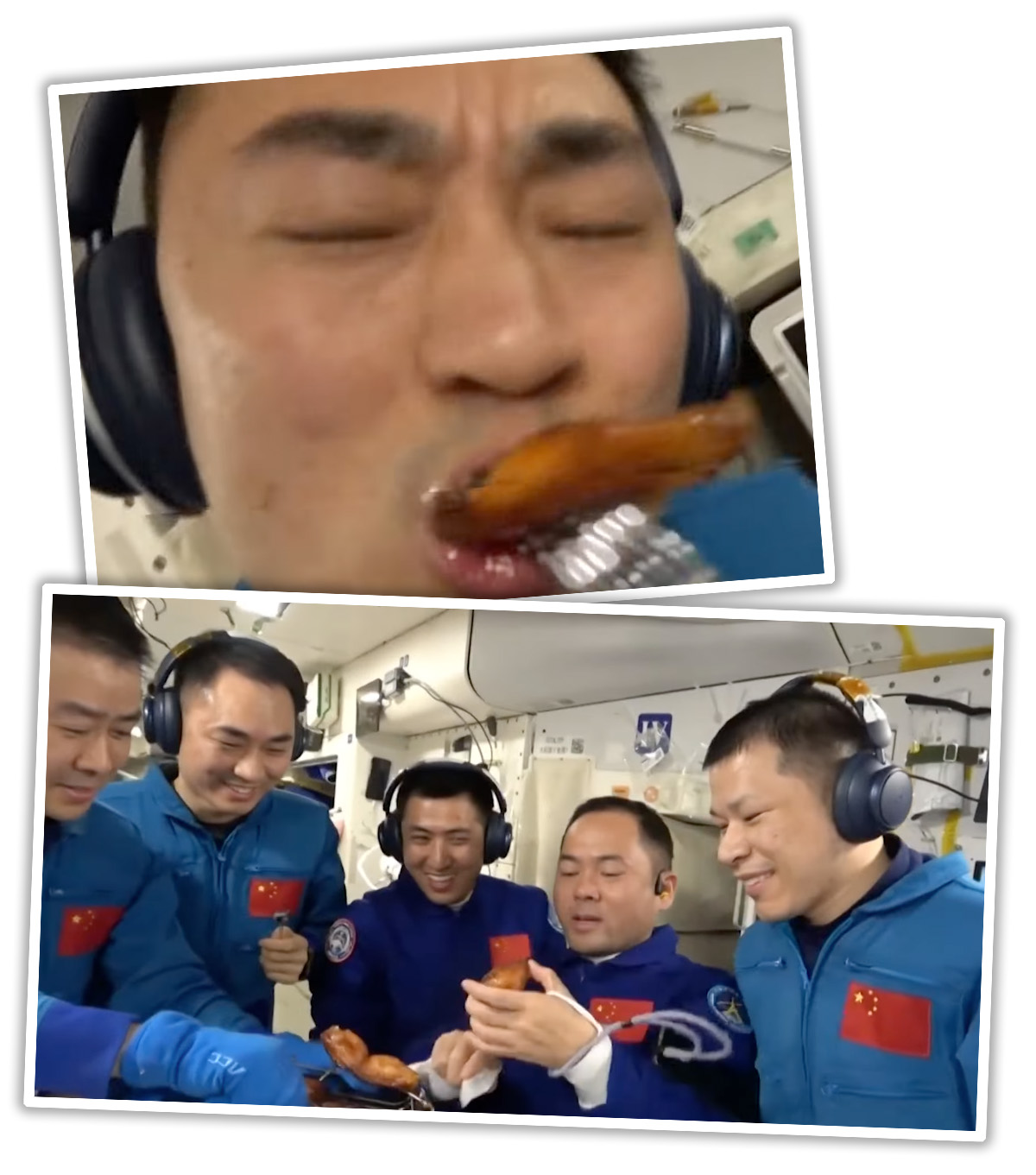
The food is significantly better looking than most space food, being real, genuine meat, on the bone in the case of the chicken. This is food intended to be eaten soon after docking, and likely is not held to the same storage and preservation standards of other space food that would be stored on the station. Most food served on Tiangong is closer to what most space food looks like, which is to say various pouches of goops and clumps:
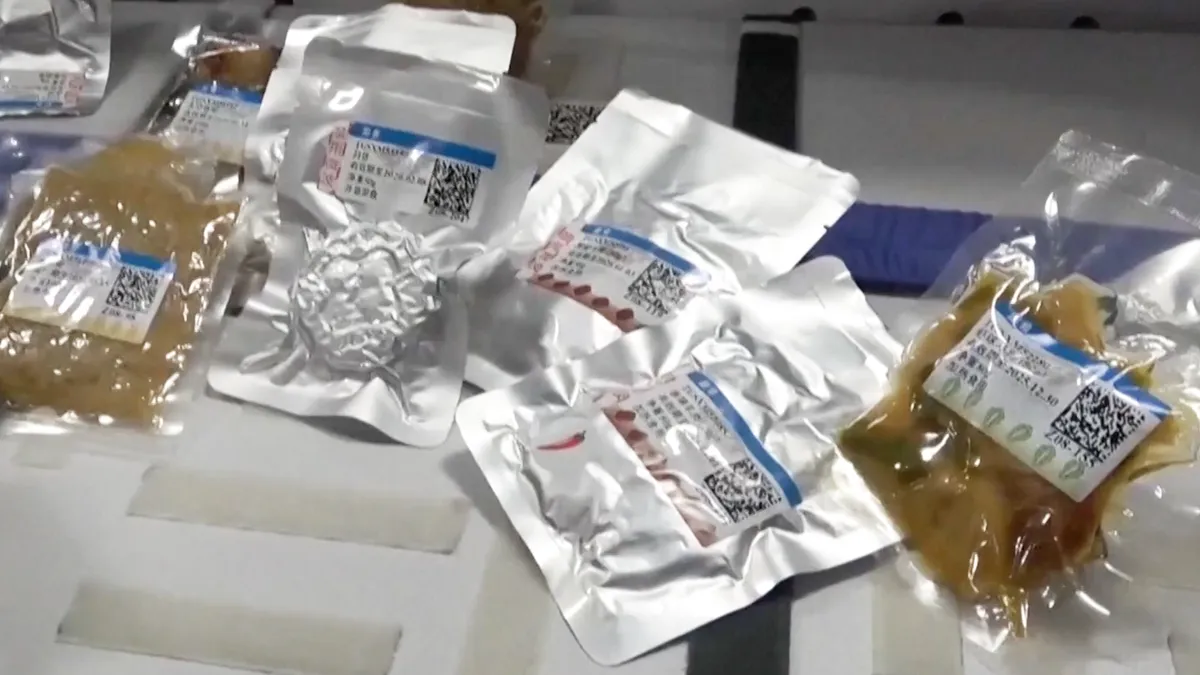
That doesn’t mean it doesn’t taste good – I’ve heard a lot of what is eaten on the ISS and other spacecraft is actually quite good – but it doesn’t look as appetizing as real food.
Which is why I think I’m so impressed with this recent orbital cookout; look how good these steak bits look:
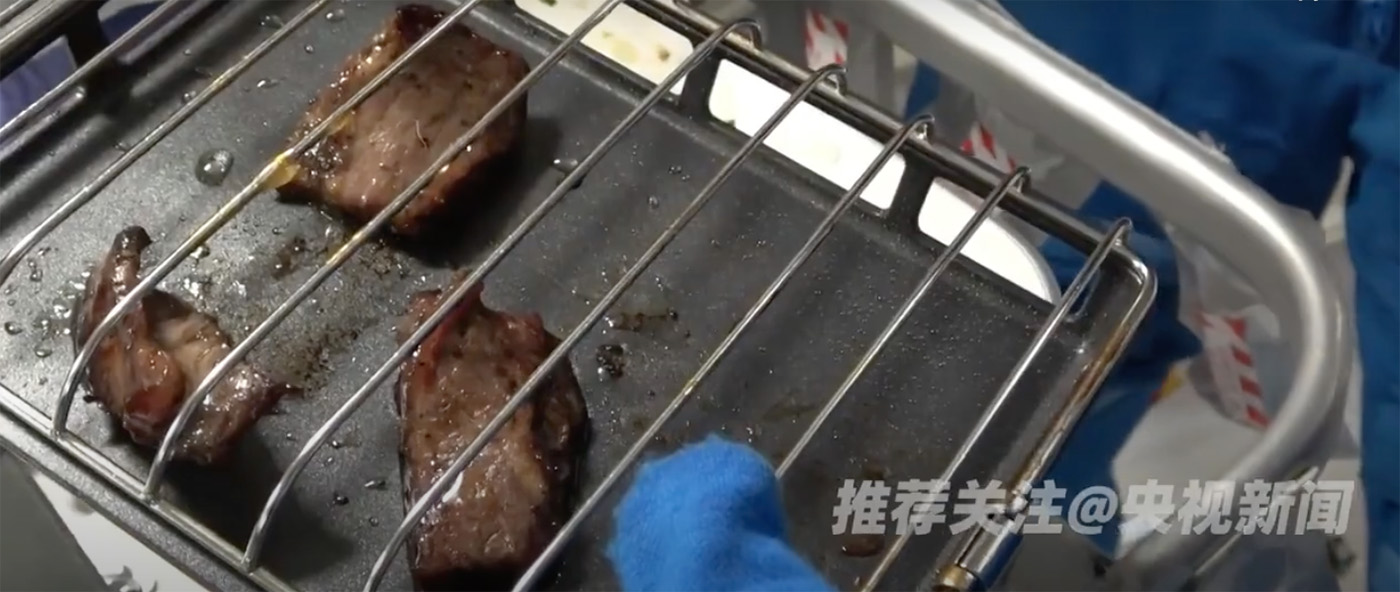
Those look great! I wonder if the microgravity environment keeps juices inside the meat more, since there’s no dripping, as such, in the absence of gravity? Hopefully these taikonauts will be writing up full reports on this all.
It’s interesting to see the progress in space food preparation; as astronauts and cosmonauts and taikonauts spend long periods of time working and living in space, food becomes more and more important, not just for health and nutrition reasons but for cultural and psychological reasons. Things have come a long way from the days of the Apollo-era Wet Meats:

Even the old ’60s and ’70s-era Apollo capsules had some attempts to make food more palatable; the capsules had a water injector to re-hydrate foods in packages, though, sadly, the water wasn’t heated:

Later, when America launched their first space station, Skylab, provisions were made for food warmers, so astronauts staying in space for long periods of time (the record on Skylab was 84 days, for example) could eat hot food, and that food was served on a sort of “table” to make eating more like an actual meal as opposed to floating upside down and sucking meat paste out of a bag. The table setup was kind of appealing:

The ISS has used a table for communal meals pretty much since its first crewed expedition in 2000. The astronauts and cosmonauts have been pretty creative with their combination of long-lasting packaged food, canned food, and fresh food, and even put togther things like pizzas when they have the ingredients available:

I’m happy to see this space culinary development happening aboard the Tiangong, and look forward to more space-cooking advances. Will we see safe, zero-G deep fryers at some point? Woks? Rotisseries? If we’re serious about having a long-term presence in space, the food has to be good.




/https://tf-cmsv2-smithsonianmag-media.s3.amazonaws.com/filer_public/4e/d0/4ed07d81-5081-4599-aa27-8a1080c55f2f/doubletreecookie-scaled.jpg)
The Skylab dinner ‘table’ sort of reminds me of a Nagra tape deck in its general shape and chonkyness: https://www.alamy.com/vintage-nagra-42-1970s-mono-professional-reel-to-reel-tape-deck-image473433186.html I owned a Nagra 3 while I was in college and it was awesome: up to that point, I’d never experienecd any kind of really high quality audio recording/reproduction. I want to say it was made in 1967 (I purchased it used of course, I think for about $600. in the early 90s) but I’m not positive. I wish that I still owned it despite the fact that I now have no use for it, since it was so gorgeously machined and assembled: https://hifivintage.eu/fr/portables-bande/4594-nagra-3.html It was also heavy as a half-bag of concrete mix… like an SGI workstation: you reach to pick it up only to discover that it’s two to three times as hernia-inducing as expected.
Not to nit-pick, but I notice how the new oven on the Chinese station is procalimed to be a first, which isn’t technically true judging by that strange one-big-cookie-in-a-plexiglass-box thingy. Also, I can’t help but take note that the new Chinese space oven is declared to be ‘completely reliable and safe’ which it probably is (I don’t think I’d hesitate having one in my own kitchen) but having seen so many videos of Chinese-made EVs catching fire by now (literally, hundreds of separate videos) that the bold claim tempts ridicule, or at least some gentle teasing.
The ‘thermostabilized wet meats’ used on Apollo missions really don’t look much worse than the TV dinners I subsisted on as a kid in the 1970s, though NASA probably should have enlisted the help of a marketing consultant to come up with a better name. 😉
Finally, I’m grateful to have lived in a time when it’s possible to witness people living, eating, working, etc… in zero G. Though male astronauts from most nations still seem to favor crew cuts, female astronauts’ hair usually looks great in zero G. 🙂
I’m pretty sure if we ever do push out past the moon at some point freeze dried irradiated long pig will be the only thing on the menu.
I can’t believe we lost the race to grill in space race to the commies.
Hopefully ‘Merica can be the first to grill clams in space, at least
I hope there is a NASA team hard at work on space smoker technology. The first BBQ in space better be American.
That’s going to be a tough order. Proper BBQ requires smouldering wood which burns oxygen. NASA will probably phone it in by doing exactly what the Chinese did but add some liquid smoke and market it as “Space BBQ!” or some such nonsense.
Some may say you shouldn’t create an open fire in a space ship. To those people I say, “Is space worth visiting if it doesn’t have BBQ? Give me brisquet or give me death!”
Which is why I propose an autonomous solar powered BBQ pit in permanent polar orbit. Imagine it, the sun shining on the wood which causes it to smolder creating just enough smoke to flavor the meat while the sun also provides the heat needed to cook the meat. A solar powered electrolyzer would recycle water to make just enough oxygen to keep the wood smouldering. A dedicated robot would be the pit master and drones would deliver raw materials to the pit and deliver delicious BBQ to hungry astronauts. I call it the Solar Polar Pitstop.
I mean, Chinese culinary arts has been around longer than most civilizations. Losing this one to them is kind of a given.
Buffalo is not in China, sir. Take your wing revisionism somewhere else.
When ever I hear space food I can only think about that time the cosmonauts convinced the astronauts that a toothpaste-tube of borscht was vodka and got someone to take a swig during the Apollo-Soyuz mission.
That story might also be bullshit but whatever.
I heard it the other way, that the Soviets had to re-label their vodka as ‘borscht’, because NASA frowned on booze in space.
Yes but the Italians came up with a zero-gravity espresso machine for their astronauts.
Priorities..
I bet these guys want to open a window after this.
Those food items look as tasty as anything I have had on Earth. However I’m going to have to decline purchasing because cooking 6 wings or 6 bites of steak at a time the rest of the crew is waiting for the 5th batch before I am sharing. ME SO HUNGRY!!!
As for grilling once the Vegans started grilling vegetables and fish anything with grill marks is grilling.
I always wondered if space is so cold can’t they just bag the food up and attach it to the outside and thaw it out when needed? Of course it will take longer to thaw at zero kelvin but an interesting science experiment.
And finally if they didn’t need to recycle urine for water wouldn’t it be all shits and giggles to put stored urine in a squirt bottle, go outside and squirt it and release a quarter mile icicle of urine? All in the interest of science of course.
> I always wondered if space is so cold can’t they just bag the food up and attach it to the outside and thaw it out when needed
There’s a lot of unfiltered solar radiation out there. I don’t think the food would retain its integrity.
“There’s a lot of unfiltered solar radiation out there. I don’t think the food would retain its integrity.”
It doesn’t take much shielding for the astronauts to live in that radiation bath for up to a year. If anything the radiation would help preserve the food.
The whole space station counts as a fair amount of shielding, no?
Someone on the ISS gets about 72 mSv of ionizing radiation over a six month mission. That same person on the ground might get an average annual exposure of 2.7 mSv or less with clean living. Head outside of Earth’s Van Allen belt and you’re looking at 220 mSv per six months, presumably with shielding similar to the ISS. Cancer risk becomes significant at doses of 100+ mSv
https://en.wikipedia.org/wiki/Effects_of_ionizing_radiation_in_spaceflight
So the ISS ain’t nothing but if it was me I’d rather have a few hundred miles of good o’l atmosphere.
Maybe they could even use the radiation as some form of microwave to cook as well.
There’s plenty of radiation to choose from, everything from radio to gamma. However the solar spectrum peaks in the visible spectrum, which BTW is why our eyes are tuned to use it. So while microwaves are certainly available good old thermal radiation will do the job better.
Plus you don’t get that nice char from microwaves.
“I always wondered if space is so cold can’t they just bag the food up and attach it to the outside and thaw it out when needed? Of course it will take longer to thaw at zero kelvin but an interesting science experiment.”
Its only cold in the shade. Anything exposed to sunlight quickly heats up:
“Most satellites reside in low-Earth orbit (LEO) or geosynchronous earth orbit (GEO), with LEO satellites occupying any altitude below 1,200 miles, and GEO satellites occupying a constant altitude of 22,236 miles. The answer to the question “How cold is space?” in near-Earth regions is a perhaps surprising average temperature of a brisk 50°F (10°C). However, this average masks an extraordinarily wide temperature range, from as low as -148°F (-100°C) in shaded areas to as high as 248°F (120°C) when directly exposed to solar radiation.”
https://citylabs.net/cold-outer-space/
Which itself offers an interesting experimental opportunity to cook food. I imagine it could save a lot of power too.
Heat doesn’t rise in the absence of gravity, but if you have some forced air component to the oven to keep the air circulating, it would work fine.
This just sounds to me like they shipped an air fryer to space. Not that that wouldn’t be delicious, but I’m surprised it took people that long.
I’d be much more concerned with how to filter and contain the moisture / grill residue in space. I’m imagining they’re using extremely lean meat or least cuts with very little excess fat.
Vacuum air filtration systems are pretty effective – a water-filtered system would probably work best for grease.
As far as the Air Fryer – There’s always Temu….
Said no grease or oil
What comes out of a piece of meat when you cook it?
“What comes out of a piece of meat when you cook it?”
One would hope deliciousness.
Yeah, air fryers don’t use oil either, but the meat itself still has fats and oils in it. My guess is the cuts they brought to space were specially prepared to minimize those.
Hey bro, have you checked out my grilled wings? They’re out of this world!
I can’t believe I missed the space cookie last time I was at Udvar-Hazy. I guess I was too interested in the space toilet.
Well if you drank a lot of space beer that is forgivable
If the forward facing documentary Cowboy BeBop is to be believed, we’ll all be frying up peppers and beef* on open flame wok stoves in space.
*No actual beef was available at the time of filming.
Well there wasn’t any beef until Kobayashi started getting the farts then there was plenty of red meat protein.
I look forward to the upcoming Taikonaut Ovened Chicken restaurant chain.