

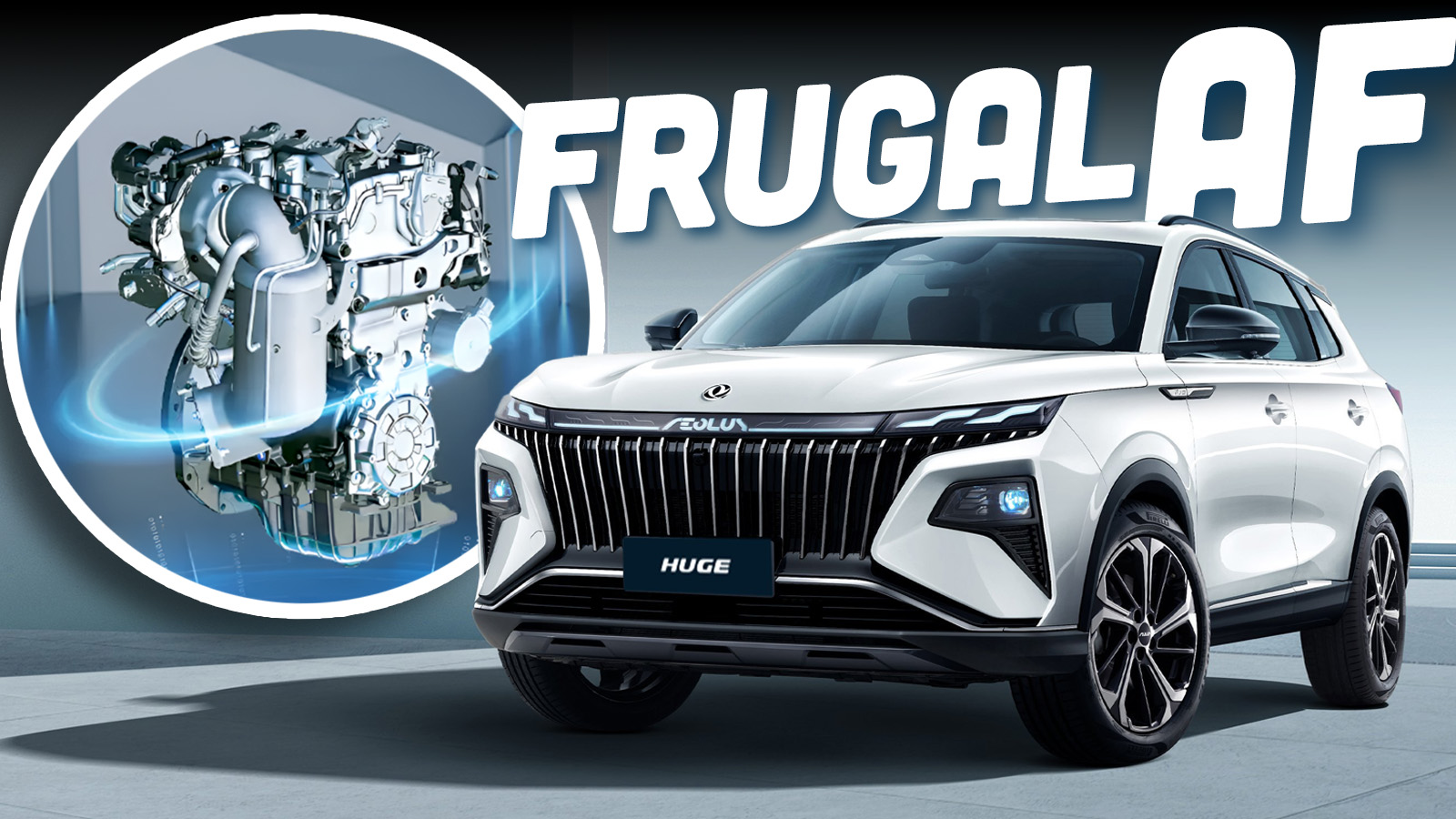
Just a few months ago, I wrote about how Nissan was able to produce a road-going engine with a thermal efficiency—the amount of energy produced versus wasteful heat—of 42%, beating out the likes of Toyota and Hyundai to become the most efficient engine on the market. Well, Nissan’s title didn’t last long, if Chinese automaker Dongfeng is to be believed.
The Wuhan-based manufacturer revealed this week a new 1.5-liter turbocharged engine that it claims can reach a peak efficiency of 48.09%, surpassing the likes of Nissan, Toyota, Hyundai, and even other Chinese manufacturers like BYD, which has claimed a thermal efficiency in its engines of over 46%.


As a reminder, Formula 1 engines achieve a thermal efficiency of just over 50%. So to see a road car engine, which needs to run for tens of thousands of miles without major servicing, is damn impressive. Dongfeng’s claimed success is thanks not to one single big advancement in engine technology, but to a smattering of new tech combined.
Inside The Belly Of The Combustion Beast
Let’s start inside the combustion chamber. Dongfeng claims a compression ratio in its 1.5-liter engine—that is, the ratio between the cylinder’s available space when the piston is at the bottom of its stroke and at top-dead center—of 15.5:1, which is far higher than the normal range of 9:1 to 12:1 you’d find in most road cars.

In fact, Dongfeng’s engine beats out the previous record-holder for road-going engine compression ratio, held by Mazda’s Skyactiv-X engine, which uses a 15:1 ratio (prototypes used a 16.3:1 ratio, but that was reduced for production). A higher compression ratio is better for efficiency because it more densely squeezes the air/fuel mixture into a tighter area, increasing its pressure and therefore its temperature. A higher temperature means the engine can produce more energy from the combustion process, all other factors being equal.
Why don’t all engines run a compression ratio like this, then? The biggest downside to an ultra-high-compression engine like this is its fuel requirements. All of that heat and pressure generated by squeezing the air/fuel mixture together can generate disastrous results if you use low-quality gasoline. From MotorTrend:
All things equal, engines with higher compression ratios require higher fuel octane. This is because a lower octane fuel may begin to ignite prior to the initiation of the spark event through the ignition system, a condition known as detonation or auto ignition. When this happens, the early flame front builds peak pressure in the chamber before the piston has reached TDC. Compounding this pressure spike is its confinement into an ever smaller space as the piston continues its inexorable march toward TDC. Almost always catastrophic for performance engines, knock should be avoided at all costs—it’s like hitting the pistons with a hammer and a plasma torch at the same time.
Dongfeng doesn’t say what sort of fuel is required for its new engine, though if I had to guess, it likely requires what we’d consider premium fuel (93 or 94 octane) at minimum.
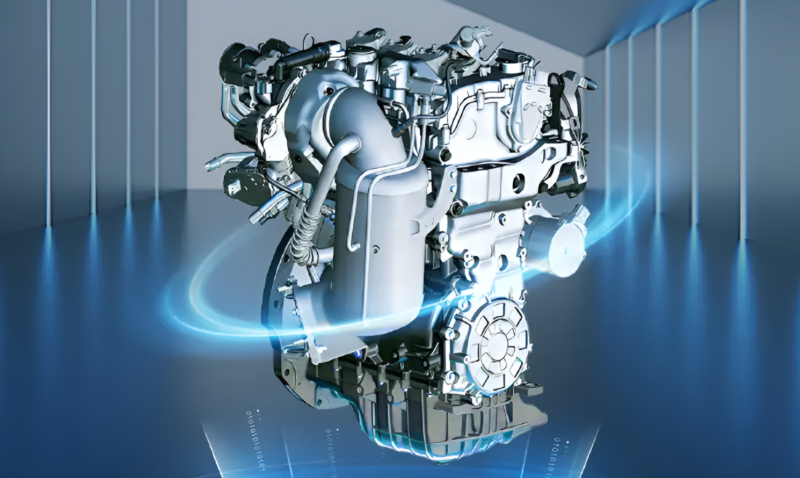
That’s not the only thing going on inside the cylinder. Dongfeng says it also applies a thermal spray coating of the cylinder bore, according to Car News China. This saves weight and space over traditional cylinder liners, at the same time lowering friction against the piston, reducing the energy needed to move the assembly.
What Else Is Dongfeng Doing?
Dongfeng claims to incorporate more than 10 different innovations into this engine to achieve such an impressive thermal efficiency, but only names a few. The most notable is a “valve seat-less design,” according to MyDrivers.com. Dongfeng doesn’t go into further detail, though if I had to guess, it’s likely the company is incorporating the same spray-in valve seat design seen on the Nissan engine I mentioned earlier (mainly because Nissan and Dongfeng currently have a 50-50 joint venture to sell Nissan-branded, Dongfeng-built cars in China).

I described this concept pretty thoroughly in that previous coverage, so if you want to learn the nitty-gritty details, I recommend reading that first. But basically, instead of installing normal valve seat rings into the cylinder head, Nissan sprays metal powders at supersonic speed onto the cylinder head to form the shape of a valve seat.
The benefit of this method, as the above diagram shows, is a valve seat that provides a straighter, smoother path for the air to flow through. The goal of any intake is to have the straightest, most uninterrupted path for air possible, because any disruptions can cause turbulence and upset the “tumble” of the air as it enters the cylinder.
Having an optimal tumble—the rotational motion of the air and fuel as it enters the cylinder—is important, because the better mixed the air and fuel are when they’re ignited, the more evenly and efficiently the mixture will burn.
There’s more on the intake side of things, too. Dongfeng says the turbocharger on this engine is a variable geometry turbo, or VGT. Compared to a standard turbocharger, these turbos have vanes that can adjust to vary the size of air passing through the turbo wheel. The adjustment of the vanes can be controlled by pressure, vacuum, or electronically, according to Garrett (Dongfeng doesn’t specify how this one is actuated). Here’s a good animation from Toyota showing how it works:
The biggest benefit of a VGT is its ability to deliver the correct amount of air and pressure over a wider operating range. At low speeds, it can act as a smaller turbo, delivering a quicker response and less lag. At high speeds, it can act like a larger turbo to move more air into the engine. The downside of this is, of course, complexity. My colleague Thomas wrote about how one particular Mercedes engine, the OM642, is famous for having the actuator in its variable-geometry turbo fail, resulting in a lot of expensive heartache.
Lastly, there’s the oil pump. Most cars’ oil pumps are driven directly by the engine, either by gears, a chain, or a belt. But the pump can also be driven electronically, like the power steering system, relieving the engine from that duty and freeing up more energy. I know some of you will voice in the comments how risky it is to run something as important as an oil pump off the electrical system, and I understand. But it’s not like belts, chains, and gears don’t fail, either. And the efficiency benefits are undeniable.
None of these innovations are new or groundbreaking, but all of them combined make an engine that manages to outdo everyone else in the industry, at least according to Dongfeng. The company doesn’t say when this engine will enter production or which cars it’ll appear in, though I have no doubt it’ll be an important part of its range-extended EV lineup in the near future.
Top graphic images: Dongfeng Motor



I’d say that’s about the size of it. Yep, spray coatings and 15.5:1 compression ratio and variable stroke and turbos are all things that you can do. No way these are reliable in anything approaching the traditional sense. But if they work reliably for maybe 50,000 miles and if they are cheap enough (i.e., extremely cheap) I could see there being a market.
you mean Nissan’s variable working engine?
I’ll roll a 3v 5.4 before the unreliable pos that Nissan inflicted on us.
“Dongfeng doesn’t say what sort of fuel is required for its new engine, though if I had to guess, it likely requires what we’d consider premium fuel (93 or 94 octane) at minimum.“
So, it could be diesel? Since they don’t even specify fuel this is effectively vaporware.
Given the ambiguity – https://interestingengineering.com/innovation/china-diesel-engine-thermal-efficiency
Spray-on valve seats and cylinder liners?
Color me skeptical about longevity.
I’m with you. However, in this market what’s considered longevity? Last till warranty ends? 100k miles? 150k miles?
Depends on the beholder I guess.
To me, I’d not consider buying any new car if I thought that 100 or 150Kmiles was as far as it’d be likely to go w/o major issues, thus no wet belt engine or Nissan CVT for me. By ‘likely to go’ I mean to the point where it stops making sense to pay to fix it… of course, most any car can last forever if money/time/effort are no object (unless it just rusts away)… but most folks don’t have that option, myself included.
I have no data to support this, but having had more than a few old cars (20-30 years or more) and having poked around (but not bought) a lot of new cars, I think many new cars can and will make it to 200 or 250Kmiles if you put those miles on fairly quickly… say, under 15 years or so. Not Nissan CVTs and wet belt designs, but most other new ones.
However, after 20 or 30 years of regular use, even if the mileage isn’t that high, there’s enough degredation of hoses and belts and bushings and plastics, that small problems crop up more frequently and at some point, you start to wonder whether things are worth fixing. Even a mid-oughts car has an awful lot of plastic under the hood: some is just cosmetic, but lots of it will cause vacuum leaks and other issues when it gets brittle/starts cracking.
This is sort of why I’d not be that afraid of buying a sub-10-year-old car with very high miles, but I would be more cautious about buying a 30 year old car with lower miles (unless it’s been carefully tended to, or I’m prepared to do so myself). It’s not a rule per se… just a guideline.
With that said, I did just buy a 37 year old car with about 165Kmiles on it, but it was one known for longevity and it had had some recent work done (bushings, hoses, etc…) before I bought it.
I feel you, I’m not too different. In general I don’t believe that’s how vehicles are being manufactured anymore. They are far more reliable than everything pre 70s/80s, but they on moving down the curve from the 90s/00s. I made the move to get a 5th gen 4Runner new and I don’t regret it. So far 70k trouble free miles, not one single issue.
I think the Chinese market is even more of a throw away market than current US.
Agreed on both points. The 90s (mid 80s to mid 00s if we’re being generous) seemed, on average, and generalizing, peak auto in terms of expected longevity. It was mostly before the wholesale switch to plastic engine bits (manifolds? oil pans?) and of course, before software became such a big part of the vehicle. A nice 90s Toyota or Honda, even with 100Kmiles on it already, is probably going to cost less to own over the NEXT 20 years than any car purchased today will over the same duration.
And yes, the main thing that strikes me about Chinese cars, despite all the flash and vast numbers, is their air of temporary. With a relatively modest number of exceptions (the biggest, most widely-sold models from the biggest companies) how is everything else going to be supported (service, parts, let alone software) 10 or 20 years from now? Or is everything simply expected to be replaced before that happens? I’m not saying that’s not an issue in North America (hello, Chevy Trax, etc…) but at least there are SOME cars that you’ll probably be able to still drive in the 2050s if need be.
I’m not an expert in anything of course, but that doesn’t keep me from having an opinion about this or that.
I think you hit the nail on the head, my friend.
I work in automotive engineering and we create contracts with suppliers for Service parts after production ends of typically 10 years.
I don’t know what they do in China, I wouldn’t be surprised if that wasn’t a thing, or much shorter requirement.
My personal peak would be 2007 personally, with each brand having their personal top +/-5 years of that. Mid to late 2000’s Hondas and Toyotas are still very reliable, but the US domestics peaked somewhere around 2004. The Germans arguably the earliest, although late 2000’s-early 2010’s VWs were pretty good (compared to their normal).
Yes, there’s a range between brands/models of course, where certain vehicles peaked in terms of appeal (complexity vs cost) vs. others. And then there’s the price peak, which is when it would have been the best time to buy a particular car or truck had you been able to see in the future. Generalizing, this would be more recent than the ‘expected reliability peak’ …the ‘value peak’ for some recent models seems to have been around 2020 (give or take a couple years) before the pandemic, supply chain crisis, inflation, and manufacturers deciding they can build less but charge more all set in. Certainly, for Camrys, Corollas, and Mavericks, 2020-1 would have provided the most bang for the buck since they’re all still essentially the same today, but buyers pay a few to several thousand dollars more per unit.
There will be exceptions to this generalization of course, but this ‘value peak’ in the ’20-21 does seem to apply for a few different models that I myself have kept an eye on for the past several years, just out of personal interest/thinking of buying.
Based on average powertrain warranties in the US, 5 years/60k miles. That’s Nissan’s current powertrain warranty, along with several others.
If we want to improve efficiency of an internal combustion engine then we should try to remove the massive resistance of valve springs of the valve train like FreeValve which has been now around for 2 decades. Doesn’t need a camshaft. Guess its not cheap enough or not stable enough. Also the electric waterpump and electric oilpump should remove tons of parasitic loss and allow for optimal cooling and lubrication when it is needed, not all the time.
Start stop technology can help too, not a fan of that since it requires a better starter motor, but if the starter motor is integrated in the fly wheel and can also drive the car from a (small) battery AND do engine braking to recuperate energy .. then that would be great.
But pushing the efficiency by a few percentages here and there, while electric motors are well above 90% … what are we doing? Developing super complicated internal combustion engines while a CHILD can create his own electric motor (wires, windings, coils, a battery, some shaft … it is THAT simple) …
Let’s keep the ICE engines simple and less efficient, like an old LS2 or so, and for other applications we can use electric motors. We don’t need 60% thermal efficient race cars – they’re RACE cars – they’re going to burn fuel like crazy – focus on the racing. Meanwhile people who need to travel from A to B all the time – give them the cheapest solutions. A simple electric motor with a simple battery. Which means no, we don’t need 1500 hp electric cars. That’s just plain BS.
The efficiency benefits of variable valve systems like free valve have nothing to do with the torque to overcome the valve springs. With any system that uses a roller, like most roller finger follower systems currently in production, any torque that needs to be put into the system to compress the valve spring is recovered when the spring decompresses as the valve closes. The torque recovery diminishes a bit at high rpm where valve inertia plays a higher role, but that’s not where the engine makes peak efficiency anyway.
Those systems are more efficient because they allow changes to the way the engine breathes, and thus how much air it ingests vs the pressure of the intake manifold it’s trying to draw that air from, to reduce pumping losses and give a longer expansion ratio than compression ratio.
Thanks, I learned something today. I always saw the compression of the springs as a huge force to overcome, every rotation, but didn’t consider the springs also help the cam to rotate when they’re decompressing. I never turned a camshaft without it being connected to a chain, so it always felt like a lot of work (force) was needed. Interesting.
Regarding your first point ; yes I think the option to open and close valves at will, at any height, is the main benefit of FreeValve. Especially compression of deactivated cylinders (valves staying open) at very low/idle RPM should reduce energy needed to keep the engine running. When air is compressed in a deactivated cylinder it heats up and then escapes when valves (normally) are opened ; a loss. FV should also be able to solve valve float – if the actuators are fast enough of course.
all fake news
Based on what I’ve read about the Nissan variable compression engine and the problems it has, I don’t have any confidence that this VC engine from a Chinese maker will be any better in the long run.
And given how BEVs and hybrids have better overall efficiency than 48%, this engine seems like a waste of time and resources to me.
To be fair BEVs are 48% efficient due to electrical assist, which could be added to this engine too and increase its efficiency. The efficiency of a BEV powertrain isn’t a clear reflection of an ICE engine’s efficiency and bringing that up here is pointless.
“ BEVs are 48% efficient”
No. The BEV motors are over 90% efficient… more than double the efficiency of this piston engine. Adding this motor to a BEV to make it a hybrid would REDUCE the overall efficiency.
I meant hybrids. I meant that adding a hybrid system doesn’t improve the thermal efficiency of the engine itself, so using the efficiency of a standard atkinson/hybrid combo to shoot this idea down is dumb
“I meant that adding a hybrid system doesn’t improve the thermal efficiency of the engine itself”
I didn’t say that. I said that a hybrid system would have “better overall efficiency”… as I’m referring to the fact that you have auto stop/start, regenerative braking and are running in electric mode part of the time which raises the efficiency of the vehicle overall.
I think you both have your acronyms mixed up…. https://en.wikipedia.org/wiki/Battery_electric_vehicle
BEV is battery electric vehicle and from a powertrain thermal efficiency perspective is likely 80% plus. The motor is 90%+ but I’m not certain about thermal losses for the battery and inverter.
Shit you’re right, my bad. I meant hybrids. Yeah BEVs are like 80-90%
“Dongfeng doesn’t say what sort of fuel is required for its new engine, though if I had to guess,”
Methanol. The answer to everything in China is methanol derived from coal. The octane number for methanol is 112, so if you put 15% into your gasoline like is allowed in some provinces the engines can handle higher compression.
Or the simple answer, diesel, which surpassed 50% years ago.
LNG is replacing diesel in the Chinese market because they do not produce enough distillates to be self sufficient
I believe that. When I was Engineering at Cummins 2011-2016 we were already releasing fuel agnostic or at least diesel/LNG compatible engines.
LNG prices are greater than 20% less than diesel there, so the extra equipment cost is paid back in as short as 6 months. Shale gas production is way up in China, as is pipeline imports from Russia. Using coal electricity to compress and chill this cheap natural gas to substitute for diesel is another way to get the transportation sector to run on Chinese coal.
You’d need about two gallons of methanol to get the same energy as one gallon of gasoline. So, a 2x larger fuel tank for Meth…
Blending 5-15% of methanol into something that can be sold as “gasoline” is not the same as 100% methanol because the other stuff can have a higher energy content. Illegally blending a little extra methanol is a low risk crime.
The electric oil pump as a way to increase thermal efficiency bragging rights is interesting. Just imagine the thermal efficiency you could get from powering the compression stroke by an electric motor instead of using inertia/another cylinder’s power stroke.
In real life the energy to drive the pump will still come from the engine, minus the efficiency losses associated with converting mechanical energy to electricity then back to mechanical energy making it less efficient overall. But hey, bragging rights!
A lot of the time a mechanical oil pump is not only pushing oil round the engine but also dumping it through the pressure relief valve, which is wasting energy. And at idle it’s barely providing enough oil pressure to keep the bearing alive because sizing the oil pump to be great at idle makes it even worse at higher speeds.
Electric oil pumps waste less energy, because oil flow requirements don’t increase linearly with engine speed.
Hang on a second. Did Dongfeng really name one of their models HUGE?
Now they’re just trolling.
They’re just t being decks. I mean docks. Sorry, ducks. Wait,
One thing I would wonder about is the NOx in the exhaust stream. Sure, add a Selective Catalytic Reduction stage, which probably also means urea injection. Then maybe an EGR.
Personally, I would very much like a diesel electric drive system, which with a fixed speed engine could probably come very close to this level of efficiency in a warranty-able and producible design. Maybe a 50 mile external charge battery, and a gen set that could make enough to maintain steady speed cruising at 90 MPH (just enough for the Dakotas).
I am curious if this requires premium fuel like you mentioned. The amazing thing about the Skyactiv-X is it is allegedly able to run 87 octane (from the sources I found online). I understand why it never made it here, but it sounds like we’re going to get the next-gen with the lessons learned as the Skyactiv-Z (announced for the new CX-5 hybrid).
Even the Skyactiv-G in my 3 runs a 13:1 compression ratio (on 87 octane) which is nuts.
I worked on a variable compression ratio engine that would go up to 40:1, and was carefully tuned to run homogeneous charge compression ignition so it wouldn’t knock on any fuel.
It’s been 16 years and it’s no closer to production, but it’d make an amazing range extender.
40:1 CR? That must have either had an incredibly small bowl and tolerances or been something like a free piston engine (with linear alternator?)
It was a 2-stroke, so not a lot of clearance needed between the piston and combustion chamber.
I did also work on a free piston engine, but I designed it to run “tethered” to a crank while they worked on the control system for the electrical machine. I don’t think they ever dared run it with the con-rod removed.
A big factor that isn’t mentioned here is that this engine is designed specifically to be used in EREVs, and is highly optimized to do so better than other Chinese companies with high thermal efficiency engines like BYD, Geely, and Chery who all make PHEVs (which still require some compromises) rather than EREVs. Due to its highly specific use case, it can completely abandon most design compromises needed to run well above ~80% or below ~30% throttle and above ~4000rpm or below ~2000rpm. They can completely abandon any tuning for throttle response or off-boost torque; I’m a little surprised that they still used a VGT turbocharger. They can also run a very deep Miller/Atkinson cycle and perhaps a high amount of EGR in combination with that very high 15.5:1 compression ratio (note that it does NOT have variable compression like a Nissan).
Most non-Chinese automakers really haven’t tried to make an engine like this yet, since basically nothing on the market uses a series hybrid setup; this its better for engines to be designed to have a broad operating window of high thermal efficiency rather than chasing peaks. Toyota put their 41% TE 2.5L Dynamic Force engine into production for hybrids in 2017 and hasn’t changed it at all in the following 8 years other than emissions updates; instead they’ve focused all their efforts on their new turbo engines. Mazda also came out with high compression ratio engines in the mid-’10s, but their last update was the addition of cylinder deactivation in 2018. Since then, they’ve focused on other projects like the Skyactiv-X that was only moderately successful in Europe (compression ignition gasoline engines are hard), the 2.5T and inline-6, and now hybrids. Several automakers have copied the high compression ratio route that Mazda and Toyota pioneered, but none tried surpassing them. Nissan is the first non-Chinese automaker in a long time to go for peak TE with the upcoming ZR15DDTe in the Rogue Hybrid.
“Formula 1 engines achieve a thermal efficiency of just over 50%”
Which is impressive and will be a lot more impressive when they reach those efficiencies while also meeting the emissions, longevity, all weather reliability, serviceability, ease of assembly, low cost etc demands of production vehicles.
They would also still get garbage mileage because thermal efficiency isn’t the same thing as a typical road vehicle’s fuel use for distance travelled, but I guess people will perpetually equate the two.
All else being equal a vehicle with a thermally efficient engine will go further on a drop of fuel than the same vehicle with a less thermally efficient engine. So those folks ain’t wrong.
They seldom are equal, so marketing loves to throw out a number like that because its sounds good, but it’s essentially meaningless in terms of what matters to customers. Thermal efficiency is more about how much fuel is converted to power, not how far the car can go (nor a measure of flexibility, which is important in a road car). It’s a more relevant measure when discussing race cars that run near peak load much of the time or a generator that can sit at optimal rpm (as the engine in this article seems like it will be used, so that’s probably fair enough in this case), but not road cars that run primarily lower loads over varying rpm. It’s not uncommon for a less thermally efficient engine to beat more thermally efficient ones for mileage if they are more flexible and able to put out more torque at lower loads and also allowing taller gearing for lower rpm. Road car efficiency is about converting fuel into distance rather than power because peak power isn’t important 99.9% of the time. It’s about stretching out the fuel’s consumption over a longer span of time because time=distance travelled. What does it really matter if an engine is more thermally efficient if it uses more fuel in the real world? Of course, if you have two engines of identical characteristics in the same application, yeah the more thermally efficient version should go farther per unit of fuel consumed, but there’s seldom going to be the case where there is a large enough difference in efficiency between two essentially identical engines that are contemporaries for it to matter much.
You are talking about peak efficiency vs overall efficiency. Sure engine efficiency may be foiled by other factors but if the whole point is to extract as much useable energy as possible from the fuel then engine efficiency matters.
Spray on coatings for valve seats reminds me of the time companies tried to do nikasil coated bores. It might work for a little while, but end of the day it’s a wear item that isn’t able to be serviced; aka the entire engine is considered disposable. As long as it lasts through the warranty period, a company guided by short term profits will be happy but if you have long term thinking and value brand equity, it seems extremely stupid.
Also, I tend to take anything China says with a grain of salt. Remember when they had zero covid cases? How about any of their batteries they sell on Amazon with crazy ratings that never match up to testing? China is full of BS’rs.
FWIW, valve seats are one of those things that used to need a lot of maintenance but really don’t much anymore with modern materials. I don’t think there’s any reason it’s not possible to create a coating that will confidently last as long as the block and/or car itself (under unmodified use–if you’re modding your engine you own the results)–but of course, the penny pinchers will have their way and who knows what we’ll actually get.
A non-restrictive air flow path on the intake side is a good thing, but I also wonder about the durability of this design. I would worry more about deformation of the aluminum of the head where the valves touch. That and cracking.
My memory seems to say that some Honda engines (the 90cc motorcycle one) had a cast iron or steel combustion chamber which was cast into an aluminum head with no appreciable flow restriction. That was back in the days of leaded fuel, but still.
Lots do.. this is just cheaper.
The stuff I was involved with had to pass smog standards with 7000 hours on the run time clock. I’m just not sure how you would make an aluminum valve seat last for 7000 hours not just because of the heat of combustion, but from the mechanical pounding.
Unless it was a very hard alloy or a very hard forged billet and the head is CNCed out of it. And then it will not be cheap.
And it has to be thermally stable. My guess is that the seat is going to expand more on the exhaust side.
Nikasil is serviceable with the proper equipment. It can be done; it is just that the manufacturer and service departments don’t want to deal with the downtime of disassembling the engine and having it machined when they can just order a long block and make the customer eat the cost.
Sure, but most shops do not do it. Like… 99% of them…do not have those capabilities.
BMW motorcycles have been known to go 500,000 miles without issues, what’s the problem with the coating if done correctly? The problem with some of those has been getting enough wear for the rings to seat properly.
Way back machine time. Back in ’85-’86 I was working for Garrett Pneumatic Systems Division as a Mfg Engr. Part of my job was to “walk the boards”. For the young’ns that was to look over the sholders of the designers to look at their designs to improve them for manufacturability. The body of a variable nozzle turbocharger looked great, but would be a difficult (expensive) to make part. I took the designs to a local job-shop to talk to their machinists to talk about the part. We primarily built pressure vessels for missile guidance, so we didn’t have the right kind of shop to actually build such parts. We were called in by our auto turbo division to work on this design. Fascinating stuff to work on. I wasn’t around long enough to see the end product. Phoenix was a place we decided we did not want to live, so we quit our great jobs and left in ’86 so I didn’t see the end result (or know the model name), but I do know it went into production.
No different than when Nissan releases something like this, I want to see it after 5+ years in a climate that sees a proper winter.
I do too, but Beijing has about the same winter temps as Chicago, so I guess we shall see.
I think I’d trust a Mazda SkyActive variant before the Chinese one.
That said, I’m still waiting for the Omega-1 (now the H2 Starfire for hydrogen, but would work with fossil fuel too) to wind up in some future-looking vehicle, perhaps as an E-REV ICE/generator combination. Looks like a great idea just wonder how long the seals last…
https://astronaerospace.com/
https://streamable.com/qzsc25
<div style=”width: 100%; height: 0px; position: relative; padding-bottom: 56.250%;”><iframe src=”https://streamable.com/e/qzsc25?quality=highest” frameborder=”0″ width=”100%” height=”100%” allowfullscreen style=”width: 100%; height: 100%; position: absolute;”></iframe></div>
I JUST learned about this engine yesterday when I was chatting with one of our mechanical engineers! SO cool!
Get back to me when they can routinely go 200,000 miles without a problem like most Toyotas do and maybe I’ll care.
Unless and until this is duplicated in Western testing, I’ll have the same degree of skepticism as I do for Chinese EV range estimates.
It’s not that I don’t believe Chinese companies capable of world-leading advancement, but their automakers’ claims are usually not accurate.
Even Chinese state media complains about it!
https://www.chinadaily.com.cn/a/202403/15/WS65f38c9ba31082fc043bcbbd.html
I was coming to say exactly that. Figures and estimates are all great, but verification or at least a 3rd party assessment at the bare minimum is needed before I accept any wild claims. I will say this has somewhat of a shot, given there are effectively zero new concepts actually in this engine, but rather a combination of every thermal efficiency advancing bit of tech all combined. I’m mostly skeptical of longevity, as this large amalgamation of technologies is very expensive to implement well, and if memory serves, Dongfeng is not a BMW/Mercedes/Audi competitor.
Now let’s see it do 100k+ miles in differing conditions.
The Model T engine had a (typical for the day) compression ratio of 3.98:1. I imagine that the gasoline you could get back then, especially in the boonies where the T was really popular, would grenade most modern engines.
I believe the Model T was capable of running on straight up moonshine
High-octane, 200 Proof, Moonshine!
Once upon a time in the time before cell phones, my dad’s minivan ran out of gas in the middle of nowhere coming back from a camping trip. He poured in the spare gallon of white gas for the lantern and camp stove. That Ford fired right up. But we couldn’t accelerate quickly at all due the detonation. That van was a slug before but now it was glacial. That white gas got us to a gas station and a tank of unleaded, however.
This is the very short version of how we ended up with tetraethyl lead.
I drove a Suzuki T500 (6.6:1 CR) on white gas for about ten miles. Got me to a gas station.
It will be a lot more interesting if instead of requiring high octane it takes advantage of multiple direct injections and the higher combustion speeds of regular fuel.
Running those high compression ratios to improve efficiency seems pointless if it means having to run super unleaded instead of regular. It’s almost $1 more a gallon where I live.
Exactly. IMO this will be a lot more impressive on regular than premium.
Atkinson cycle, where you never allow the cylinder to completely fill, so you get a more normal effective compression ratio, but you get the expansion advantage of the higher compression. Prius uses that.
True. And that Atkinson engine can use direct injection to squirt multiple tiny amounts of fuel for even better combustion efficiency without pre-detonation.
All I see with variable displacement engines and variable vane turbos are more moving parts from companies with questionable quality controls to go dramatically wrong.
The Engineer I am, agrees. I also see more moving surfaces, means more things to break, well engineered or not.
Nobody seems to care about the costs of early replacement of short lived, fragile tech. It’s especially bad when talking about such a potentially expensive component that an entire automobile could be junked for that cost.
Or a relatively cheap component buried within masses of assemblies which would require costly labor hours to access/replace.
Makes EVs make so much more sense given their overall efficiency and relative lack of complexity.