

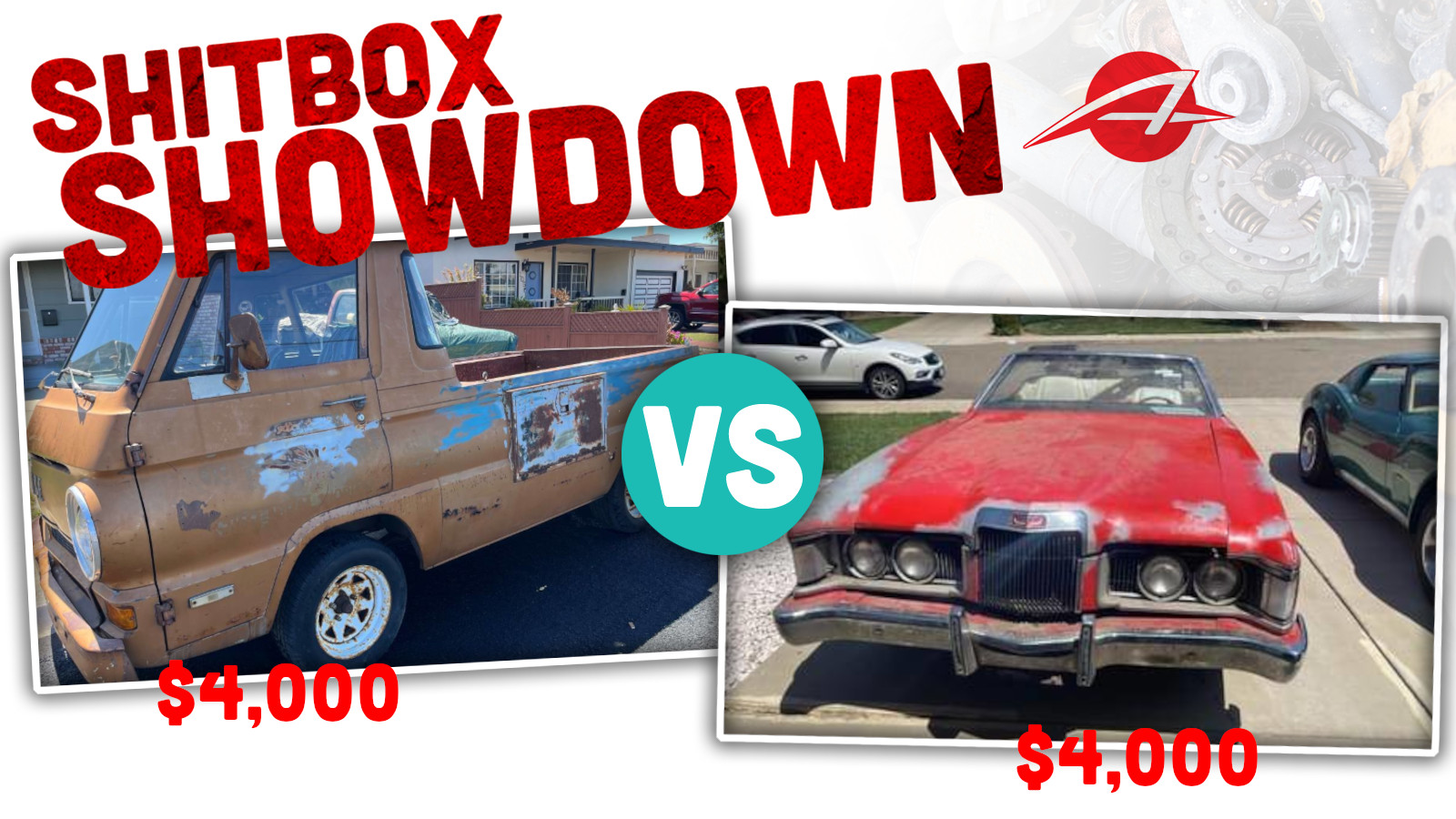
For our final entry in Despised Car Week, I’ve chosen a type of vehicle I know a lot of you aren’t fond of: sketchy projects. These both run and drive, but that doesn’t mean there’s nothing to do on them; you’ll have your hands full with either of them. Which one is worth the effort? That will be up to you.
Yesterday we looked at boring, invisible cars, and by an overwhelming majority, you would really rather have a Buick, it looks like. And from the comments, the bench seat was actually a selling point for some of you. The Buick’s simpler and more trustworthy V6 engine helped as well.


You’re probably right, but if the seller of that Malibu is telling the truth about all the work that has been done to it, you can’t count it out so quickly. With all the new parts, it may end up being the better deal, even with a little rust. I’d have to check them both out in person to know for sure. But really, for fifteen hundred bucks, either one would be a fine cheap beater.

Selling a half-finished project is hard. You have to find someone who shares your enthusiasm for the car, and who can see your vision for it, or has a vision of their own. And you have to be honest about its condition, and why you’re not pursuing the project any further. You have to be patient, too, because the right buyer isn’t just going to magically appear just because you put the car up for sale. I harbor no delusions that the right buyer for either of these cars is out there reading this right now, but if you are, a finder’s fee is customary. Let’s check them out and see what you think.
1969 Dodge A100 Pickup – $4,000

Engine/drivetrain: 225 cubic inch OHV inline 6, three-speed automatic, RWD
Location: South San Francisco, CA
Odometer reading: Unknown
Operational status: Runs and drives well
Product planning for automotive companies is often a case of “monkey see, monkey do.” One company comes up with a brilliant idea, and everyone else has to follow. Dodge’s A100 trucks, introduced in 1964, were a reaction to the Ford Econoline and Chevy Corvair 95, which in turn were designed to compete with the VW Transporter. Like the Ford, Chevy, and VW, the A100 was available as either a panel van, a window van, or a pickup truck.

Whereas Chevy and VW chose to locate the engine in the rear, Ford and Dodge kept it up front, between the front seats. Under that hump with the blanket on it is a 225 cubic inch Slant Six, in this case equipped with an aftermarket intake and a big four-barrel carb for more power. It drives the rear axle through a Torqueflite automatic, and the seller says it runs and drives just fine and has current registration.

The cab-forward design is a great way of maximizing cargo space for a small vehicle – witness the endless parade of kei trucks from Japan – but it is lacking in the safety department. Best advice: If you like your legs, don’t hit anything. I’ve always liked the automatic shifter in these; it sticks out of the dashboard, with a big round knob on the lever, and it feels very satisfying to drop it into gear.

This truck dates back to the days when you bought a truck because you needed it to do work, not because you wanted to look cool. Somebody added a crude set of utility boxes to the bed sides of this one, because they needed a secure place to put tools. Yeah, they’re ugly, but they tell a story. Getting rid of them would be a monumental task; you’d have to either find another A100 in a junkyard to cut patch panels from, or have someone fabricate new bed sides. Either way, it’s probably not worth it. Just lean into the old work truck vibe.
1973 Mercury Cougar XR7 – $4,000

Engine/drivetrain: 351 cubic inch OHV V8, three-speed automatic, RWD
Location: Atwater, CA
Odometer reading: Unknown
Operational status: Runs and drives well, but needs brake work
This car has been for sale for a long time, and I’ve thought about featuring it before, but I haven’t because the photos are so small. But I finally decided it was time. This is the second-generation Mercury Cougar, the last Cougar to share a platform with the Mustang. But the move from muscle car to personal luxury coupe had begun; you could get a fast Cougar still, but most of them leaned towards comfort.

The seller says this car has a 302 V8, but the info I found says that a 351 Cleveland should have been the base engine in a ’73 Cougar. And I’m pretty sure the air cleaner says “351 2V” on it, so I think the seller is mistaken. Regardless, it runs well, and the car is drivable, but the seller says it could use new brakes. It does have a new radiator, and the transmission was just rebuilt.

The ad doesn’t have any good overall interior photos, but what we can see is that the seat upholstery is shot and the door panels are off, but the seller says they’re included. That’s good, because the reproduction parts places don’t cater to the Cougar as well as they do the Mustang. Have the seats reupholstered and put it all back together, and it should look fine. This is never going to be a show car anyway.

The outside, frankly, is a mess. Someone has done some rust repair, but badly. It has Bondo slathered on like cake frosting, with no attempt to smooth it out at all, with primer just sprayed over the top. It’s a great example of how not to do bodywork, but what was done can be undone. If you ever wanted to learn how to do bodywork, it’s actually not a bad starting point. The convertible top works, and it’s not in terrible shape, but the plastic rear window is more or less opaque.
Neither one of these is really “worth” restoring, but they don’t really have to be. Some cars are just good practice, a way to learn how to fix stuff just for the sake of fixing it. If that’s not your cup of tea, I apologize, and I’ll make it up to you next week. But if you think you would enjoy having an old car around just to teach yourself some things, which one interests you more?




Cougar, because….reasons.
Honestly, I think it could make a good 20-footer, but not much else.
Holy shit this is bad, I don’t even know how to start thinking about which to vote for. I voted for the Dodge without knowing why.
Same.
I didn’t know Mark Tucker could be so cruel. How dare he.
I was considering to not vote out of spite,but he told us we have to.
Of these two heaps of shit, I’ll go with the Dodge. Both of these need bodywork. But at least with the Dodge, you won’t need to undo the bad work previously done.
Plus, the Dodge looks useful as a work/light hauling vehicle. And I would keep the utility boxes.
Restoring the cougar is only worthwhile for the entertainment value. You’ll never get your money back out. On the other hand, the joys of a I don’t give a fuck convertible are not to be underestimated.
This is the second-generation Mercury Cougar, the last Cougar to share a platform with the Mustang.
Except for the 5th gen which was a Fox platform?
Definitely the cool old dodgy Dodge that looks quite solid under the rough paint. The other one is just a beat-up old Bondo-buggy.
I don’t think those utility boxes look crude at all. If it was properly painted I think they would look just as professional as most utility bodies. And they do add a lot of utility.
I’m going for the van, pretty much like most everyone else. It wasn’t even close, for a variety of reasons.
These “beat up old car versus beat up old truck” showdowns are inherently flawed, since an old truck is always going to be more appealing than a worn out old car. The truck’s condition implies a life of hard work and honesty, while the car’s condition implies a life of poor decisions, and the end result is a drubbing in favor of the truck.
I don’t know about that. Typically a convertible tips the scale. This Cougar would have been a contender if it wasn’t for the rear quarter panel that caught leprosy.
Even if I didn’t have fond memories of a late 60s Dodge van with the slant 6 my last band had as its equipment hauler (courtesy of our guitarist’s parents, I think), and know just how solid a powerplant and platform this thing has?
C’mon, that Cougar was dreadful, even as a ragtop.
I’ve memories of that thing as well, it was my father’s company car for a time–hardtop, of course.
At 13 I earned some brownie points by getting underneath its driver’s seat and telling Dad “hey look, the seatbelt interlock circuit can be disabled by simply pulling this wiring connector apart!”
(He hated seatbelts. He was perfect in every other way, though.)
I never really wanted to drive that thing, though. It paled in comparison to the Olds 442 company wheels that’d come before.
Seatbelt interlocks often bricked cars long before Microsoft.
Some came with a reset button just for that.
A100 – not even close. I also like the added boxes – this is a work vehicle.
A100 all day. that thing is great. Plus I actually really like the work boxes.
Gimme the Cougar. It’s so far gone to be perfect for what I’d do with it: turn that acre of hood into a runway/racetrack for micro RC vehicles. When that Bondo comes off it can be part of the crawler course. Then chuck it all into the trunk to enjoy the sun on the way wherever. I wouldn’t care about denting it with less than perfect landings or launching 1/16 monster trucks off the windshield. Heck, turn the Cougar itself into a RC car! Make Bluetooth steering from my smartphone a reality!
The A100 is definitely the one, but I feel that I can’t vote for it in good conscience. In high school, one of my classmates had a VW van and would often give me a ride home. The first time, I sat in the front seat and was terrified once I realized there was only, like, a piece of foil between my legs and anything that we might hit. After that initial ride, I always sat in back and let him play chauffer. I can’t encourage anyone to buy this and have a run-in with some oversized truck who’s driver is paying more attention to their phone than the road (see recent Korean ferry grounding re: typical phone distraction).
I agree, but this one has gone 56 years without that happening, so it must be blessed by the almighty Cthulhu.
I think that just means it’s well overdue for a painful crash. For most of those 56 years, the other cars on the road were smaller and drivers were paying attention.
I am contractually obligated to vote for the Cougar, but I wouldn’t turn the A100 away for leaking in the driveway. Those unique utility boxes just make it cooler.
Both are overpriced by a factor of 2.
Based on what we can see of the valve cover that is definitely not a 351C if it is a 351 it is a 351W. Though from how close said valve cover seems to be to the distributor cap it could be a 302 that someone stuck in there when that is what they found to replace the dead 351W it left the factory with.
Yeah, the H code in the VIN means a 2-barrel 351, but does not distinguish between Cleveland and Windsor for some reason. My 1970 Cougar originally came with a Cleveland but I swapped it for a Windsor with an eye toward future EFI and supercharging options, since the Windsor aftermarket is so much larger. And since I pulled the Windsor from another ’70 Cougar, my “new” engine is still numbers-matching.
As for the shitbox choice, I’ll take the Dodge. I adore the first four years of Cougars, but they got super ugly starting in 1971, and I already have a convertible in better shape. Kinda better, anyway. And I’ve always wanted an A100.
Yeah it is surprising that the VIN doesn’t distinguish between the garden variety 2v 351s. I’m guessing that may have been because they didn’t know which would be the next one on the line when they generated the order.
I guess it was just a fluke of that era of Ford that they happened to make two very different V8 engines of the same displacement that happened to be interchangeable when it came to external dimensions, horsepower rating, bellhousing bolt pattern, crossmember placement, and belt-driven accessories. Maybe it just depended on the day or shift whether there’d be crates of Windsors or 2V Clevelands delivered to the line, along with the associated bracketry.
In the long run, I wonder why the Windsors won out for the next 20+ years and the Clevelands died out after ’74? I feel like I used to know.
Well in the late 60’s Ford thought the mid-range V8 (350-400) was going to be very popular. Some believe that the 351W was a stop gap measure until the 335 series engines could go into production. I’m a little skeptical since it required a significant amount of new tooling. Meanwhile since they needed a new plant to keep up with projected demand, high performance was still king and the cost of designing a new or significantly changed design was cheep compared to the tooling. Keeping the same bellhousing, engine mount locations and the relationship between them was just practical engineering to prevent the need for a different transmission case and mounts.
What happened of course was the oil embargo which changed demand for larger displacements and V8’s in general. That meant the 302 had to stay and since the 351W shared much more with it the Windsor was cheaper to keep in production.
Keeping the 351C going with the 400 was expensive at the shrinking volume so they actually dropped the 351C and replaced it with the 351M. That shared the taller block and other components with the 400. So now you had a 351 almost the size of a big block making it too big and heavy for anything but trucks.
Meanwhile they could use a V8 down under so might as well send that 351C tooling down under where they spent the money to also make a 302 out of it.
Aaahh, yes, that makes sense. Now I’m embarrassed to have forgotten the ’73 oil embargo as a factor. (I’m not quite old enough to remember that one firsthand, but I did have a t-shirt in 1980 that referenced the “odd or even day” gas rationing of that year.)
So it makes sense that there would be a move toward smaller displacements, but now I’m wondering something else. Since the advantage of the Cleveland design was the flow characteristics of the cylinder head, why didn’t Ford just expand its deployment of the Boss 302, rather than doubling down on the relatively asthmatic Windsor heads? Hmm. I guess the rising twin spectres of fuel economy and emissions control discouraged free-breathing engines. Until EFI and catalytic converters and other such technologies matured, anyway.
Has to be the a100 you rarely see them it could be useful and it’s just neat. Plus is fine in its current condition. The only thing the cougar has going for it is it’s a convertible. Doesnt even have patina just primer.
I was going to vote for the A100 the moment I glimpsed its nose in the top shot, and then I noticed PICKUP BED! Now I want to vote for it like 3 more times.
wow I want that Dodge. Would be a great motorcycle hauler.
That was my first thought! Nice long bed, locking toolboxes on the sides.
Any pickup could haul motorcycles, but the best kinds are the ones that are low, and have a lot of overhang behind the rear wheel. That way you can put the rear wheels in the ditch in front of the driveway, and the back of the truck bed and tail gate would be low enough to the driveway that you just need a wheel ramp to get the bike up to the bed.
Any advice on kitting a trailer to haul bikes?
step 1, buy trailer
Step 2, put bikes on trailer
step 3, profit
lol
I’m thinking many people are very particular about their bikes.
Guy commented on a forum that most people aren’t equipped to move bikes, which has made me research.
I’ve found some specialty shoes to lock wheels to, but not much beyond that.
Had a biker hug me once because I was careful to not scratch his bike.
That was unexpected!
I made a bike hauler once. I just took some door hinges that were a bit smaller than the front hub on a bicycle, put a quick release skewer through them with a few washers to make up the difference, screwed the hinge to a 2 x 4 that was the width of my pick up bed, took the front wheel off the bike clamped the bike to the 2 x 4 and was on my way. Easy Peezy.
Actually, the piece of quarter inch pipe welded to the front of the pick up bed with a skewer through it was simpler but I know some people don’t like welding crap to their truck so…
Clever rig.
I’m thinking more motorcycles, but would haul bicycles too.
Might be a market to carry the bigger pedalecs now?
I can’t believe someone’s trying to get $4k for that piece of shit Cougar.
Yeah, that Cougar is rough! Even sporting steelie wheels!
Bonus points for top-up pics, though.
Cougars of that generation have one of the ugliest noses ever to come out of Detroit, and all the Bondo in the back only makes things worse. Gotta be the A100. I’ve been eying a neighbour’s restored Fargo A100 (I’m in Canada) for a while now, and it’s the next best thing to a Corvair Greenbrier.
Wow that’s a deep cut of an account name. Nice!
Reference to Dodd of the Standells, or Aston Martin?
Oddly enough, neither! It stems from a misunderstood telephone call back in my college days. It’s been a pseudonym ever since.
But now I’m deeply curious about the connection. I knew about Dick Dodd, but that’s as far as it goes.
I’m not sure it’s a thing, but Chris Dodd on the Aston race team jumped on a fire in an Alpha Tauri rather timely.
The Standells are such an insider group, and I was just watching them play on the Munsters, along with Beat poetry, so their lead singer seemed like a contender.
And their selection to. play on the show doesn’t seem random in a place like LA.
So I was guessing.
A100. This is what Shaggy and Scooby take to the sandwich shop. The toolboxes are for napkins and condiment packets.
I did say yesterday that I don’t like doing convertibles due to increased risk of scalp burn due to my top of head follicle deficiency. Still applies. And that’s an honest truck. Easy Dodge.
Cabover and slant six are tough to beat. And I kinda like the utility boxes. But that drip rail rust is scaring me into the loving, eager arms of a cougar.
I chose Dodge, but only if I had the money to restore it – and I’d have the body guy inspect it first. But if you prettied that one up – especially the tool boxes – you’d have a distinctive, useful ride that didn’t use much gas.
As a poor, I run from both. But too bad the Dodge didn’t have the 3-on-the-tree. That would make it largely theft proof.
I’ll admit that’s the rust that had me wavering on the vote. But I assume anything’s repairable… right?
when I was very very small, we had a A100. It was green, and my father had put a crane/winch in the bed, for lifting landscaping boulders out of creeks/rivers. the lift was 3 legged; two legs in rear corners near the gate, and one leg in the front near the cab. I tell you all this to say, the truck being green and a giant tube-triangle in the bed, it looked just like a grasshopper, and thats what we called it.
That is an excellent story!
Finally, an easy one!
Slant Six and Torqueflite? Done. What else is in the runn…oh, who cares? Cabover truck FTMFW.