


It feels weird to say that one of the best performance SUVs money can buy is a Dodge. That’s like saying one of the best pizzas in the world comes from Philadelphia. It’s not necessarily wrong, it’s just not where you’d expect something like that to come from. The Durango Hellcat is a masterful display of ridiculous horsepower that doesn’t sacrifice the mission of Dodge’s family hauler, but it has been controversial. It actually spawned a lawsuit over allegations of false advertising, a case that probably didn’t go the way the plaintiffs expected and certainly not the way they hoped.
In the beginning, the Dodge Durango SRT Hellcat was a limited-run special edition. As the brand announced in a press release, “Dodge will build the Durango SRT Hellcat for the 2021 model year only.” Once the last 2021 example of this 710-horsepower SUV rolled out of the Jefferson North factory, the plan was to close the chapter. Indeed, when the order books opened for the 2022 Durango, the Hellcat option was nowhere to be found.


That all changed in 2023, when the Durango SRT Hellcat made a comeback. Anyone who loved fast SUVs that actually rode well was thrilled, but a select group of owners were unhappy that their limited-production vehicles weren’t quite so limited anymore. Unhappy enough to file a lawsuit seeking more than $5 million in damages, as Automotive News reported:
Seven customers say they paid more for their vehicle “than they otherwise would have” and, had they known Dodge would build the Durango Hellcat beyond the 2021 model, possibly “would not have purchased the vehicle at all.”
It’s a bold claim, and it’s hard to attribute it solely to Dodge. After all, people have the choice to either buy or not buy a vehicle, and a purported limited-run doesn’t necessarily elevate a car’s value. For instance, the Rimac Nevera is a limited-production hypercar, and second-hand examples have absolutely depreciated. In addition, final retail pricing isn’t set by the manufacturer. If buyers were to pay dealer markup, wouldn’t that part theoretically be on the dealer?
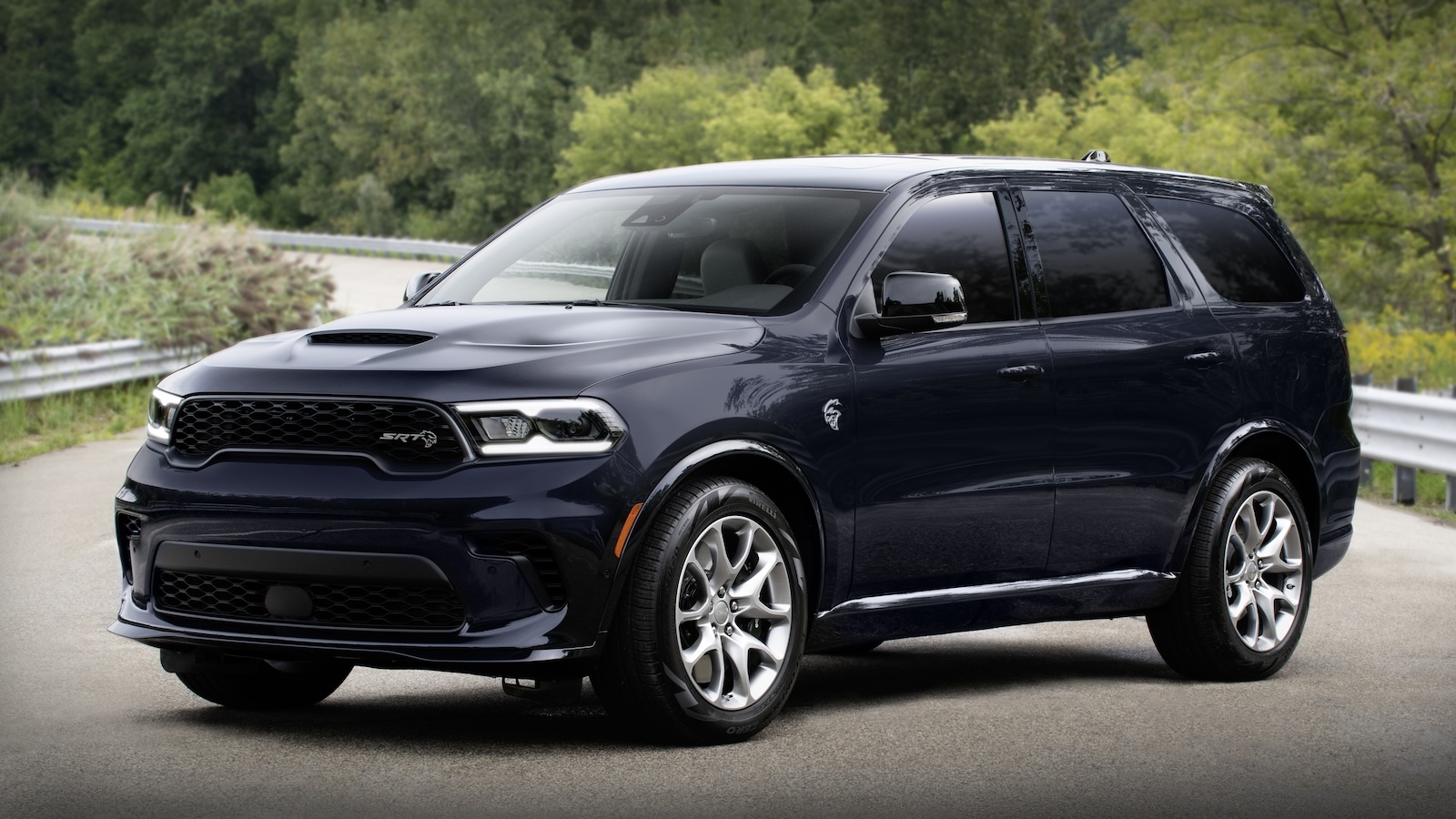
Anyway, it took quite a while for this case to work its way through the courts, but a verdict was reached on Thursday, nearly three years after the suit was filed. As Automotive News reports, Stellantis has won the case.
U.S. District Judge Jennifer Hall in Wilmington, Del., however, found no proof that the manufacturer intended to renege on its promises, or that its statements amounted to an express warranty.
She also said the automaker didn’t violate state consumer fraud laws “where the alleged ‘misrepresentation’ pertained to intended future conduct and was true when made.”
So what does that mean? Well, we need to take a step back and explain burden of proof, with the disclaimer that I am not a lawyer and this in no way constitutes legal advice. In civil cases, plaintiffs must be able to successfully argue that a claim is more likely to be true than it is likely to be false. This is generally referred to as preponderance of the evidence.
Back in 2021, the Durango SRT Hellcat was a one-and-done vehicle. Dodge later decided to revive the model. Therefore, it was up to the plaintiffs to prove that Dodge more likely than not had plans to resume Durango SRT Hellcat production two years after the model’s initial run. While I am not privy to evidence entered in the case, Judge Jennifer Hall found that Dodge’s statements back in 2021 were accurate at the time.
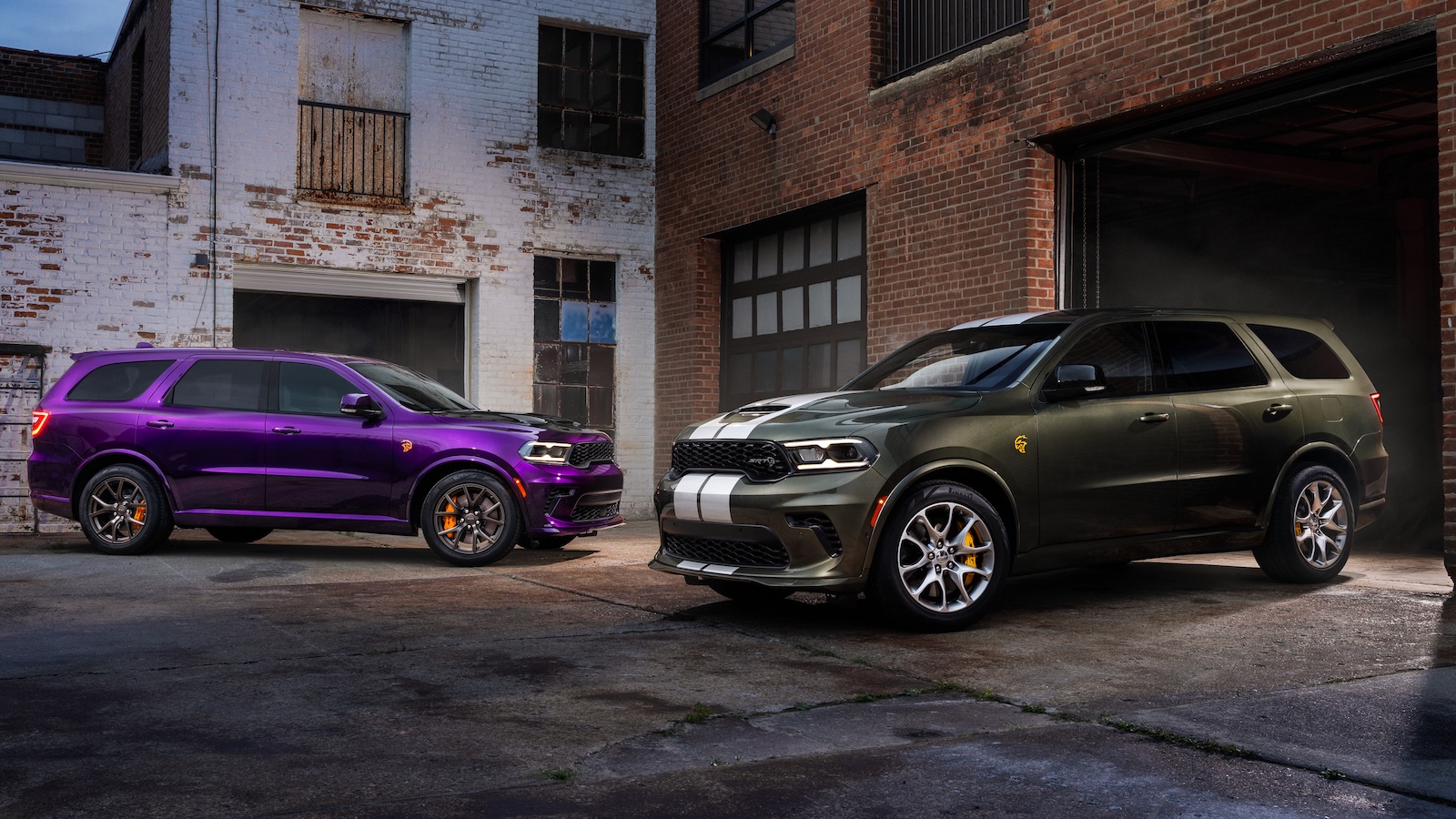
While it’s understandable that some owners would feel slighted by the reintroduction of the Durango SRT Hellcat for 2023, most cars are terrible value propositions. Outside of blue-chip collector items like limited-edition Ferraris and the like, even many appreciating cars don’t beat inflation, and that’s before you factor in carrying costs like storage, maintenance, and insurance. Buy a car because you like it, not because of its rarity or potential future value. In the case of this 710-horsepower SUV, it’s hard not to like it.
Top graphic image: Dodge


I really like the purple in that last photo.
I mean… they definitely asserted in the marketing materials that this was a product that would be made for one year only. It sounds like some buyers relied upon that assertion being true to inform their decision to buy.
I don’t care for the concept of buying limited-edition stuff as an investment, but there’s plenty of precedent in the world of things like art prints and other collectibles where the fact that there’s an explicitly finite quantity of an item is a significant part of its value.
So the real question is, was Dodge’s marketing an actual warranty to limit production after a certain number were made? Apparently according to the courts, no (I suspect because Dodge did not state an explicit upper limit on the number of Hellcats they would make–but OTOH, they did state an explicit upper limit on when they would stop making them, which I would have thought is equivalently binding). But then, it’s also hardly the first time a big corporation has gotten away with what reasonable people would consider lying in their marketing.
I would love to get a judge’s gut-level reaction when a case like this first comes to their attention because it’s on their docket or whatever.
What was the point of the limited run anyway? Stelantis isn’t going to get any benefit from dealer gouging on a rare model so why make it rare?
They go through all the trouble to make a behemoth and then…. just make a handful? I get it that all the parts are already on the shelf for other vehicles but there has got to be a ton of government red tape to bring a vehicle to market. Just sell as many as people would buy?
Unless they’re a loss leader, get people to show up at the dealership to gawk at the fancy one and then send them home with a nice 94 month loan at 22% on a v6 poverty tier example?
Why does anyone make a limited run of anything? To make it more desirable.
I get that theory, I just don’t get why a manufacturer would do that. Making a car is expensive, and selling a tiny number of them just seems like a bad ROI. They get none of the end user price gouging profit so what’s really in it for them?
It’s basic marketing. The plaintiffs in this case say claim it themselves: they would not have bought one, or would not have paid as much, if if wasn’t “limited edition”. Feeling like you might miss out is a good motivator to make people want things and make impulse buys. Also the sense of exclusivity–people like to feel superior by having things that other people don’t or can’t have. More mercenary, those who were “investing” in the vehicles were relying on limited supplies to drive up value. All of those things mean more people will by the car than otherwise might have. The strategy for the company is, how many can you make before the effect gets too diluted? Apparently Dodge decided there was enough demand that they could make another run of vehicles without relying on the exclusivity effect anymore, but those who bought one primarily because of it are now pissed.
It’s unusual for a big company like Dodge to do it, but basically all the hypercar makers like Ferrari do this all the time. It’s just they are usually more “honest” about keeping their limited runs limited, because exclusivity marketing and brand trust is a bigger deal for them.
For the plaintiffs to win, they had to prove Dodge had a plan.
That’s a big hill to climb.
“Mah Dodge ain’t worth much as I paid now that you’ve gone made a new one! Imma sue!”
‘Muricans gonna ‘Merica
Hilarious lawsuit for a car that has otherwise been exactly the same for 15 years.
I had a 2019, for a year. It had switch gear that was the same as my 1999 Dakota. the switches themselves were slightly updated, but the muscle memory to reach for the headlight switch/fog lights was immediate.
I didn’t hate it, but I can’t bring myself to pay new prices, and even with the base V6, gas mileage was terrible and filling the thing was expensive. $75/tank for 88 octane was a hard pill to swallow.
Let me clarify here.
This is Phillips et al v. FCA US LLC et al., 23-251, District Court for District of Delaware.
There was no “verdict” entered.
The Court granted the Defendants’ motion to dismiss.
Meaning that even if everything Plaintiffs said was true, they still couldn’t win.
Judgment was not entered.
Plaintiffs have 14 days to amend their complaint and almost certainly will do so.
So likely years more to come on this.
And if you want to know why things are so expensive here, this is Exhibit A. Defending frivolous lawsuits is not cheap.
While I think the verdict was absolutely correct, this is the sort of thing Stellantis has openly invited to happen based on the sort of people they so heavily market their cars to. Bold, brash, and extremely entitled people that care more about noise than substance, hence stupid lawsuits.
These are also the same people who see collector Ferraris increasing in price and think their Dodge SUV (or “I know what I have” 1 of 312 1999 Corvettes with red over black interior built on a Wednesday by an operator named Jim) are in the same category…
This is like suing a band over reforming after a “farewell tour”.
In the case of a Dodge Durango Hellcat, I mean come on. If someone is paying aftermarket VIP prices to see something like Warrant (sorry for the stray, Warrant) for the last time, and they come back? Lol, that’s on you.
I paid quite a bit of money back in 1992 to get front row seats for the Ozzy Osbourne “No More Tours” tour. Just to see him one more time before he retired… Lol
How dare you disparage a terrible act with a lot of self awareness.
https://www.youtube.com/watch?v=OR1xpknCHCQ
Sort of picked a random hair band, but I was aware that the frontman hated Cherry Pie. Admittedly didn’t know he died though.
I did apologize in advance for the stray.
There is one very notable difference, you don’t buy farewell concert tickets with the expectation that they will increase in value over time. After the concert, that ticket has zero value (or maybe limited sentimental value), no matter how many more times Warrant plays.
There is a logical expectation, albeit very speculative, that a value of a limited distribution of a desirable vehicle may increase in value over time.
Of course, FCA could have avoided this by making the 2023 version a Hellcat Demon, instead of a mere Hellcat. There is not a reasonable expectation that Dodge would later come out with an even more desirable version of the vehicle, as long as it is not the exact same model as the promised limited edition.
This is true, though I could argue the “I was there” credibility (a la LCD Soundsystem’s Losing My Edge, ironically a band who ended up doing the farewell to reunion pivot themselves) value decreases greatly when you see a farewell concert that was in reality, just another concert.
But that argument is pretty flimsy, lol.
As someone who saw Stevie Ray Vaughn’s last concert on Auditorium Shores in Austin, I get it. However, in that case, it tragically was not intended to be his last.
Both very cool and simultaneously uncool.
nelsonhaha.jpg
I can’t imagine looking at a Durango and thinking, yep, that’s a sound investment in a future classic right there. It isn’t even one of the cooler Edward Herrmann ones
Pizzeria Beddia is awesome.
https://philadelphia.today/2025/07/pizzeria-beddia-best-pizzerias-in-the-world/
I for one am happy they continue making them
Wait until my lawsuit hits over my Ford LTD! Liars!
I’m going to take a slightly different tack on this…
In 2021, Dodger said that they were only going to do a 1 production-year run.
Then, they announced another for the 2023 model year.
But here’s the question: how far in advance of the 2023 model year production start did they make the decision to revive it?
Maybe some of the other Autopian writers haves some idea of how long it takes to go from “maybe we should do this” to “actually doing it.” I’d be shocked if it was less than a year
Well they had just about everything they needed to restart making them. It’s not like they had to do a redesign or have new manufacturering equipment
You could prove it with parts ordering, did they order the parts for 2023 back in 2021.
It really depends on what they did to the tooling at the factory if they left everything in place and made no updates they could resume production quickly like months. Especially since it shares components with other Dodges.
All the tooling was still actively being used. In 2022 you could still buy a V8 Durango and a Hellcat Challenger or Charger, so all of the necessary parts and tooling were definitely still there.
It just makes the “collectability” argument that much more absurd, since the only thing special about the Hellcat Durango is they stuck some parts-bin parts together in a different configuration than the hundreds of thousands of other Durangos out there.
Very much an “I know what I have” type of “collectible”.
I think this could be an argument if the Hellcat Durango was something like the Ford GT where the entire car was essentially bespoke and you couldn’t buy anything like it once it went out of production.
But in 2022, you could still buy a V8 Durango and you could still buy a Hellcat Charger or Challenger. All they had to do was deliver some Hellcat motors to the Durango line and stick on some badges. I wouldn’t be surprised if it was less than 3 months from decision to production to restart it.
Even bringing the Hemi back in the Ram was only a couple of months, and they had supposedly put the Hemi completely out of production.
But those extra engines weren’t just lying around. If they wanted to build more Durango Hellcats without reducing Charger/Challenger Hellcats, they’d need to manufacture more Hellcat engines.
Right, but they were actively manufacturing Hellcat motors in some volume. It doesn’t take much to say, “hey, let’s make 10% more Hellcats next month than this month.” That kind of fluctuating capacity planning happens all the time and going from 1000 engines a month to 1200 or whatever is much, much easier than going from 0 to 200.
And I’m not sure on production numbers, but I wouldn’t be surprised at all if they had planned more Challenger and Charger Hellcat production than the market was buying in 2022 and realized they needed to reduce production. Bringing back the Durango Helllcat might have been a response to lagging Charger/Challenger Hellcat demand and needing to use those planned engines somewhere.
Will be interesting to watch depending on what happens next in the litigation.
“No, no, no — the 2024 model was actually called the Hecate. Not Hellcat.
You know, Shakespeare, double double toil and trouble?
No? OK, I’ll pack up my things. Any severance?”
–how to work for Dodge for a single day
Just think. They admitted to buying a Dodge, and thought it was an investment. It’s swamp land in Florida time.
There’s an awful lot of really low mileage Vipers from the 90’s for this exact reason.
And pace car edition Corvettes and Monte Carlos, and, well, Corvettes in general
“A fool and his money”.
So between the seven of them, they overpaid by five million dollars? I don’t understand lawsuits.
Pain and emotional suffering damages for owning a Stellantis product.
There are lot more than 7 people that should be suing for the emotional suffering for owning a Stellantis product.
its a proposed class action, so if they won it would be on behalf of everyone who bought one
I doubt they intended to win. This is the kind of case you hope annoys the big company enough they settle just to make you go away. If they had each recouped some chunk of what they overpaid, and their attorney fees, they would likely have settled. My guess is Dodge was annoyed enough to take it all the way.
I recently sat in one of these at a new car expo. Gotta say it was one of the only vehicles I sat in that passed my base screen test. Are all screens integrated fully in to the dash? Nearly every other car is a tablet glued to the front of the dash and I hate that with a passion.
Dodge also had the considerable risk of settling turning into a bunch of customers suing that their “special edition” wasn’t worth as much for one reason or another.
Dodge’s whole schtick for the last decade+ has been sticking new graphics and trim lines onto the same old products so people think they’re somehow special and will overpay.
And it could still end that way.
Dodge will not entertain any kind of settlement discussions unless/until the case gets into the merits phase.
And their dismissal motion was granted here, so Plaintiffs need to try again if the case is to move forward.
The Plaintiffs, at least according to how the article is written, lost on the merits, not a technicality. So they can’t bring the same claim again, except by appeal to a higher court. Its really hard to imagine that they will find monetary value in an appeal, so it would be driven by a pure need to punish Dodge at that point I think. Its possible their attorney was working on contingent this whole time and its cost them nothing, but I would be surprised by that, and even more surprised if the contingent attorney was willing to go to appeal. Personally, I imagine this is now fully dead.
I would actually be interested to know how many of these owners have already sold off their vehicle anyway.
The article is written that way, and it is incorrect. See my above comment. The court yesterday granted a motion to dismiss and allowed Plaintiffs 14 days to amend.
well that changes everything about what I said. I suppose thats what I get for having an opinion based on one source. If its just a motion to dismiss and they have 2 weeks to amend the complaint, I think you are most likely correct and this continues.
Are you saying that buying a new Dodge wasn’t a sound investment strategy?
Instead of 40% first-year depreciation, this one will have 30%!
??
PROFIT
I’m surprised people actually thought they’d win this lawsuit, it’s pretty obvious that paying dealer markup for a volume brand car is never a good idea, hell it’s not a good idea for an exotic either.