

Restomods have their place in the world, but most of them don’t excite me. Striving to differentiate the new car from the old one, small tuner shops and manufacturers often do too much when it comes to modification and modernization.
The results are usually restomods that stray too far from the original car’s design, and end up looking goofy or worse. These cars also almost always cost way more than a lot of new supercars, making them appealing only to a very small sect of rich people.


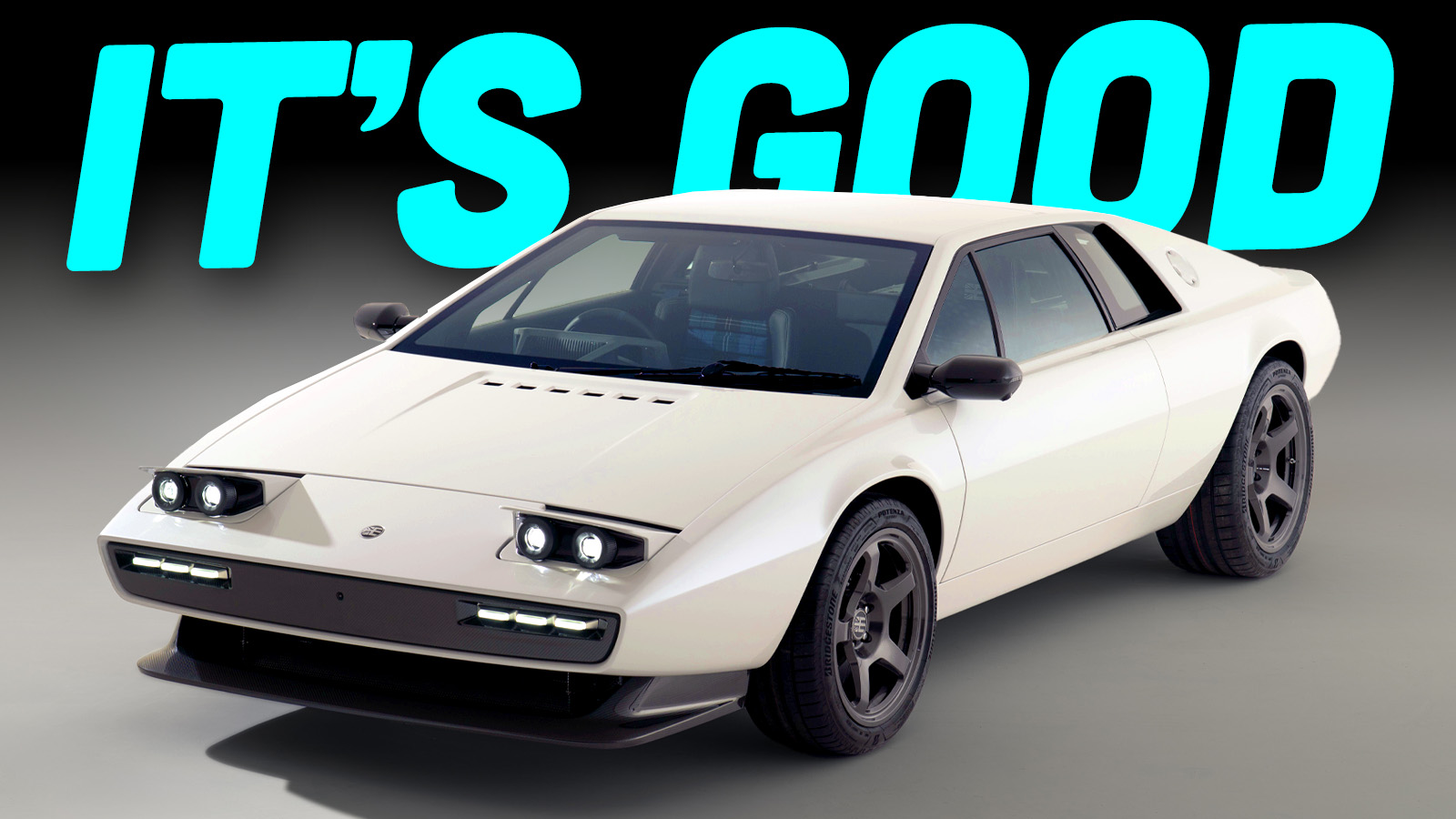
While this latest Lotus Esprit restomod will cost an arm and a leg, I have to admit I really like it. Instead of going over the top with a widebody kit and extra aero, Encor, the firm responsible for the car, uses a far simpler, cleaner design inspired by the 1975 Series 1 Esprit.
This Is How All Restomods Should Be

I think restomods should aim to be as subtle as possible. All modern underneath, but generally comparable to the original car. From a distance, I shouldn’t be able to tell whether the car I’m seeing is a restomod or not. And I think Encor nailed it here.
The only significant changes are to the lighting and the wheels. In place of turn signal lights embedded in the front bumper, there’s now a thin strip of daylight running lights. The pop-up headlights have been retained, fortunately, though the lights themselves are far smaller than the originals. The taillight area, meanwhile, has also been rewored to include a thinner set of blocker light pods.

The wheels are the biggest differentiator here. Instead of using the original S1 wheels for inspiration, the five-spoke wheels were inspired by the five-spokes found on the Esprit Sport 350, a rare, more hardcore version of the Esprit V8.
It’s Not Actually an S1 Esprit
Encor very creatively calls this restomod the Esprit Series 1, and while it might look like a Series 1 Esprit, its bones come from the opposite end of the Esprit family tree. The carbon fiber body panels hide a Series 4 Esprit from the 1990s, complete with that car’s 3.5-liter twin-turbo V8 engine.
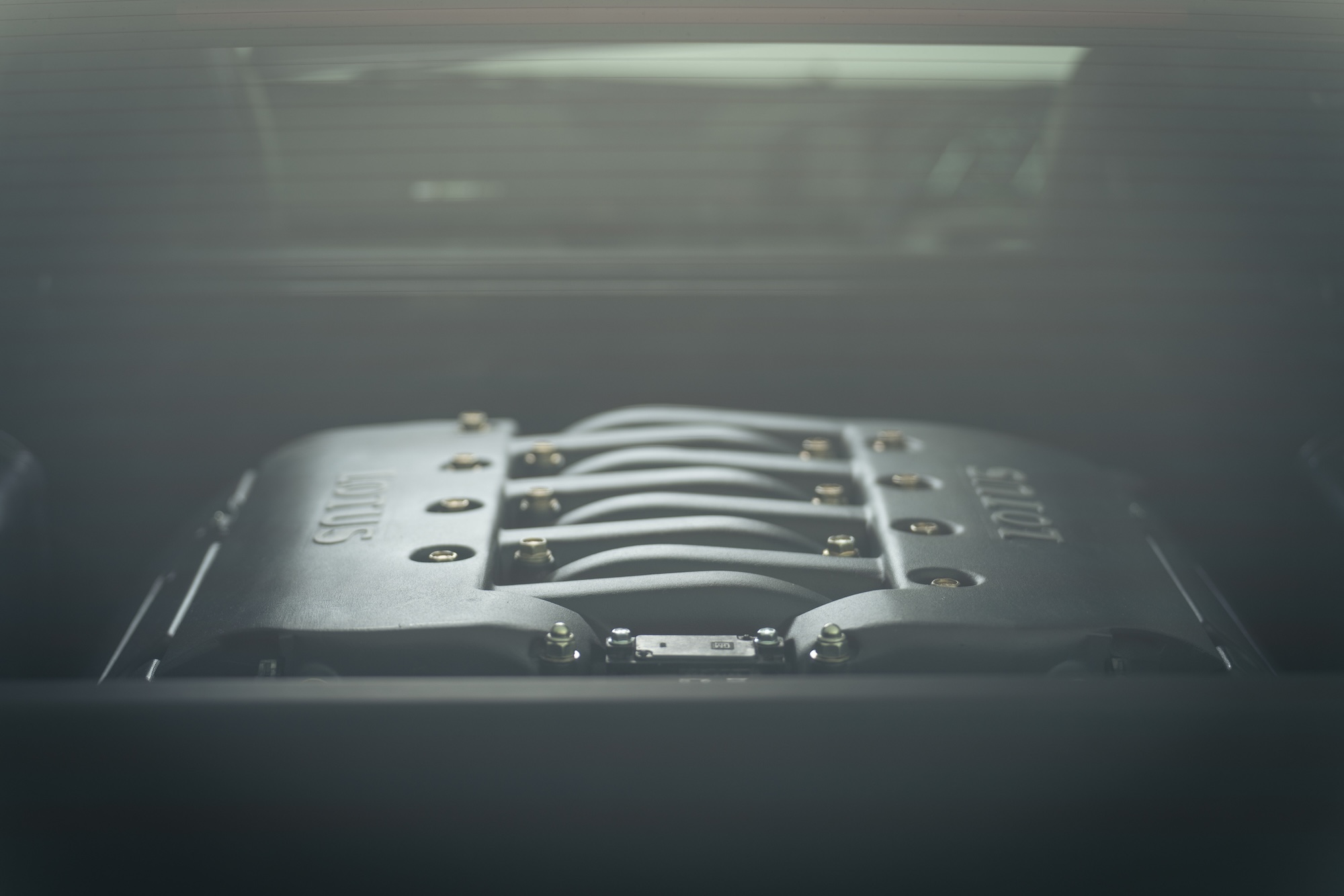
Being a restomod, every inch of the powertrain’s been thoroughly gone through and upgraded. Encor says it’s added forged pistons, better injectors, and rebuilt turbochargers. The throttle body has been converted to an electronic unit, while the fueling and cooling systems have been replaced with more modern, higher-performing equivalents.
The result is an extra 50 horsepower, for a nice, even 400 horses in total. Torque is up about the same, from 295 pound-feet to 350. Encor says the Series 1 can sprint to 62 mph in four seconds, on to a top speed “close to” 175 mph, in case you care about performance numbers like that. I personally don’t, but more power and modernity are always nice when dealing with vintage sports cars.

What I’m really happy about are the changes Encor’s made to the transmission. The Renault-sourced five-speed is famous for its ability to fail, even at stock power levels. Chief engineer Will Ives told Autocar the firm wanted to replace the gearbox altogether, but the car’s packaging made that difficult. The press release mentions a stronger input shaft and revised ratios, but it goes deeper than that:
Ives said “it was always considered a limitation of the [original] car, but it’s pretty much impossible to package anything else within the space”, so the team had to find a way to “effectively recreate a new transmission out of the casings of the old”.
Keeping “just a few” pieces of the gearbox’s internals, the team created effectively a new unit. They also added a limited-slip differential to improve the drivetrain’s strength.
“We’re addressing that weakness and that enables us to then take the engine up to a slightly higher output, because we’re no longer limited by the original gearbox,” said Ives (pictured belowm, centre right).
A bunch of other stuff has been upgraded, too. The Series 1 gets the suspension from the Sport 350. The new brakes, meanwhile, come from AP Racing. Thankfully, the power steering has not been converted to electric assistance; Encor is keeping it hydraulically assisted to preserve the car’s “driver-focused character.”
Okay, Maybe I’m Not Completely Sold
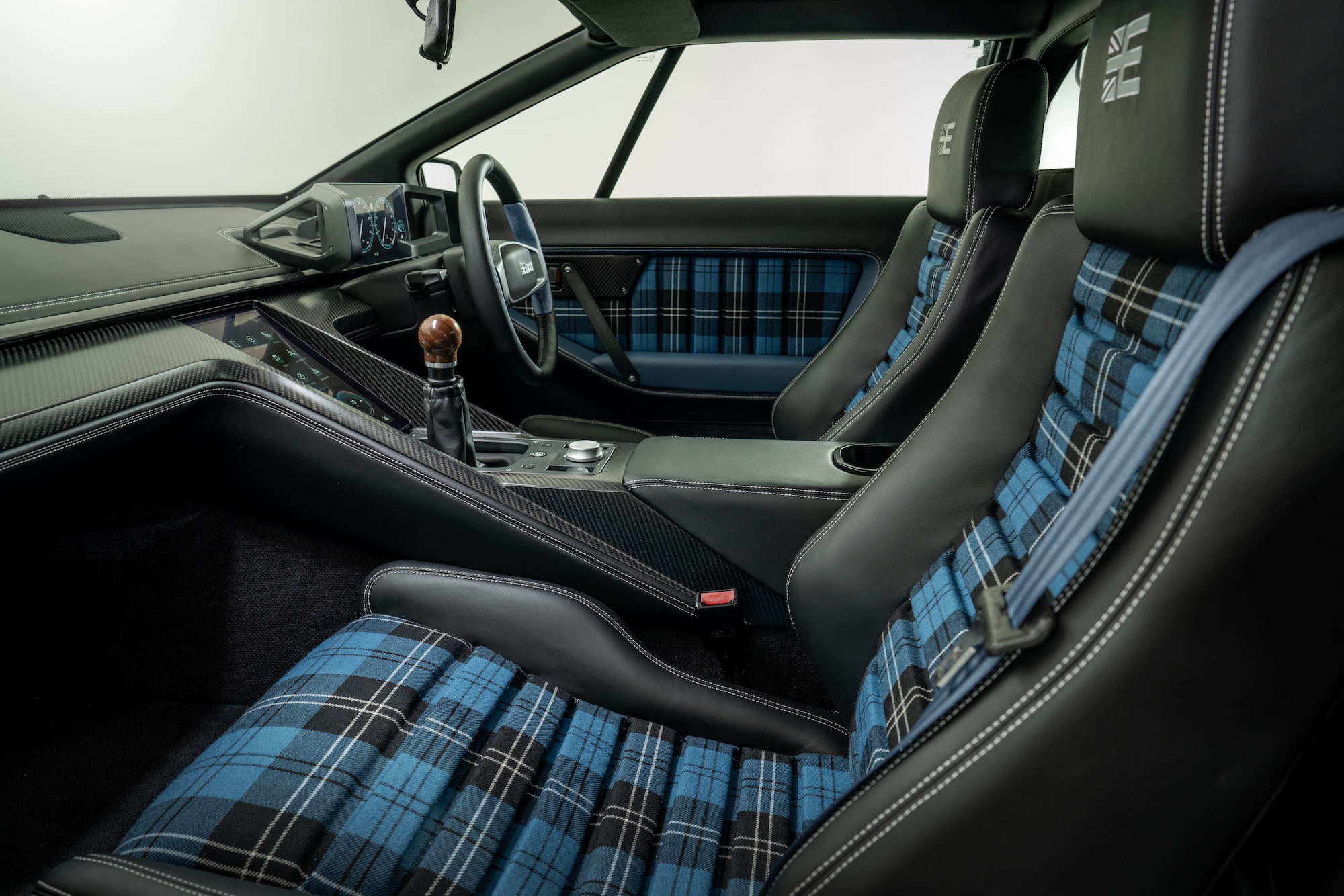
I think I can forgive Encor for the wheels, but I don’t think I could live with this interior. While it retains the same general shape as the original Esprit’s cabin, it’s decidedly modern, with a carbon fiber center console and two big screens: one for the gauge cluster and another for the infotainment system.
The inside doesn’t look like a bad place to spend time. I greatly enjoy a plaid-trimmed cabin and the two-spoke wheel, after all. But if I’m paying £430,000 (around $574,000) plus the cost of a donor car, I feel like some nice, classy analog gauges and trim would probably be more appropriate here.
Encor is planning to build 50 of these Series 1 restomods, which feels like the right amount. There can’t be that many more people in the world who would want a car like this and have that kind of money to blow … right?
Top graphic image: Encor




The screens suck because, well, screens in cars suck, but what really ruins it are the stupid fucking lights. They are awful.
I’m not entirely anti-screen, and get that it’s a lot easier to pop in a digital dash when converting to something like a Haltech or Link ECU, but if two guys in a shed can make analog gauges work in a restomoded Mini (Project Binky) there is no reason this car that costs more than my house can’t have them as well.
Agree that the plaid seats are nice, and the cold, uninviting carbon-fiber trim and LED gauges are out of place. The Esprit was cozy and plush.
Up front, I kind of like the toothy LED running lights, but the beady pop-up headlights are character-changing in a bad way. And the front air dam looks like a big rubber dustpan.
The Dodge Challenger ass is unfortunate.
I get that the rub strip that hid the body joins on the original isn’t functionally necessary, but it was also an important styling cue.
Why is it such a restomod trope to have wheels & tires that are way out of proportion? The thing looks like it’s headed off-road.
I wonder how many fully-restored S3s I could get for $500k…
Absolutely the most significant change is getting rid of the “rubbing strip” along the middle of the body side that hides the flange where the top and bottom FRP mouldings were bonded together.
So that’s why I had such a hard time recognizing this car at first…
I knew there was *something* not there.
The pop-up headlights are bad and should feel bad.
Either put the headlights in the bumper or do it properly. It instead uses 4 tacked on things that don’t fit at all.
$600 thousand dollars? 😀
Come on, that’s beyond the pale. I’m not saying that they can’t find 50 buyers at that price, what with all the aspiring Bezos and Musk types around, but I’m sorry, that price just seems like an optimistic ‘what the market will bear’ decision.
The blue plaid seats look cozy though.