

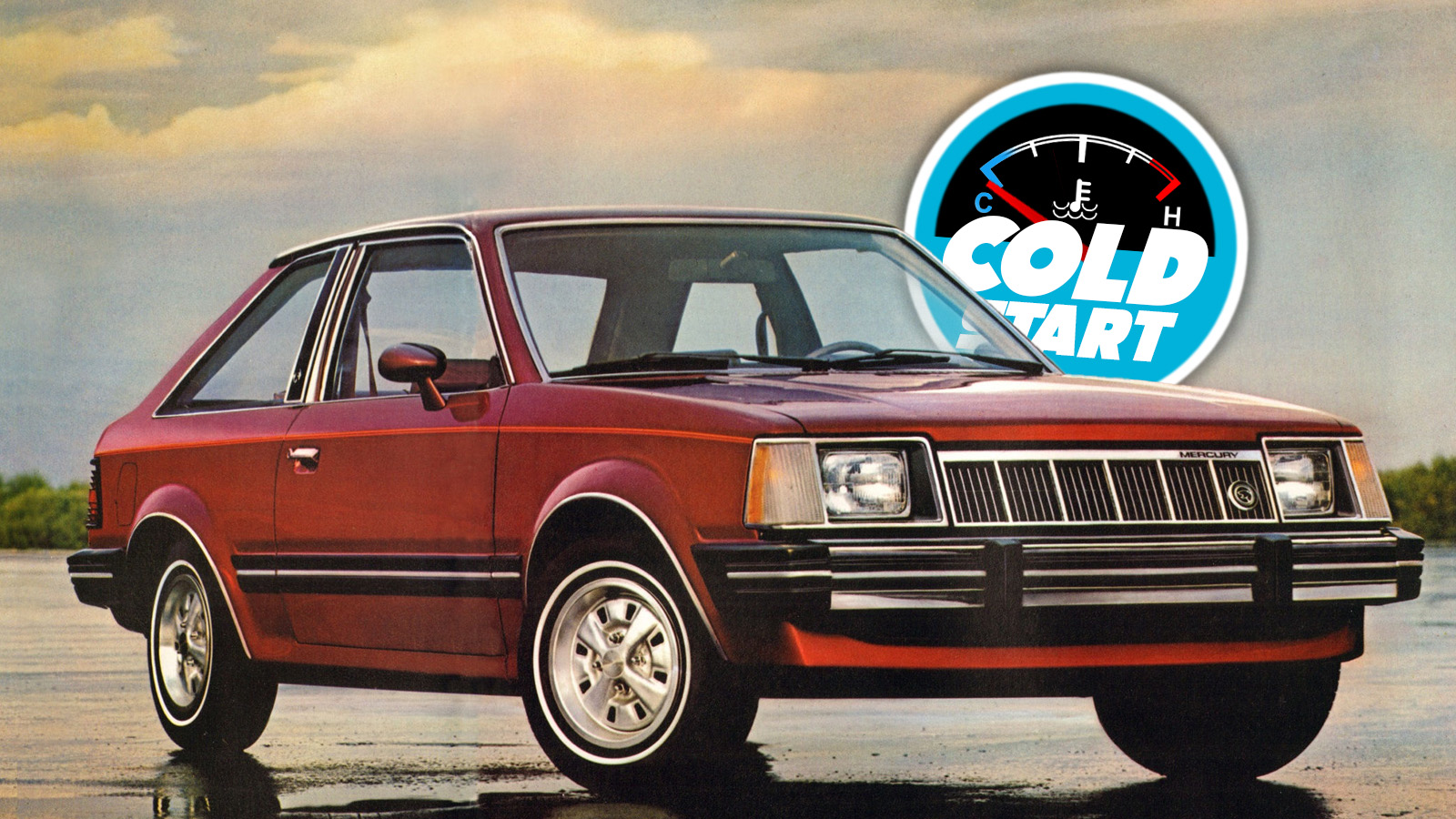
First of all, I need everyone to stay calm. Freaking out and throwing chairs (you know who you are) is not helping. At all. Except that time we needed those chairs moved, fast, that time it actually was really helpful and thank you again for that. But when it comes to the subject at hand today – the Mercury Lynx – the only way we can do this is if everyone remains tranquil.
The Mercury Lynx (Mercury’s first FWD car!) was the badge-engineered version of the US-market Ford Escort, and what I mostly want to focus on this morning are the “tells” of upscaliciticicityness, those ineffable markers that telegraph to the world that you are a person who spent a little more on their car.


We’ve already addressed how the US-market Escort and the European-market Escorts differed, and used those subtle markers and styling differences as a way to discern what means “American” or “European” in the human mind:

… and now we’re going to do the same thing to see if we can distill down what meant “premium” or “luxurious” to the 1980s American mind by comparing the Ford and Mercury versions of this same car:
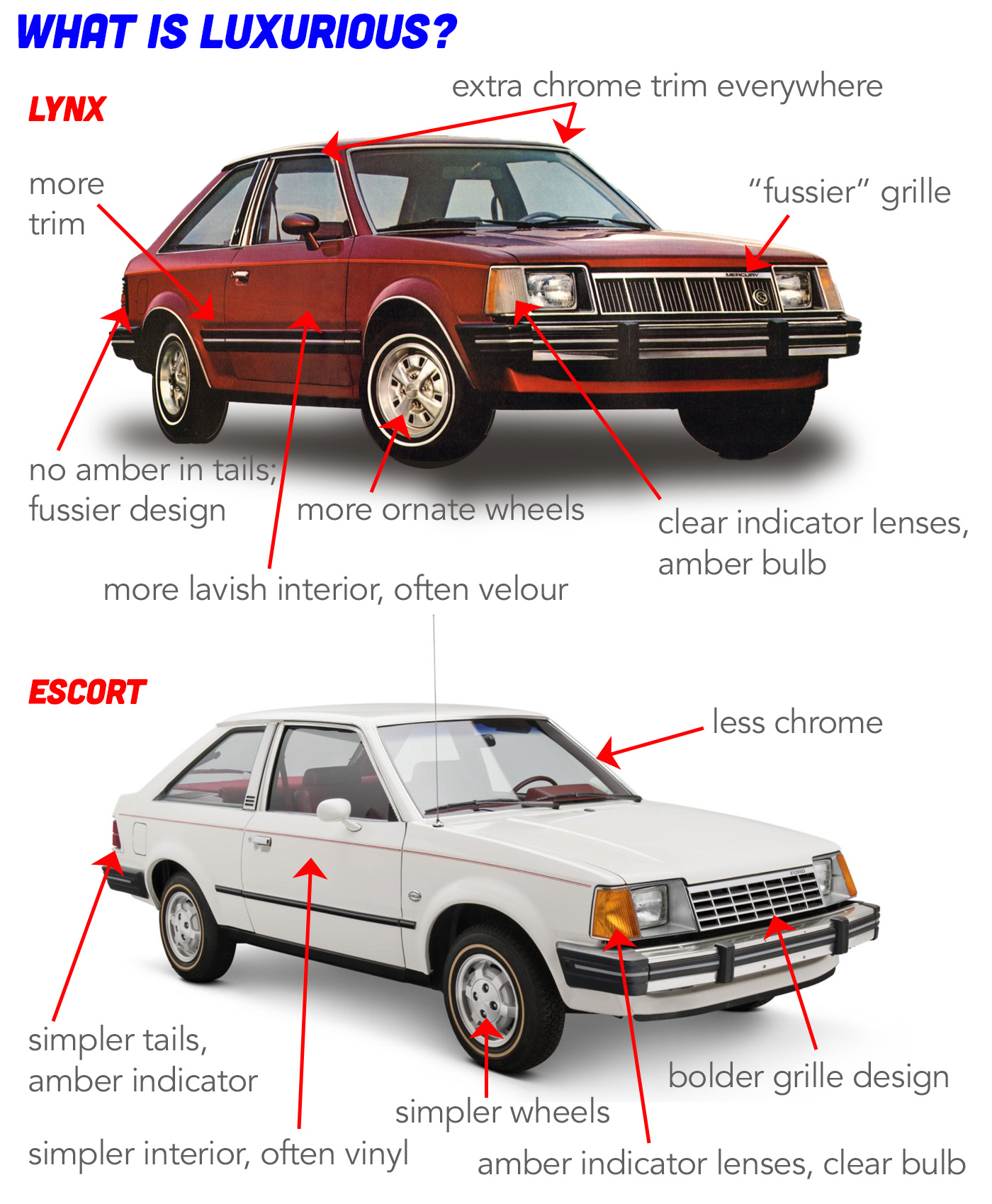
These tells represent some of the most basic signifiers of an “upmarket” car, because the Mercury Lynx was really barely changed from its Escort sibling. As a result, the changes we do see can be interpreted as being a sort of baseline for conveying the concept of a more premium or luxurious car.
They’re mostly aesthetic choices, and revolve around the concepts of increased ornamentation, usually in the form of chrome trim, and what I always think of as a sort of “finer” scale to the detailing. Smaller design elements, higher density of those elements, thinner lines, that sort of thing. The two grilles here are a good example of this, as are the taillights, with the Mercury version having a lot more linear detailing and no amber indicators.
Speaking of, amber as a color seems to have been deemed downmarket, and “premium” cars often have clear indicator lenses with amber bulbs inside as opposed to vivid amber lenses.
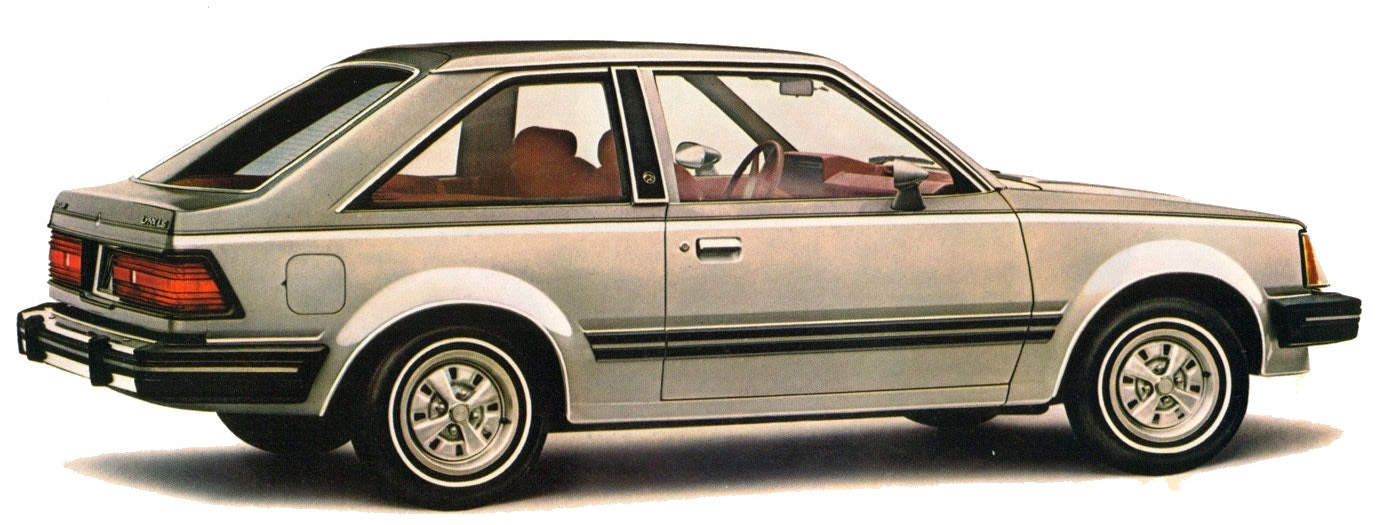
These are telling distinctions, I think, and I suspect there are many important cultural anthropology papers waiting to be written based on these concepts. You can cite me in the footnotes, if so.
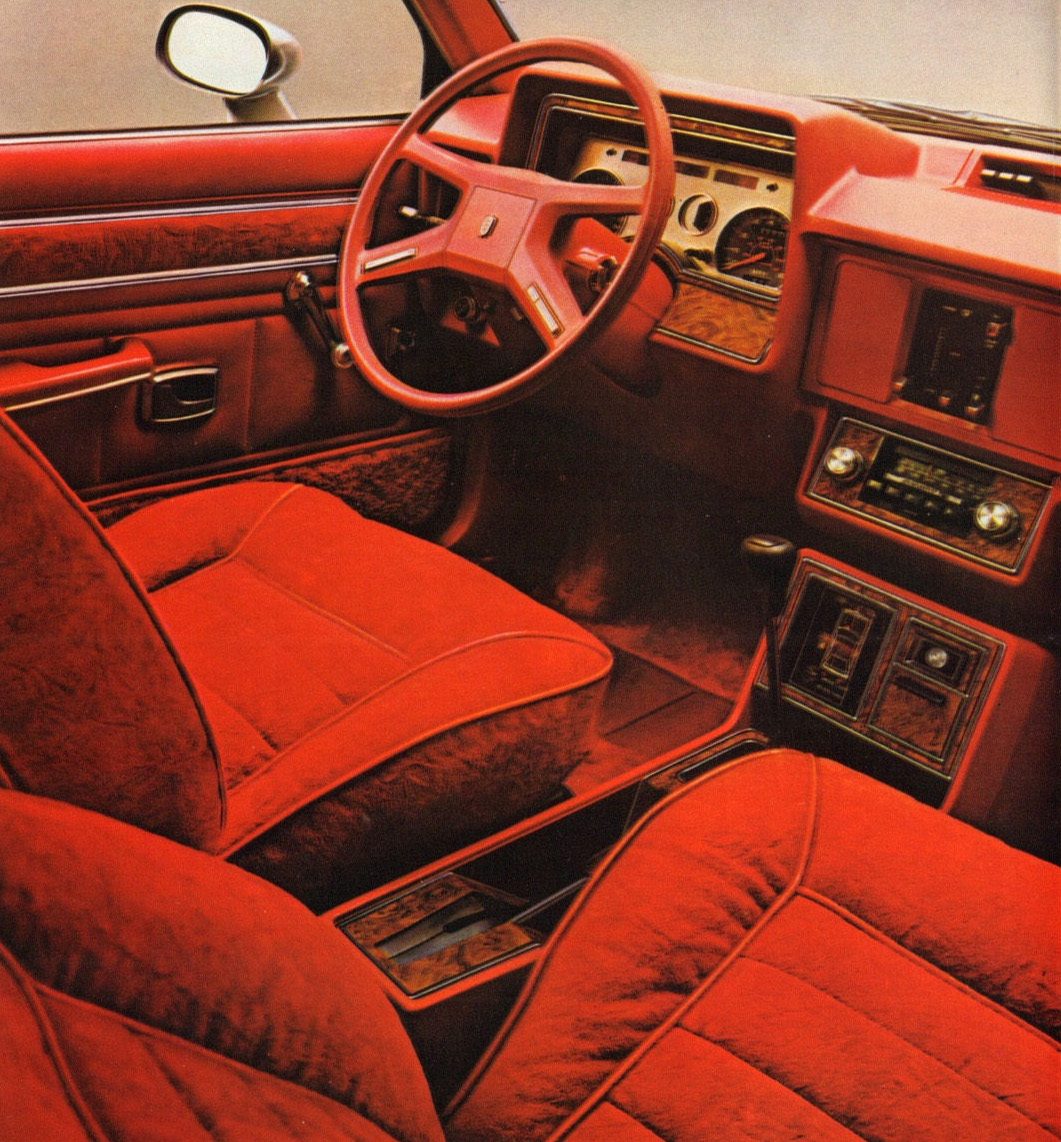
The interior, of course, is where the magic really happens, as you can see in this gloriously scarlet vision above. Upholstery is deliriously velour, rich and deep, and look at that fake wood! It looks like some sort of bird’s-eye maple? Definitely a more ornate grain than the usual fake wood trim, which is sourced from fake oak trees or even fake pine.
And look how much fake wood there is! Every surface has been slathered with it! I also like how in this car, which seems to lack air-conditioning (!) has two flat red panels replacing the air vents. It’s amazing to think of a time when an upmarket anything wouldn’t have included air conditioning.
Of course, the other part of making a car feel premium is how it’s being marketed, and there’s no quicker way to classy than taking a ride on the Vangelis train:
Also, look at those lynxes!
If the man who scored Blade Runner isn’t enough class for you, what about a giant white sphere set into what looks a lot like what would become the Windows XP desktop more than a decade and a half later?
I also love how much attention is given to the digital clock. The sporty version of the Lynx, the LTX, wasn’t really the equal of a VW Rabbit GTI or anything like that, but it was likely a little more fun than the base Lynxen:
I haven’t seen a Lynx in decades, but I hope if, somehow, you encounter one, you’ll take a moment to really consider the many cultural questions they evoke.


This is a wonderful cultural studies piece! At the time I would have found that red velour pretentious, a sort of denial of the radical downsizing Detroit had succumbed to and whose oppulence belonged in the land yachts of a decade earlier. Now I wish for the option of colors.
Of the three triplets shown, I like the “aero” front of the European one most, it’s almost Audi-like.
Of course this sort of Roger Smith brand engineering denigrating whole marques to nothing more than names and trim levels helped put GM on the road to bankruptcy decades later with Buicks, Oldsmobiles, Chevys, Pontiacs and eventually even Cadillacs largely indistinguishable. At least Ford only had the Mercury clone and the better differentiated Lincoln.
I had a 88 Plymouth Horizon but wanted an Escort GT- the first and second gens (before the bean ones) were pretty cool. I think that, to *my* young mind, what signified “upmarket” was the tiny vestigial trunk bump that made it look a bit less like a hatchback.
My buddy drove a hand-me-down 1984 Mercury Lynx known as ‘The Black Cat’. I had a 1991 Ford Escort. We both crashed our respective shitboxes within the same week.
Unfair to compare the visuals of the US Escorts with an XR3; should have used an L or a GL – and then another comparo between a Euro Escort Ghia and a Mercury Lynx.
Also, I’m being the euro pic is about ten years newer
Nah, it’s just that Americans were/are behind their times – the XR3 was available from September 1980; here is a first-year example for sale:
https://www.historics.co.uk/auction/lot/lot-198—1980-ford–escort-xr3/?lot=6915&sd=1
Wow, it’s amazing what composite headlamps and less chrome will do.
The first car I remember my parents owning was a two door Escort. (A Euro one because this was in the UK). With two doors, one wing mirror, and in baby-shit yellow/brown.
This clearly had a big impact on their car buying, because they never owned another Ford.
Now I know it could have been worse. They could have owned the US version of the Escort, yuk.
The Mercury Tracer was a massive improvement over the Lynx, because it basically a Mazda
I see a few robot forms in the center dash & console!
Let’s talk Mercury Lynx with 2.0L Mazda sourced diesel.
Good news! AI has confirmed upscaliciticicityness’ wordinessity:
The Mazda based Tracer that came later was very nice.
Green or purple required
Ahhhh yes, the high class Escort! Oh that didn’t come out right.
It’s telling that at the time the American brands idea of luxury was more trim pieces, the Japanese was a car that started every time.
I knew a kinda crazy old lady that had and lynx and a merkur. Her reasoning was she wanted something European but also with American price and support after living in Germany for years.
A high school friend had one of these- I can still feel that 1-2 upshift in the 3-speed auto: it would rev pretty high in 1st off the line and then absolutely fall off a cliff into 2nd practically down to idle. No tach, of course. Just awful. But it always started and went!
Y’all forgot about the diesel version.
Air conditioning on upmarket cars? 1965 was the first year one of the Cadillac models made AC standard equipment. 1977 was the last year you could save a few dollars on any of the Cadillac models by skipping the AC option.
Who needs AC on a winter beater, I mean Lynx/Escort ???
I took my base model ’87 Lynx L, ditched the garbage 1.9 CVH and 4 speed trans when the clutch gave up, swapped the “HO” 1.9 EFI and 5-speed drivetrain and wiring harness from a ’86 XR3 and the interior from an ’84 Turbo RS. Great car education as i was growing up, and fun backroad barnstormer w/ light rear end and low power. Could do 2 wheel burnouts through second, and a mini chirp from one tire in third. Surprisingly good car, the hatchback could fit whole 250cc dirtbikes, once the interior was removed!
I can smell that interior photo… both when it was new, and what it smells like today.