


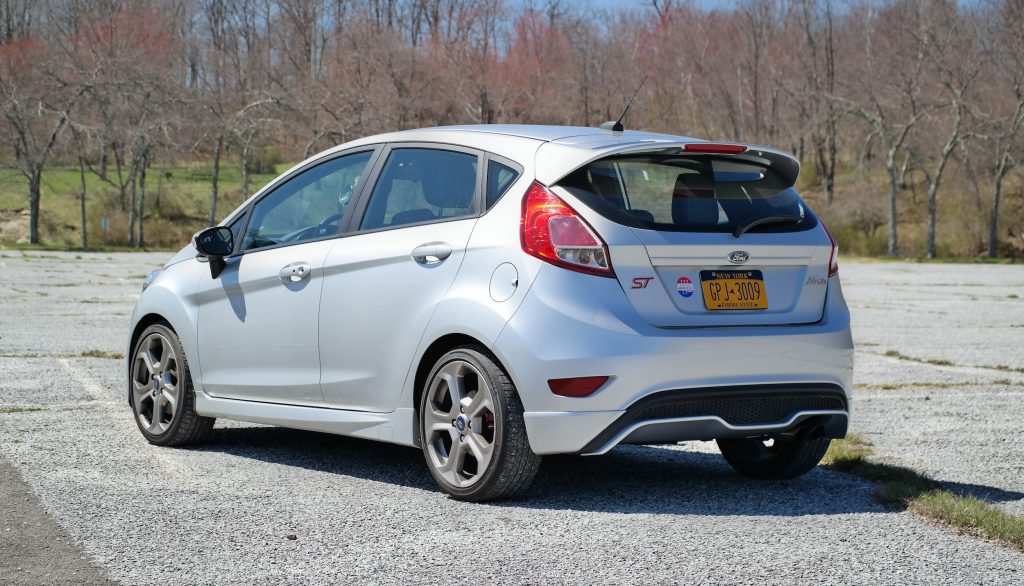
Throughout college, I owned what I consider to be one of the greatest hot hatches of our time: A 2014 Ford Fiesta ST. The rowdy little five-door was a flawless steed, hauling me to and from my parents’ house every semester, but also helping me break into the automotive space through autocross, track day, and ice racing events. I bought the car new and put nearly 50,000 trouble-free miles on the clock before finally getting rid of it.
As an enthusiast car, the Fiesta ST is near flawless. It had a turbocharged four-cylinder making nearly 200 horsepower—plenty for something that weighs just 2,720 pounds. The only transmission available was a slick-shifting six-speed manual. Mine even had the optional Recaro bucket seats, which are still among the most aggressively bolstered I’ve ever used in any road car, ever.


While I can sing the praises of the Fiesta ST for days, it does have one glaring flaw: The gas pedal. On first glance, you might not understand what I’m talking about. It’s just a metal-capped pedal, after all. The spacing between all three pedals is pretty good, and there are even rubber grips to keep your shoes from slipping off. This issue is something you’ll only really pick up on if you drive the car hard.
So What’s The Problem?
The drawback lies with the physical positioning of the throttle pedal within the footwell. For some reason, the pedal is placed far closer—maybe about an inch or two—to the carpet than the brake pedal. It’s not really an issue when you’re just driving and shifting normally, and many owners may never notice it at all. But I noticed it immediately, and it drove me crazy throughout my entire three-year ownership.
Why’s this a problem, you may ask? Before I dive any further, I have to explain the art of heel-toe shifting. Heel-toe shifting, also known simply as heel-toeing or rev-match downshifting, is the act of matching your engine’s RPM to wheel speed while slowing your car down. This is done by leaning one part of your foot—typically your heel or the right side of your foot—to the throttle to “blip” the engine while the clutch is depressed, slotting the shifter into a lower gear simultaneously. Here’s a quick tutorial video that depicts heel-toeing nicely:
Heel-toe downshifting smooths out the downshifting process on deceleration, eliminating the jerk you’d feel if you simply put the car into a lower gear and let out the clutch pedal. That sort of jerking motion upsets the car’s balance, so heel-toeing is important if you’re on the edge of grip coming into a corner—it’s an essential practice if your goal is to extract the most performance from a car. Heel-toeing is also far less harsh on your clutch disc than if you didn’t rev-match.
Back to the Fiesta. The reason I dislike the gas pedal in the little Ford is due to its height relative to the brake pedal. Because it was so much lower, I found it impossible to perform a proper heel-toe shift. The only way to get my foot on the gas and the brake at the same time was to really push down on the brake pedal. But in most real-world scenarios, I never needed that much brake pressure. So I stopped trying.
I Wasn’t The Only One

Source: Brian Silvestro
For a while, I chalked up my inability to heel-toe in the Fiesta to user error. But when I started driving other cars—Miatas, BMWs, Porsches—I realized I could heel-toe just fine. So it had to be the car. I even drove a newer 2016 model-year Fiesta ST a couple of years ago to confirm my suspicions, and I had the same problem.
A wave of validation washed over me when I recently looked for complaints online about the Fiesta’s pedal placement. In a post to the fiestast.net forum, several users mention struggles with regard to heel-toeing in the car. Here’s a quote from one user, EBinVA, mentioning some very similar complaints:
To me heel/toe is a pain in the ass in this car. I hate the way the gas and brake pedal are positioned, the brake pedal is just barely far enough to the side to make it nearly impossible to use the inside/outside balls of my feet without huge fear of slipping off of one of the pedals and the brake pedal is raised just barely too far for me to rotate my heel over and blip the throttle.
Yes! Exactly! There’s more, too, from a user named Smatty in that same thread:
I’m no expert at driving MT but the way I have to position my foot in order to do it in the ST doesn’t even feel very comfortable. If I were needing to do it in a situation where quickness and accuracy was required there is no way I could do it with any amount of certainty or precision. I swear that many reviews I read of the car mentioned its excellent pedal placement for heel toe shifting so maybe I am doing it all wrong…
A fiestaforum.com post titled “Heel-Toe in the FiST??” from 2018 by the user Blackout had a complaint that seems to match mine:
The brakes are way too touchy to press down far enough to where my foot can actually reach the gas.
In that same thread, one user notes that a pedal spacer is “pretty much a must” for Fiesta STs. As it turns out, the pedal placement issue was bothering enough owners that some real aftermarket solutions have appeared in the time since I’ve sold mine. In the case of the Fiesta, the fix is to install a piece of specially shaped metal or plastic behind the throttle pedal mount, effectively bringing it closer in line with the brake pedal. Why didn’t I think of that?
As Always, The Aftermarket Has a Solution

There are a few different types of pedal spacers out there for the FiST. The cheapest is a simple plastic spacer out of Lithuania on Etsy that bolts between the firewall and the throttle pedal assembly, all yours for just $15.99. Another version, also plastic and on Etsy, uses a similar spacer but adds an extension piece for the pedal pad itself (above), affixed to the stock pedal via a couple of screws. More real estate is always good when it comes to heel-toeing, so if you have small feet, this can help. It costs $39.00.
The version I’d choose, though, is a bit more substantial. Like the other spacers, this one mounts to the firewall, acting as an extension for the pedal assembly. But it’s made of metal and, more importantly, it has rectangular slots with rounded ends for mounting the assembly, which means it’s adjustable left to right. That’s huge for dialing in exactly where you want your pedal to be in relation to the brake. This install video from the Project Radium YouTube channel shows exactly how it all fits together:
Being a sturdier piece made from metal, this spacer is a bit more expensive, at $47.00. It’s also made in America, by a Maryland-based company called GarageLine, which makes a bunch of aftermarket parts for a slew of different foreign and domestic cars.
Though I haven’t tried a Fiesta ST with the pedal spacer mod, I have a strong feeling it’d renew my interest in the little hot hatch. While writing this, I couldn’t help but glance at Facebook Marketplace to see how much a used FiST costs. And damn, these cars are cheap now! I had no idea I could pick up a clean one for under six grand. I have been looking for a new “fun” car to add to my stable…
Top photo: Brian Silvestro and Project Radium on YouTube
Support our mission of championing car culture by becoming an Official Autopian Member.


I had engineered a solution within the first couple paragraphs (chunk of 1×2; industrial adhesive), and then I laughed out loud when I saw you paid $47 for a block of plastic.
Just FYI: I don’t think he bought it, he had the car before these were on the market
“some real aftermarket solutions have appeared in the time since I’ve sold mine”
I think the plastic one was $16. $47 was for “metal” (I assume aluminum)
Very similar problem to what I had with my Civic SI. The throttle pedal was too far away in both the left-right spacing and depth. Luckily there was a very nicely made, aluminium spacer that you could buy to fix it.
Why did you get rid of the car??? Sounds like you really enjoyed it
Did this with my accord v6 manual. Debating on doing it with the type s. It made a hell of a difference on my accord. The pedal placement was awful.
I have a Focus ST and I thought this was going to be about the clutch pedal feel. After driving 5 different manual vehicles I did not like the clutch pedal feel of the Focus ST.
I wound up removing the factory spring and replaced it with a couple aftermarket throttle cable springs, much better.