

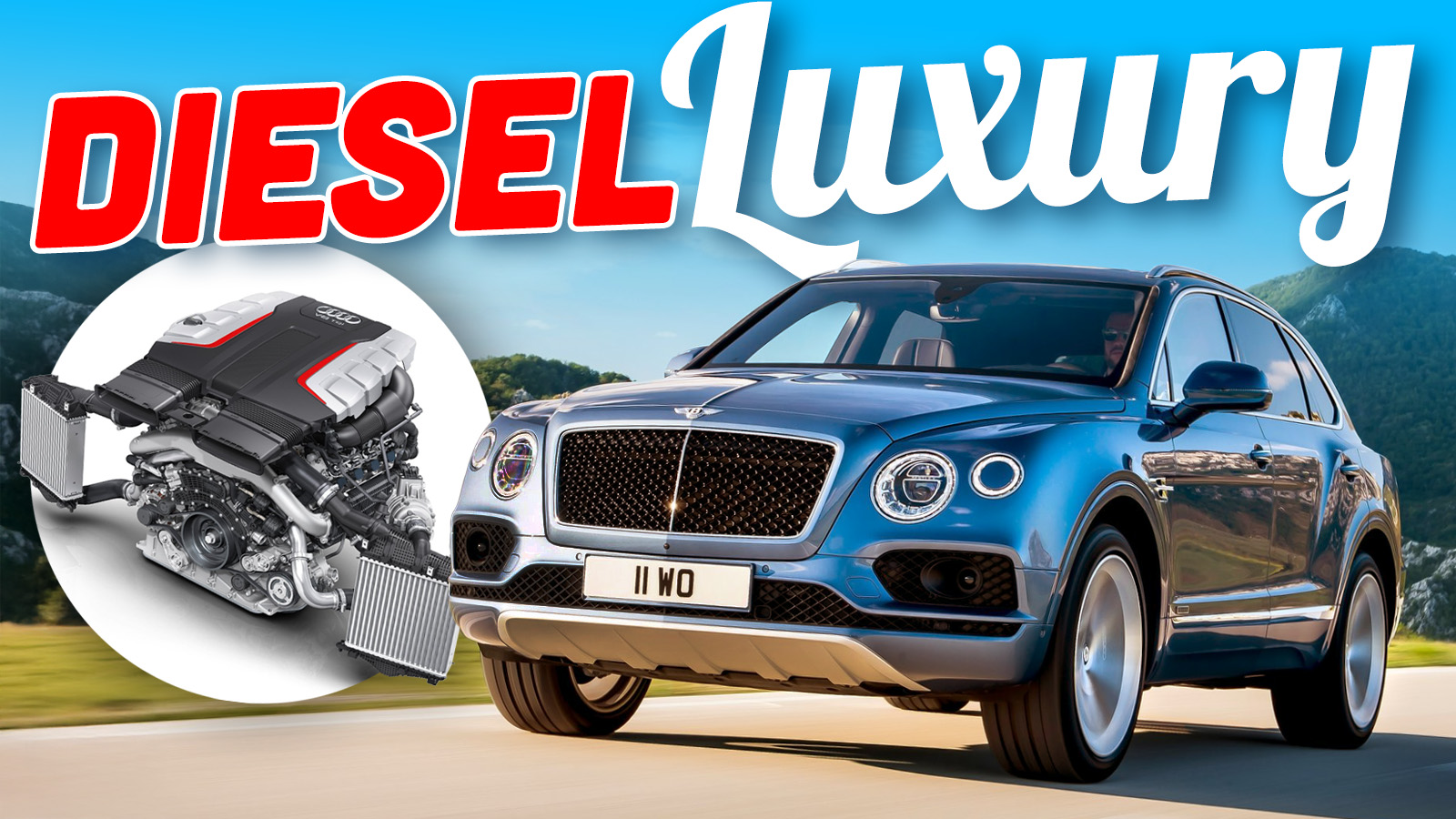
When I think Bentley, I think of big sedans and coupes with huge engines, tuned to deliver big power subtly through large swaths of uninterrupted torque and near-inperceptible gearshifts. To me, a big, low-revving turbocharged gas engine or a fully electric powertrain feels like the optimal choice for this sort of use case. The last type of drivetrain I’d consider for such a car would be diesel power.
Yet, Bentley once believed diesel power was a viable option for the buyers of its vehicles. Specifically, for its first and only SUV, the Bentayga. For a time, European buyers could opt for a diesel V8 in place of the gas-powered W12 engine, making for one of the strangest pairings of any modern luxury car.


This wasn’t just any diesel V8, either. The engine was weird in its own right, employing a “triple-charged” forced induction system, as Bentley describes it. At first, I thought that meant three turbochargers. But it’s far more interesting than that. The engine uses two turbos and an electrically driven supercharger instead.
As with all truly weird and wonderful things, the Bentayga Diesel didn’t last long, having been on sale for just two years before being axed. But for a moment, you could buy an ultra-luxurious SUV from one of the world’s prestigious brands that was powered by the same stuff used by work trucks, 18-wheelers, and bro-dozers.
The Bentayga’s Diesel Engine Wasn’t Developed Specifically For The Bentayga

The Bentayga was a pretty big deal when it was launched back in 2015. It was among the first SUVs to appear from an ultra-luxury brand, pre-dating cars like the Rolls-Royce Cullinan, Aston Martin DBX, and Lamborghini Urus by several years. I remember back then how the media speculated whether a utilitarian vehicle could have the same presence as Bentley’s monolithic Mulsanne sedan or elegant Continental GT coupe, or whether such a car would “dilute” the Bentley brand.
Naysayers were proven all wrong, of course. The Bentayga was an instant hit, becoming Bentley’s best-selling model in 2016, the first full year it was on sale. The SUV has retained that crown for nine years, having made up over 40% of all Bentley sales since it went into production.

The Bentayga was launched with just one engine option: The company’s widely used twin-turbo W12, which had been featured in cars like the Continental GT and the Flying Spur (as well as cars like the Audi A8, the Volkswagen Phaeton, and the Touareg). Rated at 600 horsepower and 664 pound-feet of torque, it had the muscle and the cylinder count worthy of the Bentley name.
Just one year later, Bentley added another engine to the lineup for European buyers: A diesel V8, codenamed EA898. Originally developed for the Audi SQ7, which shares much of the Bentayga’s underpinnings, it made just 429 horsepower, but torque was quoted at 664 lb-ft—exactly the same amount of twist as the gas engine, with 33% fewer cylinders. And it was weird.
Three Different Sources Of Forced Induction
Taking over from VW Group’s long-running 4.2 TDI V8, Audi says this 4.0-liter unit was developed anew from the ground up to be used in the SQ7 starting in 2017, before later appearing in the Bentayga and the Volkswagen Touareg.

As a fun aside, America’s version of the SQ7 was supposed to get this engine when the car debuted stateside in 2019, and was even developed to pass America’s federal standards, according to Car and Driver. But it got a gas V8 instead because, well, Dieselgate happened. So in theory, the stars were nearly aligned to the point where a diesel Bentley in America could’ve happened—not that Bentley would’ve brought such a car to the U.S. market either way.
Ok, back to the engine itself. The 4.0-liter TDI didn’t use a traditional twin-turbo setup, where each cylinder bank gets a turbo of its own to spool up. Instead, it used a sequential turbocharger system, with all eight cylinders feeding into a small turbocharger for low-speed, fast-response applications, and a larger turbocharger for higher airflow and more power. The turbos can also vary their geometry to adjust boost ratios on the fly.

Sequential turbochargers aren’t all that common anymore, and they’re pretty neat. But that’s not the only thing providing the 4.0-liter TDI V8 with boost. There’s also a supercharger attached to the engine, turning this into a triple-charged affair. Unlike a normal supercharger, which is spun via a belt connected directly to the engine, this one is spun via the Bentley’s onboard 48-volt mild hybrid system, which also powers the optional active roll control. Called the Electric Powered Compressor (EPC), it was pretty cutting-edge when it was introduced in the SQ7 back in 2017. From Audi:
This EPC strongly supports the 4.0 TDI engine when starting off and accelerating from low load for exceptional take-up with no turbo lag. It is placed in the air path downstream of the intercooler, close to the engine. Because the EPC does not require any exhaust-gas energy to develop boost, it can be used at any time, thus making it the solution for the traditional weaknesses of the classic exhaust-gas turbocharger. With this technology, turbo lag is history.

The EPC provides the engine with the boost energy needed for the dynamic delivery of power in less than 250 milliseconds. Driven by a compact electric motor, its compressor wheel spins up to 70,000 revolutions per minute. The 4.0 TDI thus develops its immense power immediately, with no perceptible lag.
If that weren’t cool enough, Audi also incorporated a variable valve lift system on both the intake and exhaust camshafts. The system, called Audi Valvelift System (AVS), works sort of like VTEC in that different cams are used in different scenarios. In the case of this engine, cams are selected based on the sort of boost the engine’s computer is requesting. From the original press release:
The inlet and exhaust cam shafts each have two cam contours per valve. On the inlet side, one cam contour supports starting off in conjunction with the EPC, while the other optimises cylinder filling and thus power at high engine speeds. The AVS system on the exhaust side enables activation of the second exhaust-gas turbocharger. The sequential charging system controls the two exhaust-gas turbochargers so that only one turbocharger is used at low engine speeds. The second is activated additionally at higher loads and engine speeds. The customer benefits from very good torque delivery and dynamic response across the entire engine speed range.
The exhaust streams from the two exhaust valves are hermetically separated, with each driving one of the two turbochargers. In the lower engine speed range, one valve per cylinder remains closed, so that the full exhaust stream flows to the active turbocharger. When load and engine speed increase, the AVS opens the second exhaust valves. This directs flow to and activates the second exhaust-gas turbocharger. The engine achieves its maximum output in this biturbo mode. The switching by the AVS enables fast and precise activation of the second exhaust-gas turbine.

All of this tech meant the 4.0 TDI could deliver as much torque as the mighty W12 with the same number of turbochargers and four fewer cylinders, all while being more efficient. When the Diesel was launched, Bentley made a big deal about how it could travel over 1,000 kilometers (621 miles) on a single tank of diesel fuel. In typical Bentley fashion, it gave London to Bordeaux, France, Verbier, Switzerland, or the Scottish Highlands as examples of places you could now travel to without having to stop for fuel in your Bentley.
Amazingly, that peak torque of 664 pound-feet was available from just 1,000 rpm, just a few hundred rpm above idle. That meant a respectable 0-60 time of just 4.6 seconds, and a top speed of 168 mph, which made the Bentayga the quickest diesel-powered production SUV ever.
The Brightest Stars Always Burn The Fastest

In truth, the diesel Bentayga was destined for death before it ever entered production. The SUV was unveiled in September 2016, almost exactly one year after parent VW Group’s Dieselgate scandal erupted into the public eye. The resulting blowback would force VW to turn away from its diesel investments and instead focus on electification and hybridization. And Bentley was very much included in this corporate shift.
At the same time, the Diesel was also becoming a bit irrelevant within the Bentayga’s lineup. By the time 2018 rolled around, Bentley had added an entry-level gas-powered V8 version and an even more efficient V6 hybrid variant. For a short while, buyers in Europe could choose between a V6, two different V8s, or a W12 for their Bentayga’s powerplant.
Despite the Bentayga’s incredible range, monstrous torque, and solid efficiency, it was unceremoniously axed from Bentley’s lineup after 2018, becoming the brand’s first and last diesel-powered vehicle to ever reach production.

A Bentley spokesperson wouldn’t reveal to me just how many diesel-powered Bentaygas were built, but if I had to guess, there aren’t many out there. Out of the 105 used Bentaygas listed for sale in the United Kingdom on Pistonheads.com, only seven of them are diesel-powered. Out of the 275 Bentaygas listed on Germany’s Mobile.de used car site, just 14 of them have the TDI engine.
While the diesel Bentayga is mostly overlooked by the car world now, I suspect it will only be a matter of time until it’s brought back into the limelight as an ultra-rare, collectible version of Bentley’s most popular vehicle. It’s just too weird to be forgotten.
Top graphic image: Bentley, Audi


This was by far the best engine for the Bentayga. I worked at Bentley when this was launched, and then again later on the PHEV, and the V8 diesel was the best powertrain by far.
The W12 is just a willy-waving powertrain – the V8 sounds better and was always just as fast (official numbers tended to be downplayed for the V8 to make the W12 seem faster). But the V8 petrol is wasted in this application. The V6 PHEV has a pretty short range and feels very underpowered with a flat battery.
This diesel was very quick off the line, had effortless cruising torque, and was happy to be revved out too if you wanted to push along.
So is it true that VAG dealerships willing to service this for engine-out procedures (most of them) needed a special hoist/lift/whatever because the standard one was not strong enough ?
I think that was on the V10 Toerag
Ah! Indeed. I’m getting old.
I love diesels but I really believe the reason stuff like this exists are people that have interacted with very rich people that live in bubbles. They have large ranches, islands, and yachts. Everything runs off diesel. Diesel last a lot longer as long as you keep moisture out and aren’t dealing with diesel bugs. Makes everything simpler using diesel as much as possible. It used to be alot of the big ranchs had fleets of vag diesels now they are probably all using luxury pickups.
The engine is a dream.
I worked a lot with it when it was shortly used in the Panamera. Lots of testing with it. What a great thing it was.
I remember test driving this back in the day. Honestly it didn’t feel any different from any other high-powered luxury SUV.
I’ll bite. Were you actually interested in purchasing this….uh ‘interesting looking’ luxobox or the opportunity just came up?
I was curious as I’ve never driven a Bentley before and the opportunity was offered to me. Wasn’t really in a position to buy one in any case.
I would have done the same.
Seems frighteningly complicated with so many expensive points of failure.
A British car with many points of failure? I can’t believe that!
I’m sure this is a nightmare to maintain.
It’s not often y’all tell me about an engine that I genuinely had no clue was in a car, but damn if you didn’t get me this time. This is just as cool as the diesel escalade, another car that is neat but otherwise pointless.
I’m here for it
These things are depreciating very quickly too.
Sounds desirable and heinous. I love it.
Is 50% of 12, 8?
I firmly believe that the Bentayga lacks the presence of a continental or flying spur, and certainly compared to the Mulsanne. It makes up the bulk of sales and absolutely dilutes the Bentley brand. It’s steep depreciation even relative to it’s stablemates shows this, they are simply not as special as the coupe and sedan that Bentley makes. The interior and exterior design and proportions are fine, but just fine, they looks a LOT like every other luxury crossover, a Continental GT or Flying Spur looks far different from something like an S class or 8 series.
It’s really not great looking. It’s the ugliest car built on that platform for sure. Kind of crazy how MLB can give you the Bentayga and the Urus, in addition to 12 other cars and SUV’s.
It’s still no V12 TDI, which is clearly the best of the oily VAGs.
Congrats, you found the worst possible way to phrase that sentence.
*doffs cap*
That sounds like a condition you should speak to your gyno about
Pedantic side-note: sequential turbos are very common in industrial diesel applications.
Sequential or compound turbos? Sequential is one or the other engaged, which I think is the case here (and I can only remember the RX7 using this approach, although there are probably some other JDM models that also did it).
Compounds have the larger turbo feeding the smaller turbo to hugely increase the pressure ratio.
I think the fourth generation Supra also used a sequential turbo setup–but in its case, the turbos were actually the same size, just piped sequentially. Because of this, I believe there was a way to modify them to act in true parallel fashion.
I also always thought that in sequential turbos, one turbo would be supplying boost at the start, but both would be eventually supplying boost (as opposed to only one or the other operating)?
I believe the Porsche 959 had sequential turbos.
The Chiron has two pairs of sequential turbos.