

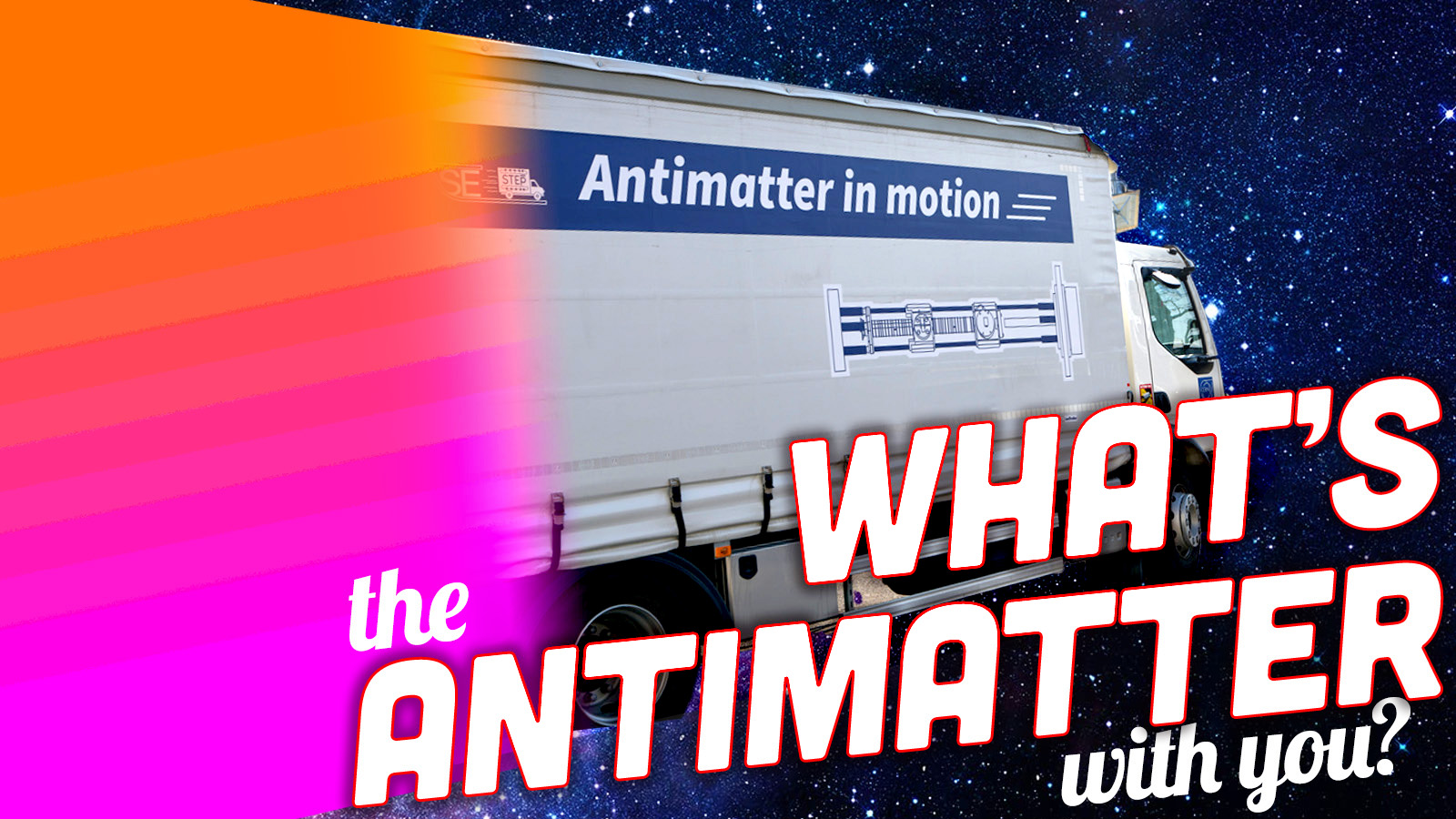
One of the great mysteries of the universe is the question of why there’s anything around at all. And by anything, I mean anything – stars, planets, meteors, nebulae, chicken salad sandwiches, small lengths of string, ketamine, anything. That’s because antimatter exists, and if it contacts normal matter – the stuff your shoes and otters are made of – both kinds of matter annihilate one another in a massive explosion. So, if matter and antimatter were created in equal amounts in the Big Bang, as the laws of physics suggest they should have been, then why is there any matter around at all?
But there IS matter. So it’s kind of a mystery why that is. To figure out what is going on with all this, organizations like the European Organization for Nuclear Research (CERN) have been conducting experiments and, more importantly, making antimatter. This isn’t easy; in fact, CERN operates the only “antimatter factory” in the world. Of course, being the sole source of something as important as antimatter is a big deal; there are other research laboratories that would love to have some antimatter to mess around with, but how does one transport something that annihilates normal matter on contact?


Well, CERN has just figured out a way to do just that: throw it in a truck.
I’m guessing you’ve already clocked that this may be more complicated than I made it sound in that sentence above. This is likely because you’re aware that the vast majority of trucks you can buy on the market today are made of matter. Check it out and see! Toyota, Ford, Chevy, Hino, Volvo, whatever – they’ve all decided to make their trucks out of the same stuff: sweet, delicious matter. That means were you to take, say, even one ounce of antimatter and toss it into the bed of your F-150, there would be an explosion with an energy equivalent to 1.2 to 1.3 megatons of TNT, or about 80 to 100 times more powerful than the nuclear bomb dropped on Hiroshima in WWII.
That would probably cause a lot of damage to your bedliner. So how the hell did CERN pull this off?
The key to it all is something called the BASE-STEP system, which is described as a “transportable antiproton trap.” The BASE-STEP system is built around a device called a Penning trap; hopefully this schematic diagram will give you an idea of how it works, along with a picture of an actual device:
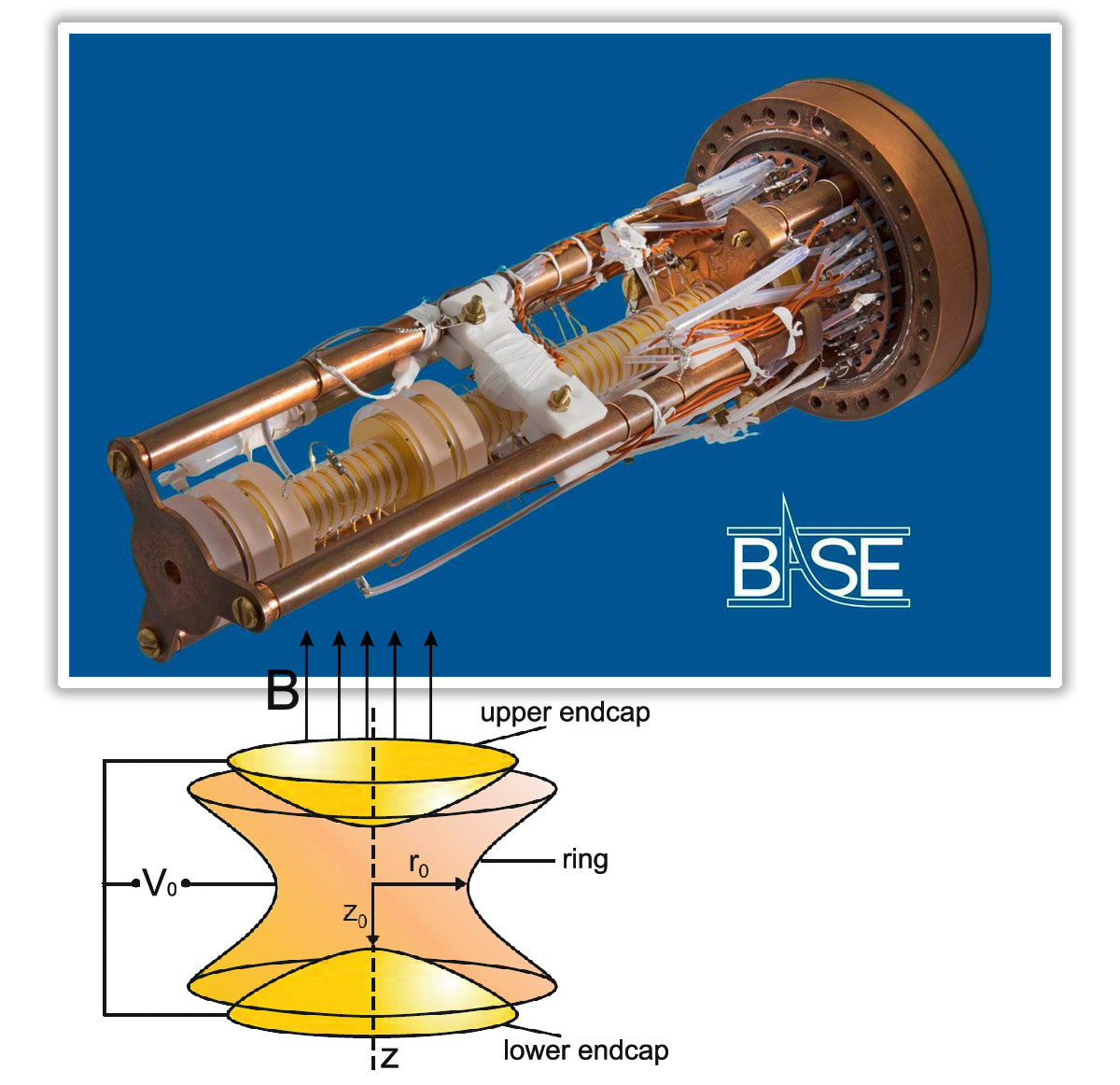
Essentially, there’s a combination of electrical and magnetic fields that contain the antiprotons in a stable way without them contacting any actual matter, which would be, as we have established, bad. The device was tested with regular matter protons back in October of 2024, and CERN has now managed the feat with antiprotons.
Here’s how CERN describes the achievement:
Today, in a world first, a team of scientists from the BASE experiment at CERN successfully transported a trap filled with antiprotons in a truck across the Laboratory’s main site. The team managed to accumulate a cloud of 92 antiprotons in an innovative portable cryogenic Penning trap, then disconnect it from the experimental facility, load it onto a truck and continue experiment operation after transport. This is a remarkable achievement, given that antimatter is very difficult to preserve, as it annihilates upon contact with matter. This world premiere is a test, the ultimate aim being to transport antiprotons to other European laboratories, such as Heinrich Heine University Düsseldorf (HHU), where very-high-precision measurements of the antiproton properties could be performed.
…and here’s a picture of the truck that was used to carry the antimatter, which appears to be an Iveco? It’s hard to tell. One of those cabovers they love in Europe:
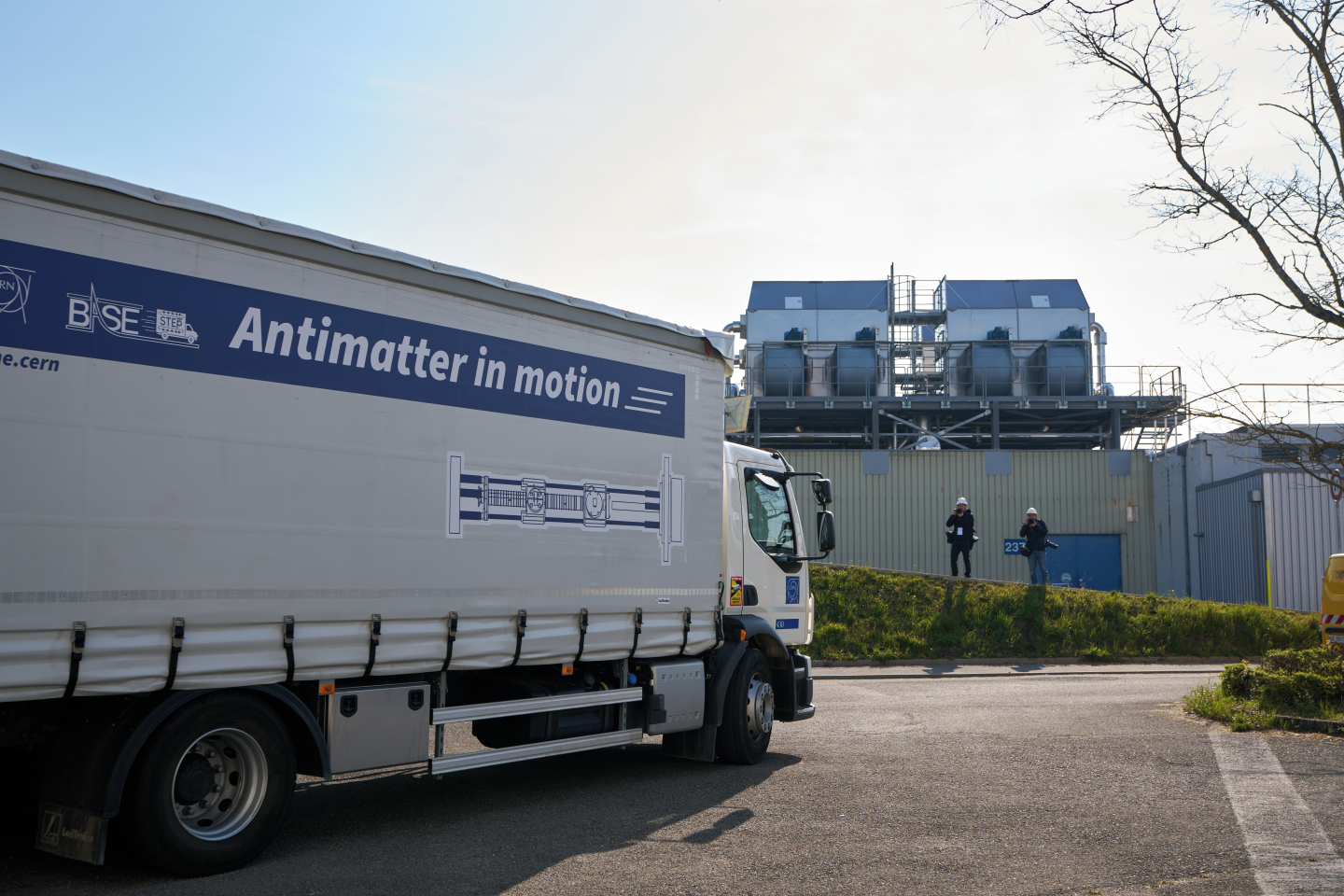
You can see the BASE-STEP trap on the side of the truck there, though I kind of think maybe there should be more warnings on this thing, considering the wallop antimatter possesses. The truck drove the 92 antiprotons around for about 30 minutes, at speeds of up to 26 mph. I guess it’s smart not to speed when you’re haulin’ the old antimat.
Trips of longer durations come with their own challenges; for example, a trip to another lab in Germany that is about eight hours away would require a bit more hardware. As BASE-STEP project leader Christian Smorra told PhysicsWorld,
“This means we’d have to keep the trap’s superconducting magnet at a temperature below 8.2 K for that long. So, in addition to the liquid helium, we’d need to have a generator to power a cryocooler on the truck. We are currently investigating this possibility.”
Just a reminder, 8.2 K is in Kelvin, which means that temperature is just a touch over Absolute Zero. It’s cold.
The ability to actually transport antimatter is a huge step, even if it may seem trivial now. But if we’re to understand the nature of the universe, of antimatter, and potentially even develop power systems that are based on matter/antimatter reactions (replacing the relatively low power density of current pasta/antipasto reactors), then one of the first things that we need to figure out is how to safely store and move antimatter around.
CERN gives a few more details about the size and weight of the antimatter trap:
BASE-STEP is small enough to be loaded onto a truck and fit through ordinary laboratory doors, and it can withstand the bumps and vibrations of transport. The current apparatus – which includes a superconducting magnet, liquid helium cryogenic cooling, power reserves and a vacuum chamber that traps the antiparticles using magnetic and electric fields – weighs 1000 kilograms: much more compact than BASE or any other existing system used to study antimatter.
So, it can fit through lab doors and weighs a bit over 2,000 pounds – roughly one ton – so that suggests to me it could actually be carried in the bed of a pretty normal, mainstream pickup truck.
You’d definitely want to spend the money and get the good ratchet straps if you were to transport antimatter in your pickup bed, though. And I’d even do the thing where you tug on one of the straps and say “that’s not going anywhere” twice, just to be safe.
Transporting antimatter in a truck is basically the first step to building a warp drive! Here we come, stars!
Top graphic image: CERN


I had a sticker on the glove compartment of my old car that said “CONTAINS ANTIMATTER – DO NOT ALLOW TO COME IN CONTACT WITH MATTER”. It confused almost everyone who rode in the passenger seat.
Of course you dropped this post while I was conducting a variety of field trials of annihilating brain cells with alcohol. I’m generally relatively fascinated by all that anti-matters.
AI summery;
The energy released by 92 antiprotons losing containment and annihilating with regular matter is incredibly small, totaling approximately \(2.78 \times 10^{-8}\) Joules (0.0000000278 Joules)
Physical Effect: This amount of energy is not hazardous and would be insufficient to raise the temperature of a tiny drop of water 0.05 grams by more than 0.00000013 C. It is often described as enough energy to lift a grain of sand by a few millimeters.
I hope someone can invent this can of “honey I spilled the thing” antimatter you can just toss in the car to get rid of pet hair and nasty spills nicely
Don’t cross the streams.
Ghostbusters – Don’t Cross The Streams
Sorry I’m late to this party but isn’t EVERY truck transporting anti-matter all the time??
They better enjoy that liquid helium while they can, 1/3 of the world’s supply comes from Qatar through Hormuz.
The CERN has it’s own Liquid <insert relevant gas> production facility
They need a massive amount of liquid helium and hydrogen to keep all the superconducting magnets they have hiding in the tunnels.
I’m a very pro-science guy, and I do need to start with this preface, beause holy shit, am I about to say some possibly spectacularly ignorant shit. But I have to get it out of my chest, now that it’s been mentioned.
I… I kinda miss the point about why we’ve been pouring endless funding into researching stuff like anti-matter, new particles/particle acceleration, even stuff like quantum computing. The fringes of physics, the stuff that’s kind of incomprehensible even for people in adjacent fields. Do we not have more urgent science to fund that would actually improve people’s lives? Feels like for every under-funded study on the nuances of a specific mental ilness there’s 5 multi-million research projects that spent decades working on having a photon jump from an atom to another or some shit.
Welp, that’s it. It’s out of my system now. Please educate me.
So much of our modern medical technology is the result of knowledge gained through research into nuclear physics and quantum mechanics. PET scans, MRI, Nuclear Magnetics Resonance Spectroscopy(NMR), Radioisotope Imaging, SPECT Scans, Targeted Radionuclide Therapy for cancer. The understanding of Quantum entanglement has greatly increase the resolution of MRI imagery. If you ever had cancer or know someone that did they likely benefited from the decades of research into fields that no one knew beforehand would have these developments.
I had a complication after surgery in 2019 and nuclear based imagery was used to detect and treat my issue. Here is a fascinating article on how this field has led to amazing medical discoveries.
https://www.polytechnique-insights.com/en/columns/science/quantum-the-indispensable-ally-of-modern-medicine/
I know this, and I’m not proposing halting research on the really bonkers shit, just questioning if maybe there’s an imbalance re: the funds spent on more “mundane” research projects that more often than not are on the verge of collapsing because researchers can’t round up a few hundred thousand dollars to keep going vs the wacky stuff that billions are poured into, like what they do at CERN (which, in all fairness, ends up getting redistributed, and not just for science; a videographer friend of mine made some good money on an artistic project a few years ago at the LHC). But it may just be a matter of perception: the wacky stuff likely gets more media attention because it also generates more clicks.
You literally said ‘you kinda missed the point’ and asked for an ‘education’. There’s never enough money for every research project in any field. But you never know what breakthrough will be the one to impact millions of lives.
Yesterday’s pointless science research is today’s necessary knowledge for cutting edge applications and tomorrow’s “everyone takes this for granted” technical knowledge.
One example that comes to mind is modern chip production. At this point the amount of electrons per logical switch is so small and the switches are sol close together that you need to take into account quantum effects when designing the chips.
To say nothing about the bonkers approaches they need to take to manufacture the chips at scale.
That’s a very fair point, but at the same time I must confess I sometimes find myself questioning the very need to develop computational power to the point where got, where we basically just navigate an ecosystem of pocket or bag-sized supercomputers which mediate all our interactions with the world, and talk to the supercomputers in our cars, for them to speak with the slighlty less advanced circuitry in the garage door motor actuator – are we doing all this because it’s useful? Or because companies convinced us that cramming more chips into things, and adding more and more shiny pixels to screens and putting those screens and chips everywhere, and wireless everything, would revolutionise our lives and wellbeing, and it’s all just convenience-oriented gimmicks and a lot of marketing to justify the pricetag?
I started reading the article – then I realized it didn’t matter.
I tried so hard, and got so far, but in the end…
Awesome!
Torch, the reason they don’t need more warning signage is the antimatter is immaterial.
(I’ll see myself out.)
I was wondering why anyone would need this and what kind of experiments would be done on a sub-molecular level.
Then I realized it doesn’t matter.
Jason needs to design a hazmat placard for antimatter.
> * <
Methinks that David Tracy has been hauling leaking antimatter canisters in his trucks for many years. That explains all the missing matter.
Did they hit a Tim Horton’s on the drive? I hear beans ground by smashing them with anti-beans creates one smooth pour-over…
It was apparently a Volvo truck specifically picked for its air suspension
https://cdn.prod.www.spiegel.de/images/751e0898-0522-4ab5-bbad-4548d7ea9bac_w800_r1.3333333333333333_fpx33.7_fpy44.93.webp
This content is why I subscribe to The Antiopian
> roughly one ton
Precisely and exactly one ton. 1,000 kg. Translating that into lbs and then lbs into tons is madness!
Come on now, we’re just talking about transporting antimatter, we don’t need to be precise or anything.
In American English, it’s precisely 1 tonne (a metric ton, 1000 kg), which is roughly 1 ton (2000 lbs in the US system).
Thanks for the correction! And also big eyeroll.
1,000 kilograms = One metric tonne = 2,205 pounds = 1.105 US tons. Yes, we are mad.
They’re bad ass full stop. Never dealt with them in Europe but in Japan they pull up, a team of 6-8 forklift drivers load the truck, another 6ish people strap it down, 2 people validate it, and the trucks gone in under 10-15 minutes.
Oops, this was meant as a reply to jdoubledub’s comment.
Next destination: Wossamotta U.
Just watch out for Boris and Natasha.
All well and good until a speeding Altima finally delaminates its second spare tire and spins into the truck at 80mph…
Now that would release some seriously Big Altima Energy…
Big Antima Energy!
How does this work with proton packs and ghosts?
Yes just kidding
This is wild. But isn’t air matter? Or any kind of gas? Seems you would need to create a vacuum to hold it secure and something to keep it centered in the vacuum. Warp speed acceleration or deceleration will be a problem.
The description includes “a vacuum chamber”.
Missed that