

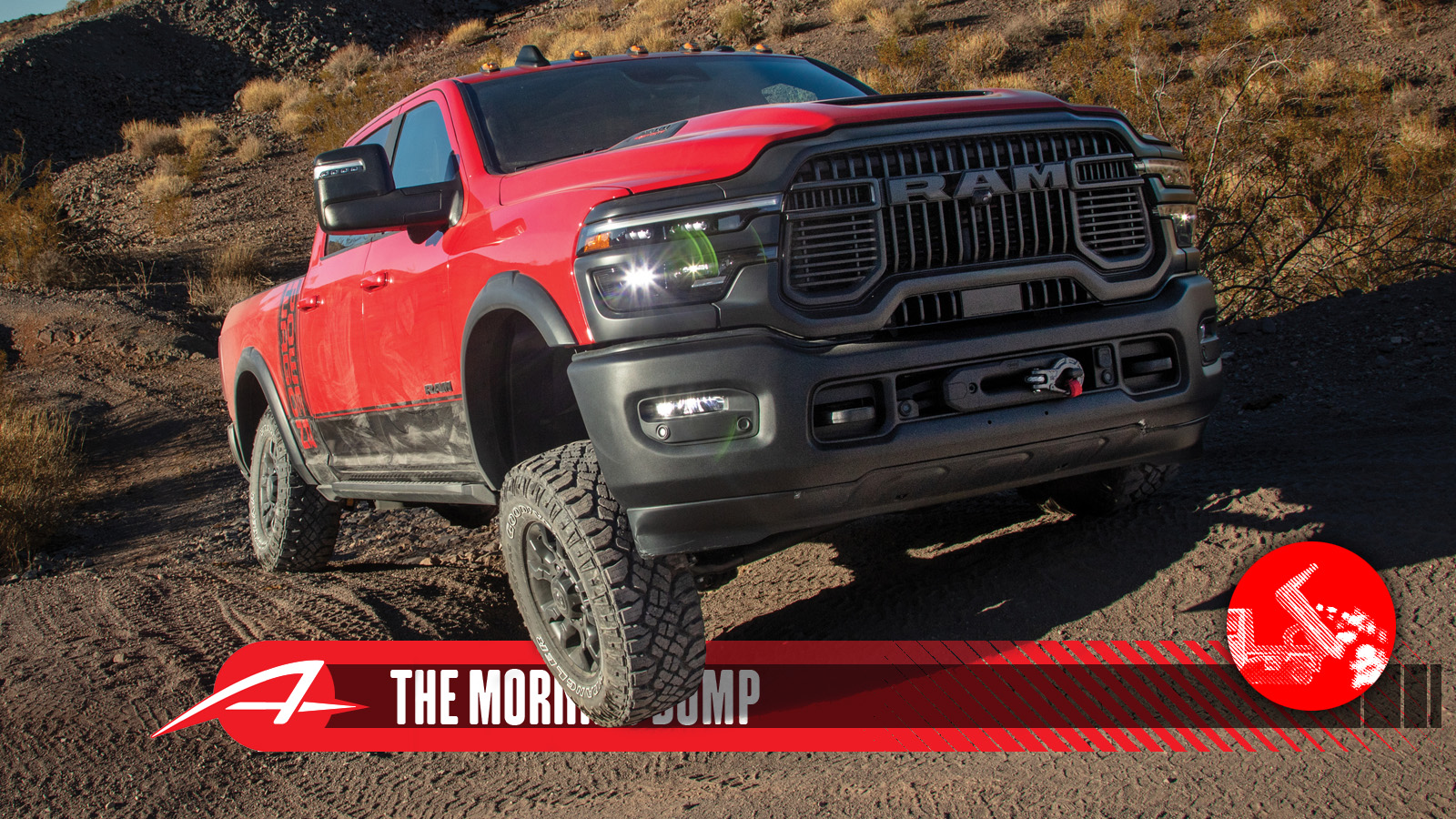
Writing about regulations and trade barriers in the automotive world feels a little bit like being a Giants fan; you can’t ever really accept anything as final. There’s been a strange quirk in the current trade deals that essentially benefitted foreign automakers over American ones. This loophole has been mostly closed, to the benefit of a lot of brands that aren’t Ram.
Yes, The Morning Dump is about trade again, but there’s no big debate this time as the conclusion the White House has come to is mostly sensible. Also sensible is the pick for Porsche’s new CEO, who seems to be setting the brand up for potentially more hybrids in the future.


While automakers have generally lowered profit forecasts this year due to trade, there’s one segment of the automotive world that’s raising them.
BYD is one of those companies going in the wrong direction, though it may have found a great partner in Japan.
U.S. Automakers Get A Long Tariff Break, But The Ram HD Potentially Gets Broken
That Giants joke comes courtesy of my neighbors. I was walking to my parking spot and I heard a plaintive wail emanate out of an apartment in a nearby building. I half-joked to my wife that she didn’t need to call the authorities since it was probably a Giants fan. It wasn’t until I got home and saw the box score that I realized how correct I was.
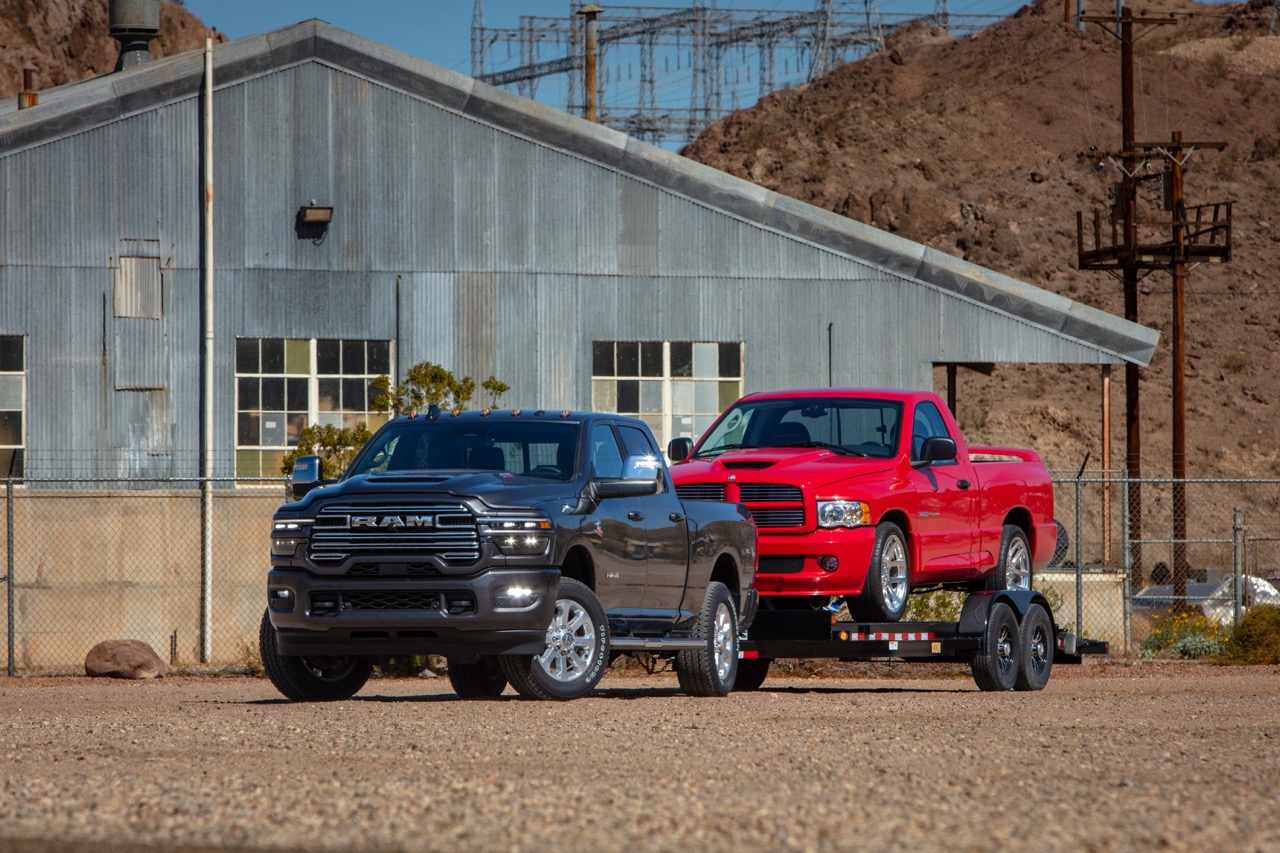
Ram isn’t in that bad of shape, but it’s currently in an awkward position. I’ll explain.
The current trade situation is extremely complex and even the experts don’t always seem to fully know what’s going to happen or what is or isn’t active. One of the strange quirks is that countries building cars in foreign countries might actually get a better deal than carmakers building vehicles in the United States. That’s the inverse of what was intended with these tariffs.
There are two big reasons for this. The first is that, while there aren’t a lot of signed deals with other countries, there are outlines of deals with countries like the UK and Japan to bring in cars at lower tariffs of 10-15%.
Aren’t cars built in America subject to 0% tariffs? you might ask. Yes and no. Cars assembled in America aren’t subject to an import tax, but all the parts and materials (like steel and aluminum) are. Some of these tariffs are extremely high. This means that an American-built Honda CR-V could be cheaper to import from Japan than build in America because a vehicle built in Japan isn’t subject to any other tariffs. That’s just an example, and I’m not sure that’s the case for that specific vehicle, but you can see how the math could play out.
Automakers like Ford and GM complained about this. and the Trump Administration agreed to give some temporary relief. Here’s the formula for how this works, via the AP:
The amended action provides a rebate of 3.75% relative to the sales price of a domestically assembled vehicle. That figure was reached by putting the 25% import tax on parts that make up 15% of a vehicle’s sales price. Multiplying those two percentages together is equal to 3.75%.
As far as trade related formulas go, that one is relatively simple. If your vehicle sells for $50,000 you’ll get up to $1,875 in rebates to offset the existing tariffs. This was initially planned to only last a short period, but it will now continue until 2030 as a way to give automakers time to adjust their supply chains.
The strange catch here, as always, is with the USMCA. Does this apply to vehicles built in Mexico or Canada that follow USMCA rules? Stellantis better hope so, because with this agreement came some great news for Ford and GM and some terrible news for Ram. Specifically, that the administration is going to add a 25% tariff on imported medium- and heavy-duty trucks and parts.
Ford builds all of its big trucks in the United States, so this is great for them. GM also mostly builds big trucks here and seems to have enough capacity to build all its big trucks here. That’s not the case for RAM, which produces its heavy duty trucks in Mexico. Here’s how this could play out, according to Bloomberg via Automotive News:
Some truckmakers fiercely lobbied for reductions and other stakeholders warned about the potential for sweeping tariffs to cause higher vehicle costs, which could also ripple through the construction and shipping industries. The USMCA exemption could potentially dull the impacts on Ram pickups made by Stellantis in Mexico, representing some of the roughly 245,000 medium- and heavy-duty trucks imported to the U.S. last year, according to Commerce Department data.
A couple of weeks ago Stellantis asked for a waiver for this specific tariff. Ford and GM told the White House to tell Stellantis to pound sand, basically. Where this ends up will be interesting. Does Stellantis chair and largest shareholder John Elkann have the pull? Does the recent work by the company to shift jobs here help? It’ll be interesting to see what happens.
New Porsche CEO Loves Hybrids, Just Like Me

As expected, current Porsche VW Oliver Blume will step down next year. Don’t worry, he’ll still technically be in charge of Porsche because he’s also the CEO of parent company Volkswagen. So who is the new guy?
Former Porsche engineer and McLaren CEO Michael Leiters. As explained by Reuters, this dude loves hybrids:
Leiters worked for Porsche between 2000 and 2013. During that period, his roles included executive assistant to the then-CEO Wendelin Wiedeking and project manager for the brand’s Cayenne plug-in hybrid SUV. He was appointed product line director in 2010, a role that he carried out until leaving for Ferrari.
Leiters worked as chief technology officer for Ferrari between 2014 and 2019. At Ferrari, he helped develop Ferrari’s first two hybrid electric models, the SF90 Stradale and the 296 GTB.
McLaren is also big on hybrids, obviously.
While this is going to be a tough gig, I’m down for more Porsche hybrids.
Toyo Is Making Money, Going To Buy Back Some Stocks And Automate

It’s a hard time to be an automaker right now. A tire company? It seems better, as Toyo Tire Corp. Chief Executive Officer Takashi Shimizu announced in a call where he also expected the company to make more money.
While new vehicle sales in US have softened, orders for pickup and SUV tires are rising, lifting margins through a stronger product mix.
“If new car sales decline, replacement tire demand rises,” Shimizu said. While peers expect the slowdown to weigh on earnings, Toyo Tire has seen orders for pickup-truck tires rise 10% from a year earlier, he added.
So what’s the next step for the company?
Toyo Tire is stepping up automation and digital investment to cut costs and boost productivity as it faces rising labor expenses overseas and a shrinking workforce in Japan. The company aims to use technology and artificial intelligence-driven systems to streamline production and strengthen its global competitiveness.
“We want to reduce headcount per factory to about 500 from the current 1,000 to 1,500 by leveraging tools such as AI,” Shimizu said.
And the company will buy back shares! That’ll be good for employees…
BYD Will Be Able To Sell An EV In Japan For Under $14k

The BYD Dolphin Mini (or Seagull, depending on market) is probably the best example of the affordable, Chinese-style small electric car. In China, it’s a less-than-$10,000 car, though it costs more elsewhere.
BYD just made a deal with mega retailer Aeon in Japan to sell its vehicles via that company and, with local incentives, that’ll end up being a cheap car according to Nikkei Asia:
Chinese electric vehicle maker BYD and Japan’s Aeon will enter into a sales alliance by the end of this year, Nikkei has learned. With the major retail chain’s discounts and incentive programs, consumers will be able to buy an electric car for less than 2 million yen ($13,300).
Aeon will initially set up sections handling the new service inside some 30 of its commercial facilities and general merchandise stores across the nation. The expected deal may change Japan’s conventional automobile distribution structure that is dominated by dealerships affiliated with carmakers.
Aeon will serve as an intermediary on behalf of BYD to receive orders and arrange sales contracts. In the future, it plans to import EVs from the partner. In cooperation with BYD’s dealers in Japan, the retail chain will display EVs inside its outlets and market them to visitors. BYD plans to increase the number of dealers in Japan to 100 by yearend, while Aeon will open the EV sales sections within its commercial facilities that are close to dealers.
I don’t think BYD is going to even attempt to sell cars here, though I’m curious what a BYD Seagull built for America would costs. $25k? $20k?
What I’m Listening To While Writing TMD
What is “Agnus Dei” by The Last Dinner Party even about? Marriage? I’m not entirely sure. This feels like music not made for me. Let’s just say, I don’t see myself in a lot of the band’s protaganists (and hopefully not in any of the antagonists). Still, it gently rocks.
The Big Question
If you could hybridize one vehicle from any automaker what would it be?
Top photo: RAM



Midsized three row and two row SUV’s should’ve been hybridized, like, 2022. Next best time is today.
Its a damn shame that the only hybrid offerings in the three row segment is:
Ford Explorer HybridToyota Highlander HybridHyundai Santa Fe HybridI want to see a Buick Enclave/Chevy Traverse/GMC Acadia hybrid, Honda Pilot hybrid.
But they were way back in the early 2,000’s. Cadillac Escalades, Toyota Hylanders, Escapes/tributes, Mercedes 450’s. they were everywhere. they cost more than most of the highest spec ICE only vehicles and in most cases netted 2-3 MPG less. and of course they are all mostly gone because the cost of the relatively small batteries of the time are still higher than most are willing to spend.
The much harder question is what vehicle would I not want to hybridize? I’m struggling to come up with a single one.
Although…in the spirit of trolling terrible people, I might hybridize a Tesla just to watch the EV purist Elon stans tear their hair out.
Edit: Regarding this:
I tried a new AI tool last week, and the first thing I did was use its “help” function to see what it can do. The response had such terrible typos I legitimately had trouble understanding what it was saying. I could decipher it eventually, but I have zero interest in an AI manufactured tire. I don’t need a tread pattern that is a nonsense combination of mud terrain and slick.
But then we’re in one of those eras of groupthink where the safest thing to do is jump on the AI bandwagon because if you don’t you’ll probably get fired (which is the only reason I’m using most of this stuff). Most of these AI projects are doomed, but until the failures start getting headlines the stupidity of “AI everything” will continue.
“We want to reduce headcount per factory to about 500 from the current 1,000 to 1,500 by leveraging tools such as AI,” Shimizu said.
I’m sure this kind of talk is all the rage down at the CEO country club, and it’s certainly reinforced by the echo chamber of corporate earnings calls, where every idiot analyst wants to be the first one to ask about a company’s AI strategy and no CEO wants to look like they are unprepared for it.
And sure, if your job is producing internal powerpoint decks or you’re a copywriter or corporate creative then you’d better figure out a new line of work. But I don’t think people who design and manufacture tires need to rush down to their local Job Services just yet. AI is impressive in its ability to synthesize other peoples thoughts as long as you don’t need to rely on it to be totally accurate or to even have any common sense. But half the time it can’t even figure out which end of the donkey is the ass.
Pretty much all daily grinders should be hybrid, but for an odd suggestion, the GRZ, as long as it was still offered with a manual. I get around 30 mpg, but would love something more like 40+ with better low and midrange torque.
Yeah, I was going to say, and RWD sports coupe would be great. Toyobaru or Mustang, why not have them do 40+ mpg?
Agreed. I love my BRZ but my two biggest complaints are the poor mpg plus the premium fuel requirement. I know it’s a sports car and fuel economy shouldn’t be top priority, but damn, my XJR is 20 years older, 1000 lb heavier, twice as powerful, and only gets slightly worse fuel economy.
I find the 30 mpg I get acceptable, but the premium is annoying where it doesn’t have a turbo (or its torque) and the tank is on the smaller side. Hybrid, they could downsize the displacement back to 2.0, maybe knock the CR/rpm down to run regular, and get better torque where I’d prefer it. Could possibly bump the gearing up a little, too, which would help on the highway, but even just having the motor assist alone would be a nice bump in mileage and torque.
Man, I can’t tell what any of their songs are about. But I like ’em.
The Odyssey needs to be a hybrid. I’d love to see a non-turbo I4 minivan, and hybrid is the only way they’re willing to do it. The Sienna is nice, but an Ody hybrid would be good too. The Carnival hybrid is turbo.
It’s gotta be the Honda Passport and Pilot right? They’re both fantastic and the Passport just looks incredible especially in that orange. Add a hybrid option and keep building em in the US of A? Printing money.
I need an update from Honda on their large platform hybrid tech. I know it’s coming, but where are we fellas?
Dull answer, but Honda Pilot. Love my Pilot, but wish Honda would offer a hybrid option.
Same, I wish it was an option for the current gen.
As the former owner of an old Prius, I think hybrids are great 15-year cars, but beyond that you’re looking at all the potential failures of an ICE car PLUS all the potential failures of a BEV car.
Here in The Land That Rust Forgot™, I see plenty of daily driver ICE cars that are two decades old, but the number of 1st and 2nd gen Prius has diminished to darn near zero.
Weird. I live in a rust zone and 2nd gens are still common. I only see the occasional 1st gen, but they weren’t numerous in the first place.
It is possible that the desert heat is less kind to NiMH batteries than your climate is.
Probably not, but it also doesn’t make it a good exemplar for long term battery longevity.
Michigan here, and I live 1.5 miles away from a small auto repair place kind of in the hood that always has 10-20 2nd gen Prius in various states of disrepair on the property. Eastern European name on the sign. Bringing in rust free cars, swapping in a cheap refurbished battery, and fixing everything else with parts from donor cars might be a better business model than you think.
There’s a place here in Indiana who services and sells Priuses, mostly the second gen. My friend sold them her thoroughly worn out Prius and when we got there there was a field full of 50+ Priuses, waiting to get rebuilt or parted out. They’ve been in business for ages so they must be doing something right. I still see second gens pretty frequently. If you ever saw that picture of a Prius mated with a Subaru Baja, that’s their car.
In Michigan you can buy a clean title California Prius with high miles from the auction sites, swap in an engine and suspension from donor cars with a salvage title, and then resell to someone as a clean title car without ever having to pass any emission or safety inspections.
That’s how it is here too, no inspections of any kind. Certainly makes running a business like that easier.
Any vehicle that is in the top 20 of sales in the US should have a hybrid option. Some of them are like the RAV4 or Camry and the F150 offers the option. The volume is there, whats the excuse from automakers?
An EREV Body on Frame SUV or HD truck would be sweet. I’d love to have an F250 or Expedition that was EV all the time except when I need to tow long distances. EVs rule for in town/short distance driving, and I was heavily considering a used F150 Lightning. Except I want to take the race car to tracks, and the closest one is 180 miles one way.
This. I love my Suburban to an irrational degree but EREV would be so excellent – even plug-in or mild hybrid would be an improvement. Then again I’m not willing to spend the money that would entail on a new vehicle since I’m a cheap son of a gun and I beat on my well-used example pretty hard.
I just think of how great a little diesel generator instead of the 6.7 Powerstroke could be for 50% of the retail sales customers. (The guys that get the big lifted F350 to tow the boat twice a year etc.) All of the torque from EV, similar towing capacity, and insane range.
You beat me to it, while my expedition gets 21mpg even getting to 26 would be nice.
“If you could hybridize one vehicle from any automaker what would it be?”
Ford Transit/Transit Connect. Hyrid tech is well suited for local delivery vehicles.
If it’s truly local, nothing beats EV.
I’ve said this many times but I’ll keep saying it until the cows come home-every single family hauler should’ve been hybridized yesterday. Crossover, van, whatever. The idea that you should just have to accept bad fuel economy in those vehicles is nuts to me. It’s not the 2000s anymore.
The fact that cars like the Pilot/Odyssey, Traverse/whatever the hell the other variants are called, Palisade/Telluride (there’s technically a Palisade hybrid coming but I’m not spending money on a brand new Korean hybrid powertrain and I’m not apologizing), etc. force you to deal with mileage in the teens is nuts to me.
Literally none of these cars are driven hard unless dad is bored while he has to take the kids to the soccer game and literally every single family will be happy to save on gas. Plus a lot of these cars are used for road trips and whether or not you can BEV through a road trip is still very region dependent. Every single family hauler should be a hybrid.
They also sell gajillions of them so there are legitimate environmental benefits to this as well. With regard to BOF stuff I’m less passionate. If you don’t have a use for a Tahoe or Expedition and insist on one as your family car so you don’t have to get a van then fuck right off….but if you’re one of the 7-10 people that actually needs one to tow and haul while carrying your spawns around then I’m not sure there are any significant benefits to going hybrid because it’s added complexity for only marginal fuel economy and emissions gains.
To change lanes for a second can someone explain the hype around The Last Dinner Party to me? I feel like this band has been shoved down my throat for the last 2-3 years and I just don’t think they’re that good. I get that the all female rock group schtick appeals to people and is super marketable but the actual music is painfully mid. I do appreciate the lead guitarist’s unconventional solos but that’s about it.
I feel like we’re just so starved for mainstream rock music that isn’t either shameless 60s and 70s worship or butt rock that people get super hyped up for bands that are merely average. Idk maybe their best work is ahead of them but like….another band that’s only permanent members are women that’s also from the British isles is right there and way cooler. They’re called Wet Leg. They absolutely rule and their music is way weirder and more interesting.
I disagree on the BoF hybridization. I have more than a few friends with the Powerboost F150 and that powertrain would be killer in the Expedition/Navigator. I had a Pre-Production, “Engineering validation” Navigator for a week this past January and with almost entirely highway mileage I still only averaged 15.7mpg. conversely a PB F150 was getting 19mpg in those same conditions.
Wet Leg is super awesome so I agree with that.
The Last Dinner Party is a strange deal. They’ve put out some remarkably catchy songs, they seem talented, and their singles are actually pretty darn quirky as far as structure goes for an “alternative rock band” (all rock bands at this point are alternative I guess as rock doesn’t really matter anymore). I’d argue that their schtick is something of a rock/operatic combo, something that’s basically closer to musical theatre for the romantasy crowd than something that’s a straightforward rock band. It’s glam in spirit, but sort of punk in aesthetic. To me anyway, if that makes any sense.
Anyway, their songs when they come on, are welcome to me. They’re not as exciting or interesting as say, a band like Geese, but they’re fun.
And I don’t think we’re going to have to wait long for everything to be a hybrid.
I think you low key figured out why I don’t like them. I am just not fond of musical theater as an art form. I’m not going to sit here and say it’s all bad or say that there aren’t musicals that I enjoy (Rocky Horror Picture Show is one of my favorite films) but in general I just tend to find it really contrived and cringy.
The Last Dinner Party is rock by and for theater kids. I suppose you could maybe argue Wet Leg has some of those vibes as well but their music is just so damn catchy and the fact that they don’t take themselves seriously really makes me like the act a lot more….whereas TLDP has always felt very serious to me.
It’s a little schlocky and half their songs make for karaoke bangers. Where “Nothing Matters” or “This is the Killer Speaking” make for something tipsy people would enjoy singing and partying to, nobody wants to be around me when I’m singing along to Taxes.
This is communal music, it’s pop. It’s solid, but it’s not tremendously interesting. But I too am cis-hetero-commenting on a car blog (we’ll use that as a stand-in for neurodivergent) dude, and not everything is made for my old, brooding, 00’s indie-rock ass. And that’s fine lol.
The Last Dinner Party hasn’t really registered on my radar but I’ve been listening to a lot of all-female or female-led rock/indie/punk lately. Wet Leg, The Warning, Dea Matrona, Mannequin Pussy, Otoboke Beaver, Amyl and the Sniffers, Descartes a Kant, Fin del Mundo, and others lead me to believe rock is alive and it’s the gals who are saving it.
I saw TLDP last year in Seattle, and I can tell you that the women (which were the majority of the crowd) were VERY into it. As in: TLDP-inspired costuming. It was a fun show, and they do play up the dramatic/theatrical quite a bit. I’m just gonna say that if you’re not female, you probably don’t “get” all of the appeal of the band.
As for Wet Leg, I understand that they put on a great show these days. I regret skipping their show last weekend at the Greek in LA. Their new album has some really inventive stuff on it.
I am a cis hetero moderately neurodivergent dude lol, so fair enough. I mean music made by women for women is always going to do numbers and teenage girls basically decide what’s cool and what isn’t, so it doesn’t surprise me to hear that that’s a big part of their success. I mean…Taylor Swift’s discography is probably 2/3rds or more pure slop at this point and she’s maybe the biggest artist in the western world solely because of how relatable normal women find her.
Which has always been fascinating to me because she’s a conventionally attractive, cis, hetero, white, alpha female type and I’m positive that the vast majority of her listeners have been traumatized by people like her their entire lives, but alas…this is a discussion for another time.
we have a Korean hybrid, 2023 Niro, love it, solid car, well worth the $$ we paid for it!
Oh the stuff they’ve been making for a while is quite good. I’m just nervous about the new Palisade drivetrain because it’s brand new and there are bound to be teething pains, especially since Hyundai hybrids include regular transmissions and turbocharging. There’s just a lot more that can go wrong,
ah yeah makes total sense, time will tell!
I was going to make a counter argument that with average car prices creeping ever higher that the last thing needed is the additional cost of a hybrid power train. But I just checked Toyota’s website and most of their hybrids MSRP for $2-3,000 more than the non hybrids (same trim levels). Trucks were closer to $4-$5,000 more. The hybrid Rav4 costs ~$3,000 more but gets 14 mpg better in the city (27 vs 41). Still, at $3 a gallon, you’d save enough on gas to cover the (already relatively nominal) upgrade to hybrid in about 80,000 miles. Dealer markups throw a big wrench in this math, however.
Something that needs to be emphasized more in these calculations are the other benefits that hybrids provide over a period of time. So often people do some math and say something to the effect of: “it’ll take XX,XXX miles to recoup the gas savings, so it is/isn’t worth it.”
Here are a few other positive things that owning a hybrid can result in:
I’ll take a “Gattaca edition” 1963 Studebaker Avanti.
Oh, yes! Take my money already!
The F150. But not that “powerboost” BS, I want them to EREV the Lightning.
Hadn’t even thought of adding hybrid to an EV, but, yes, 100%. EREV F-150/Expedition should have been on the market a year or two ago, bare minimum.
I would PHEV or EREV the Miata.
“Gently rocks” feels like an oxymoron, but I guess it’s applicable since “gently rolls” sounds weird.
Miata. More torque and I consider the mpg abysmal for the amount of sacrifice required to make it your daily.
Let’s tax the vehicle components, under guise of making money and that it won’t cost people money, and then let us turn around to extend tax breaks (to end mid-next-administration) because it’s costing people money and they’ll likely complain (or, worse, vote).
Probably the Lucid Air.
This is an insane take. I love it. Of all the BEVs to hybridize, you pick the one with the biggest range.
It’s just the one I like most. *shrugs*
Cut that 118kWh pack in half or down to 1/3rd, shove a tiny generator in there, and bob’s your uncle for a lighter car.
+1 for Bob and his uncle
Amazing answer.
David Tracy Thought.
EREV everything.
Uphold Chairman Tracy Thought
Stop. I can only get so EREV.
Apologies to:
https://i.imgur.com/6gRCnAr.gif
What a strange formula. How many percent do tires make up a car’s sales price? Or steering wheel?
I would have hybridized the VW ID Buzz.
It would now less land could be bought by people that actually need/want a minivan, not just people who want a more practical EV.
Good suggestion. I see those sitting on VW lots in all their multicolor glory and then look at the price, Insane.
Bingo. Take the ID Buzz, make it the price of a typical hybrid minivan, and allow me to go on real road trips with it.
If the ID Buzz wasn’t severely range deficient and if it were priced like a real vehicle I would absolutely buy one.
My wife wants one SO bad but it’s just not realistic. We have 6 chargers within a reasonable distance to our house. They’re all at dealerships, and the closest one is 25 miles away.
I’m not even against the idea of buying an EV, but for something that’s specifically designed to be a family road trip vehicle? with 200 miles of range??? For roughly 70k well equipped?
It really sucks that VW spent 25 years working on this on and off, and gave us something so compromised that it hardly works for it’s intended purpose. No idea where a combustion engine or generator would fit, but if it were possible and I were VW, I’d be shoehorning an engine in ASAP.
Last mile delivery vehicles are primed to hybridize.
Yeah, I would kill to have a 4xe drivetrain in my mail jeep. I go through about 10 gallons a day, 6 days a week. If I could regen brake and have the engine off at every mailbox and package stop I bet I would save AT LEAST 50 gallons of gas every month.
Hear hear! Transits and Sprinters have cubic feet of space under the floor for batteries. I’ve not crawled under a Ducato, so maybe there’s space there or maybe not. The typical use case for these vans lend themselves to hybrid use.
2 Door Wrangler. Make it a range extended BEV or a PHEV at the minimum.
This is the right answer. I am waiting for Ford to do this to the Bronco before I buy one.
Perhaps blasphemous on this site, but Jeep has a long way to go to prove it’s reliable as-is, let alone adding electric complexity.
If properly done it would reduce the complexity. Having an ICE engine as a generator makes for lower wear on the engine (not having to rev up and down) and with a BEV drivetrain there is no need for a transmission.
Mission, I’m sure, will be failed successfully. This is, after all, Stellantis.
Sadly true. I’d be driving a 500e now instead of my Leaf if they didn’t give the new one those stupid electric door handles.
Don’t get me wrong, I still think I’m better off with the Leaf overall, but I’ve used my rear seats for maybe 4 days out of the past 7+ months since getting the Leaf. From a form factor and turning radius standpoint the 500e would be a better fit for me.
If you could hybridize one vehicle from any automaker what would it be?
I would say every and any HD truck should be hybridized at this point
School busses needed to be mandated as EV/REV/HEV long ago.
Long idle times parked with exhaust pipes at Kindergarteners’ head-level, fully planned fixed routes, with only a few needing to be designated for long-distance.
But standing next to school busses and breathing diesel exhaust builds so much character in kids!
Look man, I love my Braeydyn and would do anything to protect him. But EV buses don’t work and they are expensive Lib bullshit. Now excuse me while I go protect him from the measles vaccine.
Edison Motors is trying VERY hard to make this a reality. They’re basically stuck in regulatory hell at the moment as there’s no emissions standards for on-road generator setups.
But they’re trying to get diesel-electric hybrids rocking, specifically aimed at right-to-repair with every aspect of the trucks. They look cool as shit, too.
Edison Motors builds series hybrids. There are emission standards for hybrids and they are the same as for regular diesel or gasoline vehicles.
What Edison is trying to do is get regulators to allow them to put a stationary diesel generator without a DPF or SCR into a motor vehicle – which isn’t going to happen.
Nowhere have they claimed they’re running emissions free. They’re using gensets with full emissions equipment.
Unfortunately, no one currently makes an “on road” diesel generator setup, cause they’re literally the first to do it.
Gensets with full emission equipment to not meet the emission standards for on-highway vehicles. Nonroad diesels like the ones used in generators are subject to EPA Tier 4f standards. Those allow 50% more NOx and PM than allowed for an on-highway diesel. You can run nonroad diesel without a DPF and meet Tier 4f.
Different applications, different emissions requirements, different emission controls.
Zero chance you can meet on-highway emission standards without SCR and a DPF today. That doesn’t even take into account the 75% cut in NOx and 50% cut in PM that comes in 2027.
From what I can find, Scania (the gensets they want to use) don’t have a DPF, but they DO have both SCR and EGR.
Which makes sense, cause your soot load is negligible in a steady RPM state. We already see the difference in regeneration cycles between long haul and city trucks/buses.
Probably the reason that DeBoss has been testing their trucks at a university to compare drive cycle emissions (OE gas engine, diesel engine, same diesel engine in generator tune). So they have the data to show the reality of on-road emissions.
If it’s as bad as you say, then their findings won’t help them clear regulatory hurdles.
Yes, Scania Tier 4f engines have SCR but not DPF.
The reality of on-road emissions does not matter when it comes to vehicle certification. HD engines are certified on a dyno separate from the vehicle. Any engine used in a vehicle has to pass the onroad test cycle.
Edison explains this in a video titled “Why Canada Won’t Let Us Build Hybrid Trucks” He gets quite a few thing wrong but admits that regulations will not allow him to put a non-road engine into a motor vehicle.
A couple things he says that are incorrect:
The title for one. Canada absolutely will let him build a hybrid truck – he just has to use a onroad engine and do the certification. He argument is basically – well I can’t afford to do that.
On-road and Non-road emission standards are not the basically the same. As noted above non-road standards allow 50% more NOx and PM.
Canada adopting Euro standards won’t change anything. He says in Australia you can use an EPA Tier 4 engine in a vehicle. That is false. In both Europe and Australia you have to use an onroad engine just like in the USA
He also claims he can’t use an off the shelf onhighway engine. That is also false. He could buy a Cummins X10 and program it to run at a single RPM to turn his generator. That engine costs a lot more, is much more complicated, and takes a lot more system integration. The development would be expensive.
I get that his is frustrated but part of starting a business is learning about the regulations before you start designing.
Non-road engines have been banned from use in on-road vehicles for 30 years.
He actually has a better chance with his pick-up truck idea. Vehicles under 14,000 GVWR are certified on a chassis dyno and if his setup is a clean as he claims it will pass with no problem. (See the BMW i3 with a motorcycle engine (which have much lower emission standards than cars))
I’d agree for the vocational HD vehicles, EREV would make a huge amount of sense. For long haul class 8 trucks though, which are mostly just running steady speed on the interstate, going hybrid doesn’t do much. And HD truck makers/buyers really, really don’t want to add high voltage electronics to the vehicles if they can help it. The long haul segment needs fuel decarbonization, whether renewable diesel/H2/methanol in a combustion engine, or lots of batteries with lots of charging stations.