


This week has been strange, with the government promoting the idea that both wood-panelled station wagons and Japanese-style kei cars could suddenly be sold in the United States. That’s strange. I don’t entirely know what to make of that, but if there’s sincerely going to be a change to the rules in order to allow small cars here, I have an idea of what companies should do.
The Morning Dump is sometimes here to point out the problems, but that’s easy, right? Today, I want to be solutions-oriented. I’m going to start with what the administration is saying, and what the issues might be with what they’re saying. But then I want to talk about some products that could make it here.


Then I’ll talk about Nissan and the usual troubles with Nissan, as well as the potential for tax cuts to get more people into dealerships next year.
You Can Already Sell Small Cars And Wagons In The United States
This was covered well earlier this week, but President Trump said that he’s going to guide Transportation Secretary Duffy to make it easier to sell small cars here. Then, in the video above (or here), Sec. Duffy told CNBC’s Phil LeBeau that station wagons could make a comeback in the United States.
“Listen, the auto industry is very competitive, right?” Duffy replied. “And by the way, if we bring prices down and we get newer cars on American roads, newer cars are way safer.”
“If you’re building a car, developing a car that Joe Biden or Pete Buttigieg wanted you to build, that’s different than market demand,” he continued. “This rule will actually allow you to bring back the 1970s station wagon. Maybe a little wood paneling on the side, Phil.
It’s both important that the government regulate and guide the car market due to its critical importance, and also, historically, a bit of a nightmare when it does. This is bipartisan, too, as NAFTA was an H.W. Bush idea that Clinton ran with, and Cash 4 Clunkers was an Obama-era provision.
What’s important to note is that automakers can build small cars and sell them here, and often do. The Ford Fiesta, the Honda Fit, the Chevy Spark, and on and on. They can also build wagons whenever they want, as happened with the RS6 Avant and BMW M5 Touring.
For me, this is confusing, and I can tell the commentariat is having the same kind of cognitive dissonance meltdown. Obviously, inflation is up, and the President likely came into office at least partially on the concept that Biden took egg.
This is weird for me because, on the one hand, I want wood-panelled wagons and Autozams. On the other hand, I know that there are crash safety standards and certain EPA rules that make it harder to sell small cars here; though, in general, all of this is surmountable.
The Detroit Free Press polled the major automakers, and basically none of them would commit to actually building a car like this:
When asked by the Detroit Free Press if the Dearborn-based automaker would actually consider building and selling such a vehicle in the United States, Ford spokesman Griffin Anderson sent this statement: “Nothing specific to share at this time, but as America’s largest auto producer — including F-Series, the best-selling vehicle in the U.S. for 43 years — we’re always looking for ways to give U.S. customers more choice and affordability in vehicles they love.”
GM spokeswoman Liz Winter said the Detroit-based automaker has a policy of not commenting on future products.
Stellantis spokeswoman Jodi Tinson emailed the following statement: “Stellantis is always looking for opportunities to adapt our product portfolio to meet our customers’ needs and give them the freedom to choose vehicles they want at prices they can afford.”
That’s not a “no” and Ford actually has the perfect car.
Ford Should Sell The Puma Here
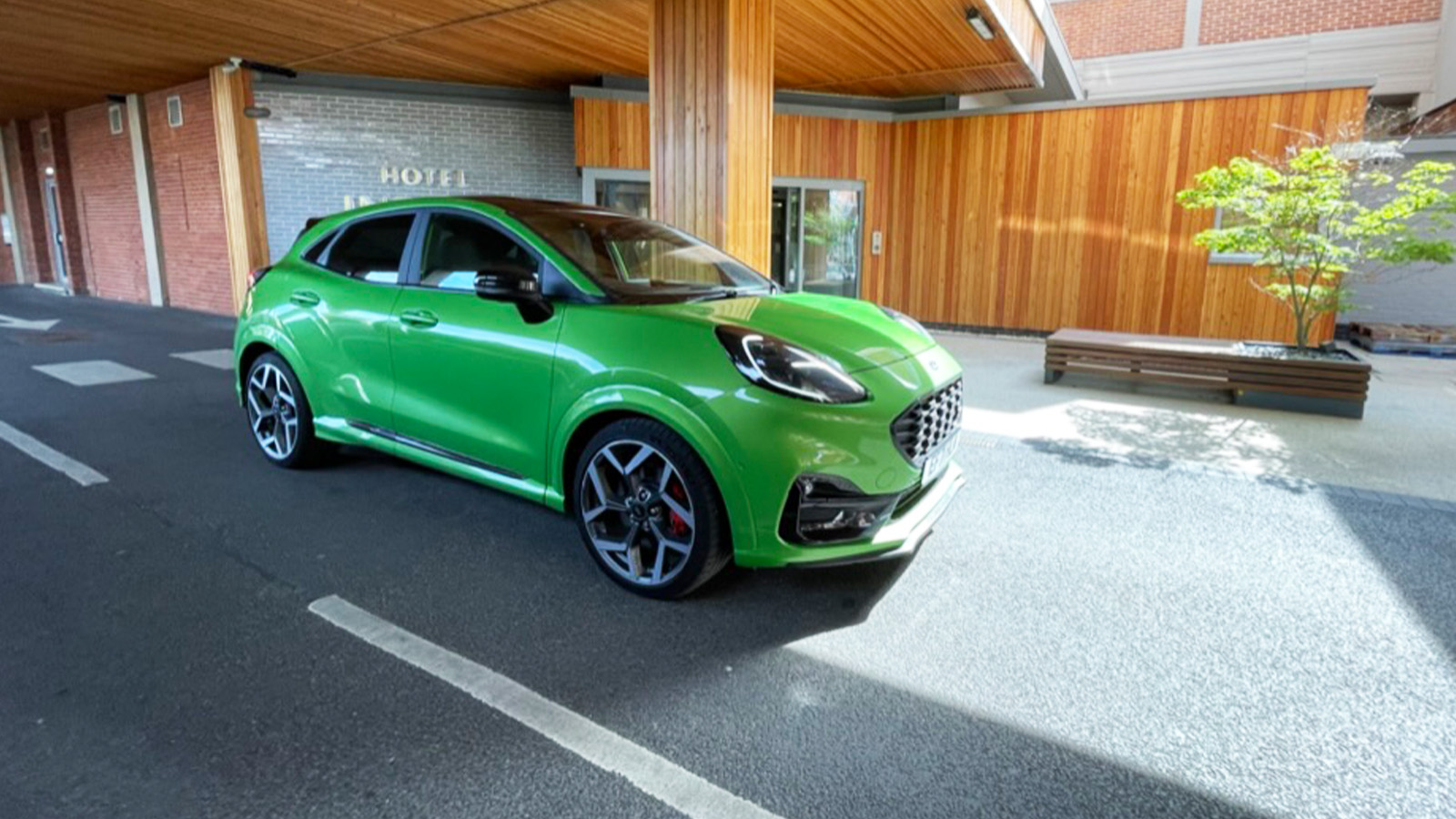
This is a Ford Puma. It’s a Fiesta-based European Ford crossover built in Romania and sold in Europe. It is excellent. I drove one while I was in the UK a couple of years ago and adored it. You know who also adores this? Ford CEO Jim Farley, who said he wished it were for sale in the United States.
Now, here’s the trick to this. What the Trump White House wants is for these cars to be built in the United States, but it is actually not that big of a deal if they’re not, unless the rules are written in a specific way to keep them out of the country.
The Puma is built in the EU and therefore subject to a 15% tariff, plus some other potential tariffs for specific material content (which might be offset because Ford is also a local producer, but I’m not a Section 232 expert, so this will depend on a lot of factors that seem to change by the week). That’s not terrible, really? With the average transaction price above $50k right now, a cheap car is a cheap car, and there are always incentives and tax breaks to be had.
This is about a $28,000 car in Europe, but everything is more expensive in Europe except food, real estate, drugs, and healthcare. Could this be a sub-Bronco Sport car in the $22-25k range to compete with the Trax? That would be dope.
My wild theory here, after talking to some friends, is that Ford should just import the Puma and sell it here as a cheaper car. With the OBBB and the EPA rolling back CAFE penalties and goals, there’s likely to be less of a penalty. These are safe cars and not kei small, but still smaller than what we get.
Also, it’s good. It’s a good car. Plus, Puma is a cool name. I also think Nissan could make a deal with Dacia to bring the Duster here, and Volkswagen could start selling SEATs here. Let’s get creative! There are plenty of non-kei sized cars that would probably do well here as cheaper cars.
[Ed Note: I don’t see how the Puma is going to move the needle compared to current US offerings, but I do like it. -DT].
Nissan Needs A Friend
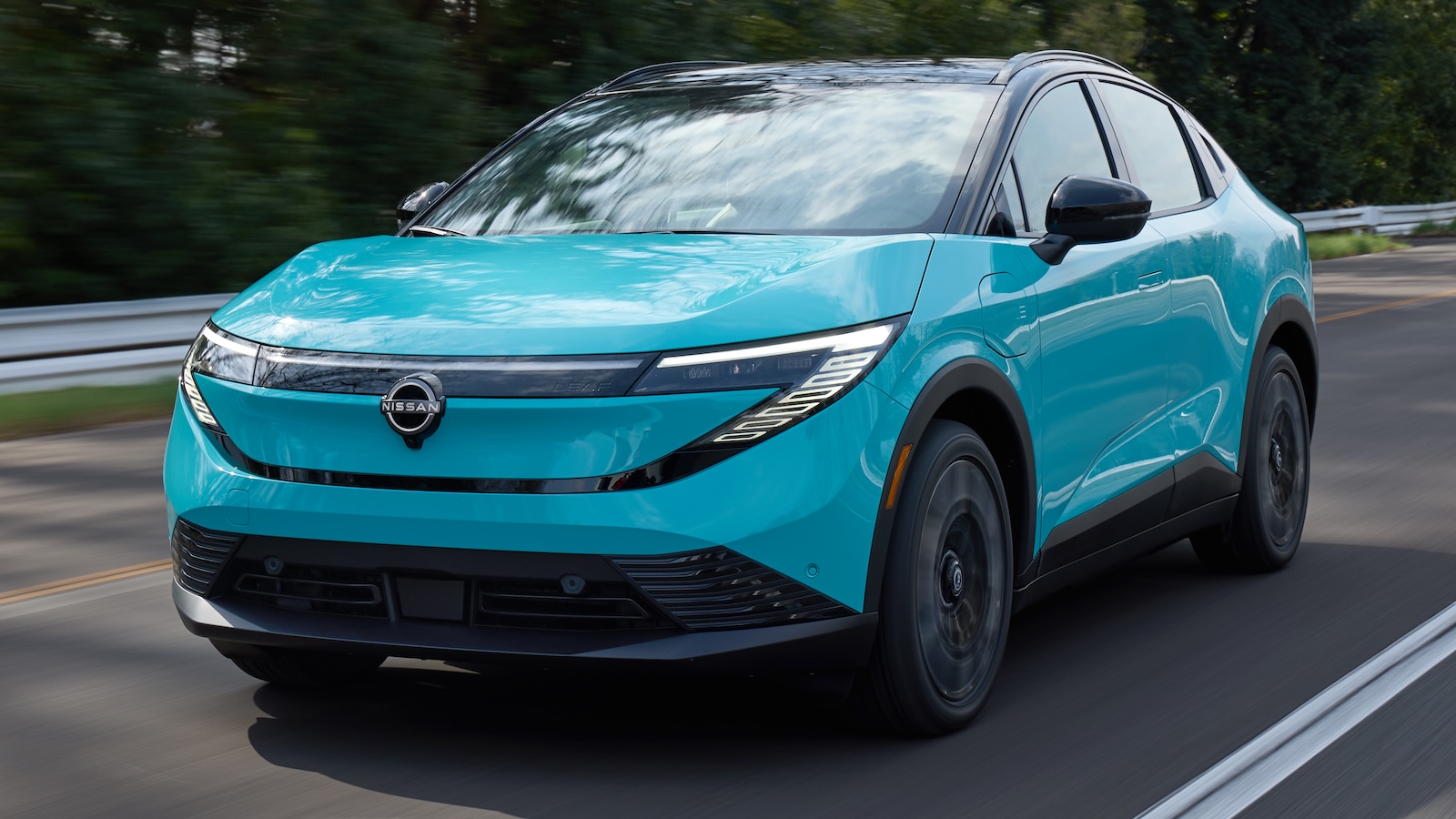
The history of Nissan is a history of partnerships that just didn’t quite work out, for whatever reason. An unequal structure between Nissan and Renault was the rotten foundation on which that partnership was built, and the whole thing crumbled when Nissan had Carlos Ghosn arrested. The Honda deal was going to be another case of Nissan being subservient, which Nissan seems unwilling to accept.
According to this Automotive News report, Nissan wants a partner, but it still has some conditions:
“Nissan is open for business with other automakers,” Nissan Americas product planning chief Ponz Pandikuthira told Automotive News at a media event here.
But the company has made one requirement clear in discussions with prospective mates: “It must be reciprocal. Somebody has something that we would like; we have something that they would like,” Pandikuthira said.
“We would not engage with a partner just to buy a vehicle, or platform, or piece of tech,” he continued. “That’s what makes it a long-term commitment instead of just a transaction.”
Besides some totally fine and semi-competitive EVs, Nissan also has big trucks and the Nissan Frontier. Who wants a truck?
Will Lower Tax Bills Spur The Car Market?
The economy vibes are kinda bad right now. No one knows what’s going to happen. I get the sense that a lot of people are just hanging onto mediocre jobs, and jobs are hanging on to mediocre employees until something gives (which explains my staying power).
A look at the Manheim Used Vehicle Value Index shows, well, things are just kinda stuck. Demand is there, but prices are a little high, so volume is ok but not great. Maybe something can fix that?
Here’s what Jeremy Robb, Interim Chief Economist at Cox Automotive, had to say:
“Like most metrics we track across the automotive landscape, wholesale prices dipped in October before showing modest improvement in November.
“As November progressed, both new and used retail sales lifted from October levels, and the longest government shutdown in history came to an end. While consumer sentiment remains subdued, early reads suggest confidence is recovering. We’re seeing good vehicle sales supported by lower APR rates, and price depreciation is trending back to normal, with values slightly higher than usual. We’re also only a month from January, when lower tax withholding rates will boost take-home pay. Once consumers feel that in their paychecks and realize their tax refunds could be substantially higher this year, we are expecting some tailwinds to hit the auto market.”
Whatever you feelings about the tax cuts, there are many consumers who will see at least modest tax savings in the near term. Will that be enough to offset tariffs? Will the increased in EVs coming off-lease lead to more people buying cheaper used electric cars?
For the sake of the economy and the deficit, it would be helpful if people took that money and bought more things.
What I’m Listening To While Writing TMD
David called me from the road the other day, and he was in a town he’d never heard of, near Sacramento. I asked him: “Is it Stockton?” I guessed this because that’s the home of the best band in history, aka Pavement. Here’s them performing “Unfair,” which is premised on the idea that SoCal sucks all the water and good stuff out of Northern California. Slinging nachos like you just don’t care.
The Big Question
If you could bring back one car from the 1970s what would it be?
Top shot: Ford




The Puma ST has always intrigued me. This should come as absolutely no surprise to any of you.
TBF That green paint rules.
It reminds me of Porsche’s metallic bright green (I forget the official name) and that’s a pretty huge compliment to give a Ford
Kermit?
It’s relatively cheap and looks both cheerful without looking like a prey animal, nor too much like a predator. It’s a nice balance.
I’d hope if they did bring it here, we got the ST in the first year, and also that they don’t bother with bringing the DCT over. I don’t know of a single modern FWD-based DCT that hasn’t had some sort of issue. Ford PowerShift, Kia/Hyundai’s, VAG’s, (I think that encompasses most/all the ones sold in the US recently), they all have had problems.
The Hyundai wet DCT in the N cars is great. I’ve driven an Elantra N with it in addition to my Kona and it’s fantastic and makes VW’s DSG feel like a slush box by comparison. That being said I have no fucking idea why Hyundai has tried to shove it in regular cars. At low speeds and in traffic it can feel like someone not driving a manual particularly well.
I don’t care, it’s a trade off I’m willing to make to be able to bang off super fast shifts and have an instant kick down when I’m driving hard. But for the average Santa Fe buyer? Dear god. One or two clunky shifts and they’re probably rushing it back to the dealership. And DCTs don’t always go into gear instantly at low speeds. Sometimes you get a delay and a thunk into gear.
Putting them in family cars is absolutely asinine. Anyway do they offer the Puma ST with a stick? I was under the impression they were all DCT but I could be wrong.
Edit: they’re available in stick. It’s basically the same powertrain as the Fiesta ST that we no longer get.
Yeah I went back and read the article from the author’s drive in England from last year. Stick shift, but the 1.5L I3 we didn’t get since we didn’t get the final generation of Fiesta. We only got the 1.6L I4, but it was manual only.
People need to really want to BUY these cars though, in volumes that make them profitable. Smaller car make people fear getting in an accident with the behemoths, like an Escalade, a Expedition, or a Huge Truck.
The easiest way to revive small cars and do what Europe does and have an energy policy where poor MPG hurts the wallet, and raise gas taxes. That would drive the Market for smaller more Efficient cars. This administration has desire to move this way though.
Now there you go making sense. That kind of behavior is not acceptable.
It’s funny, because the only reason kei cars exist at all is very strict regulation (and the main reason small cars are popular in Europe is regulation). Reducing regulation will absolutely not result in more small cars.
It will, however, result in higher profit margins for the shareholders. Funny how that works.
Well let’s be honest in Asia and Europe there is like one road big vehicles fit. The rest have lanes you can’t ride 2 Vespas side by side.
I’m not a big government intervention guy but a law saying a vehicle can’t be as big and as heavy as a WWII Tank isn’t a big ask. I just went grocery shopping bread, eggs, and Vodka, dude in his truck taking up 4 parking spots right on the front row. He looked like a Biden supporter.
“dude in his truck taking up 4 parking spots right on the front row. He looked like a Biden supporter.”
Username checks out.
I suppose if emissions and fuel economy standards don’t matter anymore, Mazda should bring back the REPU, the pickup truck that thinks it’s an RX7.
The RXamino.
RXchero was right there, and more appropriate as it came before the chevy model, and is generally the superior option of the two.
Came here to say Cosmo, but actually REPU is the correct choice.
RXs (stylized to look like the prescription symbol) are just what the doctor ordered.
Is Mazda also in the medical field? What’s with all the RXs?
Let’s bring back the Designer Series Continentals – Bill Blass, Cartier, Givenchy, and Pucci – and as a nod to modern tastes, include an “outdoorsy” version, say Arc’teryx, Moncler, or Patagonia.
This is a great idea, especially in Colorado. if bringing back a 70’s car, maybe a 70’s outdoorsy brand-not sure any of those companies were around in the 70’s? i could be wrong, maybe Patagonia was Chouinard at the time? Perhaps Kelty, Lowe, Expensive Mountain Stuff, The North Face, Sierra Designs. Ford already did the Eddie Bauer colab. Id love me a Jansport Suburban, an Adventure 16 Bronco or EMS Range Rover! There’s gold in them there restomod hills!
North Face, Moncler, Patagonia, Canada Goose, all of them were around in the ’70s, so very, very doable. Thick wool coats, hard leather boots, and your Lincoln personal luxury coupe – a match made in heaven.
The combination of the Original comment and yours. The Pierre Cardin Javelin or AMX. Groovy
An outdoorsy Lincoln Continental in Patagonia garb would be absolutely wild, lol.
With tariffs they can’t just take a car from another market and start selling it here. They would have to set up domestic production ($$$$ and years). After all that the margins would have to be miniscule, which means profitability would have to be supported by volume. Without tariffs, a small could be sold globally and made profitable. With tariffs, I do not believe the US market alone could support a market for small cars. Your average American would gladly double their loan length rather than purchase a small car. I’m in agreement with most commenters here that smaller cars are the better choice, but the fact of the matter is that Americans do not want them.
Yeah, this is yet another example of the economic incompetence of Trump who always thinks that there is a simple solution to complex problems. Cars are too expensive? Well small cars are cheaper! Oh, but you can’t import them from a low-cost country without a big tariff that makes them just as expensive as the options we already have. And no manufacturer is going to spend hundreds of millions to set up US manufacturing for some kei car that will end up costing just as much as an Escape once you have to pay all your workers American wages, and not enough peoplle will want to buy one and drive on the same highways as 8000lb F-350s with a 10″ lift.
Yes chicken tax has been around 50 years, Trump clearly has a time machine went back in time to outlaw them only so he can make them legal in his 2nd term.
It must be exhausting to be you.
Not just tariffs but also US specific regulations. If we allowed vehicle that meet EU standards in the USA without modification we would have a lot more small car options.
Just as it makes no sense to set up manufacturing it also makes no sense to spend millions to federalize a car to sell tiny volumes in the US market.
Yeah, whatever happened to harmonizing safety and emissions standards during tariff negotiations?
Those negotiations aren’t done so it could happen.
Of course it also requires an act of congress. Trade agreements are negotiated by the executive branch but ratified and approved by the Congress.
Yeah, not holding my breath, but stranger things have happened.
Dreaming here – but if it happened it would be interesting if automakers were only allowed to import EU spec vehicle or if we could make them he in the USA for sale in the USA.
Automakers would love to simplify the product line and I suspect we would shift to making EU spec vehicles.
Not true. Just buy a golf cart factory and turn it over. They are about the same vehicle. Just Kei vehicles are less expensive and more useful
It has always baffled me they never brought the Puma over. It’s genuinely one of the coolest things they’ve made in recent years, it’s in a market segment that people can’t get enough of, it looks neat, and it’s kind of sports car-y.
Instead we got the EcoSport, because reasons. Both Fiesta-based taller hatchbacks (swing-out doors count as hatches, right?), but notably different interpretations of the base recipe.
Puma ST with the 2.0L from the EcoSport and the manual from the Fiesta ST sounds like a hoot.
The reason was price.
We got the Ecosport made for middle income countries instead of the Puma made for Europe where people will pay more money for a good small car.
You do finally get to it at the end of the section in a single sentence, but Duffy is of course talking about how CAFE disincentivized anything that couldn’t be construed as a light truck in his station wagon comment. This sort of statement has long been an uncontroversial feature of internet car culture. Saying “They can also build wagons whenever they want” is the same kind of thing as “there was no EV mandate”. Both statements mislead by removing all detail and nuance.
Now, since all of this could easily be reversed in 3 years, I actually think you’re right this ends up as a strange incentive to import small cars here from other places while you still can. If CAFE was rolled back more permanently via legislation, then perhaps there would be interest in building non-crossovers here.
Automakers can build a wagon anytime they want. The Civic and Camry didn’t go away just because they are passenger cars. We could get the Corolla Wagon sold in Europe – it would have the same requirements as the Corolla sedan that absolutely dominates compact car sales with 70% market share. Instead Toyota gave us the Corolla Cross because they know it will sell better and for a higher price than a wagon
I doubt you will see a reversal if the current administration finds a way to change the regulation ( 49 CFR § 523.5 – Non-passenger automobile) so that crossovers become passenger cars again. The current CAFE rules require light truck to accelerate fuel saving much faster than passenger cars as a way so slowly bring the two back into balance.
Yes it’s true they can. My issue isn’t the bare, unadorned truth of that statement. My issue is that the truth of that statement has no effect on reality, much in the same way that you could technically put your hand on a hot stove anytime you want. This is for a variety of reasons, one is that CAFE disincentivized things classified as cars.
Your statements about the Corolla just go to show that only automakers really committed to and technologically able to remain in that market stayed there. Not just because of customer preference for larger vehicles, but because the government made it harder.
I did not claim that CAFE was the only or even the main reason why we don’t have more cars – you’ll notice the careful use of “perhaps” in my last sentence. Generally, I agree that people have a preference for larger, better equipped vehicles and the US populace has the spending power to exercise that preference.
All I’d add to expand on your last sentence is:
People have a preference for a larger, better equipped vehicles – yes, no argument there – particularly when they aren’t much more expensive than a small basic vehicle. And CAFE is part of the reason the price gap isn’t as large as it could be. If footprint didn’t impact emissions standards the small cars might not be much cheaper but the crossovers replacing them would certainly be more expensive.
Toyota remained committed to selling the Corolla sedan because it sells.
I’ve been driving wagons for 30 years. I like them but see why people prefer the advantages of a crossover with a higher ride height.
CAFE can certainly be blamed for the death of the large, V8 station wagon and definitely had an influence on product mix that started putting SUVs and crossovers into the hands of consumers, but at this point I don’t think it’s relevant to the product mix anymore. People buy crossovers because they like the easier entry, higher vantage point, and versatility (or perceived versatility).
The MPG difference between crossovers and the similarly sized car has even been shrinking for years, and with hybrids is even more irrelevant.
If it’s Accord wagon vs CRV, the CRV wins every time in the US market. Duffy is trying to pitch this as “we’re removing these regulations, and you’ll finally have choice again” when the reality is if they remove the regulations there’s still no one who will choose wagons or small cars.
I suspect the real driving force is very wealthy donors who stand to gain more wealth through the removal of regulation. The consumers don’t get anything out of this.
today at Kommentariat U. I learned that regulations are for punishing “wealthy donors”
Done right, regulations are a way to use the power of the state to counter the worst impulses of pure capitalism. In its purest sense, capitalism will encourage the accrual of wealth regardless of the impact to the environment, the health and safety of workers, or the health and safety of the customers.
Sure, there can be an argument that “market forces” will take care of that through competition, where workers and customers can choose to work for or purchase products from companies that do account for these things, but that only works if there’s a lot of competition, which isn’t the case as corporations grow and monopolies consolidate.
So while regulations aren’t strictly put in place to punish wealthy donors, they often become obstacles to the accrual of wealth. Which tends to be the reason wealthy donors all seem to want fewer regulations.
Getting rid of CAFE is not going to make people want to go back to squatting and stooping in an out of their station wagons, when they can so easily step in and out of their CUVs.
Or see cross traffic when stopped at a light.
I have an Acura TSX Wagon. If pretty much any vehicle pulls up next to be to my left I can’t see to make a right turn. My other car is a Bolt with a much more upright seat position. Even sitting 4-5 inches higher makes a big difference.
I loved my GTI, but I could not stand the visibility issue. Unfortunately, you need an SUV or truck to see anything these days.
I genuinely don’t understand the appeal of sedans, having owned both sedans and wagons. Wagons are just so much more practical. Other than a slight weight increase over the rear, and an arguably “less secure” cargo area (meh, any thief could get in either if they wanted), there’s no real disadvantage I’m aware of. Plus they typically have rear wipers and defrosters, which makes clearing snow and rain off the rear glass easier.
I’m told sedans are more “sporty,” and there are some slight advantages to NVH from separating the cargo compartment from the passengers, but I’m a wagon/hatch fan. At least a lot of the smaller crossovers are actually just hatches with some cladding and they haven’t completely disappeared like the marketing would have you believe.
I’d say wagons and hatches are the most popular market segment in the USA. They are just a bit taller than they used to be.
That’s certainly one possible interpretation of the current market. I’d like to see a return to lower profile 5 doors though, especially as EVs become more prevalent given the aero advantages to being lower.
EVs have the problem of putting the battery under the floor which raises the height.
Driving an EV is so cheap that aero doesn’t really matter as much. Once a car goes 300 miles more range is mostly bench racing.
Yeah, but I’m the weirdo who picked an Impreza over a Crosstrek for the gas mileage…
I’m sure there are a few people that care about saving a buck a week.
(That is the difference between driving a Model 3 vs a Model Y)
Back to the future from the 70’s? Datsun 510 or Datsun 240Z
Buuuuuuuuuuuuullllllllllll sheeeeeeeeeeeeeeeeeeeeet.
*laughs in $65k Jeep Wrangler that is recalled once per day*
To be fair, she said looking for opportunities, not seizing, addressing, or creating them with their vehicles. Most people DO choose the vehicles they want at prices they can afford…they’re just overwhelmingly not Stellantis vehicles.
“Oh look, an opportunity! There is goes. Wave, kids! Bye bye, opportunity!”
-Some product development exec at Stellantis, probably
This is about a $28,000 car in Europe, but everything is more expensive in Europe except food, real estate, drugs, and healthcare.
Uhhhhh, this implies basically everything that matters is cheaper in Europe. I’d imagine this is extremely variable.
That’s the joke. They are taxed higher and pay more for consumer goods but day to day life is easier.
One 1970s car, hm? Well, since the aircooled Beetle is technically a 1939 machine, I’m going to go with the AMC Gremlin. We need a hatch that’s not actually a hatch, with straight sixes and V8s available, that has starred in such cultural icons as Homestar Runner and The Simpsons.
Can I bring back an entire car brand from the 70’s?
Now to decide whether I bring back AMC or Pontiac…
AMC, obviously. While it had a few unique offerings, most Pontiacs at least shared a platform with other GM products. That said, the liftback 90s Firebird was an awesome car though.
I feel like the small overpriced car platform is where EVs fit best, give us the Nissan Micra!
For the 70s car I guess a Kharmann Ghia but that’s not really got the wood paneling vibe.
Or a 5 or Inster!
I do not believe that Trump is just blowing smoke up are arses regarding kei cars for America but until car insurance reform happens a Kei car in America will have a monthly insurance bill higher than its monthly finance payment…
He went to Japan, saw something he never saw before, thought it was neat, made an off-hand remark, his army of ass-kissers nodded and smiled and told him what a neat idea it was and how handsome he is, media outlets took this off-hand remark as gospel truth, and here we are. I guarantee you he already forgot he even said it.
I’m still surprised this is even news. Trump does this thing all the time. He goes to a place; sees something he thinks is cool. Then stands at a podium and demands someone else do something about it by order of fiat. Ignoring usually decades if not centuries of systematic reasoning for why the thing he thinks is cool does not exist in America. and Outside of that one time we kind-of attempted a military parade, usually this ends in some press briefing from what secretary ordered to do the impossible, where we get a none-sense statement from that week’s sacrifice. and We all move on to the next wacky off-the-cuff statement about how the Washington Football Team needs to name their new stadium after him or whatever.
I get why it’s news, because it’s incredibly random that he of all people would express a liking for kei cars, but I don’t get people being at all remotely hopeful about it. If a president, any president, had said something like this 20 years ago, yeah, that might mean something is about to happen. This is a guy who opined for 10 minutes about the Filet-O-Fish at the McDonald’s summit. 95% of everything he says is nonsense.
The entire point is to keep him first in the news every day all day. It’s the full court press game and the admin is very successful at executing. The opposition does not get any screen time.
I’m still surprised people take anything he says seriously. The man has expressed every possible position under the sun and believes exactly none of them (except the ones about how great he is).
He could actually make small cars competitive in America but that would require CAFE standard reform. The Honda Fit, Ford Fiesta, Nissan Versa, Toyota Yaris were all discontinued because they weren’t competitive – I don’t see how making even smaller cars is a winner.
Americans will not buy smaller cars until there is a financial incentive to do so. This wont happen until gas ain’t cheap and loans aren’t 96 months.
What in Sam Hell is a Puma?
Oh, my sweet summer child. “Puma” was a shoe brand that was popular in the ’70s.
(Please go watch Red vs. Blue, episode 2: Red Gets a Delivery)
Puma was a shoe company founded by the brother of the founder of Adidas, and both of them joined the Nazi party in 1933.
Didn’t I just tell you to stop making up animals?!
Personally, I can’t wait for GM to bring over the Chevrolet Chupa-Thingy
Kia Walrus or GTFO
“I like it! It’s got a RIIING to it.”
Will this be Chevy’s answer to the VW Thing in our back to the 70’s event?
A man of Internet culture I see!
“See these hooks here? They look like tusks. Now what other animal has tusks?”
“A Walrus.”
“Didn’t I just tell you to stop makin’ up animals?!”
Watch this, it explains everything
https://youtu.be/je8Rjn0JIGs?si=45ACbgy_wDZSgs8t
well, actually nothing but its a good one.
Pete Puma!
https://www.youtube.com/watch?v=aGns_QEUPTw
For the longest time, I had a “My other car is a Puma” bumper sticker, so I’m glad someone else was here to make this joke.
I want the Saab Sonnet back!
As a Saab tech of that time, Please no.
How about a Sonnet with a modern engine? Or at least not a 2 stroke or a V4? Say a Hayabusa maybe? That would be a hoot!
A proper Blazer K5 back to the market to compete with the Bronco and Wrangler, just modern enough.
They already have the vehicle for it, pretty sure you can still get a regular cab shortbed GM pickup. That’d be an easy conversion.
Of course, then you’re driving a GM pickup.
Which 70s car to bring back?
Volkswagen Golf/Rabbit, the most perfect automotive form ever created.
Rivian R3X agrees.
Forget the ’70s: how about a Honda Element?
YES!
though, in general, all of this is surmountable.
Yes, but at what costs? While I by no means expect a flood of kei cars, changing the rules will change the costs, which changes the profitability math, which changes what an OEM might consider as worth their time.
As for what should come back from the 70s, I vote Bricklin SV1
I’m pretty sure the reason we didn’t get the GR Yaris is because the regular car didn’t sell in the land of SUVs and BroTrucks. Now all of a sudden we want small cars?
(Don’t get me wrong, small-ish cars are my thing.)
Yeah, it sucks that small cars are always penalty boxes here. All the power and features are size-walled behind bigger vehicles and it blows.
I thought the reason the Fiesta was built in Mexico was because the profit margin was so small that it wouldn’t be profitable to build in the states.
That is the reality for every small car. You can’t build cheap cars with $70 per hour labor.
Who pays $70 per hour for labor? The average automaker wage in the U.S. is much less than that.
Here is a summary from Google:
However, in Mexico, the data is different, of course:
Toyota is much more generous:
You a listing only wages – which is less than half of the equation.
The real equation is wages (straight time and overtime) + FICA + unemployment insurance + Medical Insurance, short term disability + long term disability + 401K + UAW contract signing bonus + yearly profit sharing bonus. Then that is divided by number of hours worked after subtracting the paid holidays (17), family days (2) and vacation time (up to 25 days), and Christmas shutdown days (7)
“You can’t build cheap cars with $70 per hour labor” is a bare-bones statement.
=/= $70.00 per hour, including all possible costs and benefits, including an amortized signing bonus (?!), unemployment insurance (which is not a benefit to the employee, but a fund that the employer pays into), and the rest of the kitchen sink.
You denying reality does not change reality. I know exactly what the labor rates are at all of our North American assembly plants and the US ones are all $70 and above.
Unemployment insurance absolutely is an employee benefit. It is paid out to them if unemployed. It is also a cost directly related to their wages. Same with FICA. Just because the law says employers have to pay that tax directly on behalf of the employee doesn’t mean it isn’t a benefit.
I did this breakdown for someone else back when the strike was going on. Ford 2023:
$58,240 – Base Wage (2080 hour x $28 per hour)
$ 2,250 – 2019 Contract Sign Bonus ($9K / 4)
$10,416 – Yearly Profit Share
$25,000 – Medical Insurance
$ 5,447 – 401k (6.4% of wages + $1 per hour worked)
$ 4,609 – FICA (7.65% of wages)
$ 709 – Unemployment
$106,671 – Total Pay
Hours
2080
-160 (Holiday)
-200 (PTO)
1720
$104,951 / 1720 = $62 per hour
That is before any overtime and before they got a 23% pay raise with the new contract.
Yawn.
I’m wracking my brain for something I would want to come back from the 70’s, and you know what? I can’t think of a single car that I remember from the 70’s that I would want. The beginning of the smog-choked, terrible build quality that happened then which lead to the term “malaise era”, coupled with fuel crisis, rust, etc. leaves me pretty happy that the era has passed.
If you should happen to have a 1972 Porsche 911E sitting about, send it my way.
I almost added a bit about an air-cooled Porsche 911. However the power numbers weren’t exactly stunning, and without modern electronics, they were known as “Dentist killers” and “widowmakers” for a reason if you didn’t know how to handle a rear-engined car.
Well they had enough power to kill you if you did something stupid, so I don’t know whether that counts as stunning.
The lack of anything that interferes with driver control for better or worse is the whole point.
I’d like mine in signal orange with the ATS cookie cutters please.
Is the Puma available with a 5 or 6 speed manual?
If Wikipedia is to be believed…yes!
Ford UK site lists 6 speed manual with hybrid 1.0 liter ecoboost. The wet timing belt engine. Never mind.
But wait! There’s more; after 2016 Ford replaced the wet belt with a timing chain, or so I just read. Seems too logical of a decision for Ford in this time period.
Wikipedia also lists a diesel engine, no idea where that’s offered or if it pairs with the manual (or for that matter if it’s a good engine).
Am I the only one who thinks of several things before automobiles when I read “wet belt”?
“replaced the wet belt with a timing chain” seems so…
I believe that the oil pump is still a wet belt on the timing chain versions.
Now sounds more like the Ford we know; replace the internal timing wet belt with a good old chain, but leave the internal oil pump belt behind.
Puma also comes in a hybrid w/ 1.0 ecoboost…had this as a rental last year in UK. Liked it as a basic car. Size wise, feels pretty similar to wife’s Crosstrek.
Anyone remember Pete Puma from WB Looney Tunes?
This was decidedly not my experience living there. Region-specific?
Yeah, that’s a head-scratcher. America has had a “cheap food” policy for a long time now.
Notice I didn’t say “cheap + good food policy”.
It’s pretty dependent on where you are. In my travels, I found *If you’re not in a high tourist area or central city* it is close if not cheaper in the EU. If you’re where the people actually live, like a Hull or Lille. Food costs all-around pretty good. Likely because there are so many options of small grocery chains. Comparative to the often-localized monopoly supermarkets that make up the US market (Albertson’s, Food Lion brands, etc.).
You forgot the big kahuna, SquallorMart.
It’s not my experience either.
Many places in Europe are vastly less expensive to live than many equivalent-size places in the USA.
$149,000 in France
https://www.french-property.com/sale-property/1634-BVI80061
Looks nice to me
Yeah bizarre throwaway line there that adds nothing to just listing the price it retails for in Europe and saying it might be different here.
I was just thinking I might move to a waterfront penthouse in Europe where I would consume only fried drugs sandwiches before checking myself in for some cut-rate angioplasty.
COTD
Had the US Ambassador to France telling Les Echos news paper that the standard of living in Mississippi is higher, measured by GDP per head than in France.
Been to Mississippi, live in France. It is not….
I mean, that is a statement of fact. Whether or not GDP per capita is the best measurement for standard of living or quality of life is certainly debatable.
Considering a handful of individuals in the US hold more wealth than the entire bottom 50% of the US population, probably not.
“debatable” is a nice way of putting it
Meh, I’ve lived both in Europe and in relatively poor parts of the US (never MS). Each has reasons to recommend it over the other. It’s not as simple as “ha ha rednecks bad”.
Agreed, it’s not that simple. But Mississippi’s GDP beating France versus it’s poverty rate is about as good an example of GDP not being an indicator of quality-of-life as it gets. It’s probably a great indicator of wealth disparity though.
Pre pandemic I found the grocery prices in Swedish supermarkets more or less on par with many California supermarkets. Except for mushrooms and cheese, those were cheaper and more varied in Sweden.
And you can get reindeer which is unobtanium in California. It’s delicious, especially at this time of year.