


This week has been strange, with the government promoting the idea that both wood-panelled station wagons and Japanese-style kei cars could suddenly be sold in the United States. That’s strange. I don’t entirely know what to make of that, but if there’s sincerely going to be a change to the rules in order to allow small cars here, I have an idea of what companies should do.
The Morning Dump is sometimes here to point out the problems, but that’s easy, right? Today, I want to be solutions-oriented. I’m going to start with what the administration is saying, and what the issues might be with what they’re saying. But then I want to talk about some products that could make it here.


Then I’ll talk about Nissan and the usual troubles with Nissan, as well as the potential for tax cuts to get more people into dealerships next year.
You Can Already Sell Small Cars And Wagons In The United States
This was covered well earlier this week, but President Trump said that he’s going to guide Transportation Secretary Duffy to make it easier to sell small cars here. Then, in the video above (or here), Sec. Duffy told CNBC’s Phil LeBeau that station wagons could make a comeback in the United States.
“Listen, the auto industry is very competitive, right?” Duffy replied. “And by the way, if we bring prices down and we get newer cars on American roads, newer cars are way safer.”
“If you’re building a car, developing a car that Joe Biden or Pete Buttigieg wanted you to build, that’s different than market demand,” he continued. “This rule will actually allow you to bring back the 1970s station wagon. Maybe a little wood paneling on the side, Phil.
It’s both important that the government regulate and guide the car market due to its critical importance, and also, historically, a bit of a nightmare when it does. This is bipartisan, too, as NAFTA was an H.W. Bush idea that Clinton ran with, and Cash 4 Clunkers was an Obama-era provision.
What’s important to note is that automakers can build small cars and sell them here, and often do. The Ford Fiesta, the Honda Fit, the Chevy Spark, and on and on. They can also build wagons whenever they want, as happened with the RS6 Avant and BMW M5 Touring.
For me, this is confusing, and I can tell the commentariat is having the same kind of cognitive dissonance meltdown. Obviously, inflation is up, and the President likely came into office at least partially on the concept that Biden took egg.
This is weird for me because, on the one hand, I want wood-panelled wagons and Autozams. On the other hand, I know that there are crash safety standards and certain EPA rules that make it harder to sell small cars here; though, in general, all of this is surmountable.
The Detroit Free Press polled the major automakers, and basically none of them would commit to actually building a car like this:
When asked by the Detroit Free Press if the Dearborn-based automaker would actually consider building and selling such a vehicle in the United States, Ford spokesman Griffin Anderson sent this statement: “Nothing specific to share at this time, but as America’s largest auto producer — including F-Series, the best-selling vehicle in the U.S. for 43 years — we’re always looking for ways to give U.S. customers more choice and affordability in vehicles they love.”
GM spokeswoman Liz Winter said the Detroit-based automaker has a policy of not commenting on future products.
Stellantis spokeswoman Jodi Tinson emailed the following statement: “Stellantis is always looking for opportunities to adapt our product portfolio to meet our customers’ needs and give them the freedom to choose vehicles they want at prices they can afford.”
That’s not a “no” and Ford actually has the perfect car.
Ford Should Sell The Puma Here
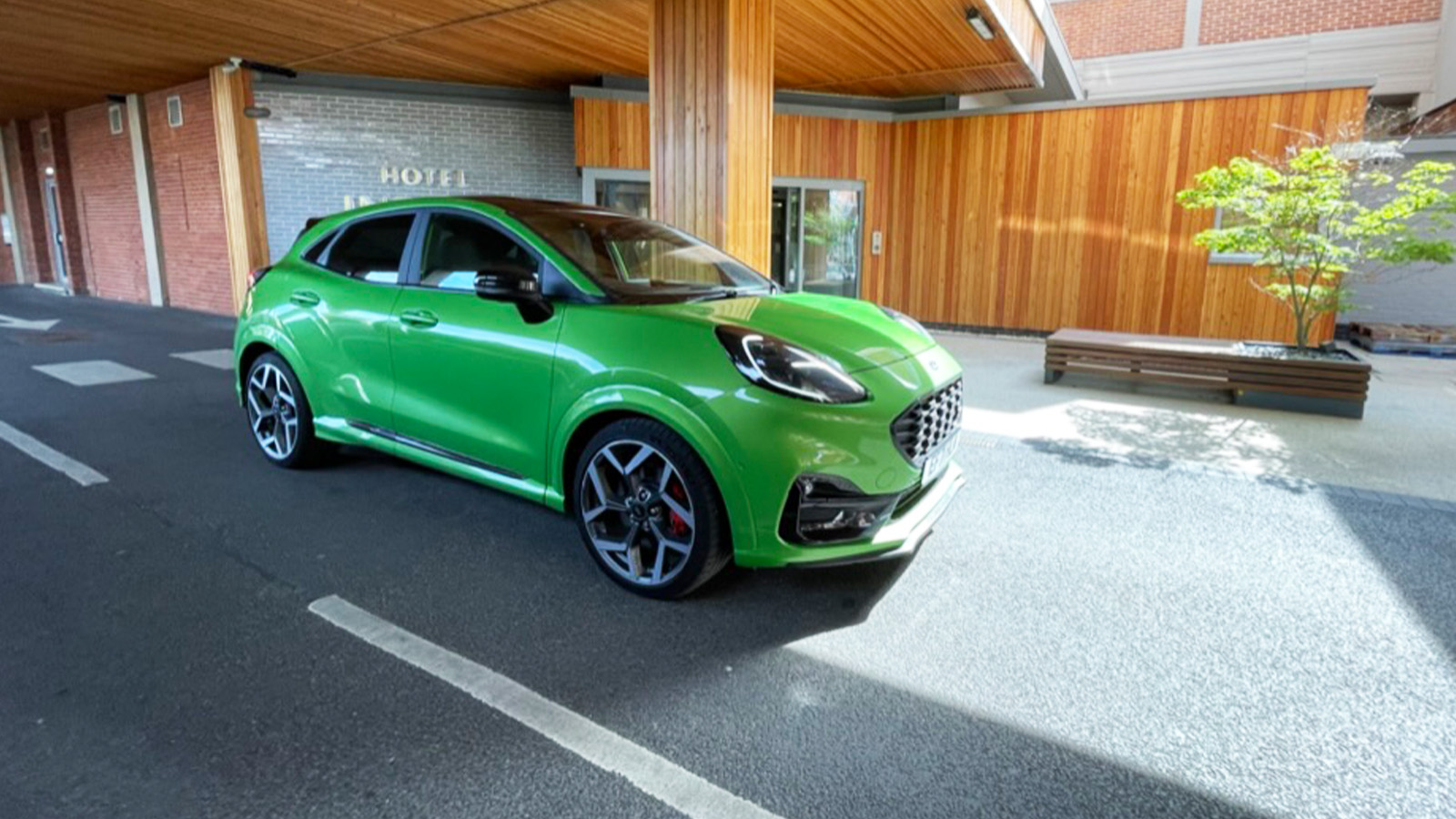
This is a Ford Puma. It’s a Fiesta-based European Ford crossover built in Romania and sold in Europe. It is excellent. I drove one while I was in the UK a couple of years ago and adored it. You know who also adores this? Ford CEO Jim Farley, who said he wished it were for sale in the United States.
Now, here’s the trick to this. What the Trump White House wants is for these cars to be built in the United States, but it is actually not that big of a deal if they’re not, unless the rules are written in a specific way to keep them out of the country.
The Puma is built in the EU and therefore subject to a 15% tariff, plus some other potential tariffs for specific material content (which might be offset because Ford is also a local producer, but I’m not a Section 232 expert, so this will depend on a lot of factors that seem to change by the week). That’s not terrible, really? With the average transaction price above $50k right now, a cheap car is a cheap car, and there are always incentives and tax breaks to be had.
This is about a $28,000 car in Europe, but everything is more expensive in Europe except food, real estate, drugs, and healthcare. Could this be a sub-Bronco Sport car in the $22-25k range to compete with the Trax? That would be dope.
My wild theory here, after talking to some friends, is that Ford should just import the Puma and sell it here as a cheaper car. With the OBBB and the EPA rolling back CAFE penalties and goals, there’s likely to be less of a penalty. These are safe cars and not kei small, but still smaller than what we get.
Also, it’s good. It’s a good car. Plus, Puma is a cool name. I also think Nissan could make a deal with Dacia to bring the Duster here, and Volkswagen could start selling SEATs here. Let’s get creative! There are plenty of non-kei sized cars that would probably do well here as cheaper cars.
[Ed Note: I don’t see how the Puma is going to move the needle compared to current US offerings, but I do like it. -DT].
Nissan Needs A Friend
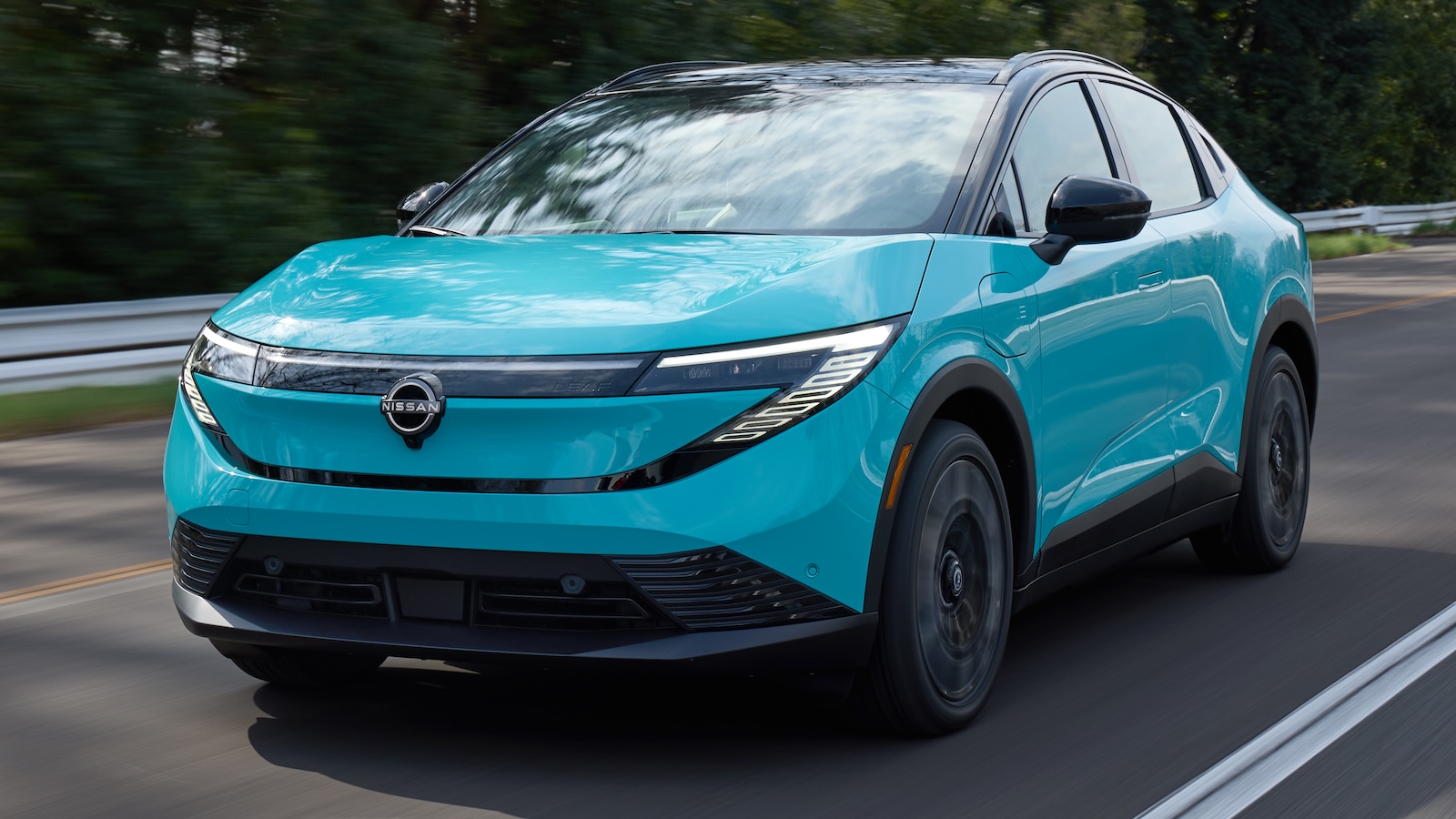
The history of Nissan is a history of partnerships that just didn’t quite work out, for whatever reason. An unequal structure between Nissan and Renault was the rotten foundation on which that partnership was built, and the whole thing crumbled when Nissan had Carlos Ghosn arrested. The Honda deal was going to be another case of Nissan being subservient, which Nissan seems unwilling to accept.
According to this Automotive News report, Nissan wants a partner, but it still has some conditions:
“Nissan is open for business with other automakers,” Nissan Americas product planning chief Ponz Pandikuthira told Automotive News at a media event here.
But the company has made one requirement clear in discussions with prospective mates: “It must be reciprocal. Somebody has something that we would like; we have something that they would like,” Pandikuthira said.
“We would not engage with a partner just to buy a vehicle, or platform, or piece of tech,” he continued. “That’s what makes it a long-term commitment instead of just a transaction.”
Besides some totally fine and semi-competitive EVs, Nissan also has big trucks and the Nissan Frontier. Who wants a truck?
Will Lower Tax Bills Spur The Car Market?
The economy vibes are kinda bad right now. No one knows what’s going to happen. I get the sense that a lot of people are just hanging onto mediocre jobs, and jobs are hanging on to mediocre employees until something gives (which explains my staying power).
A look at the Manheim Used Vehicle Value Index shows, well, things are just kinda stuck. Demand is there, but prices are a little high, so volume is ok but not great. Maybe something can fix that?
Here’s what Jeremy Robb, Interim Chief Economist at Cox Automotive, had to say:
“Like most metrics we track across the automotive landscape, wholesale prices dipped in October before showing modest improvement in November.
“As November progressed, both new and used retail sales lifted from October levels, and the longest government shutdown in history came to an end. While consumer sentiment remains subdued, early reads suggest confidence is recovering. We’re seeing good vehicle sales supported by lower APR rates, and price depreciation is trending back to normal, with values slightly higher than usual. We’re also only a month from January, when lower tax withholding rates will boost take-home pay. Once consumers feel that in their paychecks and realize their tax refunds could be substantially higher this year, we are expecting some tailwinds to hit the auto market.”
Whatever you feelings about the tax cuts, there are many consumers who will see at least modest tax savings in the near term. Will that be enough to offset tariffs? Will the increased in EVs coming off-lease lead to more people buying cheaper used electric cars?
For the sake of the economy and the deficit, it would be helpful if people took that money and bought more things.
What I’m Listening To While Writing TMD
David called me from the road the other day, and he was in a town he’d never heard of, near Sacramento. I asked him: “Is it Stockton?” I guessed this because that’s the home of the best band in history, aka Pavement. Here’s them performing “Unfair,” which is premised on the idea that SoCal sucks all the water and good stuff out of Northern California. Slinging nachos like you just don’t care.
The Big Question
If you could bring back one car from the 1970s what would it be?
Top shot: Ford



I’d like to refer everyone to Electrek’s take on the small-car thing. The headline pretty much summarizes:
https://electrek.co/2025/12/04/if-you-think-trump-will-bring-kei-cars-to-the-us-you-might-be-as-dumb-as-he-is/
The thing and Karmann Ghia come to mind as something from the 70s you can’t really get anymore that I would love to see again. I was thinking so many of those van based trucks but they exist in the world and you could build one or I’m sure someone is building something you could put on a cutaway.
Puma reeks of ecosport to me sounds like a good idea just isn’t. They aren’t that cheap to begin with then import and transport fees plus whatever regulation they have to go though for a car thats really not that great just and just little cheaper then something that works better. The japanese keis have a better chance of working just because they are relatively cheap, functional, and reliable. The yaris does well in Europe I suppose they could bring that back but would be better off bringing in some kind of kei box.
I rented a 1.0 Ecoboost Puma in Italy a few years back and it was absolutely fantastic. The hybrid system is one of the best I’ve ever driven and it even had a manual transmission. Nothing else in it’s class is even close.
And the KEI’s are different – enough – for now to have that forbidden fruit draw for some.
That and the people that love box cars along with colors the US doesn’t really get. It seems like anytime the japanese oems bring in a car targeted for teens to late 20s they attract the older population. The xb, cube, element, etc. Many Keis are great for people with mobility issues doors often open wide, seats move around, plus the boxy design allows for more space to get in and store things.
A Kei sized car with a 1200cc engine would be a hoot.
The Scion xB was very popular and still sought after, especially the first generation.
Why can’t we have nice things here in the Land Of The Free?
The first gen xb is in classic territory. They suffered from terrible 2nd and 3rd owners. Many got stanced and endured a lot of damage. Its surprising to me the market with older people with mobility issues is so strong especially for decent examples they are often paying close to what they cost new for the xb and even more confusing the cube.
I still see them on SFBA CL. A clean 1st gen with reasonable mileage (and no rust) can be had for $2-4k:
https://sfbay.craigslist.org/pen/cto/d/montara-toyota-scion-xb/7894606244.html
https://sfbay.craigslist.org/eby/cto/d/alameda-scion-xb/7896073798.html
Ford Tried the Puma Essentially, it was call EcoSport and the 1.0 Pile of Garbage basically killed it for anyone subjected to driving it regularly.
70’s were a tough time, most things built then were pretty bad. I think maybe a 1970 was peak muscle car in my opinion, but a few things like Cuda’s and Challengers were still decent up until 72. Same with most US brands though I suppose.
The one car that does stand out though was the SD455 TA in 73 or 74. 73 looks better , but both were under the radar types of cars made to correctly perform. Some might say the 1st year little red express since it was still not choked by a pancake Catalytic converter and the 340 head on the 360 helped it flow properly while the cam was not retarded in a vain attempt to decrease emissions by as of then unsure design engineers.
The Ecosport used an older Fiesta platform, was taller, heavier, thirstier, had worse styling in and out and worse build quality.
I’m not a fan of the 1.0 wet belt Ecoboost, but there are other engines available. And a 6 spd manual too
“…as America’s largest auto producer — including F-Series, the best-selling vehicle in the U.S. for 43 years — we’re always looking for ways to give U.S. customers more choice and affordability in vehicles they love.”
So we can expect another trim level of the F150 and Mustang in the near future.
The Puma is a fantastic car – the UK’s best-seller for three years in a row – but it won’t work in the US because your figures are way off. It’s not a $28k car at all.
Here in the UK, the petrol Puma starts at £26,580. That’s about $35,500 at the time of writing, and that’s for the entry-level model.
For the range-topping Puma ST in your photos, you’re looking at £33,880 – or about $45,200.
That said, you’re making way too big of a deal out of perceived safety issues. The previous-generation Fiesta, a European design, was sold in the US with no issues.
The nicest one you can get in Italy with the manual comes out to $32k USD. This price is close to competitive with similar vehicles. Unfortunately, many Americans seem to think that they need AWD at this price even though what they probably need is to keep nice tires on their car.
If I was to bring back a vehicle from the 70’s it would be the Plymouth Trailduster. That would bring back Plymouth as well.
I would definitely buy both a Pacer and a Gremlin if they were put back on sale.
The Puma is already six years old and had a mid-cycle refresh. I doubt Ford will go to the expense of Federally certifying it in the current generation.
Also would have to check the stats to see if Real Estate is cheaper in Europe as a whole. As a Brit living in the States one of the few things that seems cheaper here is real estate. The other one is gas.
they would more likely make a Maverick into a SUV? Or would that be a crossover? Anyway, less tooling and the product already has a following. the Puma is too much like the outgoing Escape, except it comes off as cheaper looking to me.
I think we’d have bought a Maverick SUV as our family vehicle. We thought about it, but couldn’t swing it with the large dog and kiddo – just too tight inside. And the Santa Cruz did not have the hybrid out yet (thogh they say it’s coming). Ended up in a base CX-50 hybrid, discounted down to thirtytwo large (plus TTL). If XLT Maverick SUV existed around that price range… we would have bought it.
I would absolutely buy a Maverick SUV, but with two kids and a large dog we really like the small third row of the Mazda5. I’m holding out hope that they’ll do the Maverick based Transit connect replacement like they hinted at a while back.
I’d absolutely buy a Puma if they came here.
Ford’s made a big fuss about how it’s now hardcore back into racing again, but aside from the Mustang and Raptor, it’s so far all stuff consumers won’t be able to buy. A small vehicle with a rally connection might nicely diversify the portfolio, esp with younger buyers.
If they would bring the Puma to Canada tariff-free, then I would have to give it a look.
As for what 70s car I want to come back…
Gimme black Trans Am. A special.Editions, gold bird on black. Build it on the modern Camaro chassis, but not like one of those body kit Trans Ams some builders put out.
And give it the damned T-roofs.
The Puma would suck a lot less than the EcoSport did, that’s for sure. Then again, just about everything sucks less than the EcoSport.
I would be curious how it could suck all that less when it is also running the 1.0 joke motor.
The EcoSport was trash all around. The powertrain. The appearance. The interior. The structure. The NVH. It was all bad. None good.
By most accounts the Puma is a solid small car.
“Will that be enough to offset tariffs?”
The simple answer here is no for most people. The Tariffs are a tax hike, and that hike has a bunch of middle men (every producer balancing the prices of their goods versus the extra taxes they pay). Some of those middle men will reduce profits to maintain market share. Some will directly pass on the tax hike. Some will use it as an opportunity to apply additional price pressures on consumers in captive markets, which is a growing share of the market today.
So in general, charging more taxes then trying to give them back will only serve to redistribute more wealth upwards, as intended.
Listening to anyone from this administration speak is painful.
As a kid of the 70s I always wanted a VW Thing. Still want one so that’s my choice.
Those were some shitty cars. If they could be made better, better MPG, better HP: deLorean.
A Grand Wagoneer with a modernized powertrain would be nice.
Eh. Most of SoCal water comes from the runoff of the Eastern Sierra or The Colorado River. The San Joaquin Valley, maybe. But thank them for all that agriculture product.
Gonna guess that the Bay Area sucks more water from Stockton or wherever.
Cannot comment on other “good stuff” that got sucked out of NoCal.
The Road Rules guy is definitely highly qualified and has his finger on the pulse of the US auto market. If he says it, it must be true.
The footprint-based fuel economy regulations made it tough to sell smaller cars in the US.
The Puma would be more interesting to me if Toyota or Honda (or any Japanese or South Korean company) brought it to market. Over (at least) the past decade, Fords seem like such bummers to own.
If there is truly a desire to have a much wider range of smaller, cheaper cars available in the US, the way to do it would be to allow importation of small quantities, say up to 1000 units/year, of vehicles that meet Euro/Japanese standards, and make it tariff free. No need to certify to US standards, or invest in all new production, just ship the cars over and sell them.
I don’t see any automaker investing a billion dollars to certify and set up domestic production of a cheap, small, low margin vehicle that probably won’t sell in large quantities.
This is the answer – although the number would need to be more than 1,000 per year. Realistically we could simply all vehicles that meet EU rules to be sold in the USA. They are ahead of the US is a lot of regulations anyways.
However, the current administration wants cars sold in the USA made in the USA so that is pretty unlikely.
This would have to be the way for the first few years, and if they sold well I am guessing you might see production of them here. But even as a supporter of this move, I understand getting started will have some hurdles that need to be smoothed over to make it work.
Does Trump have a driving licence? Never seen a photo of him driving.
Likely doesn’t anymore, but he did at one point #TBT: When Donald Trump pumped gas in West Palm Beach
^Link to picture of him filling up his Diablo back in the 90s.
IIRC he isn’t allowed to drive anymore. Biden had an interview during his VP term talking about the Secret Service not letting him drive his Corvette, then again when he drove the F150 Lightning it was a big deal to him.
Not sure, but presumably, he has no need for one anymore. Plus, his balance and perception seem flawed, so it’s probably for the best that he doesn’t drive.
If I’d ever seen a single photo of him changing a car’s oil, or a baby’s diaper, that wasn’t an obvious PR stunt (like his various photo ops in garbage trucks, in the drive-through window at McDonald’s, etc…) I’d dislike him slightly less.
I’ve always assumed he doesn’t even know how to drive; he grew up in New York with money so driving seems like it would be a thing that other people do for you.
Do golf carts count?
I would have liked to see Ford’s Ka, and VW’s Up! GTi (my brother has one in England) but I like the small cars that can still be driven on highways. Kei cars really aren’t good for anything but city use.
One car that won’t be coming to the US without a name change is the Ford Ka. If it’s not perfect, people will nickname it Kaka.
It would do great in Boston, free advertising.
cousins from the city always called poo kaka and I never understood why they called it that. Never heard it from anyone but them. Do you know why they do that?
“Caca” means “poop” in Spanish and, apparently, Cornish.
Did your cousins live near a Latino neighborhood?
I remember a radio ad for a dealership when I lived in that area, “CAHS! CAHS! CAHS!”
If you could bring back one car from the 1970s what would it be?
Easy. Citroen SM.
So is Trump proposing that somebody produce a “people’s car” for the US