


This week has been strange, with the government promoting the idea that both wood-panelled station wagons and Japanese-style kei cars could suddenly be sold in the United States. That’s strange. I don’t entirely know what to make of that, but if there’s sincerely going to be a change to the rules in order to allow small cars here, I have an idea of what companies should do.
The Morning Dump is sometimes here to point out the problems, but that’s easy, right? Today, I want to be solutions-oriented. I’m going to start with what the administration is saying, and what the issues might be with what they’re saying. But then I want to talk about some products that could make it here.


Then I’ll talk about Nissan and the usual troubles with Nissan, as well as the potential for tax cuts to get more people into dealerships next year.
You Can Already Sell Small Cars And Wagons In The United States
This was covered well earlier this week, but President Trump said that he’s going to guide Transportation Secretary Duffy to make it easier to sell small cars here. Then, in the video above (or here), Sec. Duffy told CNBC’s Phil LeBeau that station wagons could make a comeback in the United States.
“Listen, the auto industry is very competitive, right?” Duffy replied. “And by the way, if we bring prices down and we get newer cars on American roads, newer cars are way safer.”
“If you’re building a car, developing a car that Joe Biden or Pete Buttigieg wanted you to build, that’s different than market demand,” he continued. “This rule will actually allow you to bring back the 1970s station wagon. Maybe a little wood paneling on the side, Phil.
It’s both important that the government regulate and guide the car market due to its critical importance, and also, historically, a bit of a nightmare when it does. This is bipartisan, too, as NAFTA was an H.W. Bush idea that Clinton ran with, and Cash 4 Clunkers was an Obama-era provision.
What’s important to note is that automakers can build small cars and sell them here, and often do. The Ford Fiesta, the Honda Fit, the Chevy Spark, and on and on. They can also build wagons whenever they want, as happened with the RS6 Avant and BMW M5 Touring.
For me, this is confusing, and I can tell the commentariat is having the same kind of cognitive dissonance meltdown. Obviously, inflation is up, and the President likely came into office at least partially on the concept that Biden took egg.
This is weird for me because, on the one hand, I want wood-panelled wagons and Autozams. On the other hand, I know that there are crash safety standards and certain EPA rules that make it harder to sell small cars here; though, in general, all of this is surmountable.
The Detroit Free Press polled the major automakers, and basically none of them would commit to actually building a car like this:
When asked by the Detroit Free Press if the Dearborn-based automaker would actually consider building and selling such a vehicle in the United States, Ford spokesman Griffin Anderson sent this statement: “Nothing specific to share at this time, but as America’s largest auto producer — including F-Series, the best-selling vehicle in the U.S. for 43 years — we’re always looking for ways to give U.S. customers more choice and affordability in vehicles they love.”
GM spokeswoman Liz Winter said the Detroit-based automaker has a policy of not commenting on future products.
Stellantis spokeswoman Jodi Tinson emailed the following statement: “Stellantis is always looking for opportunities to adapt our product portfolio to meet our customers’ needs and give them the freedom to choose vehicles they want at prices they can afford.”
That’s not a “no” and Ford actually has the perfect car.
Ford Should Sell The Puma Here
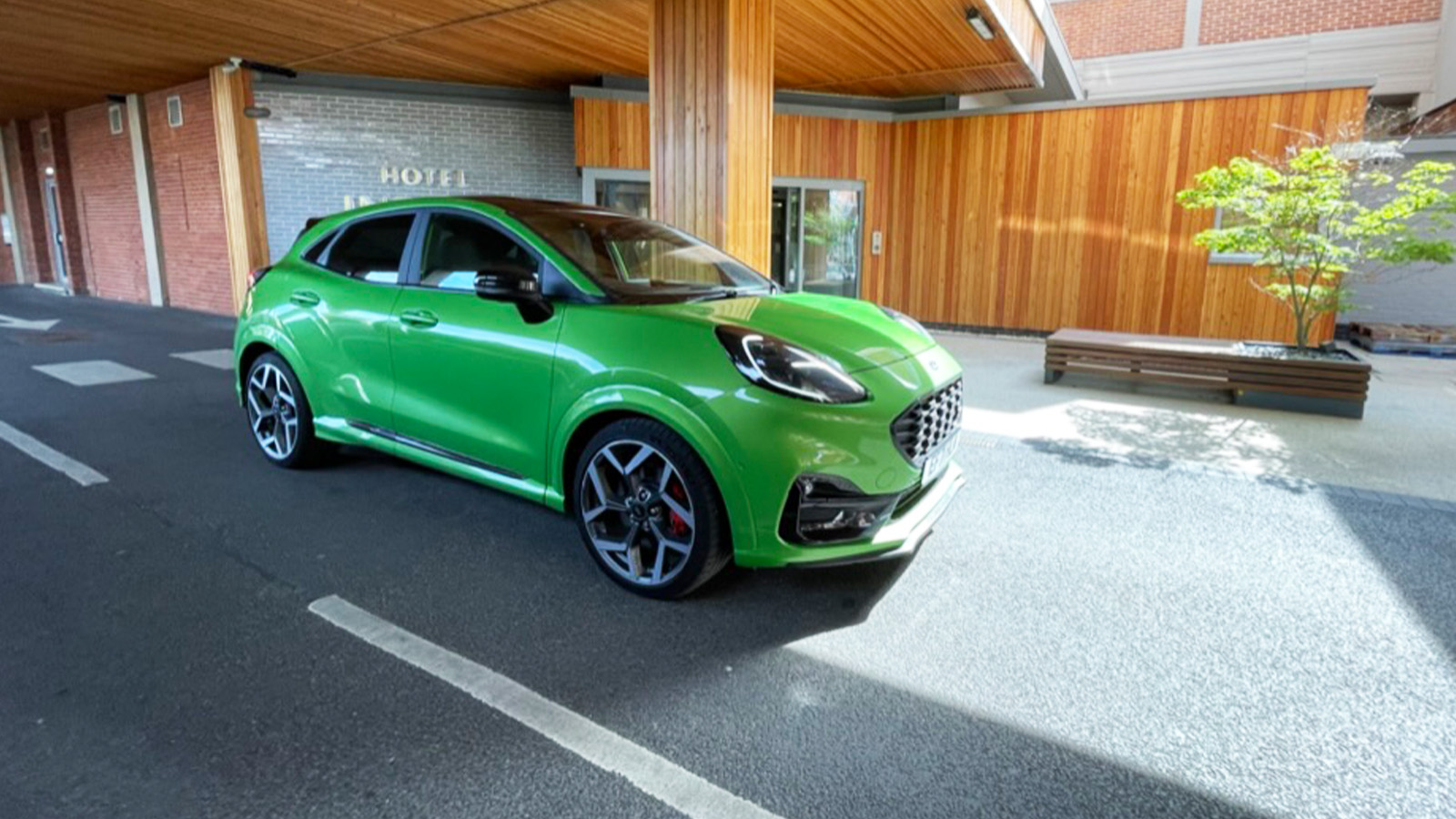
This is a Ford Puma. It’s a Fiesta-based European Ford crossover built in Romania and sold in Europe. It is excellent. I drove one while I was in the UK a couple of years ago and adored it. You know who also adores this? Ford CEO Jim Farley, who said he wished it were for sale in the United States.
Now, here’s the trick to this. What the Trump White House wants is for these cars to be built in the United States, but it is actually not that big of a deal if they’re not, unless the rules are written in a specific way to keep them out of the country.
The Puma is built in the EU and therefore subject to a 15% tariff, plus some other potential tariffs for specific material content (which might be offset because Ford is also a local producer, but I’m not a Section 232 expert, so this will depend on a lot of factors that seem to change by the week). That’s not terrible, really? With the average transaction price above $50k right now, a cheap car is a cheap car, and there are always incentives and tax breaks to be had.
This is about a $28,000 car in Europe, but everything is more expensive in Europe except food, real estate, drugs, and healthcare. Could this be a sub-Bronco Sport car in the $22-25k range to compete with the Trax? That would be dope.
My wild theory here, after talking to some friends, is that Ford should just import the Puma and sell it here as a cheaper car. With the OBBB and the EPA rolling back CAFE penalties and goals, there’s likely to be less of a penalty. These are safe cars and not kei small, but still smaller than what we get.
Also, it’s good. It’s a good car. Plus, Puma is a cool name. I also think Nissan could make a deal with Dacia to bring the Duster here, and Volkswagen could start selling SEATs here. Let’s get creative! There are plenty of non-kei sized cars that would probably do well here as cheaper cars.
[Ed Note: I don’t see how the Puma is going to move the needle compared to current US offerings, but I do like it. -DT].
Nissan Needs A Friend
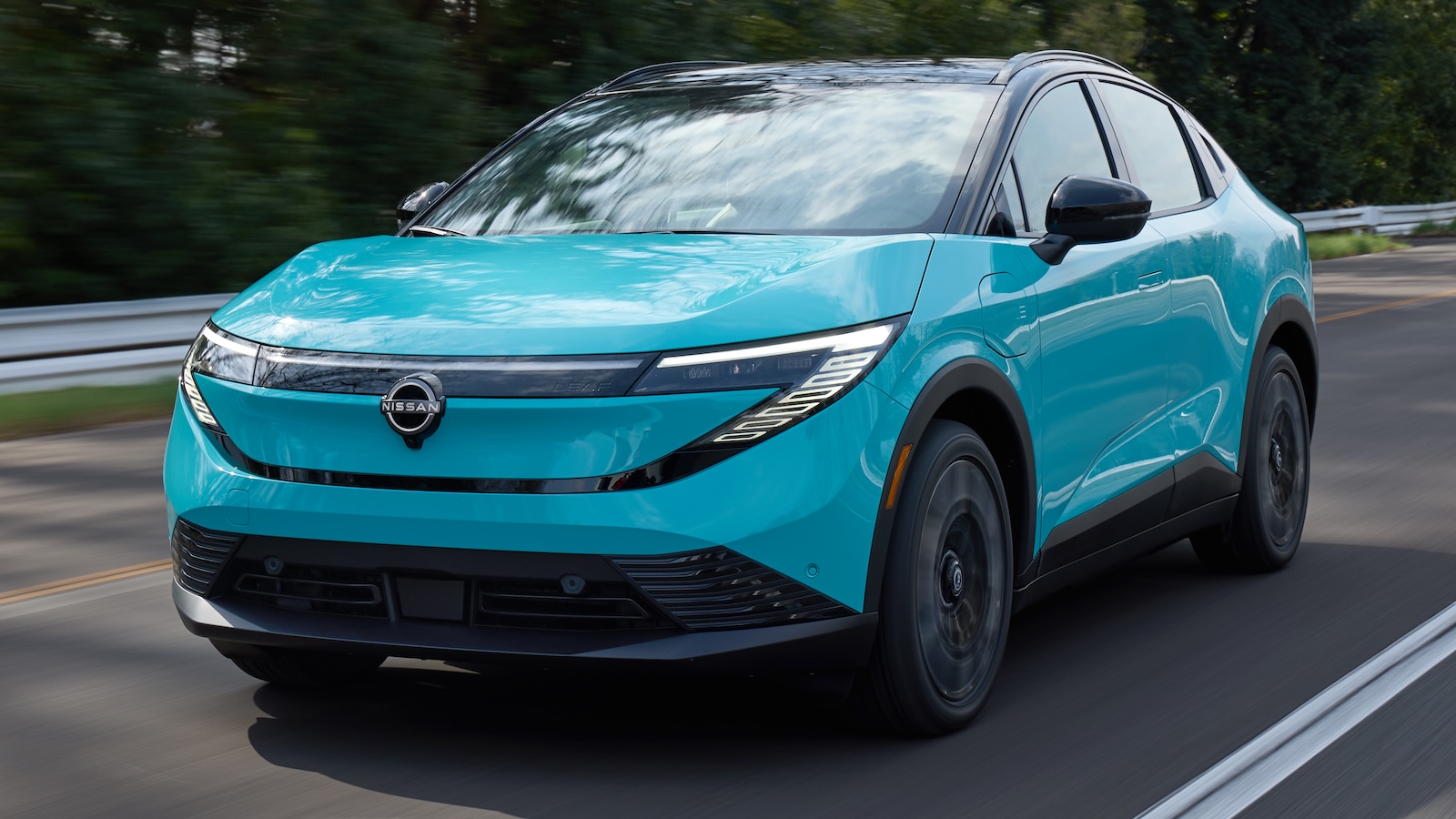
The history of Nissan is a history of partnerships that just didn’t quite work out, for whatever reason. An unequal structure between Nissan and Renault was the rotten foundation on which that partnership was built, and the whole thing crumbled when Nissan had Carlos Ghosn arrested. The Honda deal was going to be another case of Nissan being subservient, which Nissan seems unwilling to accept.
According to this Automotive News report, Nissan wants a partner, but it still has some conditions:
“Nissan is open for business with other automakers,” Nissan Americas product planning chief Ponz Pandikuthira told Automotive News at a media event here.
But the company has made one requirement clear in discussions with prospective mates: “It must be reciprocal. Somebody has something that we would like; we have something that they would like,” Pandikuthira said.
“We would not engage with a partner just to buy a vehicle, or platform, or piece of tech,” he continued. “That’s what makes it a long-term commitment instead of just a transaction.”
Besides some totally fine and semi-competitive EVs, Nissan also has big trucks and the Nissan Frontier. Who wants a truck?
Will Lower Tax Bills Spur The Car Market?
The economy vibes are kinda bad right now. No one knows what’s going to happen. I get the sense that a lot of people are just hanging onto mediocre jobs, and jobs are hanging on to mediocre employees until something gives (which explains my staying power).
A look at the Manheim Used Vehicle Value Index shows, well, things are just kinda stuck. Demand is there, but prices are a little high, so volume is ok but not great. Maybe something can fix that?
Here’s what Jeremy Robb, Interim Chief Economist at Cox Automotive, had to say:
“Like most metrics we track across the automotive landscape, wholesale prices dipped in October before showing modest improvement in November.
“As November progressed, both new and used retail sales lifted from October levels, and the longest government shutdown in history came to an end. While consumer sentiment remains subdued, early reads suggest confidence is recovering. We’re seeing good vehicle sales supported by lower APR rates, and price depreciation is trending back to normal, with values slightly higher than usual. We’re also only a month from January, when lower tax withholding rates will boost take-home pay. Once consumers feel that in their paychecks and realize their tax refunds could be substantially higher this year, we are expecting some tailwinds to hit the auto market.”
Whatever you feelings about the tax cuts, there are many consumers who will see at least modest tax savings in the near term. Will that be enough to offset tariffs? Will the increased in EVs coming off-lease lead to more people buying cheaper used electric cars?
For the sake of the economy and the deficit, it would be helpful if people took that money and bought more things.
What I’m Listening To While Writing TMD
David called me from the road the other day, and he was in a town he’d never heard of, near Sacramento. I asked him: “Is it Stockton?” I guessed this because that’s the home of the best band in history, aka Pavement. Here’s them performing “Unfair,” which is premised on the idea that SoCal sucks all the water and good stuff out of Northern California. Slinging nachos like you just don’t care.
The Big Question
If you could bring back one car from the 1970s what would it be?
Top shot: Ford


I just want to point out that zero of the listed vehicles were built in the USA.
Fiesta: United Kingdom, Germany, Spain, Brazil, Argentina, Venezuela, Mexico, Taiwan, China, India, Thailand, and South Africa
Fit: Japan: Suzuka, Mie China: Guangzhou (GAC Honda); Wuhan (Dongfeng Honda, Life) Taiwan: Pingtung
Spark: South Korea
RS6: Germany: Neckarsulm
M5 Touring: BMW Dingolfing Plant in Germany
All results are top line from Google. The Chevy Sonic and Cruise are two examples of small cars that were actually built in the USA.
“If you could bring back one car from the 1970s what would it be?”
All the Saabs.
Mercedes-Benz W123
1972 911E
I’m not particular.
A few minutes ago, I would have said bring back the Ranchero, but having read The Bishop’s article on the original Fiesta, I really, sorta-kinda, very much want one of those instead.
That said, I rather like the notion of the station wagons and personal-luxury coupes making a comeback – as long as I can find a groovy pad with a conversation pit to chill out in with my lady at the end of the day. (And maybe host the local swingers club on the weekend, natch.)
Lincoln Mark III, large (did I say large?) luxury coupe, plush interior, more power than you would ever need, smooooth ride!
There is no modern equivalent!
If you could bring back one car from the 1970s what would it be?
The Lancia Stratos
I also want genuinely small light cars again. I grew up thinking a BMW 2002 or first generation Honda Accord was a normal sized car and 2000 lbs was a normal curb weight. The things I disliked most about our Mazda CX-5 were its 4000kb weight and poor packaging. I suppose I have some of that back with our Fiat 500, although it looks incredibly small on the road
“If you could bring back one car from the 1970s what would it be?
The Lancia Stratos”
Those have been available for a while:
https://www.lbspecialistcars.com/str/
Yes and one with an Alfa Busso V6 is actually more usable, but an actual Lancia is different from a replica and would give Lancia something worth having instead of a rebadged Chrysler
They have the Ypsilon Rally cars. Let’s see how those go.
“If you could bring back one car from the 1970s what would it be?”
Lamborghini Muria
I would be curious to know where David is or was. I grew up in Davis and worked in Woodland and Sacramento after college. Then moved around the country a bit. I drove from Tacoma, where I now reside, down to Woodland (CA; there is a Woodland in WA as well) to visit my mom with Alzheimer’s Thursday and Friday. The weather through southern WA and most of OR was just really snotty. Fog and a lot of rain. So, David and I probably crossed paths at some point, but with big rigs throwing up a lot of spray, I really couldn’t be looking for his Jeep heading north along the way. Until spring is truly here, my subsequent trips will be on Alaska Airlines and a rental car out of SMF.
I will be down here for a few days for the visit before heading back up. The weather looks pretty sloppy along that stretch Tuesday, so prayers and fingers crossed for David. It’s not going to snow, but it’s going to be very wet.
Fun fact: Siskiyou Summit, at 4310 feet, is the highest point on I-5. About 4 miles north of the OR/CA border. The road through there is curvy and features multiple 6% grades. Not fun in the wintertime.
Those grades are something. My Accord, if on cruise control, sometimes downshifts two gears to try to keep the target velocity. Both uphill and downhill.
The biggest problem is the cost of certification, type approval, and likes for the US market: NHTSA and EPA demand at least $40 million per model. Audi, BMW, and Mercedes-Benz have to do the separate process for saloons and estates despite both based on same platform. Not to mention the cost of designing and engineering the vehicles for the FMVSS and EPA. Not cost effective for smaller volume or vehicles with thin profit margin.
Australia and Japan had harmonised most of their ADR and JIS to ECE regulations, bringing the cost down and widening the market choice for the consumers. Canada was strong-armed into rescinding its decision to switch from CMVSS to ECE regulations in 2000.
Why can’t United States do the same, too? United States had ample opportunities in the 1990s and 2000s to harmonise its regulations, but it chose “Not Invented Here” syndrome and came up with endless excuses such as “oh, things are so different here than in Europe” (Australia is geographically very similar to the United States).
Funny. I drove a 6-spd Puma not three weeks ago in Italy and hated it. Every primary control felt like slop and not confidence inspiring, the car felt larger than it actually was, and the electronic nannies made we want to pull my hair out.
I appreciate your post Mr. Husky. 🙂 Especially since I’ll never get to drive one myself.
First: Limit HP
– Honda Civic / Toyota Corolla sized cars sub 3k lbs = 150 Max HP
– Crossovers/Minivans/Station Wagons = 250 Max HP
– Trucks = 350Hp max – if truck is over 5k lbs, you need CDL to drive, regardless of Commercial or Civilian use.
Second: Outlaw lifted trucks / bro-dozers.
Third: Exhaust DB limited to 90Db WOT.
Outlaw aftermarket loud pipes.
No.
YES!!
“ if truck is over 5k lbs, you need CDL to drive, regardless of Commercial or Civilian use”
Yes, a special endorsement for any vehicle over 5k.
Also, perhaps a requirement to be able to see the road 10 feet in front of them. I swear there are people in F250s that can’t see anything closer than 300 feet away.
A 5,000lb restriction would practically outlaw roughly half of EVs currently on the road.
Let’s have some fun and tell Donnie Dumpster that Joe Biden wouldn’t let automakers use vent windows in cars. That will bring the 70s back.
> If you could bring back one car from the 1970s what would it be?
The BMW 635csi would be nice to have again.
The big American wagon I’d want to bring back is the Caprice Classic from the ’90s, not the ’70s.
Leave it to Duffy to slip in an anti-Democrat/progressive remark into any statement.
I’d rather bring back an idea from the 70s than any specific car: the notion (that I got to know where you got it from) that cars should be available in multiple configurations; no just sedans but also notchback and liftback coupes and wagons, and of course, RWD being the norm (with available AWD).
Plus, front bench seats.
And a panoply of color choices, both outside and in.