

Head-up displays are a love-it-or-hate-it technology. Whenever I bring them up to friends or colleagues, there’s never a dull opinion. You either can’t drive without one, or you turn it off as soon as you get in the car. Personally, I’m not terribly fond of HUDs; they’re usually pretty distracting for me, and they’re never worth the data they project onto the windshield, which is usually just a repeat of whatever’s already shown in the gauge cluster.
I’m in the minority, though, because head-up displays have become commonplace on the option lists of virtually every luxury carmaker these days. You’ll be hard-pressed to find a manufacturer that doesn’t offer at least one model with a device that projects data directly onto the windshield, at least as an option.


So … Not Ford, The Carmaker?
The only reason I stumbled across this patent is thanks to the inventor’s name. Occasionally, I’ll search the United States Patent Office’s database by punching in manufacturer names. Most of the results will, as you might suspect, bring up patents filed by those automakers. But every so often, other inventors make their way into the search results.
This visor-style HUD is a great example. The patent wasn’t filed by Ford, the carmaker, but by a guy named Ford—specifically, a person named Rinard Ford out of San Francisco. For a few minutes, I assumed the patent was the carmaker’s, until I actually started reading it and discovered it was an independent design.
This design, not being from Ford Motor Company, means it’s less likely to end up as an option or standard equipment on future Ford vehicles, though it’s weird enough that I still think it’s interesting enough to talk about. So let’s do it.
The History of In-Car Head-Up Displays

Before talking about this visor-style HUD, it’s worth diving into the history of head-up displays in cars. While it’s true that the first head-up display to appear in a production vehicle didn’t come until the late 1980s, the idea was around for far longer. The concept for the C3 Corvette, the Mako Shark II, had a head-up display all the way back in 1965.

It wasn’t until 1988 that shoppers could actually have a HUD of their own in a vehicle from the factory. Unlike today’s head-up displays, which are neatly integrated into the dashboard, Oldsmobile’s was placed on top of the dash in a simple box, displaying two things: Speed and turn signal indicators.
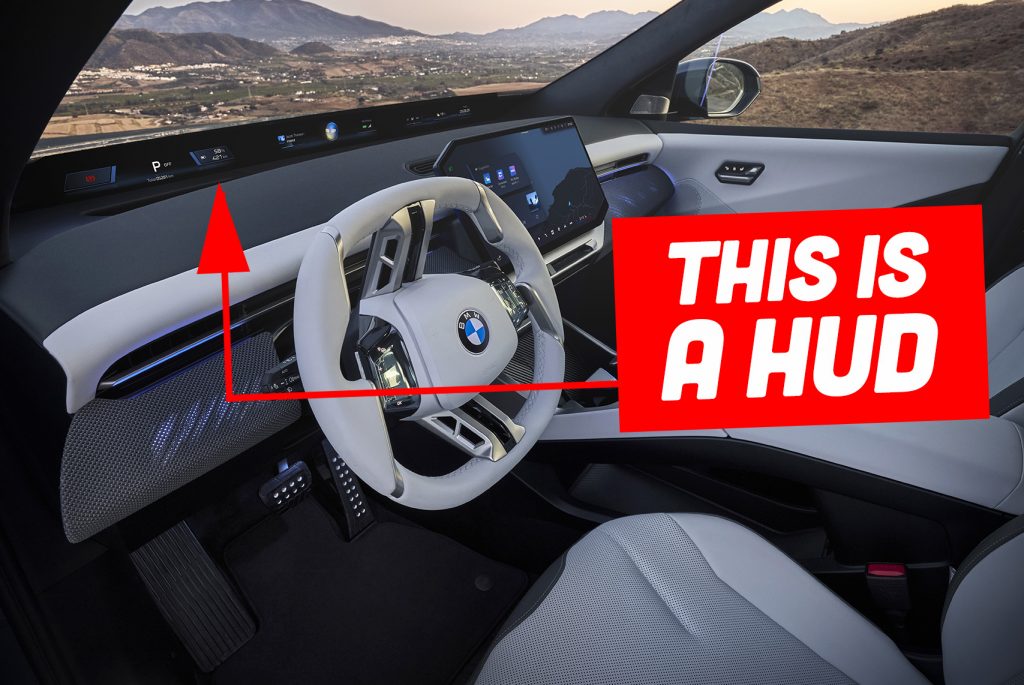
Fast-forward to today, and head-up displays display a far wider range of data points, from rpm to current gear, to range, to GPS directions, and everything in between. Some manufacturers, like BMW, have abandoned traditional gauge clusters altogether in favor of advanced head-up displays. In the case of the new iX3, the entire width of the lower windshield is used as a HUD for occupants.
Why This One Is Cool

Instead of being embedded into the dashboard and using the windshield as a display, Ford’s (the guy, not the company) HUD is a standalone device with its own see-through glass that flips down from the sun visor area, directly in front of the driver’s line of sight. This offers several advantages over the standard head-up display design you’re probably familiar with. From the patent:
Various heads-up-display (HUD) systems and devices have been used and implemented in automobiles to provide drivers with visual information in a way that the drivers do not need to take their eyes off the road ahead. However, all such prior art systems and devices known to the present inventor have considerable drawbacks and disadvantages. For example, some drawbacks and disadvantages of various prior art systems include that they are: (a) dashboard mounted and intended to reflect onto the glass of a windshield; (b) cumbersome and complicated to build and use; (c) not portable and able to be moved from vehicle to vehicle. HUD systems that project ontoa windshield can be difficult to read if the windshield is dirty, or if there is strong glare. A cumbersome and complicated design should normally be avoided if possible. Further, a lack of portability limits the usefulness of HUD devices for drivers who have more than one automobile, or who rent cars frequently when travelling.
On that last point, Ford’s design is posited as a portable device, rather than something that’s integrated into the car from the factory:
In certain embodiments, the heads-up display visor is portable, and is affixed to the driver’s conventional sun visor by a clip, thereby allowing a driver to move the device from one vehicle to another.

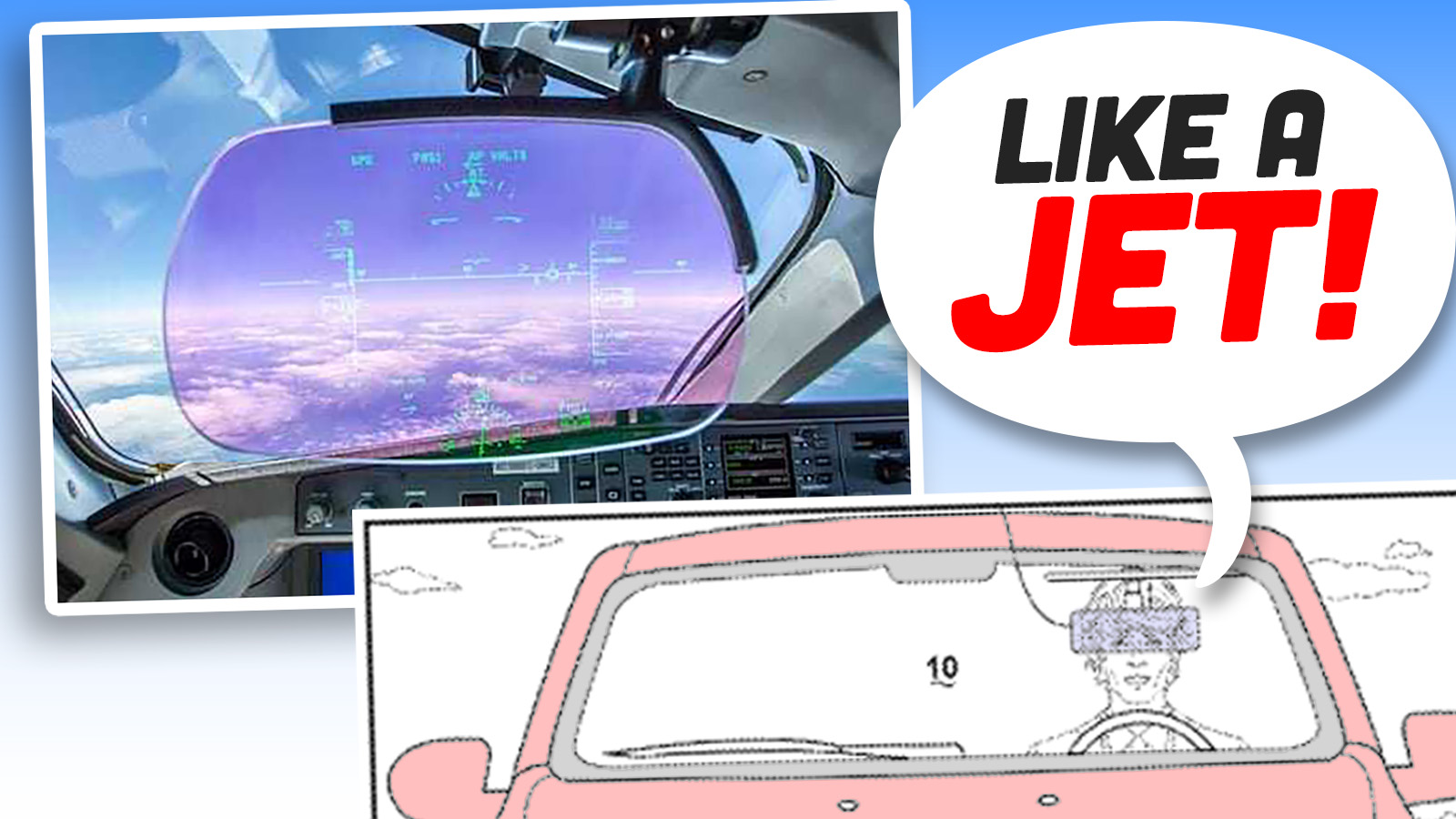
The patent includes drawings for the entire assembly, including the aforementioned clip and the hinge where the HUD can flip down to occupy the driver’s field of view using an extendable arm, or upwards and parallel to the sun visor, where it’s out of the way. According to the drawings, the HUD display itself would measure five inches tall and 12 inches wide, which, depending on how close it is to the driver’s face, could occupy the entire front-facing field of view or just a section. There are also provisions for Bluetooth connectivity, UV light material, and even an embedded facial recognition camera.
This Isn’t Entirely New, And I See Some Shortcomings

A drop-down HUD like this is reminiscent of the head-up displays you’ll find on commercial jetliners. The one above, found in a Bombardier C Series/Airbus A220, shows important live data like altitude, airspeed, bank angle, and more. Ford’s version is capable of displaying all the normal stuff that head-up displays show in modern cars. From the patent:
[T]he projection image of driver assistance information comprises one or more of vehicle speed information, vehicle performance information, engine condition, tire condition, tachometer information, environmental conditions, heating and air conditioner settings, entertainment conditions, stereo settings, navigation information, maps, turn-by-turn directions, interface information with other devices, interface information to a smartphone, connectivity information, connectivity to a Bluetooth headset, connectivity to a voice command system, driving condition warnings, an indication that the road is slippery, an indication that a collision is imminent or an indication that the brakes should be applied.

Aftermarket head-up displays aren’t an entirely new thing, either. They’ve been around for years, but most are designed to be mounted to the dashboard, similar to that original Oldsmobile design. This one, made by a company called Hudway, can fit onto the dashboard of a wide range of cars.

One big problem I see with this design is the placement of the HUD screen itself. Patent drawings show that the device would be positioned over the steering wheel column, but there’s no telling how well that clip would hold in the event of a crash. Whether it’s glass, a clear polycarbonate, Plexiglass, or some other type of reflective plastic, I wouldn’t want it to come between me and my steering wheel airbag. But that sort of argument is true of most aftermarket visor-mounted car accessories, so it’d be unfair to single out this device as any more risky.

While I’m not the fondest of head-up displays, I still hope this device one day becomes a reality. I’d be curious to use something like this, simply so I can play out my dreams of becoming a big-time airliner pilot.
Top graphic image: USPTO, C Series Aircraft Limited Partnership


HUD (if executed well) could be really useful.
I think finding the balance between useful information and yet not distracting the driver’s primary view is the primary opportunity.
In an aircraft spaces between aircraft are understandably need to be quite large. On terrain firma… especially on a multi-lane highway or interstate, for cars traveling along side you are literally a few feet away.
Making the HUD solution easily transportable is another excellent idea, having it connect via Bluetooth or NFC (or similar) wirelessly.
I would like to think about hud built in to eyeglasses could be a more elegant solution with less end user friction. Again the above opportunities still apply