

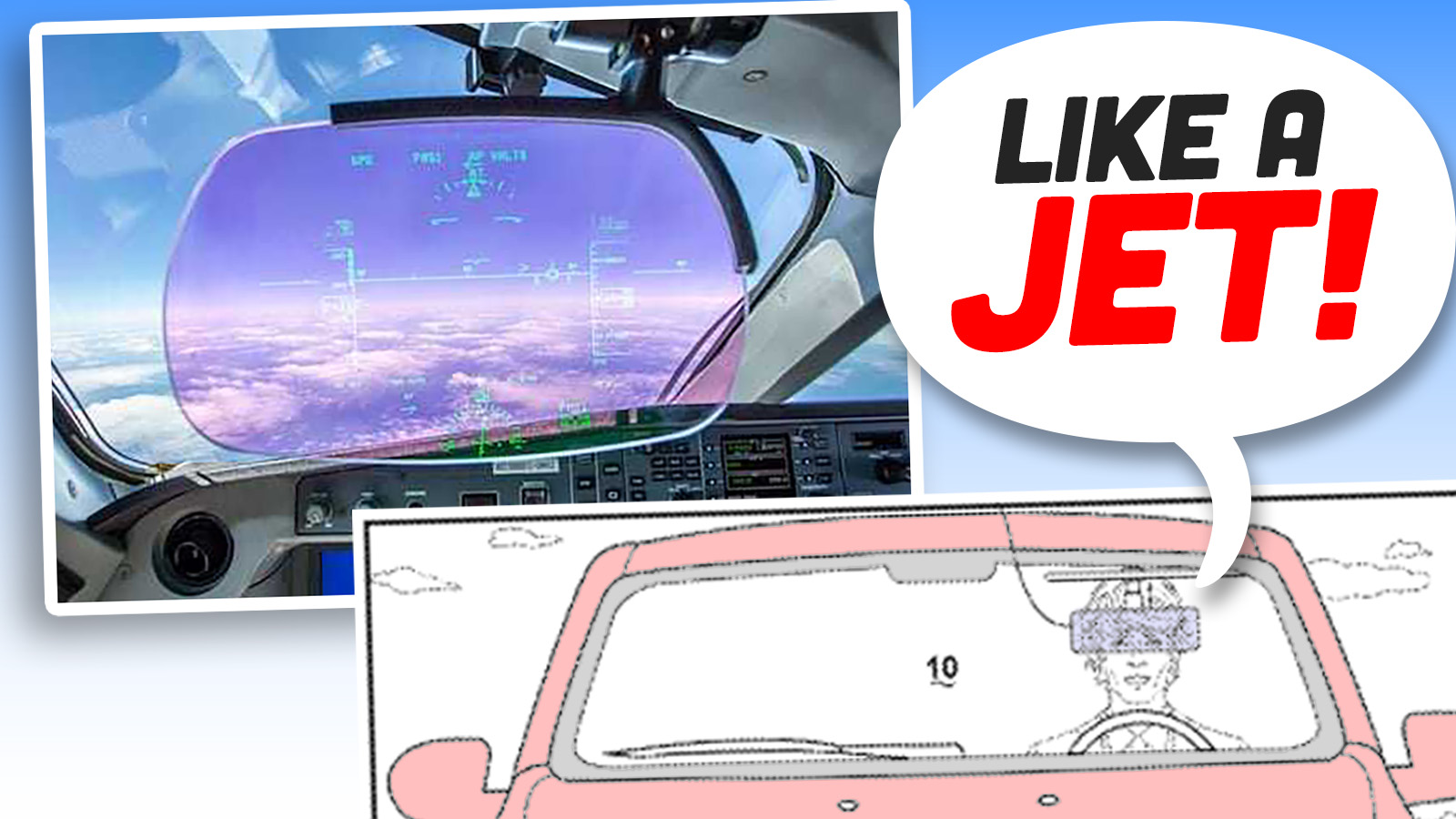
Head-up displays are a love-it-or-hate-it technology. Whenever I bring them up to friends or colleagues, there’s never a dull opinion. You either can’t drive without one, or you turn it off as soon as you get in the car. Personally, I’m not terribly fond of HUDs; they’re usually pretty distracting for me, and they’re never worth the data they project onto the windshield, which is usually just a repeat of whatever’s already shown in the gauge cluster.
I’m in the minority, though, because head-up displays have become commonplace on the option lists of virtually every luxury carmaker these days. You’ll be hard-pressed to find a manufacturer that doesn’t offer at least one model with a device that projects data directly onto the windshield, at least as an option.


So … Not Ford, The Carmaker?
The only reason I stumbled across this patent is thanks to the inventor’s name. Occasionally, I’ll search the United States Patent Office’s database by punching in manufacturer names. Most of the results will, as you might suspect, bring up patents filed by those automakers. But every so often, other inventors make their way into the search results.
This visor-style HUD is a great example. The patent wasn’t filed by Ford, the carmaker, but by a guy named Ford—specifically, a person named Rinard Ford out of San Francisco. For a few minutes, I assumed the patent was the carmaker’s, until I actually started reading it and discovered it was an independent design.
This design, not being from Ford Motor Company, means it’s less likely to end up as an option or standard equipment on future Ford vehicles, though it’s weird enough that I still think it’s interesting enough to talk about. So let’s do it.
The History of In-Car Head-Up Displays

Before talking about this visor-style HUD, it’s worth diving into the history of head-up displays in cars. While it’s true that the first head-up display to appear in a production vehicle didn’t come until the late 1980s, the idea was around for far longer. The concept for the C3 Corvette, the Mako Shark II, had a head-up display all the way back in 1965.

It wasn’t until 1988 that shoppers could actually have a HUD of their own in a vehicle from the factory. Unlike today’s head-up displays, which are neatly integrated into the dashboard, Oldsmobile’s was placed on top of the dash in a simple box, displaying two things: Speed and turn signal indicators.
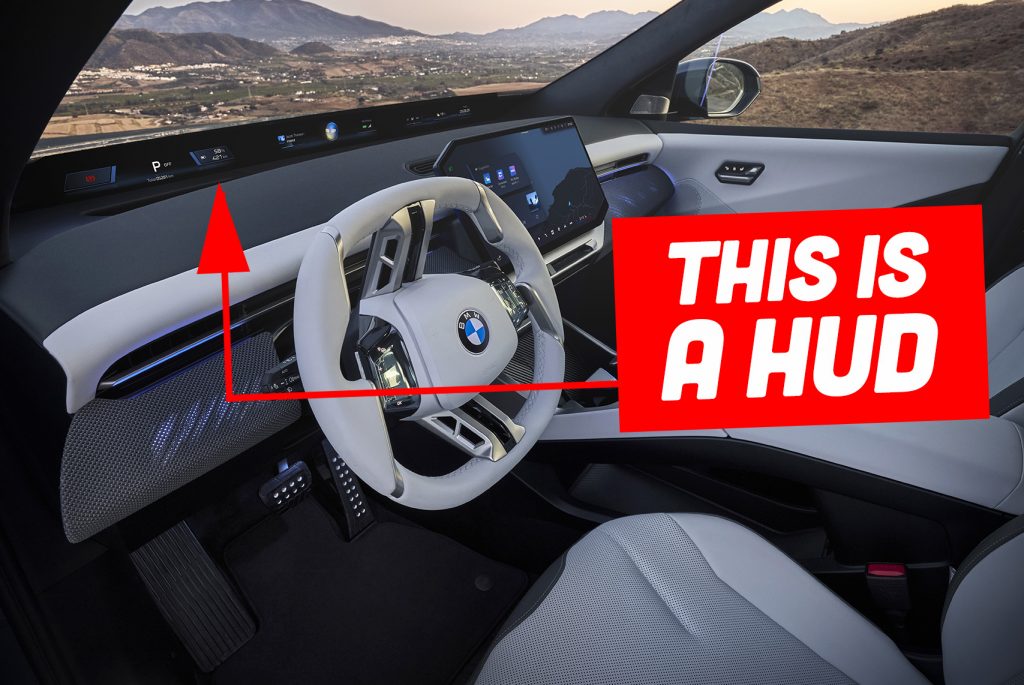
Fast-forward to today, and head-up displays display a far wider range of data points, from rpm to current gear, to range, to GPS directions, and everything in between. Some manufacturers, like BMW, have abandoned traditional gauge clusters altogether in favor of advanced head-up displays. In the case of the new iX3, the entire width of the lower windshield is used as a HUD for occupants.
Why This One Is Cool

Instead of being embedded into the dashboard and using the windshield as a display, Ford’s (the guy, not the company) HUD is a standalone device with its own see-through glass that flips down from the sun visor area, directly in front of the driver’s line of sight. This offers several advantages over the standard head-up display design you’re probably familiar with. From the patent:
Various heads-up-display (HUD) systems and devices have been used and implemented in automobiles to provide drivers with visual information in a way that the drivers do not need to take their eyes off the road ahead. However, all such prior art systems and devices known to the present inventor have considerable drawbacks and disadvantages. For example, some drawbacks and disadvantages of various prior art systems include that they are: (a) dashboard mounted and intended to reflect onto the glass of a windshield; (b) cumbersome and complicated to build and use; (c) not portable and able to be moved from vehicle to vehicle. HUD systems that project ontoa windshield can be difficult to read if the windshield is dirty, or if there is strong glare. A cumbersome and complicated design should normally be avoided if possible. Further, a lack of portability limits the usefulness of HUD devices for drivers who have more than one automobile, or who rent cars frequently when travelling.
On that last point, Ford’s design is posited as a portable device, rather than something that’s integrated into the car from the factory:
In certain embodiments, the heads-up display visor is portable, and is affixed to the driver’s conventional sun visor by a clip, thereby allowing a driver to move the device from one vehicle to another.

The patent includes drawings for the entire assembly, including the aforementioned clip and the hinge where the HUD can flip down to occupy the driver’s field of view using an extendable arm, or upwards and parallel to the sun visor, where it’s out of the way. According to the drawings, the HUD display itself would measure five inches tall and 12 inches wide, which, depending on how close it is to the driver’s face, could occupy the entire front-facing field of view or just a section. There are also provisions for Bluetooth connectivity, UV light material, and even an embedded facial recognition camera.
This Isn’t Entirely New, And I See Some Shortcomings
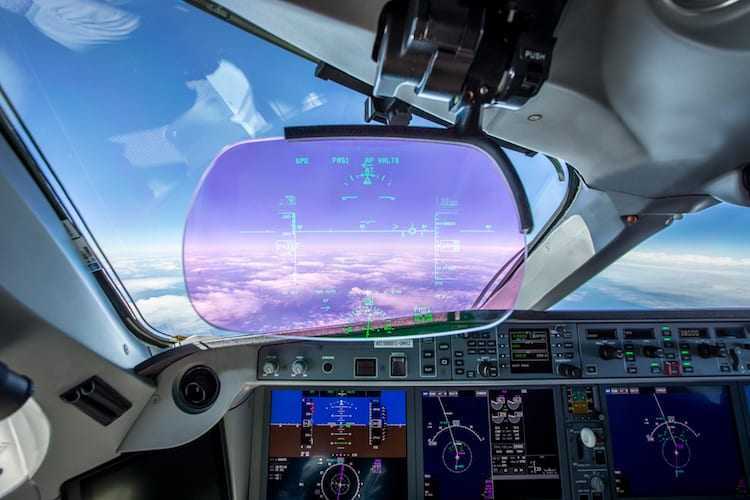
A drop-down HUD like this is reminiscent of the head-up displays you’ll find on commercial jetliners. The one above, found in a Bombardier C Series/Airbus A220, shows important live data like altitude, airspeed, bank angle, and more. Ford’s version is capable of displaying all the normal stuff that head-up displays show in modern cars. From the patent:
[T]he projection image of driver assistance information comprises one or more of vehicle speed information, vehicle performance information, engine condition, tire condition, tachometer information, environmental conditions, heating and air conditioner settings, entertainment conditions, stereo settings, navigation information, maps, turn-by-turn directions, interface information with other devices, interface information to a smartphone, connectivity information, connectivity to a Bluetooth headset, connectivity to a voice command system, driving condition warnings, an indication that the road is slippery, an indication that a collision is imminent or an indication that the brakes should be applied.

Aftermarket head-up displays aren’t an entirely new thing, either. They’ve been around for years, but most are designed to be mounted to the dashboard, similar to that original Oldsmobile design. This one, made by a company called Hudway, can fit onto the dashboard of a wide range of cars.

One big problem I see with this design is the placement of the HUD screen itself. Patent drawings show that the device would be positioned over the steering wheel column, but there’s no telling how well that clip would hold in the event of a crash. Whether it’s glass, a clear polycarbonate, Plexiglass, or some other type of reflective plastic, I wouldn’t want it to come between me and my steering wheel airbag. But that sort of argument is true of most aftermarket visor-mounted car accessories, so it’d be unfair to single out this device as any more risky.

While I’m not the fondest of head-up displays, I still hope this device one day becomes a reality. I’d be curious to use something like this, simply so I can play out my dreams of becoming a big-time airliner pilot.
Top graphic image: USPTO, C Series Aircraft Limited Partnership


I just picked up a 2022 GTI Autobahn and its got a HUD which shows a ton of info from vehicle speed, speed limit signs, school speed limits, adaptive cruise info, etc. I love it
my Fnord HUD subliminally shows the strife and discord inherent in navigating shared roads with irrational beings at a high rate of speed. I find it marginally less annoying than how my Ford entertainment system won’t let me change artists on mp3 usb while moving.
So this has nothing to do with the 26th premier of Ontario and leader of the Progressive Conservative Party of Ontario or any of his colorful family?
Back again! This is not legal advice, but general publicly-available info.
As usual, this is not a patent but a pending patent application publication and has yet to receive any rejection/office action from the USPTO. However, it is a continuation application from two granted parent patents (US11285812; US12358435), with a priority date reaching back to 2019.
This is interesting because for an individual inventor/applicant, they generally are happy with the single patent that they can hang on their wall and brag about. They don’t often opt for the cost associated with filing continuations unless they plan to commercialize or license. Makes me wonder what Mr. Rinard Ford’s plans are.
Maybe you guys would want to hire a part-time IP consultant to preview articles like this! 😉
Needless to say, I’ve never had a car with a HUD, nor (as best I can recall) have I ever driven one. I’ve sat in a few now and then, and… meh. I can take or leave them. I much prefer the ones that project onto the windshield itself rather than onto a little board of plastic that looks like a miniature motorcycle windshield in front of the driver. And of course, the whole thing has to be disableable. TBH, I don’t need to see much of anything from the instruments ALL the time… I can see how it’d be handy for driving directions, but most folks I know have their phone just audibly tell them about upcoming turns, so I don’t know how much handier having the same info projected in front of you really is.
With that said, I do like AEB (automatic emergency braking) front and rear, and while I’ve lived OK without it for almost 45 years of driving, I wouldn’t say no to a 360 degree camera system either. The way a Tesla beeps at you if you don’t move after the light turns green seems mildly handy too.
It’s not a HUD, but I do like my Accord’s RH rear view camera that is a second confirmation I’m far ahead enough of the vehicle I just passed to move back right. And it has been wildly amusing to front seat passengers. I’m a little sad they discontinued it for subsequent generations, but it wouldn’t be a game-stopper either.
“Luke – Your targeting computer is off!”
“Use the Force, Luke”
I recently drove 700 miles (one day) with our Rav4 fully loaded so I used the rear camera-based rear view mirror as nothing could be seen in the mirror at all. I never did get used to changing my depth of focus to be able to quickly see the display. It functioned, well until the constant rain saturated the lens wherever it was located.
The HUD in the Rav4 is negated whenever I wear polarized dark glasses. I wonder if this display has that challenge. If I tilt my head I could see it, otherwise it just wasn’t there.
My wife’s BMW X5 had the same polarization stupidity. It’s hard to believe that no engineer at either company wore polarized sunglasses.
My ’17 Accord has a little camera in the RH rear view mirror fairing that takes over the top infotainment screen when the turn signal lever indicates I am about to move back to the right lane. It works great except in the rain. Maybe I should apply a little Rain-X to it? One time, a little spider was crawling across the lens while I was making a right turn, and it made me laugh so hard I almost peed my pants.
You can’t fix the polarization issue because the polarization issue is inherently caused by the light being reflected off a transparent surface. That’s how polarized sunglasses work to reduce reflections in the first place.
I mean you could in theory rotate the entire apparatus by 90 degrees so that the reflection is coming from the side rather than above or below, but that has some fairly obvious practicality issues.
Well, that’s what I was wondering. I’m not a design engineer, but I thought if they rotated the “projector” 90 degrees, it would work with polarized sunglasses. As I said, I’m not an automotive or optical engineer so I don’t know what the obvious practicality issues are.
I did a a fair amount of software engineering and implementation out in the field. At customer sites as big as CNN and NBC. So, please humor me.
I did learn to crane my neck 45 degrees or just glance down to the actual speedometer or just go with the flow and know someone was going to be going faster than me.
Zero tickets in the last 33 years.
Sigh, I should have read the other comments before commenting.
The only direction that the light from a heads up display can be polarized in is the same as the light that polarized sunglasses are trying to cancel out.
If the whole display was rotated 90° and it was projected from the side that would work, but that would be a pretty weird windshield.
There’s pretty much no excuse for LCD screens in the dashboard being polarized in the wrong direction —that’s just flat out stupidity, but heads up displays have to be vertically polarized.
Thanks for pointing that out. I hadn’t thought it out all the way through.
I don’t quite get the point of that BMW “HUD.” Doesn’t seem any different than a gauge cluster at the base of the windshield.
The advantage is the focal length. Because it’s being projected and reflected, you focus your eyes at the distance between you and the dash plus the distance between the projector and the mirror. My Prius has a similar setup and it is legitimately an improvement over just slapping a screen in there.
Ahh, okay! Thanks. Too many things are inexplicable lately so this is a relief.
I am only interested in electronics that are not built in.
It would be nice if manufacturers enabled the process, but I won’t hold my breath.
I had a flip up/down display for a Kenwood tape deck.
If gauge sets are an option, I’d like to see an inclinometer for hills.
I don’t want to replace an entire dash because the free wheeling volume knob failed on schedule, decades before it should.
If I want a sunlight grade monitor, I can get what I want. Still probably cheaper than OEM.
Outdated electronics sourced from some random hellhole shouldn’t be marketed like rare curios because the car is designed to use nothing else but a product that hasn’t existed for years.
I love the HUD on our Mazda CX-50. Makes it so easy to follow GPS instructions while keeping my eyes up on the road
You say this idea comes from Ford? I think it’s absolutely Prefect.
My Nissan Ariya is the first car I’ve ever driven that has a HUD and I like it. There are a few bits of information I’d like to see it display (such as the current speed limit and the radio station I’m tuned to), but mostly it does the job well and keeps me from having to look at the dash. I don’t find it distracting and I think it enhances the driving experience.
The G70 has the posted Speed of the road traveling, sitting next to the speed you are going, the color of the speed you are going changes with speed in excess of the posted speed. however, either the onboard map system is not fully up to date or it has some trouble on certain roads, but I have on more than one occasion notice the signs on the road are often 5 miles under what the car thinks they are. I doubt that will be an argument against a ticket though.
not sure if the radio station will ever make it, but I would not mind the surround camera view to pop up on the screen when parking snout first.
I see what you did there. Stay Calm.
And most importantly – Don’t Panic.
Yes! I can’t believe I messed up that quote. … I’m so embarrassed now.
My car has a HUD and I like it. It’s focused down at the end of my hood, so I can always read it, even while focused on the road. People complain about HUDs disappearing with polarized sunglasses, but I have to consciously tilt my head at a very specific (and unnatural for me) angle to get that to happen. Under normal circumstances, it may fade a bit here or there, but it’s still perfectly legible.
Mine is also nicely unobtrusive, however, and I’m not sure that’d be the case for what is being presented in this article.
There’s quite a bunch of Citroën with a HUD.
It’s not the fighter jet kind of hud, It’s more a display above the regular instrumentation level that repeats you critical stuff (speed, speed limit, if you set up a route, the next turn…)
Personally I find it useful when the car I rent has it (the latest C4 I rented had it)
After, it’s not something at eye level, it’s down just above the top of the console in your periipheral vision.
Hmmm. Could I use it to send a Sidewinder off at the idiot driver ahead of me?
“Arming CRV-seeking missiles.”
Might be best to use an inertia missile to minimize collateral damage.
There might be an innocent car in the area.
“We’re too close… switching to guns”
“which is usually just a repeat of whatever’s already shown in the gauge cluster.”
Just you wait until presbyopia kicks in.
Some of the helmet displays out there do something similar. With a visor or more of traditional HMD device. Traditional HUDs are just so easy I can’t see that catching on outside of a random Chinese company and or Kickstarter that wants to bring something a bit strange to market.
Our newish X3 has a HUD and I could take it or leave it. Configurability is minimal and it doesn’t even have the option to show things like “What gear I’m in” — sounds petty, but with 8 gears and a hyperactive four-banger, I would love this information more clearly without having to move my eyes even to the gauge cluster while shifting mid-turn and pushing 6/10 or harder in a RWD, rear-biased, peaky engine. Not much an issue in a manny tranny with 5 gears because you always know where things stand based on sound and feel.
And that also proves my point — unless you’re doing something other than showing me information from the gauge cluster, why are you even there? To be fair, if you use the nav system, it gives you quick instructions that are helpful. It also shows if a door is ajar. But that’s about all beyond speed.
My wife is 5’2″ and didn’t even know about the HUD — unless she moves the seat to an uncomfortably high position, the cluster hump blocks the reflection.
> X3
> four-banger
Say it ain’t so.
See, what I want is an Augmented Reality HUD. Stick a pair of IR & night vision cameras to the top corners of the windshield, then use the driver-monitoring to determine the position of my eyes, and project parallax-corrected cues onto the windshield for directions and collision warnings.
Deluxe version integrates a license plate reader and flags known bad drivers.
And you just found the one car feature I’d actually pay a (small) subscription fee to have.
Probably not far from this. The Nav in my Mini is “augmented-ish”, kind of like the Mercedes version that shows directions on a live video feed (though..IIRC Merc has a version that projects directions on the windshield). The real-time data it would need is certainly feasible now too. In theory, it might even be less distracting than pulling out a cellphone.
The dystopian version of this will include ads, just like streetview!
Radar is affordable now, as are starlight cameras and infrared.
If you find the better ones too pricy, boat versions show up second hand.
One way to deal with blinding headlights.
As a bonus, you can use Meta’s VR world and attend Zoom meetings while driving.
In the third-gen Mazda 3 they offered a ‘flip-up” Driver Information Display which popped a transparent sheet up from the dashboard to reflect the HUD. This went away in favor of the more traditional windshield HUD in current Mazda products.
As a kid I thought the HUD in the Pontiac Bonneville was the coolest thing. Always wanted one in my car, and was very happy my CX-30 came with one.
I have never owned a HUD car but in the few I have rented I was either too tall to actually see it or because it was a rental. I did not figure out how to raise it on the glass high enough to see it. If I end up with one some day, fine, I would never pay for it as a free standing option.
My old Prius head a borderline HUD with its instrumentation at the very base of the windshield.
NOTE: for a fascinating read on why so many Gen2 Prii had failed instrument displays, look up “capacitor plague.” It’s a story of physics, corporate espionage and industrial piracy.
My newer ride doesn’t have any such feature. It’s the usual instrumentation where you expect it, and I don’t miss the HUD feature at all.
So tell the Ford guy he can keep it.
See, I want to emulate GA flying instead, and want those green tinted sun visors for the limited windshield real estate of my Bug. I don’t need an X-Wing targeting computer display right next to my face.
Yep, complete with a noise-cancelling set of David Clark headphones. Jamming out to the Dave Clark Five, of course.
The DCs I wore in the news choppers I flew in were not noise-cancelling. They just had cushioning foam and pinched on your ears so hard that it hurt after a couple of hours. There’s a reason that all of the tourist helicopters in Hawaii use Bose. That said, the DCs were better than nothing, back in the day. Those and a pair of Ray Bans were a look.
Curious if Ray Bans were ever actually high quality eyewear like Randolph Engineering?
I’m guessing they must have been at one time bc like Randolph Engineering (still is), Ray Bans were also specifically approved for use by US armed forces.
I have heard Ray Ban quality has gone down significantly since they were long ago bought out by eyewear giant Luxottica which is like the P&G of eyewear
Yeah. Your latter point, sadly, does not surprise me. The REs definitely had a different design aesthetic than Ray Bans but also looked cool in their own way. I never had a pair of the REs. I bought a couple of pairs of RB Aviators back when I was flying. Then I stopped because I kept sitting on them. Then I bought another pair when I finally stopped doing that.
TBH, now I buy polarized sunglasses three at a time from Amazon and they have less optical distortion than the windshield on my car. OMG my ’01Jetta was horrible about that. Around the edges.
My current ’17 Accord is fine, other than all the little pits and chips from rocks hitting it. It’s only when the sun hits it just the right/wrong way that I really notice it. And it’s not distortion but just seeing all the little imperfections. Impact craters of stuff that has come off the road.
In the Jetta’s defense, there was a rock big enough for me to see it coming before it hit the windshield at freeway speed. It was the size of a goose egg. It sounded like a gunshot when it hit the glass. But it didn’t shatter or even leave a crack or really any sign that it had happened.
I had to have Safelite inject some goo into an impact crater five years ago or so, but it has held up, and the damage has not spread further. With some of the safety stuff built into windshields these days, that’s not a trivial issue.
Ha thinking of pitted (windshield) glass My 2nd to last DD was a 98′ Jetta TDI.
The windshield was massively micro pitted.
I didn’t realize how bad it was until I got a giant Crack that developed across the bottom of glass.
It wasn’t until I had the glass replaced that I had the ‘ah-ha’ at just how bad the old windshield was; I couldn’t believe how clear the view out the new glass.
I was really impressed how tough that Jetta’s windshield was. Yes, micropits etc. But the big rocks I SAW COMING didn’t do much more damage. 20 years between me and the subsequent owner and it was still on the same windshield.
It was totaled when the subsequent owner didn’t license it and put sovereign citizen paper plates on it and drove around like an idiot in SE TX and refused to get out of the car when he was lit up by the local cops. They broke several windows to haul his butt out of the car. The replacement cost of the windows was more than the salvage value of the car.
It deserved a better death. It was at about 167K miles and had mechanically had many more to give.
I have cheap Amazon reflective HUD displays installed in my cars. Use for speed only, not the compass or any other “feature”. One thing I like is I get real speed via GPS signal. I do a LOT of highway driving travelling for work and find it a useful companion.
Ummm. No. No and F#$&#ing NO!
How long before someone is reading their text? Watching youtube? Just because it’s semi-transparent, drivers don’t need anything extra to take up their mind space.
As an example, and be honest here, how many time have you driven past an exit you were supposed to take because you were busy chatting on a (hands-free) phone call? Mentally you were still driving but you were on auto-pilot. Having a HUD that displays anything beyond maybe speed and alerts is a bad idea.
In addition, what about the ability to physically focus on the nearby screen while trying to maintain eyeball focus on distant objects? Unless you have 20/20 vision anyone with bifocals is going to have a tough time with this. This same issue pops up with rear view cameras that take the place of mirrors. Eyeballs have a hard time focusing on the nearby screen while trying to look at distant objects in the rear view. Hurts the brain.
Now get off my lawn you kids!
That’s why I like reflective, as a slightly farsighted person wearing readers for daily tasks it works. I see a digital speed, does not need to be crisp and clear.
If the image is properly collimated, as in an aircraft HUD, then the projected image will appear at visual infinity; you won’t have to re-focus to see the readout clearly. It will always appear sharp and superimposed over the field of view.