

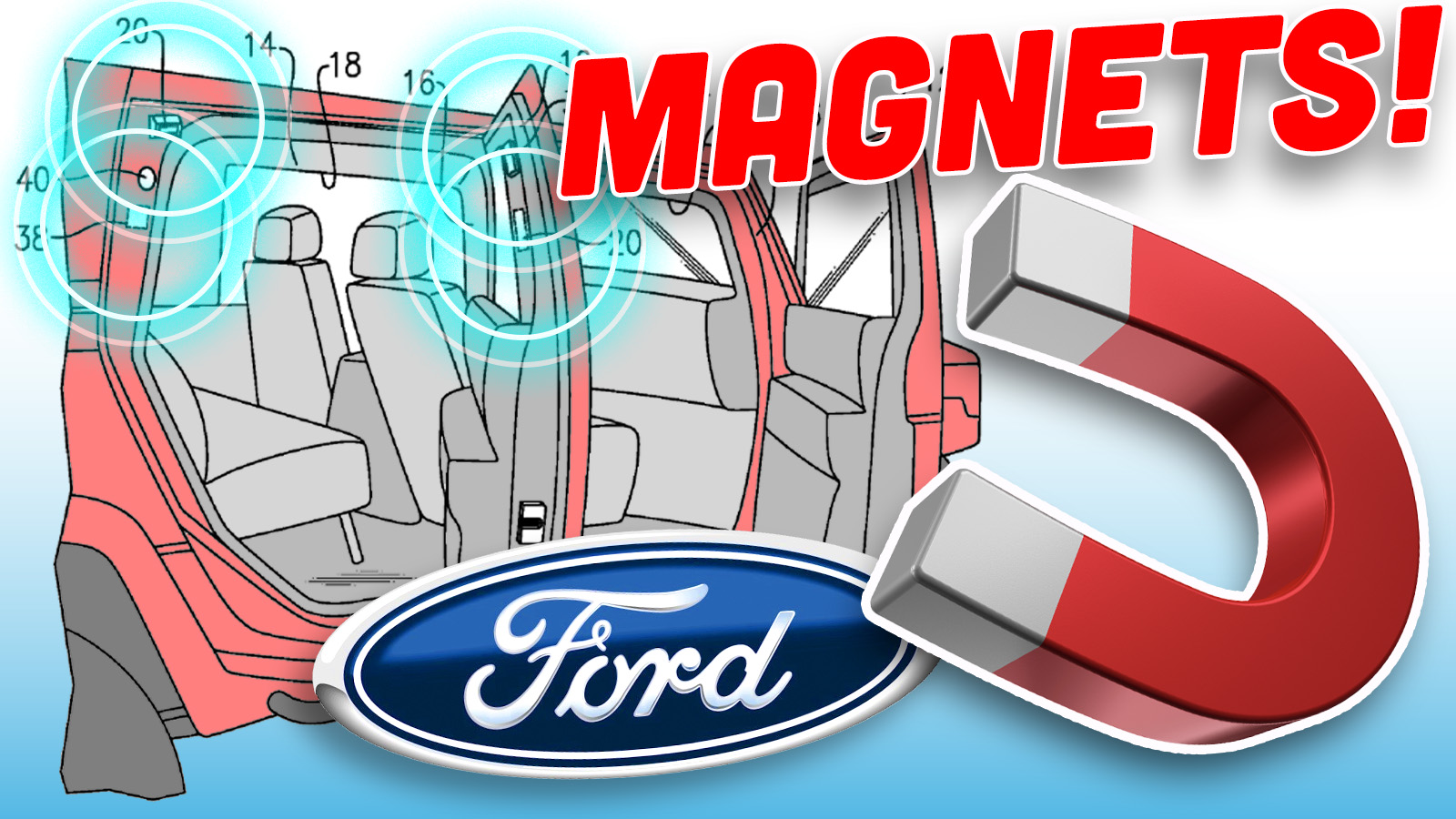
It’s cool how the car industry is always tinkering, always exploring ideas. New battery chemistries, new designs, new gadgets, some of which could appear in a future. Maybe not always the future, but certainly a future. The latest example? Ford has applied for a patent for magnets in doors that should work a bit differently to what you might expect.
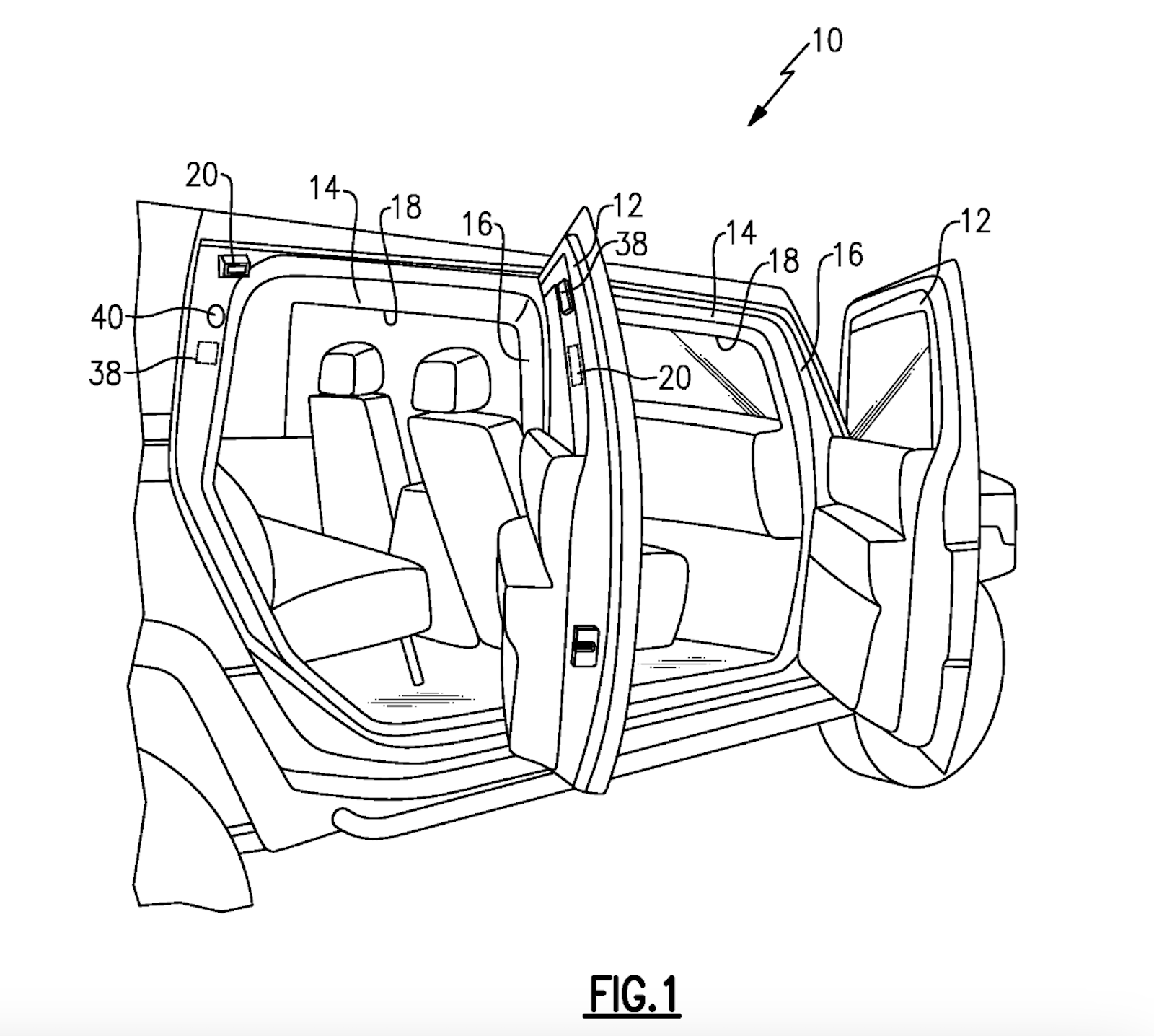
Unsurprisingly, what Ford’s proposing is a series of electromagnets either in the door jamb and acting upon a receiver in the door, or in the door and acting upon a receiver in the jamb. You know how magnets are, it should work either way. It’s officially called a “Vehicle Door With Multi-Purpose Magnetic Assembly,” because that’s exactly what we’re looking at.


Obviously, magnets aren’t replacing traditional door latches as the primary way of keeping a door closed because there are several roadblocks on that train of thought. If a crash were to affect electromagnets tasked with holding an entire door shut, the door could open and an occupant could go flying out the window Looney Tunes-style. Unfortunate. A latch just works better as a primary way of securing a door. However, latches and hinges only cover certain points of the door. The role Ford proposes for electromagnets is one of preventing areas of doors like the window frames from moving. As the patent application states:
Analysis shows that aero-loads can reach over 300N near an upper portion of the window area on certain vehicle doors. During these high wind speed conditions, a header region of the door may deflect in an outboard direction. If door deflection reaches a certain point, the seals on the body of door can lose contact with the opposing sheet metal surface, which can result in wind ingress, vibration, and other noise conditions/issues.
To address these issues, in one example the magnetic member, e.g., an electromagnet, is mounted on the fixed vehicle structure, e.g., the vehicle body, and a magnetic receiver is mounted on the door to hold the door in place and reduce deflection. The reverse mounting configuration could also be used. Aero-loads that reach over 300N can translate to over 3.5 mm of door deflection. An electromagnet can provide 500N or more of holding force to overcome this wind force. Additionally, the electromagnet can be scaled or calibrated for a variable force so that more or less force gets selectively applied to hold the door in place as needed.
Translating from metric to ‘Murican, 500 Newtons of force is equivalent to about 112.4 pound of force keeping the upper part of a door tight in the jamb. Beyond preventing high-speed deflection, I can see another benefit to this technology. Electromagnets are pretty simple, durable things, and as door seals age and sometimes lose their shape, a little extra force on them sounds like a way to keep cabins quieter for longer.
Of course, putting a lid on noise isn’t the only thing magnets in door assemblies or door frames can do, and the patent application also claims this tech can hinder unauthorized vehicle access. A lifesaver if AAA’s doing it, but a day-ruiner if a criminal is doing it. Ford claims that a car’s security system can crank up the force provided by the electromagnets to make a door much harder to open, even if someone’s picked the lock. It’s a neat concept, but I see two problems with it. Firstly, if you’ve called AAA because you’ve somehow locked yourself out of your car, having electromagnets hold the door shut sounds like a pain. Second, if a thief’s motivated enough to pick the lock, what are the odds they’d also be motivated enough to break the window?
I reckon electromagnets on door assemblies will likely be more effective at preventing wind noise, functioning as secondary latches for big doors, and providing a backup or even primary door-ajar signal than they would be at stopping thieves. Still, it’s worth giving magnets a shot. Wind whistle’s annoying, and I do like the idea of double-locking without the bulk of a second mechanical latch. Will we ever see this technology in a production car? Who knows? Manufacturers patent all sorts of stuff that never sees the light of day, but as cars continue to get faster and quieter, maybe magnets aren’t a bad idea.
Top graphic images: Ford/USPTO; DepositImages.com



This reminds me of the IRSB system in the mid 2010’s that Ford ‘pioneered’.
What’s IRSB, you ask?
Inflatable Rear Seat Belts
Or, as every 2011-2019 Lincoln MKT and uplevel Explorer/Flex driver knows; a constant airbag warning light on the dash.
Ford: putting not-so-useful features in cars since forever. I’m looking at you, Microsoft SYNC.
What about ford’s notorious frameless windows like on the Bronco. How would that eff that up?
Fomoco needs to spend ALL OF THEIR MONEY in quality control.
Here we have Mr Jim Farley spending his time with celebrities such as Ms Sydney Sweeney.
I wonder how he will react if she BLASTED him point blank for QC issues on her car.
“Not for the reason you’d think”
So, you’re saying that Ford ISN’T using the magnets as solenoids to fire the doors at would-be thieves if the window is broken??
That won’t mess with analog watches, will it?
If you hold the watch up to it for days, possibly. But being in the vicinity shouldn’t hurt.
Regardless, any watch enthusiast who owns mechanical watches should also own a demagnetizer.
One does wonder about the possibility of electromagnetic interference for some pacemakers, especially since duration of exposure can be a significant factor (it’s one thing to be near an appliance such as an induction cooktop for a few minutes which is bad enough but another thing to be sitting in possibly close proximity during multi-hour-long road trips.)
Though it does seem like newer pacemakers are less suspectible to problems caused by electromagnetic interference but there are still people out there rocking some pretty vintage pacemakers. Heck, there are still a few (9 as of 2007-2015, so just a small handful at the most today) people using NUCLEAR-powered pacemakers. When they die their pacemakers and their plutonium energy sources are supposed to be returned to the Department of Energy with ultimate disposal being at Los Alamos.
Gah, meant to include the fact that those nuclear powered pacemakers were only installed (implanted?) from 1974 to 1987, with the newest ones now being some 38 years old. Can’t believe I left that salient fact out.
That’s what I get for writing & posting a comment while suffering from insomnia in the middle of the night, lol…
I miss the good old days, BTW. Phone books, pay phones, and paper checks for all LOL
Don’t get me started on “soft close” doors and trunk lids. I cringed when Aunt Lola said, don’t slam the trunk lid closed on my car like a car, this is a Cadillac trunk! Oh, and my sister when getting out of her (Thankfully traded for an Iconic 6) Don’t pull that obvious door lever to get out of this POS Telsa, you may hurt it. Use the pushbutton to get out!!!!! Technology for technoligies sake will trap and kill us all! OK, rant over. Now get off of my lawn.
remind me again what was so awful about mechanical door latches that worked fine on vehicles for over a century…………ughhhhhhhhhhhh
You must have missed the part where it was stated that this is intended to supplement the mechanical latch, not replace it.
You mean…we’re supposed to read these, not just glance at the headline and a pic or two and fire off a response?!
“Not for the reason you’d think” — so not to repel other vehicles also equipped with magnets if a crash was imminent?
Carmageddon was and remains criminally underrated
With Ford quality half the polarities would be opposite causing cars to attract each other.
Meanwhile on August 5, 2030. Today Ford announced a recall of 2027-2028 Ford F150s due to inferior metals being used on the door magnets used to seal and secure doors closed. Doors may not close properly leading to increased risk of opening when not commanded. This opening increases the risk of occupants being ejected from the vehicle during a crash.
TDC, you are so correct you don’t even know… or you do.
2031: Ford announces an additional recall to address faulty body control modules that may not respond to commands to demagnetize the door locks. Owners are advised to drive with at least one window open when conditions permit and maintain an adequate store of food, water, and hygienic supplies in their vehicles.
2045: Ford announces a mandatory recall for 66000 2033 F 150s which have had water leaks into the cabin due to the magnets being improperly fixed AFTER THE FIRST RECALL….
and the story goes.
Seems like nowadays if thieves are targeting something inside your vehicle, they’ll just break the window anyway, don’t see the door magnets being much a plus in that instance. If they’re looking to steal a fairly modern vehicle, then yes, they need something more than just the tools that will get the door open.
Well VW has has the windows that roll partially down to get out of the weatherstrip to open the doors. Can magnets be much worse?
As for picking the lock on the drivers door, that is probably wafer lock easy, but then the alarm goes off if you are fobless and unprepared for radio games.
Do not try this on other peoples vehicles or your own if it is critical transport.
I just want the emergency explosive door hinges.
Boom and kick it open, someplace there are patents for those too. (-;
Try explaining that to your insurance company though.
“You’re only supposed to blow the bloody doors off“
Aaand it’s time for a re-watch.
Ejecto seato!
The Mercedes SLS had explosive bolts in it’s door hinges, because if it was upside-down, you’d have no other way of opening the gullwing doors.
Other cars with gullwing doors rely on the ‘kick the windscreen out’ method of exit in a roll over.
Why install a second mechanical latch up high, when instead you can install a grossly over-complicated electromagnetic system?
I would not want to be the one tasked to design a second latch and linkage mechanism that is
I mean, every tailgate on every pickup ever made has two latches linked together. Not exactly difficult to do. Don’t forget the old Ford/Chevy/Ram/Toyota suicide doors on extended cab trucks that had latches top and bottom. If space is a concern, put the upper striker on the door, and the latch mechanism on the body. A pushrod on the door can then actuate the latch whenever the handle is pulled.
It’s not just a “electromagnet and some wire”. It’s:
They will have to use those special magnets on aluminum doors.
I got some electromagnets for a project a few months ago. They claim 130lbs of holding force. About $10 each. I had them hooked up to a power supply and from what I recall the draw wasn’t more than a handful of watts. I know an auto application is an order of magnitude more complicated, however it doesn’t seem like it would be insurmountable if someone was really committed to making it happen. Not saying I think they should.
Looking at all of this, it could be that the best design could be to widen the rear edge of the glass frame to accept a rod, put a bell crank in the lower door to connect mechanisms, and put a bolt similar to a regular spring-loaded home door bolt on the door at the top end of the connecting rod, and a catch on the door frame. Downsides would be
The tall entrance door on an MCI coach deals with this issue by using a mechanical latch on the trailing edge, plus two air-operated two lock cylinders that engage when the bus is in motion, one beside the latch and another at the very top of the door. The door ajar sensor in the doorjamb reads the presence of a magnet molded into the door.
Then the door magnets go out of calibration and lock you in and only a dealer will have the software to recalibrate them. Or they could just not make the vehicle a friggin’ brick—300N?! I have frameless doors and I can push the window with one finger, yet at quite post legal speeds it doesn’t pull open.
Who picks car door locks? Is the Lockpicking Lawyer’s channel not doing well and the lawyering falling off to where he has to resort to theft from vehicles? Anyone stealing the car will need to spoof the fob, which means they’d be able to get past the doors, anyway.
The 2000 Ford Prodigy sedan was one of Ford’s most efficient designs ever. 0.199 Cd value.
The 1985 Ford Probe V had a 0.137 Cd.
The fact that wind resistance causing issues with weather stripping and door placement shouldn’t even be an issue today.
I hadn’t heard about the Ford Prodigy and I googled it expecting an impractical Syd Mead fever dream like the Probe V. But, wow, that’s an – and I mean this in a hugely positive way considering it’s an aero study – incredibly boring car. It looks like every rental parking lot circa 2010. It certainly knocks down the ‘it would look weird and nobody would buy it’ argument about aero.
Syd Mead’s designs weren’t all that aerodynamic, and were quite impractical. Aesthetically, they were top notch. His designs inspired Blade Runner after all.
The difference between concept art and technical illustration is practical engineering.
Ford should just spec one trunk monkey per door. A single trunk monkey can apply way more than 112.4 pounds of force. First responders will need to carry bananas to unlock the doors in case of emergencies, but monkeys are more compliant than magnets. Also useful in sentry mode.
https://en.wikipedia.org/wiki/Trunk_Monkey
I thought the current consensus is just to make the pillars and window frames thicker. If you can’t see the air, it isn’t their.
*EV on fire after an accident*
Owner: “Release the electromagnetic locks Ford.”
Ford: “I’m sorry Owner, I’m afraid I can’t do that.”
Sorry, something went wrong. Try again later.
YOU GOT A MUSTANG AND YOU GOT A MAGNET
MUSTANG HAS ANTENNA BUT DONT YOU GRAB IT
MUSTANGS MADE OF IRON
DRIVER MADE OF MEAT
The top of the door on a 2CV gets pulled out far enough at speed (I used to get 70mph out of mine regularly) that you can see daylight through the gap.
Similarly, a stiff wind or a passing semi could easily pull the side curtain frames on my TJ far enough out to see daylight. 🙂
My Peugeot 206 did the same, although that might have also been because thieves would break in by bending the top of the door out enough to reach the door lock.
I didn’t keep anything valuable in the car, so they never took anything, and I’d just bend the door back to mostly the right place.
Magnets? How do they work
Sky ants and the devil.
Miracles
Fuckin miracle
Nobody knows!
To make their cars more attractive?
That’s a polarising opinion.
negative
They ground them to the ground.
What a lode.
Seems like a way to trap passengers inside if things go wonky after an accident.
Instead of those little glass hammers, we’ll have portable EMPs in our cars.
Look, obviously a bunch of people are going to have to die. I think we can all agree the benefits are clearly worth it.
A rigid enough door frame wouldn’t need electromagnets to keep them from flexing. Plus electromagnets need power to keep their magnetism, which seems like a waste of power in an EV.
I think the best use for this might be for frameless doors. They always look so much cooler than framed doors, but they do tend to let water or air in. A glass that had a metal strip imbedded in it at the top edge would let you seal it with magnets.
OR…How’s this for an idea…
Just use gaskets with a magnet built into the sealing edge. My refrigerator has this and I bet yours does too!
Low tech solution.
(I’ll take my check now)
sorry, only solutions that use 27 individual ECUs and a 1-wire bus can be used. how else would they justify the subscription to keep them working???
“ATTENTION: Your trial period has now expired. To continue enjoying vehicle ingress and egress privileges, please renew your subscription immediately.”
I’ve got little clay corncobs and kittys my niece made on my fridge door. They seem to work pretty well too.