

Back in 2017, Audi came up with this trick piece of software for its big-boy A8 sedan, where sensors along the side of the car could detect an incoming T-bone from either side. If the sensors detected an imminent impact, the computer would use the car’s active suspension to quickly raise that side’s body by two inches, so that the force of the impact would be absorbed mainly by the car’s side sills and floor pan, rather than the doors.
That tech debuted nearly a decade ago, but I still think about it pretty often. Using trick suspension tech not only to make the ride or handling better, but also to make a measurable difference in the survivability of a crash, is the type of clever engineering that warms my heart.


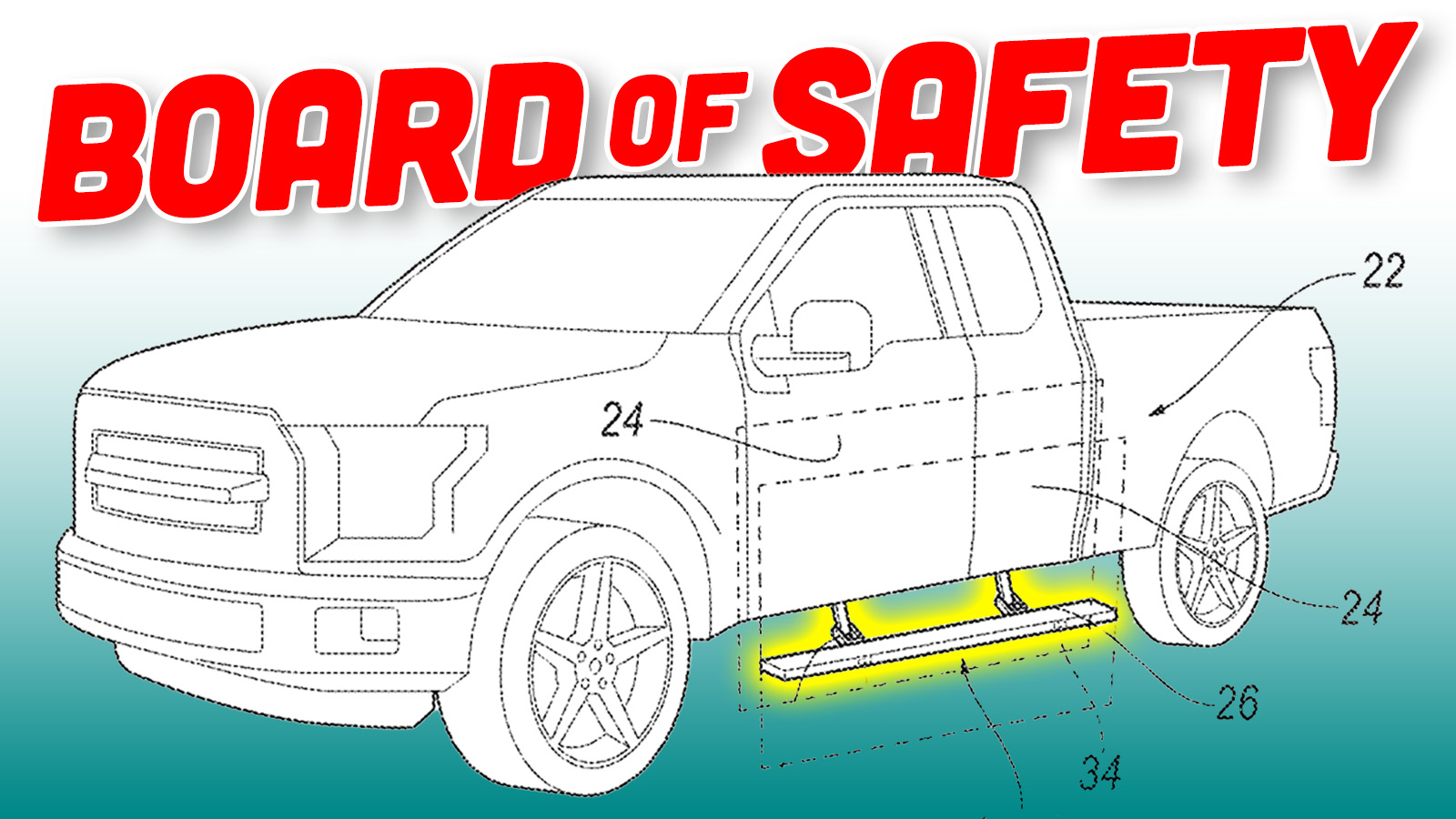
In a patent application published on Thursday, Ford is taking a similar approach to impact detection. But instead of using the suspension to mitigate injuries, it’s using deployable running boards often found on trucks.
Side Impact Detection Has Been A Thing
A T-bone-style crash is one of the scariest types of impacts I can think of. If I had the choice, I’d always rather take a frontal or rear impact instead, because at least in those scenarios, there’s a bunch of plastic and metal between me and the crash. In a T-bone crash, the only thing between me and the oncoming car is a door and whatever sort of safety equipment the manufacturer built in.
That’s why I’m a fan of Audi’s solution. It repositions the entire car in an attempt to direct the impact around and under the driver, so they don’t take a full-on hit. Watching the system work is mesmerizing, even all these years later. Here’s a video of the system in action:
Since its debut in the A8, this sort of tech has migrated elsewhere in the industry. Mercedes has a version of its own, but instead of raising just one side of the car, it raises all four corners. Here’s a clip of its system working:
In typical Mercedes fashion, the company goes one step further in a T-bone scenario with the system found on its S-Class sedan. In addition to raising the suspension to prepare for an impact, it also inflates the outermost air cushion inside the seat to push the driver farther away from the door, unlocking more space between them and the impact. Genius stuff.
Ford Is Using The Tech In An Entirely Different Way
Ford’s patent application, titled “Impact Detection With Deployable Body Panel,” was first filed all the way back in August 2024, but was only published today on the US Patent Office’s website. At its core, the idea consists of a sensor and a computer that work together to decide whether a vehicle—in the case of these patent drawings, an F-150 pickup truck—is about to be T-boned. But instead of raising the suspension to better direct the impact into the side sills, it deploys a running board or side step to act as the front line in a crash. From the application:
[A] computer includes a processor and memory storing instructions executable by the processor to: predict a potential certain impact to a vehicle; in response to prediction of the potential certain impact, move a deployable body panel of the vehicle from a stowed position to a deployed position.

Above are a couple of drawings that show the running board in its stowed and deployed positions. Note how in the deployed position, the side step is extended outside of the lines of the body, meaning it’d be the first thing an oncoming vehicle would touch in a T-bone-style crash.
But instead of using the running board to dissipate the energy of an impact, like Audi or Mercedes, Ford is using it as a detection device to better time the deployment of the vehicle’s airbags. While it might only be a few centimeters, having that much more time for the vehicle to react to an impact gives engineers a bunch of opportunities to make improvements. From the application:
The movement of the deployable body panel to the deployed position positions the deployable body panel for earlier detection of certain vehicle impacts. The deployable body panel moves relative to a body of the vehicle from the stowed position to the deployed position, and in the deployed position, the deployable body panel is positioned so that certain impacts with objects will occur at the deployable body panel prior to adjacent body panels of the vehicle, thus providing earlier detection of certain impacts.
Earlier detection of certain impacts allows for the vehicle to be equipped with occupant-restraint technology that uses the relatively earlier detection and/or allows for operation of occupant-restraint technology, e.g., an airbag, based on the relatively earlier detection. For example, the earlier detection provides the use of a relatively larger airbag for which inflation initiates prior to certain vehicle impacts with other body panels of the vehicle 10 based on detection of that impact at the deployable body panel. As another example, the size, shape, and or placement of the airbag may be based on the relatively early detection. The earlier detection may allow for dual-stage inflation of the airbag.

Above is the step-by-step process used by the computer to determine whether to actually deploy the airbags using the deployable running board sensors. Note the alternate pathway towards the bottom, where, if no actual impact is detected, the running boards are retracted back into their stowed position “to increase fuel economy of the vehicle,” according to the application.
This is really cool because, like Audi and Mercedes with their quick-acting suspension, it’s using existing technology and repurposing it to cleverly improve the safety of occupants. Ford is using the extended position of the running board to figure out if the vehicle is going to get hit sooner than if no running board were there. The side step is buying the computer precious milliseconds to activate airbags to better ensure the safety of the occupants.
This design isn’t foolproof, obviously. When I shared this application with the rest of The Autopian staff, my colleague Mercedes rightly pointed out that the running board is positioned pretty low on the side of the truck, meaning taller vehicles—like other pickup trucks—would simply avoid it altogether before striking the actual body. Still, I’d much rather have such a system on my truck than not. An imperfect impact mitigation system is far better than no impact mitigation at all.
Top graphic image: Ford / USPTO


Oh boy I can’t wait til someone jumps on their running board and sets off the airbag. I’m also assuming this feature makes Ford trucks even worse off-road than they already are.
I’m no engineer but I believe that Ford needs to work out the basics and quit building crap vehicles that demand buyers return to the motherships for endless recall performance visits and leave this “new” inventive technology to the Japanese to implement.
Airbags. Because if the Ford truck lifted its suspension, the impacting Miata would just slide right under.
What? You don’t like my choice of crash vehicle? I thought Miata is always the answer.
The quick deployable guillotine will make sure the poor hairdresser doesn’t suffer.
Having sat on the parcel shelf of a 260Z while it T-boned and submarined under a Volvo 240 a few decades ago, I can speak for Audi’s strategy. Ford’s idea is clever but seems kinda selfish.
My inner physics major (Ha!) thinks that raising one side of the car makes for better force deflection.
Will they be heated? They don’t deploy if they are frozen over or covered in ice.
My daughter was likely spared injury in a T-bone crash in her now deceased ’09 Vibe by the side airbags. I guess anything helps.
I wonder how many salt belt winters it will take to break that and just how many money lights it will put on the dashboard when it goes. Being tied to the airbag systems I can only imagine how expensive that will be to fix.
Or possibly worse, some “bad code” causes the airbags to randomly deploy when there’s a car merging towards you
If it is on a FoMoCo vehicle it will be broken before it is even installed.
My Explorer can’t remember where the memory-equipped sideview mirrors are supposed to be on startup…. Or to turn on the defroster and heated seats with the remote start when it’s cold out…
It also has the whiz-bang airbag SEATBELTS in the back. Yes, the seatbelts have airbags – and they are incredibly uncomfortable and unwieldy to use. Don’t ask what a replacement buckle costs, both of mine are broken in one way or another. BTW – the fragile airbag wiring harness is also pinched when you fold up the rear seat. An absolutely brilliant ‘safety feature’ overall.
I don’t trust that Ford can make something like this side-impact Mansfield bar work reliably. Nor do I believe that they will do much to lessen a side impact.
I doubt these systems will age any better in an 8 year old German luxury car
You’d be surprised.
Because when you bring a Mercedes-Benz into the dealer for it’s annual service (A or B), they know exactly what needs done per it’s time and mileage in accordance w/ the factory recommended service schedule.
When you bring a Ford in for it’s annual service, you’d better have the service book in your hand, because the service writer will have no clue what is supposed to be done given a certain mileage/age other than changing the oil, filling the wiper fluid and telling you that you need new tires.
I would be surprised, because that’s true only if all of the owners have taken their cars to the dealer for all service and repairs once after the warranty has expired. This doesn’t happen very often because of the exorbitant parts and labor rates German luxury brands charge
I’ve owned a few older German luxury models and although the essential mechanicals are stout for the most part, if properly maintained the ‘luxury’ components with a myriad sensors and motors don’t age well, and cost way more than they’re worth to repair.
I’ve taken my old Mercedes-Benz to independent specialists who also know and follow the A/B service/mileage maintenance requirements – and they’re definitely better when it comes to costs for unscheduled repairs for broken items – especially if they can access the part from a parted out car vs new stock from the manufacturer’s part system…
…but I found that for the most part, the dealer didn’t cost much more and had loaners available for me whereas with the independent shop, I had to deal with Ubers and being without a vehicle.
So sometimes the dealer makes sense.
Swap in some manual seat belts from the junkyard. <20$
@Space: Not quite. TRUST ME, I’ve looked into this.
The airbag belts have TWO retractors, plus a completely different buckle assembly.
The C-pillar trim needs to be completely swapped out to have a different shoulder belt guide, because the ‘standard’ belts only have the singular lap belt retractor/reel.
The buckles actually contain the airbag propellant as well as the pre-tensioner – one ‘bang’ retracts the buckle and the spent gases are sent through the buckle and into the airbag in the belt.
The worst part is that it will trigger an SRS module fault that may or may not disable the ENTIRE SRS system, depending on who you ask…
I’m sorry that yours is that way, that’s rediculous design. I was able to swap them in My Ford but mine were not the airbag belts.
I remember the first time the door card on my Fiero fell off and I got to see the actual structure. It quickly explained why the doors sag, but it did make me feel slightly better about getting t boned.
This falls apart as soon as you look at any of the electric running boards on Ford trucks. Almost inevitably, one is stuck up, one down. So what’s the system going to do in that case? Will it never deploy airbags, because the running board never deployed to get hit by the incoming vehicle?
I would hope (perhaps foolishly) that normal triggers for deploying airbags would still function when this deploys. Both because of stuck running boards and vehicles tall enough to miss the running boards.
This is what those in the safety biz refer to as: Miata Impact test-proof.
And what protection do cars get from high riding trucks and SUVs that about to decapitate them?
“Good Night and Good Luck”
Trucks need to be lifted higher!
If we just lift trucks 6 feet higher the cars can just run right under them.
Clever
Awesome, now when you take the non-functional, stuck power running boards off after 6 years of snow and gravel gunk, you’ll be taking off $2500 running boards instead of $1500 running boards! (unless these running boards have gotten any better since the ones on my 2015 f150?)
And removing them will permanently light up the airbag light on the dash.
Thank you for calling this a patent application instead of a patent! And as for not publishing until now despite being filed in 2024, all patent applications publish after 18 months of filing; it’s a statutory timeline.
I can’t wait for someone to set off the airbags when kicking snow off their boots on a running board.
This. I drove a 2 year old minivan recently and beeps, buzzers, and lights were constantly going off. If it had this feature, it probably would have fired the airbag when I took it through a McDonalds drive through.
I can only imagine trying to explain how a teller drawer caused the airbags to deploy.
too bad the active suspension wasn’t strong to deploy and launch the car high enough vertically to completely avoid getting hit.
Speed Racer approves.
All I think about is a Fall Guy type truck jump. Oh, the 80’s, how I miss you.
This is all great until you pop the airbags when you bop over a snowbank. How many bent running boards have we all seen out there?
I think the flowchart suggests that a running board strike would only trigger airbags when it has been deployed for this purpose. I would hope so, at least.
What’s to keep the running board from acting as a ramp? If the vehicle doing the t-boning has short or no front overhangs and has large tires, it would drive up directly into the passenger compartment. At speed, this could be far deadlier than without the system in place.
I don’t think those running boards are strong enough to do that. They are pretty spindly and you are talking about multiple thousands of pounds at many miles per hour. I think they crumple immediately.
I’m sure the Audi solution was considered pretty carefully and the risk of this is low, but the thought of one side of the car lifting up makes me think it’s a solution that could turn a T-bone into a rollover.
That’s a good consideration. It probably isn’t much of a risk with a heavy sedan like the A8, but with an SUV or truck the physics won’t have as much leeway.
Perhaps, but I think having the impact hit a more solid part of the chassis is worth any added rollover risk. With modern roof design, putting the car shiny-side-down is probably safer than taking an impact directly on the door, especially if said impact is strong enough to cause a rollover in the first place.
Yeah I think it results in improved protection, it’s just counterintuitive on first glance. Props to Audi for figuring it out and not getting bogged down by the first thought of rollover risk.
This sounds like an important step towards my dream: explosive reactive armor for cars. If it can stop a HEAT round it can stop a distracted driver in their 6,000 pound truck.
Mercedes could go one better on their system by installing rockets on the 4 corners to lift the car completely over an incoming t-bone threat. Or they could use springs, provided that they make a BOING-YOING-YOING sound as the deploy.
I laughed waaaay too hard at this.
This was my first thought on the solution. Could also go for the Hedgehog armor currently popular in Ukraine. Might stop a jacked brodozer from pancaking you.
+1 to you, Sir. I did need that laugh today 🙂
“Hello, 9-1-1? Yeah, uh, I’ve been in an accident and my car jumped up on someone’s roof and I can’t get down.”
I think I like the Audi solution best. Changing the angle seems like a great solution and intuitively seems more effective (though engineers with all the data may disagree with my intuition). But, really, repurposing any tech you can to help is nice.