

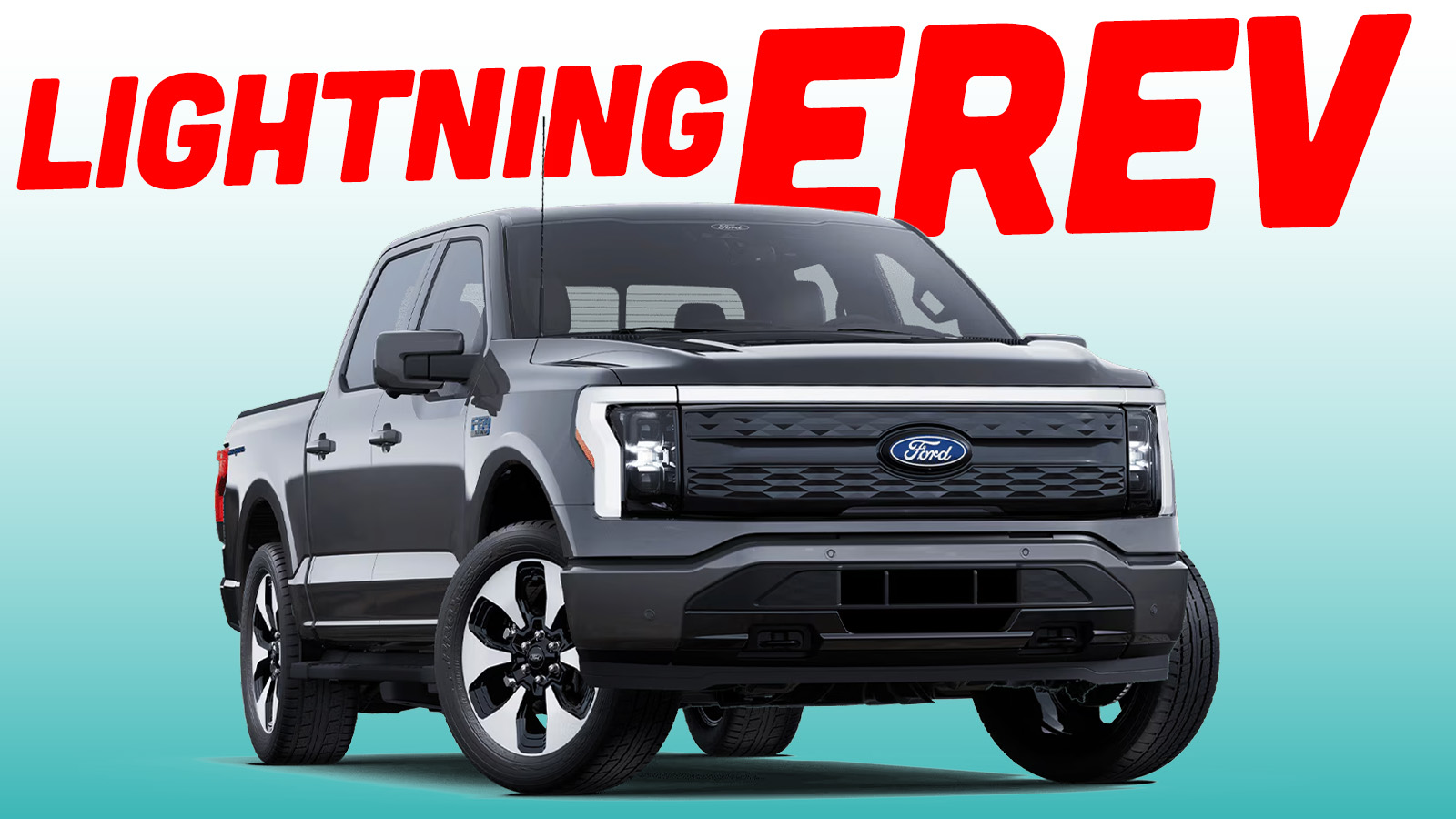
There’s two things that keep this world moving: trucks and compromises. It’s easy to see the value of the truck part, but the compromise part may be more subtle. But the truth is, compromises are just accepting reality and doing your best to make the most of what you have. That’s what an EREV (Extended Range Electric Vehicle) is: a great compromise. An EREV gives you all the benefits of electric drivetrains – high torque from takeoff, fewer moving parts, great acceleration, quiet, all that – but also you’re not tethered to an EV charging infrastructure that, let’s be honest, still isn’t really done. It’s the best of both worlds, and now Ford is building EREV F-150 Lightning trucks.
Ford is ending production of the battery-electric F-150 Lightning and replacing it with the F-150 Lightning EREV, which is something we’ve suspected would happen for a while. You know why we thought that? Because it makes a hell of a lot of sense, that’s why. You know how trying to tow with most battery-electric trucks means you can go, like 100 miles or so, and then you’re screwed? Or what about losing a full quarter of your range if you have a full payload? Who wants that? Nobody, that’s who.


Adding a combustion motor that can act as a generator for the electric motors and battery changes the game completely. Here’s what Ford’s press release has to say about it:
Leveraging advanced Extended Range Electric Vehicle (EREV) technology, the next-generation F-150 Lightning will offer the best of both worlds: the seamless, instant power of an electric powertrain and the freedom of a generator-backed estimated range of more than 700 miles.
Unlike a traditional hybrid, the F-150 Lightning EREV is propelled 100 percent by electric motors. This ensures owners get the pure EV driving experience they love – including rapid acceleration and quiet operation – while eliminating the need to stop and charge during long-distance towing. Like the current F-150 Lightning, the next-gen version will also offer exportable electricity that can power everything from work sites to camp sites to homes during a power outage.
The current battery-electric F-150 Lightning has a range between 240 and 320 miles. The EREV more than doubles that to 700 miles, and, even better, if you drive it somewhere out in the sticks, you don’t have to worry about trying to find some nonexistent charging station. You know you can find a gas station.
EREVs make so much damn sense; for most of the time, you can use this like a pure battery EV, but when you’re hauling or towing or on a long trip, you can free yourself from the restrictions of an EV. Sure, in a perfect world maybe we wouldn’t need the combustion motor, maybe we’d be running these things on fusion reactors that use pollution for fuel and the exhaust is giggles. But that’s not reality. For reality, an EREV makes a hell of a lot of sense.
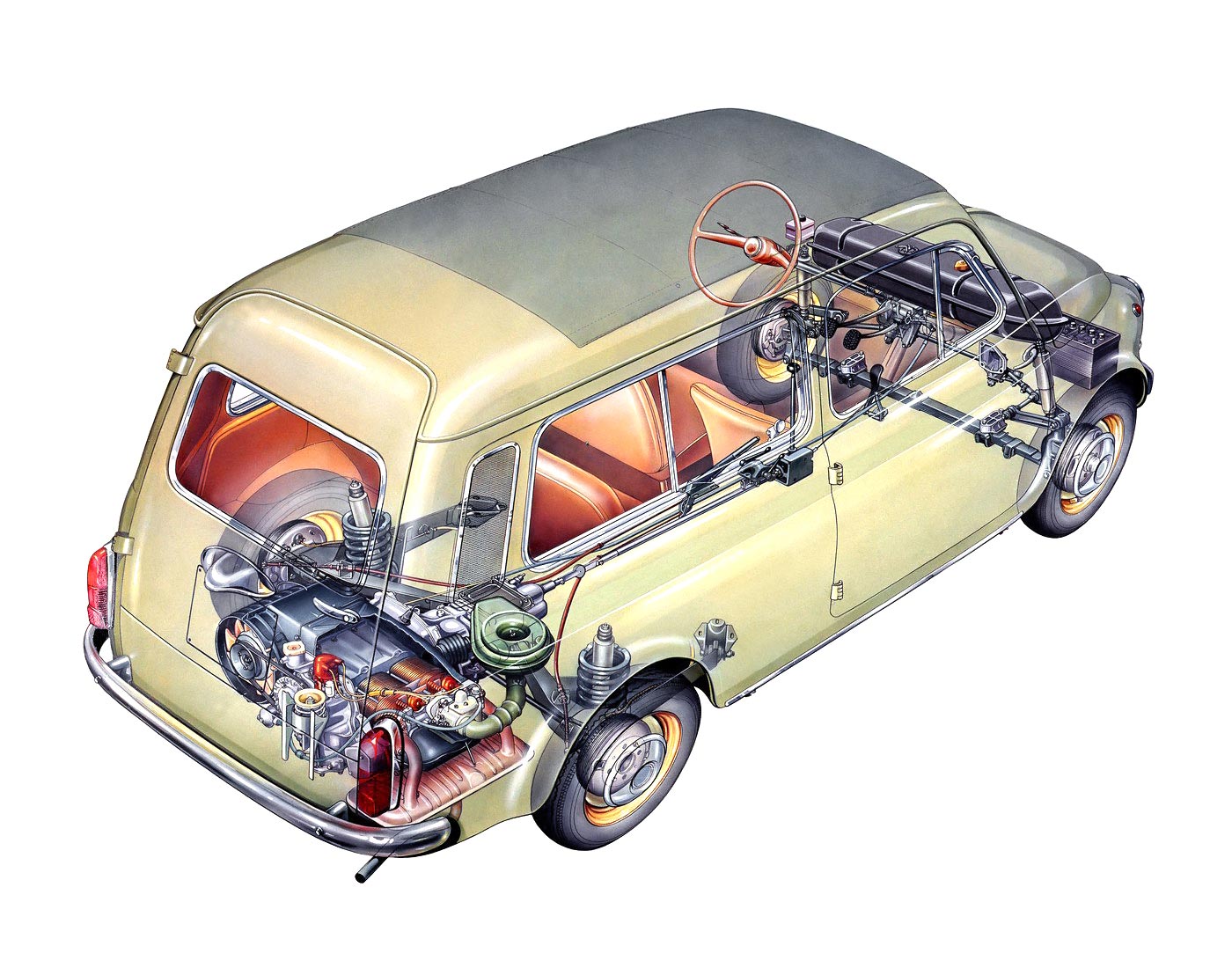
I’m curious to see where Ford will package the combustion engine, and what engine they’ll use. Will it consume the entire cavernous frunk of the F-150 Lightning? Just part of it? Will they cram it under the bed, somehow, an inline engine laid sideways, like a Fiat 500 Giardiniera? I’m very excited to see.
This is a good move on Ford’s part. About time.
The other announcement Ford made was that it would turn some of its planned battery production into commercial Energy Storage Systems (ESS), which is to say giant batteries for industrial use, which seems like another good compromise.




I’m apparently the old man in the room. Just bought an F150. Didn’t even turn my head at EV, HEV or even turbos. Just give me a V8 and I’ll be on my way.
I was looking at a F-150 RCSB. The only way Ford will build you one is with a V-8. They know what’s up.
Really? Is it because it’s considered a pure work truck and for that they assume just keep it simple?
I wouldn’t even want a V8. the old 300ci I6 would do everything I need to do in a truck, and then some.
If given the option, as someone who’s owned quite a few V8s over the years, I’d pick a straight six over a V8 just about any day. But not the Hurricane, because I don’t care for forced induction in a daily and especially don’t trust Stellantis to do that x2 and have it be durable long-term
Like I said – I’m an old man. However, when my nephews found out they immediately asked to “hear it.” I guess a ‘grunt gene’ runs in the family.
Pretty sure an even smaller I4 would do the trick for 95% of the things trucks get used for and be able to do most of the last 5%, just slowly, in the right lane in a much lower gear. Entire armies are moved using 2 1/2 ton trucks with *only* 90-105 hp.
Exactly. Somehow semis move 80klbs with less power than modern turbodiesel pickups produce. I used to drive 40klb buses that had all of 250hp (albiet lots of torque), and they did 70-75 just fine.
I mean you chose the objectively worst option. I will never understand why turbo gas engines are somehow unreliable when turbo diesel engines make the world go around. What’s funny is the main issue any of the Ecoboosts has in the F150 was timing chains, which has nothing to do with them being turbocharged. The 5.0 also has these issues too. So you’ll get worse fuel economy, less power (with a worse power band), and probably won’t be more reliable. Especially towing, since that V8 will be screaming while an Ecoboost hums along at 2-3k RPM with a trailer passing you on the highway.
I myself would probably go with the ecoboost, although I think the Coyote is still a good option. A few points:
– Ecoboost are known to be thirsty when towing in the real world. I feel like the Coyote would possibly have the advantage.
– The sound of the V8 is better hands down
– Turbo diesels are not reliable
– You could get that 700hp blower kit
Yeah, my father’s F350 Diesel is a workhorse. Also has a $200+ oil change, $200-$300 cost for fuel filters that are changed every other oil change. Need to drain the water separator nearly monthly. All that and it gets worse driving range with a trailer than my Silverado EV because it does not have the extended size fuel tank.
Hmm. Along with intake valves and coolant leaks. Twin turbos means twice the likelihood of turbo-related issues. And if the Coyote is ‘screaming’ in a particular condition, a comparable 3.5L Ecoboost is going to be at least 2.5k or even 3k – not 2k. The torque curve on the boosted engine isn’t actually flat. I’d be interested to see thermal mapping of the components during those events too. Perhaps if I planned on any substantial towing and didn’t live in a particularly flat part of the country I’d have taken a deeper dive into the turbos. For me, the old man, old school V8 is perfect. All in all, I don’t disagree with your post, but do take issue with your use of the word “objectively.” /sarc
Properly designed gas turbos are extremely reliable. The problem comes in the cost cutting and trying to do too much with too little. Though ultimately TANSTAAFL, it is simply a bunch more parts to potentially go wrong.
But driven properly, a turbocharged engine is the closest thing to a free lunch that thermodynamics allows. To compare relative apples to apples, I replaced an ’08 2.0T Saab with an ’11 3.0L n/a BMW. Both engines at very similar tech levels (port injection, variable valve timing), very similar performance levels (Saab bit more torque, BMW bit more hp), same weight, same aero (both wagons of ~3400lbs). The Saab used about 15% less fuel across the board, city or highway. A friend still owns that car, 250K on it and climbing and it’s never had a turbo issue. But subjectively, the BMW six is a much, much nicer driving experience, if a less efficient one.
Surprisingly, from what I can find the V-8 may actually do slightly in terms of towing MPG than the EcoBoost. The 3.5EB is easy on fuel at low output like driving around town, but it gets thirsty as the power output rises. It definitely does noticeably worse towing than the Chevy 6.2 (but better around town), though the cost of 87 octane vs 91 about balances that out.
As far as reliability goes, I think the gen1 ecoboost was worse than the V8, which makes sense as it was a much newer design. The gen2 seems roughly equivalent, though.
And the 3.5EB is definitely nice at higher altitudes.
Yeah, you’re the old man. I own a Silverado EV 4WT. Shocked at how much better it is than any ICE truck I’ve ever been in. Perhaps you prefer rotary dial phones? 🙂
I encourage you to test drive one. When I drove from SLC, to Yellowstone, to Billings, then down through rural Wyoming to Evanston, I lost any fear I had of charging. I was not towing but even if I had been, I would not have been worried. Without towing I never dropped below 150 miles of range, and that was more about me choosing to do that by skipping chargers than it was for any other reason.
I understand why Ford is doing this, but as an EV Lightning owner I’m disappointed. The towing limitations are real, but a lot of the concerns about range overall are overblown. The joy of simplicity of BEV ownership cannot be overstated. I have no interest in going back to ICE, even as an EREV, again.
I asked an owner of one at my local grocery store parking lot. He echoed your sentiments about the truck. He doesn’t toe regularly ( he said about once a year for an annual camping vacation). Outside if that , it is his commuter and excels at truck stuff.
I’m semi interested since Ford will probably be offering great deals on the remaining inventory.
Tow not toe. Love voice to text
Tow knot toe?
“Tow not toe”
I was about to make a ‘camel tow’ joke…
They depreciate so fast, you can get a really nice deal on a used one too
My brother is eyeing the used ones, he gets free charging at work so potentially he could save money over his prius lol
Also very good deals on Silverado EV WTs lightly used.
I think Ford correctly gauged their market in that a Lightning is better at what most people use their half-ton trucks for: almost all commuting and errands, maybe carrying something large-ish from Home Depot once every couple years, maybe towing a boat to the lake 30-100 miles away a few times a year or a road trip here and there.
The problem is, if people were buying based on practicality for commuting they wouldn’t be shopping for a truck in the first place. They’re shopping on what they’ll theoretically want to be *able* to use it for, even if they won’t actually do it in practice.
The towing limitations are exactly why I haven’t bought one already. I require range as I tow projects regularly, and often go where charging infrastructure is not.
Sure, you are a good use case for the EREV while I am not. Why not offer both the EV-only and EREV models? Killing the EV versions seems shortsighted
Cause batteries are expensive, trucks need a lot of them, and people aren’t buying the expensive EV trucks in high enough numbers to justify.
EREV, if they’re smart, allows them to cut the pack in half or down to a 3rd. Reducing a LOT of cost.
Agreed. My Silverado EV gets better towing range than my father’s 2016 F350 diesel.
How long is a full recharge on the road? And do you have many areas where you can charge without unhooking?
20-80% in 40 minutes. As of a year ago it was the fastest charging vehicle Car and Driver had ever tested. Yes, charging to 100% takes another 30 minutes. So enough time for a netflix episode of whatever I’m watching at the time. I’ve never noticed the charging time being a problem because I should be relaxing or napping anyway on a long distance trip. There’s also a guy on youtube who makes a decent argument that charging beyond 80% is the slowest way to do long distance travel.
As far as pull-throughs, there are more than you think. One like this is near me: https://insideevs.com/news/771783/gm-pilot-evgo-200-charging-stations/
Again, year to year, there are a lot of changes. I should also say there’s lots of areas where with all but the longest trailers, you can charge without disconnecting. I’ve seen it done where you pull to the end charger with plenty of room for the trailer behind you and just angle your truck out. It’s very common when you’re not in a city that of a bank of chargers, only one or two will be occupied and you’re not causing a problem.
I tend not to take rest stops when I’m solo traveling/towing. I’d rather have that time back at the destination.
I’ve had a few car retrievals where multiple hours of charging (burned about 200L of fuel in my F150) would’ve meant a hotel stay in remote areas. Causing both cost overrun AND another day away from home.
When traveling with family, trying to entertain my 6 year old in a parking lot is a lot less attractive than a local park or playground (we pack our meals when traveling) .
Plus, according to Plugshare, pull through stations in Canada are rare as Hen’s teeth outside Vancouver and Montreal.
EV towing can be made to work, but it’s far from ideal.
Seems like 10kW ought to be plenty, right? Just throw one of these in the bed, they’re only $3500.
https://www.generac.com/residential-products/standby-generators/gaseous/standby-generator-10kw-wifi-enabled-7171/
The Lightning averages something like 2 miles/kW-hour. So a 10 kW generator wouldn’t get you very much
okay, fine 🙂 the 30kW unit is $14k. How much more are you going to get out of any other EREV engine?
“How much more are you going to get out of any other EREV engine?”
The Ram 1500 REV engine about 130kw.
I really need to learn more about how this works. A quick search for a 130kW generator shows me a unit that costs $40k and has an 8.86 liter V-8 NG engine. How is RAM making equal kW with a significantly smaller ICE engine??
Well NG is less energy dense than gas so that accounts for some of it, but it is an industrial engine designed for a constant output at that level all day every day.
Meanwhile the lowest output Pentastar makes a peak of 160 kW or 215 HP. So even with the conversion losses 130 kW peak is reasonable.
You’re comparing apples to oranges.
That $40K price is the retail price for something designed for industrial use.
There is likely at least a 100% markup on that.
The engine in the Ram is an engine they build themselves… so Stellantis gets it at cost. Plus the V6 in the Ram is produced in much higher volumes than the engine in that generator you are referring to.
And that also has a huge impact on cost.
Let’s assume the pure electric range is 210 miles. If it was able to turn on manually as soon as you start and you were in city driving with an average of 30mph that would net you more than 40 miles of additional range over 8 hours not bad, could be useful for contractors and delivery drivers.
On the highway at 65mph this would get you like 10 extra miles, Bad.
My understanding is that the generator only kicks on when the battery reaches some low threshold. Otherwise you drive around for regular day-to-day driving purely on battery. So the generator would need to provide a large output to keep up with the demands of the EV drive system in real time.
13.5 horsepower?
More like 150kW, at least 200hp for a truck that size, and to be able to keep the truck moving when the battery is nearly dead. And that’s being gracious of saying maybe only 50% is needed and the batteries can smooth out the highs and lows. The Lightning’s motors are over 300kW or 400kW depending on how it’s optioned.
What would be nice is if they can just put in a nice regular V6 last forever engine instead of the Eco-boost that boosts the wear on the engine. That seems to be the practice with most EREVs so here’s hoping.
“More like 150kW, at least 200hp for a truck that size,”
Note that in the Ram 1500 REV, the engine/generator puts out up to 130kw.
Haahahahahahaha
Leave the math to the engineers.
Rivian has to introduce a range extender now, I just can’t see them remaining competitive outside the narrow range of hardcore EV enthusiasts once this is out.
people don’t, and have really never, bought Rivians to be a replacement for a traditional truck
True, and maybe there’s enough of a niche there for them to survive, especially since the cybertruck flopped so hard. Actually, rivian is probably the number one beneficiary of tesla’s public self immolation. Maybe the play for them is to stay pure EV and soak up the “I bought this before we knew elon was crazy” crowd
Range extender battery, yes. ICE? no.
EREV tov!
Following this press release, Ford announced a prophylactic recall of all future F150 EREV models.
“Prophetic”? Maybe?
Or, are you saying that Ford condoms do not have quality as job 1?
I encourage you to look up the word ‘prophylactic’ in your dictionary of choice.
(Hint: it has other definitions)
technically its the same definition, just a broader use
Or narrower, no body shaming here
Wow! Thanks, man! There was zero chance I knew that and was reaching for a joke!
I am much better for your thoughtful comment!
A prophetic preemptive recall of prophylactics?
Very exciting for those of us that understand math, but there’ll need to be a hell of a lot of consumer education on EREVs and potential cost savings. I fear it will be an uphill battle, but less-so than the old Lightning.
Side note, what is the most capable type of engine for EREV applications? NA? Diesel? Triturbo? A secondary EREV system hiding inside like a russian nesting doll?
Reduce the size of the battery and stuff a big flat-4 (or a small flat-6) under the bed and Bob’s your uncle.
The answer will be a cheap Atkinson cycle engine
Looking at the generator industry, I’d say an under-stressed NA 4 or 6 cylinder tuned to run in a narrow RPM range is ideal.
The most likely option I see is the 2.5L NA I-4 Ford uses on the Escape PHEV, since that engine is already tuned for efficiency and is bolted to an electric motor. It’s not a drop-in platform, but it’s at least in the ballpark. Not sure how much power it makes on its own as Ford rates the Escape as 210 system hp. It’s probably fine if the generator kicks in well before the battery nears depletion, but it would struggle if that generator output is fed directly to the traction motors in case of a totally depleted battery.
They also have an NA V6 standard on the Transit. That’s a totally adequate 276hp.
I think the 3.3 V6 from the Explorer hybrid (that, I believe, is only sold to fleets? For, reasons?) is a much, much more likely bet. Perhaps even punched out to 3.5-3.7 liters.
Logically, the 2.5 would be a great engine for this application. However, this is Americans we’re talking about, and full-size truck Americans, at that. If 1 person pulls ends up at the base of the Davis Dam on the hottest day of the year, with an overweight trailer and a fully depleted battery, they’ll moan endlessly about having to ‘crawl’ up the Davis Dam with the ‘wimpy little 4-cylinder motor’ and ‘I should have got a real truck’. It’s an unfortunate reality, but, instead of making the truck better for the 95% of the people 95% of the time, with a little compromise required that extra 5%, we have to overbuild everything because people can’t use their brain. Dodge seems set on using the 3.6 Pentastar in Atkinson form for the Ramcharger, I’d be surprised if Ford strayed too far from that. Only other option I could see would be the 2.3T in a tune similar to the EU Ranger PHEV, but, I’d bet on the V6 first.
Ah, didn’t know there was an Explorer hybrid. Yep, that makes way more sense.
I don’t think the 2.5L NA is up to the task at all, I was just looking at Ford’s corporate catalog and seeing what NA options are out there, but didn’t know about the 3.3L hybrid. That’s a perfect fit.
They didn’t offer the consumer version of the Explorer hybrid for very long, when they dropped it they claimed it was to free up the components for use in the Police versions where it was/is quite popular.
The 2.5 is appropriately sized for a nice power/economy balance in the Escape HEV/PHEV but it wouldn’t cut it in a F150 towing once the battery reaches the “hybrid” SOC range.
Yeah, I noted that. The BMW i3 REV had the same problem if you were relying solely on the little scooter engine.
The crazy part is that this little engine has to be OBD-II compliant, including an evaporative control system on the tiny gas tank, and meet on-road emission standards. Not so simple then. But I guess BMW has done it, though they have motorcycle engines as a starting point.
With a claimed 700mi range it won’t have a tiny tank and there is a good possibility it will use the same tank as a regular F-150. Ditto for being OBD-II compliant as I expect they will use one of their current engine families, like the one in 3.3 in the Police Explorer Hybrid or the base F-150’s EcoBoost 2.7. So yeah very simple.
Thanks, that makes much more sense. I was still thinking on the scale of the i3, where the F-150 is much larger and will have a lot more range.
I3 is totes exempt from emissions standards. Does not put out enough emissions to matter, according to the DMV. It took me 4 separate visits to the DMV, and printing out a huge chunk of their own regulations to convince them, but it only requires an initial inspection when purchased, which is performed by the DMV staff.
So, what happens first.
What ever it is, if it has a front bench, they’re getting my money.
It’s funny how those very brands are often brought up on this site as some of the least reliable and most recall prone manufacturers. Yet everyone is thirsty to open their wallets when it comes time to engineer the most complex vehicle imaginable…
(Speaking as a Ford owner….)
In my defense, every time it has come up, I have been very clear that I am not happy Stellantis and Vokswagen were going to be my choices.
Now Ford.
Maybe having the Lightning out first will have helped?
Maybe?
As a Ford Mach-E owner, I’m totally happy with its reliability and Ford as a brand. It has had a few recalls, but only one actually required going to a dealer. All the rest were OTA updates or Ford sent a van out.
I own a 2021 F250. So far I think there have been 7 recalls. None have required a separate trip to the dealer, although mobile service has come to my house once and I had to wait an extra two hours for recall work during my last oil change. I think there are still two open recalls, so I presume my next oil change will also include another hour or two of recall work.
I have mixed opinions on the Ford recalls. There have been a lot and it is annoying, but the recalls haven’t been particularly disruptive and have never prevented the truck from working. The truck has otherwise been trouble free for 80k miles.
Overall, I find it hard to complain about recalls and vehicle quality in 2025. Maybe those complaining about Ford quality are younger and don’t remember a time when cars were near death at 100k miles?
Yeah it would be nice if any of those old vehicles had lasted and were being used today. Oh wait it is a billion dollar industry. If you think any of today’s EVs, BEVs, EVAVs are even going to make it to a 3rd owner your coconuts.
I was the third owner of my Nissan Leaf? It is now on its fourth owner and is still on the road…
Data shows typical modern ICE vehicles last 12-15 years or 150k to 200k miles on average. We don’t have as much historical data with EVs, but modern EVs appear to last for approximately the same amount of time without needing battery replacement.
Regarding old vehicle longevity, it is worth remembering that for every ’90s vehicle on the road today, there are ~97 in the scrap yard. Some lasted until today, but the majority didn’t.
To your point, I agree it is unlikely we will see anywhere near as many 30 year old EVs on the road as we see 30 year old ICE vehicles. But on average, EVs hold up as well as ICE vehicles.
(Also, I was referring to ICE vehicle longevity in my original comment.)
I agree, EV’s actually can and will last a long time. I sold my 2012 Focus EV after 13 years of maintenance free driving. I replaced the brakes once as they rusted out (in a non-winter/road salt environment they brakes would never have been replaced) and replaced the tires once. Which a gas Fucus would have required as well.
The car is now being driven by a University student as their city car.
When I sold, I looked at same year gas Focus listings and listed my car at the typical Focus ICE asking price. It sold after just over a month. I gotta say, the gas cars looked awfully beat up and craptastic in comparison to mine and there were not actually that many listings. Quite a few were also listed AS-IS for parts.
Oh yeah, and I lost only 10% range over 13 years. So batteries were still going strong.
Yeah, could be. I just appreciate Ford takes product issues seriously and works to fix them at their own cost. I’d rather a car have recalls than constant issues with dealers hanging me out to dry the moment the warranty expires. No car is perfect, and I appreciate Ford trying to make things right, despite upsetting shareholders I’m sure.
That said, all the recalls have been for issues I never experienced, and none were all that severe if I had (no battery fire risk or anything like what Chevy had with the Bolt).
Or…. They could own any variety of the 3.5 transverse ecoboost and have to pay $4k at around 80k miles to replace the timing belt and water pump. Or have any model with the “lifetime” PTU fluid that fails right after the warranty ends. Or need the valves walnut blasted at 80k miles because they didn’t bother to add port injection until later. Or, or! You could own any one of their models like a 2016 Fusion with the 1.6 ecoboost four that starts leaking coolant into cylinders 2/3 at around 100k miles that requires a new engine.
Sure, Ford issues a bunch of recalls for warranty work. It’s too bad that they’ve morphed into a BMW where once the warranty is up you’d better get rid of it.
I have never had a recall on any car I have owned. I can’t imagine thinking 4 or 5 is acceptable.
Are all your cars 1978 Fiat Spyders?
Hell, nearly all global brands were affected by the Takata airbag recall for starters.
You aren’t realizing what a modern recall is for Ford. I’ve had 2-3 “recalls” in my Mach-E that were automatically resolved with an over-the-air update while the car sat in the garage. I literally did nothing. I simply hopped in the next morning, got a little blurb on the dash that said “Recall XYZ123 has been resolved”, and that’s it.
For example, the latest “recall” was a fix for the DC-to-DC battery converter that keeps the 12V battery topped up from the 400V traction battery (in place of an alternator). Apparently, the original programming would allow the 12V battery voltage to sag to the point the door locks wouldn’t work (Autopian did an article on this I think). I never had the issue, but the “recall” was just an automatic update that raised the minimum voltage threshold the DC converter is required to maintain. Done with a 2min update in the middle of the night with the car in the garage.
I’ve had ONE recall that actually required going to a dealer. They gave me a free rental car, the recall was done that day, and all was well.
I’ve owned cars from Japanese, European, and US brands, and I think every single one had a recall requiring dealer service at some point (even if it was just the Takata airbag one). For the Takata one, we actually had to get a rental car for 4 months while waiting for parts as the Honda was labeled as “unsafe for the road” and had to be stored in a Honda warehouse until new airbags arrived.
Farley’s newest Ford folly…
Less complex than PHEVs and ICE vehicles.
Single speed transmission with no reverse gear.
None are going to have a front bench… Does the regular F150 even offer that still in a crew cab? I know you can’t get it in a Lightning.
Yes, you can definitely still get a bench on the XL, maybe lowest spec XLT?
But yeah, forget about it on the EREV. It’s going to be a fancy super truck.
Yeah after I commented I went and looked and I think XL(T) you can get it, but once you go to Lariat it’s center console.
One of the selling points of the Scout is the return of the front bench seat. But, we will see.
You can actually still get a Suburban with the front bench seat. You even see them on lots occasionally – there’s even a few out there with 3 bench seats and a diesel.
Again, only in the lowest LS trim. No fancy doodads (or even leather) for you if you want a bench.
And you can’t configure the LS with a diesel online. So, I’m not sure how you’re finding those.
They may have discontinued it with the refresh, but you definitely could get a diesel, 9-passenger, LS Suburban a few years ago.
Here
Reports online that they removed the option, even through dealers who can get more customizations than us plebes online.
https://www.reddit.com/r/suburban/comments/1givunf/2025_build_buy_configuration_now_live_and_you/
I would settle for whichever one has at least a 6.5 foot bed. As much as I want an EREV pickup, I won’t buy one with a 5.5 foot bed. Having used trucks of all bed sizes for actual truck things, I’m surprised at how much difference in utility there is between a truck with a 5.5 foot bed and one with even a 6.5 foot bed.
Silverado EV is 5′ 11′. But higher trims have a midgate. To me, that’s the coup de grace, so to speak, for the truck…combined with the fact that the quad cab is the biggest I’ve ever been in, even seems bigger than the megacab from Ram though I don’t know if that’s the truth.
Same here. A big dog joined the family recently and he likes to lay his head in your lap when you drive, a 3 seat bench is necessary for us
Also on a practical note with how massive modern full size pickups are they should have 3 seats to a row for every row!
Here’s to hoping the Lightning gets the 3 seat front row option that the ICE F-150, I really want to get one and get a Leer DCC aluminum Truck cap for hauling firewood and such.
I’d still prefer a 6ft bed option but beggars can’t be choosers.
“An EREV gives you all the benefits of electric drivetrains – high torque from takeoff, fewer moving parts, great acceleration, quiet, all that – but also you’re not tethered to an EV charging infrastructure that, let’s be honest, still isn’t really done.”
As a Silverado EV owner, I can say that I don’t feel I’m making any compromises. I do feel that perhaps I have an advantage over many trucks. Given how the NYT just recently showed how you are in fact, except in a handful of places in the lower 48, within 50 miles of a decent high speed charger, I’m not particularly worried wherever I drive and I just recently drove from Billings, through WY to get to SLC with no concerns about charging.
But that quote bugs me. Look, if you want an EREV, have at it, but let’s be clear: EVs win on environment, hands down. And to make that statement above, while not including that assertion kind of gets my hackles up. EVs are ALL ABOUT the environment. That’s the beginning and end of why they exist. All of the other benefits are icing to entice you away from your ICE infatuations.
Also, do note that an EREV is more complex than an EV, or an ICE vehicle by exactly more than each because it must include all of that tech and additional tech to tie it all together. It’s not less complex and I question the statement: “fewer moving parts”…the only thing missing is the driveshaft and transfer case. That’s fewer by a few percent, and certainly it’s engines that are more complex than driveshafts. For every driveshaft/transfer box complaint there’s about 10x more regarding the moving parts of an actual ICE engine. And do note, the entire exhaust system does not “move”, but certainly requires maintenance.
Couple that with dramatically lower prices in SolarPV and other renewables, as well as drops in battery prices and constant improvements in the tech, this announcement is a real loss.
But it’s not Ford’s fault. It’s our fault. It’s the American public’s fault. Pretty much the entire damn planet is moving to EVs, except of course, us.
Now are there use cases where an EV is not ideal? Yes, but note that on the other end, EV semis are also well on their way. Those use cases are getting narrower each year.
Links to note my points:
https://arstechnica.com/cars/2021/07/electric-cars-have-much-lower-life-cycle-emissions-new-study-confirms/
https://www.nature.com/articles/s43247-025-02447-2
Efficiency
https://evreporter.com/understanding-the-complete-efficiency-picture-of-electric-vehicles/
Solar PV
https://www.newyorker.com/news/annals-of-a-warming-planet/46-billion-years-on-the-sun-is-having-a-moment
Agreed. These do everything EREVs are going to be incredibly complex and expensive vehicles. They will serve their market, but it will be a temporary flash in the pan. It’s a worst of both worlds, technological dead end that will be made obsolete by the next generation of battery technology.
Just build a decent PHEV F150.
PHEVs are more complex and less reliable than EREVs. An EREV is just an EV with a generator. a PHEV needs to drive the wheels with BOTH systems.
The Ford/Toyota torque-split planetary hybrid drive system is one of the simplest and most reliable “transmissions” ever created. Even the Ford versions are very reliable. The Toyota version is legendary. The major downside of it is it ONLY works in a hybrid.
Reliability data, posted on this very site, has shown that conventional hybrids are significantly more reliable than PHEVs.
EREVs aren’t commonplace enough for good data, but watching Nissan’s e-Power platform would be a good bellweather, as it’s just an EREV without the plug-in.
Sure, across the industry I buy that. Most PHEVs are simply newer and less proven models. But comparing apples to apples is a PHEV Prius or Camry lor Rav4 less reliable than a pure hybrid Prius or Camry? I very, very, very much doubt that, other than the newer battery tech potentially being less reliable than the old HiMH (IIRC) that Toyota historically used, and I suppose the charge port and controller are more things to break. The data is inevitably skewed.
Typically HEVs still have most auxiliary systems ran via the engine.
Once you go PHEV, that range of electric-only requires the accessories to go electric as well, lest you lack battery charging and HVAC while you drive.
At that point, you’re already 3/4 of the way to an EREV. Just make the engine a generator and use electric motors for the drivetrain exclusively. It’s been working pretty stellar in commercial industry for decades, you’re just adding a battery in the middle now.
Toyota already does most, if not all of the accessories electrically. In fact, electric A/C is one of my favorite things about the Prius going back to the beginning of them. INSTANT cold air, as compressor speed is not tied to engine speed. Electric waterpumps are quite common as well, and most cars have electric steering at this point anyway.
In commercial heavy-duty service, electric drive is NOT about efficiency, at all. It is about making a drivetrain that can survive shock loads and transmit 3000-5000hp to the ground/rail *reliably*. Completely different use case. The Europeans long ago proved that if you want to save fuel in a locomotive, direct drive is more efficient, whether diesel hydraulic for larger locomotives or diesel-mechanical for small ones. And every attempt to hybridize diesel-electric locomotives by adding batteries has been a commercial failure. The capital cost to do so far outweighs the fuel savings.
So you’re saying they did it for reliability? That kinda loops back to my original argument.
Reliability in a use case absolutely nothing like that of a passenger vehicle, with a near complete disregard for efficiency, because it didn’t really matter – fuel was dirt cheap. Efficiency is THE reason for hybridizing a passenger vehicle. Toyota did not make the Prius to make a more reliable vehicle.
We use direct-drive diesel in our light rail system because it was significantly cheaper for the short (19km) line.
If you have a reference for efficiency of direct drive diesel vs diesel electric, I’d like to see it. Cause I’m coming up Milhouse trying to find one.
You’ll need to read up in actual books from back in the 60s and 70s.
Our efficiency of…literally every component has advanced a lot in the last 50 to 60 years.
Big diesels haven’t. Emissions regs mean they have actually gotten worse.
Efficiency and specific power output is WAY up. Reliability is down due to emissions. The introduction of common rail injection ALONE was a huge leap forward.
I am talking about BIG diesels, aka what is in locomotives. Yes, they make more power, but per hp they use more fuel than back in the day. The gains from common rail are negated by the emissions systems. And of course, the far more complex fuel system means more issues and more cost. And then there is that emissions system. Hold onto your wallet when any of that stuff breaks. When, not if.
But I suspect that is actually true of EVERY modern diesel – see the MPG hit that “fixed” VW Dieselgate motors take. TANSTAAFL. And when the complexity that adds efficiency costs you more than you save in fuel – is that a bonus? My hometown has stopped buying diesel school buses and medium-duty trucks because the costs upfront and in maintenance no longer payoff in terms of fuel savings. Diesels used to be simple, reliable things that could sit out in a field for 20 years and start right up. No more.
Mind you – this is very much a “Devil’s Advocate” argument – I much prefer to not be able to SEE the air that I breath, thanks. But in terms of sheer efficiency, getting rid of emissions controls would allow for rather more of it. And a great increase in reliability too.
The biggest problem with emissions on modern diesels, is variable RPM. Steady state is easier. Also, even as emissions tighten, companies like Scania are simplifying their emissions systems and increasing efficiency by changing their approach.
In Scania’s case, they stopped trying to reduce cylinder temps to avoid NOx. Instead, they burn hot for efficiency and to burn up all the particulate. Then they just treat the NOx with a streamlined SCR process using a little bit more DEF.
The Rav4 PHEV is the same system with a bigger battery and the motors from the Highlander/Sienna System. It works extremely well as a PHEV.
Everything Toyota does works well, with few exceptions. Shame they just can’t make a car I find remotely desirable.
I’m in the same boat and it really is a damned shame. Whenever I get asked for a car recommendation my answer is usually to pick whatever Toyota model fits the lifestyle. Simply can’t go wrong there.
But, whenever I want to actually buy something for myself I never find anything from them I actually want to own.
Same-same, though at this point I am not sure the “Toyota Tax:” is really worth paying anymore unless you plan to put big miles on and keep the thing forever. In an ideal world, I would have bought my mother another Prius, in the real world a Soul was entirely adequate for a LOT less money, even if it is rather less efficient and likely won’t last as long, it will outlast HER and she doesn’t drive enough to care that it only gets 30mpg. And the form-factor was a better fit too.
There really isn’t any significant reliability data for EREVs since the only one we have seen is the i3. Sure Chrysler PHEVs aren’t reliable but that doesn’t mean there aren’t reliable ones out there.
The Ford/Toyota and Honda HEV/PHEV systems are less complex than a EREV, especially the Honda, since the starter/generator and traction motor are located in the same case sharing lubrication and cooling systems while making it lighter and more compact.
I agree with you 100%, as long as we’re just talking about regular driving. I have a Polestar 2 and a Nissan Ariya as my only cars and, like you, I don’t worry about charging, even on long trips.
But towing is a different matter altogether. If you need to stop and charge for an hour or so every 100 miles (not inconceivable if you’re towing a heavy trailer), it’s just not practical. Add to that the near impossibility of finding a pull through high-speed charger and you’ve got an untenable situation. Until fast-charging solid-state batteries are a thing, I don’t think an EV truck will work for anyone who wants to tow stuff regularly.
So just build a decent PHEV to hold us over. A PHEV truck will have the option to drive the wheels directly to maximize ICE efficiency when the battery runs out.
And if towing a camper imagine having to go and charge up every day so you have electrons for appliances and camping gear.
Given the state of chargers from year to year, I’m not worried about those things. I already am seeing pull through chargers, even in unexpected places, like Evanston, WY.
But my 450 mile range truck is never going to see an 80% reduction in range if I’m anywhere near the towing limits of the vehicle.
Maybe not 80%, but probably close to 70%: https://www.motortrend.com/reviews/ford-f150-lightning-electric-truck-towing-test
That would put you at around 150 miles of range with a substantial (but still within the limits) load, which isn’t great.
I’m part of a Silverado EV forum. No one has reported numbers that bad. The Ford was notorious for having the worst towing range.
This guy does these extensive reviews is only charging to 80% or less and still putting on 160 miles on average between chargers towing an 8000lb trailer. To only charge to 80% means he’s only starting out with about 350 miles of unladen range or less. https://www.youtube.com/watch?v=6YFO4kpqlRQ
I’ve towed a small camper on road trips with my Model Y. It’s a wonderful tow vehicle except for range. Having a 15 foot long camper means unhooking isn’t aa big a hassle. But it still is one for most charging stops. And having to charge fuller at a slower rate is another pain point.
EREVs also eliminate the need for a multi-ratio transmission and starter motor. Plus many of the accessories run from the engine on a typical ICE car can shift to the EV system.
A well-designed EREV should be simpler and more reliable than a comparable ICE – see the Toyota hybrid system as an example, and those even have the benefit of parallel operation as an option. Yes, they’re not as simple as an EV, but typically reducing the battery size offers significant weight, cost, and critical materials reduction.
For the life of me I can’t figure out why even though an electric motor can get you to any speed without a transmission why exactly wouldn’t a transmission work to mechanically save electricity to improve performance.
https://www.theautopian.com/how-electric-motors-killed-the-transmission/
Have you read this piece? It’s still pretty deep, but does a pretty good job of making it accessible.
Basically, electric motors have such a flat power “curve” that an electric motor can get you up to 90 or 100 mph without the efficiency changing much. The mechanical losses and extra weight of a gearbox usually add up to more inefficiency than you gain from “shifting” around the EV power curve.
The Toyota/Ford torque-split planetary hybrid system has neither a starter motor nor multi-speed transmission whether plugin or not, and is extremely reliable from either manufacturer. No reason it couldn’t be scaled up for full-size truck use.
Though IMHO, the real issue is all the idiots using full-size trucks 99% of the time as ordinary commuter cars hauling air around. Regardless of how they are powered, they are a menace on the roads.
The only difference between a torque-split planetary “PHEV” and a hypothetical “EREV” F-150 is the ability to drive the front wheels directly from the ICE. The rear wheels in any AWD Toyota hybrid are already EV-only (or series-hybrid if the ICE is running).
If they can easily package the system to offer parallel hybrid on the front axle, that’s fine. But either way they need to size the front and rear traction motors to offer EV Lightning performance without running the ICE. I get the feeling it will be easier to adapt the current Lightning to add a range extender (series operation only) than to work out how to add parallel operation as an option. That way you have much more flexibility in packaging the ICE and generator motor.
Easier, sure. But also inevitably less efficient when you need that efficiency the most – at speed on a highway.
Toning down the frankly ludicrous performance of these things would be a good place to start too. Nobody needs a potentially *8000lb+* truck with the acceleration of a Ferrari.
Oh, 100% agreed on reducing the size of these, but also pickups are the main place where hybrid/PHEV/EREV makes the most sense opposed to pure BEV. And looking at some of your other posts in this thread we’re on the same page. I think the Toyota power split device in a PHEV configuration is the absolute best of all worlds.
My original comment was in response to the idea that going from EV Lightning to EREV was a mistake. I disagree, and think that EREV Lightnings will end up driving many more EV miles than the few EV Lightnings that are selling, thus having a larger positive environmental impact.
I think the smartest reason to go “EREV” (without the option for parallel operation) is so that Ford can take the existing Lightning and make some adjustments to add a series-hybrid generator. I think adding parallel hybrid capability will be too much of a tear-up to be done quickly at this point.
Maybe the next gen can add a power split device somewhere.
For sure an EREV F-150 makes FAR more sense than a BEV one. And given the sunk costs of the platform it’s not like Ford is in a hurry to do a complete do over to do it correctly.
But to me, generally EREVs just don’t make a whole lot of sense to start with – you lose too much highway efficiency for the added expense, especially if the “generator” is sized such that you don’t take a huge performance hit when the battery depletes, and if not you still need a HUGE and expensive battery. A bandaid at best. Ford has a simple, absolutely bulletproof hybrid system that they should be putting in absolutely everything, whether plugin or not, and if they want to add AWD, stick another electric motor in the back same as Toyota does.
But hopefully one of the various “any day now” battery breakthroughs happen and it all becomes moot. Not holding my breath on that.
It’s a shame we can’t bring some sanity back to performance expectations and reap all the benefits of that, but I fear that horse is out of the barn given all the wingnuts around here (who should know better) that clutch their pearls whenever a car with even a 10-12 second 0-60 time is discussed.
Yeah I mostly agree with your points here, owning an EV has not felt like a compromise at all and the charging situation is something that just takes a little readjustment (realize I’m privileged as someone with the means to have a level 2 charger at their residence).
But full size pickups are the one area things feel compromised still. The best answer to the capability question right now seems to be just throwing more batteries at the problem. The EREV does seem like a good solution for those with range anxiety and “Real Truck” needs.
I’m seriously considering the Silverado EV to replace our ecodiesel Ram but I’m struggling with idea of owning an 8600 lb vehicle that’s going to murder tires and driveways (never mind how things might go in a collision) as a family/bike/luggage hauler. But I love having a bed and these huge full size truck interiors are great for all the kiddos + dog (sorry R1T).
The Lightning, as is, seemed like the best compromise for our family’s use case. Oh well, there’s a used market and I’m sure in a few years there will be more options. Progress?
It’s not as much as a weight difference as you might think–between 1/2-1t. The Silverado EV is in definitely closer to the HD trucks given its nearly 6′ bed length and the fact that it has the largest quad cab I’ve ever been in. Certainly larger than an F350.
True, it can’t tow/haul like an F350 diesel, but 10k lbs is respectable. I haven’t seen any evidence so far that it’s much harder on tires than an F-350 either.
Cross shopping it with an F150, esp with the 4′ bed, I don’t think is really fair.
True I see the point about the Silverado being closer to a 3/4 ton truck in size and capability, though I think you’re in the minority of buyers if you view it that way. As someone that doesn’t need the extra tow and payload capacity though it’s not a big selling point for me. Not sure about the 4’ bed thing, I think the Lightning has the same bed as all short bed F150s at 5.5 ft or so.
I don’t think people view it that way until they get in one. Or see the Trail Boss version.
Yeah, I stand corrected, the Lightning is 5.5. I just see all these standard F150 crew cabs around with comically short beds.
The Silverado bed is big enough for me (but not everyone) to sleep in. But the non WT versions have the midgate, which is a huge plus. (One thing I don’t like about the WT is that they literally welded a wall in place when there was no need to do that–basically extra work to remove the midgate than to just put one in.)
I’ll agree with this. I don’t think many people (genuine people, anyway) have a problem with the capability of the GM EV trucks. It’s the colossal list of compromises made to get to that capability that make a lot of us tilt our heads and think ‘I don’t know – couldn’t there have been some other way?’ It’s a 3/4 ton truck, but with 1/2 ton capabilities because it’s carrying around a 3,000 pound battery pack. I’m sure they’re wonderful, and I’d love to have one – I’d drive the hell out of it – but, there is something about carting just myself around in an 8,000-9,000 pound vehicle that feels very wrong.
To me, the Lightning is a more attractive vehicle, and it comes down to this – Car & Driver has tested a Lightning Platinum with the larger 131 kWh battery, and a Silverado EV RST with the 212 kWh battery. 6,800 pounds vs 8,800 pounds. That’s *Monstrous*, even for that class of vehicle.
Trying to compare a little more apples-to-apples, I’m not seeing a ton of reliable weight figures on the new Standard Trim SEV, but, I’ve seen 7,400 pounds a few places. Still outrageous, but seemingly reasonable compared to almost 9,000 pounds. Since the Lightning offers a 6800 pound Platinum with a 320mi range, all the way down to a 6,000 pound ‘Pro’ with a 240 mile range, let’s say ~6,400 pounds for a theoretical Lightning that would match the SEV Standard’s 286 mile range. It may not sound like a lot, but, 1,000 pounds is Substantial, even in this class of vehicle. And it’s all to account for the capability to carry around that monstrous battery in the Max range versions.
I just can’t help but think how much better I’d like the SEV if, instead of a 7,400 pound truck with a 286 mile range, it was a ~7,000 pound truck, with ~140 miles of battery, and several hundred miles of gas. Even better if it was cheaper (it’d be cheaper to produce, but, whether or not they’d pass that along to the consumer is anyone’s guess). The thought that the next Lightning could weight <6,000 pounds as an EREV, while actually increasing the usefulness and capabilities and reducing the cost, is actually really exciting.
When they introduced the Scout they admitted that the EREV version was going to be less expensive to build than the EV version but they “hadn’t decided what the pricing was going to be” IE they left the door open to sell it for the same price or more than the EV.
Something feels more wrong to me to deal with environmental impact of an ICE engine in a 6000-7500 pound truck than the markedly lower environmental impact of an 8500 pound pure EV.
Again, I’ve posted this elsewhere: https://arstechnica.com/cars/2021/07/electric-cars-have-much-lower-life-cycle-emissions-new-study-confirms/
https://www.nature.com/articles/s43247-025-02447-2
It’s fair to debate the impacts of pickups and how many Americans don’t really need them. But if you’re comparing ICE to EV trucks, it’s a discussion that’s got a clear winner.
And, I’m sure you’re not alone, but you’re definitely in the minority on that one. We’re not comparing ICE to EV – if anyone is trying to argue that building an ICE generator has the same/more environmental impact than producing an extra 100+ kWh of batteries – they are disingenuous at best.
A vehicle that can operate 90+% of the time on battery, yet use less than half of the batteries to be produced, is a massive win for the environment. To say nothing of the savings in tire wear, brake wear, fixing damages during crashes (extra weight=more damage), etc. To say nothing of the improved driving experience of having literally thousands of pounds less vehicle to lug around. That’s better acceleration, better braking, better handling, higher payload, increased towing. There’s very little downside to an EREV in a large, heavy vehicle. But there sure are a lot of upsides.
Please don’t confuse this with telling you you bought the wrong vehicle. Given current options, if you need a full-size truck, and want an EV, the only option for a ‘do it all’ truck is the GM with the monstrous battery. But it’s weird that you don’t want to see smarter options that would work better for the vast majority of truck buyers.
Lucky me around 100 miles away and not super charger. And they often are broken or have shoppers parked in them because right up front by the store
That’s simply not true if you live in the lower 48 of the US, near a population center in Canada, or in Hawaii. https://www.nytimes.com/interactive/2025/09/29/upshot/ev-chargers-road-trip.html
And dealers have already marked them 50k above sticker
I’m going to be very curious how this works in practice. I see very little reason that city and highway driving couldn’t be extended dramatically with little to no disruption to power with a small motor, but when the generator can’t, on average, keep up with the draw what will happen? I guess it just draws down the battery until it runs out? will it limp mode down to a practically useless degree? I mean, if you are pulling 8000 lbs and suddenly you are limited to the equivalent of 100 hp…what happens next? The sensible thing would be to…taper off power as battery drops? run the battery at full power until it can’t and treat that as empty? What?
This is the basic problem with a series hybrid: at some speed/load condition, you start charge depleting. This becomes a problem for long highway trips, though to be fair you can run longer than if you were doing EV only and not charging at all.
That said, you’ve got some options to mitigate it:
You can usually run the engine for max efficiency, but switch to max power when you need more.
You can detect that you’re in a high load condition and start the engine sooner, and/or limit speed. You could call this “towing mode” or something.
You can couple the engine to the rear wheels at some speeds, and skip most of the generating part. This is what the Volt did. It’s not “pure EV / EREV”, but who cares, it works better.
But if the generator kicks on at 80% can it add power before the EV runs out and just make it last longer.
Ram has stated that the RamCharger can start with a depleted battery pulling max rated load at the bottom of Davis Dam and make it up on generator power alone. I can’t imagine the Ford not being capable of the same thing; it’s otherwise a lawsuit waiting to happen.
These systems are going to power so many narcosubs in our future.
I never thought I would see Jason enthused by the prospect of removing the frunk.
*Pats Volt* You and the i3 were ahead of your time old friend. Too far.
Classic GM; pioneering a major new technology and then dropping it before it gets popular
Exactly right. They are top of the market in that sense.
If they had put the Volt powertrain into a Trax or Equinox sized vehicle, it would have been a game changer
I’d argue this isn’t even a compromise. It’s just a good idea.
If it’s a compromise then basically every diesel locomotive is as well
This is a good move on their part. They should cut the size of the battery by 2/3 and go to a more power-dense make/model of battery to prevent any need to downrate the power from the drive system. Now you’ve got a significantly less expensive to build, lighter, more-efficient, more practical truck that real-world will have 60-80 miles plug-in range, and as long as there’s fuel in the tank it will have no range limit while towing.
Build one the size of a Maverick while retaining a ladder frame and they’d have something truly great.
As a 2.7L F150 owner, IDK how I feel about this. I agree the current Lightning leaves something to be desired, but my scepticism over the actual costs of an EREV do-everything super pickup remain.
Like you say, the whole point of combining an electric and gas drivetrain is to maximize the utility of the smallest battery possible- lowering the cost and weight of the vehicle, and giving you just enough electric range for everyday driving.
An EREV is basically the opposite of that… You have an already expensive full-sized pickup truck, then you give it a 70kWh battery large enough to power an entire electric sedan, only to still include a gas engine powerful enough to move the vehicle on it’s own.
IMO Ford would be much better off re-introducing the Powerboost as a PHEV with like 60-80 miles of all-electric range, or even just a decent regular hybrid. As it sits, there is almost no fuel economy advantage to buying the F150 hybrid over the 2.7 Ecoboost.
These trucks are already like $75,000 CAD for the base model hybrid XLT, I can only image what an EREV would cost.
The difference in battery size by itself is going to yield massive cost savings. The ICE acting as a generator doesn’t need to be anything fancy or powerful: run it as a generator operating at a steady speed, with no transmission. 100 horsepower continuous would be plenty even for an F150. The acceleration needed by the operator will still come from the EV system.
The pack in the F150 Lightning is seriously big enough for like SIX 200+ mile highway range non-hybrid EV sedans if the auto industry would actually focus on aero drag reduction and offer Nissan Versa-sized sedans with drag coefficients in the 0.1X range.
These massive trucks/CUVs/SUVs with triple-digit kWh battery packs and an intentional total lack of DIY reparability are the ultimate squandering of EV technology and the resources it requires. We could be building EVs to last a human lifetime and be easily fixed, with smaller batteries that aren’t going to exceed the value of the car when replacement time comes at 2 decades old.
An EREV Lightning is a massive improvement from a resource standpoint alone.
You know your stuff. I calculated it myself, and getting 6 mpg at 65 mi/hr (numbers I’ve gotten while towing a big trailer) is about equivalent to 100 hp. I’m guessing they’d build it a bit bigger than that so the engine doesn’t have to run at max power for hours at a time.
Imagine the number of engineers that would bust a nut if Ford partnered with Toyota and put a reliable Atkninson’s cycle 4-cylinder and possibly planetary gearset into the son of a bitch to run at peak efficiency when needed. Might be able to make that 11+ mpg @ 65 mph, regardless of whether you do a series hybrid or parallel hybrid. And we haven’t even done something about the horrendous aero of passenger trucks for the sake of tradition/aesthetics in order to go well beyond that 11+ mpg. They’re TRUCKS! TRUCKS ARE WORK VEHICLES, DAMMIT. YOU WANT THEM TO BE CHEAP TO RUN AND VERY, UNFAILINGLY RELIABLE.
With EV tech, service intervals go way down, too, so that opens up many more design options than with a pure-ICE truck. Ford could easily design for its F150 Lightning a 60+ kWh pack in an accessible place, perhaps under the truck bed would be ideal. All the buyer needs is a way for the bed to flip up in a place ergonomically designed to simultaneously facilitate low-hassel owner-access and sufficient resistance to theft/tampering of battery that it will make too much of a spectacle and require too much expense for a would-be thief to pull off. The battery WILL go out at some point, but that electric motor and aluminum body will last DECADES if it doesn’t get into an accident, and the battery is what will potentially render perfectly good components useless if it cannot be economically repaired/upgraded. So battery access by the owner is a must. So is generator/gearset access for removal/repair without specialized tools or procedures that require great feats of labor and/or skill.
Computerizing the hell out of them for the sake of tech, ICE and EV alike, has turned all modern vehicles into bloatware, most of the features “breakable” in some way, and I think there could be mass consumer appreciation for offerings that were practical but were very minimalist/inexpensive/GOOD that could confidently be passed onto 2nd hand and 3rd hand buyers when 2+ decades old. Does the farm truck or work truck of the future really need an AI “brain” integrated into its infotainment system that just randomly one day “decides” to brick a truck full of perfectly good parts, or worse, cause a public health hazard when some mission-critical component fails from any of the bloated number of features that have become unnecessarily-added possible failure points? Consider all the random ways a person can go out like Michael Hastings in a modern car! Or maybe something less fanciful: things are just old and you need to fix them or you can’t get to work tomorrow. In any case, Ford is currently offering up products where the owner is not going to be able to easily/inexpensively do that when the vehicle is 20+ years old, but at least THEY ARE finally considering new ideas that make sense, like making it an EREV.
If Ford starts developing some common sense(which I admittedly don’t have a whole lot of myself), Ford will realize that it shouldn’t cut corners and use plastic oilpans and make other mission-critical parts of the vehicle designed with no care for whether they naturally degrade after the vehicle’s waranteed design life and eventually become part of the ecosystem(and I don’t only mean Ford’s “ecosystem” with that comment). Decline in quality costs customers, costs the environment, wastes everyone’s time, and does the opposite of improve our lives. Maybe they might have an epiphany and get rid of as much “nag” devices and “assist” aides as they can so that people learn to actually drive their vehicles with care and attention to everything they do with that vehicle(no matter how safe or reckless)? It’s as if modern vehicle offerings are stupefying the human race out of their own sense of responsibility and self-preservation, in the name of “safety”, a trend simultaneously reflected in the design of modern vehicles themselves!
The thing is Ford and Toyota did team up to build a hybrid full size pickup and a year or so into it they decided to go their separate ways.
I could point out that a lightning was driven into a wall here and the damage seemed light, certainly I would replace the headlight, fender and bumper if it were mine, but the insurance company automatically scrapped it because it was an EV and they were massively worried about the electronics up front.
I am not going to say for sure that is solely the reason as CoPart has made insurance companies much more willing to pay out on newer vehicles so they no longer have to fully insure a newish car with damage history and they get a fair amount of the money they paid out back from the PHPH lots that do exactly what I said I would do if it were mine. But I digress.
I’ve always thought that Ford should have offered two different Hybrid powertrains for the F-150. The top dog like now and one focused on maximizing fuel economy instead of tow and HP ratings. Seems like the 3.3 as used in the Explorer hybrid would work well.
No way we are seeing a BOF truck the size of a Maverick. What we could see is a PHEV Maverick though since they protected the space for the Escape PHEV battery pack and they aren’t making any more Escapes so might as well put that capacity to use in the Mav. I’d throw down my money for one.
I would like to see how much of that bloated battery could be removed to offset the weight and range extension of the engine. Basically is there a sweet spot, say 400 miles of solid range, not heat or cold reduced range, but guaranteed range, that can be had with the gas motor while reducing overall weight at the same time. Just a thought.
Agreed. I’d be pretty happy with a 66% reduction in battery capacity to get an 80-mile EV range, then have gas for the remaining 460 miles. 540 miles total and a ton of cost savings.
I think you’re just describing a PHEV.
Yes and no, it more or less comes down to semantics. A traditional PHEV would have the gas engine with a transmission that also connects to the wheels. This is an EREV, just like the formerly named Ram Ramcharger (I still hate that name, but it’s since burned a hole in my brain) or the current Honda Civic hybrid, which is a series hybrid rather than working in parallel. In theory, an EREV is simpler than a PHEV, but who knows these days.
Nah, a PHEV needs to have an engine powerful enough to drive the vehicle. An EREV just needs exactly the engine size required to run a generator at a set RPM where it has max output.
So long as the charge logic is set up to keep a certain reserve in the batt, it’ll never need to fully supply all the power. Unless you’re planning to do a dead draw up the Donner pass at max tow with the battery already flat, you’re gonna be fine. I’d argue that scenario is poor planning on your part.
I understand the difference, I’m just pointing out that a PHEV already serves the electric 80mile commute, with an ICE for long distance driving and towing.
Why make the battery any bigger? Why lose the functionality of driving the wheels directly when it is most effiecent to do so?
Maybe an EREV like an i3 can get away with a tiny generator, but a pickup truck with a 10,000lb towing capacity cannot. Ram has already confirmed their truck is designed to accommodate your exact scenario, hence why they spaced an entire Pentastar V6 as the generator. The Scount Harvester apparently uses a smaller inline 4, but only tows a pathetic 5000lb.
Personally, I’m not sold on a series hybrid making that much sense in an automobile. The Honda’s parallel system with the planetary gearbox offers so much more flexibility, allowing the ICE to function as a generator, while still allowing it to lock in and drive the wheels when optimal to do so. I’d rather see Ford pursue an F150 with that functionality, plus enough electric range for daily driving.
End of the day Honda and Toyota have been refining their systems for like 20 years. Why are EREVs being touted as the optimal solution all of a sudden, by manufactures with barely any hybrid experience?
You might have answered your own question there: EREVs are a bit simpler (transmission-wise) than hybrids, so a manufacturer without a strong hybrid setup is betting that they’re a good solution.
I’m really curious to see how it turns out. I don’t know how they’ll be marketed–they could end up with a smaller battery and therefore a lower price (i.e. like an i3 scaled up) or maybe it’ll be the “more of everything please” approach and be marketed as the top-tier truck?
It’s possible they see an EREV as a way to keep their EV platforms in production through the ‘Trough of Disillusionment” era EVs are currently facing.
I’m not rooting for this to fail, I just don’t see how it’s going to be affordable.
Ram is going with a 90kWh battery for the Ramcharger, which already makes it an expensive EV before we even throw the V6 engine back in the mix. That’s going to be a pricy truck. I hope Ford goes for something more conservative, but historically they don’t like to advertise smaller numbers.
That would be my concern too. I mean, I own an i3, but I get that it’s simpler in use to just have a big big gas tank and regular engine!
RAM is doing RAM things and trying to make a “It’ll never derate under any circumstances cause you’re a big boy that does big boy things constantly”
The reality is that it’s ok if you have to ease off at times. ICE trucks run into this all the time with heat management.
Even then, they’re getting better capability than their V8 or twin turbo i6s with an N/A V6. So it’s clear they’re getting optimal usage.
No because since the generator can’t produce more power than the vehicle is using, according to other posts not my knowledge, you will get close to zero and need more power than the generator can provide then sitting on the back of the truck, waiting for the charge to charge to get you unstuck, watching the charge needle rise, just to watch it fall down again, sitting on the back of the truck, wondering why I bought an EV, I got 75 miles from home and my truck is now my home, 75 miles from home and my truck is now my home.
This is good! Though an even-more-complex Ford scares me a little.
About time, I think it’s been well over 5 years since their first patent application for a range extender. At the time it was suggested it would be in the bed, disguised as a toolbox up front or something.
The 1.0 EcoBoost should fit nicely in the glovebox
And spray parts into the interior.
Nope. They’ll use a 2.0 4 banger, or NA 2.7 Lackaboost to run the generator.
Oh hey look, a cool and good idea from Ford of all people! I can’t wait to see how they manage to screw it up….
Price? engine failure? major crippling recall? Who knows!?
Use of the 1.0 Ecoboost as ADM suggest would likely coverall of those concerns.
Not if I have read correctly. If you cut the battery down and lose 66% of its range, and the generator can’t produce enough charge to run the vehicle sepately you will not only not get infinite range but less than the EV with the regular battery
Could be all of these and more!
I don’t know about you, but I’ll definitely be taking out a 72 month loan through Ford Financial to find out for myself!
What is the over/under on the recalls in the 1st year?
3.3L V6 gets my vote! It was the only gas engine I’d consider getting an ICE F-150 in up until they dropped it a year ago or so.
Excited to see more on this; an idea that makes perfect sense.
Having seen an M Plate RAM EREV out in the wild already, it makes a ton of sense for Ford to jump on the train while utilizing as much of the existing Lightning as possible. 🙂
Wonder what engine they’re going to put in there? It has to be enough to charge the batteries faster than they deplete, but doesn’t need to be huge. I would think that even a small 4-cyl would do the trick.
I’d wager the 2.3 Ecoboost. Push-comes-to-shove, the 3L Ecoboost is probably up there.
NA 3.3L V6, was an engine option in the F-150 up until a year ago
I was going to say that, but I assumed it was fully dropped outside of the Exploder cop cars. Turns out, it has a hybrid option and it’s in there.
Well then, that’s the smart choice.
Jesus, that’s like double overkill.
Considering we can get 100hp/liter of displacement in N/A engines, and said engine only ever has to run exactly in it’s peak powerband, a 200hp 2.0L N/A 4cyl would put out 149kW worth of energy at the flywheel.
Assuming crazy losses through the generator and inverters to the batteries, you could still get a steady 100kW output.
My guesses were based on what I’ve seen from most hybrids today, generally being turbocharged. I wouldn’t even think of the Maverick’s 2.5L, which would be the closest N/A 4-cylinder Ford has to make 200 N/A horsepower. The only EREV that’s even remotely close (although it’ll likely be a Chrysler TC situation all over again) to being produced is using a 3.6L V6, and that thing is already severely de-rated in comparison to the 305hp it makes in the base 1500’s.
As MrLM002 said, Ford’s EREV likely is going to use the 3.3 V6, which is definitely the smart bet.
I bet it gets the 2.5L from the Maverick
the 2.5L would be a great fit. Should put out all the power required for a generator.
Nope. It’ll be a 2.7 or 3.5 NA engine.
Foolish, if they do.
Agreed. It’s a very good engine. Tweak it for maximum efficiency at the single speed best rpm for a matched up generator and you’re good to go. Runs on regular gas, no turbo bearings to spin…. It’s been around a while and is a reliable engine.
and it’s smaller. With a smaller battery pack, they may be able to mount it in the back. This would keep the frunk AND move the NVH away from the passenger cabin.