

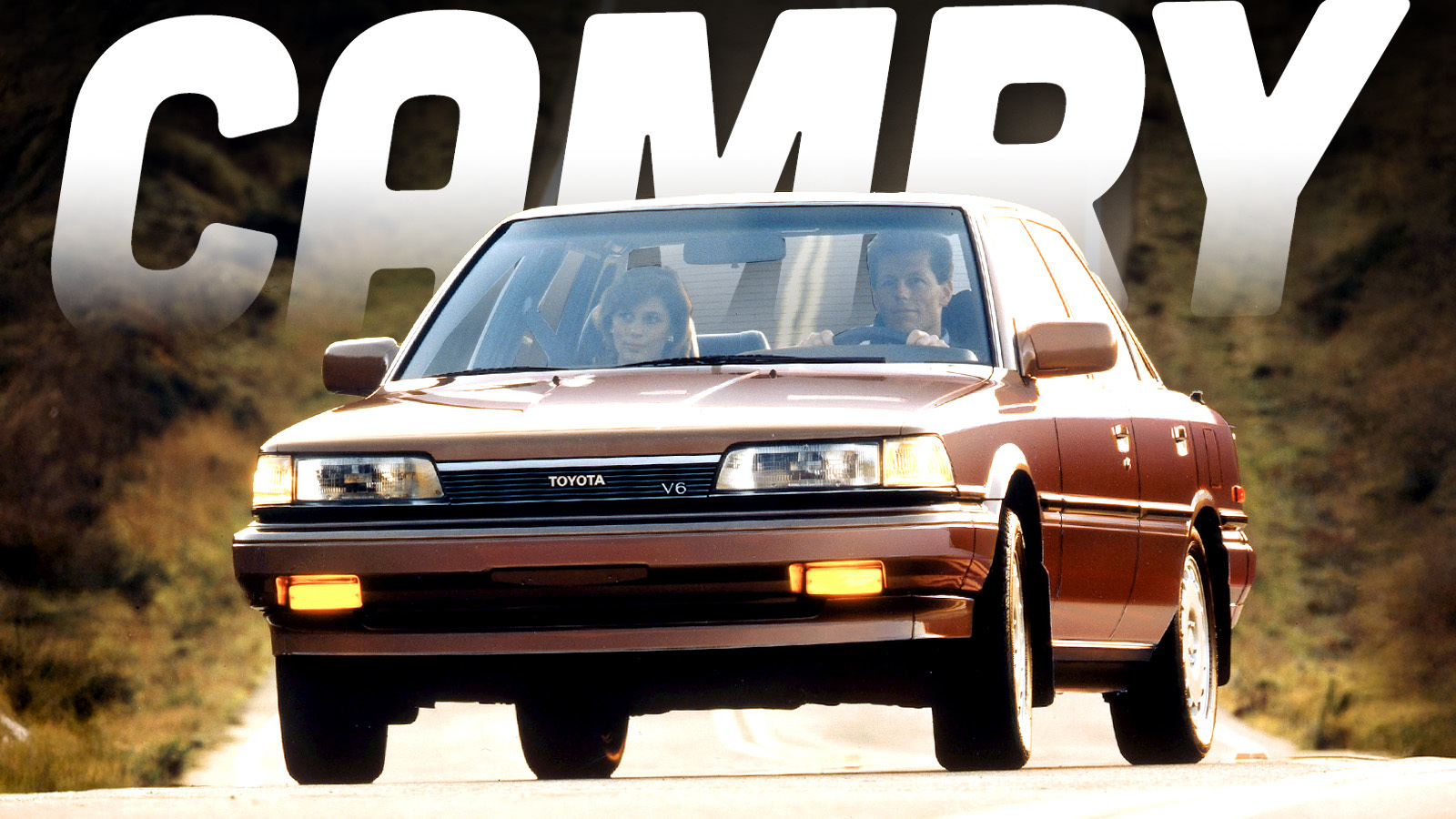
Long before SUVs and crossovers took over the streets of America, it was the sedan that ruled the country. In the 1980s, you couldn’t turn a corner on the average U.S. city block without seeing a Chevy Cavalier or a Ford Escort transporting a family of four. Four-door sedans and their wagon counterparts were the decade’s lifeblood.
Toyota was well aware of the sedan’s potential by the time the 1980s rolled along. In 1983, it launched the first Camry in the United States, following its rise as the number one import brand in the United States in 1975, surpassing Volkswagen. While it sold well, the Camry wouldn’t really hit its stride until the second-generation car’s arrival in 1986.


Seeing the possibilities the American market had to offer, Toyota smartly designed the second-generation Camry, internally designated the V20, to cater first and foremost to U.S. buyers. It had to be comfortable, spacious, relatively quick, and economical—all for a price consumers wouldn’t balk at.
Seichi Yamauchi had a gargantuan task on his hands. The Japanese designer, who was head of the Toyota design arm, is best known for his work on the first-generation MR2 sports car. This time, he had to take on one of Toyota’s most important products, one that would define the brand for decades to come.
Designed With America In Mind

This is what Yamauchi came up with. While the V20’s wheelbase remained the same—102.4 inches—the body was longer and wider than before, and more trunk space was added. The car retained its “three-box” bodystyle, but with a slightly more curvaceous front end, both for modernity’s sake and to improve aerodynamics (it got a drag coefficient of 0.34, according to Car and Driver). The roof was lowered by half an inch, too. It was shaped more like an American car than anything from Japan, which was exactly Toyota’s goal. The company wanted to meet consumers where they were. And they were in cars like the Chevy Cavalier and the Celebrity—the best-selling cars in America in 1985 and 1986, respectively.
To capitalize best on every avenue of the American buyer’s tastes, Toyota also introduced a wagon version of the Camry for the first time. Yes, there was once a time when wagons were so popular that manufacturers would design them specifically for the U.S. market—something I can only dream of now. Design-wise, the station wagon was near-identical to the sedan, save for the extended roof, the extra pillar, and the new glass.

Inside, the Camry was simple and analog done right. There was nothing mindblowing about the four-pod gauge cluster, the climate control, or the radio. Everything used real, physical buttons, and took no time at all to figure out. It was just easy to use, which is exactly what the average American buyer desired at the time. Remember, the first-gen Camry was already a success, and Toyota didn’t want to mess with the formula too much. If I time-traveled to a Toyota dealer back in ’87, I’d probably get the Deluxe edition just to have the fancy blue fabric. Though I’d miss stuff like the power windows, power door locks, and better stereo found in the LE trim.
No matter which trim you went for, your V20 Camry came standard with four-wheel independent suspension, held up by coil springs and struts at all four corners, with anti-roll bars at either end. The base car got ventilated disc brakes up front and drums in the rear. If you wanted more stopping power, going up to a higher trim got you discs out back, too.
It Was No Slouch Either

Buyers in America and buyers in Japan have different ideas about what “power” really means in a car. Toyota couldn’t just bring over a tiny engine from its Japanese-market sedans and call it a day here. So, in addition to the base 1.8-liter engine, came the 3S-FE. The twin-overhead cam 2.0-liter four-cylinder shared some of its design with the 3S-GE found in the Celica GT-S. It had double the valves of its predecessor (16 versus eight), and could rev to 6,000 rpm. The engine was rated at 115 horsepower at 5,200 rpm, 20 more than the 1.8-liter in the previous Camry. Torque climbed slightly, too, from 118 pound-feet to 125 lb-ft at 4,400 rpm.
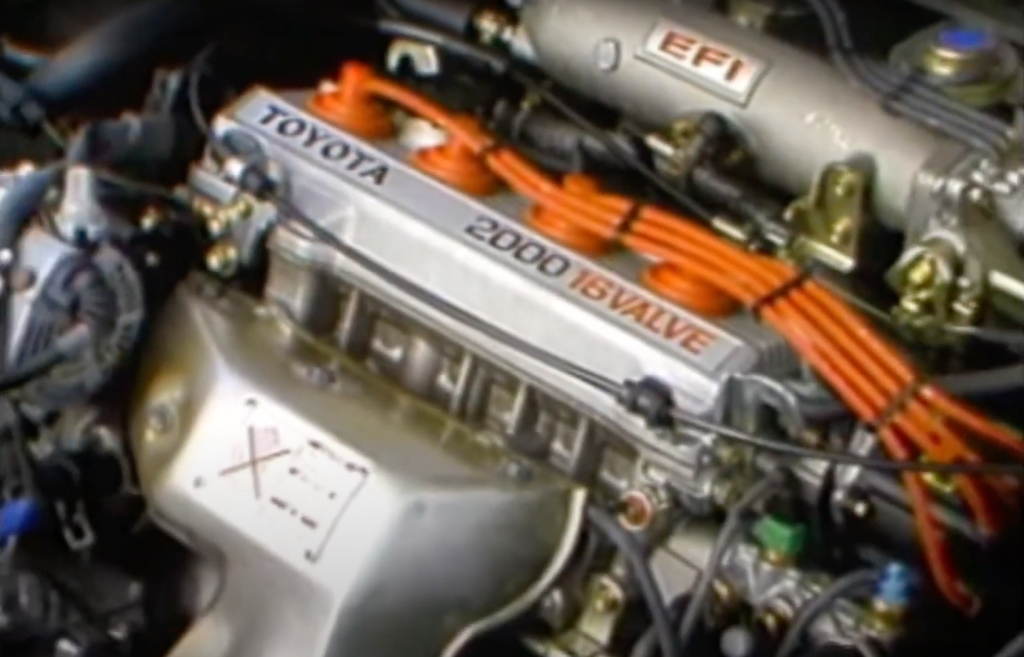
There were two transmissions available with the V20 Camry at launch: A base five-speed manual and a three-speed automatic with overdrive. Weirdly, you couldn’t get the stick with the LE trim. That means if you wanted a manual, you’d have to make do with the lesser stereo and manual door locks. Boo!
Toyota’s intent to take over the sedan market didn’t stop with the Camry’s new design. The company was entirely committed to the car’s long-term success in America, opening a factory in Georgetown, Kentucky to build the car—the first such facility wholly owned by Toyota in the U.S. The first vehicle to roll off the line in 1988 at Toyota Motor Manufacturing Kentucky was a white Camry. The facility has since expanded and can produce 550,000 vehicles and over 600,000 engines every year, and it built its 10 millionth car back in 2014.
Americans love choice, and Toyota made sure to give buyers plenty of it with the V20. In addition to the two body styles, Toyota also introduced a 2.5-liter V6 engine—the first for any Camry—in 1988. Though it wasn’t directly marketed as a performance engine, the 24-valve mill made 153 hp and 155 lb-ft of torque, making it the most powerful engine ever offered in the car.
Toyota brought in the V6 as a response to the Ford Taurus SHO and its Yamaha-designed engine—at least according to The Man Himself, John Davis of MotorWeek. The publication reviewed the V6 Camry back when it was new, and seemed to really enjoy it. Please focus on the car and not the way Davis pronounces Camry (or as he likes to say, Cam-ray).
That same year, Toyota introduced another first for the Camry: All-wheel drive. The V20 was the first generation to receive the company’s All-Trac system, which made its debut on the Celica that same year. It uses a locking center differential—the type of thing you’d normally only see on off-road-focused trucks and SUVs, even today.
Though it sounds like something that should’ve been a hit, the All-Trac Camry died after the ’91 model year, and an all-wheel drive Camry wouldn’t return to the market until Toyota added it back as an option for the 2020 model year. Like many of these ’80s and ’90s AWD cars, it was simply too far ahead of its time. Having owned a similar type of car—a 1988 BMW 325iX—I’ll always wonder why buyers were hesitant to hop on the all-wheel drive bandwagon for so long.

All of these innovations for the Camry nameplate resulted in heaps of sales. On its introduction in 1987, Toyota sold 186,623 Camrys—the most ever in the United States. Sales jumped even further from there. In 1988, dealers moved 225,322 Camrys. And in ’89, Camry sales crossed the quarter-million mark, coming in at 255,252 units. By the end of its lifecycle in 1991, Toyota had sold over 1.2 million V20s. The car was widely perceived as solid, reliable transportation, with an economical engine and an affordable price tag. The pivot towards American tastes was a resounding success.
It Was A Hit, But It Wasn’t American Enough
At least, it was a success compared to the first-gen Camry. The V20’s sales cemented Toyota as a major player in the American market, but it still faced stiff competition. The second-generation Camry was never the best-selling car in America when it was new. In 1987 and 1988, it was bested by both the Ford Escort and the Ford Taurus. Then, in 1989, the Camry’s sworn enemy, the Honda Accord, took the crown for best-selling car in America, with 362,797 units sold.

The Camry might’ve had the Honda beat if it weren’t for the Accord’s three available body styles. Unlike the Toyota, which came in just sedan and wagon shapes, Honda sold an Accord coupe, an Accord sedan, and an Accord hatchback. This was a time when coupes were still making up a not-insignificant portion of car sales in America, so it mattered.
The battle for sedan supremacy only got hotter as the ’90s rolled in. The Accord would receive a major update for the 1990 model year, resulting in a sales surge and two more years as the top-selling car in America. Ford, seeing its sales crown slip away, would respond with the second-generation Taurus. That car topped the board for four straight years.
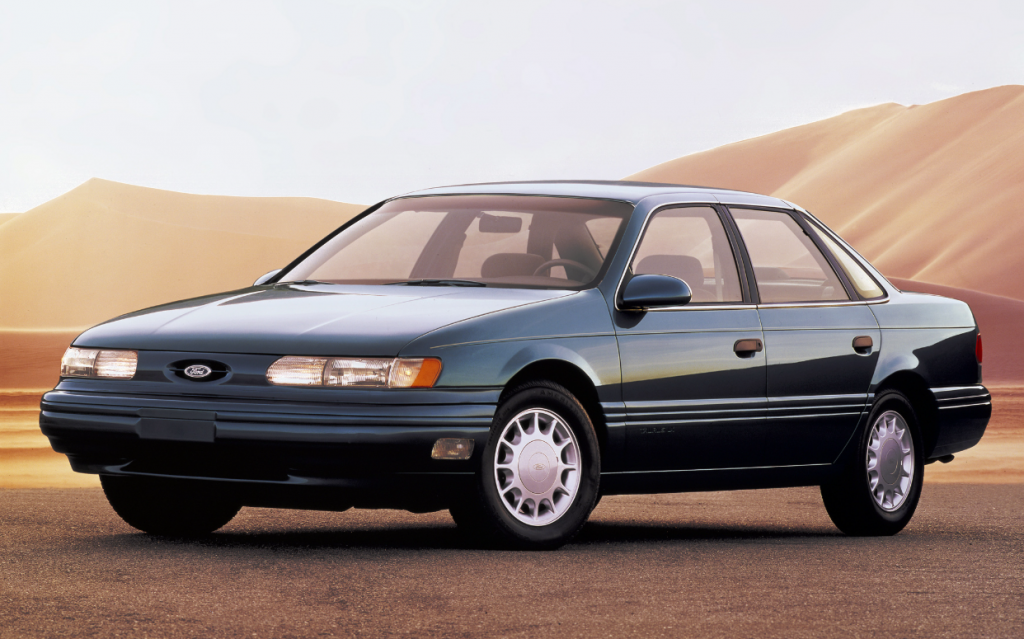
Toyota’s success with the V20 was the catalyst for ensuring future Camrys would have success. Its replacement, codenamed the XV10, had to be even more Americanized—something that then vice president of sales Bob McCurry told Toyota directly. Automotive News published a retrospective of the third-gen Camry back in 2007 that sums up Toyota North America’s demands succinctly:
It was 1989, a year after the first-generation Camry had gone into production in Georgetown, Ky., and just before the Lexus brand was to launch. The Japanese executives were confident about their performance in the United States to that point — but then they had to face some tough talk from their top U.S. executive.
McCurry wanted a vehicle suited to American tastes, not the traditional low-key Japan-sized model he saw in the designs. There is no explicit record of what the Japanese had to say about McCurry’s forceful way of making demands — a dramatic departure from the way things typically were done in Japan. Yoshio Ishizaka, senior vice president and chief coordinating officer of Toyota Motor Sales U.S.A. at the time, says only: “Some were very much offended by McCurry’s comments. Americans like a big car. Always, American opinion is the bigger, the better. That’s a very simplified argument.”
Toyota’s then-head of R&D Akihiro Wada reflected on the struggles to achieve the high demands needed to make the car competitive.
“It was too narrow and not suited for the United States,” he says. “The engineering problem was the cradle, or engine bay, holding the motor. For America, we had to cut it in half and widen it. The chief engineer proposed some very difficult designs. I made lots of comments.”
It was not a matter of not understanding what the Americans wanted, according to Wada. “All chief engineers understand American tastes,” he says. “Americans are very frank. But the engineering to meet those tastes was very difficult.”
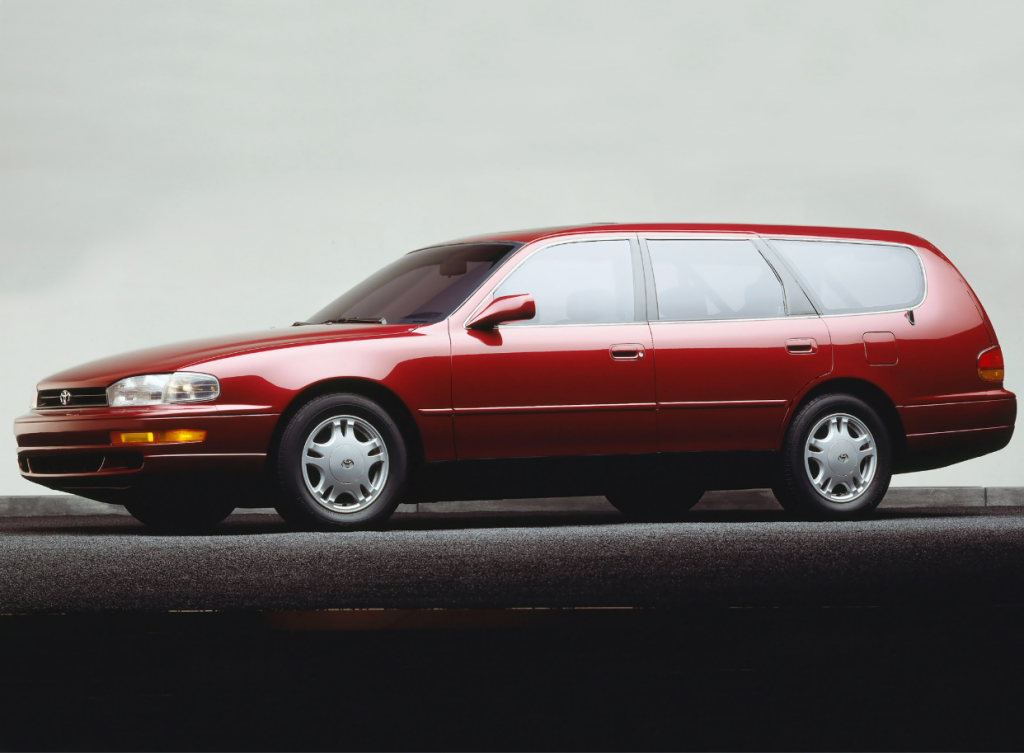
The result was a car more American than Japanese. It was two inches wider and six inches longer. The engine, now 2.2 liters, made 130 horsepower. The V6 was still an available option, now making 185 horsepower. It could even break the 0-60 barrier in under eight seconds, according to Automotive News. It wasn’t an immediate dominator—like I said before, the Taurus was eating every competitor for lunch in the early ’90s. But like the V20, it helped Toyota encroach on the segment and claw more market share year after year.
Then, in 1997, it finally happened for Toyota. The VX20 Camry, the VX10’s successor, took the sales crown in America, with 397,156 units sold. The ubiquitous sedan gripped that trophy tight and never looked back, taking the sales crown for cars for the next 25 of 26 years (the Accord briefly took the top spot back in 2001, before relinquishing it back to Toyota the next year). The Camry’s streak was broken unceremoniously in 2024 by its own stablemate, the RAV4 crossover, which sold 475,193 units despite being in its last year of its lifecycle.

That quarter-century of domination can be traced back to the V20’s mainstream success in the late ’80s and early ’90s market. Without that car, Toyota would’ve been several steps behind the competition for years. It took those learnings and smartly applied them to the VX10 and eventually the VX20. From there, sales skyrocketed.
The next 25 years of Camry sales probably won’t look like the last 25 years, but the V20 will always be remembered for being the foundation of Toyota’s reputation for steadfast, reliable, affordable, A-to-B transportation. Next time you see one on the road, remember that.
Support our mission of championing car culture by becoming an Official Autopian Member.
Top photo: Toyota




If John Davis pronounces Camry as “Cam-ray”, I can only assume he pronounces Stingray as “Sting-ree”
There’s a Stingaree Restaurant and Marina on the Bolivar Peninsula, east of Galveston, TX. Does that help? My wife and I spent a few hours waiting for a flatbed tow truck after picking up a four-inch section of electrical conduit in the right rear run-flat tire on my wife’s BMW X5. No spare and not drivable. But they did have a pleasant outdoor bar.
That bodystyle of Accord actually had a fourth bodystyle in the US, a hatchback (which was actually the third style as the coupe was introduced later—and was so popular it was the first Honda imported from the US to Japan), and a fifth bodystyle internationally: the Aerodeck, which is more of a shooting brake style.
The pop-up headlights on these wear more eyeliner than JD Vance.
Our ’86 LX-i had the pop-up lights. I worried about them a bit, but they never failed. I don’t remember what happened when you tried to flash to pass in the daytime. I thought they looked better with “European” headlamps, but that wasn’t an option.
My dad’s friend had a brown v20 from 87 to the mid 2010s. He parked it outside in front of his house never did anything to it and it still almost looked new. Everytime I saw it I just couldn’t believe it. I think he had 450,000 miles on it without doing anything major. An old lady he knew gave him a 03 so he switched to that. My dad has a 96 an old lady gave him maybe 10 years ago. The paint isn’t great but other then that it’s in good condition although it suffered from a fram oil filter exploding but didn’t do anything to it. I have to think just about any other engine it would have been catastrophic.
Somebody should give that Cam Ray video the Diabeetus treatment.
https://www.youtube.com/watch?v=BME0639IP5g
My parents bought a maroon mostly base 89 after trading in their little Mazda hatchback. Only add on was AC because Texas. I learned to drive manual on that car and she became mine when I got to high school. Took so much abuse and was still running fine when my parents traded her in in 02 after I left for college.
Fun fact, the base model is so base that the 5 speed doesn’t come with a tach. I learned to shift based on sound and feel. Probably for the best that I don’t know what 17 year old me got the revs up to.
As a pedant, I will note the 4 cylinder XV10 made 135HP unless you were under the authoritarian CAFE regime.
You forgot to mention the short-lived Diesel engine in the mid 80s!
My grandfather owned an 86 brown Camry with a Diesel engine and a 5 speed.
That would be an amazing car to take to radwood
When I was about 10, my grandparents took us to Florida in it. Several times, he had to get gas in the big rig side of a truck stop, to have a trucker try to rescue him from accidentally pouring diesel into his car.
My dad had an 88 Camry Deluxe- Blue on Blue with a 5 speed manual. The car was an advertised special at the local Toyota dealer and he showed up when they opened to buy it- along with 5 other people. They made them draw straws to see who got it, and he won. I think he paid $8800 for the car brand new.
When I was a kid my Dad had a V10 and after using it to commute for a few years, traded it in for a V20 that I ended up with as a hand-me-down. I liked the V10 better, it was a better color (blue instead of white), didn’t have mouse belts, and the boxier lines made it look almost like a Volvo. My 1989 V20 got stolen because the key and cylinder were worn down to the point that you could open the doors and start it with any key-shaped object. It was one of the most stolen cars in the US for a while. I got it back about 18 months later when the cops raided a chop shop. My Alpine tape deck was gone so I reinstalled the factory AM/FM radio that was still in the trunk. I think the V20 was the last one that didn’t come standard with the “Camry Dent” on the fender.
Even back in 1987 you could spec out a dent for the corner of the rear bumper on the options sheet.
The Camry dent wasn’t a thing prior to the XV20.
The dumpster behind the H&M my dad worked for in the 00’s concurs.
Not the second gen with the base black bumper. That thing could take hits and look mostly fine. Port o Johns in my high school parking lot didn’t stand a chance.
My FIL dailied an ‘87 all the way until it got totaled a few years ago. Despite the damage he still wanted to get insurance to pay for the repairs so he could keep it on the road.
I could tell they absolutely did not want anything to do with that and actually offered him 10k as a payout. We still had to talk him into taking the money.
I had an acquaintance who was shopping a first gen (or maybe it was second). He wanted a solid reliable four seat sedan that would last him and be at least somewhat nice to drive. He told me he test drove a Camry and it died on the test drive. I never heard the reason, and I don’t think that irritated him that much. It was more to do with a dealer not vetting the car before putting it out for test. He was really quite enraged (he was a bit of a Karen).
He ended up buying a first gen Maxima that I think lasted him at least ten years. He loved it. He was afraid that RWD wouldn’t be a good idea in snow country, but he didn’t ever seem to have any issues.
The older I get the better the 1980s / 1990s cars seem. Single DIN radio, three knob or two lever HVAC. Enough power to run the speed limit. Cold air. They lasted forever if the rust was kept away. And so forth.
I guess that is a long winded way to say that sometimes an automotive appliance is the answer. My garages are still full of project cars that I would never drive daily that are far, far more interesting. I don’t want to wrench on my daily drivers any more than is necessary. Life’s curveballs means I need a car or two that will just go when and where I need them in all weather w/o drama. We’re accomplishing that with a used EV and an an eleven year old Honda product.
We went the 1986/1987 Accord route (her and his) instead of the Camry route with excellent service. Followed that with a 1st gen CRV that we drove for 25+ years.
Toyota didn’t invent the 3 box family sedan, but they made the best version of it with the Camry. You see that a lot from Toyota. They don’t invent a market, but they’ll study what’s already there and come in with something better.
My fleet is now 100% Toyota, all at a minimum 10 yrs old and 135k. If you are going to buy (not lease) and run forever there is nothing better. I’ve owned Honda/Acura and they tend to rust faster in my climate and just don’t hold up as well.
Accord rocker panels just can’t seem to last around here. You see them rotted out on 10 year old Accords here all the time.
You do pay for the longevity.
And certain years have more problems than others. Some Camry models did have oil consumption issues.
I would say one area which I am impressed is the fuel efficiency for sure.
This is the car that convinced my Dad to switch off buying American.
So good that we bought another for mom. Only Toyotas and Hondas since.
Same with my Dad. Except with the XV20.
You know how you convert a person who loves cars into falling in love with a beige Camry? Have them deal with a 1996 Dodge Stratus for a few years. My parents, who had owned primarily American cars up to that point, haven’t owned a single American car since.
They were shocked and appalled when they heard that I bought a Chrysler van.
My dad still for some reason only buys GM’s. Despite having driven some of the Japanese and Korean cars I’ve had and commenting on how much easier they are to deal with, yet he hasn’t learned.
A nice car, no doubt, but the only correct choice during the late 80s was the 3rd gen CA Accord… because, pop-up headlights.
This…
Helped a college pal look at used cars (1996 or so). Came down to an ’88 Escort or an ’86 Accord with flip up headlights. I said – go with the Honda. Not sorry. The car never gave him a hint of problem.
Keep in mind these early Camrys and Accords are smaller than a modern Corolla. The VC30 was about Gen1 Taurus sized, they have only grown since then. I recall hearing the VC30 track was too wide to fit Japanese production lines at the time and was thus US built.
I thought the first Japanese auto plant in the US was Honda Marysville OH in 1982?
Georgetown was the first Toyota plant (unless you count NUMMI, which opened in ’84 as a 50-50 Toyota/GM joint venture, though Toyota was the managing partner in it)
When I first met her, my future ex-wife was driving one of these, maybe an ’89 or ’90 model. It was SO base that it didn’t even have air conditioning. She claimed to have bought it for $10k brand new, because it sat on the lot for a year owing to the lack of A/C.
She was too ignorant or cheap or lazy to ever get the timing belt replaced, and the thing kept going. She handed it down to her son, who took it to 180k, still on the original timing belt. I don’t remember what ultimately caused its demise, but it wasn’t the timing belt.
For me I think it was the USED Camry business that created the 2.5 decade dominance. In the 80’s and 90’s, people who just wanted an affordable car to get themselves and their family places bought a 3+ year old Camry. Its legacy as reliable, safe with affordable insurance, maintenance and financing meant that when people were able to buy something new, Camry popped up on list front and center. The cycle repeated to next generation until tastes changed to SUVs. Then the RAV4 stepped right up.
TIL there was an All-Trac Camry. Huh. Nice.
A friend at work has one. You can’t tell except for the All-Trac badge on the back. It’s pretty cool.
I think some of that generation also had diesels from the factory…
Toyota pitched a hi-po version of the All-Trac to the California Highway Patrol as well.
There was a few unicorn all-trac manual wagons around as well.
It was unbearably slow, I got to try one in the late 90s and it was like being in a non turbo diesel benz.
Punch it, Margaret!
https://www.youtube.com/watch?v=kPjFoK4HOsw
Forgot that. It was my go to comment with the boss (wife) for years.
She drove like a blue haired old bag, even at age 22.
Made me nuts but she never got a ticket, or accident, or even a warning in 46 years.
Apparently I said it as a small child as my great aunt was accelerating onto a highway and she was laughing so hard it was nearly dangerous.
Appreciated the laugh on this Monday. Gracias.
Heck yeah! Mandatory.
Ha just last week I saw a ridiculously clean low trim level (black unpainted bumper) example of one of these – I even took a photo. Never thought one of these would attract my attention, but I hadn’t seen an example so clean in a long time.
The VX20 was basically the nicest Chevy ever made. Pretty much the perfect car for the typical American who did not give a crap about cars. And a whole lot more cheaply built than the previous couple of generations, while being a whole lot bigger and softer. Perfect, obviously! I bought a low mileage minty condition 20yr old one for my elderly mother, an ’01 LE V6, and it was a good enough car if you aren’t into cars. I found it hateful to drive, but she liked it. Drowned in hurricane Ian, sadly.
That’s a VX30, arguably the first true Americanized version. Size of a Gen1 Taurus and more efficient/reliable.
Yup, missed one – thanks! The most perfectly boring car ever made.
And they sold a billion of them for exactly that reason – they made a better Buick.
When my Chrysler 300M died, I bought a used VX40… and cruised 75 miles a day with no issue and low fuel costs.
I think the VX20 went through the ’01 model year. The VX30 began with the ’02 model year.
Now that car, while admittedly being a perfectly nice sedan, was the very peak of Camry boring. Things started to get a little cheapy starting with the VX40, when Toyota started to cut costs on interior materials.
We had a VX30 in the family for 17 years. It was a car you drove while almost ignoring it because it was so reliable and so boring. They have known problem areas but none that have “of death” as part of the description.
As Tbird stated above, they basically Out-Buicked Buick with that Camry. There’s a lot of teenagers driving these Camrys, and I’d bet half of them inherited them from grandparents.
Durable, economical, comfortable, spacious. What more do you need? I’m not setting lap times (although the rear drum models were under braked when loaded). Looks nearly as good at 10 yrs old as new. Hard wearing fabrics and materials. Durable paint.
Came in here to comment on the irony of the VX20 finally becoming the top-selling sedan in the US, right when Toyota stopped trying. To my eyes the VX20 was a major downgrade from the VX10, and from that point the Camry would not be class-leading (in any category save fuel economy) ever again.
But it is still *exactly* what the average American sedan buyer wants. It’s bigish, it’s cheap (to buy and to run), and it’s reliable. They don’t really care about anything else than that, and making it “nicer” just makes it more expensive. If you want nicer, buy the Lexus version. I assume they still make the one that is more-or-less a fancy Camry? Or has it grown into being a fancy Avalon?
But the average American can buy an Accord for the same price, and get a better car. The same as it’s been since…uhh, forever? I guess I just don’t understand car buyers, is what I’m saying.
Are Accords “better” (in the perception of the average not a car person)? They don’t ride as squishy, they are louder, and in reality they were usually more expensive as until the Pandemic Toyota discounted Camrys pretty deeply. And I would argue that while Accords are “reliable”, Camrys are better there too – especially given that Camry V6s never ate transmissions. Gun to my head to buy one or the other, I would certainly buy the Honda too – but I think the Camry being more Buick-like is a feature, not a bug, to those people.
Hondas are always a little louder (the most unnecessary & solvable problem in the automotive world), but the Camry has a cheaper interior and just feels “tinny” overall. Yes, even the latest models — I was so disappointed when I checked them out at the auto show.
Honestly, with their naff interiors and iffy ride quality, I sometimes wonder how any Toyota survives being cross-shopped against any competitor. Then I remember that there is a whole generation of buyers who don’t cross-shop, they just head to the Toyota dealer like robots. But I think that’s finally starting to change with younger buyers.
I have driven many multiple examples of Camrys (and Accords, if not as many) going back to the mid-90s due to my constant work travel. Meh, they are what they are and the buyers don’t care. The Accord is “slightly” better from an enthusiast perspective, but the reality is as an enthusiast I have zero interest in owning either one. Far MORE interesting things out there for the same money.
Based on friends and family who have actually OWNED both, I would buy a Camry over an Accord every time though, gun to my head. Hondas are NOT as reliable in the real world as reputation would have you think (especially if you live in road-salt land), but Camrys actually are really good. Just also really, really, really dull.
“I’ll always wonder why buyers were hesitant to hop on the all-wheel drive bandwagon for so long.”
Because cost and complexity – and very frequently AWD would only be available with the smaller engine rather than the available V6.
I briefly sold Toyotas in 1993 after the new XV10 Camrys had been on the market here for a year. Those were solid, reliable cars – with materials and build quality which rivaled Mercedes-Benz.
The XV10 Camry was a genuinely really, really nice car. It looked fine enough on the outside, but it was the interior of the XV10 and XV20 that made everyone trash their various GMs. These cars rode well, were bank vault quiet inside, everything felt pretty nice and nothing rattled.
They also never broke, which was nice.
Hard to believe they were mid-size at the time. They are dwarfed by a modern Corolla.
College friend had an old ’82 Cressida, then an ’88 Legend. These cars shook me to my domestic raised core. The build quality, engineering, servicability, were leaps and bounds over everything else I had driven to that point.
Third. Everything you said.!!! I worked at 1 of the big 3. I blew their minds when I pulled up in a Civic Si and later a Sentra SE-R. I knew I wouldnt last long.
The original Taurus/Sable may have come closest to the standard the Japanese makers were setting. My current fleet is all Toyota.
Toyota needs to bring back a RWD Cressida. Too bad the suits would want it to be a Lexus.
That was the Fwd Avalon ’till discontinuation.
Add in the various Nissan, Honda and other Toyota product I worked on (I had a fully equipped tool set, jack, and stands. I did auto repair for beer money during college). I did oil changes, brakes, basic tuneups, and other…. leaf springs, sway bar links, lock acuators, window regulators….
AWD screws you three ways – costs more to buy, costs more to maintain/fix, and costs more in gas. And except in a very, very small number of use cases, is all but completely unnecessary in the real world for not-offroad vehicle. You don’t need AWD, you need the correct tires on the damned car. And you need the brains to know when not to go out on the road in the first place (or how to control your right foot for more performance-oriented cars), lest some less well-prepared idiot slide into you. BTDT, got to fix my snow-tire-shod AWD Jeep after an imbecile in a Subaru on thin all-seasons nailed me in a snow storm when I should have just stayed home. He could GO, but he couldn’t STOP.
The most ridiculous AWD cars:
Mercedes-Benz E (now CLE) Convertibles.
Followed by the discontinued S-Class convertibles and current AMG-SLs.
There is 100% zero need for these cars to be AWD.
I actually had no idea they offered the convertibles in AWD. Though BMW offered the 3-series convertibles that way, so I guess I should not be surprised.
The second gen Camry also offered a sweet looking digital gauge package.