


Did you know my dad was born and raised in Havana? It’s true. I’m technically half-Cuban. But even if my dad didn’t spend his childhood years tromping around Havana and eating sugar cane right out of the fields, I’d still be fascinated by Cuba’s car culture, as it dovetails so well with my own preferences: weird old crapboxes, kept barely running with wire, scraps, and wildly clever acts of improvisation. There’s a really impressive act of Cuban vehicular improvisation that’s getting attention now, and it’s one that’s both a very reasonable response to a looming crisis, and one that pulls from a long history of people making the best with what they have.
Fundamentally, it’s about a man converting his Polski Fiat 126 to run on charcoal.


Well, more accurately, he converted the little rear-engined Fiat to run on something variously known as woodgas or producer gas, which is a melange of (in descending order) nitrogen, carbon monoxide, hydrogen, carbon dioxide, methane, and oxygen. Of those gases, two are actually combustible in an internal combustion engine, and one helps make combustion happen, so it’s not exactly a power-dense fuel, but when you don’t have access to gasoline, it’s much better than nothing.
It’s exactly that sort of situation – better than nothing – where woodgas generators thrive. That would include the current situation in Cuba, which is under a United States-led oil blockade, and, perhaps most famously, situations like World War II, which is when woodgas-converted vehicles experienced their biggest heyday.

You may have seen pictures like the one above of a wood-gasifier-equipped Volkswagen from WWII, and there were thousands and thousands of other such converted vehicles all across Europe, including machines like tractors and city buses.

Wood gasification equipment is cumbersome and bulky, requiring big hoppers to store the fuel, whether it’s wood chips or charcoal or similar sorts of solid stock, and then vessels to “cook” the fuel in low-oxygen conditions to extract the combustible gases, and all of the required plumbing and filtering and cooling systems that are associated with getting the fuel to the engine to burn.
Considering how clunky all this is, essentially building a tiny fuel refinery into your car, it’s kind of amazing how elegant some conversions managed to be, like this 1938 Citroën 11:

The use of woodgas or producer gas for operating vehicles has always been a sort of viable last-resort, with organizations like the Federal Emergency Management Agency (FEMA) even publishing conversion guides as recently as 1989, which could help people convert vehicles in the event of an extended fuel supply emergency.

Let’s get back to our resourceful Cuban inventor who is making this old but reliable technology relevant again. His name is Juan Carlos Pino, he’s 56 and lives in the small town of Aguacate. Frustrated by the oil blockade making fuel expensive and rare, he adapted his 1980 Polski Fiat to use a wood gasifier, and the little car’s 652cc inline-twin now burns that fuel. Woodgas is not exactly a performance fuel, so it’s unlikely the Fiat is still making its original ravenous 24 horsepower as it did on gasoline, but, and this is what matters, it’s still self-propelled.

Here’s a good video about the project:
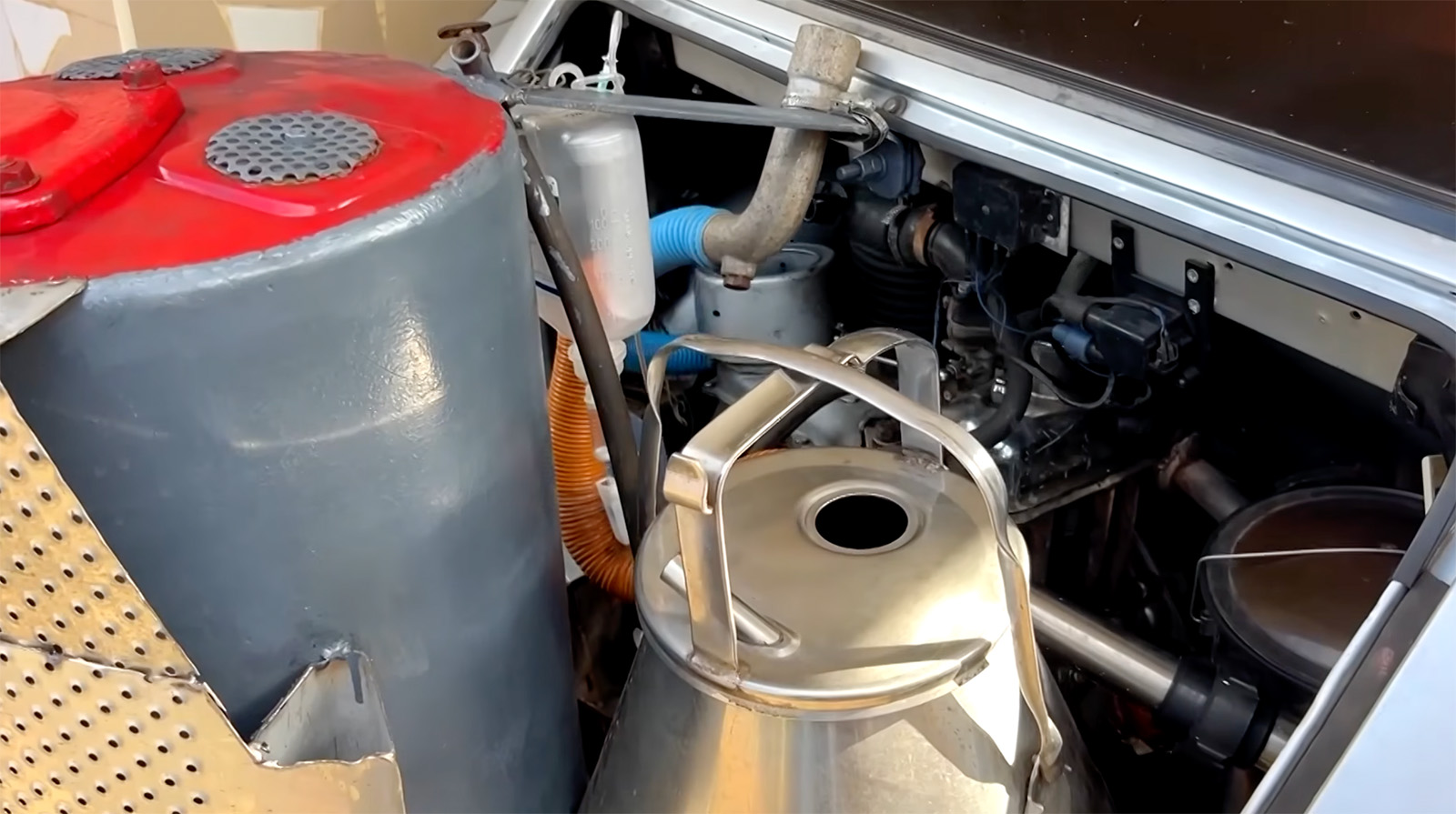
As you can see, the equipment to make this work is bulky and takes up a lot of room on the car; Pino has done a good job of integrating the major components, with the large filter (made from a milk jug and full of old clothes) and the cylindrical burner/hopper (made from an old propane tank) all hang off the back, making the plumbing to the rear engine nice and short.
I’d also like to point out that Pino’s Fiat seems to be in very good condition overall; he also seems to have done some tasteful customizations on the inside, making what looks to be a nice wood-accented dashboard, and it’s worth noting that the seats and headliner are in excellent shape. This is a nice little 126!

It’s not clear if the underhood trunk area has been used for any gas cooling or other needs, but I don’t see any plumbing coming from there, suggesting that all of the equipment for the conversion is hanging off the back there.

I’m also curious about those window stickers that look like the Apple logo stickers you get with an iPhone or Macbook; you can see them on the rear side window here:

They have little symbols on them, and a star above; is that some Cuban thing?
It’s really one of the tidiest and most compact gasifier setups I’ve seen; just to compare, here’s another homebuilt woodgas conversion on a Ford truck:
Sure, that’s a much bigger vehicle with a whole truck bed to use, but it’s still impressive how compact Pino’s setup is. Pino’s neighbors people who see the Fiat roaming around town are very impressed. He took it on a roughly 50 mile test run and achieved speeds of about 45 mph at the peak, which, considering that the other option is not moving, is great.

I’ll be curious to see if these conversions become more common as the lack of fuel continues; it’s not unprecedented to think vehicles could start being converted on larger scales. There’s at least one contemporary example of a country that still makes extensive use of woodgas vehicles to this day, North Korea, where it’s often used to power rural trucks and farm equipment.
Pino’s conversion is a smart response to a difficult situation. He’s adapting his car to make do with what he actually has available, and as a result can still drive, perhaps a bit slower and with a loss of convenience, but he’s still driving, and that’s what matters.
Top graphic images: YouTube; DepositPhotos.com



I love and appreciate Cuban industriousness when it comes to keeping older cars going no matter what. I’ve seen this Youtube video about Pino lately, but haven’t watched it yet, and of course I’ve seen some about North Korean trucks that are wood fired.
Now, if only someone would manage to get a small car to run on the ‘pull’ of a few enthusiastic French Bulldogs (internally, not harnessed in front of the car ala Santa’s reindeer) that’d really be something. 😉
I wonder if another alternative they could possibly use given the climate of down there would be sugarcane like the Brazilians do, as I would think doing an ethanol conversion would be a little easier to do then building a wood gas conversion
The thing is it really isn’t much of a conversion, the engine doesn’t need to be modified. (well an old one, I can’t imagine a computer controlled engine would be happy) You can make the gasifier out of old stove parts and other scrap, it’s a lot harder to get different fuel system components.
Oh sure, between new seals and gaskets that are ethanol rated, and making new jets in carbs to flow more fuel, i feel they as a ever crafty country that can make something out of scraps and determination could do it.
Fuel injected cars would be a bit of a trickier ordeal, but not insurmountable
One thing LeMons has taught me is that fuel injected cars can definitely be hacked to run off a carburetor, at least for a little while.
Ohh absolutely, just have to figure out how to regulate pressure from 50 to 5.
Ive joked in the end of times when we all go to the stone age, there will be a cottage industry of retrofitting carbs and distributors to cars.
I worked in Hialeah for several years where there are more Cubans than Cuba it seems and the amount of shit I’ve seen fixed with only a hammer is too many to count. Think of the movie trope of the crazy Russian that just hit things and they work again is basically every Cuban I’ve ever met. The Cuban people are nothing if not resourceful and it really made me reflect on how wasteful I am. A big reason why I try to repair before replacing is because of that time in my life.
Just a point of clarification, wood gas generators do not run on charcoal. They specifically run on wood, which still contains the hydrogen and oxygen necessary to produce combustible gasses. Charcoal is what’s left after all these volatile components have been baked off, leaving behind (ideally) pure carbon.
Unrelated to pedantry, the embargo is killing people right now through things like hospital shutdowns and is one more stain on a government that is currently 99% stains. I am ashamed and anyone who can stop them is enthusiastically invited to do so.
Seems like a useful thing for a farm to use waste to fuel a generator.