

If you’ve ever driven on one of America’s many highways, you’ve certainly seen a speed limit sign before. But some of these highways also have another number under the posted speed limit, labeled “minimum” or “minimum speed.”
As you can probably guess, this number dictates the slowest speed a vehicle is allowed to travel on the roadway. Speed minimums aren’t just there to keep slow pokes from holding up traffic; they’re usually implemented for safety reasons. It’d be bad to have an overloaded tractor-trailer going 20 mph alongside a new passenger car going 80 mph on the same road—it’s those sorts of speed differentials that can cause catastrophic wrecks.


It’s this increasing speed differential that has lawmakers in Georgia looking at whether to hike the minimum speed limit on its highways through a new bill that would raise the lowest speed drivers can legally travel by a full 10 mph. If it passes, you and your old, 30-horsepower Citroën might have to take the back roads instead.
The Specifics Behind Speed Minimums
The U.S. Department of Transportation’s Federal Highway Administration has some specific rules about speed minimums. It specifies that minimums aren’t necessary, but when they are used, they’re displayed in a particular fashion:
Where engineering judgment determines that slow speeds on a highway might impede the normal and reasonable movement of traffic, the Minimum Speed Limit sign may be installed below a Speed Limit (R2-1) sign to indicate the minimum legal speed. If desired, these two signs may be combined on the R2-4a sign (see Figure 2B-3).
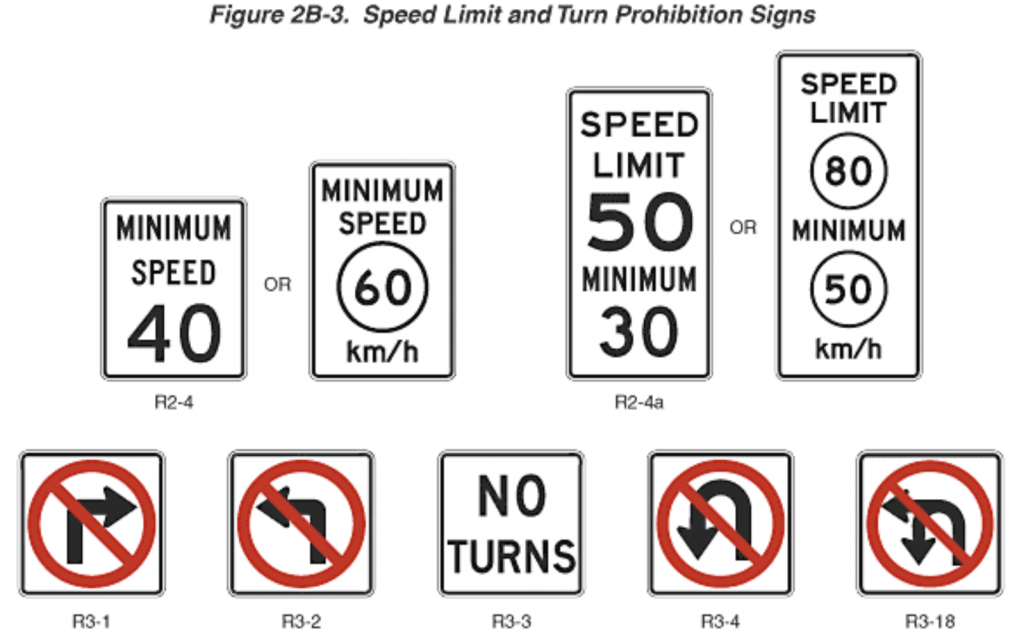
So as the FHA explains, you’ll never see a minimum speed sign on its own. It’ll always be accompanied by a speed limit sign, either directly over it as two separate signs, or as a combination sign (top right). This makes sense—if I saw a minimum speed sign after I entered a highway and nothing else, the only thing I’d be wondering is what the maximum speed was. Thanks to the combo, I know the exact region on my speedometer within which I need to be cruising.
Here’s What’s Happening In Georgia
The state of Georgia has maintained a minimum speed limit of 40 mph for its highways for decades. That minimum was enacted back when the speed limit was just 55 mph, though. Over the years, the maximum speed has increased to 70 mph on some highways. Yet the 40 mph minimum hasn’t increased to keep the speed delta constant.
House Bill 809 is an attempt to tighten that delta. It proposes increasing the minimum speed to 50 mph on any part of a Georgia highway “with a speed limit of 65 miles per hour or greater.” In a sense, it’s a law that would actually encourage people to drive faster—but only if you’re going really slowly.
The bill is sponsored by Republican state representative John Carson and was initially proposed by Colonel William Hitchens, the commissioner for Georgia’s Department of Public Safety, according to Georgia-based nonprofit news service Capitol-Beat.org:
Col. William Hitchens, commissioner of the Georgia Department of Public Safety, said Georgia State Patrol officers have seen significant damage and injuries involving slow-moving vehicles.
“Driving below the speed limit can, in some cases, be as dangerous as traveling above the posted speed limit,” Hitchens wrote in a letter last month to Carson about his proposal. “Vehicles that are traveling below the minimum speed can cause traffic issues such as long backups and cause motorists to take evasive actions due to approaching the vehicle faster than expected.”

Not everyone is a fan of the bill. Capitol Beat also spoke with Democratic state representative Rhonda Taylor, who voiced her concerns for drivers who might not be able to negotiate the higher speeds.
Senior citizens and student drivers might struggle with a higher minimum speed limit, said state Rep. Rhonda Taylor, D-Conyers.
“It would be a better solution … (to) move to the right,” Taylor said. “It almost feel like I’m being penalized because I can’t drive 50 miles an hour.”
Currently, people who break the law can be fined up to $1,000 and be issued three points on their license, according to the Georgia Department of Driver Services. According to local news affiliate WABE, local jurisdictions usually carry a much lower fine, between $100 and $200. If House Bill 809 passes and the minimum goes up, that won’t change. My advice? If you have a slow car, just take the scenic route. You’ll have more fun, anyway.
Top graphic image: DepositPhotos.com




My uncle was once pulled over on the highway for going too slow. Wasn’t even given a warning, straight ticket. He will hate this news as he is never in a rush to get anywhere
Significant part of the problem is the number of vehicles exceeding the posted speed limit by more than 10 mph. The speed differential is on both ends. A higher percentage of people driving in a 70 mph zone are going >80 than those going <60.
If you really need to drive like it’s a race… rent track time.
No, anybody who has the misfortune of sharing the road with you is penalized at your (or, much less likely, your car’s) inability to achieve a safe speed. I nearly wrecked many years ago outside D.C. because some poo-brain thought it would be a good idea to operate a matte black car with no exterior lights at 40 MPH at dusk in the passing lane.
If those slow drivers used their hazard lights, does that make them legal?
I have a buddy who totaled his car when the car in front of him on the highway zipped over when the car in front was still well below the 70mph speed limit. He says the car he rear-ended looked like someone was living in it. Clothes and food packed to the windows.
In any case, speed differential is a hazard, and for every freeway, there is usually a highway or two that will get you there easily-enough.
Edit: Does Nav have a “no highways” option?
Can we please focus on the important part? The header photo is implying that one of the greatest cars in history is best representative of “too slow”. This type of rampant abuse is just plain wrong. Jason himself should crack down on this. Leave the 2CV alone.
It’s important to remember that almost no one in Georgia actually follows speed limits. Setting the cruise at 70 in a 70 usually results in being continually passed by everyone not in a Semi. You’ll likely spot a few weaving through traffic at 90+.
a 40 mph minimum always felt like too low of a speed to be helpful IMO. 50 feels like a step in the right direction.
Shoot if you’re doing 70, there is a strong chance that dump trucks and tractor trailers are going to be passing you as well, at least around Atlanta
Oh absolutely. I’ve been cut off by semis plenty of times on the I20/I85 routes. I avoid 285 like the plague but I’ve heard its the worst.
Yeah 285 is somehow worse than 85. 985 going up to Gainesville is still my least favorite. I take back roads basically as much as I can, even if its a longer trip
I hope there is exemptions for poor weather conditions.
There’s gonna be someone driving in torrential rain or on ice or snow trying to maintain the minimum speed.
The law states that you are to maintain speed safe to the weather/road conditions. Going slow in the snow, fog, or driving rain is always allowed.
The entire purpose of the Interstate system was a high-speed motor vehicle transit. Since American drivers can’t obey the edict of slower drivers keeping to the right then use a different road. There are plenty of state highways that existed prior to the building of the Eisenhower National System of Interstate and Defense Highways the can be used instead.
Speed doesn’t kill. Speed differential does.
Speed doesn’t kill – it’s the sudden stop that does you in.
Our latest insurance gps monitoring dings us for going 6 over posted for one minute or more. 3 days last week I had a 45 min commute on I81 in SW Va. it’s their van, so I dutifully set the cruise at +3 the whole way. f#€k me I thought I was going to die several times.
We brought it up last safety meeting, and if they don’t present us with an arrival time for GPS Monitored stickers in tomorrow’s, I’m going to have my own printed: Insurance Mandates GPS Monitor. Sorry, Y’all!
Uggh – I81 is one of my least favorite Interstates. The merge with I77 in your area is just brutal.
How are they determining “posted” speed? My 2 year old car makes errors all the time.
There has been some pushback on that 😉
All I can do without seeing the >system’s map is go by physical signs and drive to those.
I have a spare front & rear dashcam and am seriously considering installing it so I may save clips of how hard I’m being crowded to send to our safety guy. He keeps asking for our ‘near misses’, so I think I should help them out with that. Especially as there are some 30ish more chillers I must commute to in the near future.
Frankly, the 5 over or less is absolutely BS. 10 wasn’t scary, but this feels dangerous at times
Your insurance mandates it ? ours sends one for a month if requested to give ‘better ‘ rates I thought of getting one and letting my wife drive my car instead of me.
Work insurance mandates GPS trackers. My beef is that dinging us @ 6mph over is insane. So my thought is to install a dash cam I have—then pepper our ‘near-miss’ app with footage from semis crowding me on I81 to prove my point that limiting us that low is dangerous.
Then get off the damn road! That’s exactly the point. If anyone cannot maintain at least 50mph, they are a danger on the road and should GTFO. Also, BTW, if they’re travelling closer to the speed of traffic, it will be easier for them to manage said traffic.
Right. The minimum is to avoid people traveling dangerously slower than the flow of traffic because they have a donut on the car or their overloaded truck can’t make it up a hill. Not because the speed “feels scary”. If that’s how the minimum is being interpreted, then it should be raised even further. Obviously weather conditions need to be accounted for, but if you don’t feel comfortable moving with the flow of traffic it’s going to be a whole lot scarier when 18 wheelers are breathing down your neck.
They used-to be called “Expressways” for a reason.
Sammy Hagar needs to record a new version of “I Can’t Drive 55”, except that this one will now be called “I Can’t Drive 50… No Seriously, I Can’t”
A lot of people on here seem wildly unaware of how much of the freeway system has no viable side roads.
Freeways have been in place long enough that areas have developed without infrastructure improvement.
Remote and or difficult terrain makes it impossible or too costly in many places to even have parallel access roads.
An area approaching mountains a friend lived in has only two roads in or out, and those led to the freeway.
Upgrading one of those took most of a year due to terrain, so the entire built up area was gridlocked that entire time.
Police know the freeways have to be used often regardless of speeds, but traffic is way past designed loads now.
Massive freeway crashes and blockages are getting to be routine between cities.
Turns out there aren’t enough side roads to handle the traffic on the freeway, so all alternate routes gridlock.
Worse as you get into mountains.
I’ve had to move loads with iffy trailers, and not ideal haulers.
Often slower is safe and predictable.
I try to do that late at night.
Heavy traffic and highway patrol nuisance stops keep me on less ideal roads.
(Last time I had a big trailer moved on the freeway, I was stopped for “possible human trafficking” and had to wait forever for that one trooper that knew anything about highway law to arrive.
They still would have cut my lock if I hadn’t had the key handy.)
No passengers of course.
Here’s a sensible way to look at it.
If you’re not alert enough to react to differential speeds and other traffic, you’re not fit to control a vehicle at any speed.
Context is important, and while this is the case for some areas of the country, it absolutely is not in others.
Where I live taking the freeway is entirely avoidable. My mother used to take an hour and a half to drive to the airport via surface streets because she hated the freeway.
Georgia IMO is one of the places where you absolutely should avoid the freeway, the Georgia 400 is a parking lot during daylight hours, and a 6 lane wasteland at night.
Out west, where the freeways are long, straight and traffic ahead of you is visible for miles? Sure you can plan for that. Driving the twisty poorly lit freeways in the south east? No, you can’t; and there are service roads parallel to the freeways for this exact reason.
Both things can be true, and in this case raising the minimum speed on the freeways in Georgia is safer than leaving it at 30 MPH below the posted limits, while not doing that in say Nevada.
Half of Tennessee has no useful bypass routes, and the rest is sketchy.
The road I live on meets no state standards, was probably turned into an official road by default. It’s very dangerous.
It was dirt for years.
Overloaded freeways are serious enough engineers were planning to separate truck traffic years ago. I don’t know what happened.
Perhaps if govt subsidized work from home, it might actually save the country money in road expenses?
Freeways in LA used to flow almost full time, like a casual 80 mph in midtown.
Now I know people there that never willingly go near a freeway.
Twenty years ago I hit DC late at night and there was zero traffic.
None.
I’m told that simply cannot happen.
Crossed the city in no time.
It was extremely surreal!
The disparity of our roads is the real problem here, it’s almost like we need policies at every levels of our government to cooperate and address the needs of everyone, not just those that can “afford” it.
Oh and speaking of surreal, I once spent like two hours in the middle of the night driving south on I77 through North Carolina without seeing another driver heading south, with normal traffic heading north. I turned the radio on instead of my usual road trip CDs in case some sort of catastrophe had occurred. This was in the before smart phone era.
Beat me to it. I’ve been to just about every corner of Georgia without needing to take a highway. Google maps has a convenient option for avoiding highways, which makes motorcycle route planning much easier.
It usually takes 30-40% longer to get where I’m going, but there’s always been a reasonably direct route to take.
Plus you get to hit all the sick jumps in Hazzard County!
Minimum speed on Belgian highways is 70kph. The lowest speed traffic is normally a strict 90kph for trucks. Bulk speed is about 120 kph.
Back when I dailied my 34hp Peugeot. I always took the scenic route.
One time, the scenic route was blocked by police for ‘VIP transport’. I think it was Bono or someone like that.
They just forced me on the onramp, no stopping allowed. I could just about reach 90kph on the flat, but had a serious uphill section before the next offramp.
My speeds krept down to about 70kph while the trucks treated me like a mobile chicane.
I did not like this one bit and I fully support minimum speeds on some roads.
Actually being forced onto freeways you do NOT want to take became increasingly common in Memphis because of massive crime scenes.
They even rerouted an interstate bus.
FYI last time I took a city bus there, it took me nine hours one way, not redirected.
By car, ten to twenty minutes.
I’d like to refer everyone unfamiliar with it to Malcolm X’s ‘Slow Car, Fast Car’ speech.
While it was political allegory, read literally, it is on point about driving.
And it’s brilliant.
Quick question…
Where in the US are speed limits shown in km/h?
My US spec car speedo has a km/h scale inside of the mph scale. I guess Canadian spec cars have the reciprocal? (It’s been a while since I’ve rented a car outside of the US and I can’t remember.)
I’ve only ever seen it once: on I-29 in Sioux City, Iowa. Not entirely sure why, but presumably there’s a high amount of cross-border traffic there (and they strictly enforce the speed limits on I-29 in Sioux City).
Hmmm. I’ve been there and it’s a whole state S of the border. Oh well.
Indeed, but… meat packing plants, among other things, may attract certain groups of people. But idk, I’m just spitballing.
Between tariffs and ICE raids in heavy ag labor areas, I’m surprised food isn’t even more expensive.
Yeah, I can’t really explain that. For all intents and purposes, the handful of big meat processing companies are a monopoly, their supply isn’t increasing as much as demand has been (and may actually decrease as the average age of livestock producers continues to rise), and the workforce in the yards and packing plants is (in some cases, literally) under attack. The only thing I can figure is that we ticked off enough countries such as China that American consumers aren’t having to compete as much with exporters. And there has also been talk about importing more meat (I’ve heard about Mexican and Argentinian beef, but I’m sure there’s other stuff going on, too). Or maybe prices are going up, but that just hasn’t reached consumers yet.
Take what I’m saying with a grain of salt, I’m not in the ag business in any way, but I’m from farming families, and I live in farm country, I try to pay a little attention to what’s going on.
It’s going to take significant bumps in pay before you see US citizens picking crops, slaughtering and butchering livestock or re-roofing houses in the summer Texas sun etc.
I’m no economist, but I hold these truths to be self-evident.
President Bush Sr. signed the executive order 12770 (Metric Conversion Act) in 1991, mandating the metric system for the road signage by 2000. Then, the states demanded the federal fund to pay for the new signage, the labour in changing the signage, and the engineering work. The act didn’t specify the source of funding.
Thus, the 1998 Transportation Equity Act cancelled the mandate and let the states decide to convert to the metric system or not. Many states obviously didn’t bother to convert the signage.
So far, only one stretch of I-19 between Tucson and Nogales is fully metric.
I thought Carter started it, but it was never accepted.
The 55 mph speed limit initiated a culture of high speed driving unmatched since then.
The US was suppose to fully convert to metric – not just for road signs. The intention was to reduce costs and confusion by using common global standards.
The Metric Conversion Act passed in 1975 – signed by Ford. Carter created the US Metric Board to help plan the conversion. Reagan killed it in 1982 because – ‘Merica.
Little by little corporations have converted on their own because it saves money. The USA is only about 15% of the global economy today and everyone else uses metric. No reason to make a specific US version if we don’t have to.
UK still uses stone and other novelties.
I like rods and hogs heads myself.
Bosch had a conversion chart for everything from cubits to hectares and every sort of medieval measure.
I read somewhere that Arizona was contemplating reverting that stretch of highway to mph but not sure if they did or not.
I-19 between Tucson and Nogales has/had speed limits posted in km/h. Not sure if they still do, heard they were going to revert to mph only.
Still km/h as of Nov 2025
In 1976 a federal law was passed to voluntarily convert everything. to metric overy a 10 year time frame. When I was in grade school they did NOT use inches or other nonstandard units for anything since the assumption was everything would be metric within a few years. So, there’s state and federal signs like this on the books in preparation for that (even though it seems to have never happened.)
I remember being taught the metric system in junior high in the early 70s and then it just stalled. High school and college chemistry were the only places I continued to use it. I have travelled abroad enough that I can do the basic conversions… speed, weight, distance, temperature, pretty quickly in my head. People outside the country were often amazed to meet someone from the US who could.
“Senior citizens and student drivers might struggle with a higher minimum speed limit.”
“It almost feel like I’m being penalized because I can’t drive 50 miles an hour.”
No, if these people can’t maintain the speed limit then they should not be on that road. Who are they, to become a hazard and impediment to those that can?
You are right. Rhonda is wrong.
Some drunk drivers drive slowly to consciously or unconsciously compensate for their slowed reflexes. Raising the minimum limit might make picking them out and pulling them over.
We know police target slow drivers under that excuse.
Discouraging caution on a roadway is a form of cultural suicide.
Not every lane of a multi lane highway needs to or even should be moving at the speed limit. It is often cited that the safest gradient between lanes is 4mph. If true as the leftmost lane travels at the speed limit the next lane over should be moving 4 under, the next one over from that 8 under and so on.
True, but the law also says to stay in the right lane unless passing. It gets complicated really fast.
That’s not true for all states.
Europeans mandate far higher differentials and have a much better driving safety statistics.
As mentioned above it is common for heavy trucks to be limited to 30 km/h less than cars and light trucks
Europeans also tend to actually require drivers to be competent.
True but it also means that speed differential isn’t inherently dangerous.
Higher overall speed and higher gradient means the risks and consequences of a collision are inherently greater than at lower speeds and lower gradients. That’s the danger.
I do agree, but it’s not always possible/practical to take another road. I think this is less of a concern for feeble drivers than it is for operators of large, heavy equipment, but still.
Florida should set the minimum to 80. If you aren’t going at least 80 you just about get run over.
If someone is unable to drive at 50, they shouldn’t be driving on the freeway. Or possibly at all.
If someone is going that far under the speed limit, 99% it’s the vehicle not the driver. Heavy trailers climbing hills, vehicles carrying wind-sensitive loads, engines in limp mode, cars sporting a donut spare, etc.
I always understood the minimum speed limit as a warning to what you are describing. Don’t take your 50cc moped on this road, if you can’t handle this on your donut spare get off the highway, etc.
Someone in a functional automobile going 15+mph under the speed limit because they are scared should absolutely not be on that highway or probably any highway ever.
In which case they should turn on their emergency flashers to indicate that they are a hazard. This has all been covered in Driver’s Training, right? RIGHT??
Fair point – my mind was on driver’s who technically COULD go above that speed but were choosing not to.