

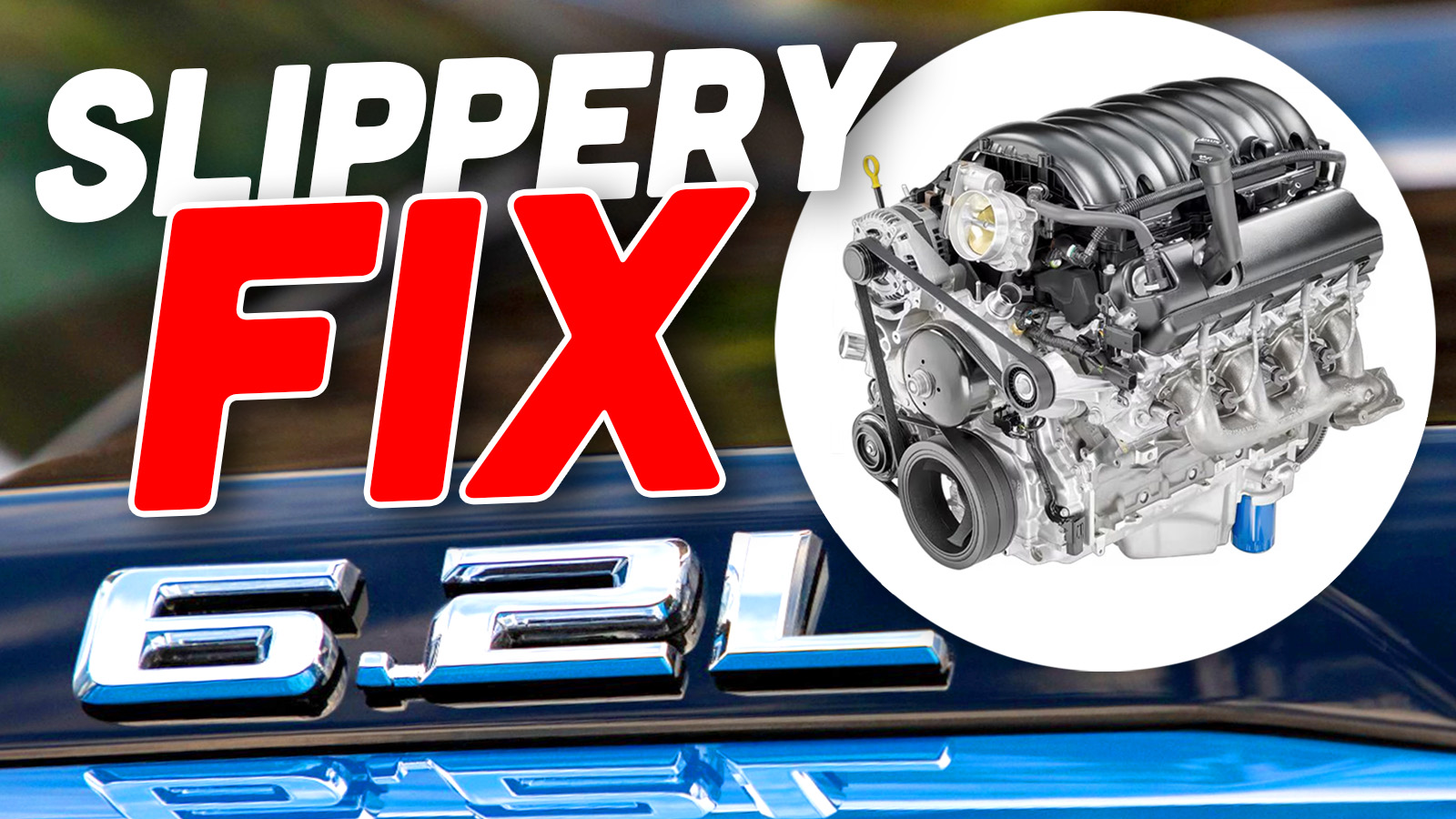
For the past year or so, General Motors’ line of full-size SUVs and 1/4-ton pickup trucks equipped with the brand’s optional 6.2-liter “L87” pushrod V8 engine has revealed itself as being plagued with issues. It started in January 2025, when the National Highway Traffic Safety Administration launched an investigation into over 870,000 vehicles equipped with the engine due to reports of premature, major failures.
Three months later, GM recalled nearly 600,000 of those vehicles, with the brand revealing it had received no fewer than 28,000 complaints over the issue. And eight months after that, the NHTSA launched another investigation into whether GM’s recall fix “failed” after the government agency kept receiving complaints, even from vehicles that got the recall work done.


Now, following that investigation’s launch, GM has made an extremely tiny (but important) update to how it wants the L87’s recalls performed: It’s changing the type of oil dealers will be instructed to use.
Here’s Where We’re At

To catch you up, GM’s April 2025 recall for the L87 is a two-fold affair. Part one involves an inspection, and if the engine passes that inspection, technicians move on to part two, an oil change with a new type of oil. Here’s the gist of it, from the last time I wrote about this subject:
For a remedy, dealers were instructed to inspect the 6.2’s internals to look for early signs of failure. If the dealer determined any signs of a potential failure, they were to repair the engine or replace it entirely, as necessary. Repaired engines would get connecting rods and crankshafts “produced after the suppliers’ suspect manufacturing window,” according to GM (via the recall doc). GM doesn’t say exactly what was changed, only that a “series of crankshaft and connecting rod manufacturing improvements implemented on or before June 1, 2024, addressed contamination and quality issues.”
If there were no signs of failure, the dealer would replace the oil with a higher-viscosity oil and replace the oil filter. Vehicles were also given a new oil cap with the updated oil weight printed on the top.
The L87 originally came with 0W-20-weight oil from the factory, but that gets replaced with 0W-40 with the recall. Specifically, GM instructed dealers to replace the old oil with Mobil 1 Supercar 0W-40. As of today, though, GM wants dealers to start using a different kind of 0W-40.
Here’s What’s Changing Specifically

In a series of service bulletins sent to dealerships nationwide and seen by GM Authority, General Motors is now instructing mechanics to use Mobil 1 FS 0W-40, rather than the Supercar blend. A representative for the brand confirmed the news to The Autopian via email and provided the following statement as to why it made the switch:
GM revised its bulletin to specify the use of Mobil 1 FS 0W-40 because of its wide availability, price point and performance criteria that meet the needs of the recall remedy.
According to GM Authority, the company is instructing dealers to switch over to the new oil once they run out of the fancy Supercar stuff. From the article:
Until now, dealers have been using Mobil 1 Supercar 0W-40 oil for these repairs. However, GM has now directed dealers to use Mobil 1 FS 0W-40 oil once the existing Supercar oil inventory has been depleted. Critically, dealers have also been notified that they will soon no longer be eligible to claim the $50 reimbursement previously offered to offset the higher cost of the Supercar oil compared to the FS 0W-40 and the original 0W-20 specification.
Why Is It Important?

Considering GM Authority’s reporting and GM’s comment above, it’s very likely the company is making the switch because simply Mobil 1’s FS is cheaper and easier to get ahold of than the Supercar blend, while still fulfilling the same parameters engineers needed for the recall fix. But I think it’s still worth digging into what’s changing here.
Oil is the lifeblood of any engine, and even minor changes in its formula can have lasting effects, not only on reliability but also on performance and fuel economy. While these FS and Supercar blends may have the same oil weight, they differ on some key levels.
Going by Mobil 1’s website, the outgoing Supercar blend is described as something you might use in a sports car rather than a truck or SUV:
Mobil 1™ Supercar 0W-40 is an advanced full synthetic motor oil specifically designed for high performance cars to provide exceptional cleaning power and wear protection, and deliver outstanding overall performance. Mobil 1™ Supercar 0W-40 is proven in high performance North American sports cars and suitable for use in everyday driving and high performance track events.

Digging deeper into Mobil 1’s product guide, the company specifically mentions Supercar as suitable for “Corvettes and Camaros that call for 0W-40 oil.” The FS blend, meanwhile, sounds like it’s a bit better suited to daily driver duty. From Mobil 1’s website:
Mobil 1™ FS 0W-40 advanced full synthetic motor oil is engineered to deliver excellent all-around performance in gasoline and diesel engines (without Diesel Particulate Filters or DPFs) with the latest technological advancements. Mobil 1 FS 0W-40 motor oil provides exceptional cleaning power and wear protection to keep your engine running like new in most driving conditions, from mild to extreme.
Still, both of these descriptions are pretty vague and don’t actually get into the nitty-gritty details of how the two oils differ. Thankfully, that product guide I linked earlier also spills the beans on some differences in additives. All mass-produced engine oils have their own unique blend of additives, mixing stuff like antioxidants, detergents, and anti-wear agents to improve the oil’s effectiveness and longevity.
While Mobil 1 doesn’t publish its exact blends online, there are a few useful nuggets of info. For instance, the FS blend of its 0W-40 oil contains slightly more phosphorus and zinc than the Supercar blend, according to the company’s chart. Both of those materials are used as anti-wear additives, according to Valvoline:
Phosphorus is a powerful additive that minimizes friction and reduces wear on the moving parts of the engine.
Phosphorus is most commonly used in zinc ester formulas, with Zinc Diakyldiphosphosphate (ZDDP) being the most common additive. It creates a protective film on metal parts and protects the engine parts from friction and wear.
Some other sources of phosphorus in engine oil are corrosion inhibitors, friction modifiers, antioxidants, and extreme pressure additives.

While Mobil 1 doesn’t reveal calcium levels on its website, the folks over in the Bob Is The Oil Guy forums, where people obsess about oil science 24/7, have reportedly discovered that the FS blend has slightly less calcium than the Supercar blend. Calcium is used in oil as a detergent additive, meant to keep deposits from forming and neutralize acids, according to MachineryLubrication.com.
Mobil 1 also labels the FS blend as meant for “high HT/HS applications.” In the world of engine oil, HT/HS means High Temperature, High Shear. Basically, this is the measure of how well the oil can function while being subjected to the stresses of an engine. From the Spanish oil producer Repsol:
Why should we care about HTHS viscosity? The truth is that it is crucial for three reasons:
-
The high engine temperatures. Internal combustion engines generate a lot of heat during their operation. In this regard, HTHS viscosity is relevant because it tells us how the lubricant resists the reduction of its protective film under these extreme conditions.
-
High loads and shear rates. The engine’s moving parts experience high shear rates due to the rotation and interaction of the components. In this situation, the HTHS viscosity provides information on how the lubricant forms the right film to protect the various parts from this wear.
-
The balance between fuel efficiency and durability of the engine. Here is where the balance between HTHS viscosity and other properties of the oil comes into play, such as thermal stability or resistance to wear.
Repsol goes on to say that an oil with high HTHS viscosity can maintain its function and prevent premature wear, but at the cost of greater friction, which increases fuel consumption. That’s because the more resistance an oil causes within an engine, the more drag it produces on its moving parts. That means it takes more effort (a.k.a., more burning fuel) from the engine to spin itself.

What does all of this mean for GM’s L87? Without knowing all of the exact differences between the oils or the company’s thinking behind the switch, it’s tough to tell for sure. But this data suggests that the new oil has slightly more anti-wear properties and slightly less cleaning properties than the outgoing stuff. Take that information how you’d like.
The high HTHS labeling might be a good or a bad thing, depending on whether you value reliability or fuel economy more. Seeing as how the oil weight is the same between the two blends, I suspect any change in fuel economy will be extremely minor. Personally, I’d take a working, slightly inefficient engine over more wear and more efficiency every time.
Top image: General Motors


and I thought Coyote tick was annoying…at least it is not blowing up the engine
The very fact that lemmings are still willing to place their hard-earned cash to buy one of these vehicles with obviously defective engines speaks volumes on some Americans’ stupidity. Spend $80k and be stranded with a damaged engine 14K miles later…Why?
Ah yes. This reminds me of the oil wars at Fred’s TDI Club back when I owned one.
Sounds like GM is just trying to run out the clock on the warranty period by changing the oil. Sorta like Ford did with their transmission lead frames in the 2010-2014 F150.
Hmm GM what do I do since I daily drive my C8? Never mind, recent history shows I don’t need to listen to your oil advice.
Very misleading headline. You’re clearly implying this has something to do with the Fed investigation, when it just as clearly does not.
As someone who occasionally reads the BITOG forums for fun, I appreciate the deep dive into the different oils. I don’t appreciate the clickbaity title.
I’m just amazed that such a thing as 0W-40 oil exists. Those chemists are earning their money.
You might be surprised then that 0W-16 and 0W-8 exist. We have stock mutiple brands of each.
The low weight doesn’t surprise me so much, it’s achieving the huge variance between cold and hot viscosity that amazes me. You can even get 0W-60!
If GM was saying you should switch from 0W-20 to 0w-30 oil, I would think it’s a ‘belt and suspenders’ type approach where they have identified a manufacturing problem and are addressing that, but to be extra safe they are adding a modest increase in oil viscosity. That would make me think it might be ok to keep one of these vehicles.
But going from 0W-20 to 0W-40 is a huge change and reeks of a desperate attempt to get a fundamentally flawed design through the warranty period. I would think you would need to change all sorts of stuff in the oiling system and tolerances of the engine to accommodate that drastic of an oil viscosity change. This ‘fix’ stinks in every way imaginable.
I just had an oil change yesterday, tried to get them to switch without a two hour inspection on my motor and they refuse to do it. They did say, that when I do the inspection and switch, they will automatically extend my motor warranty to like 150k. So there is something there. I don’t think GM has done well handling this, but at least it isn’t a 12 month thing like Toyota is doing and then leave you fucked.
A 150k warranty is nothing to sneeze at, so that is at least something. Very interesting that they won’t let you switch without the inspection; I can’t make any sense of that.
So my takeaway is that the supposed fuel efficiency/lower maintenance cost selling point for the L87 is a sham, because the only way to get those benefits is to use oil that can’t handle the demands of a big-ass V8. And that the main reason this is a scandal now is because these engines are going kablooey a lot sooner than GM thought they would.
Reminds me of the Ford recall for cars slipping out of park, whose fix was a sticker reminding the driver to use the parking brake.
I forgot about that one.
This is such a bullshit “fix”, man. Here use this one kid of oil only so this boat anchor engine makes it past the warranty period. Hope you’re not stupid enough to buy this slag used otherwise it’s your problem! This is basically destroying what little trust I have in the company all because they don’t want to pay for engine replacements. It really comes across that they are just too addicted to the stock buybacks and layoffs to do what they should be.
Brother called me from the dealership with a customer that was interested in a new Escalade. Said he has a ’01 Deville to get rid of, but the dealership would only give $100. He was asking if I knew anybody that might buy the old car. Joking around, my reply was tell the customer to keep the Deville because GM has too many explodey engines right now. I heard someone start laughing in the background and my brother yelled “you’re killing the deal!” and then hung up. I guess he was on speaker phone.
That is a great story. lol
Pretty bad stuff from GM. I’m not particularly sure why anyone would buy a large GM truck other than the reputation of their engines in such applications. Get these engines to limp their way just barely past the warranty period, and you’re going to lose A LOT of customers.
We talk a lot about how much longer cars supposedly last today than the garbage of yesteryear (by yesteryear we’re talking 30+ years ago btw) and how that should factor into the price of cars. It’s ok to spend 60k and take out an 8 year loan, some say, cars last forever now! Well, having your engine fail outside of warranty with 2+ years left on your bonkers loan would probably (and should) make you feel like a total fool.
So if the manufacturer is now telling you, as an owner, that you have to use a specific brand of oil from now on, do they have to provide that oil? I assume it’s not like you can go to quick lube place and get 0W40 Mobile 1 FS or Supercar typically? (I’ve never had a vehicle that used this grade so not sure.) So now all owners of this engine are locked into getting oil changes at a few select locations or the dealers?
I would suspect that Jiffy Lube would either stock that oil (and charge more for it) or refuse to service these trucks. Liability.
Walmart carries it. It’s only a couple of bucks more than a jug of 0W40 Supertech.
Yes, but probably 90% of people don’t do thier own oil changes anymore and typically the qucik changes charge a hefty premium for synthetic then even more for ‘Premium’ products like Mobil 1. I can do a full synthetic change myself for maybe 10 or 15 bucks more than the cheapo basic blend change. But Jiffylube charges like $40 extra for synthetic and even more for Mobil 1 when it’s available. Who covers that extra that is now required? So the consumer os now locked into a premium brand oil that wasn’t specified when they signed on the bottom line? Sounds like yet another class action suit brewing down the road when owners get locked into $120 oil changes.
I can’t say, I haven’t been to a Jiffylube or any oil change place in decades for exactly the reasons you describe. If you CAN DIY why pay baked, high school dropouts $120 to do something you can do yourself in 15-20 minutes for $25 and know it gets done right?
0W40 synthetic is a pretty common oil type on European cars. Various oil companies sell a 0W40 “Euro” synthetic oil which meets a variety of specs (Porsche A40, etc). It seems that Mobil 1 0W40 FS now meets Dexos R, which is a GM spec. I would suppose that any 0W40 Synthetic oil meeting Dexos R would be acceptable.
Toyota: Our twin-turbo V-6’s are failing at a rate of 1-2%, how will we fix this? Recall all affected engines for examination and give the customer a brand new engine.
GM: Our L87 is failing at a rate of 1-5%, what’s the best solution? New oil caps.
GM: A bit thicker oil will allow these crapcans to make it to the end of warranty, or until they’re sold to the next sucker. Either way gets us off the hook. Problem solved!
Sounds about right. Seems like they are still weighing the cost of a fix against the cost of potential lawsuits to determine their course of action.
Futher detail. gm made 600,000 over 4 years and had 30,000 FIELD FAILED engines. They started getting busy on the recall once owners threatened a CLASS ACTION LAWSUIT AND the fed s launched an investigation. THATS when the evil gm vampire got moving.
Toyota had a small fraction of the failure rate and made it right with customers during THE FIRST YEAR.
1 year warranty from Toyota, 150k miles for GM. I know which one feels better to me. Especially since both are still exploding after the recalls.
So, Im wondering if owners of these vehicles HAVE to use this certain blend of oil or will the warranty will be voided? Do they have to use a specified blend of fuel as well? What about coolant? Sounds like bullshit to me.
Not a certain blend, but they have the Dexos spec.
http://www.gmdexos.com
They phased out Dexos2 and replaced it with DexosD in the time I’ve owned my Colorado diesel, which made it annoying at times to find oil in stock. Had to plan ahead for oil changes. But I’m out of engine warranty now, so I’ll probably switch over to Rotella T-6 or one of the euro diesel blends.
TSB #G448221A: Add 2 oz of ‘Motor Honey’, 1/2 oz ‘Engine Restorer’, 5 oz ‘Motor Purr’ Tune Up fluid, and 1/2 scoop of ‘Oxy Clean’ to crank case
Shake vigorously with ice.
Serve on the rocks with a sprig of mint.