

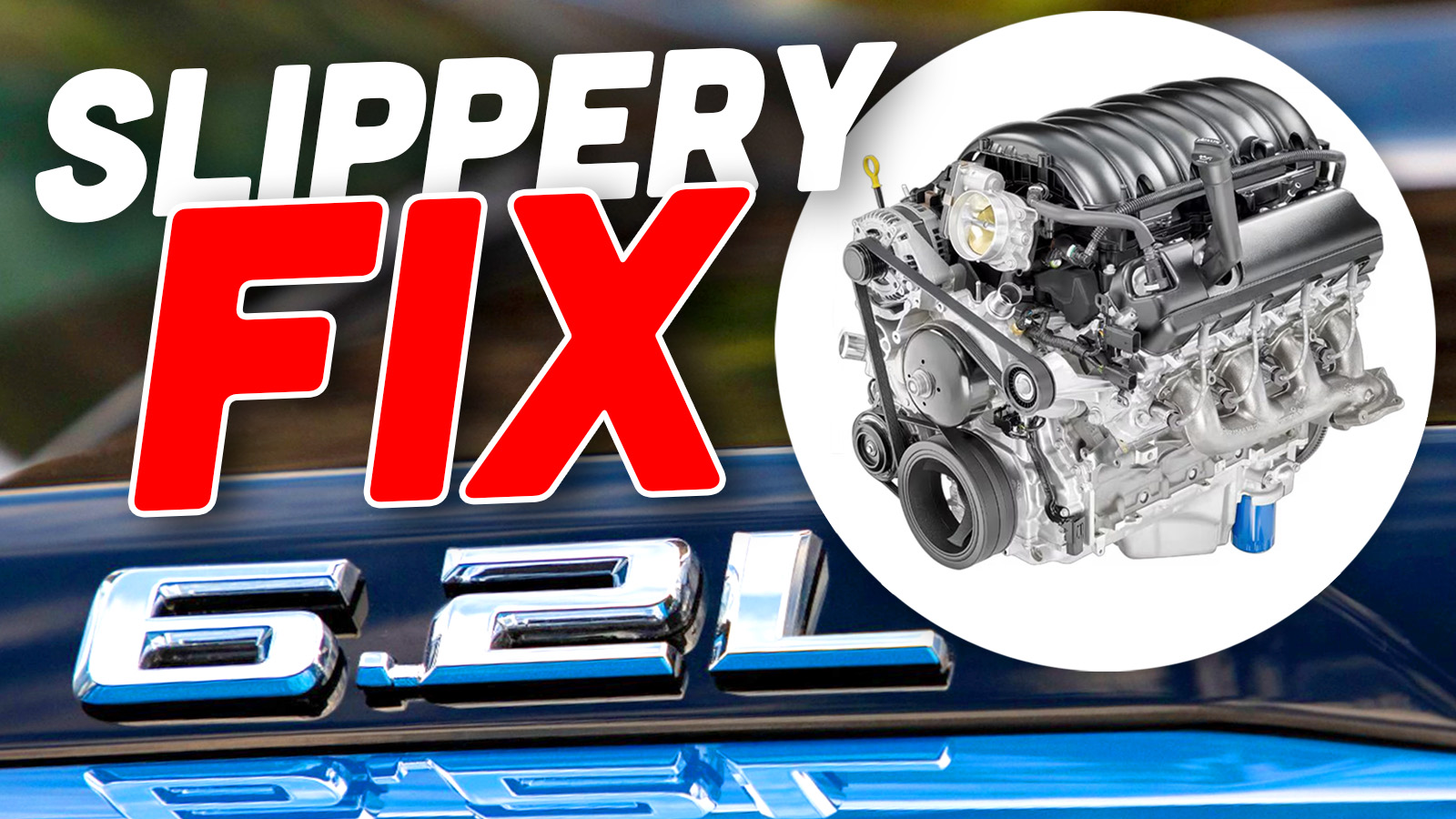
For the past year or so, General Motors’ line of full-size SUVs and 1/4-ton pickup trucks equipped with the brand’s optional 6.2-liter “L87” pushrod V8 engine has revealed itself as being plagued with issues. It started in January 2025, when the National Highway Traffic Safety Administration launched an investigation into over 870,000 vehicles equipped with the engine due to reports of premature, major failures.
Three months later, GM recalled nearly 600,000 of those vehicles, with the brand revealing it had received no fewer than 28,000 complaints over the issue. And eight months after that, the NHTSA launched another investigation into whether GM’s recall fix “failed” after the government agency kept receiving complaints, even from vehicles that got the recall work done.


Now, following that investigation’s launch, GM has made an extremely tiny (but important) update to how it wants the L87’s recalls performed: It’s changing the type of oil dealers will be instructed to use.
Here’s Where We’re At

To catch you up, GM’s April 2025 recall for the L87 is a two-fold affair. Part one involves an inspection, and if the engine passes that inspection, technicians move on to part two, an oil change with a new type of oil. Here’s the gist of it, from the last time I wrote about this subject:
For a remedy, dealers were instructed to inspect the 6.2’s internals to look for early signs of failure. If the dealer determined any signs of a potential failure, they were to repair the engine or replace it entirely, as necessary. Repaired engines would get connecting rods and crankshafts “produced after the suppliers’ suspect manufacturing window,” according to GM (via the recall doc). GM doesn’t say exactly what was changed, only that a “series of crankshaft and connecting rod manufacturing improvements implemented on or before June 1, 2024, addressed contamination and quality issues.”
If there were no signs of failure, the dealer would replace the oil with a higher-viscosity oil and replace the oil filter. Vehicles were also given a new oil cap with the updated oil weight printed on the top.
The L87 originally came with 0W-20-weight oil from the factory, but that gets replaced with 0W-40 with the recall. Specifically, GM instructed dealers to replace the old oil with Mobil 1 Supercar 0W-40. As of today, though, GM wants dealers to start using a different kind of 0W-40.
Here’s What’s Changing Specifically

In a series of service bulletins sent to dealerships nationwide and seen by GM Authority, General Motors is now instructing mechanics to use Mobil 1 FS 0W-40, rather than the Supercar blend. A representative for the brand confirmed the news to The Autopian via email and provided the following statement as to why it made the switch:
GM revised its bulletin to specify the use of Mobil 1 FS 0W-40 because of its wide availability, price point and performance criteria that meet the needs of the recall remedy.
According to GM Authority, the company is instructing dealers to switch over to the new oil once they run out of the fancy Supercar stuff. From the article:
Until now, dealers have been using Mobil 1 Supercar 0W-40 oil for these repairs. However, GM has now directed dealers to use Mobil 1 FS 0W-40 oil once the existing Supercar oil inventory has been depleted. Critically, dealers have also been notified that they will soon no longer be eligible to claim the $50 reimbursement previously offered to offset the higher cost of the Supercar oil compared to the FS 0W-40 and the original 0W-20 specification.
Why Is It Important?

Considering GM Authority’s reporting and GM’s comment above, it’s very likely the company is making the switch because simply Mobil 1’s FS is cheaper and easier to get ahold of than the Supercar blend, while still fulfilling the same parameters engineers needed for the recall fix. But I think it’s still worth digging into what’s changing here.
Oil is the lifeblood of any engine, and even minor changes in its formula can have lasting effects, not only on reliability but also on performance and fuel economy. While these FS and Supercar blends may have the same oil weight, they differ on some key levels.
Going by Mobil 1’s website, the outgoing Supercar blend is described as something you might use in a sports car rather than a truck or SUV:
Mobil 1™ Supercar 0W-40 is an advanced full synthetic motor oil specifically designed for high performance cars to provide exceptional cleaning power and wear protection, and deliver outstanding overall performance. Mobil 1™ Supercar 0W-40 is proven in high performance North American sports cars and suitable for use in everyday driving and high performance track events.

Digging deeper into Mobil 1’s product guide, the company specifically mentions Supercar as suitable for “Corvettes and Camaros that call for 0W-40 oil.” The FS blend, meanwhile, sounds like it’s a bit better suited to daily driver duty. From Mobil 1’s website:
Mobil 1™ FS 0W-40 advanced full synthetic motor oil is engineered to deliver excellent all-around performance in gasoline and diesel engines (without Diesel Particulate Filters or DPFs) with the latest technological advancements. Mobil 1 FS 0W-40 motor oil provides exceptional cleaning power and wear protection to keep your engine running like new in most driving conditions, from mild to extreme.
Still, both of these descriptions are pretty vague and don’t actually get into the nitty-gritty details of how the two oils differ. Thankfully, that product guide I linked earlier also spills the beans on some differences in additives. All mass-produced engine oils have their own unique blend of additives, mixing stuff like antioxidants, detergents, and anti-wear agents to improve the oil’s effectiveness and longevity.
While Mobil 1 doesn’t publish its exact blends online, there are a few useful nuggets of info. For instance, the FS blend of its 0W-40 oil contains slightly more phosphorus and zinc than the Supercar blend, according to the company’s chart. Both of those materials are used as anti-wear additives, according to Valvoline:
Phosphorus is a powerful additive that minimizes friction and reduces wear on the moving parts of the engine.
Phosphorus is most commonly used in zinc ester formulas, with Zinc Diakyldiphosphosphate (ZDDP) being the most common additive. It creates a protective film on metal parts and protects the engine parts from friction and wear.
Some other sources of phosphorus in engine oil are corrosion inhibitors, friction modifiers, antioxidants, and extreme pressure additives.

While Mobil 1 doesn’t reveal calcium levels on its website, the folks over in the Bob Is The Oil Guy forums, where people obsess about oil science 24/7, have reportedly discovered that the FS blend has slightly less calcium than the Supercar blend. Calcium is used in oil as a detergent additive, meant to keep deposits from forming and neutralize acids, according to MachineryLubrication.com.
Mobil 1 also labels the FS blend as meant for “high HT/HS applications.” In the world of engine oil, HT/HS means High Temperature, High Shear. Basically, this is the measure of how well the oil can function while being subjected to the stresses of an engine. From the Spanish oil producer Repsol:
Why should we care about HTHS viscosity? The truth is that it is crucial for three reasons:
-
The high engine temperatures. Internal combustion engines generate a lot of heat during their operation. In this regard, HTHS viscosity is relevant because it tells us how the lubricant resists the reduction of its protective film under these extreme conditions.
-
High loads and shear rates. The engine’s moving parts experience high shear rates due to the rotation and interaction of the components. In this situation, the HTHS viscosity provides information on how the lubricant forms the right film to protect the various parts from this wear.
-
The balance between fuel efficiency and durability of the engine. Here is where the balance between HTHS viscosity and other properties of the oil comes into play, such as thermal stability or resistance to wear.
Repsol goes on to say that an oil with high HTHS viscosity can maintain its function and prevent premature wear, but at the cost of greater friction, which increases fuel consumption. That’s because the more resistance an oil causes within an engine, the more drag it produces on its moving parts. That means it takes more effort (a.k.a., more burning fuel) from the engine to spin itself.

What does all of this mean for GM’s L87? Without knowing all of the exact differences between the oils or the company’s thinking behind the switch, it’s tough to tell for sure. But this data suggests that the new oil has slightly more anti-wear properties and slightly less cleaning properties than the outgoing stuff. Take that information how you’d like.
The high HTHS labeling might be a good or a bad thing, depending on whether you value reliability or fuel economy more. Seeing as how the oil weight is the same between the two blends, I suspect any change in fuel economy will be extremely minor. Personally, I’d take a working, slightly inefficient engine over more wear and more efficiency every time.
Top image: General Motors


In typical American car manufacturing tradition GM is crossing their fingers that this slapdash fix is enough to get this shitshow of a motor to the end of its warranty. After that it’s not their problem if peoples’ engines are grenading. Line must go UP!
Some car companies spend decades trying to live down stuff like this and for GM this is just this week’s thing that will be forgotten by next week’s thing.
It’s like school where if the problem kid that’s been given rounded up grades to be passed forward doesn’t shit himself or beat someone up in class, it’s considered a success, but the kid who’s never a problem and gets good grades raises his voice and he’s looking at a suspension (see: GM fans deflecting to Toyota’s recent issues).
Well said!
Ah yes. I see that GM’s engines have had their quality improved to match the quality of their world-class electronics that never fail.
All I picked up from this is that GM’s now using some sort of FFS oil in a half-assed attempt to fix the problem.
Watch what The Motor Oil Geek has to say on YouTube.
I dig it too. He has some really insightful info on his channel.
My parents have a 6.2 Suburban. When they told me this was the fix I was shocked. I put thicker oil in my old Subaru with 300,000 miles to reduce oil consumption, the fact that a manufacturer suggests this backyard mechanic hack as an actual solution is absolutely insane.
Another thing that confuses me, my parents also had a 2017 Silverado with the 6.2, other reliability issues aside, that truck took 0W-20 for 100k miles and never had a problem.
I am pretty pissed on my parent’s behalf (they don’t really care), it’s an extra slap in the face that the 6.2 tends to be put in the more expensive models too.
The L87 came out in 2019. As far as I know, the one in the 2017 Silverado is pretty rock solid.
I’m sure Lucas makes some “highly advance oil enhancer” that can be added during oil changes that will solve all this. Did anyone at GM check the Walmart oil section and read all the lables?
Changing the oil is a bandaid at best. You would think after so many years producing this kind of engine, they would have figured it out by now. But no!
The engine is so sensitive that this change of oil determines whether it lives or dies? Can’t say this would comfort me. Seems like another stopgap measure to limp this sh*tshow along.
Aren’t the Feds now suing GMC because this isn’t a real fix? I have an oil change on mine today, they wanted to check for the recall, but since it’s not a real fix I declined to spend another hour at the dealer this morning.
Not sure why Brian didn’t include that, but not surprised either to be honest. It isn’t even “new” news.
https://www.msn.com/en-us/autos/news/gm-s-6-2-l-v8-problems-are-far-from-over-as-the-feds-step-in/ar-AA1UA8Fh?ocid=msedgntp&cvid=696fa56c5dd14c378f51cf241f7ee93f&ei=26&apiversion=v2&domshim=1&noservercache=1&noservertelemetry=1&batchservertelemetry=1&renderwebcomponents=1&wcseo=1
Because someone at GM needs to do is donate $$$ towards a Ballroom/Bunker/Triumphal Arch….
oh it has nothing to do with the fix not working? Just purely political? Interesting please tell me more.
The same issue extends to the L86 engine, GM knows it. My 2016 failed, GM fought me tooth and nail to fix it. Residuals on vehicles with these engines are going to $0. If you still own one run away while you can, the market will figure out soon enough and your rig won’t be worth much
Well, unless you spend $2k and do a DOD delete (which, I might add, has been vetted by CARB).
… And replace the converter in the 6L.
…and the whole transmission if it’s an 8L.
Actually, you’re probably better off the light the truck on fire and claim the insurance money if it has an 8L.
Light the truck on fire and claim the insurance money. get out while you can
My BiL learned this the hard way after I specifically told him not to buy one with the 8L. “I wanted a black Silverado and this one was in my budget”
Man this was a really long article just to say that GM changed an oil recommendation.
“What does all of this mean for GM’s L87?”
I predict that what it REALLY means is the engine will continue to have problems and all this does is delay the inevitable until after the warranty period is over.
hard agree. I don’t see why GM doesn’t realize that the only reason their customers buy their trucks is for reputaiton of the small block v8. GM’s failure to make it right is going to cause a mass exodus of customers. I have family members who have only been buying GM trucks for 40 years one family members 2024 6.2 blew up 2 hours from home. she is talking about going to ford next time and that kind of talk would have been considered Heresy just 2 years ago!
Good, maybe now Walmart will have the 0W40 Supercar in stock again
Ive been wary of the oil wallyworld sells after noticing that the label on many brands on their shelves state that it was made for wallyworld. That doesnt bode well with me after hearing how many manufacturers provide them with subpar products just so they can retail them at a lower cost. I remember it being a big deal when Snapper pulled their mowers out after not agreeing to their wanting a cheaper-made mower to sale.
I’ve been running Supertech oil and filters in my cars for well over a decade with no problems.
WalMart Supertech meets Dexos1 Gen3 spec as does Costco Kirkland. Both are a solid value that I’ve used for years. Kirkland on sale (couple times per year) is under 3 bucks a quart.
SuperTech oils have been vetted in countless UOA tests for decades now and passed with flying colors. If it passes muster with the BITOG geeks it’s good enough for me (and has been my go-to MO for many years now with great results)
If it were my 6.2, I would be running 5w30 it in from the first time I changed the oil myself. I have never put any faith in anything lighter than that if you actually plan to work a vehicle at all. Lake Speed posted something on this topic (several actually). 20 weight oil is enough for modern engines, but there isn’t a large margin for error. If the actual viscosity is much lower, it can be insufficient. I guess its called sheer stability. The other takeaway from the video I learned is that the bigger the gap between the winter and standard numbers, the less sheer stable an oil is. Like I said, I would be running a 5w-30 in my 6.2.
nothing is wrong with 0w20 as long as the engine was manufactured to the right tolerances. clearly something went critically wrong in manufacturing and going to a heavy weight oil is just a band aid fix to limp the engines till they are outside of the warranty.
I think you missed the nuance about actual viscosity in my comment. there IS nothing wrong with 20 weight oil, so long as it stays 20 weight oil in the engine. Oil tends to move around based on a variety of conditions with respect to its sheer and viscosity. 20 weight is taking away margins for those changes.
I was always in the thicker-oil-is-better camp until I learned that variable valve timing systems were using the motor oil also as a hydraulic fluid. If you stray too far from the spec on the thicker side you can cause all kinds of problems there.
That’s also a filter issue. Filters have a curve where too new isn’t as efficient as used, but too old is also a problem. So where does that leave ideal changes? WTFK, it varies, but I went back to shorter change intervals (6k) and order the higher end filters.
This has always been my hangup about putting heavier oil in an engine with oil-pressure fed cylinder deactivation (which I believe these are). It feels like you’re just begging to trash a lifter and fill your engine with metal dust.
That is a very thorough analysis and I learned a thing or two. But I’d wager GM’s analysis started and ended with “It’s cheaper.”
While I don’t think this will solve this particular problem for the customers (maybe for GM, as long as the failures are out of warranty and screw repeat buyers, I guess), my car recommends 0W-20 in the US, but 5W-30 elsewhere. Since physics doesn’t vary, I go with the one specced for performance and longevity, not to game some BS EPA test and I handily beat the EPA rated mileage just the same. That’s with a heavier grade oil, not merely HTHS, so I wouldn’t think the difference in mileage would exceed the typical deviation you’d get in testing even the exact same oil. The other side of it is that there seems to be increased consumption with 0W, which (if true) I’m sure isn’t factored by the EPA, but does affect the environment in the real world. More importantly, a lot of people today seem to be under the impression that hoods are sealed to the consumer, so they don’t check the oil (on cars where they even can). Greater consumption can obviously lead to premature engine failure, particularly with today’s highly-stressed engines. Only time I’d use the 0W-X is in a hybrid due to all the cold starts and those engines aren’t highly stressed, especially running the Atkinson cycle.
Another thing, as I understand it, the wider the range of the oil, the more additives are involved, the sooner it breaks down. In a world of highly stressed engines and 10k oil change recommendations, something like a 0W-40 doesn’t seem like a good combination for longevity.
I’ve used 0W-20 in many different vehicles for decades without any issues. I think the problem for current models has more to do with the combination of 0W-20, plus smaller oil control rings for better efficiency, plus direct injection carboning up those rings and other oil passages in the engine.
That’s a big contributor, fuel getting into the oil, oil getting past the rings. Another reason to ignore those 10k oil change recommendations and question whether the real world benefits of some of these emissions/mileage compromises are worth the reduced service life (especially when losing vehicle weight would do both without the reduction in resiliency). These low tension rings turned the clock back on oil burning by several decades with a number of engines even from companies with good reputations for, what, a low single digit percent improvement in efficiency on a test stand or maybe some fixed road loop? These engines then go into overweight cars with unnecessary AWD driven largely by people with terrible driving habits often resulting in higher fuel consumption that can be well in the double digit percentages and we end up sacrificing longevity and adding the emissions of burning oil for paper gains.
In the summer, I see about 10* lower oil temp readings 0-20 vs 5-30 and consumption went down to about 1/2 qt/5k miles. I know they’re dealing with the broad spectrum of people who buy cars, but OEMs should more clearly spec engine weight and change intervals by usage and vehicle than they currently do in the owners manuals (that nobody reads, but at least it will be there) with better definitions of what qualifies as harder use in modern engines, including merely running mostly short trips that exacerbate fuel dilution of oil.
Soooooo…. is it time to fill my 7.3 IDI up with Mobil FS 0W-40!? That 15W-40 it specs gets awfully syrupy when cold…
FS stands for “Fails Sooner”, so factor that in to your decision.
This is one thing but does not address the the other 6.2L GM V8 engines (L87/L86) since 2014 with the AMF / DFM lifter failures. Heck goes back to 2007 with the then new 5.3-6.2 with cylinder deactivation.
What a joke the technology ends up ruining things. It happened to me on my Yukon years ago..
you would think they would’ve copied the more power design, which seems to be much more robust.
I’ve always understood that low (hot) viscosity oils have been introduced to maximize fuel efficiency. So what effect does switching from 0W20 to 0W40 have on fuel economy? Sure, you might be willing to give up a fraction of an MPG to extend the life of the engine, but it’s gotta add to fuel costs over the lifetime.
It’s not going to amount to much. Just assuming a .5 mpg (20 to 19.5mpg) swing you’d be looking at a difference of about $700 over 200,000 miles. Idk what these things get but the ultimate impact won’t add a significant financial burden.
About 0.7 to 1.5% depending on the specific oils.
(As the manufacturing engineer responsible for fluid filling and storage at our North American factories I get to have this cost / benefit fight with design engineers all the time.)
I use the international 5W-30 over the 0W-20 the OEM recommends for the US market and I beat the EPA rating. I even beat the city rating while towing a utility trailer (though, TBF, that’s primarily on low traffic roads of moderate speeds).
From what I understand, the greater the range of viscosities, the more additives, which break down sooner, so if you went to 0W-40 from -20, I would think you’d want shorter oil change intervals.
on a v8 it will be extremely negligible fuel economy hit. on a 3 cylinder or 4 cylinder you may notice 1 or 2 mpg.
It’s for EPA credit. Trucks tend to stick around so any fuel economy increases are magnified over a fleet of them. Going from 10.5 to 11 mpg is way more significant for fuel use than going from 49.5 to 50 mpg.
I really don’t like mpg as a description. It makes something appear linear that is asymptotic.
Good luck to whoever owns a vehicle with an L87. I mean that sincerely.
Just enough of a bandaid to get it out of the recall period,then it becomes whoever owns its problem.
Oil’s well that ends well, I guess.
Can’t I just do 3 quarts of 0w20 and 3 quarts of 10w40?
“Are we just rearranging deck chairs on the Titanic?”
“Per Niente. This is the Andrea Doria.”
Fine engineering from Garbage Motors
That’s not an iceberg, thats the Stockholm!