

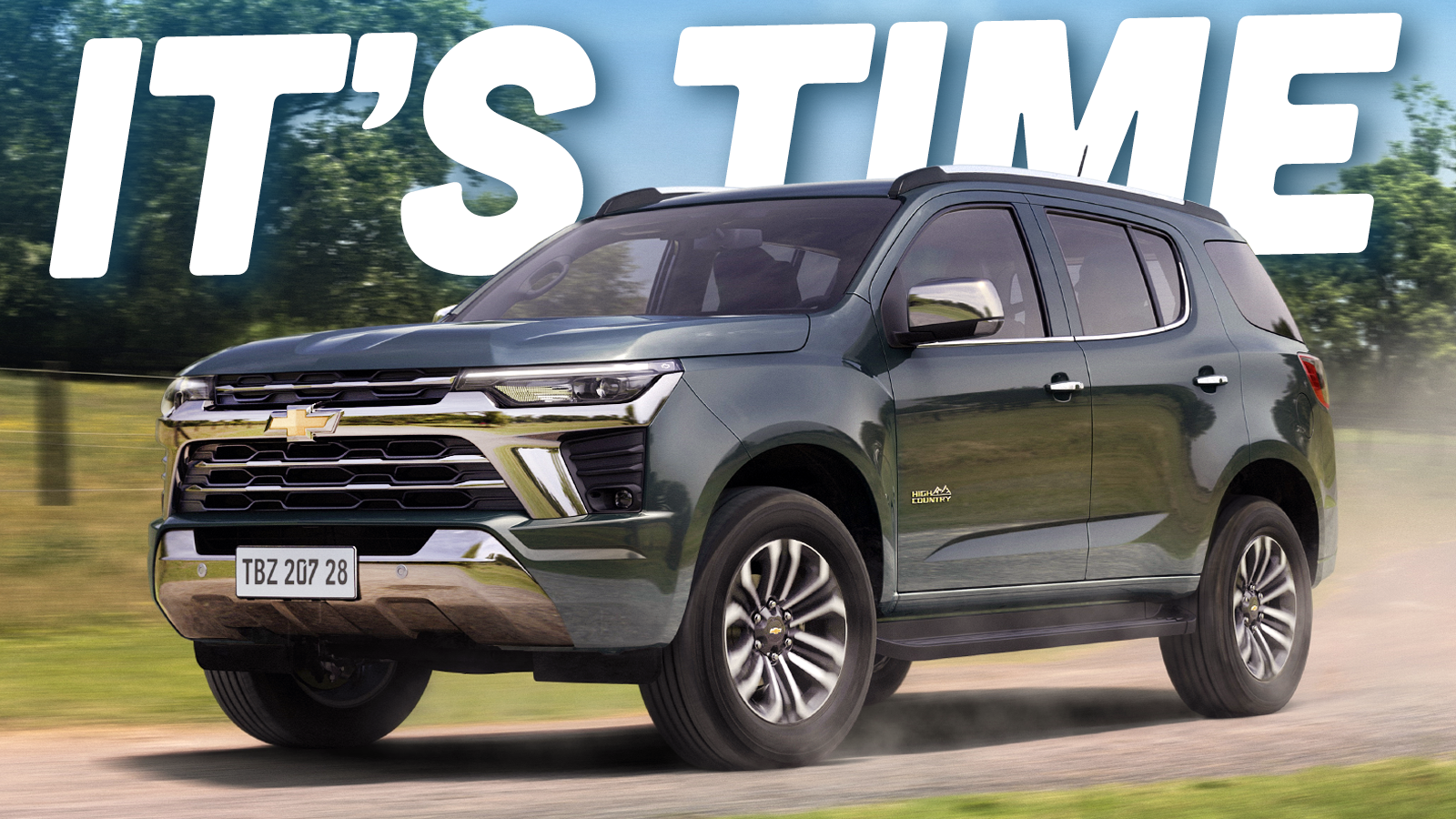
It seems like every time I write something about the Jeep Wrangler, the Toyota 4Runner, or the Ford Bronco (and the Bronco’s rumored Lincoln- badged cousin), there are a handful of readers in the comments section wishing that General Motors would make a mid-size body-on-frame SUV of its own. Well, it already does.
Anyone who follows GM’s product launches overseas will know that Chevrolet sells a Trailblazer in other parts of the world, for markets like South America, the Middle East, and East Asia. But it’s not the Trailblazer you or I are familiar with.


No, this Trailblazer is its own, specific SUV, inside and out. While the Trailblazer you see dozens of on the way to work every morning is a unibody crossover with barely any off-road chops, this truck is a proper body-on-frame vehicle with a true four-wheel-drive setup. Even cooler is that it comes with three rows and a standard turbodiesel engine.
The overseas Trailblazer is the GM body-on-frame SUV of America’s fantasies (well, maybe not the diesel part, but you get what I mean). If there’s any vehicle Chevy should introduce to its lineup in North America, it’s this SUV or something like it.
Picking Up Where The Old Trailblazer Left Off

Let me catch you up on some Trailblazer lore. The TrailBlazer name—Chevy originally capitalized the “B,” but stopped doing that later—was actually first used to identify a high-end trim level for the S-10 Blazer in 1999. The first-generation TrailBlazer first hit the scene as its own, distinct vehicle in 2001 as a way for Chevy to break further into the mid-size SUV space. This version used GM’s GMT360 platform, which was a body-on-frame design meant specifically for SUVs.
While it wasn’t as fancy as a Land Rover, as reliable as a Toyota or Lexus, or as capable as a Jeep, the Trailblazer’s body-on-frame setup and real, actual four-wheel drive with a low-speed transfer case meant it could hang with any of those cars through most off-road challenges, and deliver most of the comfort and reliability. And in the modern day, they’re far more affordable used. Don’t believe me? The great David Tracy picked one up as a rental a few years back to just see how it would do off-road, and came out deeply impressed. From that post:
It’s unlikely a Toyota Land Cruiser fan is going to fall in love with the Trailblazer. But I do think it’s an excellent low-cost alternative in that it offers a lot of the things a Land Cruiser does but at a fraction of the price. Is it as capable off-road? No, but it’s 80 percent there. Is it as comfortable on-road? I mean, almost — I’d say it’s 90 percent there. Is it as reliable as a Lexus LX or GX? No, but it’s probably 80 percent there. Multiply all those out and you’re at about 60 percent. Now consider that I sold my 265,000 mile Lexus LX470 for $7,200, and that you can buy a Trailblazer with half as many miles for half that price, and you see where I’m coming from.

The first-gen TrailBlazer could be had with three different engine choices, including two V8s and one of America’s last straight-sixes, the all-aluminum 4.2-liter Atlas unit with dual-overhead cams that, near the end of production, was making nearly 300 horsepower. Every engine was paired to GM’s just-fine 4L60 four-speed auto, which got the job done for around 200,000 miles before usually needing a rebuild.
Throughout its 2002 to 2009 production run, the TrailBlazer was also known for spawning a handful of badge-engineered siblings based on the GMT360 platform. There was the GMC Envoy, the Oldsmobile Bravada, and the Buick Rainier, plus cars like the Isuzu Ascender and the weird Saab 9-7X.

When the first-gen TrailBlazer ended production in 2009, that was the last North America would hear about the nameplate for over a decade, when Chevy revived it domestically as a more pedestrian, cheaper, more economical crossover, which is how the car still exists today. But elsewhere, the “real” Trailblazer lived on, getting a second generation with a body-on-frame construction.
The One Cool Chevy We Don’t Have

After a couple of years without a Trailblazer in the lineup, Chevrolet revived the name in 2011 for another mid-size, body-on-frame SUV, showing it off as a concept (above) at the Dubai Auto Show. This time, instead of getting its own platform, it borrowed the truck architecture found on the second-generation Colorado sold overseas.

The production version shared much of the concept’s looks, with the general shape of a tall, boxy-ish SUV, with a silhouette that reminds me of a Lexus GX470 from the mid-2000s. The fascia, meanwhile, looks like a cross between two Chevies: the second-generation Equinox and the Uplander minivan. Is it beautiful? No, not really. But it definitely got the job done.
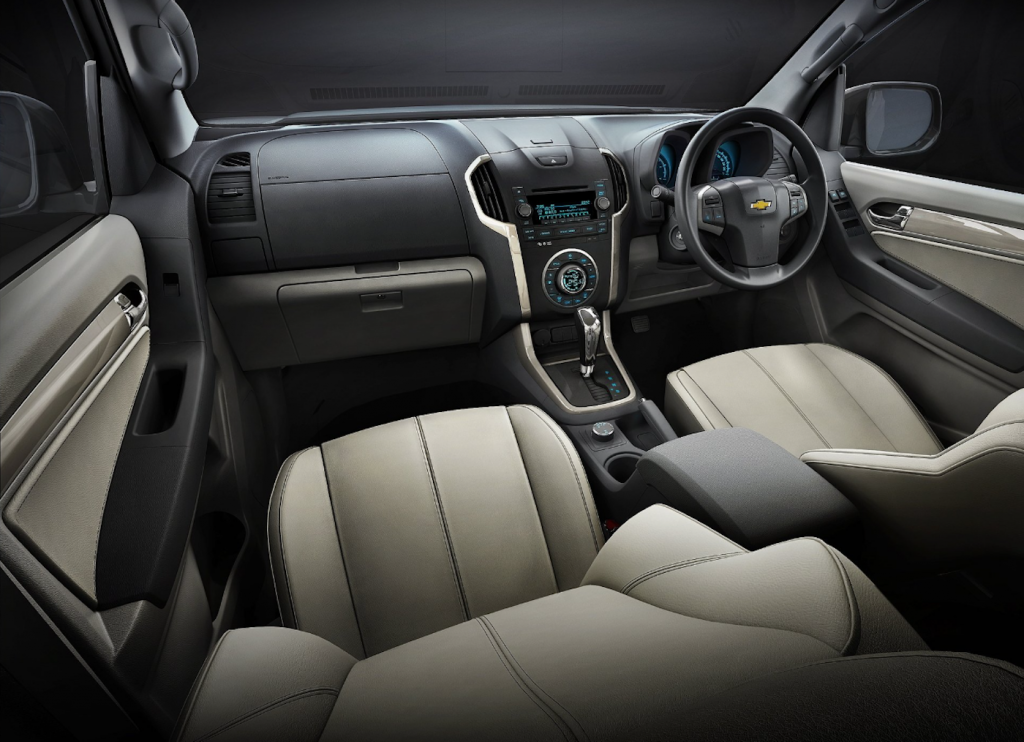
The inside is very much reminiscent of early 2010s Chevy products, with a plain steering wheel, vertical vents, and a standard GM center stack with lots of physical buttons and knobs, including a neat center button cluster for climate control. While it’s not as outwardly utilitarian inside as something like a Bronco, it’s straightforward enough to appreciate. Plus, there’s even a fold-out third row in the back, which adds to the appeal.

What’s most important is how the Trailblazer retained its ruggedness for this new generation. In addition to keeping the body-on-frame setup, it still used an old-fashioned four-wheel drive system with low range. Buyers could choose between a 2.5-liter or a 2.8-liter turbodiesel inline-four, or a gas-powered V6. Between the engine and the wheels was either a six-speed automatic or a six-speed manual (which was later dropped, sadly). This is just as much a truck underneath as the first-generation Trailblazer ever was, if not more so.
It’s worth noting that while it’s badged as a Duramax, the 2.8-liter turbodiesel is actually sourced from Italian engine manufacturer VM Motori, according to Australian site Drive. Thanks to stuff like a high-pressure common-rail fuel system and double-overhead cams, it makes 207 horsepower and a respectable 376 pound-feet of torque. Regardless of the source, Drive seemed to enjoy it. From their 2019 review of the Trailblazer, which was badged as a Holden for their market:
It’s a nice and composed engine, which brings on that big shunt of torque quickly after pedal depression. It’s managed well by the six-speed automatic gearbox, which is your one and only choice of transmission.
Although it reads like it’s only a low-rev lugger on paper, it does feel pliable through the rev range. There’s more rattle in the engine compared to more modern offerings from Ford and Toyota, but I reckon it’s still good nonetheless. Bonus points for a high-mounted alternator and a protected air intake as well.

Because this type of no-nonsense SUV is popular in so many parts of the world, GM has been building this Trailblazer for well over a decade now, with two big facelifts: One in 2016 and another in 2024. Overseas, the Trailblazer closely mimics the 4Runner-Tacoma approach, in that it shares most of its looks, interior design, and mechanical layout with its pickup truck sibling. In this case, the Trailblazer currently wears the same face as the second-generation Colorado (not the one we here in America get, but the one built for overseas markets).
To drive, the rest-of-world Trailblazer seems pretty pleasant, at least according to Drive:
Like most other ute-based wagons, the Trailblazer ditches leaf springs in favour of a five-link coil spring set-up for the rear live axle. Up front, it’s the same independent suspension as the Colorado. It’s a well-sorted set-up too. It rides pretty well and absorbs big bumps without too much fanfare. There is still a reminiscent jiggle that reminds you of its ute-based lineage, but it’s nothing overly bad.

Ford’s Everest is more refined, but the Trailblazer easily holds its own against the MU-X, Pajero Sport and Fortuner. Articulation is average for the class, and we didn’t come across any fading issues from our off-road driving – conditions weren’t really that tough in that regard.
The on-road driving experience improved with a big leap from the use of a new electric power steering set-up, which replaced the old hydraulic system. It feels sharper overall and gives variable weighting between low-speed and high-speed driving. It’s not just marketing talk either; it’s really tangible and beneficial.
I’m glad Drive brought up the Everest—like the Trailblazer, it’s another mid-size truck-based body-on-frame SUV that’s not sold in America. As cool as it is, I can sort of understand why Ford doesn’t sell it here: Because the Bronco already occupies much of that segment for the brand. GM, on the other hand, doesn’t have that conflict. There’s just a truck-based SUV hole in its lineup begging to be filled.
So, Why Doesn’t GM Bring It Here?

Back in 2023, GM President Mark Reuss was asked by The Drive why the company didn’t offer a mid-size off-roader to compete with the likes of Jeep and Ford. He told the publication, “I’m not gonna do a Bronco” for a couple of reasons:
The first is simple. Reuss explained that he doesn’t want to be “late to the party.” Doing a Bronco competitor now would put the brand plumb last in bringing a two-row, body-on-frame 4×4 to the market. The second has to do with emissions. Reuss claimed that Ford has to sell trucks like the Maverick as a hybrid because doing so many cars powered by internal combustion hurts Ford’s corporate average fuel economy. He doesn’t want to move backward in that regard.
So long as the Wrangler and the Bronco remain in production, there’s no fixing that first reason. But honestly, that doesn’t sound like a great reason anyway—Ford went years without selling a Bronco, but no one had any qualms about them reviving the nameplate for 2020 and putting it back on sale. Now, the Bronco is the second-best-selling SUV in the company’s lineup, behind only the Explorer. So being late to the game shouldn’t be an excuse not to capitalize on America’s ever-increasing demand for rugged off-roaders.

And the second reason, about corporate average fuel economy, isn’t a problem anymore, since the federal government announced back in July that it would no longer penalize manufacturers for not meeting those fleetwide standards. To pass safety regulations, an American-spec version of this truck would probably have to be based on the U.S.-market Colorado, but I wouldn’t mind if the looks and engine didn’t change. If Chevy doesn’t want to offer a diesel, the 2.7-liter inline-four found across its truck and SUV lineup would do nicely, too.
While the market feels ripe for something like the overseas-market Trailblazer to hit U.S. dealers, there is one problem remaining: What should it be called? Blazer feels like an obvious choice, but that name is already being used for an electric crossover. It’s also pretty close to Trailblazer, which, again, is already in use by a different, gas-powered unibody crossover. Perhaps it’s time to revive the name Tracker. It just feels right.
Top graphic image: Chevrolet


I passed a gas station on the way to work and diesel was $5.65 per gallon. There is zero reason anymore to put it in a car or small SUV. Diesel had it’s time, but now it’s dead outside of full-size trucks.
It would fit fine in the lineup otherwise, but that’s not a guarantee at sales success, even if it’s the most capable thing around. As others have said it would need a deeper reskin before coming here. The facelift helped, especially inside, but the roundness of the basic design is more like the previous gen Passport and there’s a reason Honda went squared and boxy on the new one.
4Runner gets/got away with BOF compromises and older mechanicals and design (before) and all because it has longevity and brand recognition. A Grand Cherokee would actually be a competitor too, but that also has the recognition and can be pretty luxed out, which would likely require work on GM’s part there. And by the time you get to a loaded up one of these, you’d surely be into Tahoe territory. People would be more likely to spring for the Tahoe/Yukon/Suburban, because that’s what they’ve always done. Toyota and Jeep don’t move nearly the same sales volume in that segment as GM does.
This Trailblazer was a result of GM Thailand’s development with Isuzu for the body-on-frame platform that would go on to become the Colorado that would later be slightly modified to accommodate a shorter wheelbase for this SUV, the Trailblazer.
Like Isuzu, GM Thailand never intended for this platform to hold anything but 4 cylinder diesels and it’s a vehicle developed solely for developing nations, i.e reducing costs on suspension and chassis development to focus on reliability, repairability, and undercutting the competition.
Writers at the Autopian, perhaps you already know this, but cars developed for poorer countries tend to have very bad handling and cheap, plasticky interiors. This type of vehicle does not work for the US.
It’s the same story why the Hilux and Tacoma are always developed differently despite being the “same” vehicle. It’s because Americans can pay more, which allows the margin to put in a more luxurious interior and better handling. The Hilux, on the other hand, is focused on being as cheap as possible because its main demographic earns less than a McDonalds burger flipper in Idaho.
Funny thing is:
Cars built for US market have cheaper suspension parts and cheap, plasticky interiors. This type of vehicle does not work for most other markets than US and probably some developing countries.
Perfect for here we are collapsing nation with crumbling infrastructure.
Toyota also has the Hilux-based Fortuner in similar markets as this Trailblazer, whereas North America gets the 4Runner.
I love this comment, well you would expect it to hold its own against the MU-X because its the exact same vehicle just with a different engine.
The previous gen MU-X, yes. But the current MU-X shares absolutely no similarities to the current Trailblazer.
Last sunday I rode on a friend’s new-ish Trailblazer. Much to my surprise it is a competent, comfortable, composed and very roomy vehicle.
The torque was enough for city and highway use, and I guess the 2.8 diesel is quite efficient, too.
The real answer is that the body-on-frame Trailblazer would cannibalize Tahoe sales GM already gets and reduce margins because it’d be cheaper.
The Tracker name should have been used for the new trailblazer cuv. It fits GM’s history better.
The Trailblazer is significantly smaller than a Tahoe
Tahoe intenders would likely bypass this and still stick with a Tahoe. Anyone that is seriously considering a full-size SUV, still wants the size.
It’s just gm being gm. They have something that would sell rather well but it would probably mean they need to do somethings that would also probably sell very well. Like a small bev pickup thing or a smaller hybrid pickup thing. Or gasp a small hybrid or bev van all the trade people want. But I get why the trailblazer never made it to us. The same reason everything else like it rarely makes it to the us. So many smaller 3 row fairly bulletproof bof SUVs out there in Latin America and Asia. But almost everything is a cuv because people buy them.
Yeah, framing it as “Ford must sell” the hybrid Maverick to make up for the Bronco is only a good argument if you don’t know how much people love the hybrid Maverick. A better way to put it would be “For can sell” because they have a wide array of popular hybrids that GM doesn’t.
They all love to self sabotage. Ford still owns the trucklet market but they could have really made it work if they kept their dealers under control. Dealers might be part of the reason they want a new thing they can sell for over MSRP. I’m not sure they will be able to do that any time in the future. As the markets that typically do that are hurting. Toyota is probably the only one that can sell some vehicles at msrp right now. Everything else is sitting. Dealers could make money on presales at msrp I’m sure there were some bolt people put down for the new bolt.
They want to live in the fantasy world they created 5 years ago and it’s not going to happen for another 95 years. Meanwhile another 08 is just around the corner so they better have something cheap and cheerful to offer.
You seemed to have misspelled “excellent” when discussing the 97X. I’m not sure why but you spelled w-e-i-r-d.
Take the Colorado body on frame platform and make a SUV out of it. Can even reuse a lot of the sheet metal since the Colorado is already the best looking mid sized pickup.
Why stop there? Body on frame midsize or fullsize sedan with V8.
Why stop there? Wagon with V8 and 4×4 optional. Goive it a 5k tow rating.
“corporate average fuel economy, isn’t a problem anymore, since the federal government announced back in July that it would no longer penalize manufacturers for not meeting those fleetwide standards.”
Just because the feds are not collecting fines today doesn’t mean that CAFE doesn’t matter. The program is still there and credits are still accumulating or being burned. The fines can be turned back on just as easily as they were turned off. If started today the BoF Trailblazer wouldn’t be available in the USA until the next administration.
“Perhaps it’s time to revive the name Tracker. It just feels right.”
Not IMHO with this thing. The Tracker was tiny in comparison.
It would make for a flip-flop with the TrailBlazer name here – was a midsize SUV, EXT form actually longer than a Tahoe, now it’s a little crossover.
It just feels right was a Mazda slogan anyway.
Well if they bring it over I’d recommend they you know… make it look… not like that.
It looks like it came from the era of the Orlando and Captiva because, well it did.
It is vastly better than the Captiva I rented a couple years ago.
Yay FINALLY!!!!!!!!!!!!!!!! 😀
It’s about time you guys wrote an article on it! I’ve mentioned this thing many times in comments on the Trailblazer and other SUV-related articles/TMD segments. Yeah it’s basically just a Colorado wagon.
They could even bring back the TBSS with a V8 too 😉
If GM wants to protect their US shit, maybe they could sell the international TB here as a GMC Jimmy or Envoy, which would also give GMC a unique product in GM’s US lineup.
Also, don’t forget about the Xterra that Nissan sells in the Middle east and China
I wouldn’t say this Trailblazer is the anything of my dreams. In short, it’s ugly. As you pointed out, it debuted fifteen or sixteen years ago, and has since had several facelifts and interior redesigns. GM has tried to give it a modern look, but the bolt-on bits and interior are incongruous with the hard points of the dated body tooling, which has an organic, off-putting look.
The cars that are successful in this space, the Bronco and Wrangler, have boxy, undeniably masculine and up-to-date designs. That’s also true for the 4Runner and Land Cruiser, which would be better comparisons for this Trailblazer. And those two have the added bonus of name continuity and strong brand equity. And the Passport, which is unibody and which uses a transverse-engine setup, punches above its weight with its styling and practicality, so it’s another great once.
I doubt this Trailblazer would sell here, even if it is BOF and somewhat rugged. And it might not even be able to pass US/CA crash test rigors without extensive modifications, anyway.
See also: the Ford Everest, which is another car people claim to want, but which to me looks a lot like a 2007-2012 Hyundai Santa Fe from the sides.
The rear 3/4 make it appear the size of a Nissan Armada/Patrol but the interior shot looks like it’s much much smaller
And all of it, inside and out (screen aside), looks like it was newly released for the 2010 model year as a police SUV to pair with the FWD Impala.
“And the second reason, about corporate average fuel economy, isn’t a problem anymore, since the federal government announced back in July that it would no longer penalize manufacturers for not meeting those fleetwide standards.”
For now….
This is not a good long-term strategy for any company to play that game.
And yet EVs are being cancelled left and right.
Go ahead and give up any attempt to compete with the Chinese – We’ll be watching them begging for bailouts/going bust in 10-20 years.
“Reuss claimed that Ford has to sell trucks like the Maverick as a hybrid because doing so many cars powered by internal combustion hurts Ford’s corporate average fuel economy. He doesn’t want to move backward in that regard.”
Well… The Maverick hybrid actually sells well and Ford would be stupid not to offer it.
And I would say that GM is stupid not to offer something similar. All that money they spent on the Voltec hybrid tech is going to waste.
And while the Ultium BEVs weren’t on sale yet, certainly Reuss must have known the Ultium platform vehicles were coming.
Also back in 2023, they did have the Bolt. They could have made a Bolt pickup truck at minimal additional cost to offset the CAFE issue.
“What should it be called? Blazer feels like an obvious choice, but that name is already being used for an electric crossover.”
My vote goes to calling it Bigus Dickus… OR call it the Grand Blazer.
I originally read Bigus Dickus as Big Dingus and I think it would also work
Ford had announced, at the release of the Mustang Mach-E, that it will make money from the beginning.
It’s staggering the sheer volume of good tech that GM abandons. But GM is going to GM.
Maybe someone should tell Stellantis that they could shove a Hemi into it.
There needs to be a Bolt pickup and the name for it is obvious. El Camino.
E-Camino
Penis Mightier
For the last time…. I’m not selling penis mightiers!!
I am sure someone will bring up that GM does not want to steal sales from other parts of GM or some nonsense.
I just hope if they brought it here they would not cover it in black plastic wheel arch garbage.
They could revive the GMC Jimmy name?
Guilty as charged. Doesn’t mean I’m wrong.
I do like the idea of using the Jimmy name
“So, Why Doesn’t GM Bring It Here?”
The reason the 2001-2009 Trailblazer, Envoy, Oldsmobile Bravada, and the Buick Rainier, Isuzu Ascender and the Saab 9-7X were discontinued was the abysmal fuel mileage.
I still have a 2003 GMC Envoy. The best mileage it ever got was 18 mpg, with near-bald all-season tires on it and if I kept it in 2WD and drove 50 mph down a 2-lane road. Once I installed the General Grabber tires on it for better traction in the snow, the mileage is down to 10-12 mpg.
It’s amazing to fill it up at the gas station and have the fuel range show less than 190 miles remaining on a full tank. I just laugh.
4.2 or 5.3?
4.2L inline-six.
2003 Envoy SLE
I’m sure, with modern engines, this would do much better than the GMT360 SUVs did on fuel economy, but the reason they don’t sell it here is because it wouldn’t sell. It doesn’t look good, it doesn’t distinguish itself in any positive way from the cars that exist here, and it’s probably nearing end-of-life, anyhow.
GM may choose to develop a new midsize BOF SUV with the US in mind, though.
Too bad they didn’t offer any 4-cylinder or diesel versions of the GMT360 🙁
At the time, the Atlas was the only postwar American DOHC I6 (it would be another 20 years before Chrysler’s Hurricane I6 came out)
“Too bad they didn’t offer any 4-cylinder or diesel versions of the GMT360”
I concur. I have a 2010 GMT355 regular cab pickup with the 2.9L 4-cyl. It’s a great little truck with plenty of power for such a light truck and it gets 25 mpg. I don’t know how well that motor does with an automatic and a heavier vehicle, but there’s a bunch of crew cab GMT355s out there.
Amen, thats why I gave away my GMC Envoy, between the extensive repairs needed and the awful MPG, it wasnt sustainable long term. I still miss it, one of my best winter beaters I ever had.
fun fact: the 1st gen Trax was called the Chevy Tracker in many overseas markets
Damn I thought this meant we were getting one but alas, it’s just speculation. I’ve been asking for a BOF SUV on the Colorado/Canyon platform for years. I’ll happily settle for the Turbomax since it’s an extraordinarily underrated engine, but I’m having visions of a Babymax powered one and…woof. I’d buy one tomorrow.
I genuinely don’t need a pickup or something as big and wasteful as a Tahoe since I’m a city dweller. I like the Bronco well enough but it’s so damn common at this point and I don’t really want to make the refinement compromises. The new 4Runner is…fine and will remain on my shopping list. I also like the Passport but the fuel economy is unacceptable.
I don’t have any delusions of a Turbomax being any better on that front but at least I’ll get 150 extra pound feet of torque for the trouble and the engine is as reliable as modern GM stuff gets. Anyway I’m probably winding up with an R2 in the end because it’s just so hard to argue with literally anything it offers and I can make an EV work no problemo, but it would be cool to have some other options.
The 4Runner hybrid would be a damn fine choice if it was actually more efficient. Unfortunately in the real world it isn’t. The iForce Max powertrain somehow doesn’t improve performance (the added weight negates the raw gains) or efficiency so I don’t really see the point. I’m hoping Toyota will update it by the time I’m shopping and find a way to make it…you know, good.
The R2 is really shaping up to be a really interesting alternative to the 4runner/Wrangler/Bronco space. I have half a mind to save my pennies and get a used one in 2 years instead of a CRV Hybrid for my wife.
It’s about the have a seismic effect on the market and I don’t think people realize it
BOF Colorado/Canyon with an EREV setup would be it. 75-100 miles EV with the range extender solves all the problems. Everyone seems to be standing around waiting to be second to the party.
The Scouts seem cool but they’ve borked the rollout so badly that they’re beginning to feel like vaporware
Ain’t that the truth. I have a deposit down and I’m not worried about having to buy it.
Me too. I’m more than happy to put off that purchase for as long as it takes
As I said in the Lincoln Bronco discussion, the only reason IMO to put up with BOF interior space and on-road handling compromises is the open roof of the Jeep or Bronco.
Toyota has this space well covered for those who don’t think like me.
Now, a bigger full size “Blazer” would probably sell.
A full-size Blazer would probably not sell, not in meaningful numbers.
The market has spoken, and people really want their off-roaders to have four doors. It’s why the two-door SUVs went away, in the first place. It’s why the Wrangler and Bronco and Defender sell ten times as many four-door units as they do two-door ones, and it’s why no one else even bothers with that configuration here.
People hardly even buy single-cab trucks.
And if you have a vehicle with four doors on the full-size truck platform, it’s not going to be meaningfully or functionally different from the Tahoe.
Furthermore, I think tons of people will and do put up with BOF if the SUV has the right styling, feature set and capabilities.
I never said 2 doors though.
You’re right that it would be a Tahoe derivative, but I think an aggressively styled 2 row variant with a removable roof and off-road chops would be a cool idea and would get some customers who want the space of a big SUV but the style of a Jeep/Bronco.
On the other hand, maybe I’m the only buyer.
I hear ya. That’s kind of what the original Hummer H2 was, although it was wider and incorporated some 3/4-ton construction and suspension. And because the Hummer EV does exist, unless GM discontinues it, I think they’d be wiser to go with a midsize platform and classification. A full-size Blazer might also run the risk of pricing itself out of a market or just stealing Tahoe/Yukon sales while only being marginally more profitable on a per-unit basis.
Take the Colorado and turn it into an SUV. If Chevrolet can successfully sell the Tahoe/Suburban and the Traverse, I see no reason why they couldn’t make a BOF SUV and without it eating up too much of the Equinox and Traverse sales.
I agree with you, but my dispute wasn’t that another BOF SUV wouldn’t be worthwhile; it’s that they don’t need a full-size one. They need a midsize one, and yes, it can be on the Colorado platform.
But it needs to have better styling than this thing. It needs to at least be as rugged and good-looking as the 4Runner, Land Cruiser and Passport.
If they kept the Colorado styling and just made it an SUV, I’d argue it would be.
It could definitely share front doors, the dashboard and most of the front clip with the Colorado, and it’d look good.
This is more a 4Runner competitor than a Bronco, if we’re being strict on vehicle format. No removable roof. And that’s a good thing for refinement, packaging, and–as Ford has shown–keeping water out of the cabin.
Spent quite a few miles overseas in the 2011 version of the Trailblazer with that 2.8 diesel. Clattery is an understatement. Stiff, unrefined ride quality and cheap interior as well, but that’s been somewhat true of the Fortuner as well. The chevy did feel pretty solid and durable.
Jealous that you drove one! Was it the stick or the auto?
By “spending miles” I meant as a passenger, sorry. That’s why the ride and interior quality complaints came up. Driving inferences from the passenger seat are less body roll than my 4R, but less comfortable ride, and a solid nudge of torque from the 2.8 that makes it feel spunky, but our driver was probably deep in the throttle given her assertiveness. It feels and sounds like a big compact truck in about every way.
ditto the Ford Everest.
Nobody that truly wants a body on frame 4×4 dreamt of this. Looks like the same bland crossover you’ll find from any automaker.