


This year of our Ford 2026 has been around for over an entire day now, and that hasn’t changed the fact that it’s still as cold outside as it was last year, a magical time known as Two Days Ago. Cold is like ranch dressing in the sense that when it’s in the air, it tends to saturate everything it touches, covering them with its essence. In this case, essence of cold, not ranch. Consider steering wheels, which can get painfully cold. Luckily, there are ways to solve that, which, I now know, go back way further than I realized.
I normally equate heated steering wheels with cars from the past 20ish years or so, usually more premium models, and the heating is accomplished via electrical resistance heaters embedded inside the steering wheel. I was fairly confident in this assumed history, comfortable in my ignorance.


Then, yesterday night, I spent four bucks on a book from a used bookstore, Floyd Clymer’s Historical Motor Scrapbook Number 8, where I saw this:

Holy crap, Floyd, how have I never heard of this? Also, Floyd, would it have killed you to cite some sources here or even give the name of the person or company that was developing this system? The heating system described here is pretty fascinating, too: it uses hot exhaust gases, which are channeled from somewhere off the exhaust manifold and into a hollow steering column, and from there into a hollow steering wheel, effectively turning the whole steering column into part of the exhaust system.
I can imagine this could have worked pretty well, maybe even too well: the exhaust system in air-cooled Volkswagen Beetles (and other air-cooled cars, like a Citroën 2CV) uses exhaust gases running though pipes to heat fresh air, and those gases get those pipes very hot. I can easily imagine such a heated steering wheel getting too hot to hold after a while, and there’s all the potential for exhaust gases to be leaking inches from your face.
Of course, I think this solution was targeted at open cars, which would be absurdly cold to drive in the winter, but that also means exhaust leaks from the steering wheel are less of an issue than in an enclosed car.
After a little digging, it looks like this exhaust-heated steering wheel setup likely originated from someone named Charles Burg, who is mentioned in this video (at 8:30) about early heated steering wheels, along with some other early attempts:
Another fascinating and mildly terrifying attempt to make a heated steering wheel came from Robert W. Coan, who specialized in aluminum products, like this dish you can buy on eBay, if you’re into that sort of thing. Coan’s idea was to pump hot radiator coolant – just water in that early 1900s era, and scalding hot water at that – through a hollow aluminum steering column and steering wheel.
It doesn’t seem like either the exhaust gas method or the hot engine coolant methods of steering wheel warming ever actually made it to market, but a much simpler and safer-seeming method did: electrical. In fact, the earliest patent for an electrically-heated steering control seems to pre-date the steering wheel, even, or at least the universal application of the steering wheel, because it’s a patent for a heated steering tiller handle:
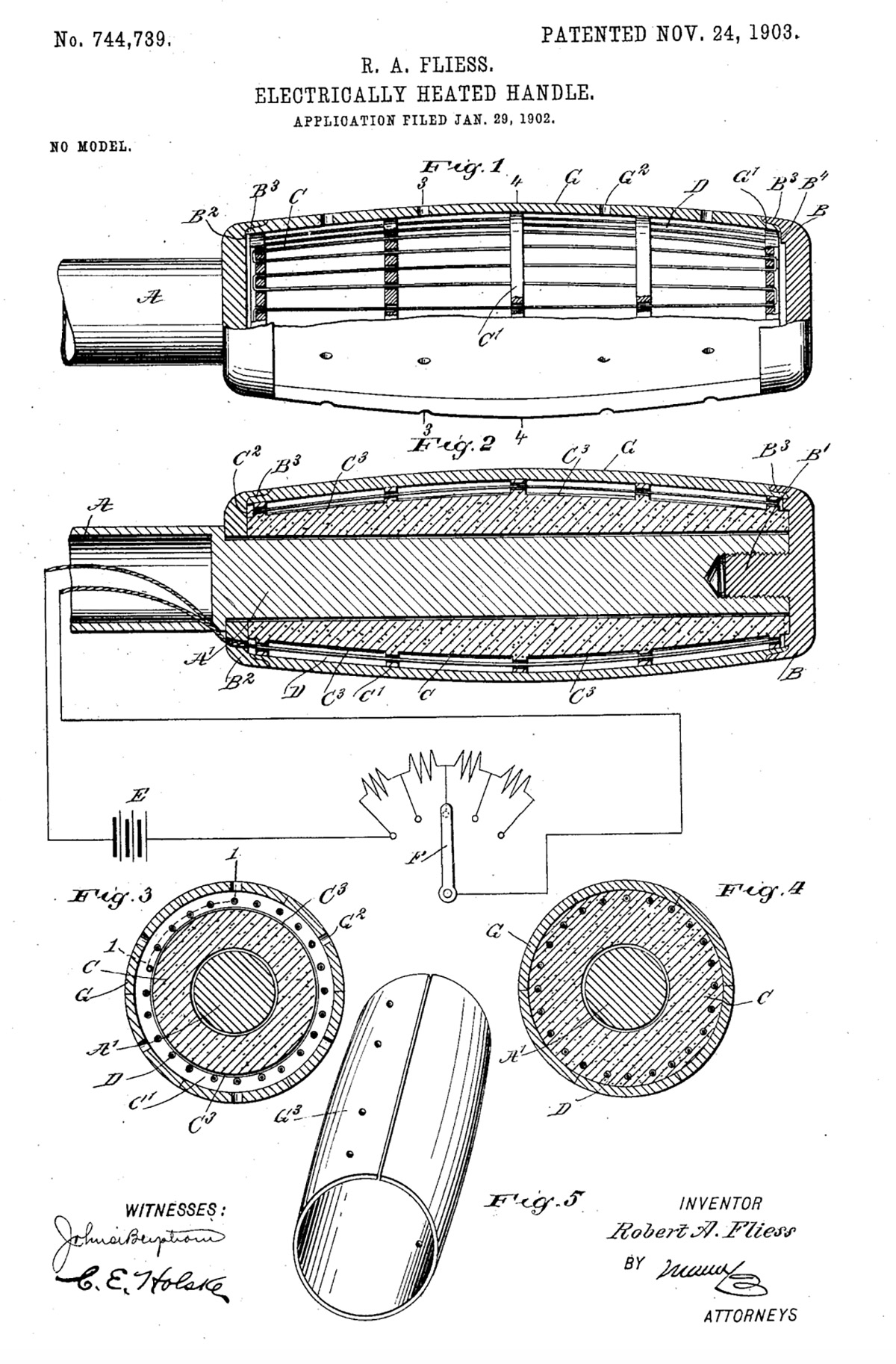
Patented by R.A. Fleiss in 1903, this was a handle with what appears to be four resistive heating coils embedded within it. A simple four-position switch seems to allow for one to four coils to be active at any time, giving it the ability to have four heat settings in a simple way.
It seems like versions of these electric resistance heaters eventually made it to market, with one of the more common options being aftermarket add-on heated grips for steering wheels:
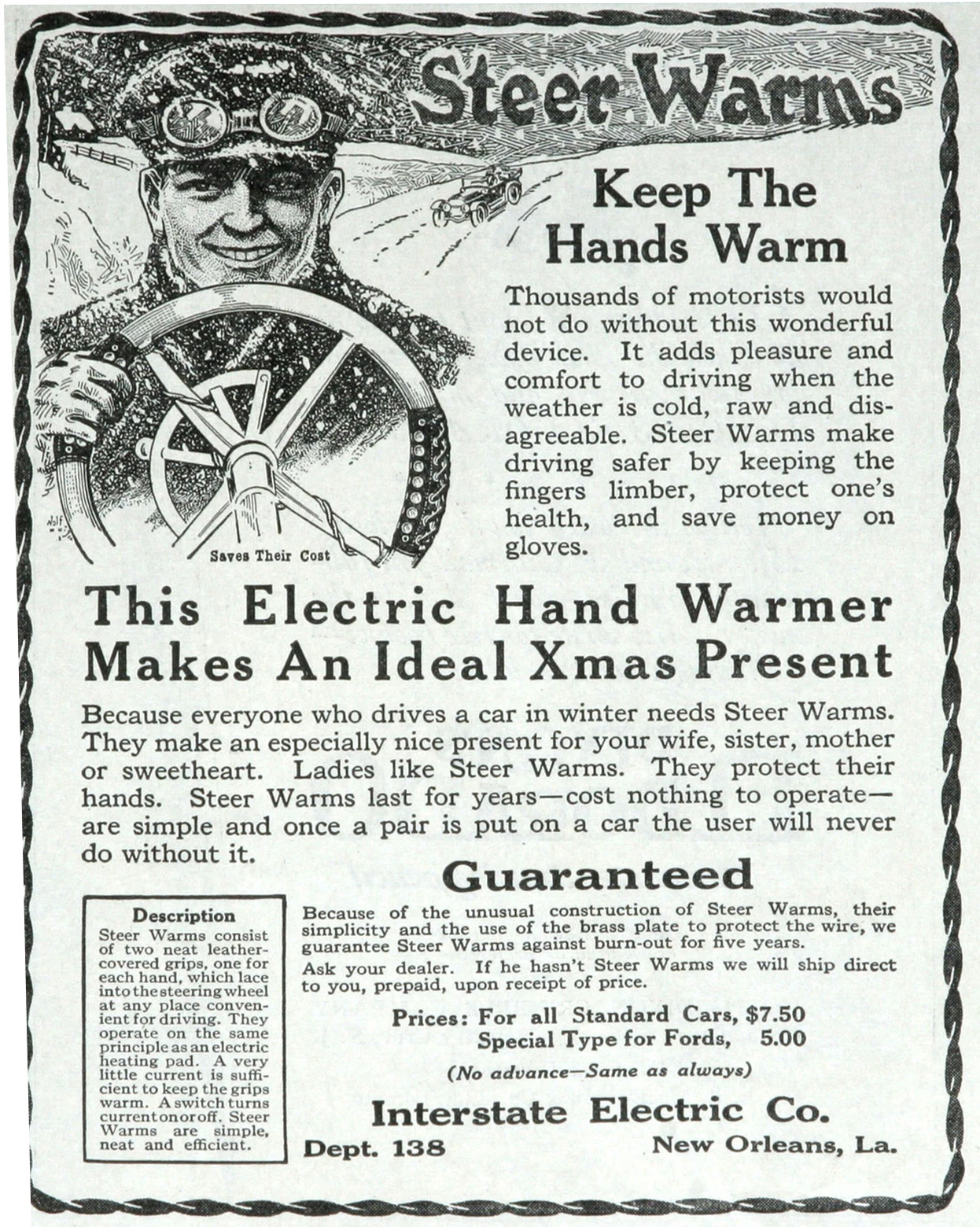
Products like these “Steer Warms” were wired directly to the battery or magneto of your car – it looks like they had a generic version, then a cheaper version for Ford Model Ts, which, at $5, would be about $170 today.
I bet these worked pretty well, though I can imagine the insulation on the wires would get brittle and crack, and I wouldn’t be shocked to learn these things ended up causing some fires, but I don’t know that for sure.
Still, in an open car, in the bitter cold, I’m sure drivers were thrilled to have something like this.
Those exhaust/coolant-warmed ones, though, I think I’m good taking a pass on those.




Are you telling me that Steer Warms will both “Protect my health” AND “Save money on gloves”!?
“and there’s all the potential for exhaust gases to be leaking inches from your face.”
You say that like it’s a bad thing.
Drive a black car with black leather interior in the south and you have heated seats and steering wheel and shifter and arm rests and door sills all summer long!
Funny, “black car” and “black interior” were my only two dealbreakers on a car 🙂
I also told myself ventilated seats were a must, but cloth or perforated leather are still pretty good compared to solid leather. Nothing like showing up with the bottom half of my shirt back sticking to me in a dark semicircle for all to see!
Well, I guess I stand corrected in assuming this was just some latter-day candy-ass solution to people who find gloves too intrusive /s
I have one and use it regularly, but it’s also the feature I could most easily live without. I’d gladly trade it for, say, a much cheaper and simpler CD/DVD combo in the dash.
I also think wheel warmers have been bolstered by touchscreens, which subtly discourages people from wearing gloves.
Do you live somewhere where it gets cold enough where you can feel the cold steering wheel sapping heat out of even gloved hands? I do. It’s not a necessity, but you won’t find me complaining about my heated steering wheel.
Oh wait I missed your very obvious /s my bad
Gloved hands, not really — That layer is usually plenty to keep me okay until the cabin heat takes over, plus the sympathetic warming effect of heated seats can also help your extremities, as well (you won’t find me complaining about good heated seats!)
Central AL without a garage means plenty of sub-freezing mornings, but single digits are rare. Around freezing is more typical and touching the wheel without gloves is still a shock to the system. I guess that’s why I have driving/running-wright gloves in my coat pockets most of the time. Heated wheels are still pretty cool, but it was something we all just did without for the majority of history, even though we had the tech to make it happen pretty easily.
I’m not saying “suck it up! Back in my day…” but it’s still a curiosity to me why it took so long. Or why ventilated seats are still a “premium” feature while heated seats are so mainstream. The tech for either one is pretty simple.
I love the heated wheel in my Nissan Ariya (as well as the heated/cooled seats), which I have set to come on automatically based on temperature and it works flawlessly. But if I do need to modify any settings on the touch screen with gloved hands, it’s not a problem with these North Face “e-tip” gloves. I’ve had them for many years and they work flawlessly on my phone and on the screens in my car.
I would not hesitate to guess that these did not work very well and that is why heated steering wheels all but disappeared for a bunch of decades.
I love a good heated steering wheel, but I often wonder what the heating elements are doing to the surrounding materials. I wonder this about heated seats too. And why is it that the heat is strongest in the parts of the wheel where you don’t grip? I would think the heat would be strongest from 8:30 to 10:30 and 1:30 to 3:30, but my experience informs me that it’s warmest at 12 and 6. Maybe the three cars I have experience with were outliers?
I think the heat is strongest where you don’t grip it because the heat is being conducted into your hands.
Yes, your hands are cooling the heaters. And they are liquid-cooled.
Looked at another way, your hands touching the wheel remove heat from the surface faster than the air touching the rest of the wheel, plus radiative loss.
Steer Warms are made of leather…I wonder if it’s leather from a steer?