

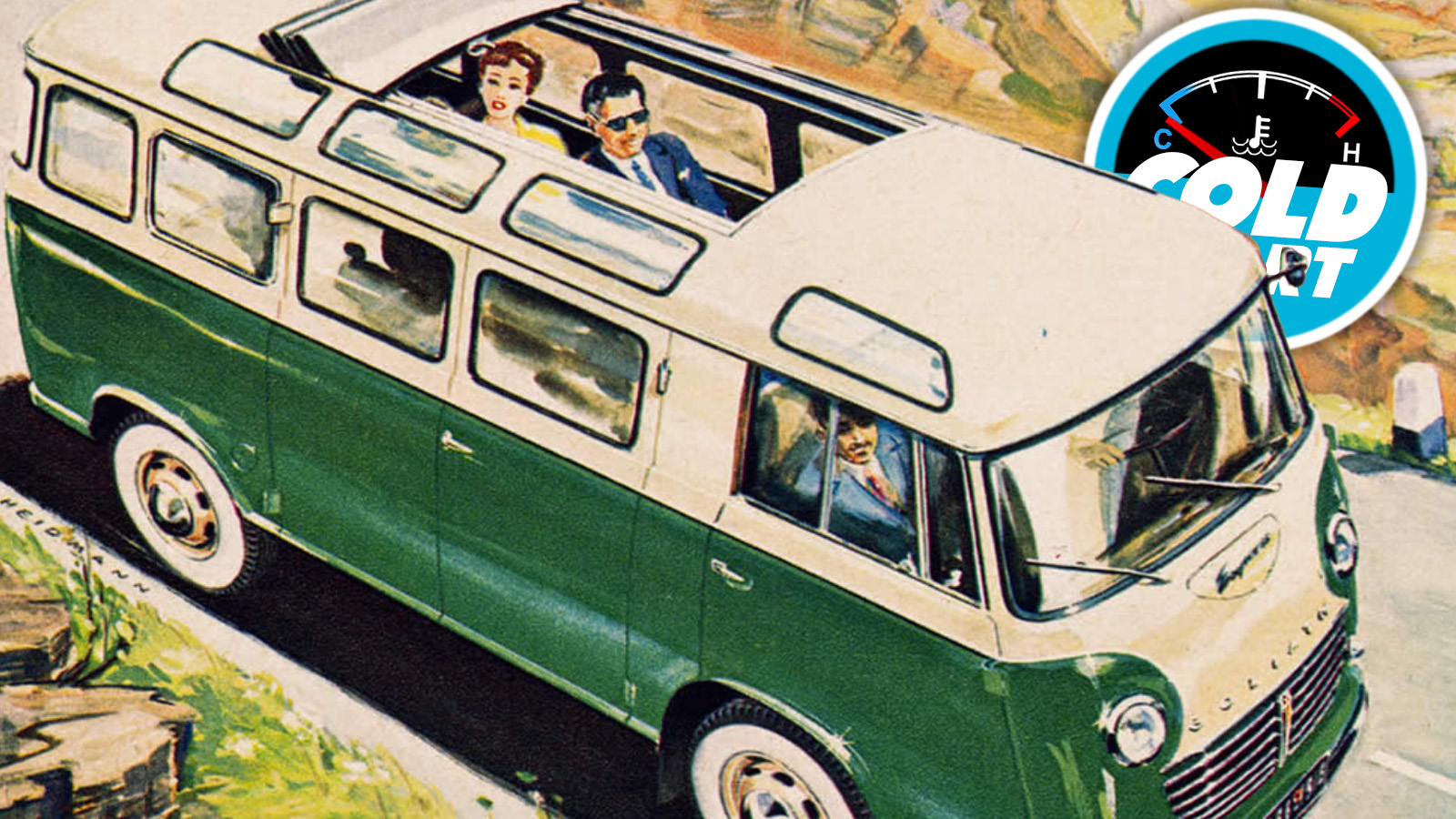
Have you heard of the concept of carcinization? It’s a type of convergent evolution where animals keep evolving into crabs. Or at least very crab-like animals. There’s just something about the crab-like body plan that just seems to work in a wide variety of environments, so much so that crab-like bodies have evolved in at least five separate times! It’s amazing. And you know what it reminds me of? Post-war Europe! And instead of crabs, the body plan that everything turns into are bread-loaf-shaped vans and commercial vehicles like the Volkswagen Type 2 Microbus.
The Microbus shape and basic design emerged in 1950 from VW, but a number of other buses with extremely similar shapes and market niches appeared on the market right around the same time; some were even a bit earlier, like the DKW Schnellaster from 1949, but most were just after the VW, like the Mercedes-Benz L 319 in 1956. Today I want to talk about the Goliath Express, because it is very Microbus-like.


Goliath was a German carmaker that was part of the Borgward group, and primarily focused on two-stroke passenger cars and three-wheeled utility vehicles. The Express came about in 1953, responding to the same sorts of postwar pressures for a commercial vehicle that spawned the birth of the Microbus. As you can see, the solution to that problem looked a hell of a lot like the one VW arrived at:
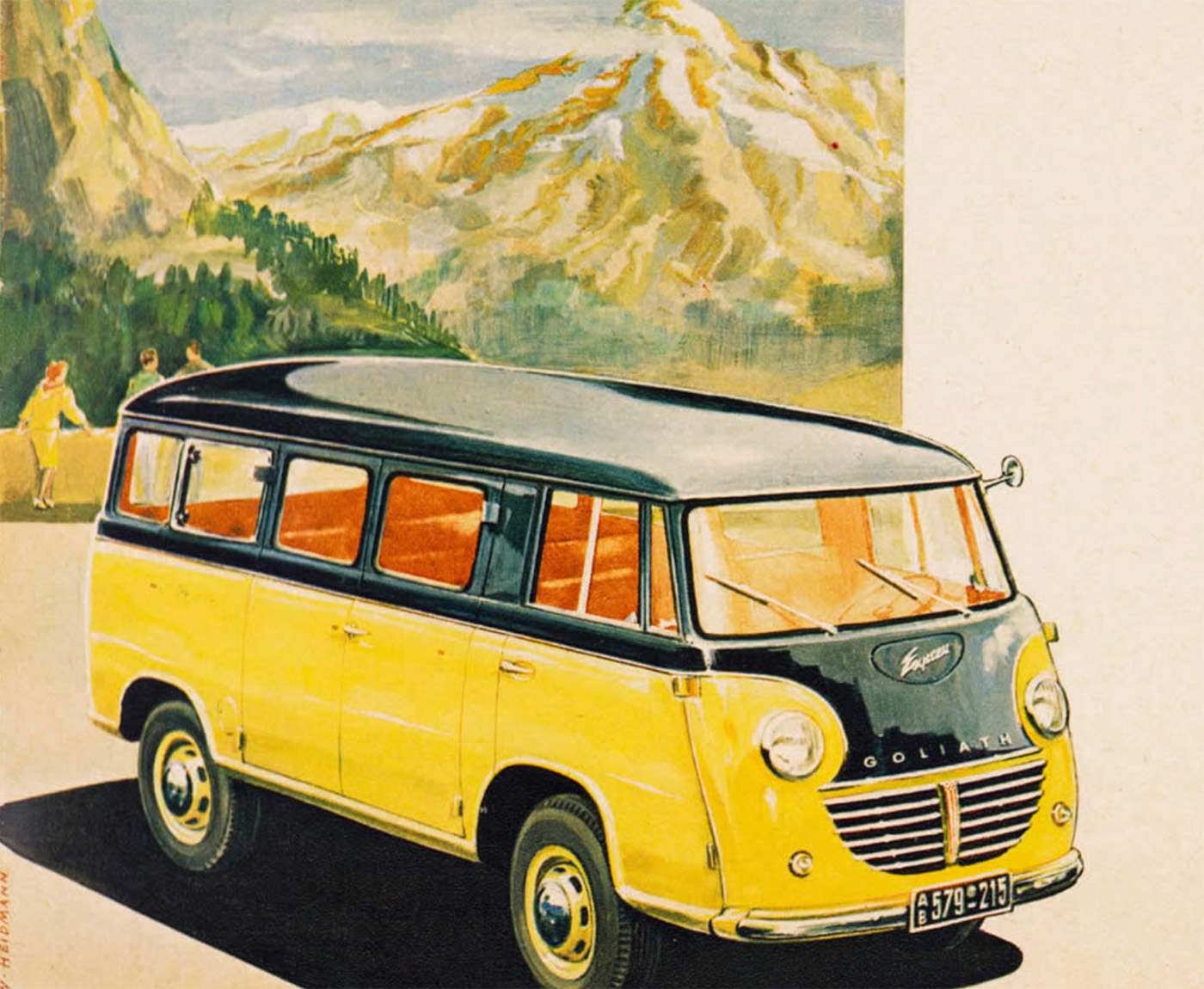
Same loaf-of-bread shape, same two-tone paint options for their passenger-carrying variations, same dual-rear-side-door entry, same optional sunroof and roof-mounted windows (see top image), same almost everything! Well, almost is doing a lot of work here, because these were quite different mechanically:
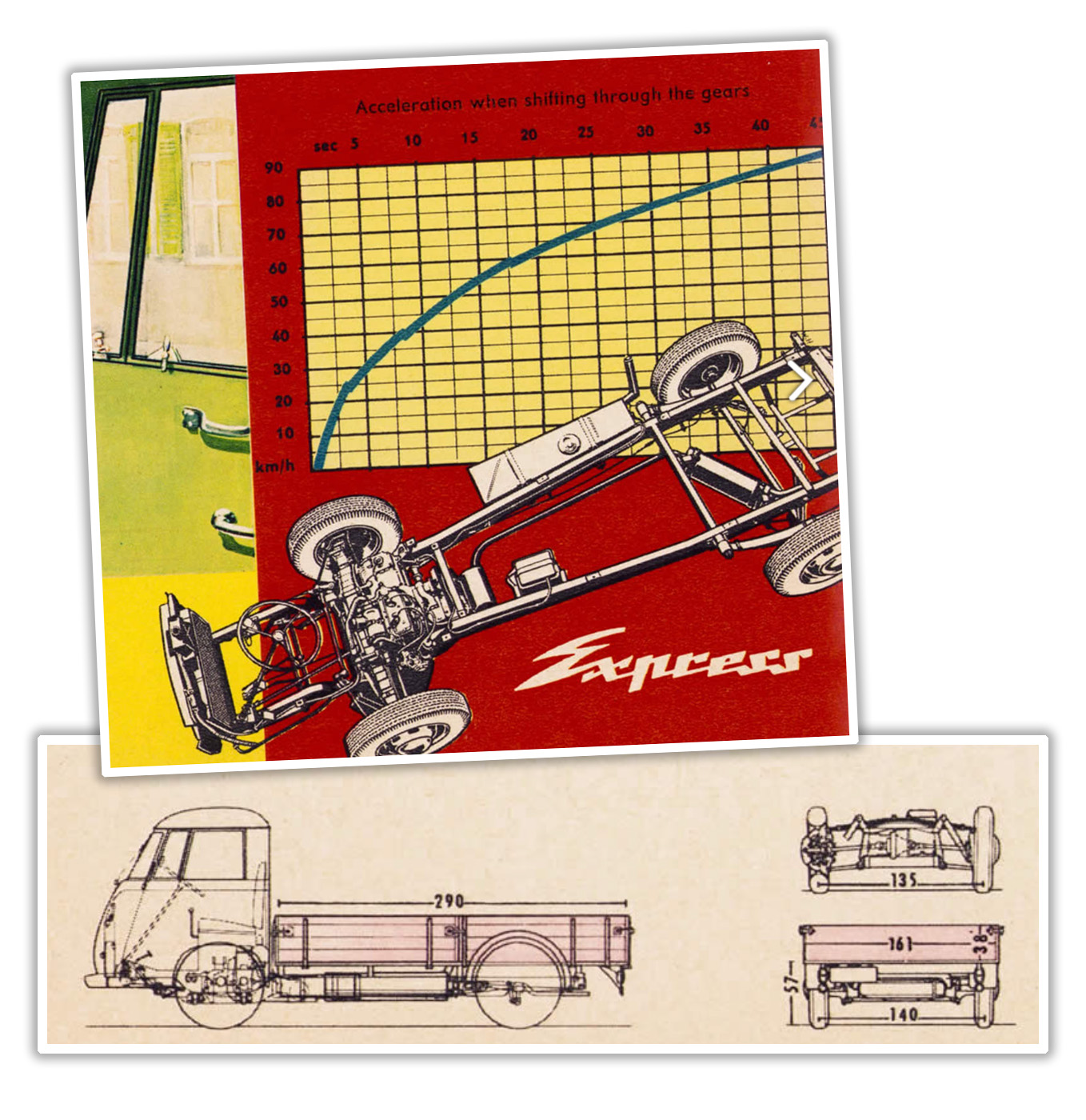
As you can see, unlike the rear-engined VW, the Goliath was a front-mid-engined design, and used a two-cylinder, two-stroke 900cc engine that made 40 horsepower; the VW flat four at the same time was making 36 hp from 1200cc, so the Goliath engine was impressive from a power-to-displacement standpoint. Plus, the packaging of the Express is pretty great, too: by packing the engine under the seat, the Express managed to have a flat load floor all the way to the rear, something the VW did not have. It’s a good packaging design, and seems to anticipate Japanese front-mid-engine vehicles like the Toyota Previa and so many Kei vans and trucks.
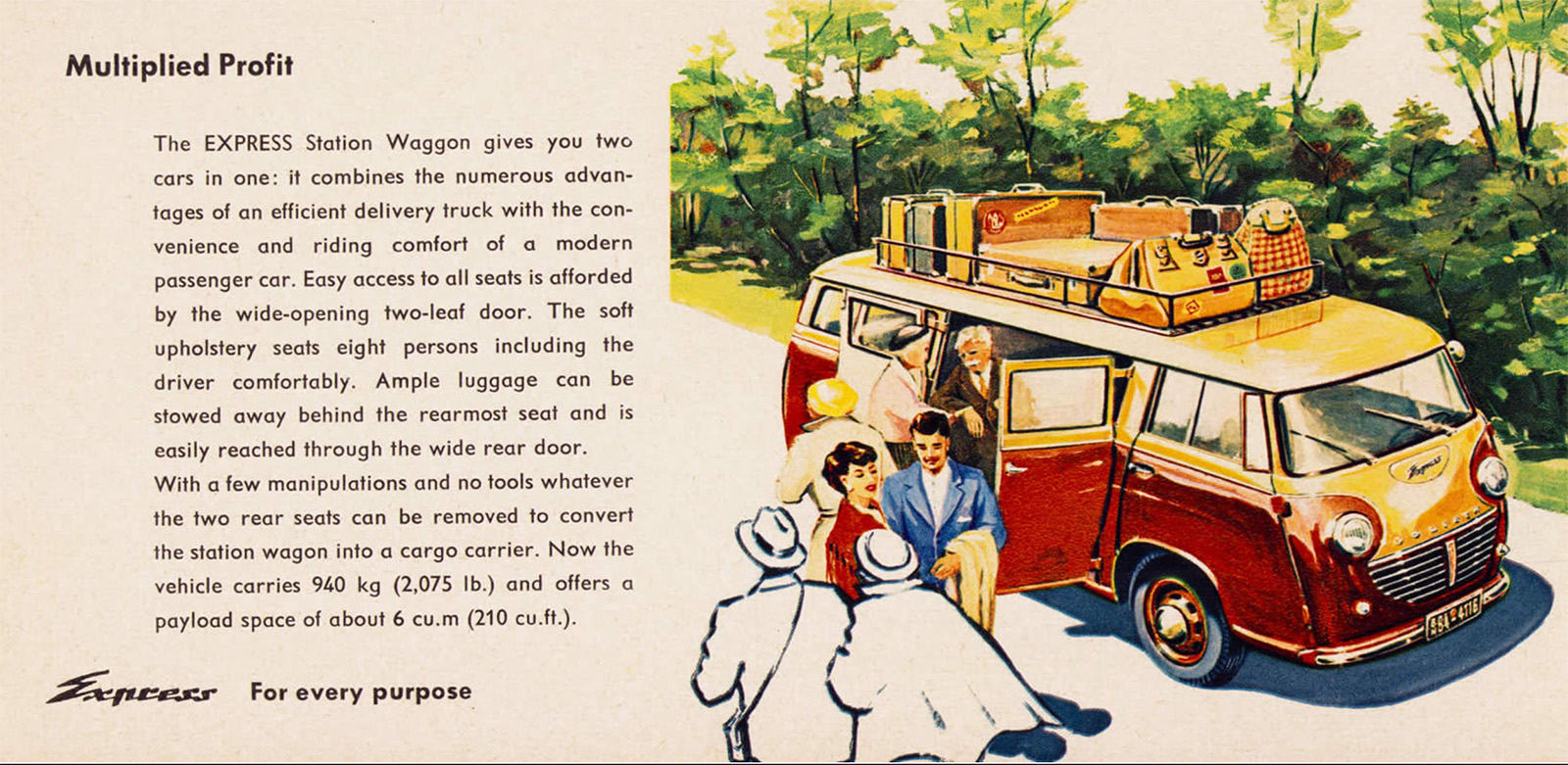
It’s also interesting how much marketing terminology was shared between the Express and the VW Type 2; in America, Volkswagen referred to the Microbus as a “station wagon” starting in the ’50s, to make it more palatable to families that couldn’t wrap their midcentury heads around daily-driving a “bus.” And here, in this 1957 Goliath brochure, we see the same thing, even if they added an extra “g” to “wagon,” calling it the “EXPRESS Station Waggon.”
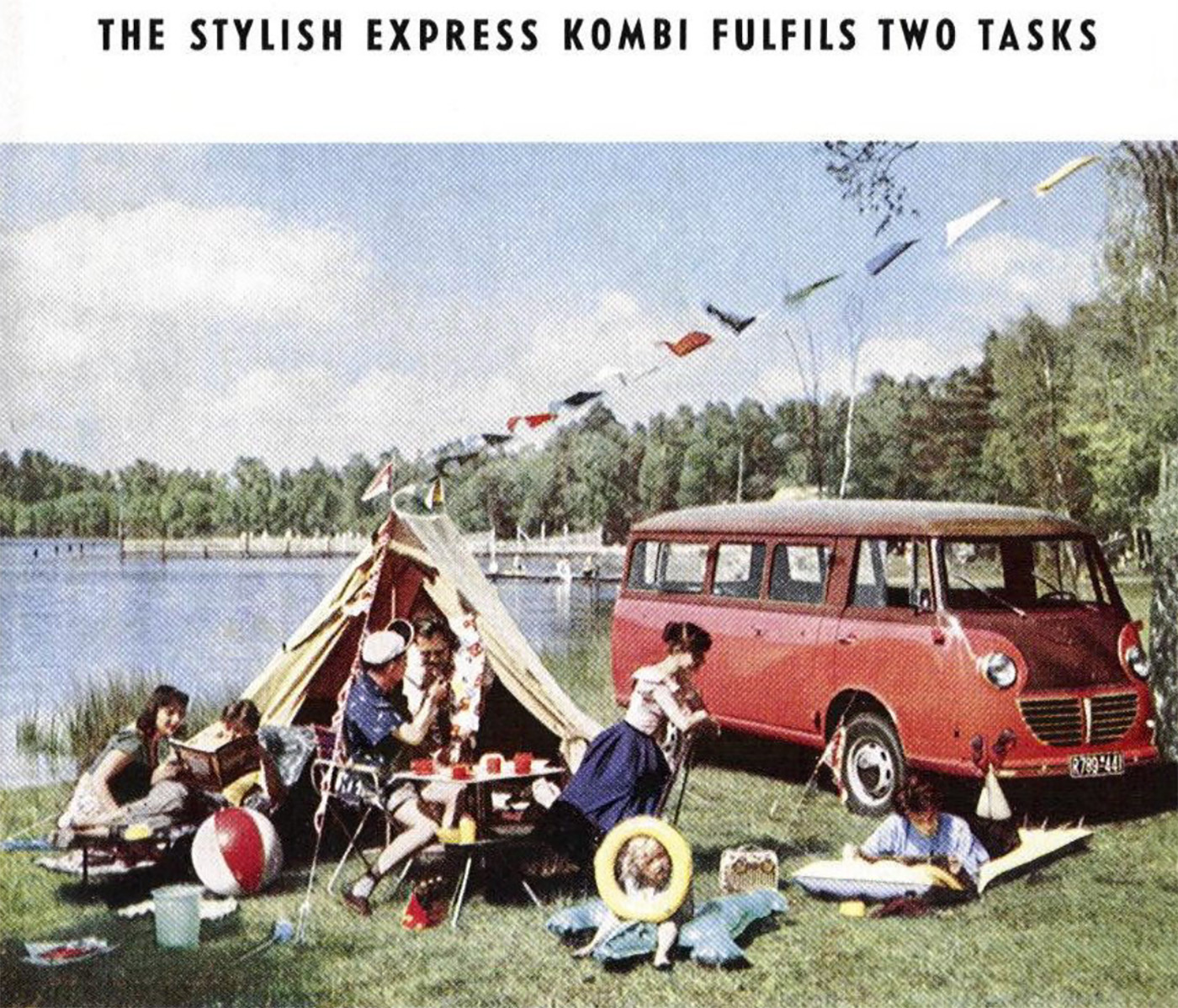
The VW Bus was also called a “Kombi” in many markets, and look at this: so was the Goliath!

There were pickup truck versions of the Goliath, like the VW, though the Goliath ones had a simpler, wooden-slatted bed that lacked the VW’s under-bed storage lockers. The faces of the Express were as expressive and happy-seeming as a Microbus, though, with a big smiling grille and what look to be the same double-glass Hella headlamp units that the VW and DKW and Mercedes vans used!
Also, is there anything more comically Germanic than a little happy van with “GUMMIWERKE” written on the side?


That is delightful, very happy looking.
Mid engine and fwd… so like the Toyota egg van 30 years earlier!
Quick search… 1st page results very few Goliah vans available for sale over the last few years, which for an obscure 65(ish) european bread loaf van makes sense
FCVs also include the Tempo Matador of the time. But perhaps slightly larger.
Kombi just meant a van with seats in the previous century.
In Germany at least… In Sweden it means a station wagon.
Metzeler Gummiwerke…for when you’ve got a fever, and it requires more gummipuffers!
“Perhaps I can help. My papa is foreman of the Dusseldorf gum-works!” Üter Zörker, The Simpsons
“Zee Germans are not all smiles and rainbows Mr. Simpson!”
Love the way the attendant at the “pumping station” (which is really all servicre stations are these days) looks like he actually works on cars.
“Waggon” was the accepted spelling in New Zealand up until 20-30 years ago; I always find it jarring.
I like the way the acceleration chart doesn’t even get to 100 km/hr, and it takes 45 seconds to get to 90. And is that the gas tank outside of the chassis?
Looks like it was FWD too? Chalk one up for the ultra-rare MF drivetrain layout.
I have never wanted a thing I knew nothing about as much as I want that yellow and black Goliath
The ad with the Gummiwerke version mentions it uses a Bosch fuel injection pump. Am I wrong in thinking that significant?
That is most likely a case of mistranslation, it’s probably just a Bosch fuel pump
Goliath did offer direct fuel injection in 1951, on the Goliath GP700E Sport (and later the GP900E), but I doubt that it was available on these.
Well it seems they actually offered fuel injection, at least according to this page (https://www.goliath-veteranen-club.de/en/typologie/zweitakt/27). It states that they offered a carbureted version with 38 HP and a fuel injected one with 40 HP. Amazing!
That’s crazy talk. Direct injection two-stroke, mid-engine, and front-wheel drive is surely a unique combination.
I’m still trying to wrap my head around this..: if it really had direct injection, how was the lubrication achieved? Did it have a little oil injector (or dispenser) in the intake?
On a long enough timeline, every family car becomes a wagon. Vans are included in this. They’re just high roof wagons.
SUV? Tall wagon
Crossover? Comfy tall wagon
My Excursion? 3/4 ton wagon
Shooting brake? wagon coupe
Pickup truck? open air wagon
It’s wagons all the way down.
We need to reinvigorate the sporty family wagon again.
Wagons on the top of four elephants on the back of a giant turtle. Somehow I imagine a brown, manual turtle but that’s just silly.
Hatch back: mini wagon
Shortroof Wagon?
Truncated Wagon?
Tailless Wagon?
W: Wagons
A: Are the
G: Genuinely
O: Only
N: Necessary
S: Shape
I’m just excited about the “superb springing” in the Express panel truck.
Torch sees a future in which we evolve into crab people. With the intelligence of humans and the succulent meat of crabs, they will be nature’s most perfect beings.
So, dumb crabs? Humans are already tasty.
Username checks out.
“Craaaaaaab People, Craaaaaaab People. Taste like crab, talk like people!” – South Park
Would this be called the Microbization? Or Microbuzation?
Microbation, probably.
It looks so happy
carcinization is my new excuse.
Curmudgeon? I’m evolving! Now get off my lawn or I’ll give you such a pinch!
Is a “Gummiwerke” a factory that makes gummy candy?
Rubber factory, more likely. Though Gummi is also shorthand for eraser in German, so this could be a rare glimpse into the oft-ignored world of eraser production, where logistics is seemingly handled by loaf-shaped vans.
My favorite eraser is the STAEDTLER® 525 B, which with some light use quickly starts to become loaf shaped. I also assumed STAEDTLER was German, but never bothered to find out
It is German, reason I know this is for livery creation in GranTurismo. Don’t remember the number, the newest one that removed basically the single player portion.
I had a Staedtler themed Porsche 962c. It looked like an eraser.
Metzeler is a German brand of tires, nowadays Motorcycle tires. At that point in time they were likely making tires in more sectors, though.
In Italian, a tire is una gomma, and a tire dealer is a gommista