

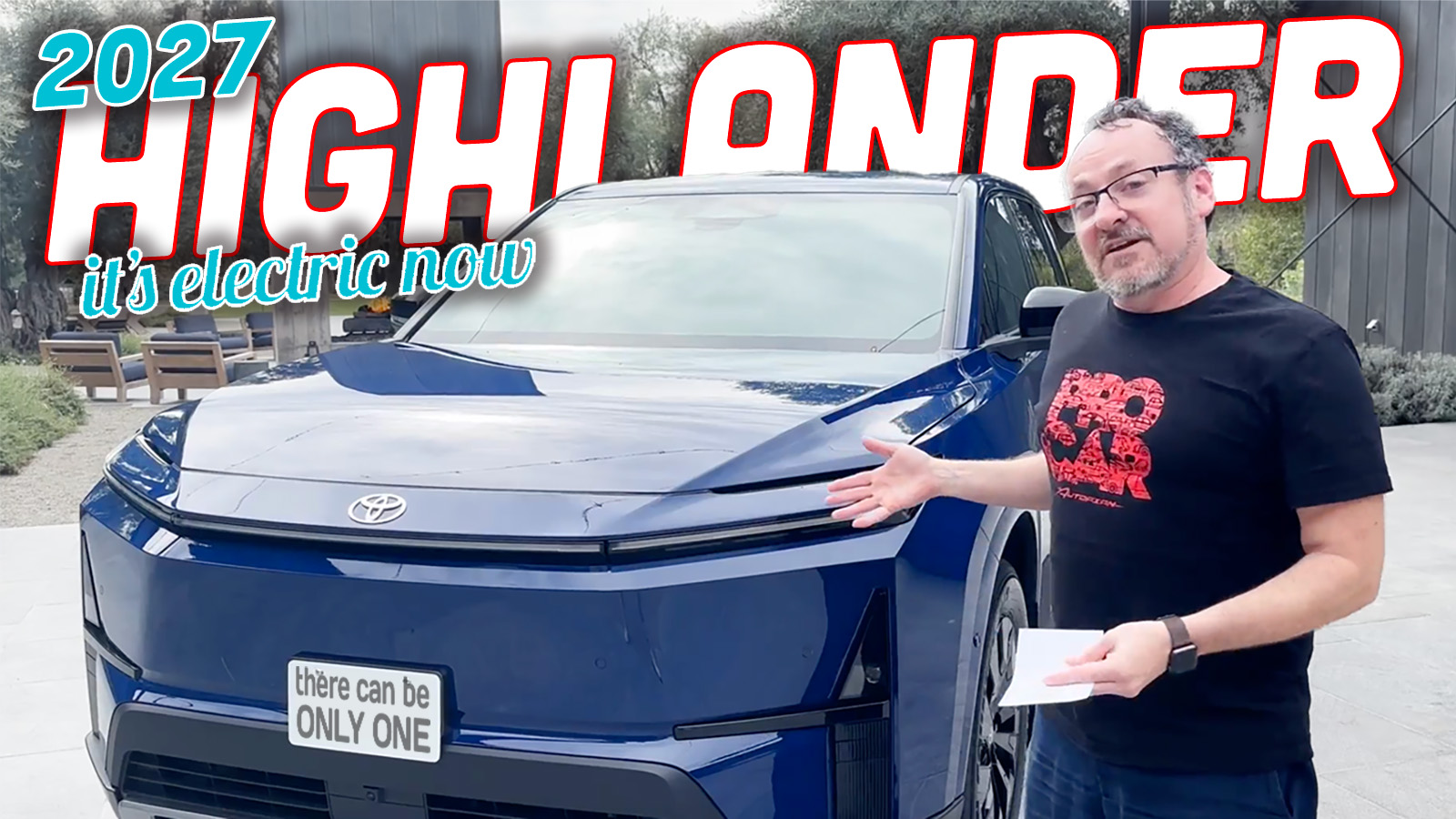
You may recall that there was recently some big news in the non-immortal-person Highlander world: Toyota has announced an all-new Highlander that is now a battery-electric vehicle. Even though this is sort of an odd, maybe inopportune time to release a new battery EV into the market, it makes a lot of sense as Toyota’s combustion-engined Grand Highlander, introduced in 2023, now outsells the current Highlander by about 2.5:1 .
Toyota has effectively made the old Highlander redundant, which means they’re free now to replace that model with something new, that fills a similar market hole but is radically different under the skin: a battery-electric crossover.


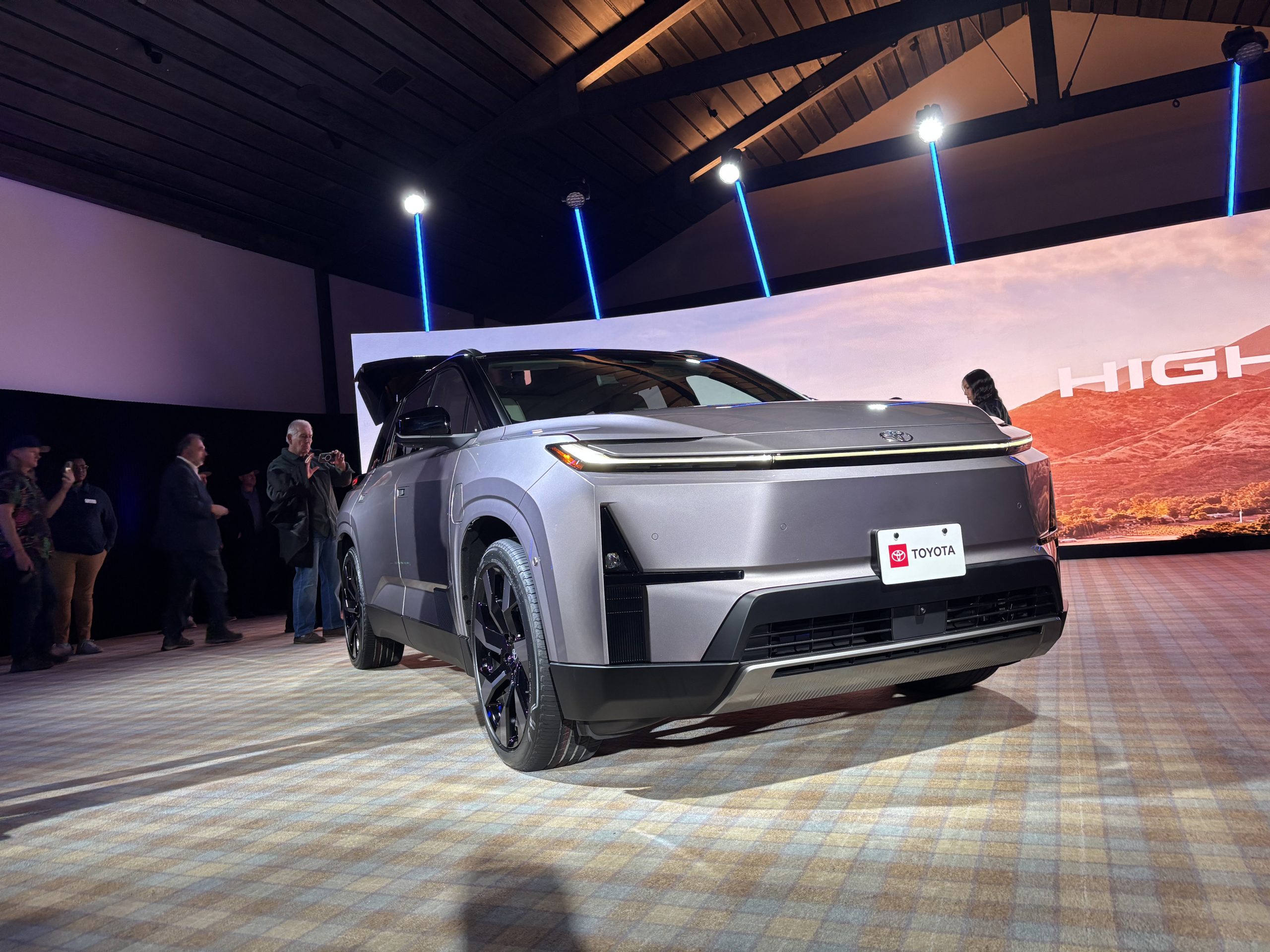
This new EV Highlander is Toyota’s first three-row EV to be brought to America since the founding of the country in 1776. Toyota seems quite excited about their new mass-market EV crossover, and good, they should be, though I think they may be getting a little PR-delulu when they write headers in the press release like:
“Highlander Reimagined for 2027, with All-New, Head-Turning Style, Elevated Comfort, and All-Electric Powertrain”
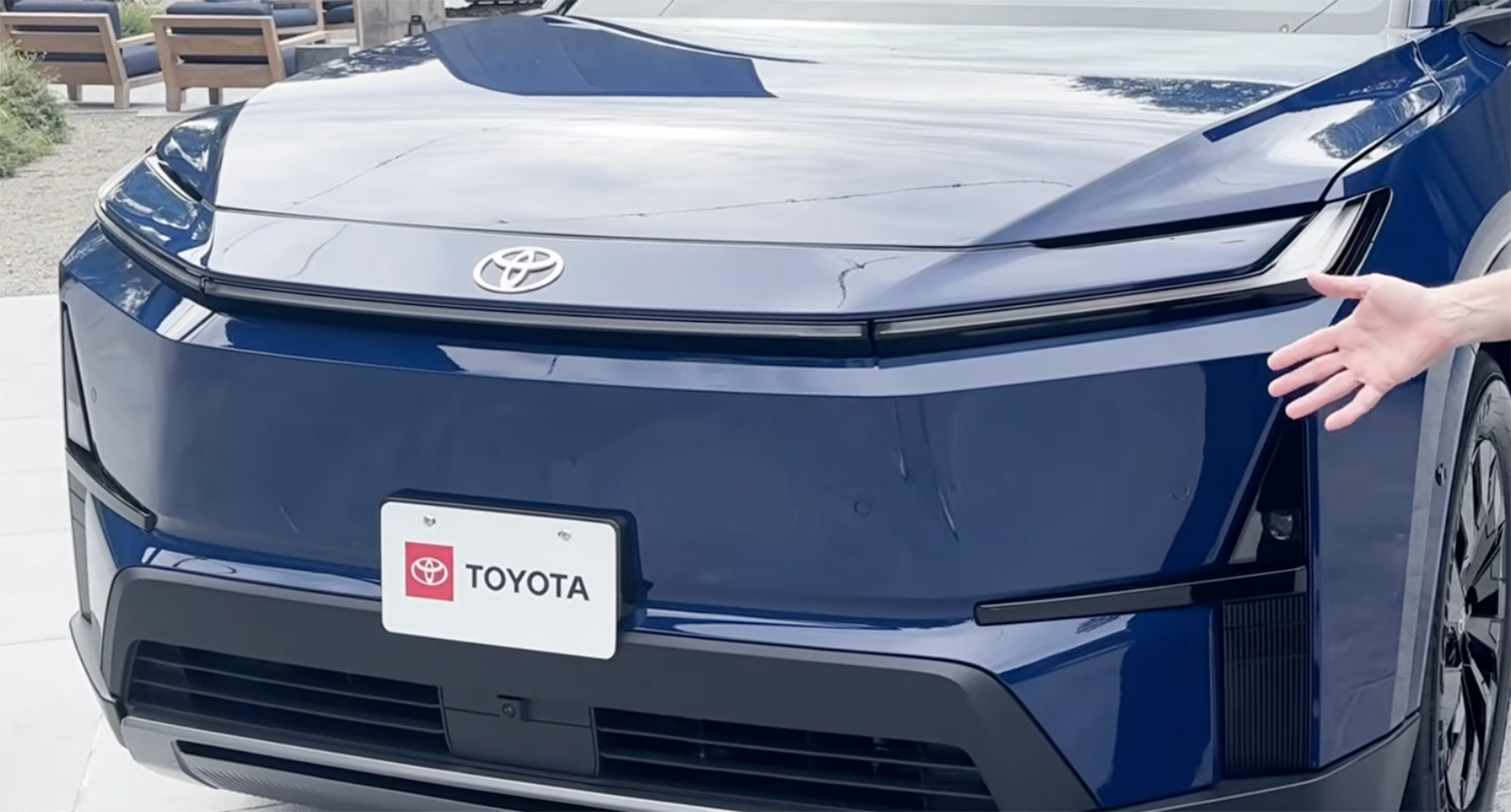
Nobody’s head is turning unless a Highlander accidentally clocks someone with a side-view mirror. I mean, it looks good, don’t get me wrong, but there could have been one parked at your local Target and you’d have walked right by it. That may sound harsh, but let’s just be honest here. Again, the redesign looks good, and the car now features what is becoming Toyota’s new corporate face, which was first introduced with the latest Prius redesign, and is a clean, largely grille-less affair with Toyota’s now signature thin LED light bar that angles up at each end into the DRLs.
Before I get too much more into telling you about the Highlander from what Toyota has told me, why don’t I show you what I found out based on questions you, our svelte and charming readers, asked me to find out yesterday, when I had about 20 minutes with the new Highlander:
And yes, before you even watch, I will tell you that I respected your inquiries and tried to show you as much as I could, including tasting the floormats. Here’s a still from the moment where I was cataloging the delicate dance of flavors to try and figure out how to best describe it to you:

That’s the look of a man who just licked a floormat. You’re welcome.
Since that’s sort of a deeply unserious moment, let me switch gears here and just dump all of those specs that I know you want, just to get it out of the way. We’ll start with the all-important battery size and range:
• XLE FWD with 77.0-kWh battery with a manufacturer-estimated 287-mile total driving range rating*
• XLE AWD with 77.0-kWh battery with a manufacturer-estimated 270-mile total driving range rating*
• XLE AWD with 95.8 -kWh battery with a manufacturer-estimated 320-mile total driving range rating*
• Limited AWD with 95.8 -kWh battery with a manufacturer-estimated 320-mile total driving range rating*
So, two battery sizes, ranges that range in range from a rangy 270 miles to a range-ranging maximum range in the range of 320 miles. Also: range.
Not bad numbers, nothing Earth-shattering, but certainly good enough for most of what these will be used for, especially if you’re able to charge at home. The Highlander has a NACS port for Level 3 DC charging, and Toyota claims that “under ideal conditions” when using DC fast charging, it can go from 10% to 80% in 30 minutes. Based on my experience with public chargers, I don’t know how much I’d rely on getting “ideal conditions,” but those are reasonable, if ideal, numbers.
In a way, this all feels very Toyota: careful, well-considered, and with reliability at the forefront. They may have been able to do faster more aggressive charging, but that would have introduced thermal issues and a cascade of related complications, and based on how Toyota’s technical ethos seems to work, I’m not too surprised they’re playing it a bit more conservatively.
When it comes to power, the AWD version has 338 combined horsepower from both driven axles, with 323 pound-feet of torque. The FWD versions make 221 hp, and 198 pound-feet of twisty-force. Like all these numbers, this feels competitive and certainly adequate but not necessarily surprising. If the acceleration is similar to Toyota’s bZ line of EVs, I think we can expect 0-60 number of around five to six seconds, given the extra weight of the Highlander. That’s plenty quick.
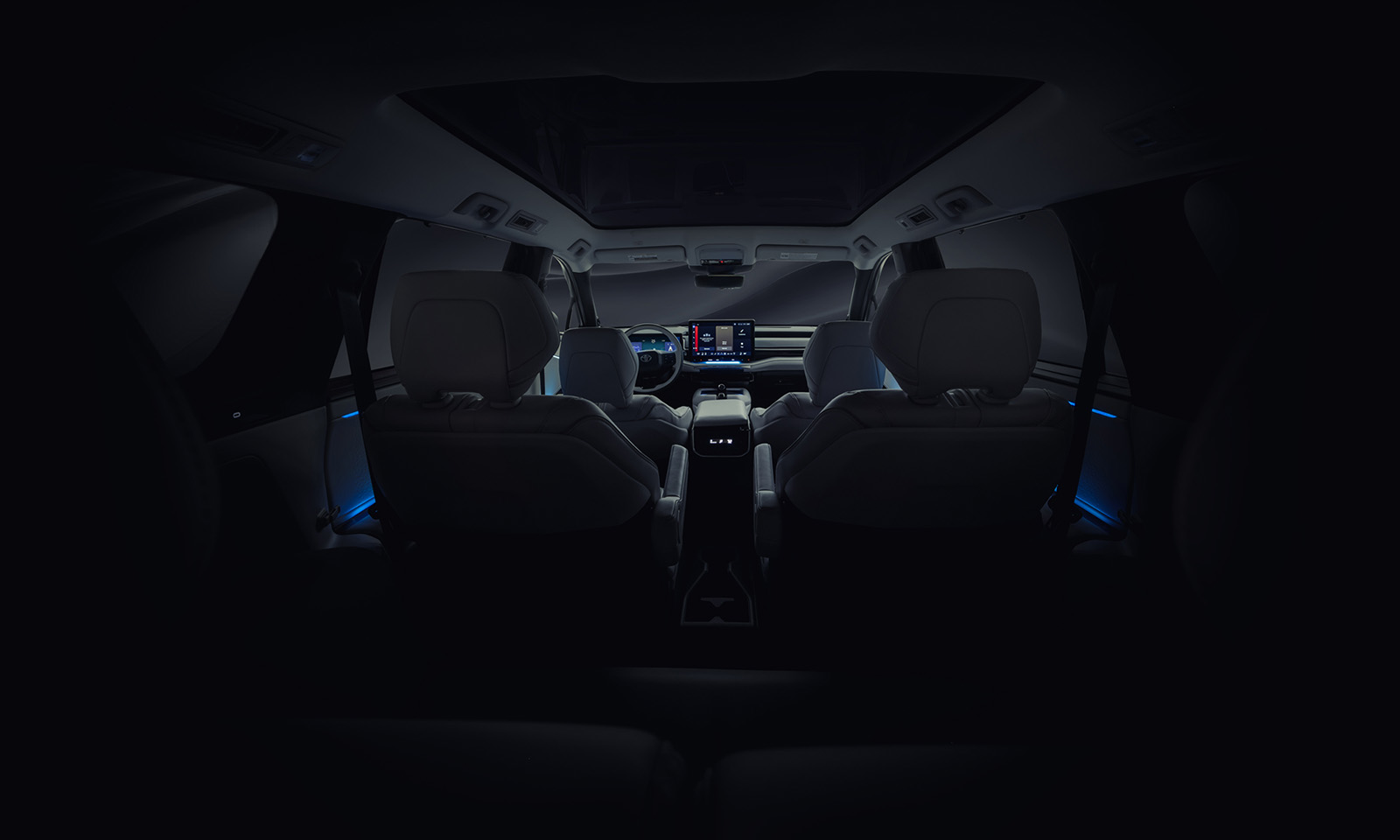
Toyota provided this absurdly dark picture of the interior, shot from the third row, and while it’s hard to tell what’s going on there, I can tell you the interior has very nice materials and a pleasing, well-considered design. It’s not particularly unexpected and while there is a sort of diagonal line/hashmark visual motif going, it doesn’t have a whole lot of genuine distinction. It’s nice, and most of the target audience for the Highlander I think will enjoy it.
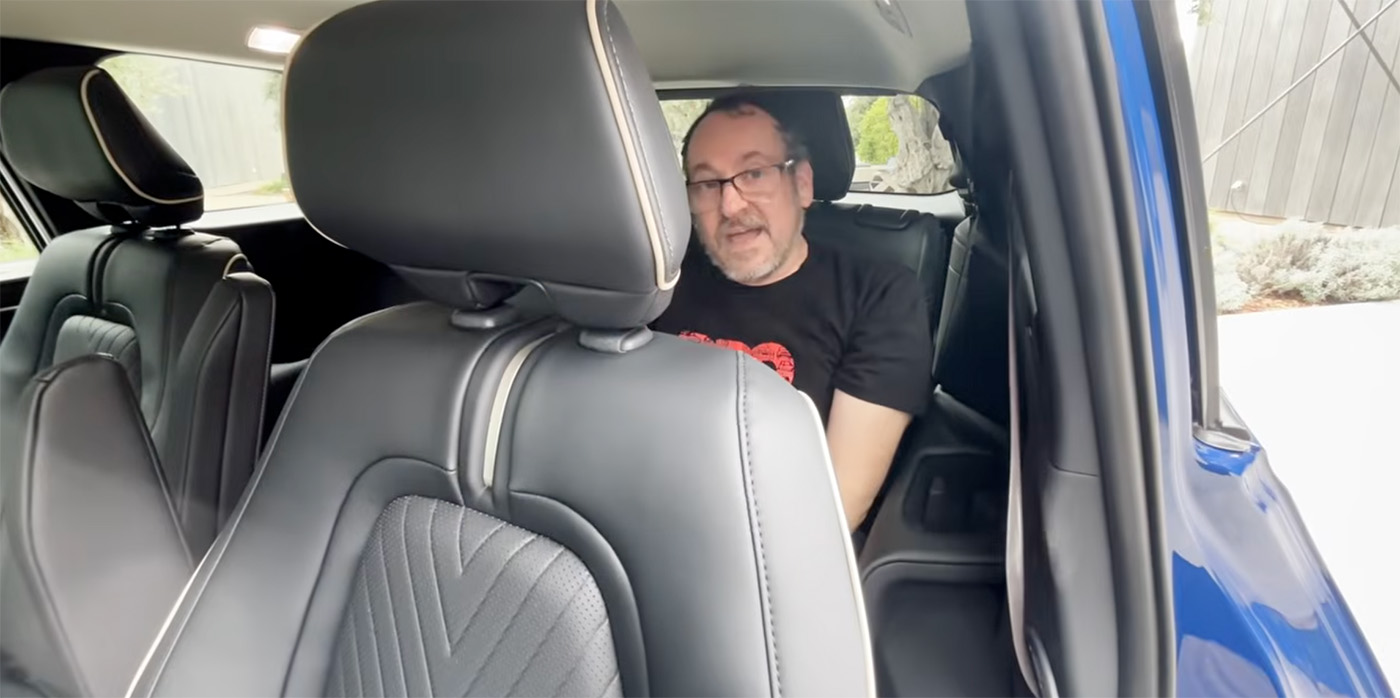
The third row is about as upright as a Methodist chapel pew but it’s pretty comfortable, and there’s a good amount of leg room, at least for a hors d’oeuvre-sized human like myself. There’s cupholders and USB-C ports back there, too.
All of the expected electronic and connectivity stuff seems to be here, including the all-important Apple CarPlay and Android Auto, along with Toyota’s suite of driver-assist tech. There’s a six-speaker audio system, a dashcam-like functionality using the built-in cameras, and the paddle shifters control the brake regen, which is a good use for those.
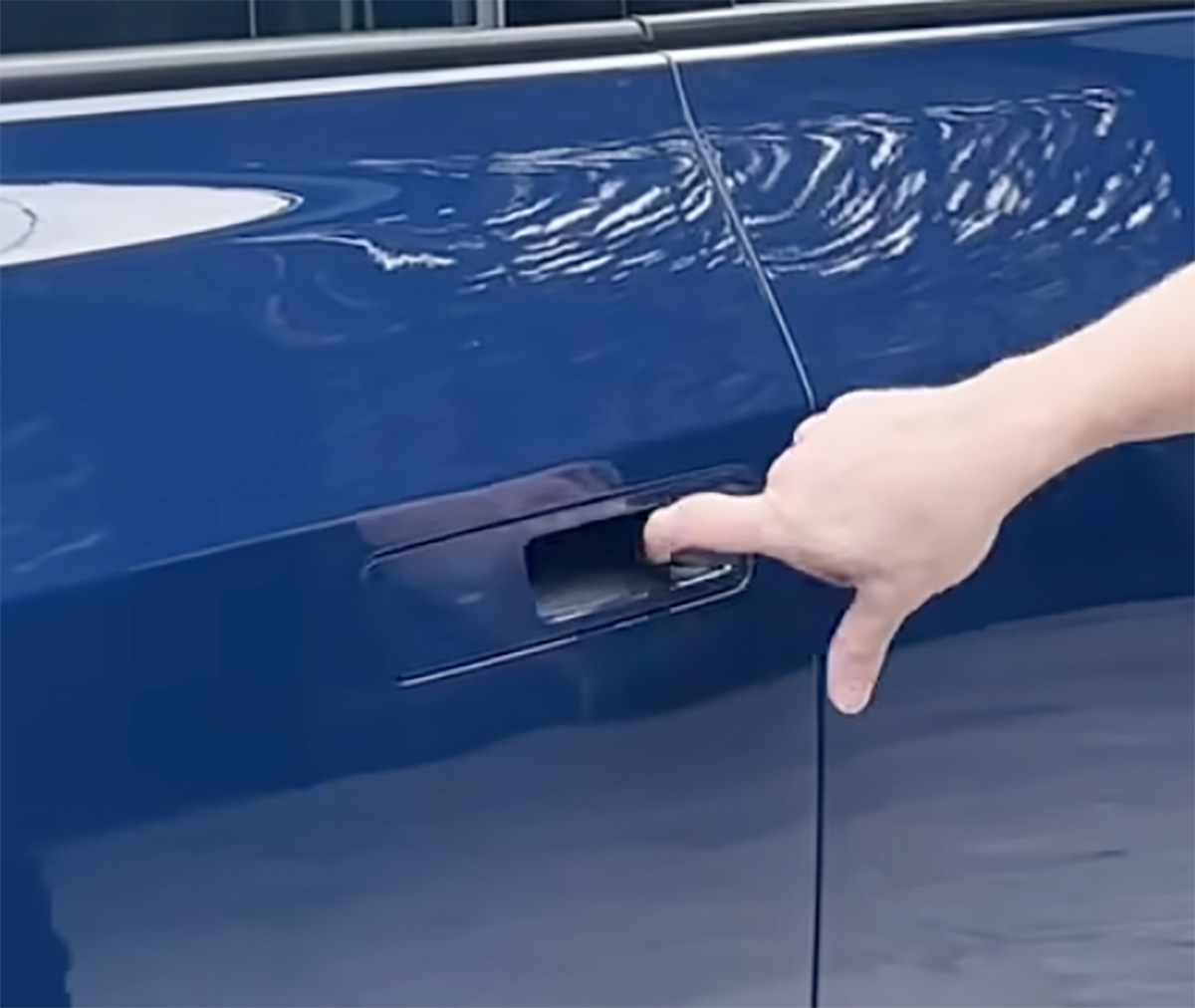
The doorhandles are powered, which I still maintain are stupid, and they have a manual release right in there, too, which, though I couldn’t get it to work, begs the question of why are they building two kinds of door opening mechanism in the same damn handle. Powered ones just aren’t that cool. Door handles are a solved problem. Just let them be mechanical, eph eph ess.
Cargo-wise, there’s a good bit of room in that boxy body; with the third row up there’s still a decent amount of room for the, oh, seven people’s luggage, if they pack light; if you watch the video, you can see that I can fit back there, too.
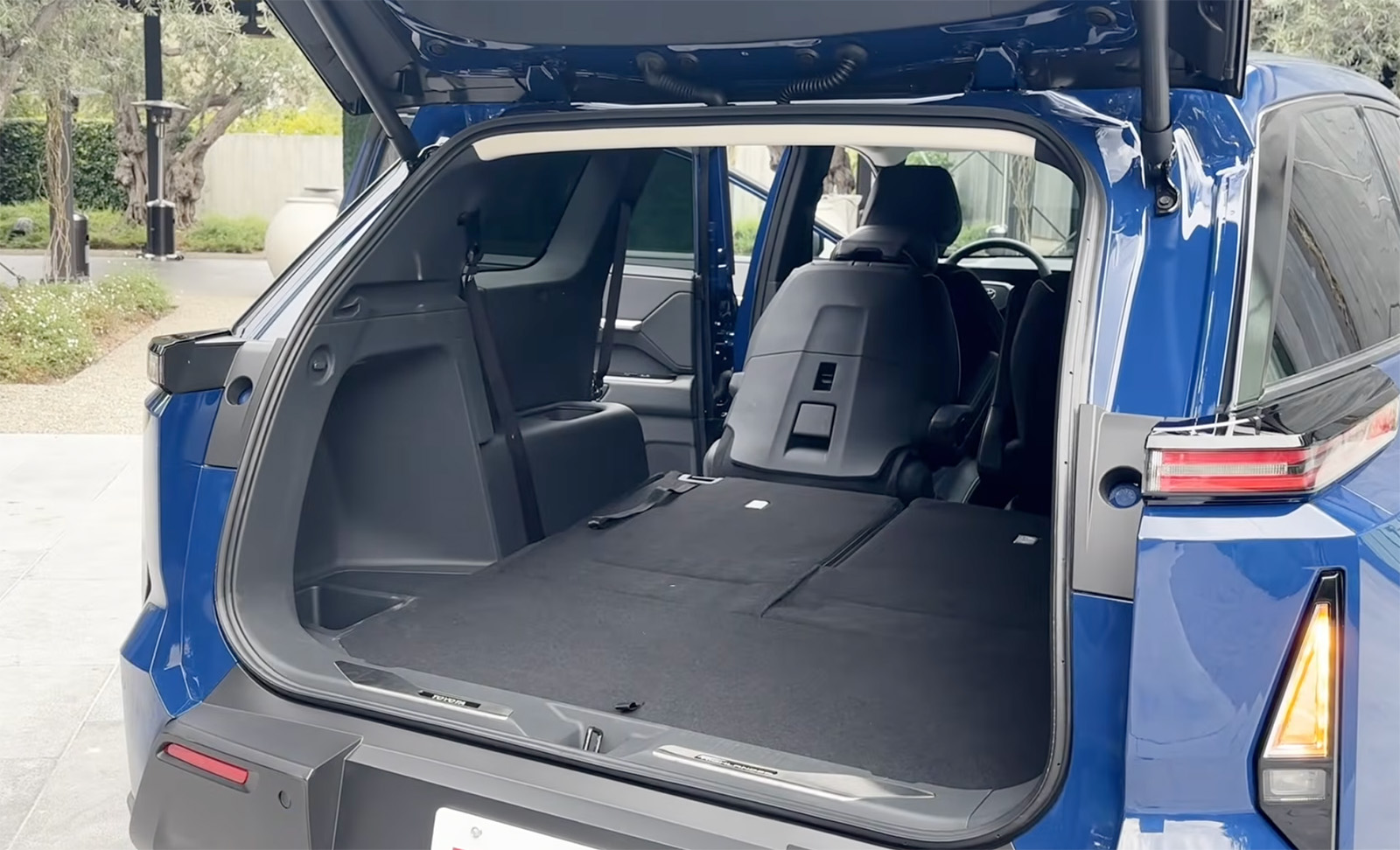
With the rearmost row down, there’s a nice flat load space that’s quite big, and the rear cargo opening is nice and wide and fairly rectangular, too. And yes, those are amber rear indicators! Nicely done, Toyota.
My only real storage disappointment is this:
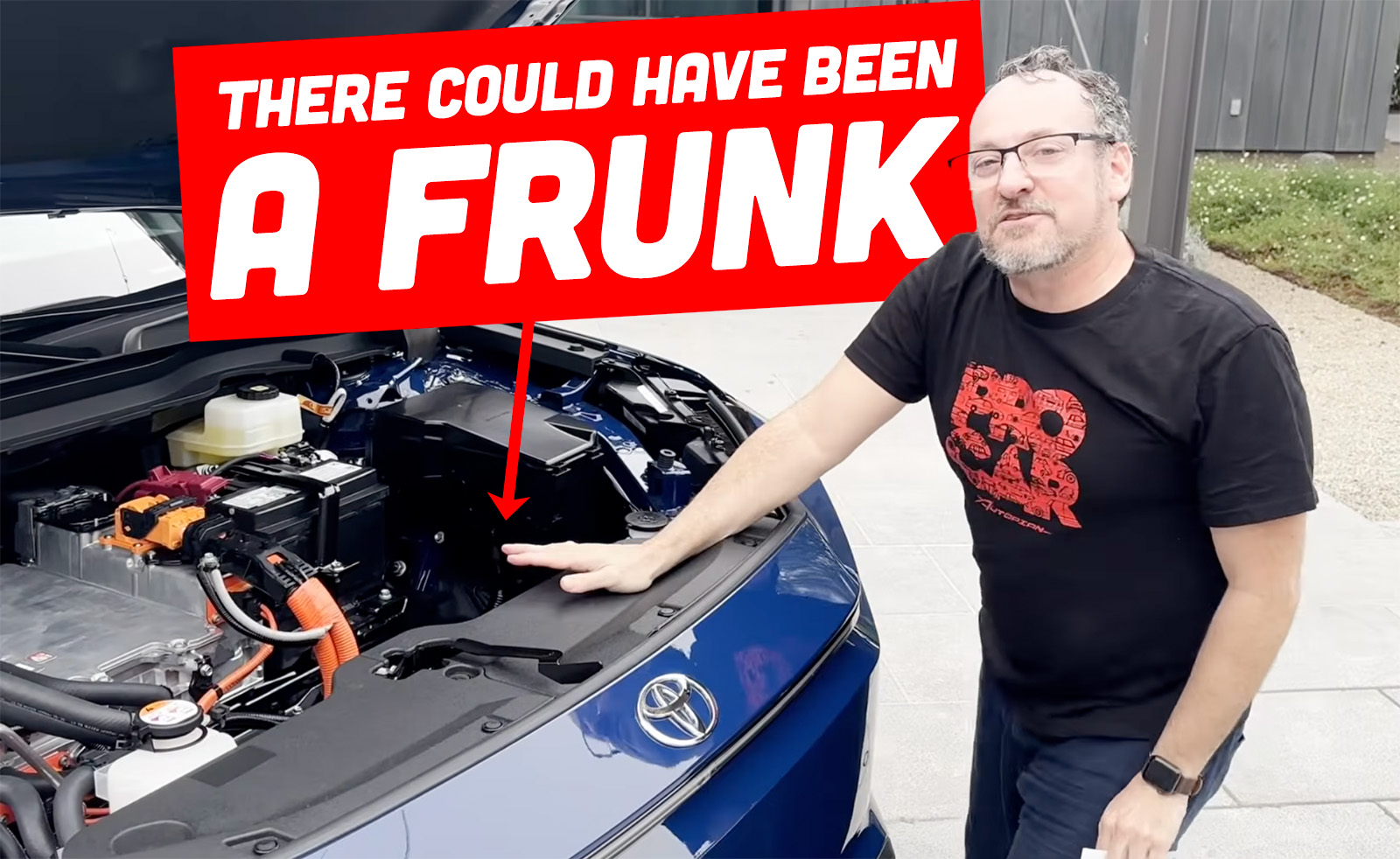
There’s no frunk. And yes, I realize the Highlander has plenty of cargo room without it, but that’s not the point. This is an ethical issue; if there is a significant volume of potentially usable space for the owner, the owner should have access to use such space. And there is plenty of space under that hood. Companies like Hyundai and Kia and Volvo and others manage to carve out small but useful volumes of space under their hoods – why can’t the World’s Biggest Automaker do the same? Frunks are great for cables and a blanket and other stuff that would ordinarily be rattling around the main cargo area.
Maybe there will be aftermarket frunk inserts. Still, it’s disappointing.
I’m about to go to the official reveal in like 30 minutes, and there may be more I’ll find out. But the embargo for this lifts at 9:30 Eastern/6:30 Pacific, and the silly rules of the internet dictate we must have something up right away, so there you go. I’ll update if I learn anything revolutionary.
Oh I almost forgot! Get a load of these color names:
“Available exterior paint colors on the new Highlander further its expressive nature. Single tone colors include the all-new Spellbound, along with Wind Chill Pearl, Heavy Metal, Everest, Reservoir Blue, and Midnight Black Metallic. Two tone paint combinations are also available, pairing Spellbound, Wind Chill Pearl, Heavy Metal, or Everest with a black roof. Interior colors are clean and modern, with Black, Portobello, and an all-new Misty Gray available.”
I love color names. Spellbound! Heavy Metal! Everest! Too bad they’re all the usual boring slate of slate grays and whites and blacks, but there is at least one blue in there.
The biggest unanswered question, of course, is how much it will cost. A Toyota rep I spoke with suggested that a final price has yet to be decided, but I know it’ll be over $22,500 because of how he laughed when I said that string of numbers. If I had to guess, I bet these will start somewhere around $40,000 and probably get up above $60,000 for the top end. I’m just guessing, of course, but that seems likely.


I just watched your video w/the new Highlander and I enjoyed it very much.
I swear to Glob, I also like that you, Doug DeMuro, etc… and so many other vloggers, Youtubers, etc… look like regular/real people instead of models. I could get into various network tv dramas where the whole cast look like they’re GQ/Playboy cover models no matter whether they were supposed to be cops, or doctors, or plumbers, or whatever. Completely robs me of all suspension of disbelief.
IME, real cops (etc…) look like regular citizens: sometimes tired, sometimes needing a shave, a bit wrinkled, etc… and that lends them gravitas and believability IMO. Same goes for auto journos IMO… the few online who somewhat resemble actors/models just don’t convince me at all.
Sorry to discriminate against the pretty, but there you have it.
All of the Toyota EVs have had Subaru counterparts. I wonder if this will follow as well or buck the trend. Subaru buyers love to be eco-friendly
Didn’t they already announce the plus sized Subaru EV?
I think that was the Trailseeker/bZ Woodland – not sure what this would be
That’s the Outback sized one, this 3-row would be one size bigger
Time for the B9 to make a comeback as the bZ9 I guess.
Oh god, I can’t imagine the reactions of dealerships if they called it the Tribeca. They’d probably sue lol
> there could have been one parked at your local Target and you’d have walked right by it
Not sure about that. The angular face has a cybertruck-without-the-nazi-cokehead look to it that would make me go “what’s that?”
Came to see if it had a normal door handle, left dissapointed.
i guess the crown signia takes the “mid sized” crossover space. just sad that the “regular” highlander is practically gone. the highlander going EV only just turns it into .. something else that they slapped the highlander brand onto. I would prefer a “regular” mid sized highlander transition to a softroader like the honda passport and the ‘Grand’ highlander can fulfill battleship/landyacht duties.
“eph eph ess”
MSN approves
What the hell color is Spellbound. The others I can guess.
The pantone is like a dark, less saturated blue or indigo
Interesting. I assumed since they offer “reservoir blue” it had to be not blue, but maybe there are two?
Eph eph ess
Is that the electrified version of FFS?
That problem was already solved too.
New attempt to avoid that dasdardly thing that prevents google from sharing their content because of all the profanity and car parts it assumes are “violence”?
I suppose it makes sense. So many Highlander hybrids out there with repeat buyer you can go full electric or step up to a grand Highlander to stay hybrid. The original Highlanders 3rd row is basically unusable if you have legs. So they have bene getting bigger every generation. This is like going back to its roots like they did with the Rav 4 to an extent. It got too big and had an unusable 3rd row for a while. It’s a whole lot better looking then bx whatever. Maybe this will have some of the magic of the 2nd gen Prius. Cost will be everything. If they aren’t close to where they were before could be a hard sale. Something tells me mid 50s. The original Highlander hybrid stickered for about $32k in 2005 / 2006 dollars. That’s about $51k to $52k today if inflation calculators can be believed. That seems about right but hopefully they get it under $50k.
mid 50s is PHEV crossover territory Kia EV9 is 56k for base model up to 80k so expect the toyota to start in the 60s plus dealer markups.
Perhaps but keep in mind Toyota has their own battery production. That will bring down cost. Also dealers might be able to get dumbass makeups for a very few in select markets but evs haven’t had markups long. Especially in the current situation maybe a few nonsense people will pay but not many. On top of that the bz stickers at $37k but is often discounted $7k or more.
in house battery production will bring down cost for toyota but not consumers.
Just look at the bz prices. $37k selling for $30k. Sticker ~$50k is plausible sticker with discounts who knows. All the oems producing BEV that have inhouse battery production have reduced consumer prices.
“If I had to guess, I bet these will start somewhere around $40,000 and probably get up above $60,000 for the top end.”
Based on what?!?
The IONIQ 9 is probably this vehicle’s closest competitor and it starts at $60k, so how are you possibly claiming that the Toyota is going to undercut it by a whopping $20k?! Are the Batteries not included?
The Kia EV9 is also a 6 seater and it starts at $55k.
I’d immediately guess that this will be MORE expensive than the Hyundai and Kia by a few grand. It will probably start at $65k and top out at over $80k.
Exactly – this will not be cheap.
“I mean, it looks good, don’t get me wrong, but there could have been one parked at your local Target and you’d have walked right by it. That may sound harsh, but let’s just be honest here.”
Channeling your inner Pearley?
LOL, J/K
I’m really hoping the Chinese banning the electronic only door handles smacks sense into everyone. Nobody asked for them, flush ones give maybe a couple miles more range but there have been flush mechanical designs going back decades. As Jason said we solved the door handle problem already.
As for the rest of it, not anything I would really shop, the lack of a frunk indicates old school engineering, I mean Teslas have had frunks for 14 years now, Ford has had them for 7 years, I’m amazed how our Prologue, with more front end square footage than our Mitsubishi Outlander PHEV doesn’t have a frunk, like our Mitsubishi front end is shorter and narrower and has a 4 cylinder engine/CVT/motor up front, the Prologue has…a motor, wtf?
I will say the Highlander was one of, if not the first SUV in it’s size to have a hybrid option so it is a bit in it’s heritage of electrification.
Unpopular opinion, but a frunk feels antiquated when it means you made the front end bigger than you needed it to be because you’re stick thinking of ICE packaging constraints. This is the worst of both since there’s no frunk, but enough room to put one in.
That’s a great point, like our Prologue looks like it could have a V8 in there but again just HVAC and motor bits. The alternative look would be things like the Telo Truck or ID.Buzz, kind of more kei style.
Yeah, I like those or something like the Canoo/Hy-wire you can see out of even. Everyone was promising a packaging revolution, but I guess that would cost development money or something. LOL
I suspect EVs will always have large amounts of space between the front bumper and the cabin, solely due to crash testing requirements. Even though you could theoretically do a cabover style EV car, you’d never pass any of the frontal crash tests if the occupants’ legs are in the crumple zone.
You don’t really need much when you don’t have a giant chunk of steel between the front and your legs. We’ll see how Telo works out in real crash testing, but they’ve got 14″ of crumple zone IIRC even though it looks flat nosed.