

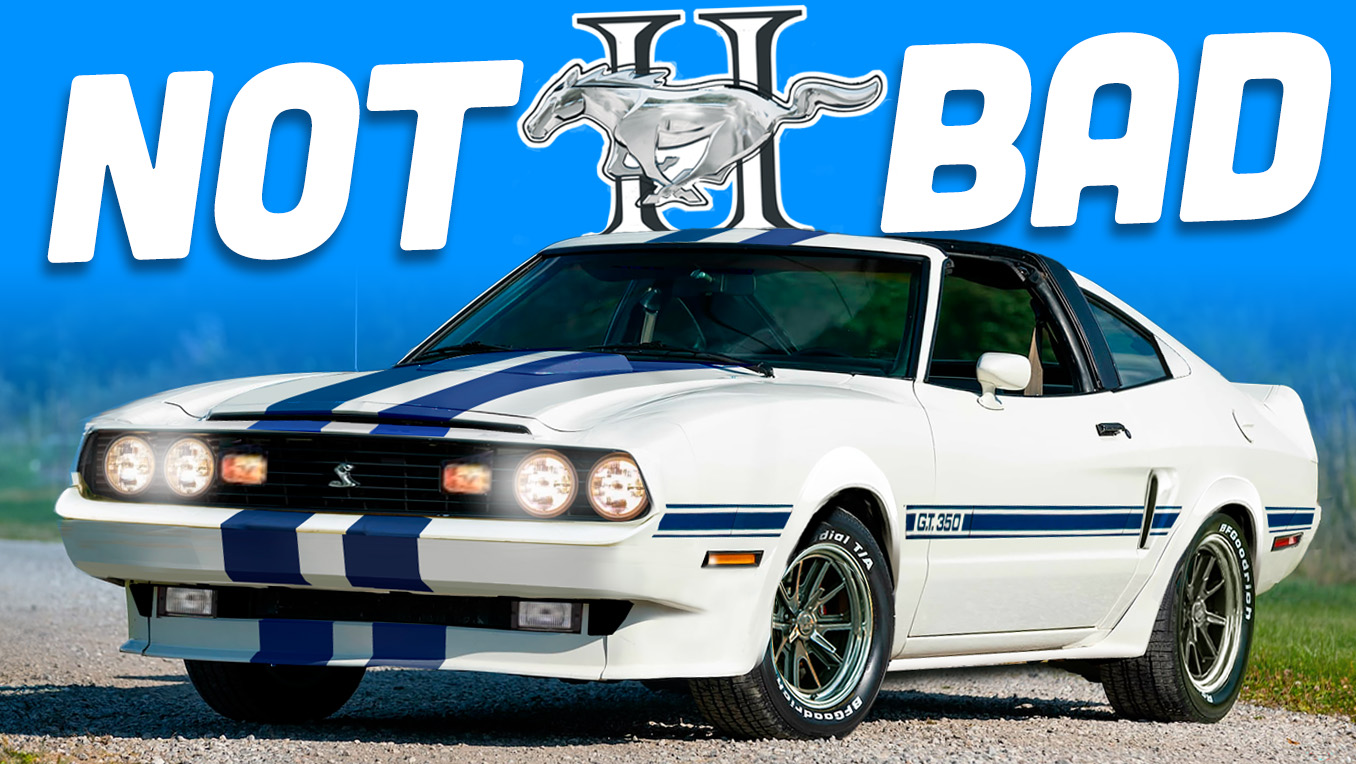
Over the years, the names “Shelby “ and “Cobra” have been associated with cars running the gamut of rear-drive muscle machines, front-drive hatchbacks, and even trucks. Arguably, the best all-around cars that bore the Cobra name were Shelby-spec’d Mustangs. From the ’66 GT350 up to some of the latest versions, Mustangs with the Shelby touch have been some of the fastest and best-balanced, most usable cars.
Ah, but there is one “Cobra” Mustang that doesn’t live up to the legend: the Cobra II. Ticking off the Cobra box on your Mustang II order got you zero performance upgrades and a whole bunch of decals, as the option was merely an “appearance package” with lurid graphics that wrote a far bigger check than the max-140 horsepower Mustang II could ever cash.


Though Ford did evoke the Shelby name in some ads for the Cobra II, the car was untouched by Shelby’s team and was instead a creation of Detroit-area contractor Motortown (who also did that Vega Li’l Wide Track) that was later moved in-house to Ford. Nonetheless, there’s Carroll’s picture right next to the ad copy that claims the car “does justice to the Cobra name” and “has the look and feel of the legendary Cobra,” so at the very least, Shelby wasn’t opposed to this travesty (or Ford just paid him enough not to be).
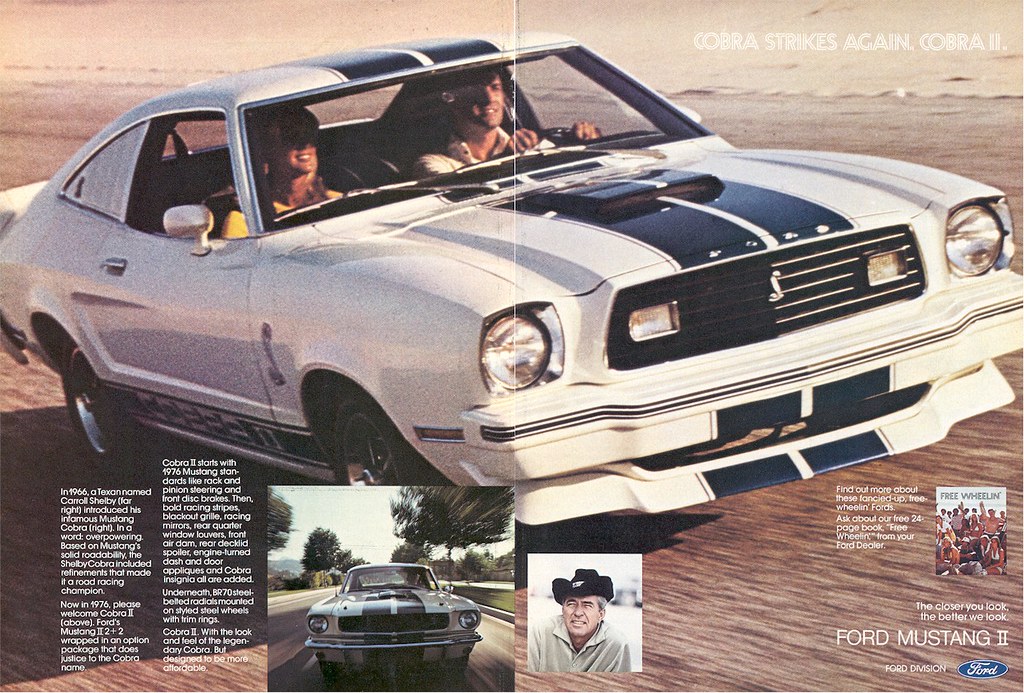
Piling on the Mustang II is played out, and I don’t want to continue to beat a lame pony anymore. In fact, I think there are a number of ways that, if given free reign, Carroll’s team might have made a real Shelby out of a Mustang II that could have been a respectable machine.
Was It Really Worse?
As much as people then and now seem to lament the loss of the “big” Mustang in 1972, there are some facts that get glossed over. Despite the cool looks, those almost-Torino-sized Mustangs were a bit barge-like, and few seemed to offer road manners resembling a sports car.

By comparison, despite having nearly as much usable room inside as the 1972 car (if not more), the Mustang II is just a much smaller and lighter car, more compact than the concurrent F-body Firebird and Camaro, and really closer in size to GM’s Vega-based Monza. Also, the Pinto-derived front end of the Mustang II featured rack and pinion steering, and to this day is prized by hot rodders looking for an inexpensive upgrade for their builds.

With such specifications, the Mustang II could seemingly have been tuned into a decent handling chassis – lighter is always better, after all. Also, you wouldn’t need some 400 cubic inch motor to get it to move, nor the weight of that big cast iron block up front to kill the handling.
Maybe if Carroll Shelby had been given the freedom to really do his signature work on a Mustang II, we could have had something formidable. Still, what about the styling?
“Sporty Personal Car”
As I’ve alluded to earlier, when the Mustang II first debuted, Ford seemed to do everything to make it as un-Mustang-like as possible, marketing it as a “new class of small car.” The luxury-style notchback coupe model was shown prominently in most of the advertising; in 1974, it appeared first inside the brochure, and on the pages immediately afterwards:
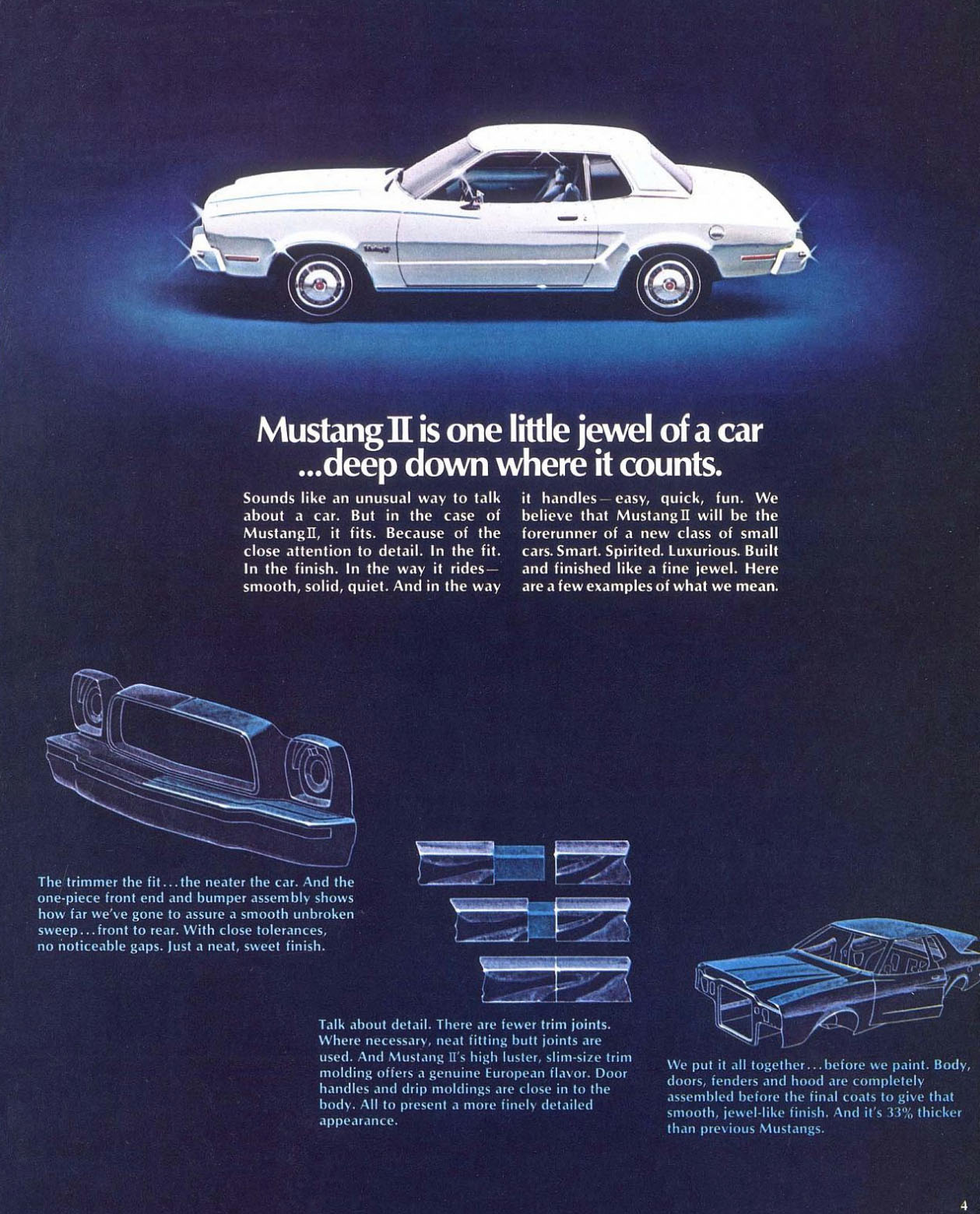

In fact, other than a few thumbnails smaller than a postage stamp, on the 18 or so pages of the first year Mustang catalog the sporting fastback 2+2 appeared on only these two pages near the end. Two pages!
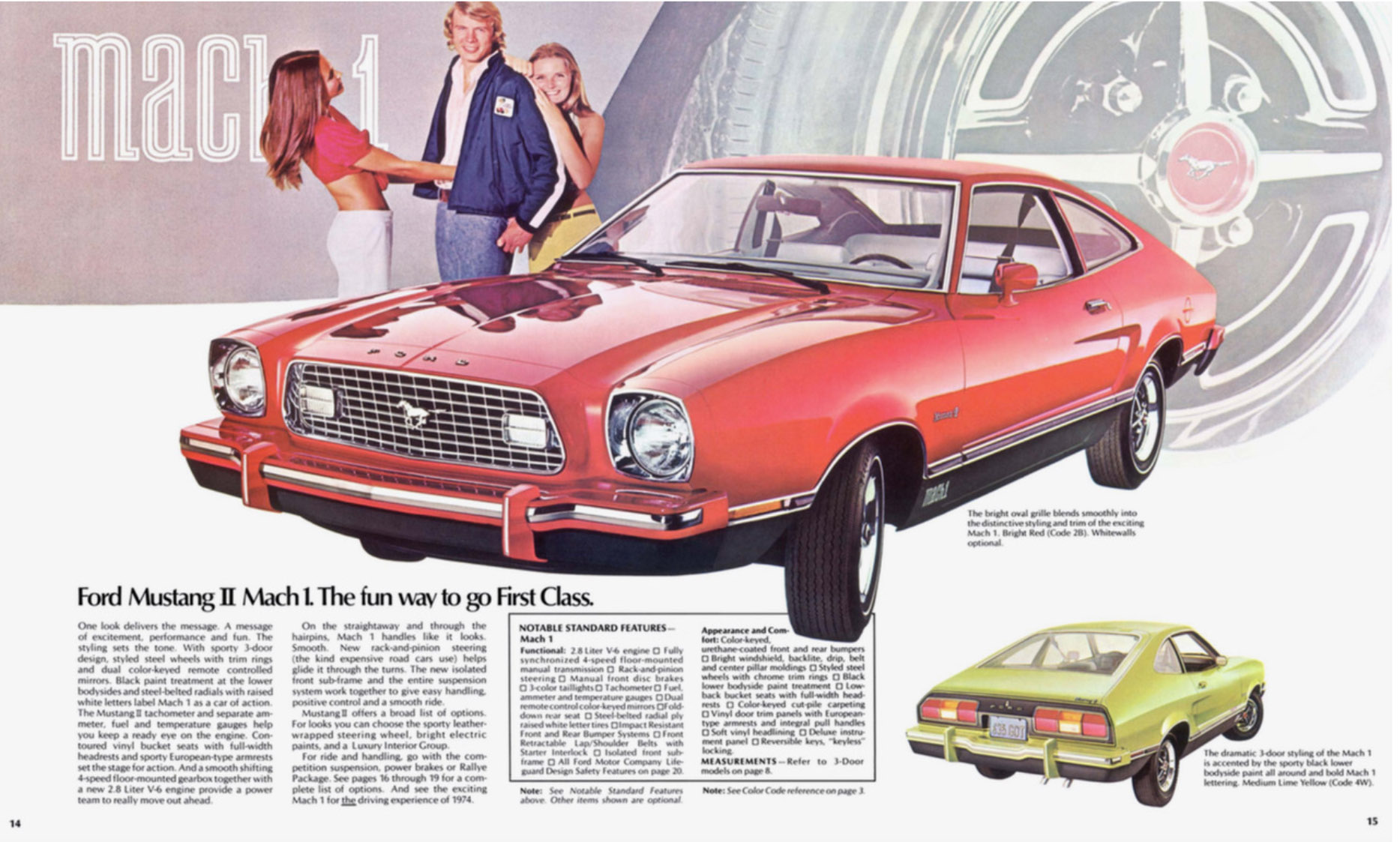
It was the same thing the next year, with the notchback on the cover and Ford nauseatingly describing it as a “personal car.” Again, only 1/10th of the brochure showed the 2+2. I’d assume that meant they were going the baby-Monte Carlo route with this poor little Mustang. Look at the stand-up hood ornament.


The market of the time likely dictated going this route, since personal luxury cars were the hot ticket back then. It wasn’t until 1977 that Ford finally realized that maybe this whole direction was ill-advised and offered that year’s brochure with a 2+2 fastback on the cover:

No, wait: they offered an alternate version of the brochure that year as well with that notchback on the cover yet again! It’s clearly obvious that Ford just didn’t care about the hatchback “real” Mustang as much as the baby T-Bird thing until it was too late to save the image.

However, if you look at the pictures of the notchback and hatchback side by side above, there’s another observation you might have. In a recent post of mine on the Mustang II King Cobra, a commenter named Cars? I’ve Owned A Few echoed what was going on in my head as well:
I’m not sure if I’d agree with the whole “ugly” part, but it’s very much a front-end treatment that’s far more suited to a luxury-style coupe than a GT car. I’m not nuts for the notchbacked Mustang II, but that nose with the separate grille and tall-standing headlights in an almost mini-Cordoba fashion does work well on the “formal” coupe. For the fastback, the nose just seems woefully out of place. That’s especially evident on the range-topping 1978 King Cobra; the back of the thing is just a slick as the rival Chevy Monza but the laid-back nose of the GM car is just so much slicker looking, and don’t even try to make Camaro or Firebird comparisons.
Seriously, put your hand or fingers over the nose of this thing and admire everything from the front wheels back:

The question is, could we improve it without replacing most of the sheet metal on the car and imagining Shelby making something worthy of the Corbra name?
Send The Brougham Home
Here’s the plan we’d implement around 1977; we’d send a Mustang II over to Shelby’s headquarters and start by ripping off the whole front nose piece ahead of the fenders and hood, trash canning the bumpers front and back, and getting to work on a new look for what we’d call a GT350. You might remember that Shelby added totally different front fascias to their Mustang creations of the very early seventies that gave the cars a dramatically different appearance.

For both the front and back, I’d want to replace the “ram bar” bumpers with body-colored urethane pieces that blend into the body in a manner similar to what Camaros and Firebirds were doing. This Shelby Mustang II might have been a good low-production testbed for Ford themselves to experiment with more of this type of material. Again, the sheet metal stays the same

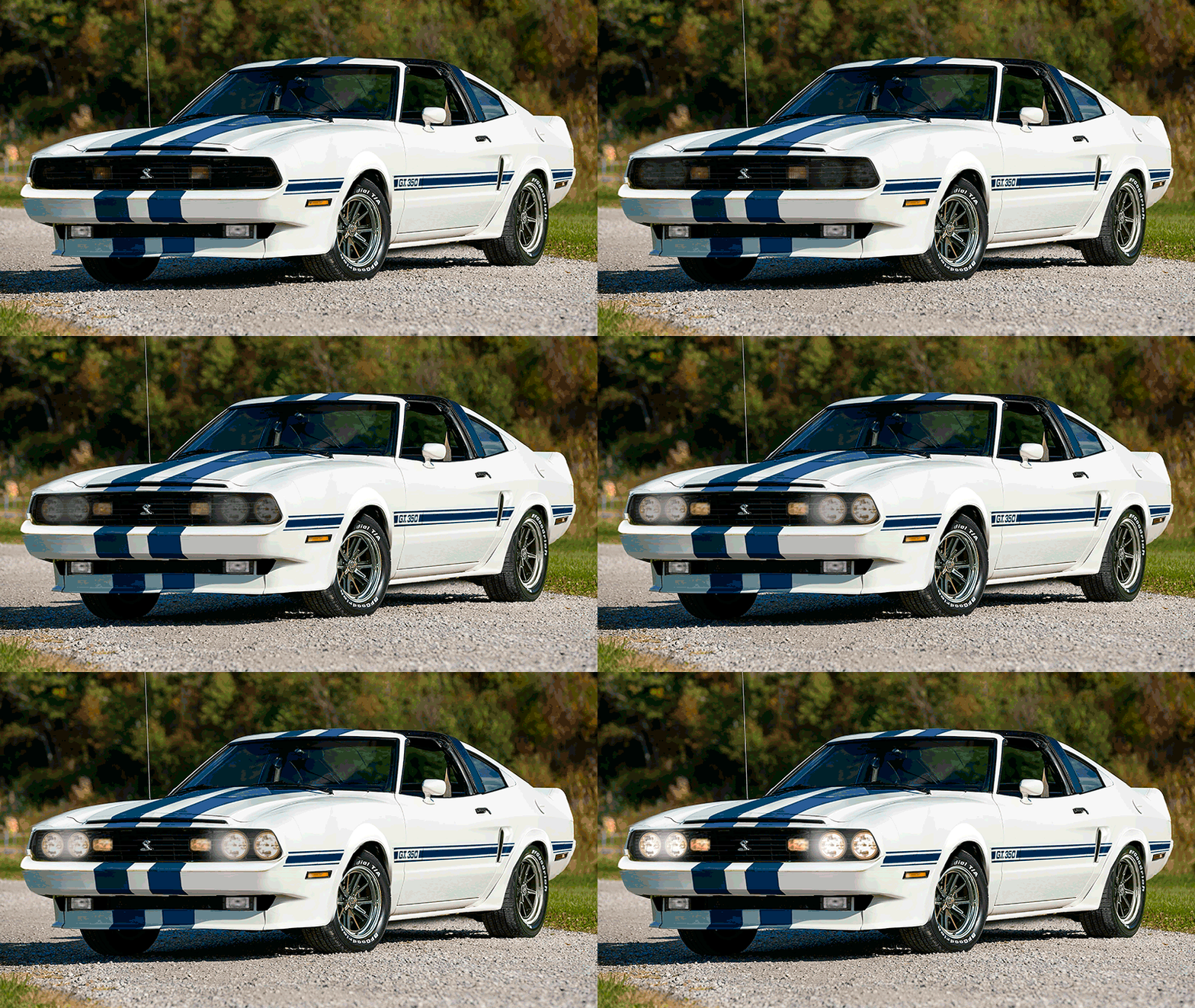
The small grille and single-shot outboard headlamps of the Mustang II would give way to a full-width grille featuring covered quad lights (I know the mechanism adds weight, so it might be an option or removed if you got a “competition” package version). The nose would be lengthened slightly, but hardly to Plymouth Superbird levels. The King Cobra spoiler might stay, but with fog lights and air intakes added to cool the front brakes. Another small detail that isn’t totally necessary is the plastic trim to give a bit of a Hoffmeister kink to the rear quarter windows.
Here’s an animation with the lights; I do wonder if leaving them exposed wouldn’t be that bad on all of them:
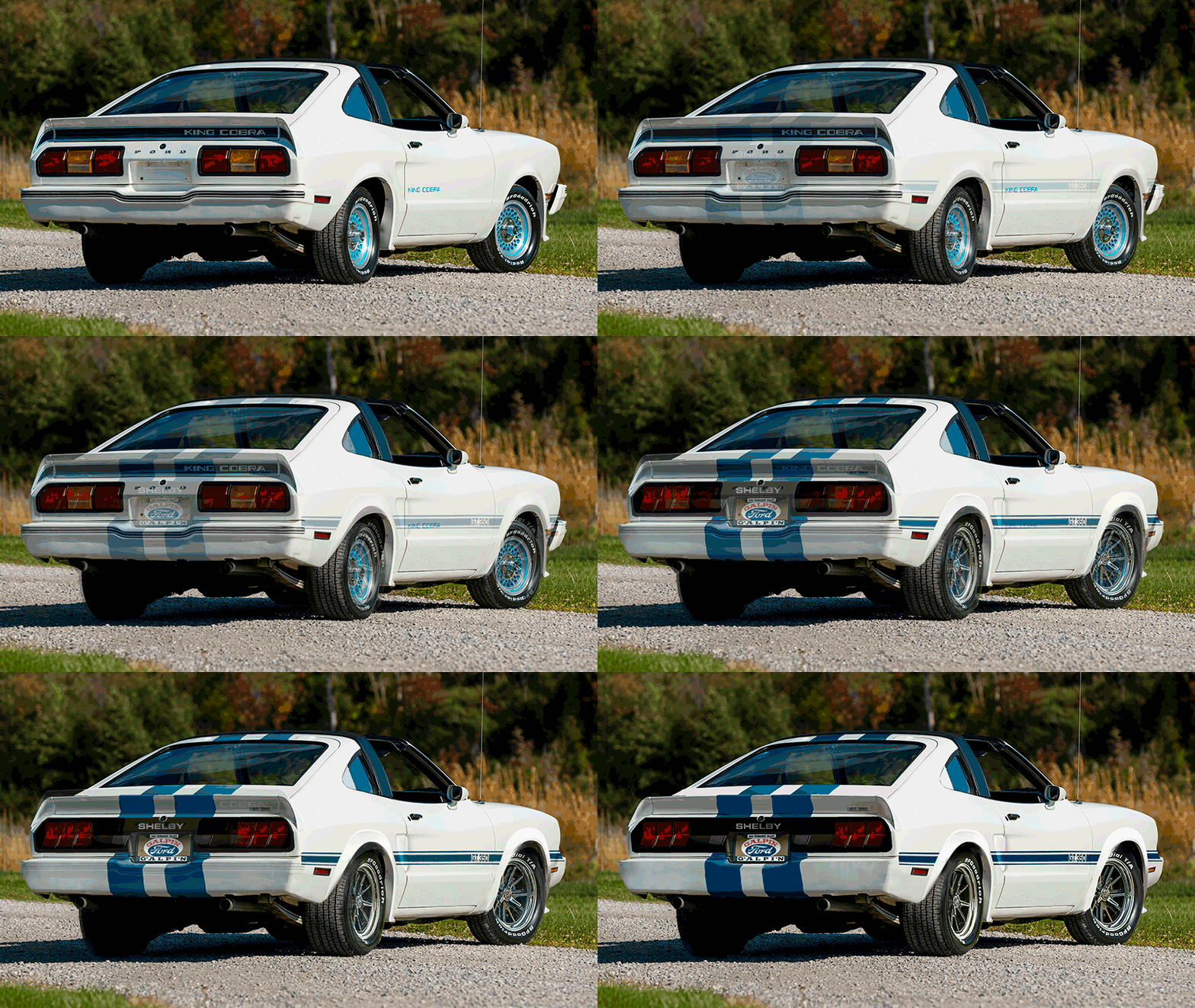
Side stripes would break up the visual mass of the flanks, and an add-on vent to cool the rear brakes could be added to each of the “hockey stick” detents on the sides. Flares on the fenders could accommodate much-needed wider rubber. Here’s the 1978 King Cobra animated over the 1977-78 Shelby GT350:

I’ve always loved the tri-color Mustang II taillights that are an abstraction of the original three-bar Mustang lamps. For the Shelby, however, we’ll add in a black tail section that goes concave instead of convex (space permitting) with all-red taillights and small smoked-out backup lights. The urethane bumper really cleans up the look as well:
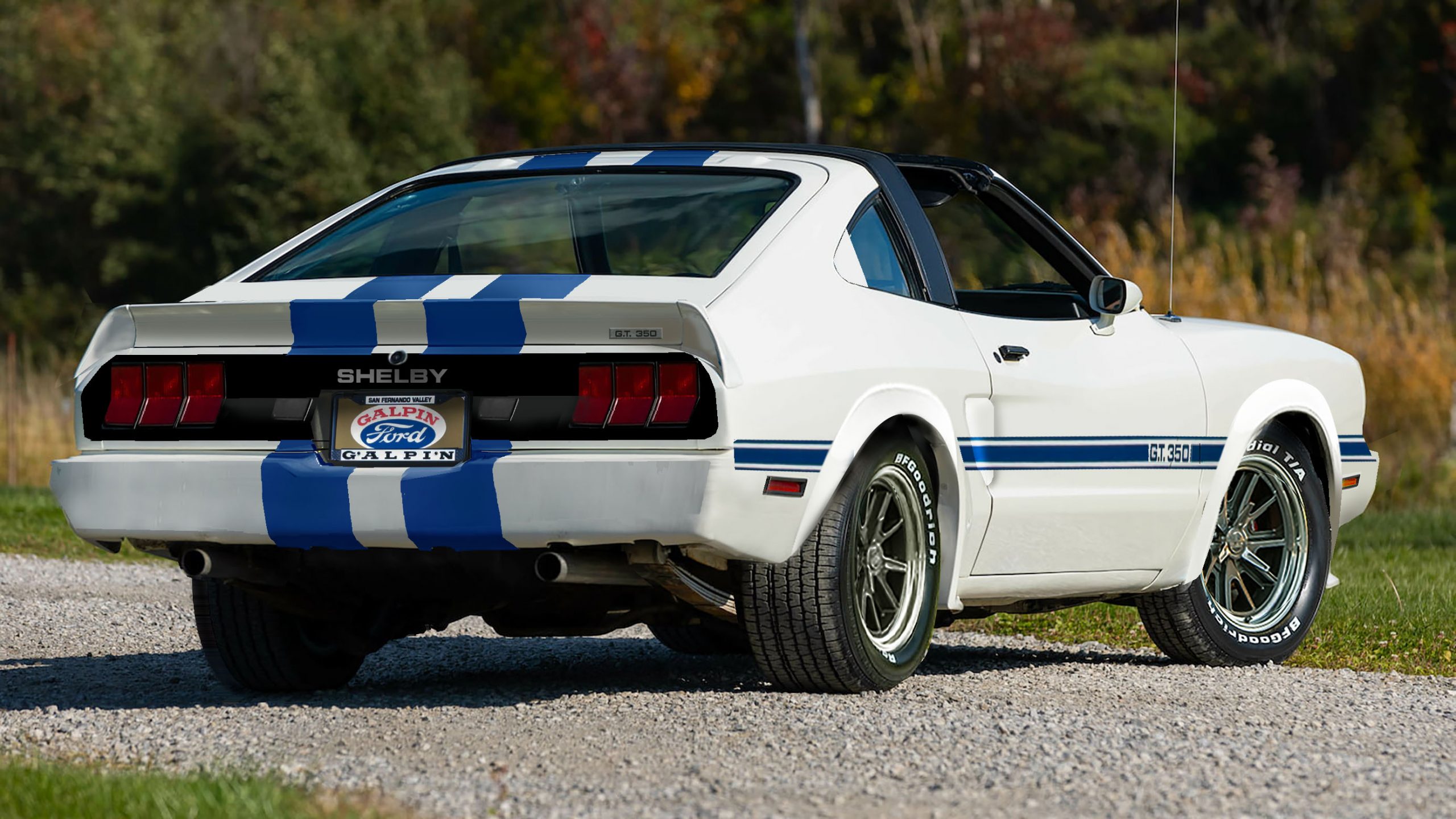
Man, Jason’s gonna kill me for ditching the amber indicators, isn’t he? You’ll see that I lowered the rear spoiler a bit to a less cartoonish height in the animation below.
Inside, the stock interior could use a bit of upgrading to make it a proper sports coupe and not a slightly upscale Pinto.

Scheel sport/racing seats could replace the lumpy originals, while a roll bar might be a popular option to stiffen the thing up. The silver Trans-Am-style dash finish would get covered in non-glare all-business black, and additional gauges (oil pressure, turbo boost) could appear in the void spaces of the Mustang dash (as well as toggles for fog lights, the headlamp doors, or electric cooling fan override). There’s also a Heathkit-style period digital clock and a Shelby dash plaque in front of the passenger’s side.

Fine, it looks better. Can we make it move?
Slug To Cobra
Mechanically, we can sort of understand why Ford had to stick such a detuned motor into the Mustang II; the government’s required CAFÉ fuel economy standards and the gas mileage consciousness of many buyers helped keep those horsepower figures in Dodge Neon territory. However, from an earlier article on the fabled Pontiac Trans Am “Macho T/A”, I know that what doesn’t work for manufacturers could still work for dealers and tuners. As I wrote a while back:
In the Malaise era, manufacturers were strictly forbidden to make changes to the drivetrains of stock cars that were shipped to dealers, and an untitled car couldn’t be hopped up when it hit the lot. That was the end of the story for most dealers, but not for Kyle and Dennis Meacham, two brothers whose father owned a Pontiac store. When the fabled Pontiac 455 CID V8 was dropped for 1977, leaving that 200-horsepower 400 as the top Trans Am motor, they knew they had to find a loophole to bring back the power to the people.
The solution the Meacham brothers came up with was “purchasing” 26 new 1977 W72 Firebird Trans Ams from their father’s Pontiac dealership and doing some tweaks they had perfected on their own cars under the banner of “DKM Engineering”. The 400 V8 received a rejetted four-barrel carb, Hooker headers, two-and-a-half-inch diameter exhaust pipes (but still with a catalytic converter), and punching open the fake hood scoop to make it functional. The changes added around fifty horsepower. The finished cars were then sold at Meacham Pontiac as “used cars” with new-car warranties. It no doubt helped if your dad owned the dealership, though I would think that Meacham senior had some major exceptions on that warranty.

There’s no reason that Shelby couldn’t have done the same thing: make the changes to brand new Mustang IIs and sell them as “used cars.” Similar tricks on the Mustang’s 302, like adding a four-barrel carb, a hotter cam, and helping the motor breathe and spit out its exhaust better, could have been good for similar power to what was in the Macho T/A. Worst case, a 351 might have been needed to do the job under the hood, but why? You see, that Trans Am in stock form tipped the scales at around 3500 pounds, which was around 700 pounds more than the 2800 of the Mustang II. So if we took that 140-horse weakling and pumped it up to around 200, we might be good.
But why just leave it at that? The Meacham brothers offered a turbocharger as an option for their bonkers Trans Am, so there’s no reason for the Shelby to be a Mustang with “a hitch in its gitalong.” Shelby could add a blower to the five-point-oh and hopefully get power up to 275 or so. The turbo Macho T/A could turn 13.9 second quarter miles, so with similar power-to-weight, the Shelby GT-350T could challenge those figures, effectively chopping the 10-second-ish zero to sixty time of the standard King Cobra down to nearly half that. Again, a blown 351 might have been the secret weapon if Carroll wanted to go nuclear scorched earth on the hot Macho Firebird.
Look, there’s plenty of room on the driver’s side under the Mustang II King Cobra’s hood for a turbo if we add some heat shielding to stop the brake fluid from getting cooked. Ample space as well for the taller heads of the 351, and if we had to add a hood bulge, so be it:
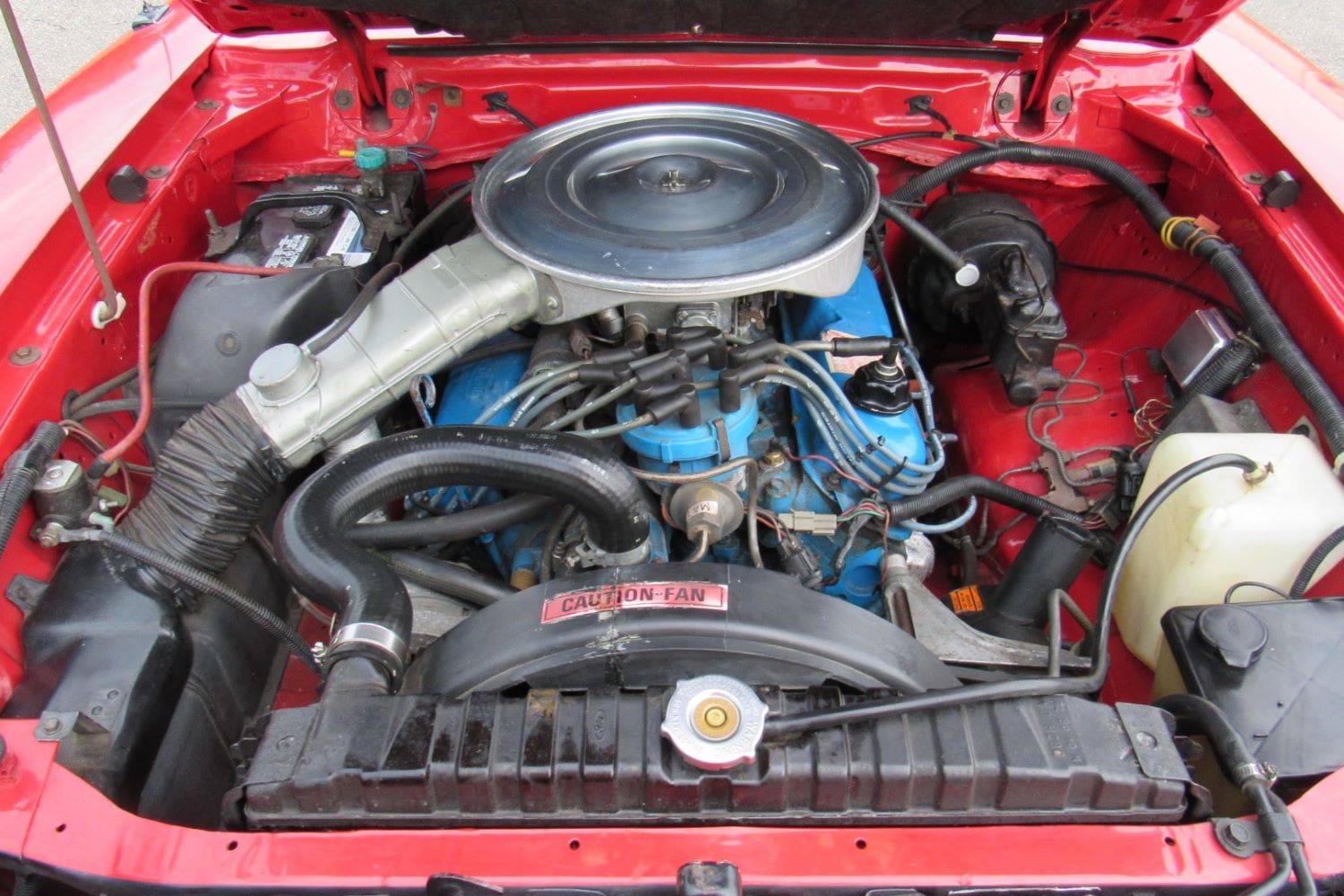
The chassis could get some tuning as well, with better shocks, thick-as-your-forearm sway bars, and maybe even rear disc brakes from the Lincoln Versailles. Considering what Shelby did with the Falcon bits on the original GT350s, they could seemingly work wonders here. A four-link setup could be added in back. Remember, the Camaro and Firebird had live axles on leaf springs in the rear as well, so it wasn’t at any major disadvantage here.
Don’t expect a Datsun Z, much less a Porsche 911, in terms of sophistication. No, this thing would probably not have been the last word in refinement, but neither was the Macho T/A. I can promise you that both the Shelby and Meacham modified pony cars would have shown a stock ‘Vette of the time taillights as they fought for glory. The Blue Oval should never, ever let the Blue Bowtie run uncontested. Ever.
Even The Shelby Charger Was Better Than A Cobra II
Ultimately, with the 1977-78 GT350 or GT350T, you’d have had something theoretically more nimble than the bigger GM F-Bodies; it certainly would have been more tossable than the big ’71-73 Mustang. Even with the slightly longer nose and NTHSA-mandated bumpers, the Shelby Mustang II I’ve proposed would be close in size to an original 1965 GT350, with performance to match. Here’s how the spec sheet would look:
1977 Shelby GT350T
Drivetrain:
4942cc OHV V8, 4 BBL Carburetor and turbocharger 278HP
4-speed manual transmission
Chassis:
Front:
Double wishbone independent suspension- coil springs and gas shocks
anti roll bar
235/60R 15 tires
Rear:
Live axle on leaf springs with Shelby four link setup and gas shocks
anti roll bar
255/60R 15 tires
Front disc/rear disc brakes
Rack and pinion steering
Performance:
0-60: 5.8 seconds
Top speed: 145MPH
A Shelby GT350 based on a Mustang II may sound like a disaster at first, but hopefully you can see that it might have made a lot of sense. As one of the smallest Mustangs ever, the “II” had the potential to be a real sports machine that the Cobra II certainly wasn’t. Better than that, this would have been a Mustang with Shelby credibility that was more than just decal-deep.
Top graphic image: Ford



The restyle looks like the 70s aussie falcon
I consider 4 metres the absolute maximum length for a car to be called “small”. (My current car is about 3.7 metres long.) A Mustang II is almost 4.5 metres, so not small at all.
I’m a big fan of the front-end restyling here, and given how much hay Ford was making about special joints for trim pieces, this wouldn’t break the bank to produce, either. The molded-in urethane rear bumper both cleans up the rear of the car and reduces some of the overhang that made the car look awkward.
Where I think I might diverge is on the turbocharger, though. In general, I am firmly in the “turbo good!” camp, but at this point in time, Ford (and Shelby, for that matter, if he wasn’t still too pissed off with Ford top brass to work with them on such a project in the first place) would have been stuck with a carburetor instead of any kind of electronic fuel injection. While I do believe the first iterations of Bosch’s Jetronic system were getting off the ground around this time, there’s just no feasible way I can think of that an American small coupe in 1976 or 1977 was going to come with something like that.
And that’s a problem, because carbureted turbo setups suck, and not in the good way. You can either put the turbo before the carburetor, called blow-through, or have the turbo situated after the carb, referred to as “draw-through.” Both have significant limitations.
Blow-through designs are difficult because, well, most carburetors are really not designed to deal with pressurized air coming in. It’s incredibly difficult to tune one to work well at both putting around speeds as well as at full tilt, especially once the boost starts getting high enough to make significant power. This results in a temperamental, finnicky motor that doesn’t want to run right except in a specific way. You can build a fast car on a blow-through setup, but getting it to feel like something more sophisticated than a home-built project is very hard.
Draw-through is arguably the more common setup, and this is what Ford did with the later 2.3 engines in the early Fox cars. However, there are significant limitations here as well. While you can more easily tune the car for a wide variety of driving styles, you’ll be inherently limited on how much boost you can push, especially with a motor built in the ‘70s. That’s because draw-through turbo setups don’t allow you to use an intercooler to bring down the intake temperature. The reason for this is that the turbo isn’t compressing the intake air charge, but the air/fuel mixture instead. When you run that hot, compressed air/fuel mix through an intercooler to cool it down and condense it, well, your fuel condenses too and you get liquid puddling in your intercooler. Your mix entering the engine is now way lean, raising temperatures further, and your intercooler is full of liquid fuel, leaving you with a dangerous and potentially explosive situation. All that means you’re running without an intercooler, so you’re limited to probably around 5-6 pounds of boost before you start having detonation issues.
The Turbo Macho T/A, like many turbo builds from this era, was probably a lot of fun on the boost. It was probably also a temperamental nightmare to keep running and likely prone to failure after any real length of time. I wonder how many if these ended up melting a piston after their owner futzed with them to try to get more boost… that was certainly the case with other early turbo motors like the Kawasaki Z1R Turbo.
I think the better play here would have been sticking with natural aspiration, maybe raising the compression since CAFE wouldn’t be an issue. A lightweight, naturally-aspirated 302 with higher-compression pistons and a four-barrel carb, a la the Boss 302, would give the car a kick in the pants without introducing the peakiness and reliability issues of a pre-fuel-injection turbocharger setup, and I can’t imagine that would be any more expensive to produce than a bunch of custom piping for a turbocharger. With a proper suspension, disc brakes at all four corners, and some stiff anti-roll bars, paired with the bigger wheels and tires you already added, you’d run rings around every unexploded Macho T/A that you encountered.
Terrific! Loving the quad headlights. I endorse ditching the amber indicators on the tail lights.