


As cars’ powertrains get quieter thanks to stricter drive-by noise regulations, their sound systems just continue to get louder. You can now get branded premium audio in most compact sedans, and if you want to know how far the rabbit hole goes, a major Chinese electronics manufacturer might’ve just raised the bar. Huawei has launched a new flagship sound system in a seriously opulent Chinese sedan, and it’s full of tricks, including the ability for the front and rear passengers to listen to different things.
Let’s talk about the car first, for a second. It’s the Maextro S800, a sort-of electrified Maybach competitor from Huawei-led alliance HIMA. Built by JAC, this thing is properly posh. We’re talking actively cooled wireless smartphone chargers, road-scanning active suspension, a fingerprint-locking safe, a fridge with branded glasses … the works. It’s one of the most expensive cars to ever come out of China with a price tag of around $143,000 at current conversion rates, so it shouldn’t be surprising that it promises a wicked sound system.


Right out of the gate, the 43-speaker system is potent, with twin 2,920-watt amplifiers pumping out serious headline juice. What does that mean for root mean square output? No idea, as that data is typically quite opaque for OEM systems. However, we do know that the system includes tweeters and mid-range drivers in all four headrests, 10 overhead channels, and a lovely motorized forward-firing dash-mounted tweeter that turns up the whimsy and should enhance clarity. Oh, and like the Burmester 4D systems in certain Mercedes-Benzes and the Body and Soul Seats fitted to the Range Rover Sport SV, the Huawei system in the Maextro S800 uses exciters in the rear seats to replication the feeling of sub-bass without blowing out the eardrums of the driver next to you.

Speaking of thump, the system features a dual-diaphragm subwoofer that Huawei claims “breaks free from traditional cavity constraints, harnessing the surrounding cabin space to deliver the deepest bass extension in its class.” While the bass extension claim needs an actual frequency sweep test to verify, I’m always a fan of subwoofers designed to take advantage of a vehicle’s design. For instance, the optional Bowers & Wilkins system in the Volvo XC90 uses an externally ventilated subwoofer mounted upside-down compared to most traditional subwoofers. As a result, it effectively turns the entire cabin into a subwoofer box, allowing for deep bass extension and crisp sound. It wouldn’t be surprising if Huawei uses a similar setup, as it’s a great packaging solution.
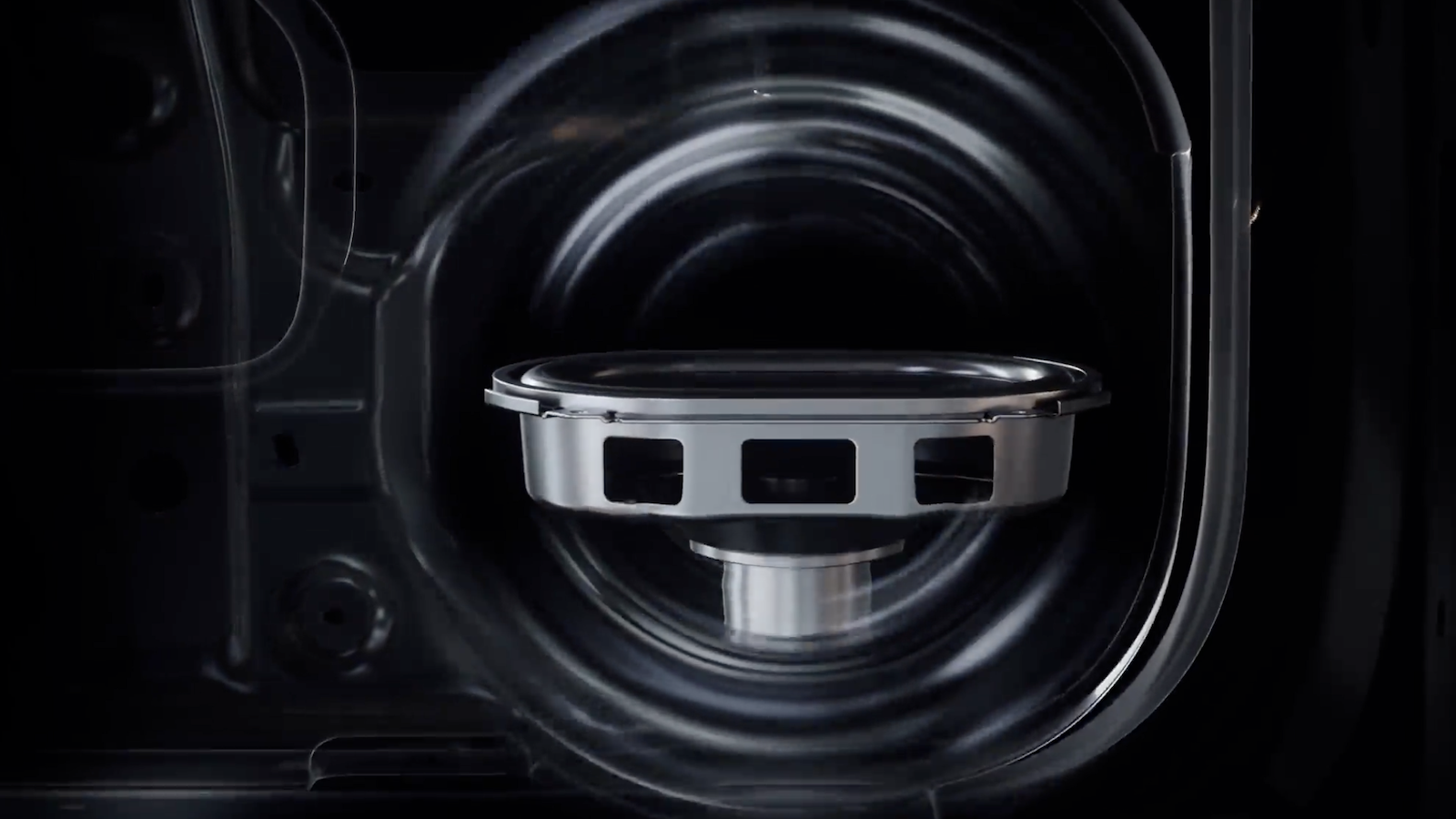
Less precedented are front door woofers rotated 90 degrees along their x-axes compared to traditional door-mounted woofers, with the cones laying horizontal. Huawei claims that this arrangement reduces panel resonance (as it should, considering the drivers don’t mount flat to the inner door panels), and that these door woofers alone can hit down to 40 Hz. Considering this system already has plenty of mid-range drivers, including two in each headrest, I’d love to hear the effect of this woofer mounting arrangement in person.

Perhaps most curious is how this system claims to let occupants listen to two different songs at the same time. Basically, it’s a method of processing that certainly sounds like a version of active noise cancelation, where targeted speakers play inverted waves of what other passengers are listening to, effectively cancelling out great portions of the sound in other areas of the car. Huawei claims 30 dB isolation between front and rear zones, and 99 percent energy separation. In essence, if the rear passengers are listening to music at a typical conversation level of 60 dB, it shouldn’t sound like anything more than a faint whisper to front passengers. Considering noise cancellation tech is offered in cars as inexpensive as the Chevrolet Trax, it seems like Huawei is taking an established technology and combining it with the advantage of a huge number of audio channels. It also helps that the staging appears to be highly directional, which is critical for zonal sound in the first place.

Even given how Harman International has been swallowing up car audio brand licences from AKG to Bang & Olufsen for years, it looks like the OEM audio war continues to rage on. With players like Burmester, Meridian, and now Huawei turning up the wick, it sure looks like the future of enjoying your tunes on the road will grow more and more immersive.
Top graphic image: HIMA
Support our mission of championing car culture by becoming an Official Autopian Member.


Boo! This feature removes one of the joys of being the driver: inflicting my musical taste on my passengers.
Dang I thought that like it let you hear both songs at the same time. That would have been cool.
on the one hand cool technology. on the other hand BUT WHY THO??
That’s a really complex way to give everyone a different set of NC headphones.
I am sure the billions of Chinese living in servitude to the CCP are excited to hear Xi Jinpings Diktats even louder as they drown out the rumbling of their empty stomachs. But for the West hearing modern so called music louder I think it is a fail.
There are far fewer than 2 billion Chinese, far fewer than “billions,” and many are eating well.
Point taken, but no need for hyperbole as it weakens the argument.
You are correct 1.4 billion as of the last census. Not hyperbole so much as bad memory. I think I mixed the total population vs China population.
Remember the old saying the drunker I post the later I am.
If Huawei would market these in the USA as having a built-in gun safe, they’d sell like hotcakes. The safe is already there, they just need to market it as specifically for gun-toting Americans.
You’re forgetting that it’s not a bigass truck.
That said, I want to meet the person who:
Well, I mean, if you give me the money, I’d technically have it to spend.
Man, captions would be helpful here. As a non-audiophile, what is the doodad in the first pic? What exactly are we showing in the second pic?
My brain shorted for a second and I read that title as “Two Thongs One Car”. Not what the article is about.
One of these zones is most likely playing The Thong Song.
Finally a solution for me to listen to Neal Stephenson novels while my wife listens to EDM on our next long road trip. $143k is a small price to pay for marital harmony.
I’ll be on your wife’s side of the car. Stephenson is way too verbose and will put me to sleep, while EDM will make the long road trip shorter.
You’re not wrong. She said that it basically sounds like the “whomp whomp” of the parents in Peanuts cartoons to her.