

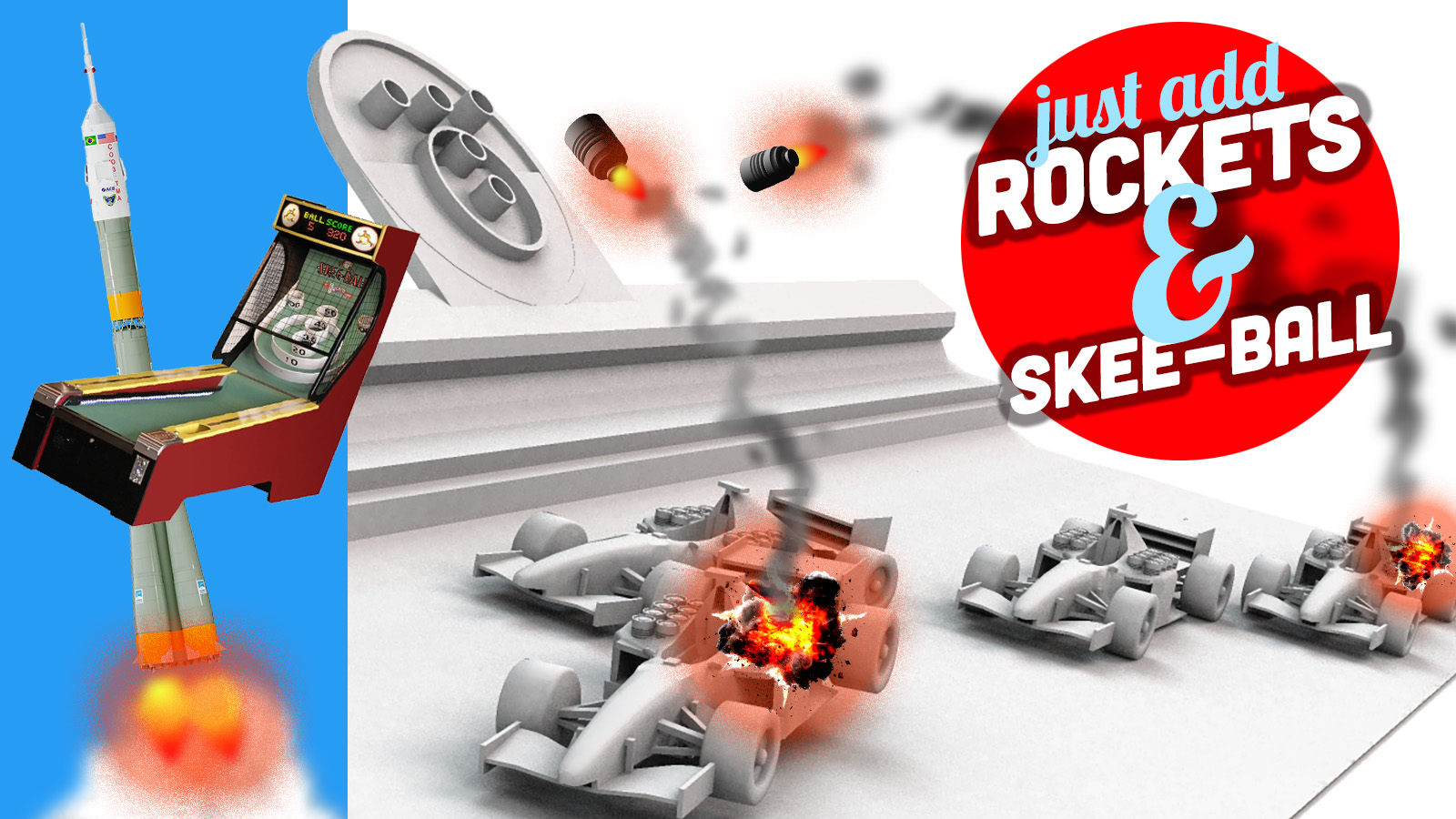
Electric car-based motorsport hasn’t exactly caught on like many have hoped. Sure, Formula E is doing okay, but Extreme E (the EV off-road racing series) has become Extreme H, a hydrogen-focused race series, E-TCR, the electric touring car series, ended in 2023, and overall it hasn’t exactly captured the public’s imagination and excitement as lots of people were hoping it would. Don’t give up, though! Because I know how to change all that, and all it takes is a little bit of tech borrowing from two of humanity’s most noble ventures: rocketry and Skee-Ball.
Yes, you read that correctly; you’re a very skilled reader, after all. Rockets and Skee-Ball are what is going to save electric car racing, in ways that perhaps you’re not expecting, but ways that I’m quite certain you’ll find very, very welcome. I call it Formula SkeE. That capital “e” is because it’s electric, you see.


Rocketry and Skee-Ball are the twin shells of the clam that could be EV racing, and the pearl that forms within is your joy and delight. Allow me to explain how this will all work.
Like so many things relating to electric cars, the great limiting factor are the batteries. They’re extremely heavy things that, while energy dense, are still not even close to the energy density of gasoline (gas has between 50 and 100 times the energy density of a lithium-ion battery by weight) and they take forever to fully recharge.
Sure, Formula E announced a new feature this year, Pit Boost, which is a 34 second-maximum pit stop to use ultra-fast 600V chargers to get, let’s see, a maximum of 10% of their batteries recharged. 34 seconds in racing pit times is an eternity, even if it’s really fast for battery charging in general, and while this can add some strategy and excitement to a race, it’s not really what I’d hope for.
What I’m proposing is that instead of dealing with boring recharging stops at all that only add 10%, we skip recharging entirely, and instead maximize speed and range by borrowing an idea from rocketry: staging.
Staging is why rockets get to space in parts; it takes a massive amount of thrust and fuel to get off Earth, which means huge fuel and oxidizer tanks in a rocket. But once in orbit, those big, heavy tanks aren’t doing anyone any good, so why lug them around? Rocket scientists, known for being pretty bright, decided that they shouldn’t lug them around, and hence the idea of staging was born.
Most rockets have multiple stages: a first stage to get off Earth and break gravity’s surly bonds, and once that’s done, that stage is jettisoned. Then there’s another stage to get to the desired orbit, and perhaps another stage or two if the spacecraft is destined for another planet or somewhere even further.
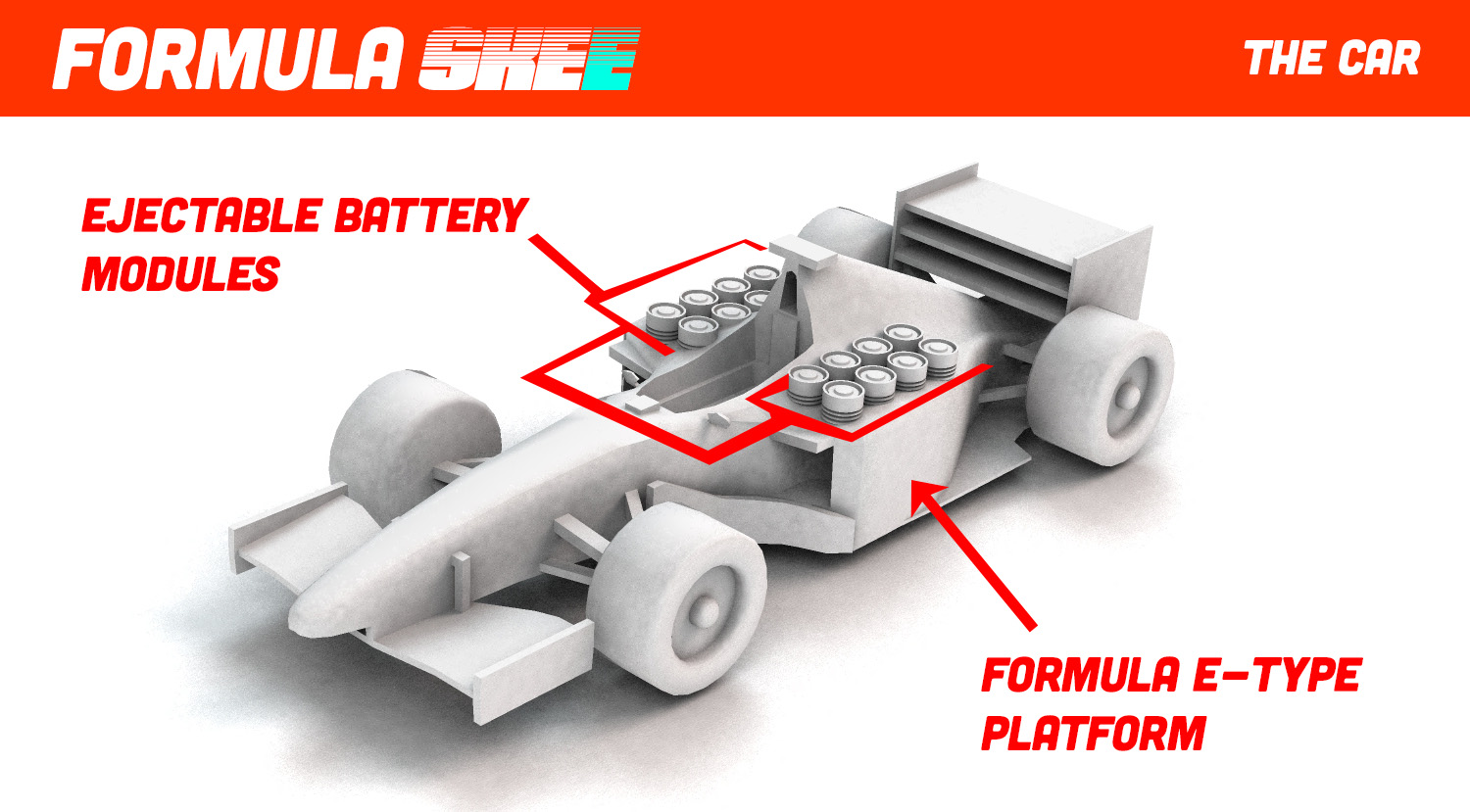
What I’m proposing is that batteries will be staged in Formula SkeE Cars. Instead of having one monolithic battery, Formula SkeE cars will have their battery pack broken up into some number of independent modules; I have illustrated it with 16 modules here, but, really, it can be any number that makes sense.
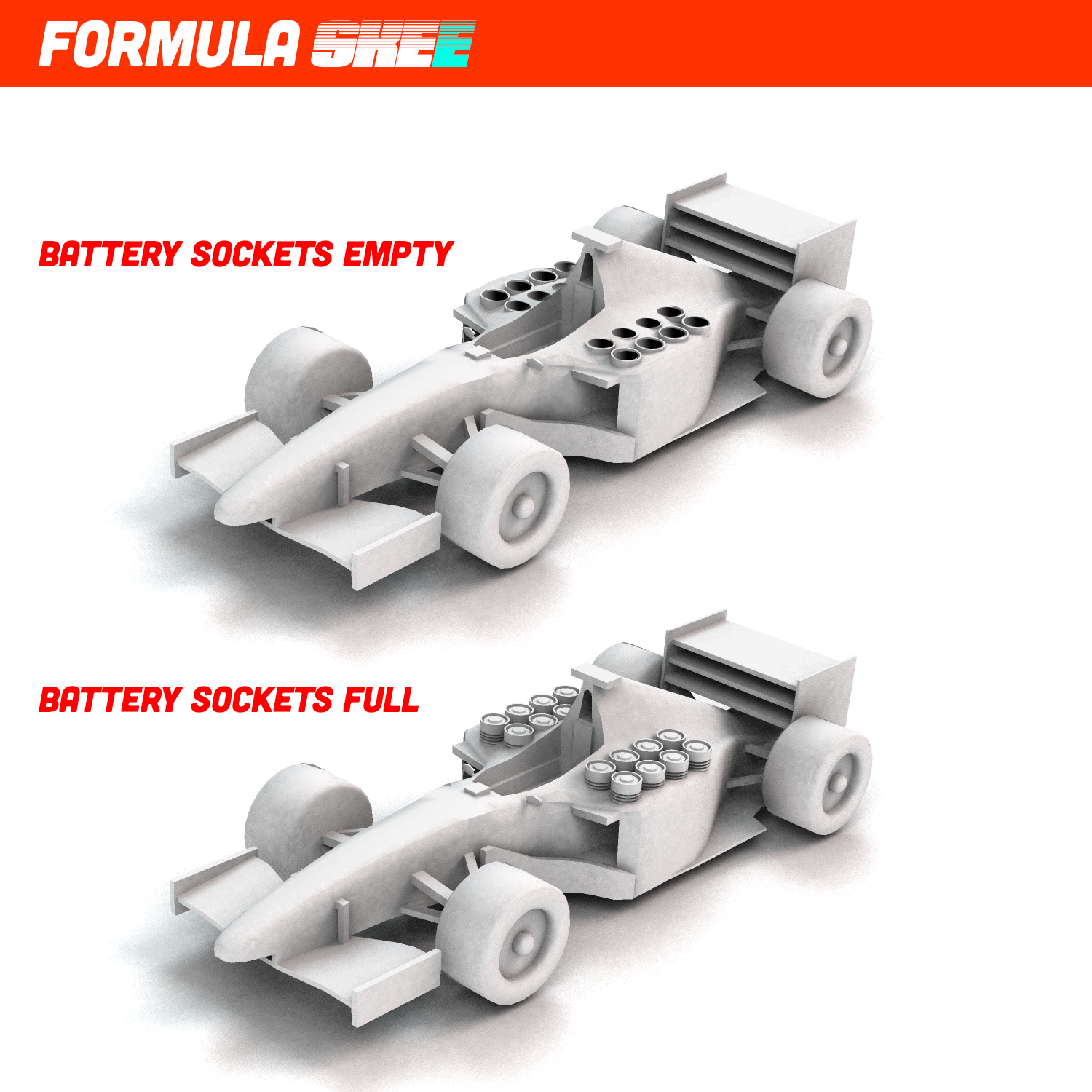
These battery modules would be used in series, and as each module is depleted, it can be jettisoned, much like a rocket stage, saving weight, which will help with performance and overall range.
But how can we jettison these spent modules? Great question, disembodied voice in my head! For that, we’re going to borrow another idea from the world of rocketry: rockets.
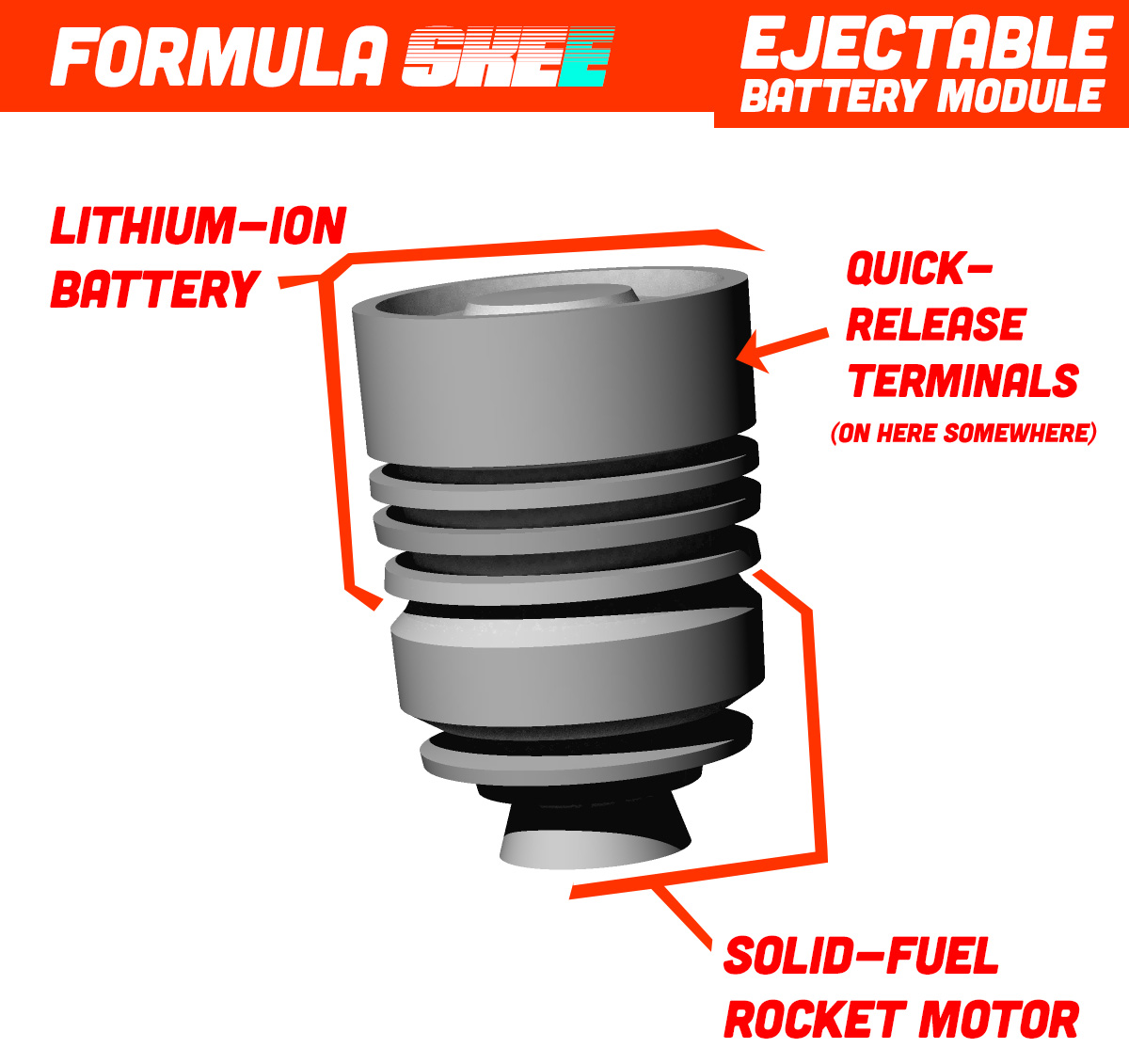
That’s right! Each ejectable battery module will have an integrated solid rocket motor! Once the battery module is used, the driver can choose to eject it, via the solid rocket motor!
But where can it be ejected? Just anywhere would be wasteful and unsafe, right? Of course. That’s where the advanced Skee-Ball tech comes in.
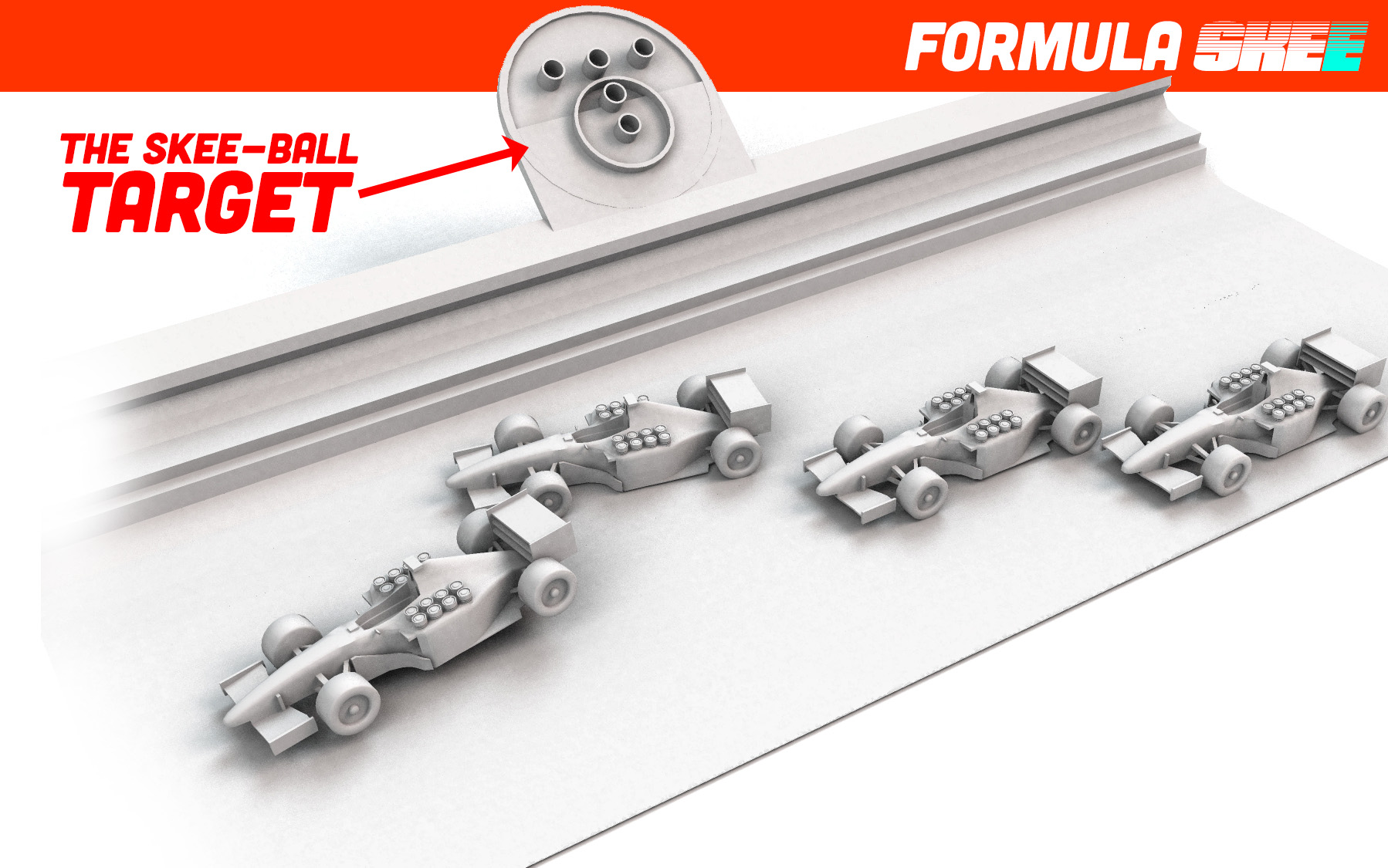
You know how Skee-Ball works, right? Sure you do; it’s the backbone of America’s thriving ticket economy. Basically, you toss balls at the target, attempting to get the balls to land in these holes; the centermost one giving the most points, and then less points for the holes radiating out from the center.
You know how it works. Anyway, the same principle is at play here in Formula SkeE races, but instead of a ball, the expended batteries are used, launched by the solid rocket motors.
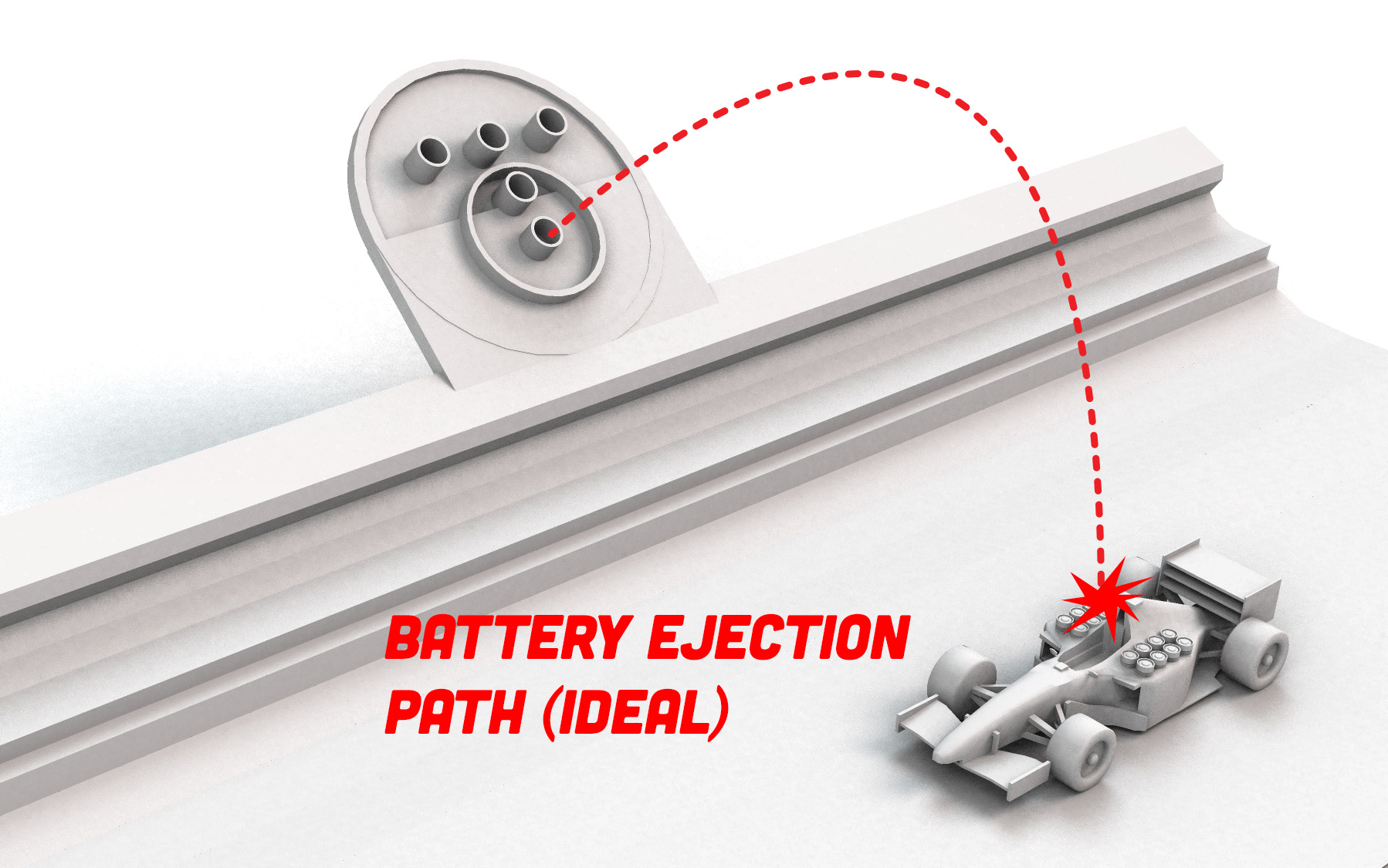
When the driver of a Formula-SkeE car has one or more expended batteries, they can attempt to launch the batteries into one of several (at least four, likely more) Skee-Ball-like targets mounted around the track. They may only launch batteries from one side of the car at a time – this can be the one closest to the target or the opposite side, launching in the opposite direction; the launch tubes are angled to allow for a parabolic path that is most likely to at least get close to the Skee-Ball target, and the cars can be set up either way.

Depending on if the driver can land the battery in one of the holes, and what hole, an appropriate number of points is added to the driver’s score. A good driver would need to strike a balance between driving skill and rocket-assisted Skee-Ball skills; the winner of each race is decided by combining the racing position with the Skee-Ball score.
This, of course, will not be easy; knowing just when to launch a battery for the maximum chance of getting it in the center hole, while driving at high speeds, is decidedly non-trivial. Plus, there’s the strategy of when to eject the batteries to optimize weight.
Think how exciting these races will be! Sure, electric motors don’t have the drama and noise of a loud, vibrating piston engine, but I think the bang and flash of solid rocket-powered battery modules screaming and arcing across the sky above the track will more than make up for the lack of loud exhausts.
Will it be dangerous? Absolutely! But you know, it’s racing, and racing is already dangerous. How much worse do a bunch of heavy, highly flammable lithium-ion missiles make things, really?
The batteries will be collected and recharged after each race, as they are designed to be tough and withstand the stresses of launching and landing. Because it only makes sense to launch batteries at the targets, systems will be in place to make the landings as shock-absorbent and gentle as possible, too.
Maybe there will be systems in place to only allow battery launches in areas right around the Skee-Ball targets; that’s probably a good idea.
This is going to completely shake up the electric car racing and Skee-Ball worlds! If you want in on the ground floor, feel free to reach out and we can pick a spot to hand over briefcases of money or whatever.
I can’t wait to get this going!




Another idea. We have VR tech now, so take the drivers out of the actual car and put them in a headset. Then, we equip the cars with real guns, missiles, oil slick, etc. Of course the cars would also have to have armor and really be setup for battle.
This is probably a bad idea for spectators and street circuits…
No need for the guns and missiles, equip the cars with robot riders that sit astride and are controlled by a HEMA practitioner in another VR headset, and let them duke it out during overtakes.
Something, something, rubbing, racing.
It’s great that someone has come up with a solution to how annoying Formula E is to watch. Really more annoying to listen to.
Jason, you have a wonderful mind. I can follow your thoughts, but I could rarely come up with stuff anything as out of the box as you do.
I think JT is onto something here. I don’t watch a lot of racing but I’d watch THAT!
I see somebody’s been playing with a copy of Blender!
Another exciting weight saver would be jettisoning the driver. A similar speed v control race strategy would apply.
Torch’s mind is a strange and wonderful place
Auto racing to to me is similar to golf. It’s something I might enjoy doing myself, but watching other people “compete”, racing cars, is about as exciting as watching paint dry. Honestly, as dull as I find televised golf, the current state of auto racing is even moreso.
Torch is heading in the right direction here.
Needed this tonight. Got to the skee ball graphic and just smiled, knowing what was coming next. Thanks Torch.
I honestly think more “gamification” of electric racing would be a good idea, you could pull in new younger fans that are more accustomed to video games/digital life than the myriad technicalities of modern racing series.
Booster pads on the track. You could take the outside line for extra power or you could thread the apex perfectly. Booster pad if you are brave enough to try and thread the straight line through the chicane.
Didn’t they literally already do this with virtual booster lanes a number of years back?
The only issue I see is that jettisonning one at a time will leave the car imbalanced. This could be solved by having targets on both sides of the track and ejecting one in each direction, both at the same time.
The suspensions are going to have to be active, to deal with both the imbalance and with it going from (guessing) a 3000 lb vehicle at the start to a 1500 pound vehicle at the end.
You’re adding the wrong things!
https://youtu.be/lIR-XCWLzL8
If adding rockets to things is wrong, I don’t want to be right.
However, the FAA strenuously disagrees with me.
Darwin is intrigued by your ideas and would like to subscribe to your newsletter.
Did Jason get this idea from an old ACME Catalog?
So, it’s kind of like biathlon, only electric and faster. Sounds like a blast.
Reminds me of this:
https://www.youtube.com/watch?v=Gxu248aD6PY
🙂
Seriously, what’s needed is either:
-or-
Unlike the MX_5 cup, allow both types to races to have a timing pause for double-yellows, so when there’s a track cleanup the racers can pause and continue
It’s all fun and games until you have a giant lithium fire in the grandstands.
think of the ratings!
Light my candles in a daze ’cause I found God
Yeeeaaahheeaahh!!!!!!
What part of a grandstand lithium fire ISN’T fun and games?
Are these batteries still likely to burn if they are exhausted? (serious question)
I’m no expert, but my understanding is that they burn as long as they contain energy, i..e. electrical energy in this case. However, since it’s bad for a battery to discharge it completely, and since these would be high density batteries, there would probably be enough energy left in them to burn for a while. Just not a very long while.
I do not believe this is 100% accurate. Lithium as an element is flammable,even if it isn’t used in battery. If lithium in a ruptured battery is exposed to air, it will burn in response to any suitable heat source. I’m not sure what temp is needed to start it, but I believe it is relatively low (maybe lower than gas?).
That said, a charged battery has a greater risk of fire as a short-circuit between the anode and cathode of a battery can create enough heat to set the lithium on fire. So a charged battery can set itself on fire, as a few folks who bought a certain generation of Samsung phone, or other cheap batteries have discovered. My understanding is that the electrolytic layer between the anode and cathode can wear more easily in a cheap battery, thereby allowing a short-circuit to occur within the battery and setting itself on fire, aka, thermal runaway.
Lithium metal will burn (it reacts with water, not air, but there is typically enough water vapor in air to still cause a reaction), but typically you won’t find appreciable amounts of lithium in metal form in a lithium ion battery currently available. While lithium metal anodes are possible and have been demonstrated in research, they still have significant problems to overcome before any sort of mass production. In mass produced li+ cells, whether they’re lfp, high nickel, lmr etc, nearly all the lithium is intercalated in voids within the anode or cathode, with only a relatively small fraction dissolved in the electrolyte between the two, or caught in side reactions like the solid-electrolyte interface (SEI) layer that grows during cell formation. What burns is primarily the liquid electrolyte, cathode and separator, instigated by heat from an internal short circuit or other source. Both the cathode and electrolyte typically also contain oxygen, so air isn’t required.
I suspected that someone smarter than me would explain why I was wrong. Once again, the Autopian community has come through. Thanks for setting me straight.
While it’s still possible given a strong enough heat source, it’s highly unlikely that they will ignite from physical damage when discharged since not only is the energy release in thermal runaway generally related to the energy content (SOC), but when discharged they won’t have the energy to heat up enough for to an internal short from physical damage to get to that threshold
Thanks!
Oh and the smell. Lithium battery fires have such a specific smell. If I can’t smell race fuel and exhaust like I want, you’ve got to give me something to hang onto, damnit!
I brought marshmallows and a stick!
My initial thought was that the seats near the targets would be cheaper, but it might be the opposite. Similar to trying to catch foul balls at baseball games, the fans could try to catch the rocket batteries that miss the targets, and keep them as souvenirs.