

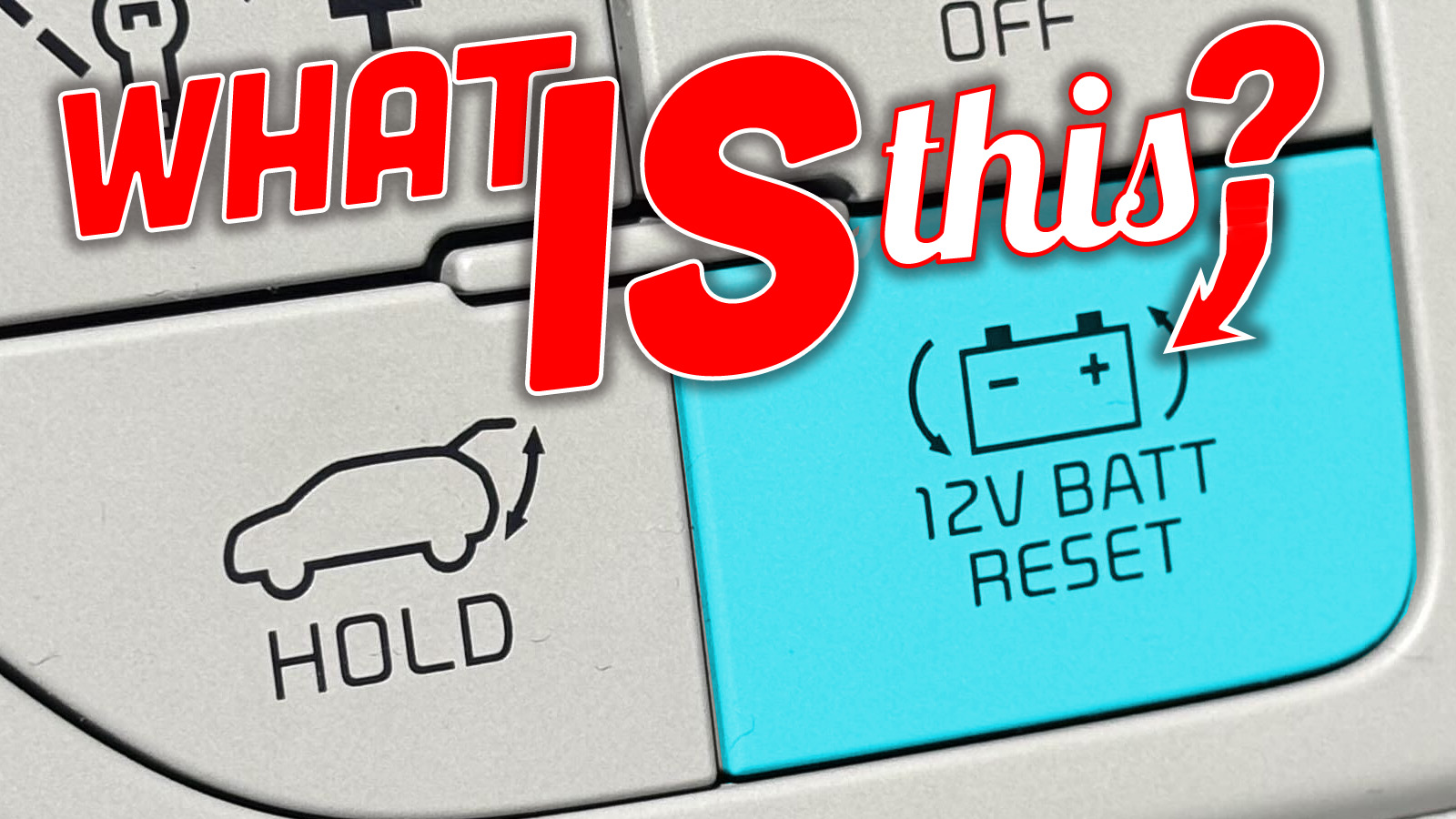
The idea of a “12V battery reset” button strikes me as odd. Hell, even the idea of a battery reset feels strange, because I’m an old man who drives cars with all of the technical sophistication of a meat tenderizer. Also, the concept of resetting a battery still feels weird to me, unless that resetting is being handled with a chainsaw, the preferred method. But this button actually does seem to do something useful, something that should help address an irritating Achilles’ heel of hybrid vehicles. Let’s take a quick look at what this thing does.
In most hybrid or electric or even hydrogen fuel cell vehicles, there’s still a separate 12-volt battery of some sort to power all of those old-school vehicle accessories that aren’t worth re-engineering for higher voltages, like windshield wipers, lights, and audio system components, and so on. Sometimes the source of these 12 delicious volts is a conventional lead-acid car battery, and other times it’s a newer-style lithium-ion battery, either an independent unit or something integrated into the larger main traction battery of the car.


The 12V battery has been an issue on hybrids and EVs because, unlike conventional combustion cars that recharge the battery via their spinning alternators with every use of the car, 12V batteries on hybrids or EVs tend to be charged via a DC to DC converter, taking charge from the large traction battery to charge the 12V. The car has systems to detect when the 12V battery gets below a certain charge and then recharges it automatically.
Usually, at least. This doesn’t always work out, and if the 12V battery dies, your car becomes a big, immobile brick that can’t start until the battery can be recharged from an outside source or replaced. It can be a colossal ass-pain. That’s what this button is supposed to help with.
The way it works is if you get to your car and find it unable to start because of a drained 12V battery, this button should help you get out of that jam. Well, that is, after you manage to get into your car using the physical key hidden in the key fob and manually unlocking the door via the hidden key slot on the underside of the door handle, because normally all of that is handled with 12V electronics.
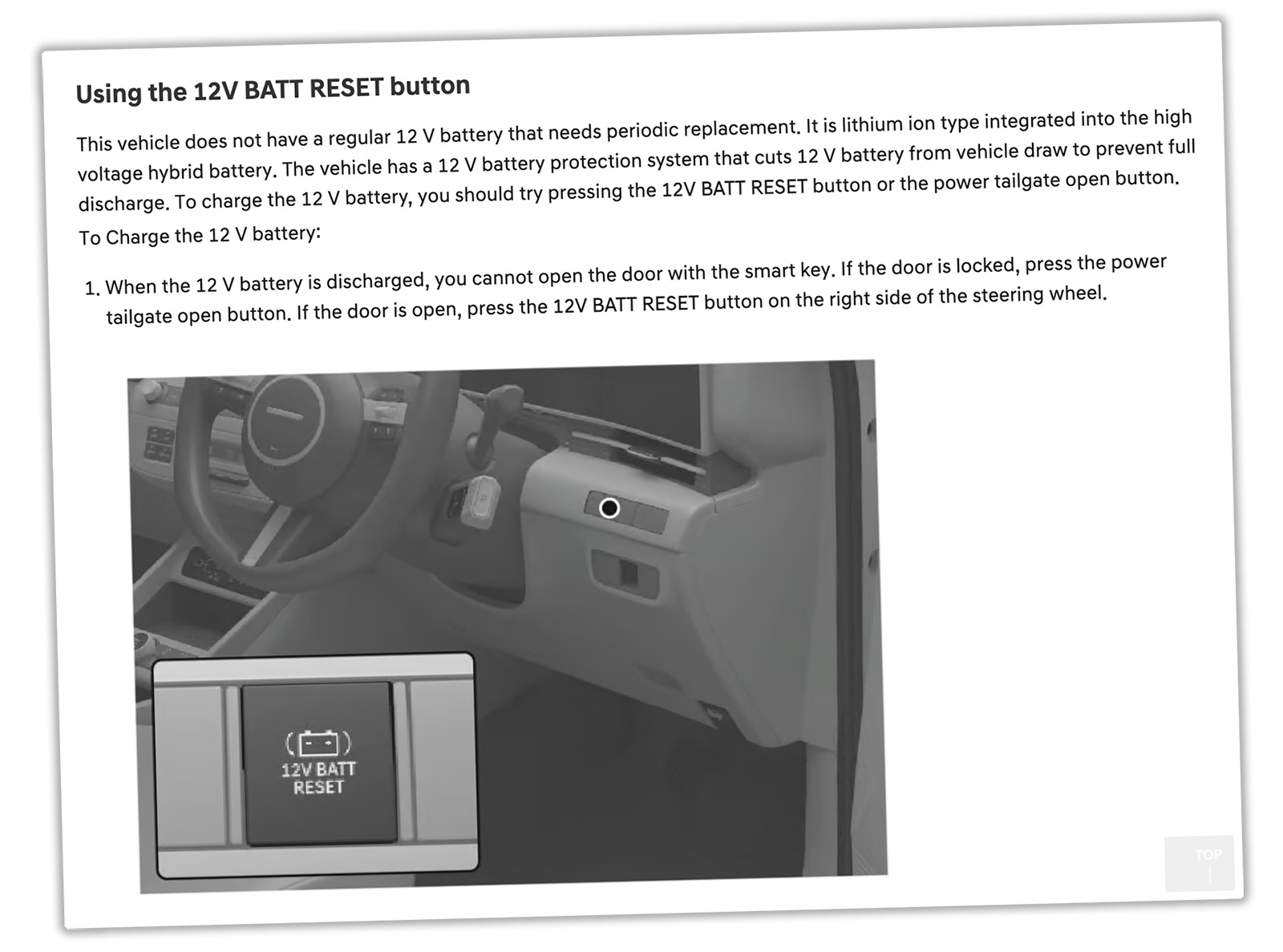
Once you manage to get into the car – it looks like the external power tailgate switch can open it if the key won’t or you don’t have a brick handy – pushing that 12V BATT RESET button will force the main battery to begin to recharge the 12V battery. You then have to start the car within 30 seconds. The recharging will then start from the main hybrid battery, and the combustion engine may not actually come on, at least at first. The owner’s manual says that when you do this, you should drive the car for at least 30 minutes to get the battery charged up, which almost certainly will use the gasoline engine on a hybrid.
The manual also notes that:
The following items may need to be reset after the battery has been discharged or the battery has been disconnected.
See chapter 4 and 5 for:
Power Windows
Utility View
Climate Control System
Clock
Sunroof
I get things like clocks, and maybe the radio and other presets needed to be reset, but power windows? Why do they care?
All of this is a little odd, for a number of reasons. First, I wonder why all of this isn’t more automated? Like, why does the owner have to push that button at all? If the 12V is below a certain point of charge, the car must be aware of that, right? So why wouldn’t it begin to replenish the 12V battery from the traction battery supply as soon as someone attempts to open/start the car? Is there a point to having a button to effectively jump the 12V system from the main power system? It just feels like if the car is capable of handling this from the push of a button, it could just as well make sure this doesn’t happen in general? Am I missing something crucial here?
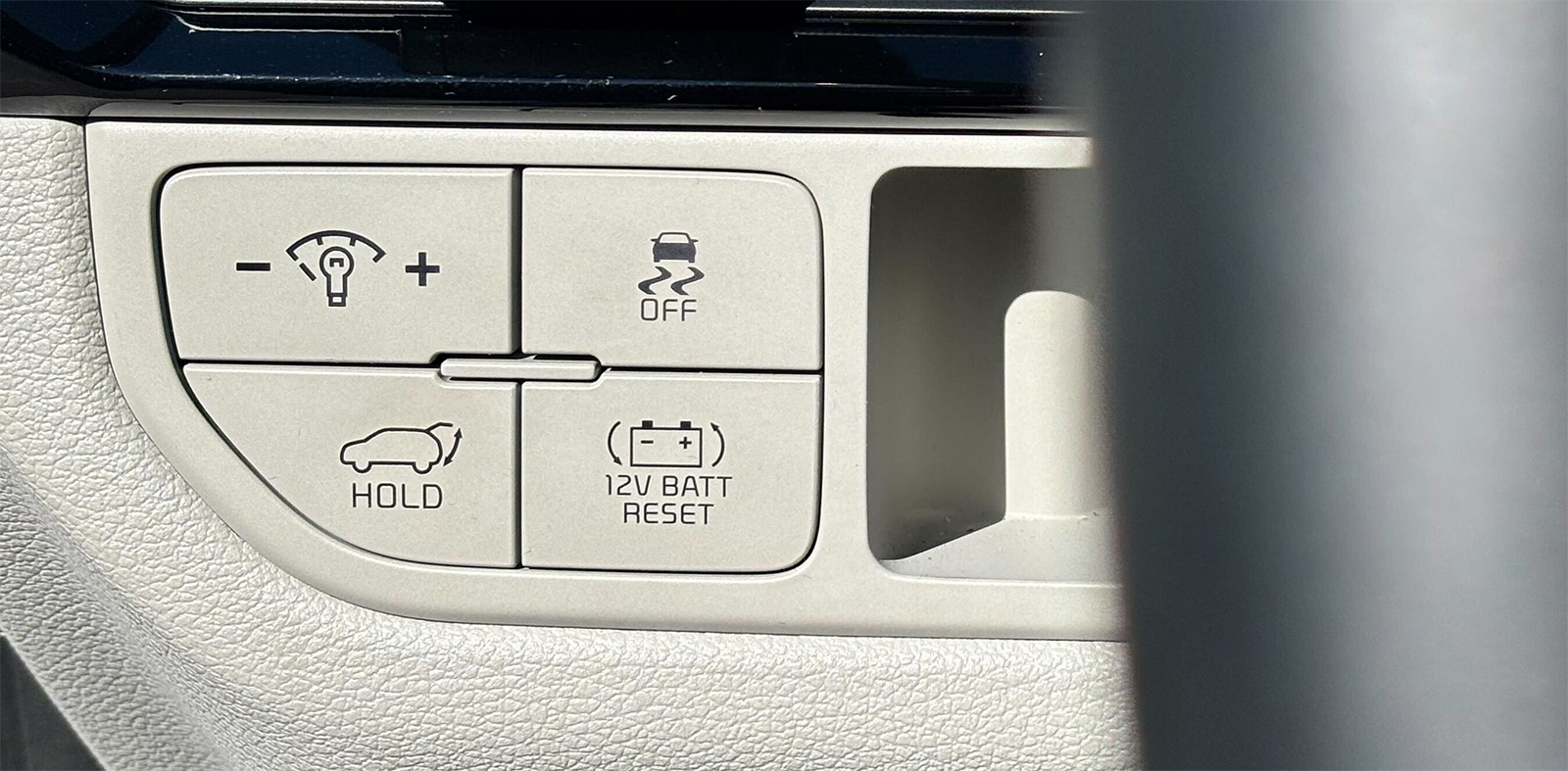
Maybe there’s a good reason for the BATT RESET button. But it’s also strange because the 12V battery has become, in many of these systems, more of a concept than an actual object. If the 12V battery is just a sort of segregated part of the main battery, then the 12V battery has become more software than hardware, a mode in which a portion of the larger battery runs in, emulating the behavior of an old lead-acid battery. It’s a strange idea to consider. So when there’s a button just for resetting the battery, it’s taking the place of removing terminal connections or jump starting a battery from another car, or accidentally dropping a wrench on the two terminals until it glows red hot and melts.
The 12V battery is now, on many cars like these, the idea of a battery.
So, what does that button do? It doesn’t really reset the battery – whatever that may actually mean – but rather just recharges the depleted on-board battery from other on-board sources of power. It all seems a bit strange to me, though, like a strange half-solution to a problem that maybe shouldn’t even really exist anymore?
Top graphic image: Matt Hardigree


My understanding of (admittedly non-Hyundai) EV systems is that the high voltage contactor is normally open (for safety reasons), and cannot be closed without a functioning 12V battery to activate the contactor. Hence problems with Teslas in long-term storage; even when plugged in, the HV battery stays topped up while the 12V battery drains.
If that physical separation has been eliminated, and the 12V battery is integrated into the HV battery pack…yeah. I don’t see the need for this button. You could completely eliminate the 12V hardware and always run off the DC-DC converter. Or automate the function as Jason suggested.
It’s not physically integrated into the high voltage battery, it is a separate battery module, however it is buried next to the high voltage battery.
The battery reset button doesn’t charge the 12V battery at all. What it does is give you at least one attempt to start the vehicle to reconnect the 12 battery, if you don’t close the contactors in 30 seconds it will not necessarily be able to start again if it’s drained too far.
The 12 v battery is charged when the vehicle is in the ready state, not when off to not excessively discharge the high voltage battery.
Thank you for clarifying.
Can KIA add a similar button for the Theta II engines?
This is a feature for vehicles that frequently sit long periods. With modern telematics, keyless entry, keyless ignition, remote start, etc., car that’s ‘off’ will still use enough juice to drain the battery while sitting for extended periods. This is effectively a push button, integrated jump pack.
Well played Sir!
The 12V battery does seem to have become the appendix of the modern EV/PHEV. No-one’s sure exactly why it’s still there and forgets about it until it goes wrong and brings your whole life to a screeching halt.
It’s there because EV and hybrid vehicles still have plenty of systems that are low-voltage, like the ECUs, power windows, power locks, infotainment, etc. Those are separate concerns from the high-voltage system that powers the drivetrain, and perhaps higher-function ancillaries like HVAC and electronic suspension wizardry on higher-end cars.
The two reasons I can imagine those are separate are:
More to the point on your second item there, you need a separate source of always-connected low-voltage power to operate the connection to the high-voltage battery in the first place. The main battery can’t operate its own disconnect switch for obvious reasons.
I suppose you could turn your car on with a giant manual Frankenstein-style lever instead. Which I grant has an appeal, but probably not for everyone.
Jokes on you, I owned a Spitfire with British electronics, so flipping the battery disconnect under the hood before contorting myself into the driver’s seat became a prized tradition. Like flipping on a new remote-controlled car, except the Triumph certainly did leak more
I’m wondering if they did something stupid like using stepper motors for the power windows and to reset them they need to “find home” by hitting the stops. Like on the water jet machining centers we have at work.
On my FRS (and presumably its siblings to this day) there was a window reset procedure. I don’t know if the issue was because of pinch risk (it has auto up on both windows, not just auto down) or because it was frameless and went up a little farther after you closed the door.
But in any case, if it got icy and the window got stuck on the way up it would think that was the new top position and only close to that point. All you had to do was turn the car on without starting the engine, roll the window down all the way, and then hold the button for a couple seconds until you hear a click. Easy.
But I assume this is what they are warning of here. The window finds a new “home” position if it’s not fully closed during the reset.
This is essentially exactly what’s happening. Newer anti-pinch safety features demand that the window stops when it encounters a specific amount of resistance. Since the resistance against movement in the track can vary form one car/window/motor combo to the next, each window has to be calibrated to figure out the normal friction versus a real obstruction.
Unfortunately, there’s usually no memory retention in the system via something simple like NVRAM or a coin cell or a supercapacitor in the control circuit or system.
Software-driven cars are capable of some pretty amazing things. But the accompanying failure modes, inexplicably counter-intuitive behaviors, and omissions that could be overcome with just a little more attention to design and engineering (like saving the window operating parameters in some kind of non-volatile memory or having an isolated backup power source) is just infuriating to those of us who remember when cars were relatively simple. Even the cars of the early 2000s (Which were well on the way to becoming highly sophisticated under OBDII and CAN bus systems) were sill predicably simple in how they behaved.
Interesting, my recently departed ’83 BMW 533i had a separate breaker switch for the power windows that would trip if they drew too much power and was reset by a button under the steering wheel, of course it wasn’t always obvious that you’d tripped until you tried opening or closing a window several times in frustration-in my case compounded by it being a 40 year old car and at any given time it was conceivable that a power window had actually failed 😀
Windows and sunroof calibration goes out and needs to be reset. They need to know their location within their travel range as part of the kickback mechanism that will retract the glass in event of an encountered obstruction. It’s more “safety” tech implemented to save some would-be Darwin Award contestant from a very remote chance of injury.
Also, both our current EVs have a feature buried in one of the touch screen menus where you can select that the 12V battery gets topped up from the main battery from time to time.
I feel dubious about this one, since it could save me from having a simple drained battery, but it could also aggravate problems when I am not around. Such as when it would try to charge a broken battery or if there is a shortcut due to rodent actions.
A fysical button would defenitely be my preference.
In theory, using something other than an alternator should allow for more ideal charging curves on the 12v battery and it should last a lot longer. Especially on an EV where you don’t need all the cranking amps. In practice it seems that in many cases they don’t care or just do a poor job of managing the 12v system.
Not a bad feature. I would have loved this in my prius.
Cars that don’t use the 12V for starting usually have a tiny 12V battery. And on the prius, it can easily be drained by listening to the on board radio while you wash the car.
I once parked the car somewhere remote in Scotland for a three day kayak trip with the missus. Someone (probably not me) left on the vanity light. So when we came back three days later, hungry cold and tired, we were locked out.
I dismantled the fob to open the doors, stowed some things and started hiking.
A few miles furter, the first sign of light just happened to be a pizzeria. Opened by some friendly folk who did not speak English. I used signs and drew pictures. Luckily he understood and called someone.
Correct. Toyota hybrid motor-generators (MGs) can charge its batteries in park, reverse or drive, but not neutral. Thus, if you have a weak battery, something like a rolling car wash where you’re in neutral could be an issue. I found this out when I took my 2008 LS 600h L, which had a failing high-voltage/traction battery, through a car wash and got a warning about discharging said battery.
Historically, laws require a clear division between the occupants and any high current. In a 12v car this is done with relays and fuses, but even a failure of those safeties will never exceed 12v. You may get burned but you are unlikely to die.
EVs today are running 400-800volts. Even with a step down DC-DC converter in place or across a segment of the main battery, a short circuit failure could potentially expose a person to instant death. My guess is that no car company wants to be liable, therefore the (presently accepted danger) legacy 12v battery remains.
Also, the industry is changing so fast that they can’t wait for every peripheral to be reinvented and are stuck using legacy parts to keep costs down.
Yes, My understanding of one EV that I read details of quite a while ago, and it makes sense that any car with a high voltage system would also follow, is that when the car is off the high voltage goes no further than the pack itself. All the hi-V lines thru the car external to the battery are de-energized. So, you need that 12V system to boot things up, aside from its memory-retention and accessory systems use.
Having worked with many pre-production HKMC vehicles:
It is a great feature. There’s nearly nothing worse than walking for miles to find the test vehicle just to find out, the 12V battery is dead.
With this button, usually you’re safe.
Great feature.
Having seen an apprentice drop a wrench across the 12v lead-acid battery terminals, I can assure you the wrench didn’t glow red hot, rather the battery went BANG and the apprentice had to jump in the shower there and then due to battery acid getting sprayed on his person, then sent to hospital for a check-up. He was lucky no lasting skin damage and no eyesight lost.
As a result, I always cover the positive terminal whenever I’m wrenching under the hood.
The 12V battery died in the daughter’s Prius over the winter. A true PITA. Just needed the jump pack to fire up the computer (after manually unlocking) and start the car. The hatch won’t open without 12V power. A 15 minute job with a socket set.
All priusses have a connector for jumping under the bonnet. Also, the bonnet is opened without power electronics.
(Source: I am one of those weirdos who reads a cars manual front to back.)
Yes, we jumped it from the fuse box under-hood.
And that is the case for the overwhelming majority of cars, too.
Weirdly, jumping from the positive terminal post did not work for my 2005 Phaeton V8, which has two H8 batteries in the trunk, one for starting and one for comfort (cabin electronics). Fortunately, I was able to get it powered on just enough to get into the trunk and swap out both batteries.
Wow. Why fix issues with parasitic power draw from the electronics when you can just shove 120lbs of battery into the trunk instead? Aston went with a similar strategy, but only one H8.
Yeah, my ’96 Jaguar XJ12 (which is the last year of the V12) has just the one H8, like that Aston. They’re not uncommon on large European cars.
But two is rather unusual.
The Phaeton’s setup is, I’m sure, to keep the electronics from being disrupted while you start car. And you can flick the key the other direction and use the comfort battery to start the engine and it will do this automatically if the starting battery is depleted, so it really is a complex system. The Continental GT and Flying Spur, since they entirely shared the Phaeton platform and electricals, also had the dual-battery system.
Meanwhile, I previously had a 2013 Audi A8 L 4.0T, and it had just the one battery–albeit mounted under the spare tire and rather a bitch to remove–so it’s not all luxury VW Group cars that had this.
Didn’t you watch Star Trek?
“We need more power to the impulse engines, Scotty!”
“Ai’m gi’en her all she’s got, cap’n! Wee’ll hae to transfer po’er from the life s’port!”
Same concept, pretty much.
I cann’o hold her t’gther m’ch long’r cap’n.
Like you, I guess I’m confused. It seems that if the 12-volt battery is part of the main battery I don’t understand why it’s not just a voltage step down device that takes the whatever voltage of the main battery and step it down to 12 volts. This device would have to have enough capacity to supply all the amperage needed by the 12 volt devices, but I don’t understand why that isn’t a better solution.
They do; that’s essentially what the DC-DC converter is that provides power in place of an alternator. The thing is the HV pack is usually fully disconnected from it when off via a contactor/solenoid/relay which requires 12v power + computer command to close.
Hardware watchdogs make sense in a software defined world. Just like when they started making what they considered non user removable batteries in devices they have a subsystem or hardware watchdog that will do a hard reset. I expect many manufacturers will have some kind of hidden connector or button in the future so good on Hyundai for putting it out in the open.
Idk man… it’s such a niche use case that it seems weird to put it out in the open. A button inside the glovebox or some other odd space makes more sense than taking up dash space with something you’re not going to use 99.99999999999% of the time.
Not really a niche case. Hybrid and EV 12V lead acid batterie die just like the 12V starting battery in a gas car.
My 2005 Prius, 2009 Prius, and 2017 Bolt have all left me stranded because the 12V battery died even though the HV battery had plenty of juice. (Had to replace the 12V batteries twice in each Prius) I carry a 12V jump pack in my Bolt for this reason.
I’m aware. But it doesn’t need to be on the dash near commonly used buttons.
It isn’t. It is on the dash with the rest of the almost never used buttons.
I have never needed to turn off traction control on a car. The screen dimming happens once. The rear hatch is unlocked via a proximity key or the key fob… The only button in the group I can see using would be the gas door unlock but I’ve never personally owned a car that had a locking gas door.
I could see glove box too. Hybrids and bev always doing strange things with 12v so easy to find probably not the worst design.
That would increase cost. New branch to the wire harness, new connector, new button, new machining operation for the button.
Adding an additional button to a button cluster is a lot cheaper.
True, its where they would normally put the auto stop start button on ice logically makes sense to replace that with the 12v reset.
I hadn’t though of that but you are right. They just repurposed that button. So this change was almost free from the hardware side of things.
It doesn’t charge the 12V lithium iron phosphate battery when you hit the reset. All hitting the reset does is reconnect the battery so you can start the car after it disconnected due to a low state of charge. If you fail to actually start the car within 30 seconds it will disconnect again and may no longer have sufficient charge to start the cars hvb and engine. If it died fully then unless the dealer has access to the external rescue charger the 12v needed to be replaced but it’s closer to $1000 or more vs a flooded lead acid battery or even an AGM.
$1000 for an LFP is nuts in 2026. Especially for one that only needs enough amps to close a contactor instead of cranking a starter motor. That’s 2016 prices.
Well looks like the part alone is ~$430-654 ish MSRP plus a $300 core charge listed on aftermarket suppliers with discounts from MSRP, plus the labor of tearing into the rear seat to get to the battery etc but yeah it’s a tiny pack vs the AGM or flooded lead acid on the PHEVs or larger hybrids
If I understand correctly, having this would have prevented our 2019 Highlander hybrid from stranding me in 10 degree weather
Yes, if the high voltage hybrid battery had a charge.
Power windows these days will often have an auto-down and auto-up feature. For these features to operate correctly, the window control unit needs to recognize position sensor readings corresponding to “full up” and “full down” window positions. These memorized values are often (but not always) stored in volatile memory. If so, then the memorized positions need to be re-learned if 12V battery power is lost.
Why doesn’t the car automatically re-charge the 12V battery while parked, rather than requiring the driver to push a button? This is probably because you REALLY do not want to excessively deplete the high voltage battery on a typical hybrid vehicle. If the high voltage battery is too low on charge to crank the engine, then you cannot operate the car even if you jump 12 volts to your 12V battery. If the car in question is not a plug-in hybrid, then you must use a special external power supply and some interesting procedures to re-charge the HV battery well enough to crank the engine.
Midtronics xRC-3363 High-Voltage Hybrid Car Charger
But couldn’t you at least allow this if the traction battery was above a certain percent?
I was thinking the same thing, auto charge until 30% on the traction battery even when off.
Also they should allow the traction battery to charge off the
12v. If your stuck at a Trailhead and only some jumper cables are available it could be useful.
The early Escape Hybrids had a Jump start button. It was hidden behind a panel on the end of the dash you can access when the driver’s door is open. You push the button and wait until the light on the button goes off. You can repeat the process, IF you have jumper cables/charger hooked up. I successfully used that on one that had sat for almost a year.
Although those were still using NiMH chemistry and the battery control module could allow the battery to discharge much deeper. As Ford prepared to transition to Li-Ion (where a very deep discharge is much more damaging to the pack health) they instituted stricter minimum power levels of ~30% so the HV jump theoretically shouldn’t be necessary.
Actually they dropped the ability to jump start the HV battery well before they went away from NiMH chemistry on their hybrids.
Correct. The 2nd Gen Escape never got Lithium packs (and there was no 3g hybrid), but that transitioned into the lithium-equipped 2nd gen Fusion and C-max hybrids which used similar BECM strategy.
It’s largely a safety thing. Common industry practice is to isolate all HV power to the HV pack when power is off.
I did that once, but I forget the details. I had to search online what was happening. It was something dumb like the remote app was telling the car to keep doing something that drained the 12V battery.
I didn’t have to do anything unusual to get in the car. Maybe I had left the car unlocked? Maybe that was the problem?
My memory was some online searches recommended plowing through multiple menus and toggling something and it wouldn’t return. Fingers crossed, it won’t.
It’s the equivalent of how your phone suddenly starts making a weird beeping sound but only when you get an email but not a text from your second cousin, and you have to spend an hour tracking down what the cause and solution is.
Isn’t it great how tech makes things simple?
Oh, I wish my Prius had this.
The battery that can only be accessed by opening the electrically operated hatch. The second time that happened I cut the thing over the battery so I can access it without opening the back.
Definitely getting one of those battery things you plug into the cigarette lighter to wake the car up and open the hatch before a cross country trip with a full load of stuff in the back. The battery in the trunk thing is my biggest complaint with the Prius. At least it’s not as bad as a dead battery in my sister‘s Boxster.
Don’t know what gen you have but my parents 2011 prius had a jump points under the hood (under the fuse box cover) that connected to the battery
https://www.chicagotoyota.com/how-to-jump-a-toyota-prius.htm
Once again tech makes things that work more complicated and not working
It’s worth noting that on some of the cars, like my Niro HEV (non-plug-in), that 12V battery is not a tradition lead acid or AGM battery, but a lithium battery that is both a challenge to source and (to a lesser extent) replace. That 12V reset button is a huge deal if that lithium battery goes dead, because jumping the battery or throwing a charger on it isn’t really a viable option.
Used this button 2-3 times over three years in my Niro HEV. And yes, the 12v “battery” was just one end of the big stick battery under the back seat.
It’s not part of the high voltage battery pack, but they did package it in the same case. It is a separate battery module and a different chemistry to the main traction battery.
Also if the battery is drained it disconnects and that reset button just gives you one more chance to start the car and charge it again.
I’m still stuck on how, and why is my door a jar.
Because you are a pickle.
It must be a problem that automakers have trouble with in general. My company’s E-Transit just had a recall to update the software that handles this very thing. Prior to the update it was prone to kill the (physical) 12V battery if the van sat unused for a few weeks. We never ran into that issue but the recall letter said it was a thing.
So whatever intractable problem prompted Hyundai/Kia to add this button also plagues Ford.
Still a better system than the Jeep 4XE, where a dead 12v battery will result in you being able to start the car, but do nothing else, including the ability to shut it off. You’ll then have to leave it running in your driveway until it runs out of gas, just to get it towed into the dealership for them to tell you that was all because of a dead 12v battery.
yikes
WTF??
A Mercedes W123 diesel won’t shut off with a dead battery either.
Shove a phone book over the air intake and it will.
Phone book? Where am I going to find one of those?
The air intake is on the passenger side of the hood opening, and will gladly inhale the drying towels at the car wash, that’s always amusing.
Manual trans, put it in 4th and stall it. Otherwise there’s a big lever in the fuel injection pump that cuts off the fuel.
I feel some nostalgia for the older 240D with the manual shutoff knob.
Had one of those too, it was great. Except in San Francisco.
How do I take the ebook file off my phone and put it into the intake? Will an audiobook work too, as long as it’s on my phone?
Sometimes they don’t shut off with a live battery, either.
Yes, vacuum leaks in the door locks are the usual culprit, but the shutoff is a vacuum solenoid operated by a valve that is operated by an electrical solenoid.
I know people who just hook a big syringe to the vacuum line and bypass the whole thing.
guess they learned something from the Daimler Chrysler era.
Peak Stellantis right there. Developing the worst possible solution for an issue.
Stellantis seems to have reasonably competent electrical engineers and software developers for their ICE cars, but something really went amiss with their HEV/PHEV/EV stuff. They’re chock-full of simply the dumbest oversights and design decisions.
That said, my friends’ Pacifica PHEV has done alright.