

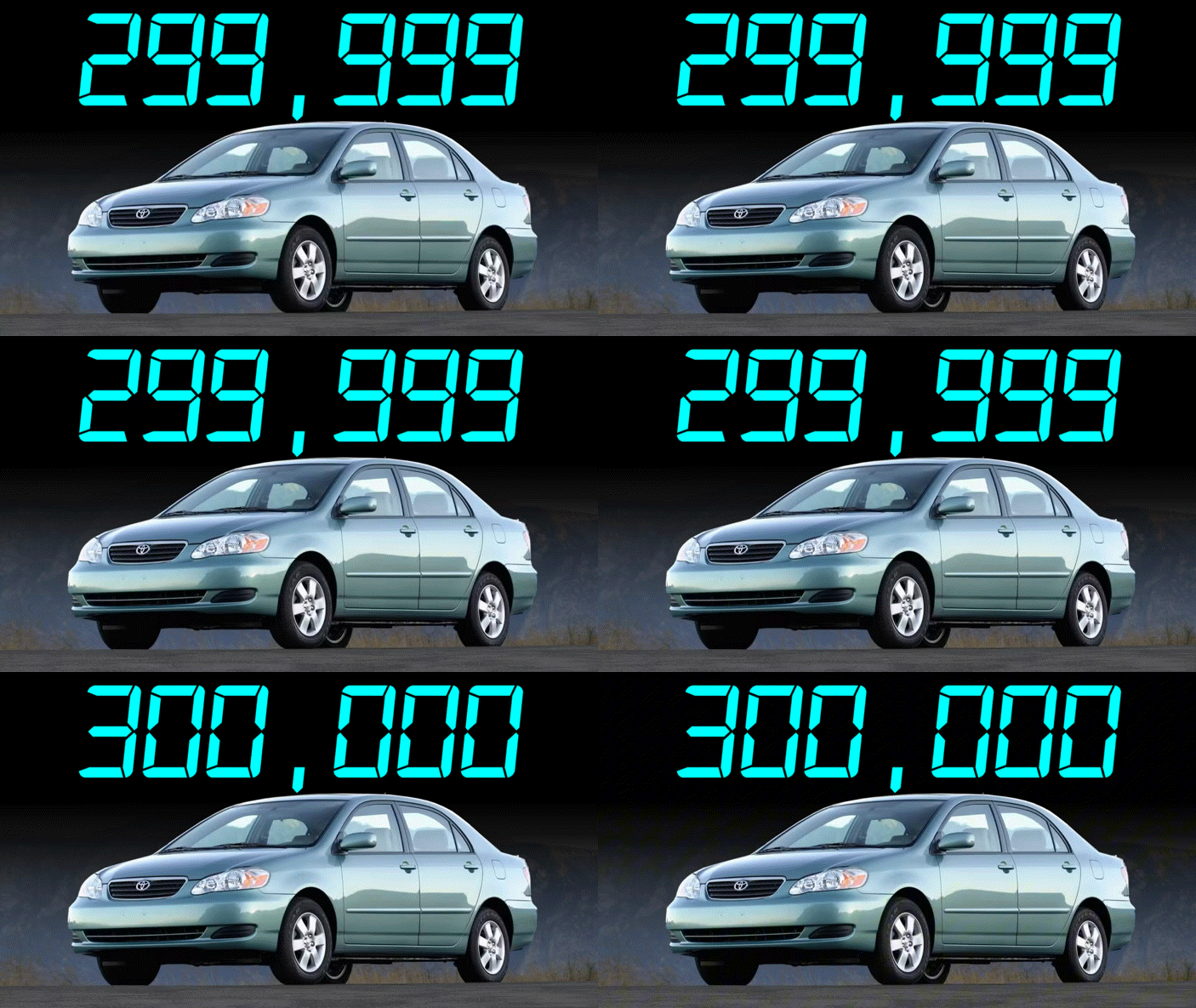
If there’s any one brand I’ve seen while shopping for cars on Facebook Marketplace with the most cars showing over 300,000 miles, it’s Toyota. The Japanese automaker’s reputation for reliability wasn’t built overnight; it came from decades of cars that, with the right maintenance, could easily go hundreds of thousands of miles without a major breakdown.
I’ve been looking at 100-Series Land Cruisers for sale recently, and it seems like anything remotely in my price range (ideally $7,000 or less) is near or above 300,000 miles. While that might scare some people, I’m not really worried, since with the right owner, these SUVs can make it well past that.


It’s ironic, then, that a handful of Toyota models from the mid-2000s have a glitch in their digital odometers that stops them from displaying over 299,999 miles. As time has gone on, and more of these cars are driven over 300,000 miles, more owners are starting to realize that there’s no easy fix.
Why Does This Happen?
According to ProSpeedo, a Calgary-based repair shop that specializes in meter repair, the fault lies in the erasable programmable read-only memory (EPROM) microchip that houses the data. The chip will register mileage past 299,999 miles, but it stops short of actually getting that data to the cluster. From its website:
It will register in the EPROM past 300,000 but it will not display in cluster anything over the 299,999. So to answer the question yes! On some it is designed in the flash file to stop at 299,999, and will not display in the digital readout anything after that point. Again let me repeat this, some Toyotas will not let the digital readout display anything after 299,999, it will register in the EPROM but will not display on cluster.
There’s much debate online about whether this was an intentional design feature or simply an unforeseen glitch that Toyota engineers missed in development. Toyota couldn’t provide any info when I asked about this quirk. The only “official” claim I can find pointing to it being done on purpose comes from a 2018 Reading Eagle article, in which a reader claims Toyota Canada told them it was a design feature, not a fault.
The problem is even worse for owners whose cars display distance driven in kilometers. Because the fault lies specifically with how the numbers are displayed, and not the actual miles driven, when someone gets to 299,999 kilometers, their odometer will freeze, too, as the video above shows. At least when you’re dealing with miles, 300k is a pretty lofty distance for most cars. But 186,000 miles? Most normal cars will do that in their lifetime.
Either way, Toyota never issued a technical bulletin or a recall for the issue, which means owners are on the hook for dealing with it.
Which Cars Are Affected, And What’s The Fix?
The vehicles affected by this weird odometer glitch include the first-generation Prius, second-generation Prius models built from 2004 to 2005, Toyota Corollas and Matrixes built from 2003 to 2008, and Pontiac Vibes built from 2003 to 2008 (the Vibe is just a reskinned version of the Matrix). In other words, a bunch of vehicles that are known for being able to go many, many miles before needing major repair work.
Sadly, no one’s figured out a way to reprogram the cluster to work properly. Drivers of the above cars have three different avenues for a “fix,” none of which are particularly straightforward.
Why did this Carrolla stop at 299,999. It’s been like this for 10 years. Probably another 150k on it since then.
by
u/Patotb13 in
Toyota
The most “official” option is having the cluster replaced with a new, zero-mile example from Toyota at a dealership, usually for $500-$700, going by people online who have had the work done. This resets the odometer to zero, which means the owner still has to keep track of the total mileage and disclose the odometer swap when it comes time to sell.
If you want to save some cash, you can also have your current odometer reset to zero by a repair shop. This costs a bit less—around $200 at ProSpeedo, plus the shipping cost to get your cluster to and from their shop. Like option 1, you have to keep track of total mileage and disclose actual miles to the new owner, should you decide to sell. Here’s a video of the process:

You could also just do nothing and continue driving without the use of an odometer. To track mileage, owners report using the car’s trip meter—which is unaffected by the glitch—to track mileage and time oil changes. Like the above solutions, you still have to track total mileage and disclose it if you want to sell. In this case, you also have to check the “exceeds mechanical limits” box on the car’s title when you sign it over to the new owner.
Having to manually track mileage on your car isn’t a huge pain, but it’s definitely less convenient than simply glancing down at the gauge cluster to see the total miles driven. Going from a brief search on Facebook Marketplace, there are various levels of due diligence done for people selling affected cars, from people disclosing actual mileage estimates to people selling their cars as if they actually have 299,999 miles on the clock. Others simply disclose that the 299k reading isn’t accurate, but don’t provide an actual mileage estimate.

If you own a second-generation Prius with this problem, there is a more permanent solution. Starting in 2006, the Mk2 Prius got an update to its combination meter (the cluster that displays odometer, speed, fuel gauge, and current gear position) that fixed the 299,999-mile limit for the odometer. Because the circuit boards fit in the same place and plug into the same connectors, you can swap them. Texas Hybrid Batteries, a shop in the Dallas-Fort Worth area that specializes in Prius repairs, will sell you a new combination meter that’s programmed to match your car’s VIN and mileage for just $150.
If there’s a lesson to be learned here, it’s that the cheap Toyota you spotted for sale on Craigslist might not have the mileage the seller suggests it does. As always, please do your due diligence when shopping for cars, even if they’re as cheap and indestructible as these Toyotas.
Top graphic image: Toyota


This would be so simple if Toyota simply offered a reset function. Original owner drives for 300K miles, sells car and the next owner drives 300K miles. Rinse and repeat.
All of this reminds me of the “Toyota announced a recall on every 1999 Corolla. Not for a problem, just because you should have bought something else by now…” meme.
https://theonion.com/toyota-recalls-1993-camry-due-to-fact-that-owners-reall-1819577805/
My mistake, I thought it was just a meme not an Onion article but yeah, that’s it!
Peak Irony!
The first time I noticed this glitch was with my friend’s 2006 Vibe that ended up with about 350k miles on it before he sold it. Of course he didn’t know the exact mileage, because he didn’t know how long it had been stuck at 299,999 when I pointed it out to him. He estimated how many miles were put on it after that, and I think he ended up selling the car, still in decent condition, for about $1500
I suspect this issue only matters if you’re some weirdo with aspirations to level off our current headed-for-disaster federal excise tax by replacing it with an annual tax on mileage, adjusted to account for vehicle weight.
Said weirdo thinks that’s not so hard to enforce since a) people are reasonably cooperative about self-reporting their income taxes every year as it is, and b) many people are willingly allowing insurance companies to monitor their driving through phone apps and such, so sharing their mileage isn’t such a huge hill to climb.
Granted my–sorry, said weirdo’s!–plan wouldn’t be implemented in the rosiest of scenarios until the vast majority of these FUBAR Japanese cars are off the road anyway. But a few might be alive and kicking, still.
I’ll have to find it, but I recently read a good analysis about why weight is not as important for road wear as many people think it is. Basically that large commercial vehicles, especially semis and dump trucks do create significantly more road wear, but that any normal car or truck under 10k pounds is so far below the design capacity of the road that it doesn’t make much of a difference.
Personally I think that consumer vehicles should be taxed by miles driven with a real emissions multiplier. All commercial and industrial vehicles should be taxed at a much higher mileage rate and separated into a few weight classes, with discounts for less emissions. And we might as well keep taxing fuel too just to keep a bit of pressure on the wound.
Sopt on about trucks. When designing roads in my area one jurisdiction counts each semi as equivalent to 100 passenger cars.
Depending on your geographical location and traffic, weather (and slowplows) actually cause more wear on a road than passenger cars.
Additional fees on commercial vehicles are directly charged to consumers, so always a good look for politicians.
By the way, most states require those taxes be applied to roads.
Try to see those books, see how far you get.
My experience with Japanese companies admitting fault or even acknowledging a problem, that’s not even there fault just passed along problem from licensed built systems is they don’t. It might be getting better but hard limit in a microcontroller isn’t unheard of. There are whole fleets of corrollas driving around Africa and the middle east with 299999 something stuck on with probably double that or more.
Pukeing at 262,144 or 524,288 would make sense, 299999 seems weirdly arbitrary.
I was thinking 360,000 could be explained or something divisible by 8 as well, 299999 is very arbitrary hard limit.
Because like the article said, it’s not a memory issue, it’s the display.
Which makes me think it is deliberate; If it can display a 0 and a 2, that’s all 7 segments.
I suspect that the needed to pick a number for the specifications and the tech writer asked the project manager what the maximum value should be , and rather than asking an engineer what number would break things, the manager just pulled a number out of the air. After that the engineers had to program it to stop working at that number.
They probably spent extra money to make it stop at 299999.
Isn’t the total miles driven available off the ODB2 port? That would be the cheap and easy fix.
Yeah I was expecting that to be listed as the cheap/easy version.
Although that company in Texas seems like they’re about to get some more business. That price ain’t bad.
Still haven’t fixed the million mile problem
https://lexusenthusiast.com/2019/02/22/matt-farahs-lexus-ls-400-reaches-1000000-miles/
https://www.motortrend.com/news/2014-lexus-ct200h-hybrid-1-million-miles-odometer
Seems philosophical at this point. Aside from tracking maintenance intervals, is there really anyone in the market for a car with 300k miles that would be scared off by 500k?
I was asking myself the same question. At some point total mileage doesn’t matter anymore.
Some state DMVs get all weird about odometers.
299,999 it is!
In kms, absolutely. A 300k km Toyota is still a $5k-ish car without rust. 400k I would be pretty hesitant, 500k I wouldn’t touch
I’ve read recently that getting these things fixed and keeping our cars running has a new term to describe us:
“Device Hoarding”
https://www.cnbc.com/2025/11/23/how-device-hoarding-by-americans-is-costing-economy.html
It’s our fault the economy is in the toilet.
And Avocado Toast.
I’ve seen the term “Device Hoarding” bandied about in the retrogaming space.
The meme goes
(insane crying face) “Just buy a PS5!”
(sane face, beside a picture of an NES) “No”.
Stop talking about me!
Where do we report abusive, personally targeted posts?
“device hoarding” is such a cynical term. The person with a decades-old set of wrenches is admirable, not a “tool hoarder,” selfishly dragging down the economy.
I get tech is different but this reframing makes it sound like it’s the consumer’s fault for not wanting to upgrade their $1000+ devices every 24-36 months if they still suit there needs.
You know what else is a productivity killer? Your shiny new PC with AI built in that constantly interrupts you with useless suggestions. How many collective hours do employees waste figuring out how to disable it?
I’m pretty sure “Device Hoarding” was devised by someone who is indebted to a “Wealth Hoarder”.
Agree and add:
Not the Consumers’ fault that some companies businesses make products that keep working for a long time.
No worries, since there are plenty of companies that make obsolete-able products that need replacing frequently.
Not the consumers’ responsibility to choose the latter over the former cuz #merica.
Why should I buy anything that becomes obsolete before I get out of the store?
You shouldn’t. That’s the point.
However, enough people do to make it profitable for companies to make things like that.
“Device hoarder” may be my new alter ego account name.
I approve this message.
Complaints of device hoarding is just another glazier’s fallacy:
https://en.wikipedia.org/wiki/Parable_of_the_broken_window
Also the gospel of Zorg:
https://www.youtube.com/watch?v=KXwqUMkXFiI
He’s a monster!
Hear, hear!
In Wisconsin, it used to be that once a vehicle hit 10 years old, the mileage was noted as ‘exempt’ when transferring the title to a new owner.
In 2021, they changed the exemption to 20 years old.
“In Wisconsin, vehicles that are 20 years old or older are exempt from odometer mileage reporting during a title transfer. As of January 1, 2021, the rule shifted from 10 to 20 years, meaning vehicles with a model year of 2010 or older are currently exempt. Vehicles from 2011 or newer must report mileage until they turn 20.”
So my 2010 GMC is exempt, even though it’s only 16 years old.
Source: https://wisconsindot.gov/Pages/online-srvcs/title-vehicle/faqs-vehicle-info.aspx#
This is still my favourite known defect, especially because it hit some of the cars most likely for it to be a problem.
Yeah it could very well be true of any dodge car or van made in the 90s, but no one made it to a 4th transmission to find out.
Painfully underrated joke!
Welcome to the Ultradrive Order of Merit!
stupid a88888 instead of 888888
and also, most other digital odometers that do have 999999 stop at 999999 instead of rolling over to zero. The only exception I know of is the EL Falcon from Australia:
https://www.youtube.com/watch?v=hCogIA2LMdY
Matt Farah’s (former) Million Mile Lexus.
Why not just keep track of the mileage on one of the trip meters and reset it to zero at 900 miles or so ? I have an intermittent glitch on the digital fuel gauge on my Civic and go mainly by a trip meter instead of the gauge . With that many miles on an older car I doubt people care much about going though the trouble and expense of a proper fix .
Your mileage may vary. Or maybe not.
Talk about a cluster…fuck. ha ha
You forgot to put on sunglasses.
(•_•)
( •_•)>⌐■-■
(⌐■_■)
YEEEEAAAHHH!
My brother has a first gen Vibe and my sister has a first gen Matrix, both stuck at 299,999km.
Our father is a mechanic and he didn’t believe me when I told them the odometers would stop counting short of 300,000km, but he eventually learned I was right.
“Why did this Carolla stop at 299,999”
Corolla or Camaro, which is misspelled more often?
Don’t forget Volkswagon.
nissan rouge is my favorite, followed by hyundai tuscan
The Ramadan suv
Alpha Romero
I’ve seen an Austin Martin V8 Vintage on Craigslist.
Brian, you hit the nail on the head. These cars are now 20 years old, cheap and indestructible. I doubt most owners care anymore.
Now this is something I’ve actually run into; because one of the managers at my work actually has a 2005 Corolla with a frozen odometer
Now this is something I’ve actually run into; because one of the managers at my work actually has a 2005 Corolla with a frozen odometer!
2003 Matrix XRS here!
With 240K miles so far. My mechanic told me about this.
Son has a 2004 Prius that might might make it to 299,999 as well.
What puzzles me is why this is even something to be designed into the cluster in the first place. What was this improving from past clusters?
And any fix requires removing a bunch of dashboard, I think. I mean, the computer apparently keeps the miles stored, it’s just that the cluster won’t display it, right?
were I to keep this car another 100K miles or so, I’d like to replace the cluster with one that works, not the same cluster zeroed out.
There are clusters that exist that work in newer and older cars.
My guess is that no one at Toyota, nor anyone else in the universe, has cared enough to fix it.
The EPROM is in the cluster itself, the ECU doesn’t know anything other than telling the cluster to +1 to the display.
This is almost certainly a programming logic error in the cluster micro controller, where it fails to display the correct number over a certain value, even though the EPROM memory has the correct value stored. Basically a variation on a Y2K glitch.
Um, in English, please??
Actually I understand it. So, could a updated cluster be made? Shirley there are dozens of us! that would buy one.
Seems like a “No one is concerned about this in 2005” kind of thing where a “recall” would have to be issued. Not a hazard to driving, so who cares?
It’s too bad they made the cars to last this long, and now I might have a really small but hugely annoying thing that’s gone wrong with my car in a few years.
I WFH, so not driving it much these days. Actually, I took a picture in 8/14/2017 when it rolled over to 200K.
In theory it could be fixed. Easiest way would be replacing the micro controller with an Arduino or something. Just need to program it to read the EPROM and output the correct sequence to the display.
That’s significantly above my pay grade when it comes to micro electronics knowledge as for exactly how to make it work, but I bet someone out there can make it happen.
Seeing how the late model Prius has a fixed cluster you can swap in, I’d bet the guts can be transplanted into an older cluster if you’re handy with a soldering iron.
My issue is more with the “taking out the dashboard” part.
Unless there is an easier way.
I’ve never worked on one, so no clue there.
In general on modern cars, I find that if you treat it the reverse of assembly, it tends to be the easiest even if it seems like more work in total. This usually means removing the seats, dropping the column, removing center console, etc.
At this point I’d rather disassemble half the car instead of twisting myself up in a pretzel, upside down in the driver’s seat, to remove an inconvenient bolt.
Rally equipment used to be a quick fix for some of these issues.
Really, no one is taking the bait on the “… and don’t call me Shirley.” joke?
Maybe they just think it’s Otto-Correct?
Good luck getting any 100-series that runs, drives, and isn’t rusting from the inside out south of 10k. You might have luck with a GX470, but that’s also similarly tough. Anything for either of those priced under 10k usually require enough maintenance to get your spend right up to that threshold.
Did you mean the LX470??? The Lexus GX=Toyota Land Cruiser Prado which was never sold in the USA. Either one are great trucks and not that much difference size wise. Maybe with gas being $4-5 a gallon prices will drop a bit. Im thinking either one has the same v8 and its 12-14mpg no matter how you drive it
I meant GX in particular. The LX470 seem to generally be priced in line with the LC, but sometimes the GX are cheaper. GX is only about 2″ shorter, 1″ narrower, but is 300 pounds lighter than the LC and wayyyyy less than the LX470, has an extra gear in it’s transmission over LC, and the same standard center locker. Sure the 100 series LC had the option of extra lockers, but those all carry a big price premium.
I had an 03 GX as a project a couple years back and it was absolutely sublime with an incredible powertrain, hugely capable, and as robust as you would expect. The GX470 often gets overlook relative to the LC, but has an equally deep aftermarket. I picked mine up for 5k with ~160k on it and a handful of issues, remedied everything for about 3k, and sold it for 10k and I probably left 1-2k on the table to get it sold quickly. This was with imperfect paint, ok tires, and a TB/WP halfway through it’s life. Miss the thing constantly, but the 14mpg no matter what you do is less than ideal. Also early GX470 don’t specify premium gas which keeps it’s fuel costs on-par with the LC-100, if not lower with an extra gear.
Since the correct mileage is stored on the EPROM is there any way to read it directly, like with an OBDII tool?
You would have to read it directly off the EPROM using a dedicated reader. I do not know for sure, but most vehicles in that era did not have a OBD based method to read mileage data from modules. My 2008 Avalon has no mileage reporting that I’ve found, despite having a bidirectional scanner and programming package.