

As a purveyor of cheap, clapped-out automobiles, I frequently involve myself in cash-based transactions when it comes to car buying and selling. Even in the year of our lord 2025, cash is still king in some scenarios, like when you show up to a Home Depot parking lot in Queens to snag a deal on a 216,000-mile Range Rover you found on Facebook Marketplace the night before.
But for normal people buying normal cars, cash is rarely the right answer. While it might feel right to pay cash for big-ticket items, like a down payment for a car, it opens you up to a whole lot of financial risk.


I bring this up because of a recent story out of Houston, Texas, where a man who worked at a now-defunct Kia dealership is accused of taking a bunch of cash for stuff like down payments, taxes, and registration fees from 14 individuals and pocketing the money for himself. From Click2Houston:
Between Aug. 2024 and Feb. 2025, Parker allegedly stole a total of $68,700 from 14 victims who believed they were making cash down payments toward vehicles.
Court documents state Parker told customers he could help fix their bad credit through a Kia “credit repair program.” He allegedly collected cash down payments and later requested more money for taxes, title, and registration fees, promising to complete their vehicle purchases once the process was finalized.
Instead, investigators said Parker stopped responding to the victims, and no vehicles were ever delivered.
Court records show Parker was already out on bond for two similar cases, one for theft and another for unauthorized use of a vehicle, both connected to his employment at the same dealership.
Digging deeper into the court records from the Harris County District Clerk’s office, officials say that Parker allegedly had the victims fill out all of the necessary paperwork before taking their cash, but that “no documentation was found at the dealership” regarding any sales transactions.

“Obviously, it’s a huge red flag if anybody asks for cash and they’re a car dealer or a dealership agent,” Steve Lehto, a Michigan-based consumer protection attorney, told The Autopian. ”Rule number one is always be able to prove that you paid them money. So if by chance you actually found a situation where you needed to pay somebody cash, you’re going to make sure you get something in writing that identifies that you paid it to the dealership, and not to just some guy.”
The only mention of officials finding proof that a transaction occurred was the sole victim who paid via CashApp, rather than with actual cash. It’s unclear from court records whether Parker issued any of his alleged victims a receipt for their payments.
It’s easy to see how something like this could happen. Cash is much easier to pocket than, say, a cashier’s check, which requires the issuer to print a recipient. If the buyers paid this way, they’d be able to specify the dealership as the recipient rather than the salesman they’re dealing with (I don’t know of any brand-name dealer where it’s the salesman dealing with the actual finances; that job belongs to the finance manager).
If you still want to use cash, you can. There are a multitude of reasons why someone wouldn’t have a bank account or would prefer to use real cash. Lehto suggests doing it carefully.
“You can use cash if you want to, but you’re living dangerously, and you’ve got to protect yourself,” he says. “And so what you need to do is get something you’re writing, i.e., a receipt, and it needs to be on some kind of letterhead. And any legitimate card dealership will give you a receipt that is obviously from them.”
Still, it’s best to avoid using cash when you don’t have to. Every other method, whether that’s a cashier’s check, a money order, a certified check, a wire transfer, or even a personal check, leaves more of a paper trail, making it easier for law enforcement to track down your money if things go sideways.
There’s also the credit repair aspect to all of these, which I think is particularly scummy if proven to be true. According to court documents, Parker allegedly told the complainants the money would also help them fix their bad credit, helping them to secure the vehicle they wanted.
“He was allegedly taking advantage of people who were screwed up financially, in that they had bad credit,” Lehto says. “And so somebody who’s got bad credit who goes to a car dealer is expecting some kind of pushback, like, ‘We either can’t sell you a car or you’re going to get horrible financing or you’ve got to put a gigantic amount of money down.’ And when some guy goes, ‘Hey, look, I can help fix your credit, but you’ve got to pay me cash,’ He’s simply taking advantage of them because he knows that’s their weakness.”
Really, this all comes down to consumer knowledge. The Better Business Bureau told me Fredy Kia, the now-defunct dealer at the center of this alleged crime, was not an accredited business with the nonprofit’s Houston division, and carried an “F” rating. A peek at the BBB’s website lists 21 complaints directed towards the business in the past three years, and an average customer review rating of one star out of five. In a statement provided to The Autopian, the BBB outlined some basic, yet effective ways to ensure you don’t get tricked in a similar manner:
We strongly encourage consumers to research any business with the BBB before making a purchase or financial commitment. This includes reviewing the company’s BBB rating, complaint history, licensing, and customer reviews.
When purchasing a vehicle, consumers should also be cautious of any promises related to credit repair services—this is not a standard offering from legitimate car dealerships. If an employee claims to provide credit repair assistance or asks for additional payments outside the dealership’s official process, it should raise an immediate red flag.
Consumers should never provide down payments or personal payments directly to an employee and should not proceed without a signed contract or consultation with the finance office. Always verify with a sales manager what an employee is promising, and request all details in writing before agreeing to any transaction.
You can’t lay all the blame on the people who allegedly got scammed. How were they supposed to know their Kia salesman was already out on bond for two other cases involving that dealership? I certainly wouldn’t have researched that thoroughly. And when a guy in a Kia-branded polo is telling you Kia’s running a program to help fix your credit because you’re in a tough spot, it probably feels pretty genuine—this wasn’t some shady used car lot, it was a whole-ass Kia dealer that had been in business since 2004.
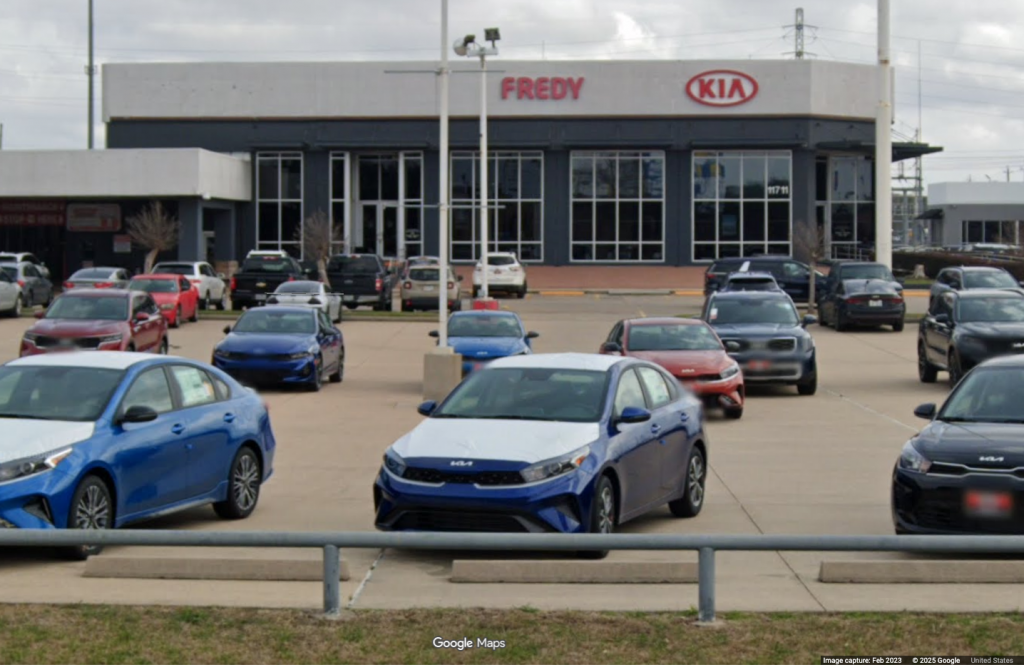
Because Fredy Kia has since been replaced by another Kia dealership run by Bayway Auto Group, a well-known Houston-area dealer conglomerate, I couldn’t get a comment from them. Here’s what Kia, the company, had to say about the matter:
We are deeply troubled by the allegations of theft involving the employee of a former Kia dealership. Kia dealerships are independently owned and operated businesses, and this dealership is no longer part of our network. We expect all Kia dealerships representing our brand to uphold the highest standards of integrity and compliance in their interactions with customers. We take matters like this very seriously and support the criminal justice process in this matter.
The lesson here is, try to avoid using cash when you can. It can leave you open to all types of easily avoidable risks. At worst, your money can simply disappear, leaving you with nothing in return. If you do end up using cash, be sure to do your research first. While you’ll still be taking more of a risk, you’ll also be more informed about your transaction.
Top graphic image: DepositPhotos.com



I flew to CA to buy a Miata years ago. Since I hadn’t seen the car yet, I wanted to be able to change the amount. I brought a bank check for half the amount and brought cash for the rest.
This was a private transaction where I left with the car and the title, and I met with the seller at his home, where we exchanged paperwork and I paid him the full amount because the car was as represented.
If I were dealing with a dealership or anyone other than the person on the title, it would have gone through the bank.
Honestly, though, ‘Kia credit repair program?’
My sympathy has limits, and anyone who fell for this does not clear the bar.
Was going to post something similar to your close. There are people who have bad credit through turns of poor luck, but others earn it. These people want to fix it, but couldn’t be assed to know the first thing about it? It’s not hidden knowledge. Maybe they just don’t like that the answer requires effort and think there’s an easy way out even if it’s through some supposed car dealer program to fix it that makes no sense before considering that it involves handing cash over to a random associate. Some people seem to be intentionally looking to be victims and that’s where my sympathy ends.
Sounds like the guy was deliberately preying on people who (probably) had a history of bad financial decisions, because they’d be less likely to notice the red flags.
Agreed, but how many times do you burn yourself before realizing fire is hot?
This is a weird take. Sure with a deal with a dealership never do cash. But if you are buying from a private owner can you demand they provide you credit? Or on a cheap car can a person accept credit cards? Brian your approach is a bit delulu. How does that cash thing work on all auto deals? I think you didn’t think this through.
When we bought our 2024 Chevy Trax LS in December of 2023, the stealership wanted more than 7% to finance it, even with a 830+ credit score.
We ended up writing a check for it.
If I’m going to finance and there isn’t some advertised special rate I always check my rate at my CU. Then I tell them I am approved at x.x% and I’ll finance with them if they can beat it by x. That gets them down to their best rate from the get go. That is why I’m now a “member” of the Washington State Employee’s Credit union because they were .25% lower.
That is the way to do it. Always come with your own financing and / or cash / check.
Or credit card. Thanks, AmEx!
I have not found a car dealer that will accept a credit card for full payment. Last car was the highest but they only allowed $5,000 on the card.
That was the limit when I bought a Toyota a couple of years ago. I put $5K on Discover for the 2% $100 and paid cash for the balance.
I just asked as a joke right before my wife wrote a check and was pretty surprised when they said “yes.” We had to call AmEx to allow it to go through but that was it. Total was $21k or something.
Wow, you got lucky with that!
I already never use cash, because I ain’t got it.
Who walks out of a large cash transaction with no product in hand or a receipt of any kind? And don’t dealerships have actual cashiers to take cash?
Honestly, I doubt event service or parts departments use cash anymore
My dealer’s service department charges an extra 3% for credit cards. They would much prefer cash, check, or debit.
I paid cash for a car at a dealership a few weeks ago. They had me tap my debit card onto a mobile reader, like the ones that servers at Olive Garden use. Then they printed out a mini receipt, exactly the same as you would get at Olive Garden. Considering how much money I spent, it felt vaguely insulting to be getting the same treatment that I’d had at Olive Garden the day before.
That’s not cash per the article’s premise. Cash in the article’s premise being bills.
OK. But do you really want a paper trail for the authorities? Like for example- you are taxed on the reported buying price of a used car. Are all of you perfectly honest in your reported transaction prices?
What is sales tax? Great to be living in a state that doesn’t try to nickel and dime.
To the meat of the question. If you buy from a dealer – you will have a receipt with the actual price paid. Private party – I do in fact list the actual price paid whether I am seller or buyer on the bill of sale and / or title. Even when I lived in states that charged sales tax on cars.
No, we are not all perfectly honest. Even if my state does not tax private party used car sales.
I’ve always been honest as private party purchases were cheap used cars from people I didn’t know and it wouldn’t even occur to me to look sketchy to someone by requesting they write it up for a lower price to save well under $100. From what I’ve been told, too low a price can trigger a minimum book value, anyway, though I’m not sure if that’s true.
Yes, I’m not willing to mess around with tax fraud to save a few bucks
Yes. If you go below the low book value, the DMV clerk will start arguing with you.
For private car sales, I use KeySavvy if at all possible, otherwise cashier’s checks.
KeySavvy is a vehicle escrow service that make sure both the seller and buyer are legit, then processes the transaction on behalf of both for about a $200 fee, which can be put on the buyer, seller, or split between both.
I was selling my Leaf private party and the buyer asked to use KeySavvy. I looked into it, it seemed legit across a variety of sources, so I agreed. As the seller, I entered the car’s VIN, the selling price, and a picture of the title. The buyer basically wired the funds to KeySavvy. Once we agreed in person to make the sale, you fill out some forms, electronically sign some things, then I mailed the title to KeySavvy. Once they received the title, they wired the funds to my account. Their website walked through everything step by step and had a very clear dashboard updated with exactly what was going on at that step. Super clear, transparent, and easy.
I don’t understand the need for an escrow service for a face-to-face transaction. What problem exactly are you trying to solve? That the seller would take your cash, but refuse to hand over the title?
I have bought and sold cars and bikes and lots of other things, and I’ve never, ever encountered that situation.
It’s better for high value transactions. When I was researching KeySavvy, I saw the most information on the service in Porsche forums.
Nobody is paying in bills for $20k+ purchases, or at least I’d strongly advise against that. Cashier’s checks are pretty safe, but fakes are possible.
As a dealer, KeySavvy can also let buyers claim the used EV tax credit (when it was available), for “private” party sales.
Even if buyer and seller are comfortable with each other, handling large sums of money manually is risky. In the end, $200 is cheap peace of mind when you’re dropping $20k+ on a private sale.
Gotta use it for the dispo…
I bring cash to the farmer’s market. And that’s about it.
yard and garage sales also.
My new policy for garage sales is “no”. We have an entire garage sale in our attic at this point. And I swear half the stuff came from other people’s garage sales.
The barber shop I go to only takes cash, but I much prefer going there than the big national hair chains.
Ah you got me. Barber as well. I have to scramble to a bank right before my appointment every time because I never remember to get the cash in advance.
I prefer to pay any and all small business in cash. It is just not always possible.
The merchant fees suck and a lot of small businesses hate them. But some of them don’t seem to mind, because at this point they get so few cash transactions that they’d rather not have to handle or deposit cash anymore.
But yeah, I understand the benefit.
There’s also the possibility of getting pulled over with the cash. Civil asset forfeiture is a real thing people. Steve has a few good videos about that as well. I will say though, as often as I buy and sell cheap cars I most often prefer to do transactions in cash. Most of my transactions are less than 5k though.
This is the main reason I stress about having large sums of cash on me, because there’s rarely anything you can do about it
I don’t use actual cash folding money for ANYTHING. I rarely even have any one me – the only reason for the past few years is I have a neighbor who has a yard sale or two every winter and sells my crap I don’t want for me. She won’t keep the money, so I end up with a $40-50 in my wallet for eons. EVERY thing goes on my credit cards for the points, and big ticket items are personal or bank check/wire transfer.
When I have bought cars privately, I have just arranged to meet and do the deal right at a bank. Mine or theirs, doesn’t much matter.
You can just go to the ATM and deposit it back to the bank.
So you are limiting your buying and selling to only bank hours? That sounds rather inconvenient.
Also, if you did the transaction at the buyer’s bank, you would still end up with either an envelope full of cash, or a bank check. Either way you would still have to make a trip back to your own bank to deposit that money. I am not seeing the convenience angle here.
I can’t be bothered. There is no ATM for my bank in the town I live in most of the time. I use it eventually for random things, like splitting a bill at a restaurant with friends. Or occasionally, you do encounter a place that doesn’t take plastic. Not often enough for me to make it a point of having cash, but it’s worth having a few bucks collecting dust in my wallet. The two $20 bills in my wallet at the moment have been there since my neighbor’s last yard sale last winter.
Bank hours are not really much of a limitation. It’s also a security issue – I want to do the deal where there are other people around. Too many shady people these days. Plus generally banks are convenient for things like getting the bill of sale notarized, which is a common requirement when selling a car.
There are these things called wire transfers. I am not taking a check from anybody, and I have no interest in dealing with cash in either direction – especially in these times of “asset forfeiture” if you run across the wrong cops. The $25-30 fee to have large sums of money magically put right from one account to the other is well worth it to me. I’m not buying $200 hoopties as a rule. The last used car I bought and paid “cash” for was $18K. I’m nor running around with $18K in cash, and these days you are a complete fool if you accept even a bank check or money order for that much from anybody – too easy to forge.
Years ago I worked for a small company of about 25-30 people. One of the benefits that was offered to us was a paycheck loan. You could borrow up to one paycheck and have it deducted over the course of 1 year at no interest.
Because this was a small company, the entire accounting “department” was a single person. For years she was having anyone who took out the payday loan write a check to her name each payday for reimbursement. I think it was years later but the guy who owned the business finally got a judgement against her after she had embezzled about $80K.
Same! I worked for a small firm where the accountant was also the bookkeeper. Friendly old grandma lady, brought in homemade cookies even. No kidding. Oh, and she embezzled from the owner for 27 years before getting caught. It was a good life lesson for me: never combine those two roles, ever. By design they should be adversarial.
There were actually a couple of small towns in my state that did the same thing and both of them were able to get away with several hundred thousand dollars over a handfull of years, before they were caught.
I know so many old guys that do nearly everything with cash and still do not use banks. They have cash stuffed everywhere. It is like they think real men use cash.
Years ago when we pulled the carpet up in my parent’s bedroom we found a few thousand stashed around in about a dozen places. When they pass we are going to have to go through EVERYTHING in that house.
My MIL stashed $19k into the bottom of a trash can in their cluttered den. Luckily FIL found it before putting actual trash on top and then throwing it all away. Crazy gonna crazy.
and that everything needs to include inside the walls and under the attic insulation. A good friend found a box of gold coins in the attic of a house he bought a few years ago.
True. It was just my mom doing this nutty stuff. Last year we found out that my dad got pissed off that his credit union was only giving him 0.05% on his saving account so he pulled out the money and hid it in his workshop.
I still use credit unions but in the 1980s my credit union gave me 6% on my checking and even more on savings ( i forget the amount) They could probably do that because mortgage rates were 14%.
Today I still have a local Credit Union but I don’t really have much money there. I moved to Ally years ago because their APY’s were so much better. Current at 3.45% – no minimum deposit, no fees, no rules.
My local CU offers 0.05% unless you jump through a bunch of hoops on minimum debit card transactions, spend, direct deposits, etc, etc. Then they will give you 3% but it you miss one of the rules it is back to 0.05%.
Uh, I avoid cash for any transaction period. Only time I ever have cash is if it’s given as a gift of some sort.
30 or so years ago I said that when McDonalds starts taking credit/debit cash will be dead.
So, you know, in addition to the OTHER risks of dealing with large amounts of cash, such as “being robbed” and “counterfeit”
The new $100s with the reflective strips are really hard to counterfeit.
Just bought my last used car on a CC. May as well get the points bonus.
We did that when we bought our Envoy.
The bank would not finance anyway. I’ll float it at zero interst for 18 months on another card. Having good credit is required in modern society.
My last car purchase the dealer would only allow a maximum of $5,000 to go on a car. So I paid $5K on a card for the points and financed the rest – since cash discounts aren’t a thing anymore – the dealer makes more if you finance.
We bought a new car with a CC once, surprisingly.
It is not hard to get a certified check from most banks. PayPal and Venmo offer transaction tracking and consumer protection as well.
Not to pick at nits, but it is actually quite difficult to get a certified check at any institution in the US. A certified check is a check issued by the institution attesting that you have funds in your account sufficient to back it. It differs from a cashier’s check, where the money is withdrawn from your account at time of issuance of said cashier’s check. Wells Fargo, BoA, others will all gladly issue cashier’s check, but none of them will issue a certified check on a personal account.
“Certified check” is language commonly used in scams, which is why I raise this.
In the US, at least, the rise of eACH has obviated the need for any kind of certified checks – any institutionally competent dealership (read: entity with a business license and business process) can determine at point of sale if you have sufficient funds. So for a lot of dealerships, you’re perfectly fine walking in with a personal check, or even a virtual check if the dealership is set up to accept them.
For peer-to-peer / private purchases, as you indicated, Venmo, Paypal, or a wire are all perfectly acceptable.
Was thinking Cashier’s check – where the funding is verified.
Is eACH the name for a business scanning a check and then the transaction is processed as if it is a debit transaction?
Also isn’t Venmo limited to only $5K per transaction?
Yeah in every case where I have purchased a car from a dealer my wife or I wrote them a personal check either for the full price of the car or the down payment and of course drove out in the car, once out of the damn F&I office.
Considering this was a dealership the requirement for cash should set off major alarm bells. No reputable new car dealer should be asking for cash.
For private party purchases cash may be the only option unless the transaction is between friends that can be trusted to write a good check. Don’t take a check from a relative, they’ll write bad checks for kids birthday presents and never make it good.
Cashier’s checks. When a person gets a cashier’s check from a bank, the money is withdrawn from their account immediately upon issuance, and no bank will issue a check from an account that does not have enough money in it
There are also services such as keysavvy or caramel that will act as a escrow agent to facilitate private party transactions
Unless the check and bank are fake – which you have no way I know.
I will not take a check of any kind for a sale unless they buyer waits for it to clear before the vehicle is handed over.
You can call the issuing bank to verify the cashier’s check’s validity. Only accept a cashier’s check from a well known bank, give them a call to confirm, and problem solved.
Good to know. Still won’t change my personal selling policy. I see no reason for someone not to bring cash. I’ll do a transaction at their bank too if they like.
I do like the new $100’s with the new security strip that changes from $100 to bells depending on the angle.
I sold an old pickup to a doctor once on a Sunday. The wife was upset that I accepted a personal check for it and let them drive away with the truck.
I Googled the guy as I was signing the title and he had a legit practice, the photo matched, and he signed the check on the hood of his Cayenne Turbo S.
I wasn’t worried. I cashed the check the next day with no problem.
Considering their already less-than-stellar reputation, the larger point seems to be “avoid Kia dealerships”.
I don’t think there are too many people who will use personal checks for such things. The advantage of cashier’s checks and debit transactions is that they won’t be subject to the two-week (or however long) hold until they clear.
I bought a used truck at a dealership and wrote a check for the down payment. They called me a couple days later saying they’d lost the check, and asked me if I’d stop payment on it and give them another one. I said I would, and the sound of relief in the persons voice was incredible. So much so, that it left me wondering…
What if I’d said no?
I just bought a new boat trailer from a marine dealer, paid the down payment on a credit card .
When I went back to pick up the trailer after the bunks were adjusted and it cleaned up I paid with a check.
I filled out the check wrong as the dollar amount that I wrote was different as I transposed two numbers so the bank only credited them with the smaller of the two numbers.
The dealership called me and said can we put the 400 dollar balance on a credit card , problem solved .
Of course this is in Northern Wisconsin where life is simpler and people more trusting.
If I lived in a Metropolitan area I wouldn’t pay by check either .
Cash , in this area yes ,in a metro area, no.
Too many dikheads that have ruined it for the rest of us honestly people.
I go to northern WI a few times a year and It is trusting if you do not look to “urban”
All are welcome here in our home except dikheads lol.
I will never forget the first time I watched a ten year old walk up to the bar and get served a beer in some place south of Ashland.
Not really related but I never miss an opportunity to mention:
My wife and I were in Cork, Ireland, for New Year’s Eve and watched with amusement a visibly pregnant woman smoking and sharing a beer with her obviously pre-teen son. Simpler and more trusting, indeed!
As long as he or she wasn’t driving the parents home lol .
Strange but true . Wisconsins alcohol lobbyists are a super strong and influential group….the spread a lot of money around .
Heres a reference
https://wisconsinwatch.org/2023/11/wisconsin-alcohol-drinking-bar-restaurant-fact-brief/
Cash (with a receipt) all the way. People always talk about banks flagging accounts for cash withdrawals, but what actually comes of that? A verification call from the bank representative?
I’ve always been flabbergasted that among friends who buy and sell cars fairly frequently the standard procedure is a bag full of cash. In 2025! And when I question this they think it’s weird that I find it weird.
But it seems like a bit of an annoying problem. You basically have to go to a bank. I’m surprised there’s not some kind of app for facilitating these transactions.
I can call my bank and they will lift dollar limits for a full 24 hours on my debit card. Purchased 5 figure motorcycles this way.
So you get out $10k+ in cash?
I’m not sure you understand how a debit card works.
Enlighten me. Can the seller accept a debit card transaction? How?
Jdoubledub did not specify that the motorcycles were purchased through private transactions. The larger context of this discussion is dealerships and other commercial entities; they are almost always set up to take debit and credit cards.
Having said that, private sellers can use apps for money transfer or they can use devices like those from Square (which attach to a mobile device and read mag stripes and/or chips) to take card-based payments.
The point is that using a debit card does not require the user to withdraw cash. However, banks may place limits on how much the cardholder can spend via debit in one day, hence Jdoubledub’s call to the bank.
Yeah the problem is that there are no easy and trustworthy ways to exchange several thousand dollars for a private party purchase. Venmo caps at like $3k or something like that, paypal fees suck, no one in their right mind would accept a check, so the only other way I’ve done it is to meet at the bank, and fill out the paperwork while being there when the cashier’s check is issued. Or better yet was when my buyer and I used the same bank and could just directly transfer the money at the bank. But much of the time, cash really is the easiest and most secure way to do it.
Agreed.
It’s also dependent on the nature of the transaction. For a $15k car, people are pretty tolerant of “meet me at the bank” if you are aren’t a pain in the ass to begin with.
For that $1200 rare motorcycle that listed 20 minutes ago and will be gone in an hour, you better show up with cash.
Yeah for sure. Anything under $5k it’s going to be cash or nothing in my experience.
Won’t most banks facilitate those transactions in person?
I bought my current car from an old friend, it was his late father’s. I gave him a check, which I wouldn’t have done without knowing the money was good, and he took it, since we’ve known each other for thirty years.
I was finally selling my Ford Focus and received $1,200 in cash in my hand, which seems like a very reasonable amount to do in cash. Then I had to give it back because my title had disappeared between when I posted the Facebook ad and when I sold it. I expect my wife or my MIL threw it out…
When selling old cars, cash is nice because there is no link between you, no take-backs, and so on.
What is this “Cash” thing you speak of?
The last bank I worked for did not keep “Cash” in our offices.
If you wanted some, you had to order it a day in advance – and you could either pick it up or have it delivered to you. Or you could get some from the ATM, or any other ATM on the planet at no cost (fees were reimbursed – including foreign-exchange fees for using non-USD ATMs, or even getting cash from cruise ship front desks)
Which was quite a surprise for a couple of would-be bank robbers over the years.
That is why you call ahead.
When I took out $25K for a car purchase I called my credit union a couple days ahead and told them I would be taking out $25K in cash on Friday. They said OK. Showed up on Friday and they said, why don’t you take a cashier’s check. I said because I’m driving 200 miles to another city to shop for cars and I don’t know who I’ll be buying from and what the purchase price will be.
So they gave me the cash. The odd thing is they counted it out at the counter and then that teller carried it over to an office for a manager to count it out again.
Not at all shocked this was Fredy. They still run a lot of used car only operations in Houston, and their entire business model has always been shady. Not surprised at all that someone working for them thought they could get a bit more off the top.
I wonder how many Fredy employees are still working at the store under new ownership- I would definitely be cautious in doing deals there.
I used to live on Fuqua not far from that dealership. I remember when there was a waterbed store right between the Kia and the McDonalds.
Also, get yourself a receipt, people!!! Even if this salesman forged the receipts, it would still be a basic paper trail.
That is the real lesson of this story.
As a serial buyer of old cars with cash, I had quite an awakening when my wife started working at a bank. Putting aside the risks outlined in this great article, withdrawing cash is seen as a red flag by your bank and large withdrawals are typically flagged for investigation. Just something to be aware of – even that car you’re paying $3,000 in cash for – can been seen as a suspicious activity by your bank.
Huh, had no idea about this. If this is true, I’m certain my bank has my account permanently flagged over my project car purchases over the years.
Very true. The DMV paperwork and paper trail is worth the hassle if push comes to shove.
Yeah I prefer not to pay cash, I much prefer international wire transfers, those are much less suspicious right?
Indeed, also be sure to have your man route them through at least 2 of offshore accounts in the Caymans.
One in the Caymans, one in Switzerland usually. But seriously, I have imported several cars at this point, so I have legitimately wired money to England, Japan, then helped a buddy in England get parts for a car he imported from here that he paid me via wire, so lots of international money transfers over the years, that’s not going to raise any flags at all!
o.O
I guarantee you someone like me (when I was involved with Banking AML) was looking at your transactions, asking questions and filing reports.
Haha I am aware, my mom is in banking and we had fun conversations about that. Good times.
It’s actually a federal law they have to report withdrawals over $10K to the Fed. FBI I assume, maybe the treasury or something but it was tied to drug enforcement/war on drugs legislation IIRC.
Correct.
Cash transactions with Banks over $10K automatically get a CTR report to FinCen. Bank auditors would actually review samples of such transactions and match them to FinCen reports. Missing report = bad audit.
Then there are suspicious activity reports (SARS) which get filed with US Treasury. That could include cash transactions which are close to, but not over $10K – because someone might be attempting to circumvent the CTR reporting requirements.
And it’s not about just drugs. Money Laundering, Fraud, Elder Abuse, Tax Evasion, Graft, Corruption….
One thing I miss about working in casinos was the number of people who tried to structure bets or payouts to avoid going on the CTR. Congratulations, now you get an SAR instead, which is so much more fun to deal with.
IIRC it took $10k before the IRS got notified.
You would not believe how difficult it is to send legit money to a legit tour operator in Uganda. I had to pay a deposit for my tour, so they gave me their bank information. Nope, can’t send a wire transfer from my bank because it’s an international recipient. How about good ol’ Western Union? Nope, it’s for individuals only, not businesses! Venmo/cash app? They don’t use that there! Instead I had to download a remit app, triple check all the third-party reviews online for legitimacy, and then remit the money to them, but I had to do an extra transaction because I calculated the exchange rate wrong and accidentally shorted them. As difficult and painstaking as it was, past of me wishes I had gone with a shadier tour operator because they’d be willing to take my money even if I sent them a box full of $20s.