

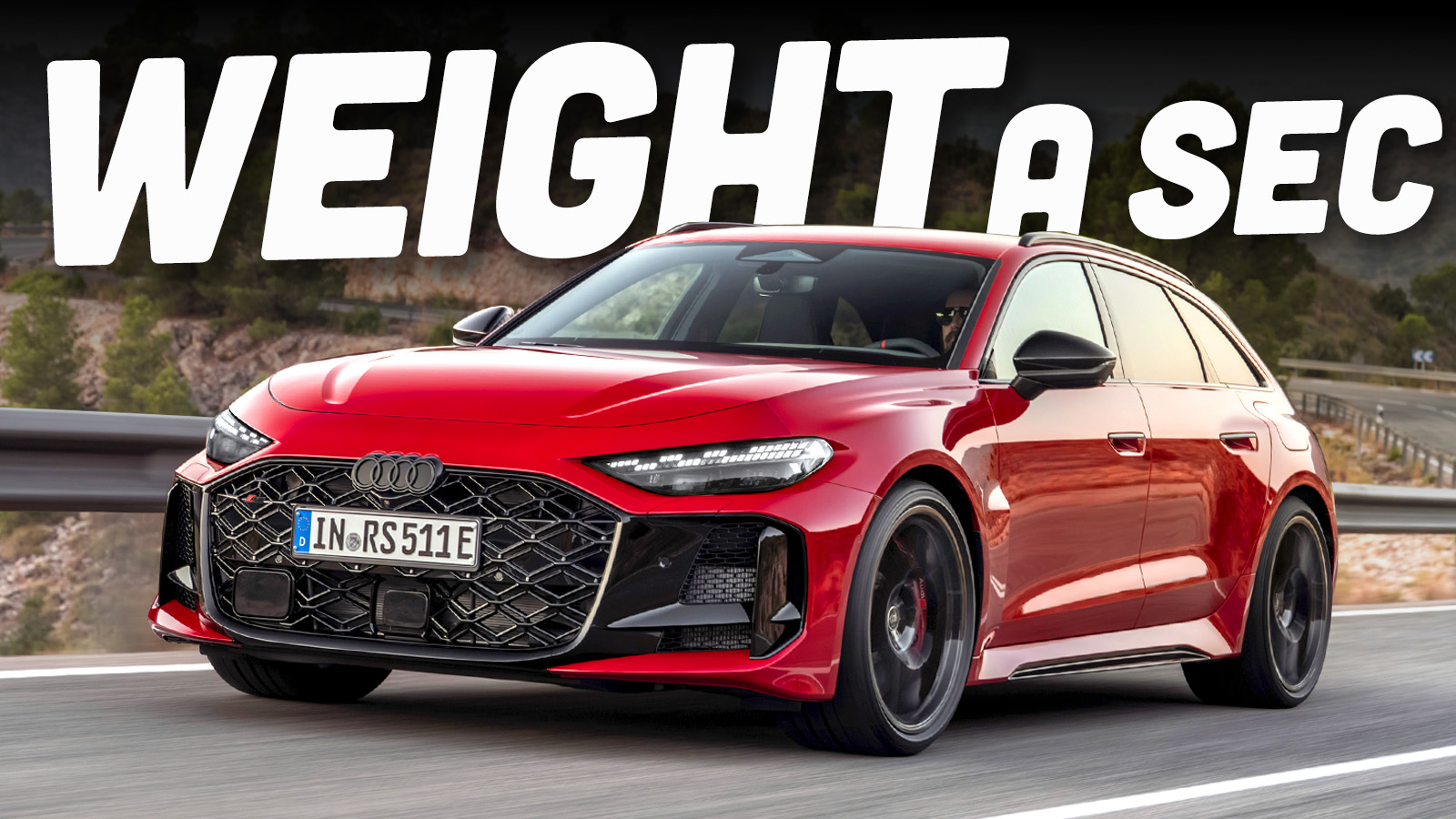
Some of the figures produced by today’s performance cars are absolutely loopy. Twenty-ish years ago, a Porsche Carrera GT made 603 horsepower, accelerated from a dead stop to 60 MPH in fewer than four seconds, and was essentially considered a hypercar. Now, you can find dozens of sedans and crossovers that achieve those same figures. The new Audi RS5 is a similar exercise in spec sheet ridiculousness, and while more power than a Carrera GT or a Mercedes-Benz SLR McLaren sounds appealing, it’s the curb weight of this compact sports sedan that stands out the most.
Let’s start with the good news: 630 horsepower and 608 lb.-ft. of torque. You want big numbers? These are some serious ones. Credit goes to an evolution of Audi’s 2.9-liter twin-turbocharged V6, kicking out 503 horsepower on its own and augmented by hybrid assistance. A lithium-ion battery pack with a 22 kWh net capacity feeds a 174-horsepower electric motor in an eight-speed automatic gearbox to produce a claimed zero-to-62 mph sprint in 3.5 seconds. For those keeping track at home, that’s four-tenths of a second quicker than the old RS5. Wunderbar.


Big power requires big brakes, so Audi’s offering the new RS5 with optional 17.3-inch carbon ceramic front discs that have the swept area to help a suitably equipped RS5 stop from 62 mph in a claimed 100 feet and should have enough thermal capacity to do that again and again—at least until the brake fluid is screaming for its mum. However, crossing the 600-horsepower mark likely isn’t the only reason Audi has fitted such gargantuan stoppers to the new RS5.
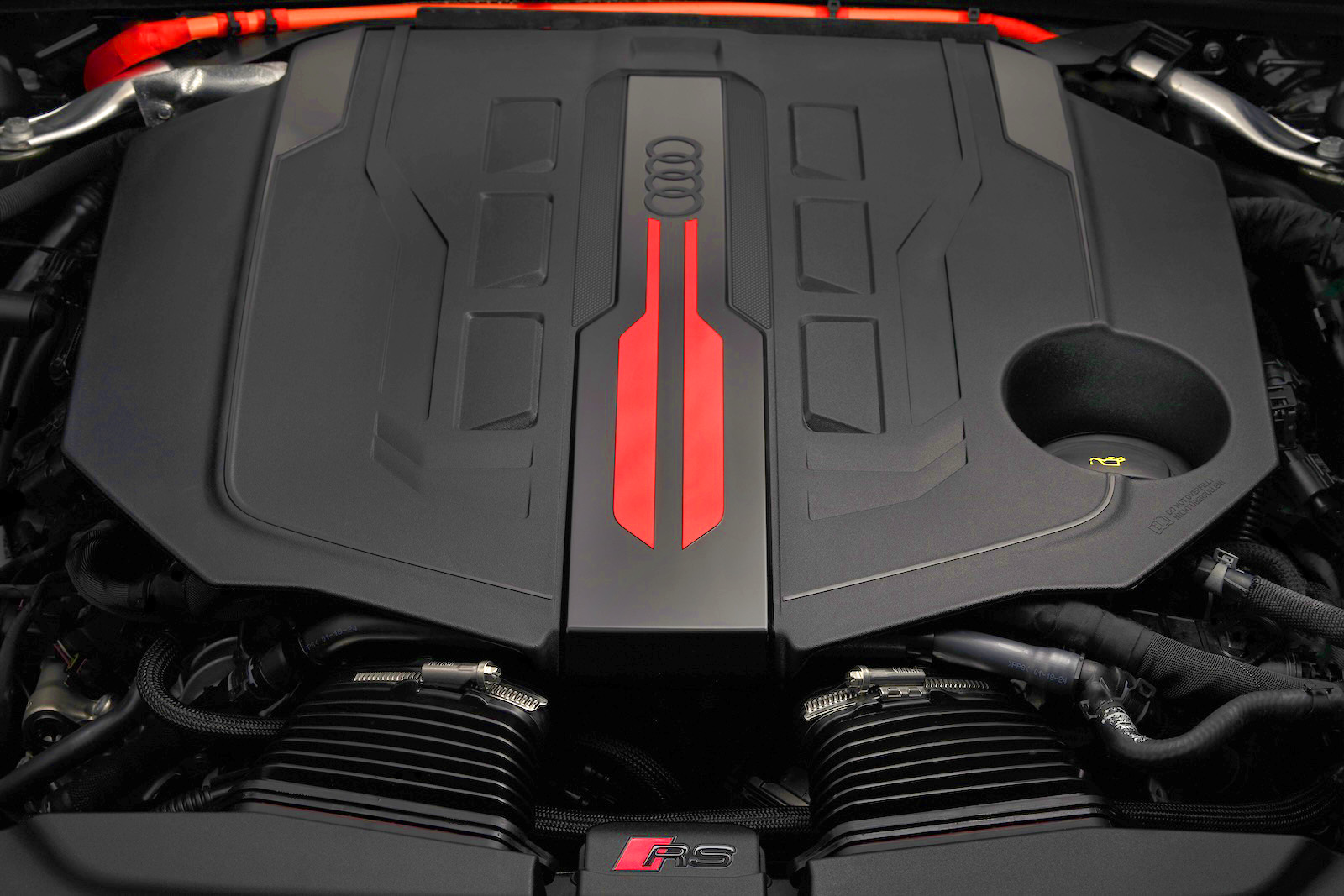
According to Audi, the outgoing RS5 Sportback tipped the scales at 4,079 pounds. Not exactly light, but still within the realm of cars like the BMW M3 Competition xDrive. However, Audi claims this new RS5 Sportback carries a curb weight of 2,355 kilograms, or 5,191.9 pounds. I get that many of us have put on a little bit of weight in recent years, but wow, that’s a 27-percent jump in curb weight. For context, that’s 69 pounds heavier than a crew cab Ford F-150 XL with 4×4, the 6.5-foot bed, and the five-liter V8.

While it’s easy to blame electrification for the weight gain, 25.9 kWh of batteries and a single electric motor aren’t entirely to blame. If we look at the new S5 with its three-liter V6, Audi claims it weighs 4,288 pounds. That’s 364 pounds more than the previous-generation S5 Sportback and 209 pounds more than the old RS5 Sportback. Considering the old, non-electrified RS5 Sportback weighed 155 pounds more than its S5 sibling, there was always going to be a significant weight penalty to the new RS5 even before factoring in electrification.

Now, the new RS5 isn’t as heavy as the 5,368-pound BMW M5, but it plays in an entire size class down, against the aforementioned M3 Competition xDrive. The plug-in hybrid Mercedes-AMG C 63 S E Performance was already considered cartoonishly hefty for the compact sports sedan segment, and this new RS5 weighs 374 pounds more than that. It’s a gargantuan sum for something generally considered a compact, which means that all the fancy chassis systems will be working overtime.

We’re talking bits like an electromechanical torque-vectoring rear differential that can shuffle torque across the axle for corner entry stability and corner exit agility. There’s a 10-horsepower electric motor just for differential control alone, and Audi claims it can shift 1,475 lb.-ft. of multiplied drive torque in just 15 milliseconds. That’s nearly 10 times faster than a literal blink. Upstream of that sits a center differential that can shuffle torque from a 70:30 front-to-rear split to a 15:85 front-to-rear split – not a new concept, but Audi has introduced a level of preload to the center differential in the aim of aiding off-throttle corner-entry rotation.

Still, even with a fancy all-wheel-drive system, more power than a Ferrari 458 Italia, huge brakes, and 13:1 steering, 5,191.9 pounds is a lot of pounds to manage. Basic laws of physics state that increased mass carries increased inertia, which will require more energy to accelerate, stop, and turn. While being able to drive a few dozen miles without using any fuel at all is a nice perk, there’s good reason to be slightly wary. And that’s before looking at it from the perspective of other road users. For those of us on foot, or on bike, or in old cars, do we really want near-5,200-pound compact sports sedans to become a thing?

As of right now, one thing is undeniable: The new Audi RS5 is officially the big boy of the compact sports sedan segment. Expect it to go on sale in Europe this summer, with arrival in the U.S. sometime thereafter. The big questions? How will it actually drive, and will we get the (admittedly 33 pounds heavier) wagon in addition to the liftback sedan? We’ll just have to wait to find out.
Top graphic image: Audi


My 2002 GMC Yukon weighs only 5133. Lighter than the RS5…
I get that this thing is HEAVY. But whether on foot, astride a bike or in a ’77 Golf, getting hit by 2024 RS5 at speed is likely to have a bad outcome as well.
The formula for kinetic energy is half the mass times velocity squared. Velocity is the bigger bad guy here.
Maybe, I don’t know, try not to hit things or people or things containing people when you’re going fast?
Well. I’m going to surprise myself and declare I have found a contemporary German car I like the looks of and given sufficient funds, might actually violate my vow to never own another VWAG product. To my eye, that thing is gorgeous in that green. In red, not so much.
I’ll take a green Sportback. Someone else can have the Avant.
Feds need to kill the footprint MPG rules that has eliminated, small, light, affordable vehicles. Replace it with weight limits based on the a foot print instead, where the larger the maximum weight allowed does not increase at the same rate or ratio to the increase in the area of the foot print. The result: smaller vehicles will cost less to meet the required weight, can have basic, simple power trains, will be more affordable to buy while not losing money for the manufacturer. This rule will apply exactly the same for all power trains with no exceptions. Overweight, over sized vehicles, no matter how expensive, will be effectively limited due to the cost of meeting the rule, as well as good old physics itself.
What is Germany doing? Self inflicted harm to their auto industry?I had to do a double take on this one.
Flashback 15 years ago – Germany:
My second generation naturally aspirated V8 Cayenne with air suspension weighs precisely 4553 lbs according to Porsche, does 0-60 in 5.6 seconds and has 400 horsepower. It feels fast enough, especially for its weight and size. It’s also 190.8 inches long. I happened to watch the Autogeful review of the RS5 and Thomas noted that the car is well over 193 inches long. That’s A6 size from just two generations ago.
Another data point is the first generation Panamera Turbo. It’s 4343 lbs, 0-60 in 4.0 seconds (stock, though some say its 3.5 with rollout), 500 horsepower and is 195″ long. Basically, the direct competitor in terms of specifications to the RS5 now and is nearly 1,000 lbs lighter. I’ll tell you what I’d rather drive.
Audi selling this vehicle as a “sports” car/wagon/sedan/liftback is just delusional. You can’t hide weight, no matter how many tricks you pull with special differentials, tires, etc. On a track, the Panamera would smoke this and be a lot better to drive as well.
I’m still in disbelief that the M5 weighs close to 5,400 pounds. A first gen Cayenne weighs ~4,800 pounds. Hell a new Chevy Tahoe is only a hundred pounds heavier.10 years ago I would have never believed those numbers.
I guess that BMW engineers have accepted that the M5 is used primarily as a street car, and very few will ever see a track. Weight is not such a massive penalty in street driving, and I wonder if there are even some advantages to having a heavier car. I’m no suspension whiz, but does a heavier car result in more stability over bumps/potholes? I know that heavier boats tend to ride much better in rough seas than lighter ones, but I’m not sure if that applies to cars.
Of course a heavier car results in more wear on pretty much all of your consumables – brakes, tires, suspension, etc.
I’m just happy we live in a world where there is still a choice not to buy such a thing.
At least for a while.
No wonder cars get more expensive all the time with all this crap loaded onto them.I hope we soon get to a point where cars become simpler again and thus less expensive. I am not in a posistion to afford this this anyhow,but if i was I would rather buy a B5 RS4.
“generally considered a compact”
wat?
Isn’t the new RS5 basically a replacement for the old RS6? Which also weighed around 5,000 pounds.
No, Audi has confirmed the next generation RS 6 Avant and V8 engine after dithering a lot about whether to make RS 6 Avant electric vehicle only, basing on Taycan/GT e-tron chassis. The rumour of electric-only version or even the hybrid version with V6 engine led to the surge of last-minute orders for current generation RS 6 Avant. That convinced Audi to stick with V8 engine for the next generation.
Man, they’re so screwed. No coherent visual identity across brands and models and all-but-kitchen-sink engineering. Slap a huge price label on it and hope it sells. I’d buy Rivian stock at this point than VAG
Who would have ever thought that the Germans would become what Cadillac was and Cadillac is now where the Germans used to be.
Ze Germans have lost the plot, all of them. No brand feels like it has its identity down right now. They feel close to where Cadillac was years back.
That’s quite a big piggier than my 460 hp 2001 S4 Avant which runs ~3,704 lbs.
But with the power bump, it comes to 8 lbs/hp vs. 8.3 lbs/hp for this new wagon, so fairly close. The 3.5s 0-62 of the new one vs ~4.0s for mine is surely helped by the electric torque down low. 😀
We’re just entering the Renaissance era of vehicles, in that big, rotund, and obese is a sign of wealth and sought after. Hopefully it won’t last long until things go back to modern again, where skinny and light is the trendy thing.
What is the Twiggy of motorized conveyances these days? A 650 cc-class sports bike?
I’ve seen one of these and it’s stylish, but I don’t want to straddle 2.5 liters of Triumphant excess:
Triumph Rocket 3 Storm Buyer’s Guide: Specs, Photos, Price | Motorcyclist
Just to put this in perspective the Audi weighs MORE at 5192 lbs, than the 1975 Eldorado featured in yesterday’s Showdown at 5106 lbs. – which is an 18 1/2 foot boat with a 500 cu. in. cast iron boat anchor for a motor.
I hate to be a broken record on this, but I drive a sedan that’s not only a class up from this in size, but has more power, just as many luxury features and weighs a literal 1000 lb less.
The choices made by German automakers to do this kind of stuff are absolutely not compulsory.
They are to keep European sales alive. Otherwise these cars would be legislated out of existence.
Just waiting for the internet trolls to start recycling the M5 Touring weight gain memes to this car. I’m aware of the size class this car and other like the C63 AMG started in back in the day, but at some point, I don’t think we should use the term “compact” given the weight and exterior dimensions of this thing.
At least it looks good.
Nope. Nope. Nope. I don’t to the F-4 Phantom school of design – “you can make anything fly if you strap enough engine to it”. Colin Chapman is far more my style “add lightness”.
This sled is 1600lbs heavier than my not exactly featherweight BMW wagon. Ridiculous, and Dog help anybody hit by it at speed, which just keeps the automotive safety arms race going full-speed-ahead. And on top of all that – it’s fugly too.
2,355 kilograms
That’s a truck not a car. My VW transporter loaded up with it’s maximum load has a GVW of 2390kg. And 990kg of that is payload.
I see Audi was jealous of how ugly BMW’s modern front ends are.
17.3″ brake rotors. Wow… That’s bigger than the wheels on all but one of my cars.
too bad it looks like it’s face got ripped off