

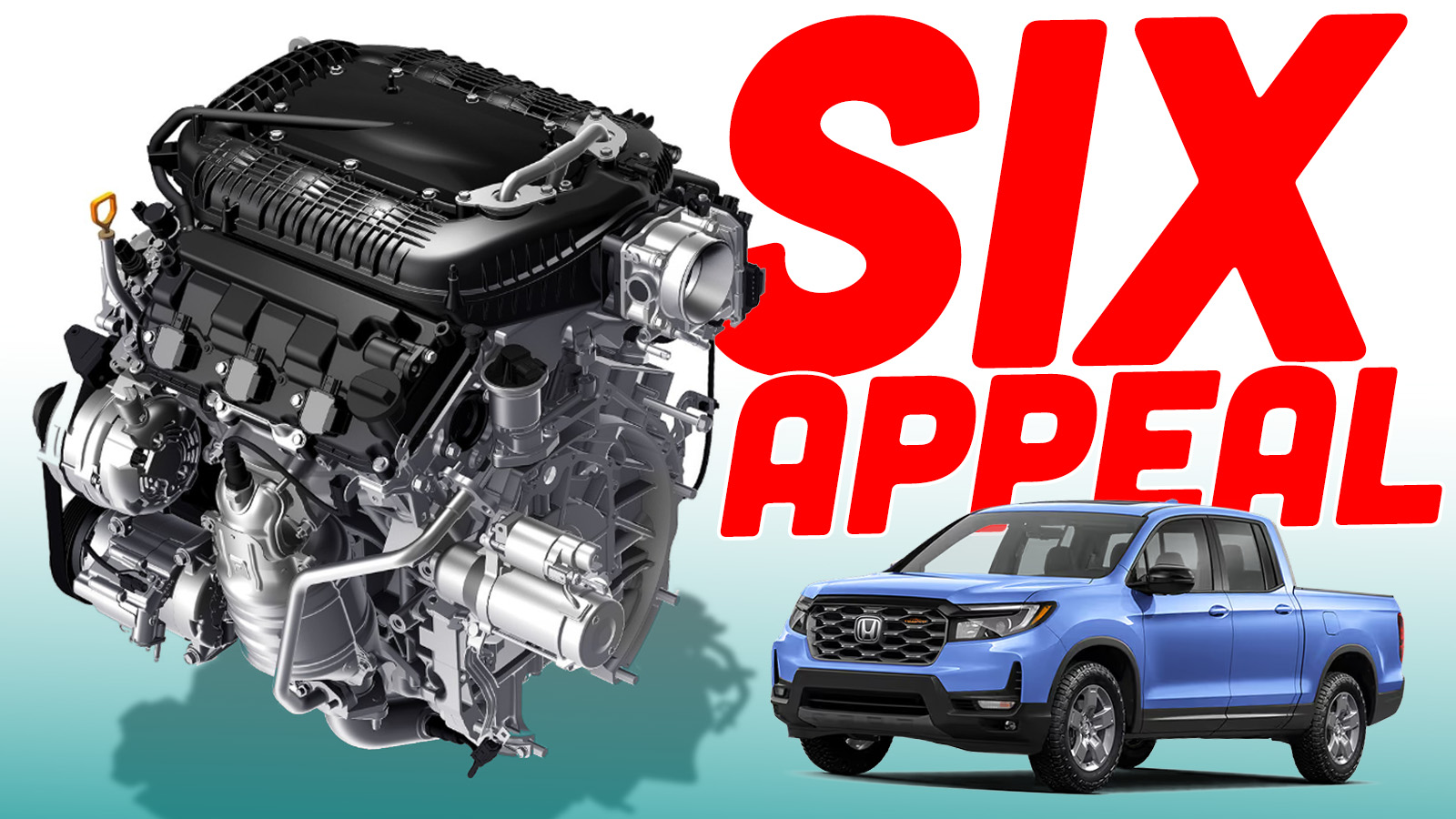
It feels like just five years ago, most people—including myself—suspected the world might never see a new gas engine for passenger cars again. Many automakers, preparing for the dawn of EV-only mandates from governments around the globe, had concrete plans to sunset their internal combustion powertrains for good and replace them with battery packs.
Of course, that hasn’t happened. A slowing demand for electric vehicles in the U.S.—one of the world’s hottest markets—due in part to the US government’s disappearing federal tax credit, means that automakers are taking a hard look at their 10-year plans and making some seismic changes, with most pivoting to hybrids.


Hybrids obviously still need ICEs to work, which means the gas engine has, for now, been spared. But the hunt for better emissions and fuel economy never stops, which means automakers won’t just keep using existing powertrains—they’ll improve what they have, and even come out with new engines.
Honda Is Leading The Charge
Earlier in the decade, Honda was among the earliest of the big Japanese automakers to set out on a path to mainstream EV production. It teamed up with General Motors to build cars on that company’s Ultium platform, and wanted to work with GM on cheaper co-developed architectures for the near future. Last year, it even revealed plans to develop an innovative solid-state battery.

Seeing as how automakers are losing any real incentive to build more EVs, Honda can’t put all of its eggs in that basket. Instead, it’s diversifying and expanding into the enlarging hybrid market. It said as much in a product announcement published earlier today:
As market demand for [hybrid-electric vehicle] models continues to grow, Honda positions its HEV models, especially the next-generation models scheduled to go on sale in 2027 and beyond, as a core group of products which will play key role during the transitional period leading up to the full-fledged popularization of HEVs.
Especially in the North American market, which will be the main market for HEV models, there will continue to be solid demand for large-size HEVs.
Honda announced plans to design a new hybrid powertrain to replace the aging gas-only 3.5-liter V6 found in the current Odyssey, Passport, Pilot, and Ridgeline back in May. Today, the company finally released more details. While I expected Honda to downsize to a four-cylinder engine, it didn’t. Instead, we’re getting a new V6 to power the system. That’s right, a new V6 in the year of our lord, 2025. Incredible.
But Why, Honda? Why?

Just how “new” is this V6? Honda is pretty light on the details, saying only that it’s “newly developed” in its release, and claiming a 30% bump in efficiency over the current gas V6, which achieves just 20 to 22 mpg combined, depending on the model it’s powering. Our man Sam Abuelsamid was on the ground in Tokyo for all of this Honda news, and according to him, it’s just a heavily reworked version of the current motor. From his article:
It’s essentially the same latest-generation dual-overhead cam 3.5-liter V6 found on the current Pilot and Passport, but it will be running on an Atkinson cycle (late intake valve closing) rather than the Otto cycle used for the current production engine. That means it will be significantly more efficient but have less torque and probably less than the current 285 hp, although the electric motors will more than make up for that.

The question remains: Why not downsize? Toyota’s moved in the direction of four-cylinders for the vehicles in this segment, with cars like the 4Runner and its iForce Max powertrain making a healthy 326 horsepower and 465 lb-ft of torque. In this case, it seems like Honda simply wants more towing and performance capability than a four-cylinder can provide. From its announcement:
Honda is developing a next-generation hybrid system featuring powerful driving performance and high towing capacity, as well as outstanding environmental performance, befitting large-size HEVs in the D-segment and larger[.]
[…]
Aiming to deliver a powerful yet high-quality driving experience befitting the large-size HEV segment, Honda will strive to improve the full-throttle acceleration performance of the finished vehicle by more than 10% compared to the ICE models currently being sold in the same segment by increasing the efficiency of the engine and each drive unit and by utilizing the battery assist.
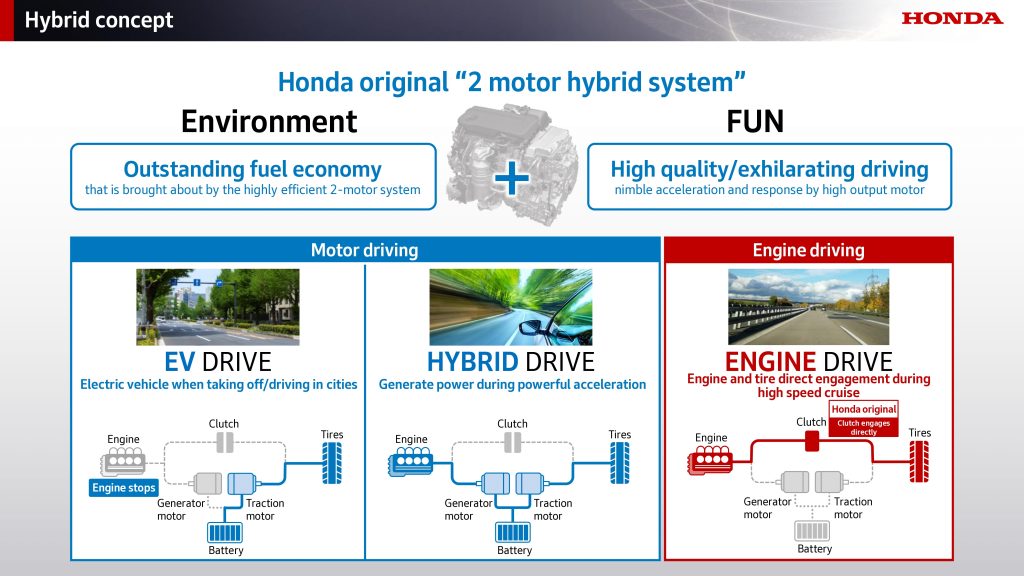
That battery assist will come courtesy of up to three electric motors. The first two will be located up front next to the motor, one acting as a generator attached to the engine to feed power to the battery, and another to send power to the front wheels. Honda’s system retains the ability to connect the engine directly to the tires, too, when needed (see the graphic above). The third motor will be located at the back of the car, to spin the rear wheels—a first for Honda. The details are fascinating, so if you want to learn more, please read Sam’s piece.
Honda has yet to release any sort of power or fuel economy figures for this new V6 hybrid powertrain, but says the system is scheduled to go on sale in 2027. That makes sense; the current V6 and the platform it resides on are many years old at this point, with cars like the Ridgeline and Odyssey in desperate need of an update. So it won’t be long until the world sees exactly what the company has in store.
Top graphic images: Honda


Dont add VCM PLEASE.
The J-series will never die!
Hopefully it still has the VTC rattle that they never addressed from the K24. And make sure it’s an interference engine in 2026 too
Is it still a timing belt engine? Can’t really see it on the pictures.
Not the end of the world if it is, but it’d be nice if they made it with a long-lasting timing chain.
I can almost guarantee you that it’ll be a timing belt. They aren’t going to change that on the V6. You can see the top of the cover in the closer shot.
Honda loves a V6 hybrid. Don’t forget the original Accord Hybrid which was a rare case of a hybrid that got better highway mileage than city because of its weird backwards electrification.
Honda service advisor here, the IMA V6 setup is not a good powertrain, speaking in terms of longevity . Obviously, hybrid tech has come a long way since the IMA V6 debuted in 2005, but the few we see come in for service nowadays usually have a whole host of issues.
I actually have one in my spare bay right now! It’s at 350k and the DC-DC converter finally shit the bed. Also has its third P0A7F code but the customer only wants us to pull the pack so they can parts warranty it out themselves. DC-DC is long discontinued so eBay used part on the way. But yea, I don’t miss working on these things on the regular. They had their fair share of issues for sure.
So this means we will still have to replace timing belts at 100k?? Come on Honda, get with the times!
Hell, our 2019 Pilot requires periodic valve adjustments too. Something like 80k mile intervals, but still. in 2019, valve clearance adjustments.
I mean technically. But really, who’s gonna do it.
you definitely want to get your Honda valve clearance adjustments done
I’ve been a motorcycle guy most of my life and I was hella confused that modern cars didn’t need valve clearance job every 30,000 km or lost 1 psi of tire pressure everyday.
FWIW I had my valves adjusted on my 2018 Type R at 100k miles and my friend who is the master tech at the dealer said it was still in spec, just adjusted closer to nominal.
Yea they are usually pretty close. Very rarely do I see any any that need major adjustment at the 100k mark. 90s and early 00s Hondas needed them a lot more though. The people burning valves on these newer engines since are very, very much the exception.
Dang, I thought nearly all modern passenger vehicle engines used hydraulic valve lash adjusters… so you are always at zero lash.
Honda is slowly getting there. The newer hybrid engines are hydraulic tappets on the exhaust cam. The new DOHC J series V6 is completely hydraulic tappets. Looking at the valve cover of this redesigned hybrid V6 it looks like they are keeping it hydraulic as well.
I’d love to see a PHEV version of this.
Honestly, I was kinda expecting they’d start throwing a de-tuned Type-R motor and their 10 speed into their larger products (and for some twisted reason, I kinda hoped they would for the Ridgeline specifically), but this definitely seems like a far better idea.
The 2.0T/10 speed needs to be in more Hondas. Hell now that the TLX is dead the Accord should get it back.
I thought it’d make a pretty quick Ridgeline Sport truck, and apparently those 2.0T/10 speed Accords have quite the aftermarket, so I can only imagine people loving to make like 400whp Ridgelines to dust some truck dudes that wouldn’t expect it.
I’m looking into the options for mine and looking forward to doing a little tuning.
It makes no sense from a marketing point of view because they already put a 2.0L naturally aspirated hybrid in the Civic and Accord.
Most Honda buyers will not understand why they’re paying a massive premium for the “same” engine.
Was that for FormerTXJeepGuy? I don’t know how an Odessey or Pilot buyer would get confused about getting “the same engine” when they come with 3.5L V6’s, and I’m talking about replacing that motor.
Almost everything has a 2.0T these days. Just tell them its the same motor as a Porsche Macan!
Good to see that not every manufacturer thinks that hybrids require a turbocharged 4 cylinder.
I’m eager to see what the fuel economy gains are as I am a few years from looking for a replacement for my 2017 Ridgeline.
Why the click-bait headline? I thought the Autopian was trying to be different.
Yes. I love that the J is getting yet another lease on life. But from the photos this looks an awful lot like the current engine!
Honda’s never made a mass-market V8 have they…?
Like, outside of motorsport?
In a marine engine, yes.
The BF350 is a 5L V8.
is it sick?
The best news I’ve read in a while, right here!
The J engine, I maintain, is one of the best designs out there.
Yeah yeah, the timing belt, I know.
Anyway, I am so here for an EREV Ody!!
It’d be nice if that V6 would finally have a timing chain instead of that stupid belt.
Also, Honda needs to make a 4-cylinder hybrid Ody and Ridgeline. Put the Accord Hybrid’s setup in the Ody, Ridgeline, and Passport/Pilot
It looks like Honda is trying to stick with NA engines with their bread and butter hybrids and I appreciate that. The 05-07 Accord Hybrid power train should’ve made it into the Ridgeline, Pilot, and Odyssey in the aughts. I’m excited for this new combination of no replacement for displacement + hybrid. It’s basically the closest we’ll ever get to a Honda V8.
Besides it probably being a dog in those big platforms, it’ll probably blow up anyway. Those engines have a head gasket engineering issue that has yet to be addressed. At least publicly.
4-cylinder power is just fine in a minivan or pickup. Also, the hybrid shit will give it plenty of low end torque 🙂
The Sienna hybrid is quite successful, for example. Honda should follow that lead.
The headline is pretty misleading.
They are just adapting their current V6 into a new hybrid drivetrain as per the article.
The real news is that they’re giving the ancient J35 a new lease on life.
Very misleading. And yes it probably is another revision to the J-series, which has always been an amazing motor (minus the 3.7 oil eater).
J series already went from SOHC to DOHC recently, this new motor is for sure a DOHC motor from the image above… so maybe more refinement to the J?
The really surprising thing is that they are bothering with a 6 cylinder at all. But I’m happy they are.
I feel really bad for saying this… but this sloppiness seems to be par for the course for Brian. This article, the Allison transmission branding article, the Mitsu dual stick article (which required an ed note from Torch), and there are more in the past. Most of the time it’s not entirely wrong, but isn’t really correct either and maybe is the sort of thing folks could get away with 99% of the time, but it doesn’t really work with this crowd. Maybe the articles need a bit more time in the oven to really verify facts before hitting publish.
Yes.
The sheer volume makes me really question the extent AI is used.
And as someone who writes for a living, I know this kind of volume is impossible at a high level of quality.
I know quantity is king, and I love the info about this new setup, but…
It seems like almost a wee bit much?
The Mitsubishi Twin-Stick article from the other day got me thinking…
Admittedly I’m a noob when it comes to engines, but can Honda use an updated VTEC system to allow the computer to switch compression & valve timing/firing to create a driver-selectable mode with higher torque (and lower fuel efficiency)? Or would it still also need a similar twin-stick/overdrive transmission gearing as well? Then maybe they could have the best of both worlds, hitting their fuel-efficency targets for regular commuting while having an on-demand moderate torque boost when needed.
This IS exactly what VTEC does. The “driver selectable mode” is already baked into the go pedal via the ECU. You should really do some research on variable valve timing, variable valve lift, etc.
Here’s a start: https://youtu.be/I5dy2Vnf95w
No, this not comparable to the twin stick which had a selectable second reduction gear. The result is the wheel torque is increased by whatever the reduction ratio is. Look into “range” portion of a Transfer Case (high and low) to understand better.
I agree with TurboFarts.
I will add that many automakers are using hybrid technology to provide a torque boost when needed, like when a vehicle is moving from a stop.
The instant torque of the electric motor makes it perfectly suited for this task. Taking some load off the ICE engine also provides a fuel economy boost, so in many ways we already have the best of both worlds.
Great! Drop it in the Accord.
…and then make the Accord available as a 350HP wagon.
With a manual!
OK, I’ll stop now.
Atkinson cycle likes big low pressure air volumes. A large low friction NA 6 makes a lot of sense. There is a reason Toyota’s hybrid 4 cylinder is a large 2.5 liter. NA also tends to perform better in real world economy versus turbo. Lower federal scores, higher customer satisfaction.
I like that they’re using a V6 for this application. As for why Toyota didn’t and uses the 2.4T, I think it’s because they needed a 240hp+ non-hybrid engine option to use in a large variety of products (their off-roady vehicles, trucks, Lexus), so making a hybrid-only N/A V6 didn’t make sense at the time. Meanwhile, Honda only really sells these V6 class models in the US, and there’s only a few of them (Pilot, Passport, Odyssey, Ridgeline).
Good on Honda for finally going hybrid on their larger vehicles.
“It’s essentially the same latest-generation dual-overhead cam 3.5-liter V6 found on the current Pilot and Passport, but it will be running on an Atkinson cycle (late intake valve closing) rather than the Otto cycle used for the current production engine. That means it will be significantly more efficient but have less torque and probably less than the current 285 hp, although the electric motors will more than make up for that.”
That also means its not a “new” engine but a somewhat modified existing engine.
But they’re giving it a new name!
If the new name is for the whole system that’s fair.
“The question remains: Why not downsize?”
They can with displacement on demand.
Awful technology. Has it been improved? It consumed so much oil on our ’05 Odyssey that we forgot to keep topping it up and it needed a new short block at 100k miles, and even before that it ate engine mounts like nobody’s business.
No idea. I wouldn’t write off the whole tech on a few bad apples though. That generation of Odyssey in particular had lots of problems.
Not really, the second gen was the one with transmission issues but the third gen was mostly carryover except the newer engine. Ours has been pretty good outside of engine issues. The transmission is original at 220k.
I think you got lucky:
https://rerev.com/articles/honda-odyssey-years-to-avoid/
What weird automotive slop hell is that list.
Its clear enough to me.
Cylinder deactivation is pretty darn ungood on the Honda V6. There’s a thriving market for VCM disabling gadgets.
Alright! These have the potential to be extraordinarily reliable and efficient. Definitely sets them apart from Toyota for continuing the use of a V6.
Here’s hoping one of the upgrades is a timing chain instead of a belt…
Some editorial freedoms done here.
Number of cylinders isn’t a judge of those items.
This is good news. The old J35 was a great motor. I had the last version of it with a manual in my Accord coupe and it was one of the best sounding motors I had ever heard. I still miss the sound of it. It reminded me of the old NSX.
So what’s involved in converting to Atkinson? Just new cams for the change in valve timing?
Basically, and a retune for the ECU. However, they’ll likely use a higher compression ratio (via pistons?) to extract higher thermal efficiency. With the reduced pressure from Atkinson cycle, the higher CR shouldn’t make it exceed the original engine’s peak cylinder pressures.
Modern implementation of Atkinson using existing 4-cycle engine construction is a difference in cam timing. With variable valve timing, they could run Atkinson and Otto depending on which makes sense at the moment and I believe Toyota does this in some cases, though I might be wrong there.
They are following the recipe of Stellantis of making the Atkinson version of a reliable engine. In this case, the Pentastar 3.6 used in they PHEV Pacifica, gets good power and good mpg.
Also Ford with their NA 2.5L used in the Maverick and Escape hybrids, and the 3.3L (debored 3.5/3.7L) used in the Explorer hybrid (now Police fleet only).
It’s what the Wrangler 4xe should have had.
Agree, and Stellantis is now expanding the 3.6 to the EREV versions. I think they found the perfect combo, reliable enough and parts available.