

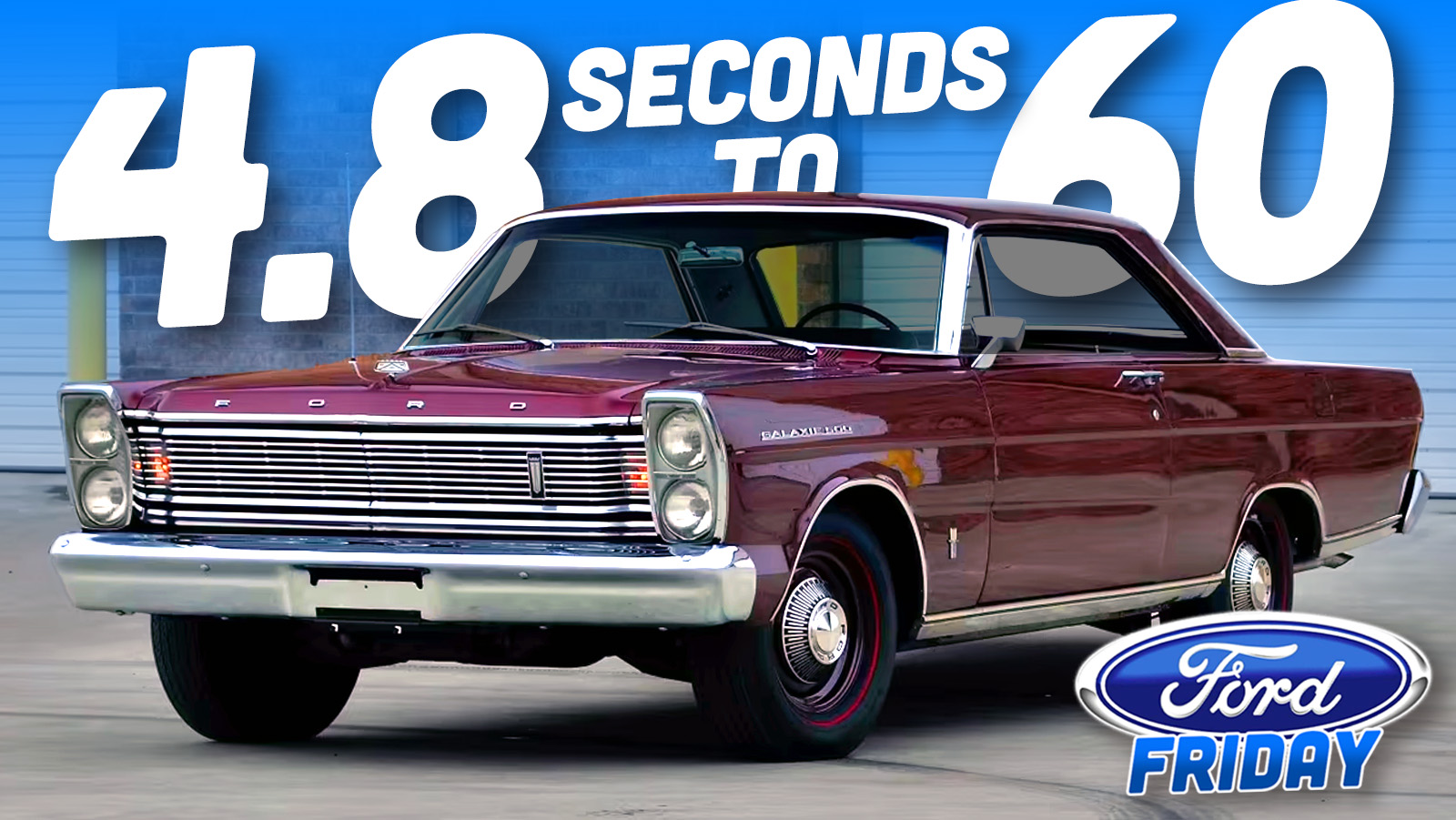
In 1965, Ford’s Galaxie 500 was typically seen as “standard-size” parking lot filler sedan that played second banana to Chevy’s Impala. Galaxie sales were usually less than half the Impalas, which often seemed racy by comparison to the Ford, even in non-SS formats. What Ford did stress, I discovered, was durability, going so far as to show its bread-and-butter two-door driving through an equestrian steeplechase course and over a ski jump in commercials.
What Ford didn’t show was how that very car could be equipped with enough power to embarrass more well-known powerhouses of the day that are now the overvalued stars of Mecum auctions. Zero to sixty in under five seconds? Oh yeah, these Galaxie 500 sleepers deserve our recognition on this Ford Friday.


I Think They Should Have Jumped It Over A Chevy
Before car brands offered lineups of at least a dozen different models from tiny cars up to luxury barges, there was the “standard” sedan and wagon that provided the mainstays of GM, Ford, and Chrysler’s sales from right after World War II up through the seventies. In the times before the Big Three offered a full range of “compact,” “subcompact,” and “mid-sized” cars, these “full-sized” products sold in the hundreds of thousands, or even over a million in the case of Chevy’s Impala in the record-breaking year of 1965.

Ford usually trailed GM’s top brand in sales, and its styling lacked the glamor of its Big Three rivals, but the new-for-1965 full-sized cars really did add some pizazz and are some of my favorites. With crisp lines in the same brand language as the Mustang, they were sizeable cars, but fit the perfect styling balance in the timeline between the tailfinned fifties products and the gargantuan, bloated-looking examples from the soon-to-arrive malaise era.

The full-sized Ford that debuted for 1965 was possibly the most-changed big Ford since 1949 and would be the biggest change until the “shrunken” Panther in 1979. Arguably its biggest advancement was a multi-link rear axle with coil springs to replace the leaf springs of the outgoing car. This particular body style of big Ford lasted from 1965 up to 1968, and they were never really marketed even remotely as “muscle” cars; affordable luxury was the value proposition that the Blue Oval was going for.

Ford chose to advertise how quiet and well-built these things were in rather strange ways that seems like terrible ideas. For the 1967 model year, they took a two-door coupe which was reportedly stock except for a skid plate to protect the oil pan and drove it through an equestrian course over eight steeplechase jumps next to a horse that was far better suited to doing this kind of thing than a big two-ton Ford with wheels.

In a different ad, Ford ran it down a ski jump in Lake Placid. I’m at a loss to understand why they did this, but in the television spot, they ran the Ford down the jump twice to prove how strong it was.
Admittedly, it looks like the landing was nicely packed with snow to level it out, but it’s still a pretty dramatic illustration. If you’ve ever driven an old big Ford, you can see how this feat was likely believable; I’m sure a number of our dear readers will say in the comments that they have done similar things with their mom and dad’s LTDs in years past. Ahem.
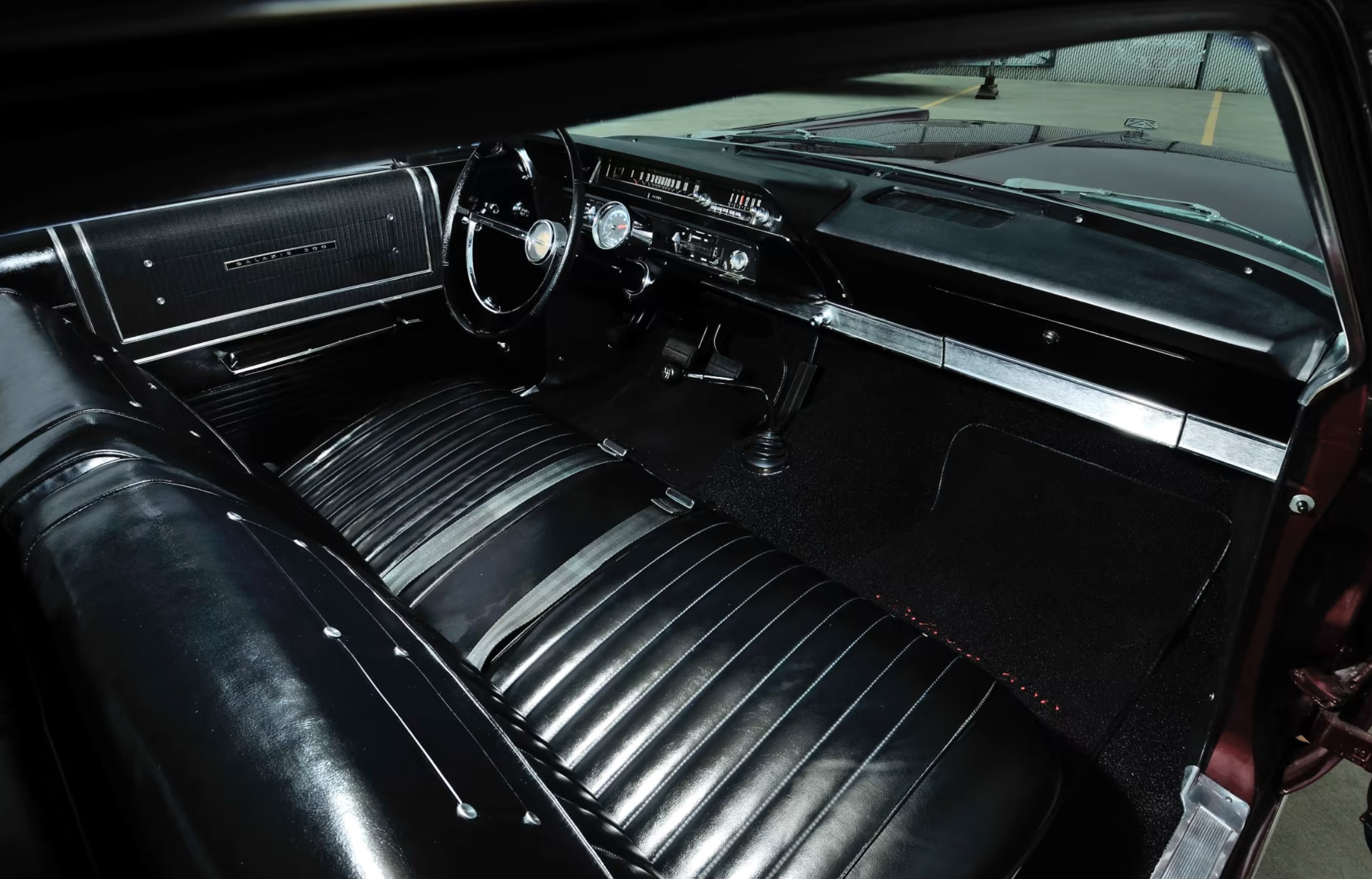
These big Fords were available in a wide range of models from the bare-bones Custom 500 all the way up to the Galaxie LTD, but certain versions of the semi-fastback two-door Galaxie 500 models were extremely special. Here’s the reason why: these were the last big Ford family cars that could be purchased from the factory with monster engines and manual transmissions. However, the biggest monster of all was something known by one letter: the R-code.
The “R” Should Stand For “Respect”
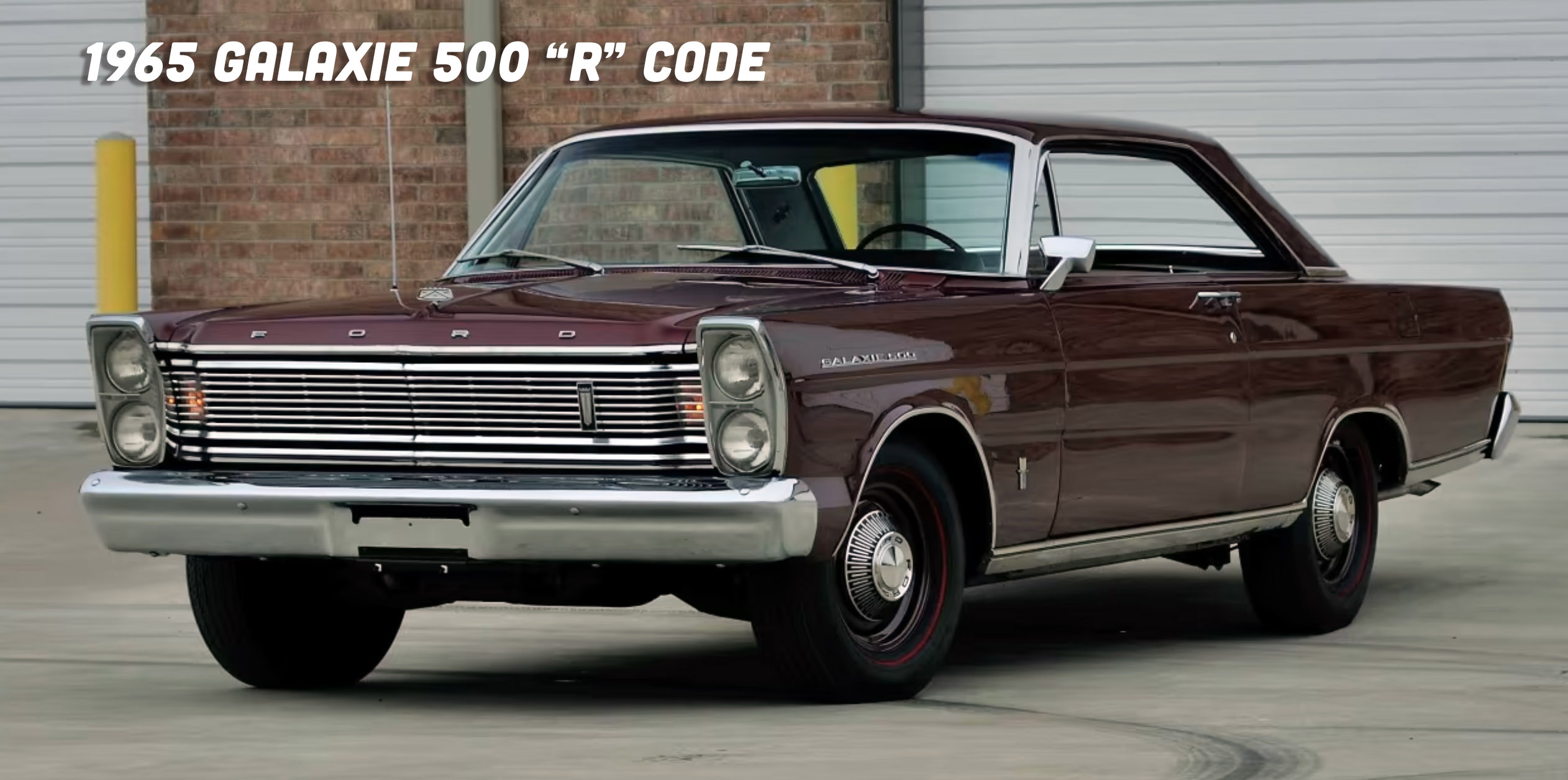
Talk about an unassuming family car – the 1965 Galaxie “R” code doesn’t look any more aggressive now than it did sixty years ago. Those looks are deceiving.
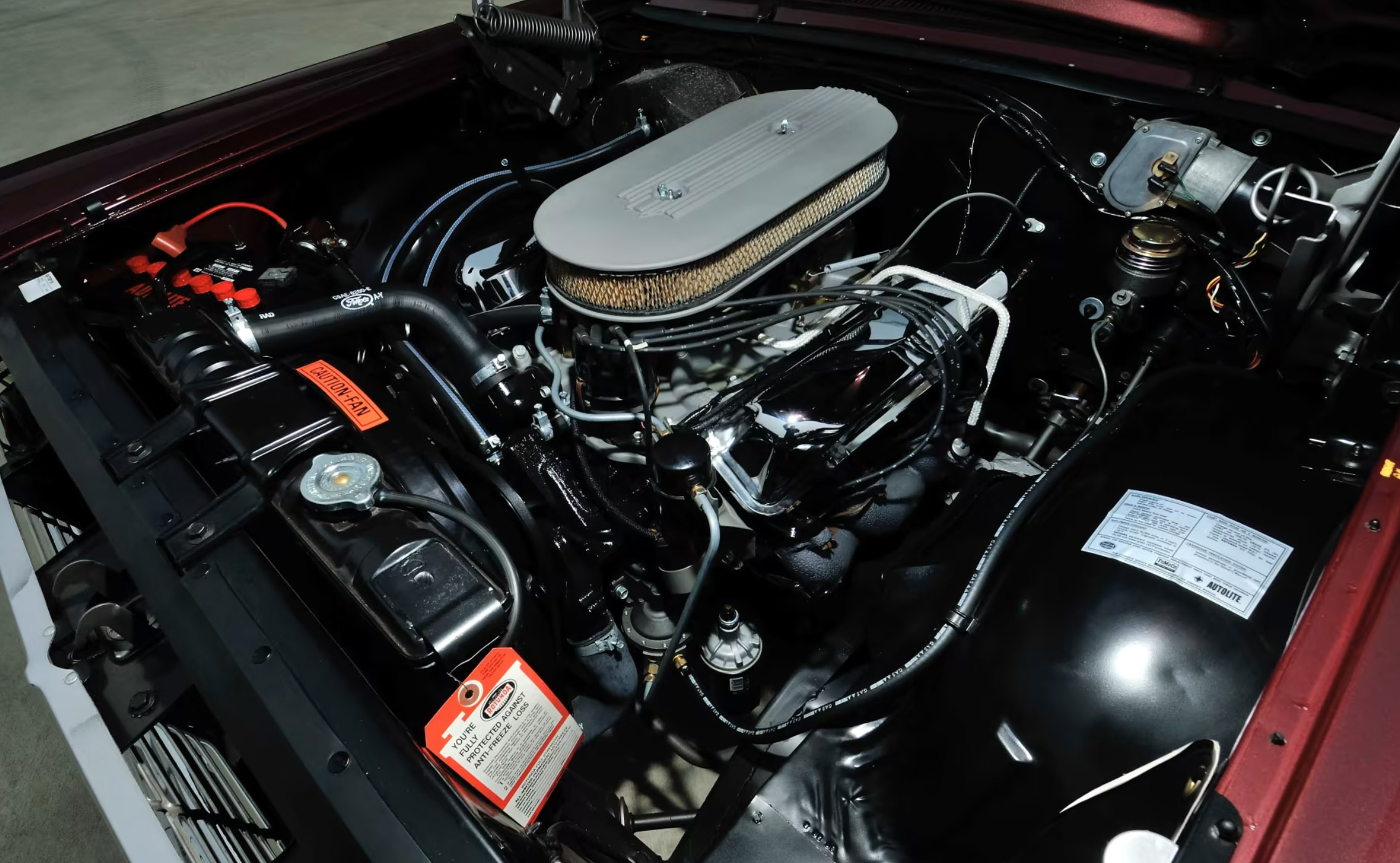
The “R” code gave you a 427 cubic inch V8, and while we might be suspicious of old-school power ratings, the Ford’s numbers of 425 horsepower and 480 lb-ft of torque were stronger than many muscle machines of the time. You want a Holley 600 CFM four-pot carburetor? The “R” code gave you two of them for eight total barrels, and Ford’s beloved “Toploader” 4-speed manual with a shifter on the floor was the only option.
Car Life magazine was able to pull an insane 4.8-second zero-to-sixty time out of this family two-door sedan, and a 136 mph top speed was impressive as well. Other sources I’ve read cite that acceleration times of more like low five seconds, but that’s mind-boggling regardless.
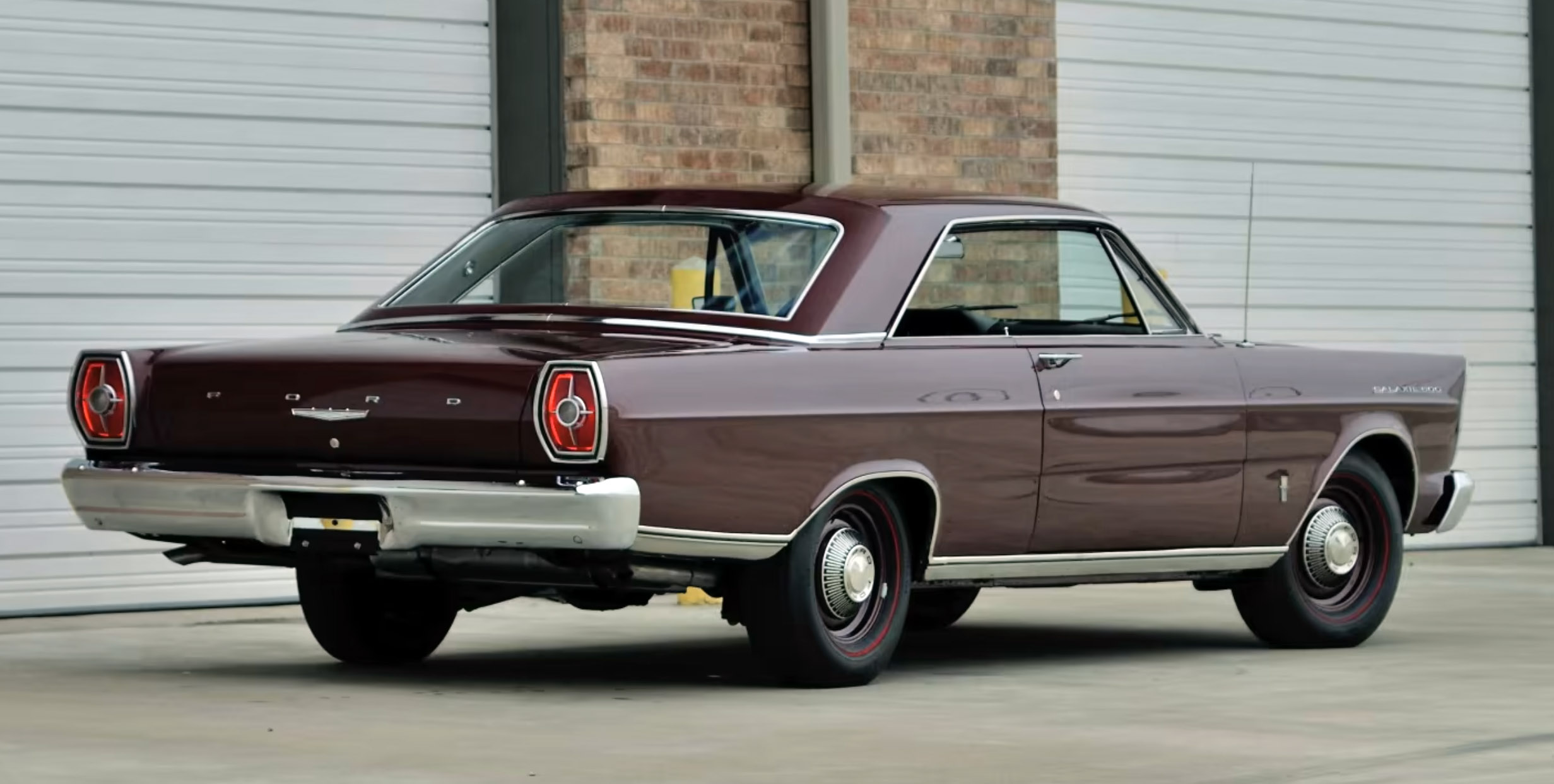
Just don’t go around any corners. Suspension was beefed up, and heavy-duty police/taxi brakes helped with stopping, but even with the larger standard 15-inch wheels, the “handling” of this understeering big Ford left a lot to be desired. Manual steering would seem to be good for road feel, but with six turns lock-to-lock, it further made the “R” code a rather dangerous straight-line warrior. In the words of Car Life, “It imposes a penalty on the driver in that the power and speed potential of the car can get him into trouble a lot faster than he can steer out of it.”
Want to see a really strange feature? All “R” code ’65 Galaxies had “Pyrex” glass headlamp covers over the sealed beams. These were still legal in America then, but my guess is that the improvement to aerodynamics was rather low.

As you’d expect, such an odd, enigmatic automotive creation found a very limited number of buyers. Out of the 560,000 or so Galaxies sold in 1965, a mere 327 of them were “R” codes; only ten are accounted for today on the 427 Galaxie Registry.
Minor changes happened to the styling for 1966, and despite pitifully low sales the year before, you could still get the “R” code option for your family-sized two-door.

Here’s a more in-depth look at the ’66 “R” code if you’d like to geek out, though I really want to see a video of someone dropping the clutch at like 5000 revs instead:
As you can see on the ski jump car, the roofline changed a bit for ’67, which was the last year for the “R” code. Finding concise production numbers is difficult, but it seems sales continued to drop, and I see claims of only 70 cars built for 1967. Non-“R” code four-speed cars and those with far more common 428s were available as well, and while not as rare, those “R” codes also sold poorly.
In 1968, the “R” code Galaxie disappeared, but Ford did have some last hurrahs for the high-powered family sedan. A “Cobra Jet” 428 rated at “only” 335 horsepower was the top motor with the manual shifter, though some claim that’s an underestimated figure.

At least the fastback styling was still rather slick and made this massive two-door seem smaller than the big full-sized car with an enormous trunk that it was. Retractable covers for the headlights were a new-for-’68 option that added to the menacing look.

The next generation of full-sized Ford for 1969 really didn’t fit into the same category as the ’65 to ’68 models. Having said that, at least the 1969 model tried one last time.

It’s still a nice-looking car but for some reason the extra curves and sail panels on this 1969 model point to the era of Ford when even the Mustang turned into an oversized behemoth.

The most powerful motor for 1969 was the 429 with power bumped up to 360 horsepower; an ultra-rare four speed floor shift was available for 1969 only and then disappeared forever as the big Ford began its “LTD years” as an automatic-only pure luxobarge. The era of the “sumo class” family muscle coupe was truly done.

As exciting as these obscure 1965 to 68 “sumo class” performance two doors are (I hesitate to call them “coupes”), there was one big-engined example of this era of Ford that was even more special and desirable. And by “one,” I really mean “one.”
Holiday Road, Ohh Ohh Ohh
If you’re the Sultan of Brunei or some similarly oil-rich individual, you can likely go to a company such as Aston Martin and have them build whatever shooting brake or other strange concoction you want. With a firm like Ford, that might not be the case, especially if you’re just a regular Joe that’s interested in a run-of-the-mill model with special equipment. You’d almost have to write a letter to Ford President Lee Iacocca to see if he’d let them build one for you, a letter which Lido would likely never even read.
That’s exactly what a person in Miamisburg, Ohio, claimed that he did back in 1967, when he asked to be able to order a new Country Squire station wagon with all the bells and whistles, including a 428 V8 and, of all things. a 4-speed manual transmission. Such a drivetrain combination could easily fit in the wagon, but checking these boxes was strictly forbidden on anything other than two- or four-door sedans. Surprisingly, Iacocca reportedly did see this written request and said, “Why not?”

If your family or friends rocked a big Ford wagon when you were a kid, the sight of a stick shift coming out of the floor between bucket seats and a console seems unfathomable, but here we are.
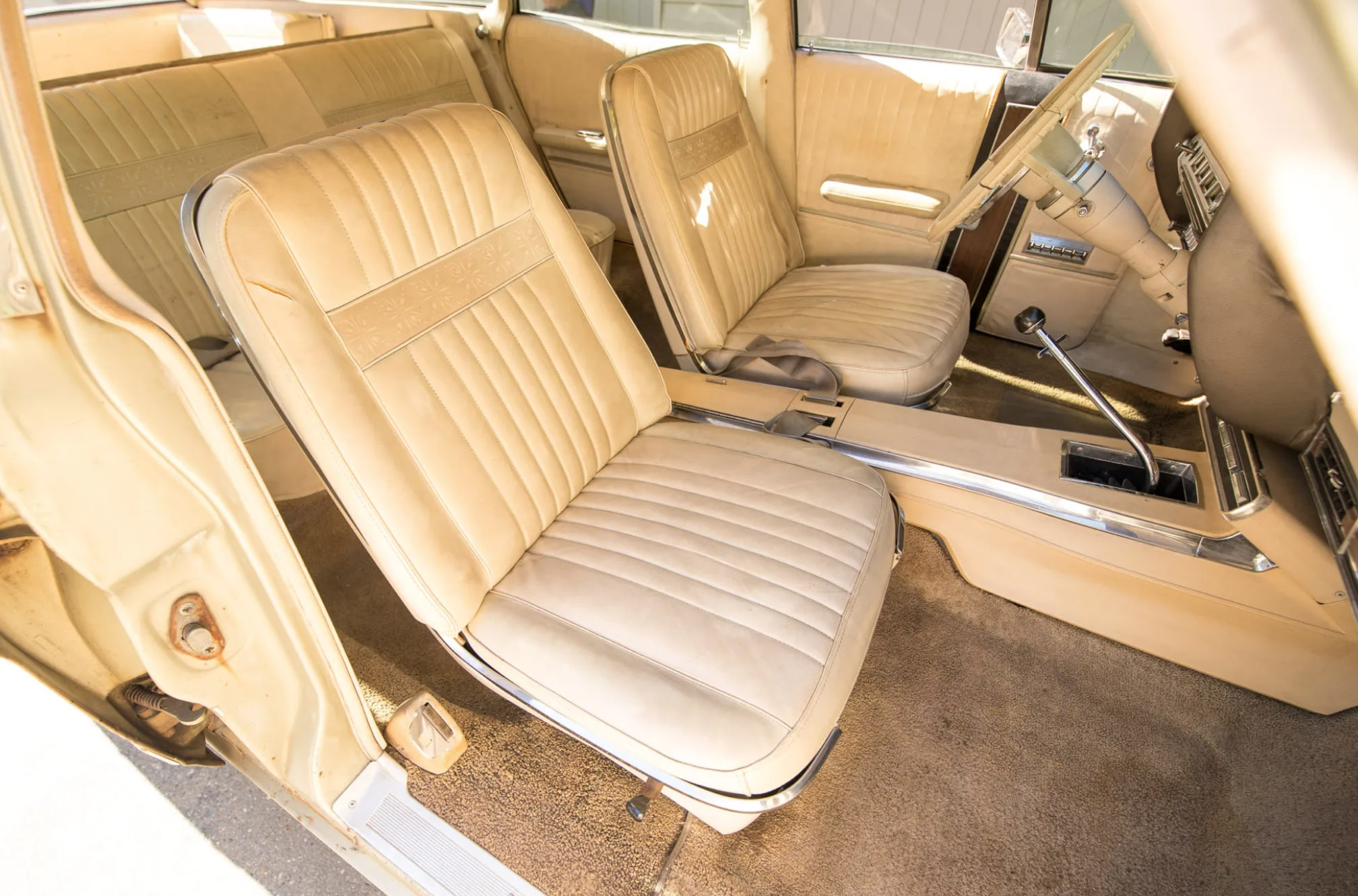
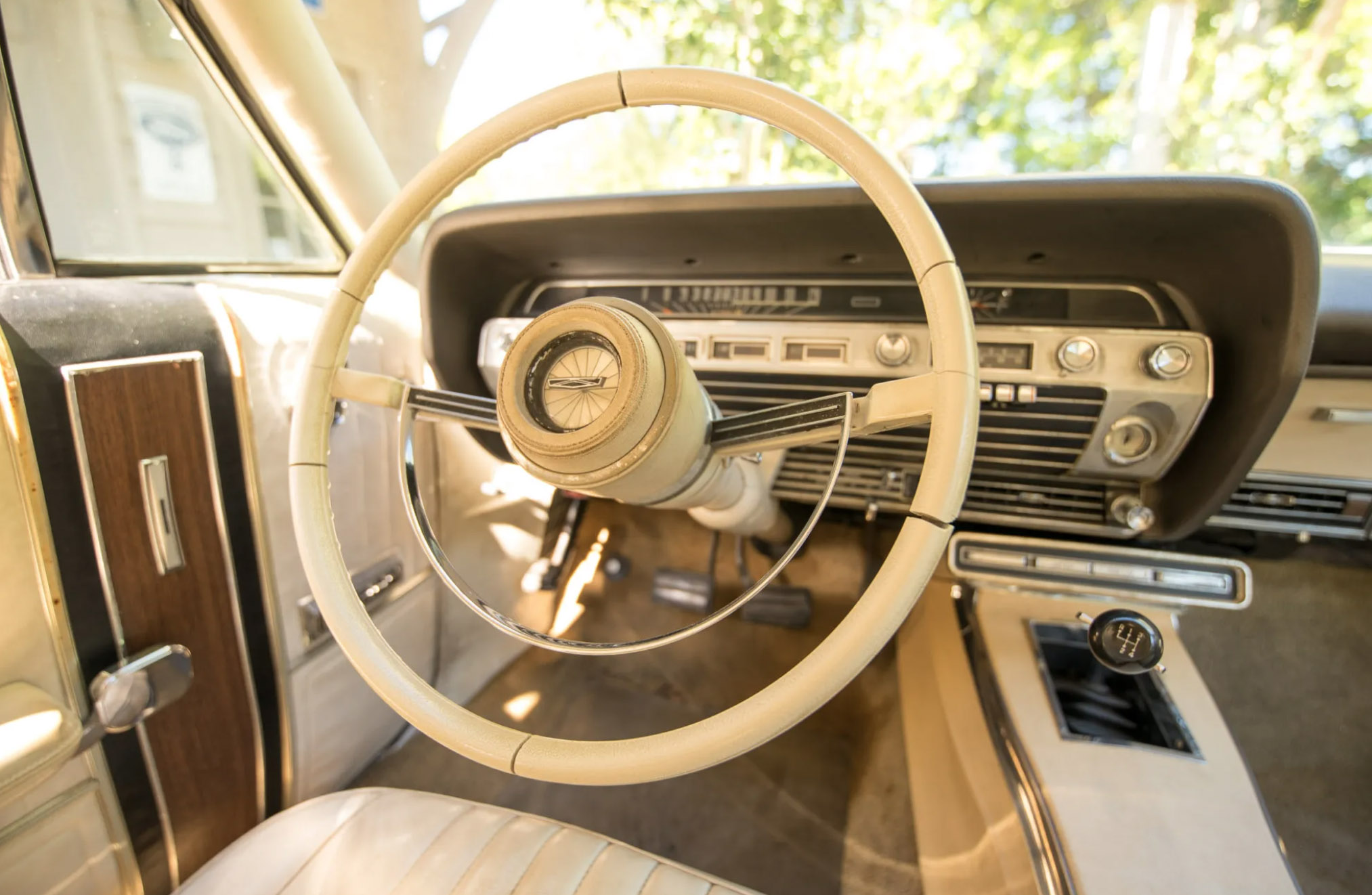

Sure, that 428 isn’t the racing-bred “R” code 427, but it still packed a punch. Look at the size of that air conditioning compressor; this thing must be freezing inside on a summer day and would make an awesome Autopian cruiser for the whole staff to pull up in.
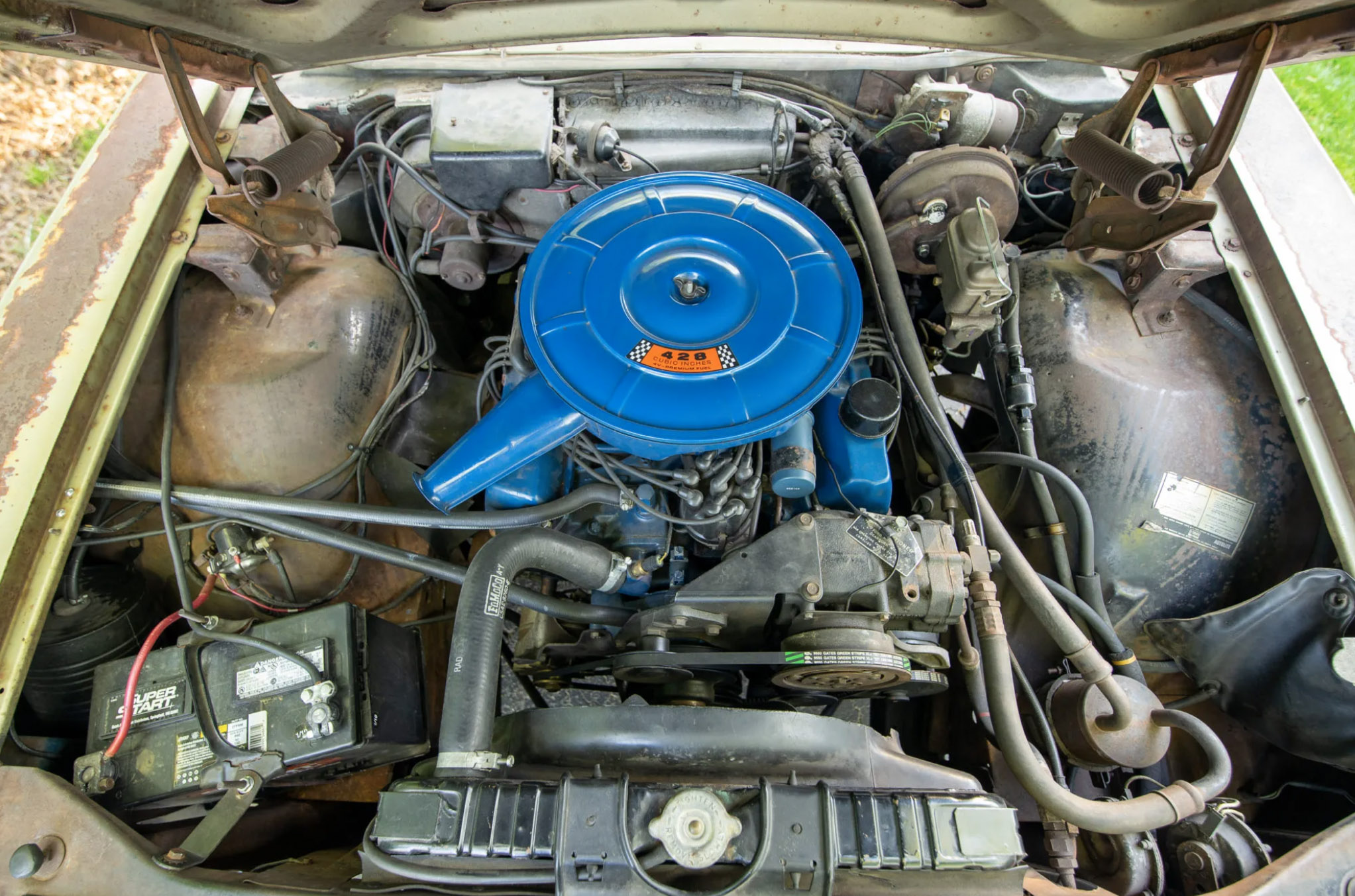
Unrestored with a rusted patina outside but a rather immaculate interior, this one-of-one-ever, big-block stick shift Country Squire has to be simultaneously one of the silliest and most awesome Fords to ever leave the factory. Auctioned on Bring A Trailer a little while back for $46,700, it has you questioning the sanity of people who would spend more than that sum on a rust pile that used to be a 911 or on a diesel W123 Benz wagon that can barely move under its own power.
This Country Squire would be an easy restoration with minor rust repair, a new coat of that green/gold metallic paint, and refurbished fake wood, but it’s only original once. Personally, I’d get the frigid A/C system in the thing fixed, install the new rear power window motors (included in the last auction), and just drive it as-is.

The original buyer apparently wanted something fun and cool that could still hold the whole family. This car and any of these mega-motor full-sized Fords are all just that.
Big Bad Bargains
Today, some people go on and on about hot SS Impala coupes, and you’ll quickly get tired of hearing people use the word “Hemi” until they’re blue in the face. Sadly, the last of these big high-performance Fords are rarely part of the conversation, and they really should be. The good news is that values are still comparatively low for those who know the secret. Non “R” code examples with big 7-liter V8s offer much of the same performance, but great condition examples have sold recently on places like Bring A Trailer for well under $20,000 – a lot of car for the money in every sense of the word.
Top graphic image: Mecum Auctions



that ’69 Galaxie is properly sexy, though they’re all really handsome machines.
How this car goes 0 – 60 in 4.8 secc must be wild.
My EV does this and it’s drama free, just goes. My evora does this and it feels you have to work for it. It must feel brutal to do this in a Galaxie.
No two 4.8 sec 0 – 60 are the same.
This is how I feel about the ’69 Polara A38 running 147 miles an hour…I think about the sheer brutality of that engine pushing a blocky “full-figured” fuselage Chrysler that fast, and all the tactile sensations while sitting behind the steering wheel approaching terminal velocity…
The Galaxie looks great as most 60’s big 3 cars did but it was second fiddle because the 60’s Impala was just gorgeous. Even against my beloved Pontiacs and Buicks, the Chevys have a clean simple beauty that is just the business.
No mention of the 64 Fairlane Thunderbolt?
Hey, I’m running out of obscure hot Fords. Gotta save some for the future.
These are my favorite articles of the week along with David updates! Thank you and keep up ford Friday!!
1965 was to me the the pinnacle of Big Three full size styling. They were all beautiful, and I’ll add Pontiac to the mix.
For decades my email address has been a portmanteau of the Galaxie 500XL and Fireball XL5 (I had the lunchbox). I just love these Fords, even if I would take the Pontiac or Chevy first.
P.S. I was 9 in the fall of 1964 when they came out. How time flies.
I would add the Rambler Classic as another good looking car of 1965. I helped my son paint one of these, which he daily’d 2017-2020, including crossing the USA. Sweet, simple, crisp lines with just the right amount of brightwork…
https://itisgood.org/auto-biography/#65Rambler
My father had a 1965 660, yellow with a white roof. We camped in it a few times. I agree it was a great car and I have wonderful memories.
My first car was a ‘67 Impala SS, and it was slow. A lot of folks don’t realize that the SS package was cosmetic only technically and could be had with the base straight 6, so it was really a matter of whether the right engine got specd or not. Of course mine was in the mid ‘00s so it was a rusty heap with a dying 283 in place of the original 327. But even after that blew up and we put a 327 in it was always a lot better at turning fuel into noise than it was speed.
This article has several errors. For one, how is it the early mid-60
s Impalas seemed more racy than Fords? By 1963.5 Ford’s 427 fastback Galaxies were running the gauntlet at NASCAR. The 1965 Galaxie 427 won 49 of 55 races at NASCAR while Chevy was generally nowhere to be found.Secondly, the “biggest advancement” of the 1965 platform wasn’t the multi-link rear axle with coil springs but instead the perimeter frame with torque boxes and the rear-steer front suspension design which set the benchmark at NASCAR for decades to come.
Third, how was promoting the quiet and well-built aspects of Ford’s new65 full-size, particularly the trailblazing luxury-based LTD a terrible idea? Truth is the J Walter Thompson “Quieter than a Rolls Royce” advertising campaign was a stunning hit.
Fourth, the bare-bones model in in 1965-66 was the Custom, not the Custom 500 which was a step up.
Fifth, the 427 production number for 1965 is incorrect. For starters, pf the 327 R-code 427 full-size models FoMoCo built that year, 7 were Mercurys and 320 were Fords. Of those 320 Fords, there are no known production breakdowns specifying how many were Galaxies vs Customs and Custom 500s.
Sixth, the 428 Cobra Jet was NEVER offered in full-size models in 1968 or any other year. As a matter of fact, the only Ford product to receive the 428 CJ in `68 was the special mid-year ‘135’ Mustangs.
Seventh, for clarity sake, the 4-speed wasn’t “ultra rare” in 1969, instead was a matter of “demand” being ultra-low. The fact is, manual shift had fallen out of favor with new car buyers that production was dropping quickly as the 1960s unfolded. By 1968, all car makers except Chevy & Ford had chosen to phase out 4-speeds altogether. Chevy and Ford continued only one more year. Most phased out 3-speeds soon after.
Overall, this article shows the depth and knowledge it takes to accurately write about Ford history. Sadly, too often that’s not the priority with sites like this.
“For the 1967 model year, they took a two-door coupe which was reportedly stock except for a skid plate to protect the oil pan and drove it through an equestrian course over eight steeplechase jumps next to a horse that was far better suited to doing this kind of thing than a big two-ton Ford with wheels.”
Nobody cares about jumping stupid fancy fences. Show me how it can jump Georgia creeks while fleeing a bumbling, corrupt sheriff better than a 1969 Dodge Charger and we’ll talk.
136 MPH top speed? Powerful enough, but there is a problem.
Friend of mine has a 72 Monte Carlo with the 402 (6.6). It has highway gears for the West, it’s a wonderful fast cruiser with an ocean of torque.
We took the thing out to Rush Valley, Utah one day to go target shooting. After my friend suggested I drive it back through Skull Valley – from the Dugway proving grounds up to I-80, where the government has been known to kill sheep – and said it was a great opportunity for me to drive the car fast.
It was, but along the road was a ranch, which I of course slowed down for. After passing the buildings there was a fairly long stretch before a cattle guard and I opened up that wonderful 4bbl enough so I was over 100 when I hit the cattle guard. It wasn’t my goal, it just happened.
The front of the car went up when we hit it – and stayed there! Now the road through Skull Valley is wonderful to ride on two wheels at speed (careful of those sheep, and cows too, though), but not in a Monte Carlo. The steering in that thing is usually absurdly light, but I could feel there was nothing there and the front of the car sort of wavered. I actually got a gasp out of my buddy.
Now I’m sure the front wheels were actually still on the road, but I’m also sure there wasn’t enough weight on them to do anything with all the air jamming in underneath. Very g-e-n-t-l-y, I eased off and the front of the car settled back down. Lesson learned, though. Big square cars over 100 MPH can get very light in the front. Be careful out there. I’ve never taken that Monte over 110 again and I never will.
I got my mk1 Legacy wagon over 130 and it was a similar experience—front tires felt like they had bicycle-sized patches. Up to around 115, it wasn’t bad, but at that speed I didn’t even want to slam the throttle shut, much less brake.
You have to back out of it when you drive over a cattle guard or you can get wheelspin on the metal pipes. I think it was the brief pause in the Niagara of gasoline, followed by wide open again, that caused what happened. But yeah, gently seemed like a very good idea.
Sorry, much different experience for you! I guess I kind of skimmed before replying.
The first car I remember was my mom’s dark blue 4 door ’66 Galaxie 500 with a 428. It’s a shame that it was my mom’s daily, which was a complete and utter waste of horsepower – of course I never appreciated what we had until high school. After a particular snowy winter in northern IL, my mom had had enough and she became the proud owner of a early 70’s LTD. My dad never had another cool car again -except for a ’88 5 liter Mustang.