


The most famous Pontiac John DeLorean might have been associated with was hardly a groundbreaking engineering feat. Putting a big engine into a Tempest to make it go faster indeed created the vaunted GTO, but it’s really the product of caveman-level engineering.
A lesser-known product of DeLorean’s time as an innovative engineer at the Excitement Division, however, was extremely advanced for the time. In fact, the Ferraris, Alfas, and Porsches that used the same layout in the years that followed didn’t even incorporate all the tricks John had incorporated into the Pontiac compact.


And did I mention that it had a “rope drive?” Forget the DMC-12: the 1961 Tempest was DeLorean’s real trip to the future.
Complex Compact Chaos
General Motors gets a lot of flak for its failed attempts to do what others had achieved, from aluminum-block Vega engines to torque-steering front-drive cars to double-overhead-cam, four-valve “Quad 4” engines that sounded like Cuisinarts mashing nuts when revved. But fails like these weren’t always the case. In the late fifties through the sixties, it seemed that GM had no fear in trying things that were entirely new and mostly succeeding. There’s no better example of this than the time GM’s big four brands launched their first “compact” cars to fight imports.

Chevrolet began by introducing the Corvair in late 1959, powered by an air-cooled flat six in back in a manner similar to a giant Volkswagen. At the same time, a longer version of the Corvair’s “Z” platform was earmarked for the Buick, Oldsmobile, and Pontiac divisions in 1961 as the front-engined “Y” cars. When you hear “GM platform” you might be imagining identical cars with different front noses and taillights, but with these early compacts but that wasn’t the case: each of the divisions tried very different groundbreaking technology on this same-platform car.
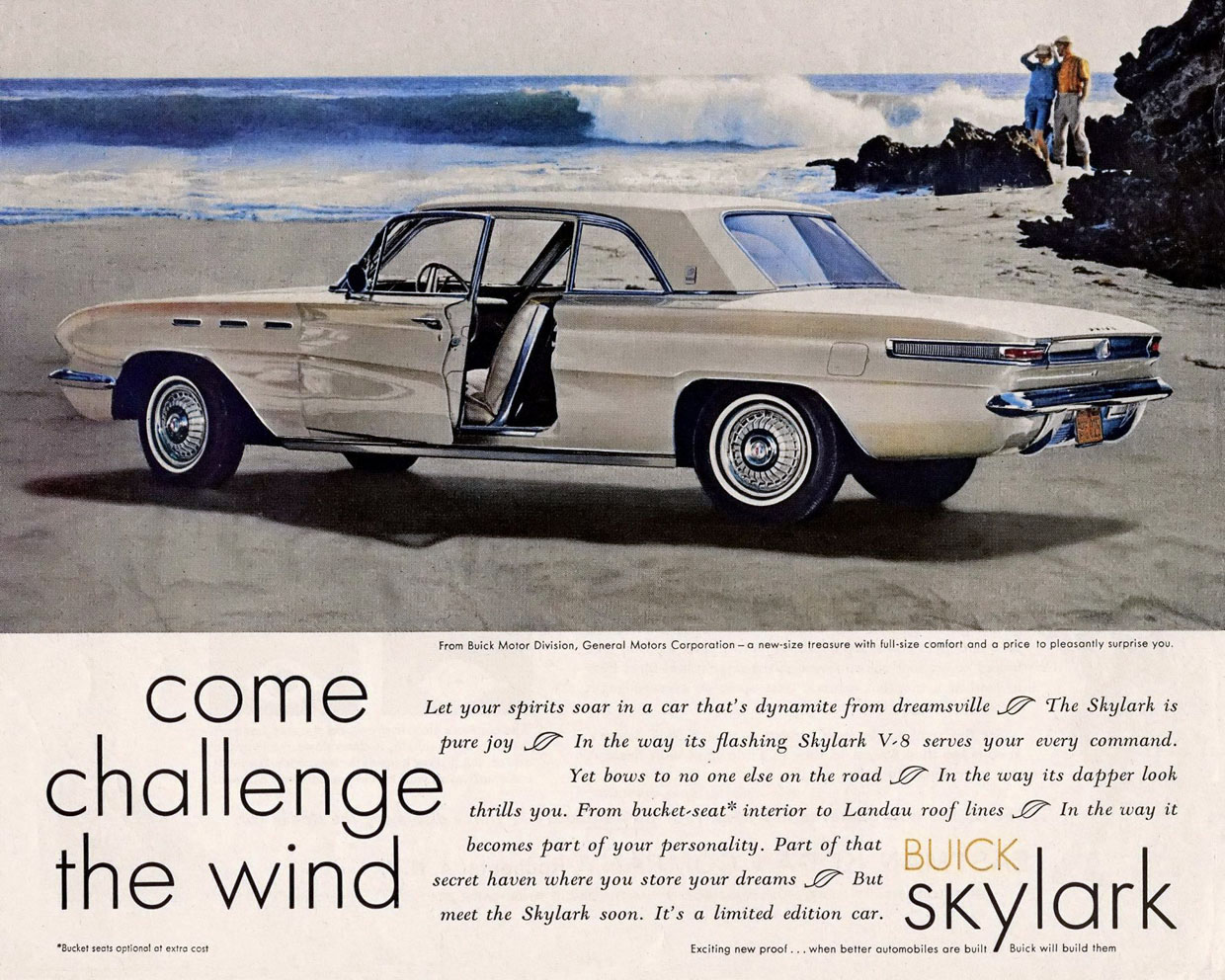
Buick developed a 3.5-liter aluminum V8 for their Skylark model that would be shared with the other divisions as well. This was a highly advanced lightweight engine for the time. Want proof? Well, when the little V8 proved to be too expensive for GM to make, they would end up selling the tooling to British firm Rover, which would end up using the motor until 2006 in their SUVs for the well-to-do. This Skylark also offered a V6 option that was the first mass-produced American car to use such an engine layout.
Oldsmobile’s F-85 entry on the platform used this same V8 but had the added magic of one of the first turbochargers, in this case with detonation controlled by a mix of water and alcohol they called “Turbo Rocket Fuel.” Mercedes Streeter wrote this car up in detail recently.

Pontiac, on the other hand, went all-out to make what John Delorean said would be “something more than the ordinary compact car.” At one point, Pontiac had considered a badge-engineered Corvair, but the decision was made to go with a more conventional layout as with the Buick and Olds platform mates. DeLorean was in the position of a frustrated chef at Chipotle who wants to create the ultimate Mexican concoction but is limited by the ingredients in the burrito assembly line. Undaunted, rolled up GM’s menu into Pontiac’s new Tempest.

Rope A Dope
In simplest terms, the Tempest is like a Corvair where the engine is moved from the rear of the car to up front under the hood, while the transaxle stays in place (though he didn’t use the Corvair’s engine or transaxle). DeLorean even utilized a modified Corvair swing axle rear suspension for the Tempest, but he did run into a problem: the Corvair’s flat floor pan really wasn’t designed to accept a driveshaft. It could have just run the thing through a tunnel on top, but for 1960 GM that would have been too easy. The only way they saw that it could work would involve running the driveshaft in an arc below the floor – was that even possible?

Surprisingly, yes. The solution to keep a flat floor was called “rope drive,” a flexible driveshaft made of forged SAE 8660 steel (high nickel, chrome, and molybdenum alloying). Notice the universal joints? No, you don’t, since there weren’t any. You could choose between a three- or four-speed manual or a two-speed Powerglide automatic. For automatic cars, the shaft was 0.65 in (17 mm) while the manual-box car’s shaft was 0.75 in (19 mm) by 82 in (2.1 m). The center point of the arc was about four inches down from the endpoints, a surprisingly curved arc for a rotating shaft.

As you’d expect, such a layout gave the Tempest a nearly perfect 50/50 front/rear weight balance, which was something the ads touted as even most sports cars of the day did not achieve to e 50.50 split, let alone small family cars.
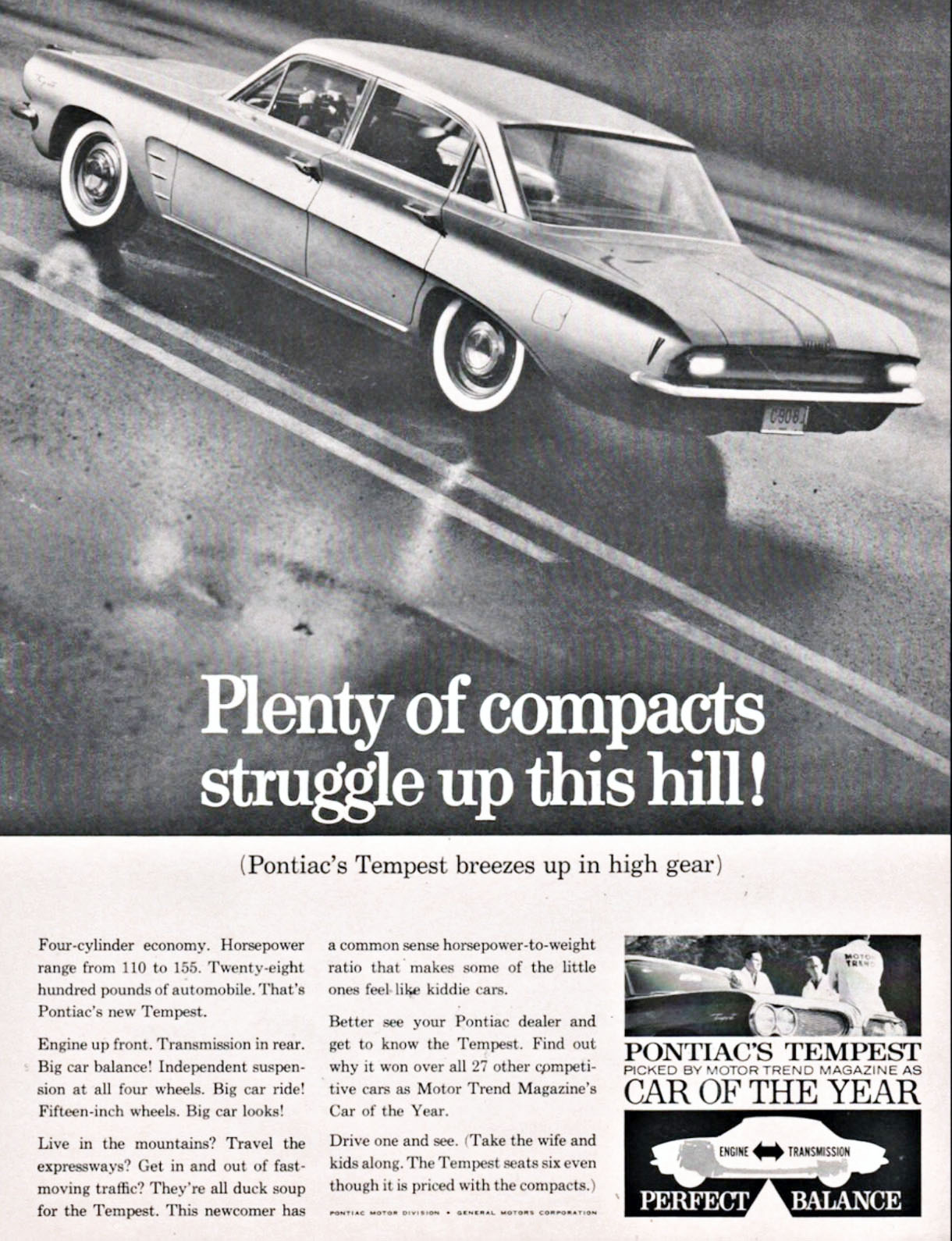
Contemporary tests found it to be a rather nimble little compact. Without the weight of the motor behind the rear axle line, it was far less twitchy than the Corvair that it shared its rear suspension with, but you could still get in trouble if you tried – see the British joke about the Triumph Herald, “hark the Herald axles swing.”
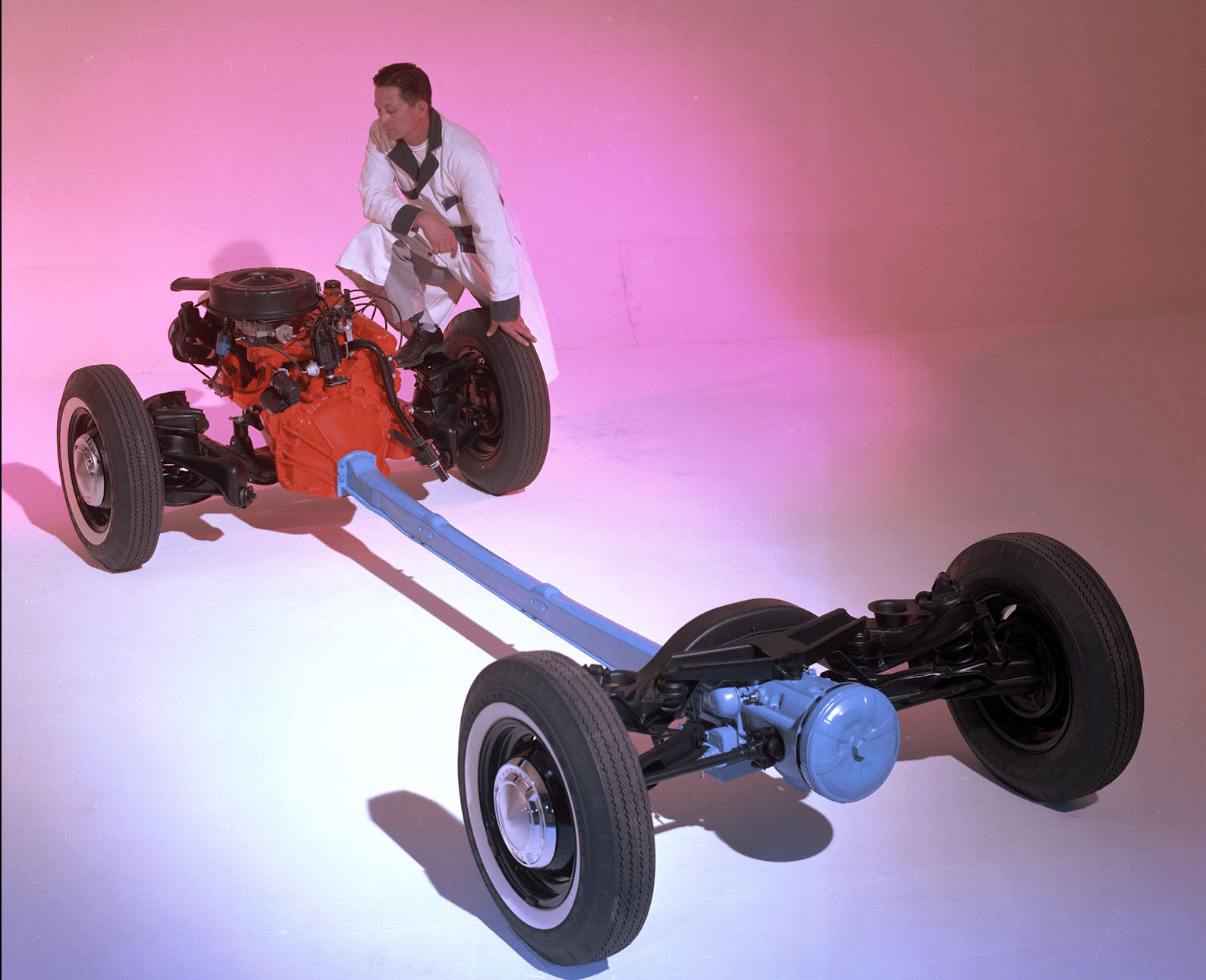
Engines for the Tempest were also far from ordinary. While even the Volkswagen-like Corvair didn’t offer a four-cylinder option, Pontiac wanted to go all European and give compact buyers that choice. The way DeLorean’s team went about it was rather odd; they took Pontiac’s 326 V8 and literally chopped it in half. This massive 3.1 liter “Trophy” four was actually economical to make since it was built on the same line as the “Trophy” V8, as Temu Bobby Deniro appears to be explaining below:

Power output ranged from 110 horsepower with a single-barrel carb up to a 155-horsepower four-barrel monster that claimed to be the most powerful four-cylinder you could get in any car; I’d believe it. Interestingly enough, the aluminum V8 from the Buick and Oldsmobile was an option, but it barely offered any more power than the “Trophy” four, so it was rarely selected (about one percent of production, based on estimates).
The 1962 got a rather bizarre nose job that was not really very Pontiac:

Thankfully, 1963 models returned to a much more Pontiac split-grille kind of look. This year, the unpopular Buick V8 was ditched for a Pontiac-built 326 eight, making a more respectable 260 horsepower. The rear suspension was also tweaked a bit to handle the power and reduce the dreaded “tuck under” tendency.

Want to hear the strangest part about the Tempest? There was a wagon, too.
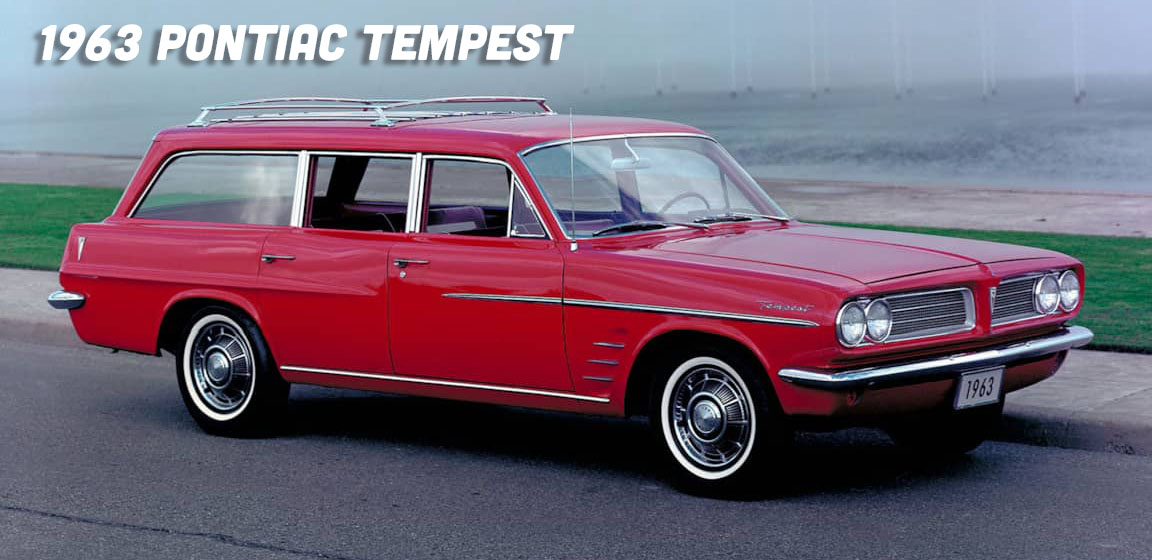
What’s so odd about that? Well, while some wagons have a more conventional layout than their sedan counterparts, that’s not what they did here. That’s right: Pontiac might have had the world’s only front-engine station wagon with a transaxle in back. I mean, it used much of the same body structure as the Corvair wagon of the time, so there was room under the floor, but what a strange layout.

One interesting note: in length and width, the trophy-powered Tempest wagon (and the related turbocharged Olds F-85 wagon and V8 Buick wagon) were exactly the same size as the Volvo 240 Turbo, so forget any claims you might have that the Swedish invented the sports long roof.
Still, the story gets even stranger.
Li’l Draggin Wagon
General Motors has had an odd relationship with motorsports, and in the early sixties, the powers that be didn’t see any advantages to having their cars turn wheels in anger on a track. In early 1963, a ban on internally building competition cars was issued, but a few Pontiac engineers became aware of the plan before it was too late.
A little while before, these engineers had created a monster motor called the “Super Duty” 421, a tweaked V8 with dual four-barrels and high-lift camshaft that was almost humorously listed as producing 405 horsepower; dyno testing indicated a figure of at least 50 more than that or even approaching 500. The powerplant had been used in the lightweight “Swiss cheese” Catalina coupe, which I don’t want to say too much more about right now: I’m running out of Pontiacs to write about, people!

Anyway, the big Pontiac with this motor was undeniably fast, but there was a limit to how much they could lighten this large car to make it faster. Clearly, a smaller car was needed for the 421 to achieve maximum speed, and the Tempest was it.

The team ordered six coupes to modify and, strange as it sounds, six station wagons to drop in 421s over the holiday break just before the end of 1962. While some independent drag racers used the Tempest to race with big motors, they ripped out the rear transaxle, kept the front gearbox, and just threw in a live axle. Pontiac engineers didn’t do that with the Super Duty wagons. The rope drive and perfect weight balance remained. They also installed a bizarre transaxle with four speeds made up of components from a pair of Powerglide two-speed automatics allowed for clutchless shifting.

You can already imagine that the 421-powered Tempest was blisteringly fast. This was possibly the quickest factory-built station wagon ever at that point and certainly the only one with a rear transaxle, capable of blasting out low 12-second quarter miles at well over 100 MPH. The car pictured here is reportedly the only one of the six wagons left, and it fetched $450,000 at a Mecum auction in 2010. It looks delightfully terrifying to drive.
Adapted By Other Compacts, But Only Expensive Ones
Like pearls before the swine, the typical compact car buyer of those days wasn’t an enthusiast, and they really didn’t care about such engineering sophistication and the cost or complexity associated with it. For the 1964 model year, the Tempest name switched to a more bog-simple front engine and rear drive mid-sized car that would ultimately form the basis for DeLorean’s famous GTO, a far more popular and faster car but a stone-age product by comparison. Later Pontiac compacts like the Ventura shared the platform of the bog-simple Chevy Nova. For maximum profits in a category where making money was tough, the more basic the better. Even today, rear-transmission Tempest values can lag below even many non-GTO later Tempest models.

Still, it was good to see the biggest car company in the nation that put a man on the moon actually trying to push the limits of automotive technology. Sure, there were issues with refinement, but what could you really expect from a three-liter four without balance shafts? Thirty years later, the new-for-1992 three-liter four Porsche 968 that actually did have balance shafts wasn’t perfectly smooth either. It had a rear transaxle as well; did you ever in a million years think that a Zuffenhausen creation would be copying an old Pontiac?
Pontiac Points: 86/ 100
Verdict: Say what you want about GM bean counter cars: this Tempest pulled out all the stops to make an advanced world-class enthusiast car.
Top graphic image: Exotic Motorsports of Oklahoma





Bishop, i can think of a few more ponchos i cannot recall you writing about! Perhaps the 301 turbo gen2, or the 89 TTA. The OHC HO firebirds and tempestes. Final GT-Faux? Grand prix 2+2 aerocoupe.
Porsche 944s and 924s had front engine/rear transaxle with a torque tube long before the 1992 968.
Correct, but I think the Bishop mentions specifically the 968 because of the 3 liter-four. 944 ends at 2.5, I think.
’89 944 S2 had the 3.0L four cylinder in naturally aspirated form. (The 968 CS added a turbo to the big four.) I used to know a thing or two about wasserpumpers and rather miss my ’88 928 and 944 Turbo S.
Thanks, did not know there was already a 3.0 944 – Always thought that was the 968s party trick.
A guy on my street in Toronto kept one of these going well into the 2000’s. I think he was the original owner. It was street parked, but obviously not driven frequently. It was a 4 door post, pale yellow with rust.
I like these rare articles that tell me something I didn’t already know. I would’ve never guessed the Tempest was a rear transaxle design, much less that it had such a weird driveshaft. Also, that body stye for the Skylark is surprisingly good looking.
In 1970 I bought a ’62 Tempest for $92 at a used car lot in suburban Chicago. The front fenders were gone and I had to take the high beam headlights out and move the low beams over. The battery fell out on a right turn one day and I had to devise a makeshift battery box for it. It didn’t have a P in the PRNDL and the parking brake cable was gone so I had to use a parking brick to throw at the front or rear tire when parking. Fortunately the wipers worked because without the front fenders the tires would throw any moisture from the street onto the windshield! It was totally uncontrollable over 45mph, but it got me around town for the better part of a year before I was able to afford better. It was a bit strange to see the transmission dipstick next to the spare tire in the trunk!
My mom has one, she still has the four cylinder engine too.
“Rope drive”is such a boring name. I’d have called it a Hempi.
Interesting that you mentioned the Porsche 968. Many years ago i heard a story from a reliable source that when Porsche was developing the 928, they needed to build development mules before their own transaxle was ready. Apparently, they used transaxles from Tempests to build their prototypes. The most interesting thing about this story is that they found the transaxles to be virtually indestructible! I’ve always loved that story and i really hope it’s true.
One of Jason’s principals drove a F85 station wagon with 215CI engine. No Jason, not while you were at Beth David, although she could have been driving a calf turd green 1968 F85. She probably had the Nissan Stanza. I’m not sure how young Jason is or I would know for sure.
I’ve always loved these but never seen or been in one in person.
One of my brothers had a 63 Tempest. This was the late 70s and it was a rusty heap but I do remember it being ‘odd’ compared to the usual 60’s American cars I was used to seeing.
I had no idea the Tempest, etc were derived from the Corvair.
But now that I do, I now know why Mother loved her Volvo 240s so much.
Tho she would probably have been better served with a Tempest than her ’62 Corvair.
That said – I don’t think the Tempest was made to be the same size as a 240 Turbo.
I believe the 1966 Volvo 140 was made to be the same size as the old Tempest.
Semantics.
I can’t begin to imagine how difficult it would be t source parts for one of these today……
Not to steal The Autopian’s thunder, but Ate Up With Motor has an article on the Rope Drive:
https://ateupwithmotor.com/model-histories/compact-economy-cars/magnificent-kludge-the-rope-drive-1961-1963-pontiac-tempest
Oh GM. So many avenues pursued before they were ready for primetime. Or novelties that went nowhere.
Had they found transverse engine, front-drive avenue in the late ’60s or early ’70s, they would have been so far ahead.
“Had they found transverse engine, front-drive avenue in the late ’60s or early ’70s, they would have been so far ahead.”
Or they would have botched it so badly, we’d all still be commuting in RWD compacts. (Not a terrible fate, actually.)
Anyway, I offer up the Olds Diesel as Exhibit A. 😉