


The most famous Pontiac John DeLorean might have been associated with was hardly a groundbreaking engineering feat. Putting a big engine into a Tempest to make it go faster indeed created the vaunted GTO, but it’s really the product of caveman-level engineering.
A lesser-known product of DeLorean’s time as an innovative engineer at the Excitement Division, however, was extremely advanced for the time. In fact, the Ferraris, Alfas, and Porsches that used the same layout in the years that followed didn’t even incorporate all the tricks John had incorporated into the Pontiac compact.


And did I mention that it had a “rope drive?” Forget the DMC-12: the 1961 Tempest was DeLorean’s real trip to the future.
Complex Compact Chaos
General Motors gets a lot of flak for its failed attempts to do what others had achieved, from aluminum-block Vega engines to torque-steering front-drive cars to double-overhead-cam, four-valve “Quad 4” engines that sounded like Cuisinarts mashing nuts when revved. But fails like these weren’t always the case. In the late fifties through the sixties, it seemed that GM had no fear in trying things that were entirely new and mostly succeeding. There’s no better example of this than the time GM’s big four brands launched their first “compact” cars to fight imports.

Chevrolet began by introducing the Corvair in late 1959, powered by an air-cooled flat six in back in a manner similar to a giant Volkswagen. At the same time, a longer version of the Corvair’s “Z” platform was earmarked for the Buick, Oldsmobile, and Pontiac divisions in 1961 as the front-engined “Y” cars. When you hear “GM platform” you might be imagining identical cars with different front noses and taillights, but with these early compacts but that wasn’t the case: each of the divisions tried very different groundbreaking technology on this same-platform car.
Buick developed a 3.5-liter aluminum V8 for their Skylark model that would be shared with the other divisions as well. This was a highly advanced lightweight engine for the time. Want proof? Well, when the little V8 proved to be too expensive for GM to make, they would end up selling the tooling to British firm Rover, which would end up using the motor until 2006 in their SUVs for the well-to-do. This Skylark also offered a V6 option that was the first mass-produced American car to use such an engine layout.
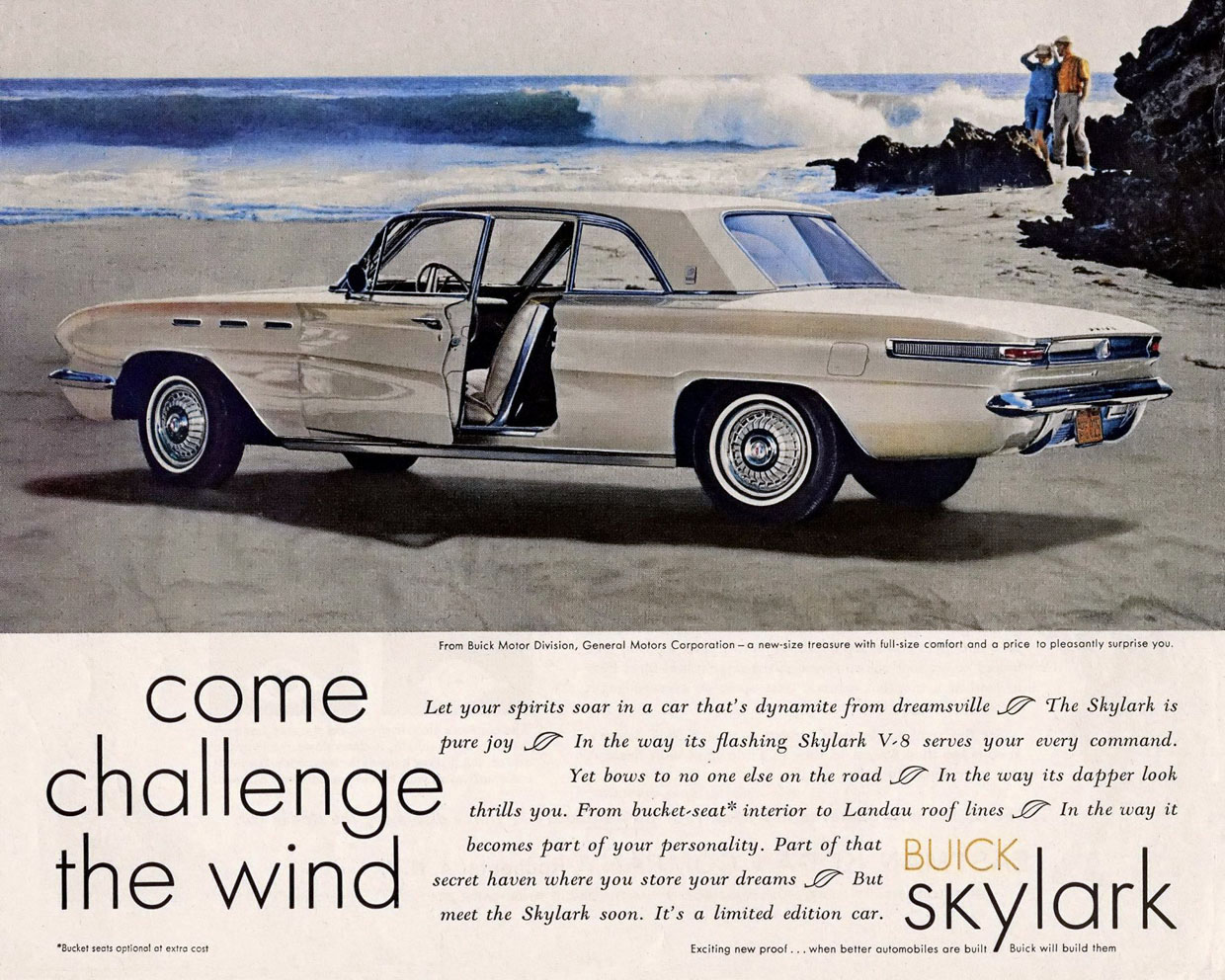
Oldsmobile’s F-85 entry on the platform used this same V8 but had the added magic of one of the first turbochargers, in this case with detonation controlled by a mix of water and alcohol they called “Turbo Rocket Fuel.” Mercedes Streeter wrote this car up in detail recently.

Pontiac, on the other hand, went all-out to make what John Delorean said would be “something more than the ordinary compact car.” At one point, Pontiac had considered a badge-engineered Corvair, but the decision was made to go with a more conventional layout as with the Buick and Olds platform mates. DeLorean was in the position of a frustrated chef at Chipotle who wants to create the ultimate Mexican concoction but is limited by the ingredients in the burrito assembly line. Undaunted, rolled up GM’s menu into Pontiac’s new Tempest.

Rope A Dope
In simplest terms, the Tempest is like a Corvair where the engine is moved from the rear of the car to up front under the hood, while the transaxle stays in place (though he didn’t use the Corvair’s engine or transaxle). DeLorean even utilized a modified Corvair swing axle rear suspension for the Tempest, but he did run into a problem: the Corvair’s flat floor pan really wasn’t designed to accept a driveshaft. It could have just run the thing through a tunnel on top, but for 1960 GM that would have been too easy. The only way they saw that it could work would involve running the driveshaft in an arc below the floor – was that even possible?

Surprisingly, yes. The solution to keep a flat floor was called “rope drive,” a flexible driveshaft made of forged SAE 8660 steel (high nickel, chrome, and molybdenum alloying). Notice the universal joints? No, you don’t, since there weren’t any. You could choose between a three- or four-speed manual or a two-speed Powerglide automatic. For automatic cars, the shaft was 0.65 in (17 mm) while the manual-box car’s shaft was 0.75 in (19 mm) by 82 in (2.1 m). The center point of the arc was about four inches down from the endpoints, a surprisingly curved arc for a rotating shaft.

As you’d expect, such a layout gave the Tempest a nearly perfect 50/50 front/rear weight balance, which was something the ads touted as even most sports cars of the day did not achieve to e 50.50 split, let alone small family cars.
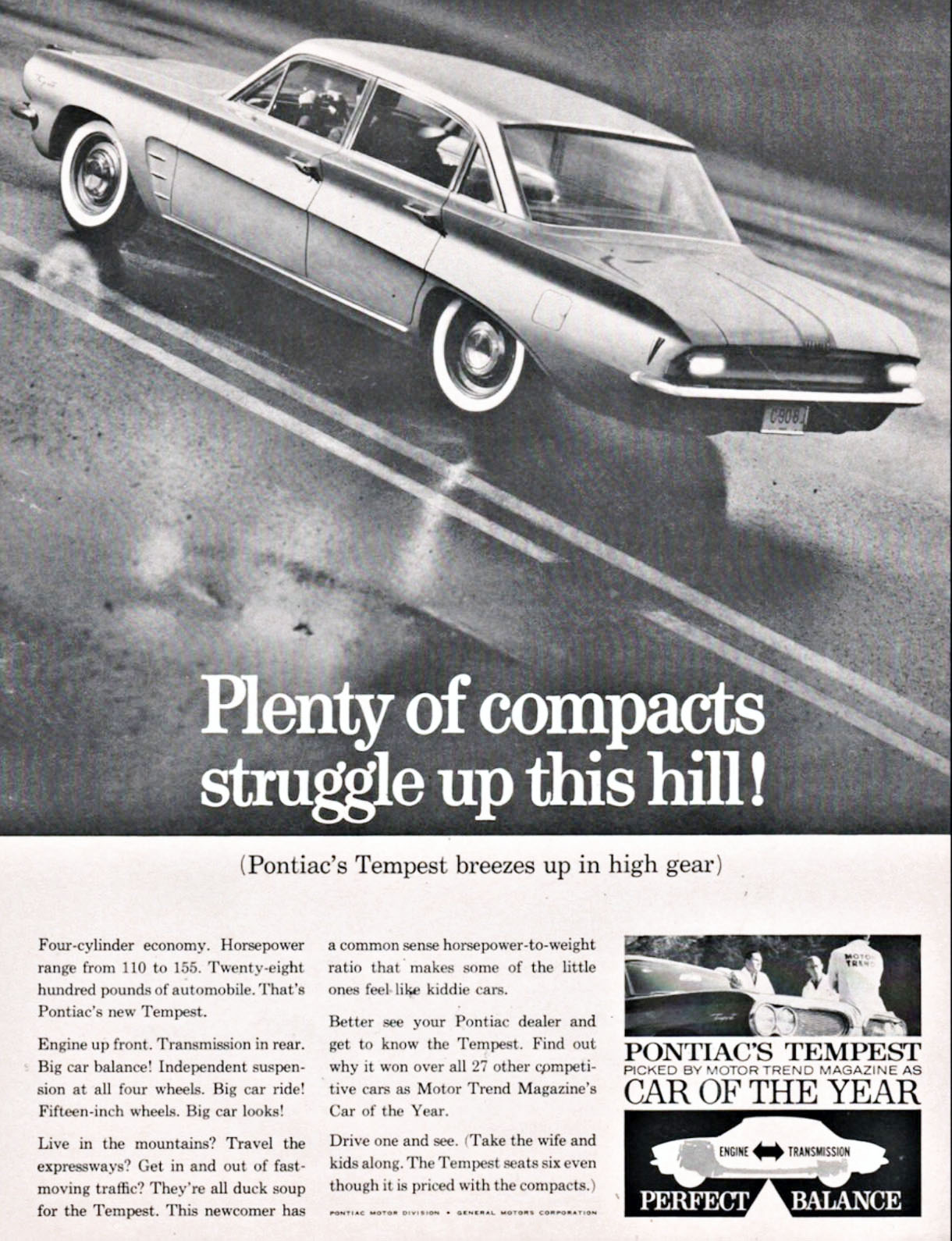
Contemporary tests found it to be a rather nimble little compact. Without the weight of the motor behind the rear axle line, it was far less twitchy than the Corvair that it shared its rear suspension with, but you could still get in trouble if you tried – see the British joke about the Triumph Herald, “hark the Herald axles swing.”
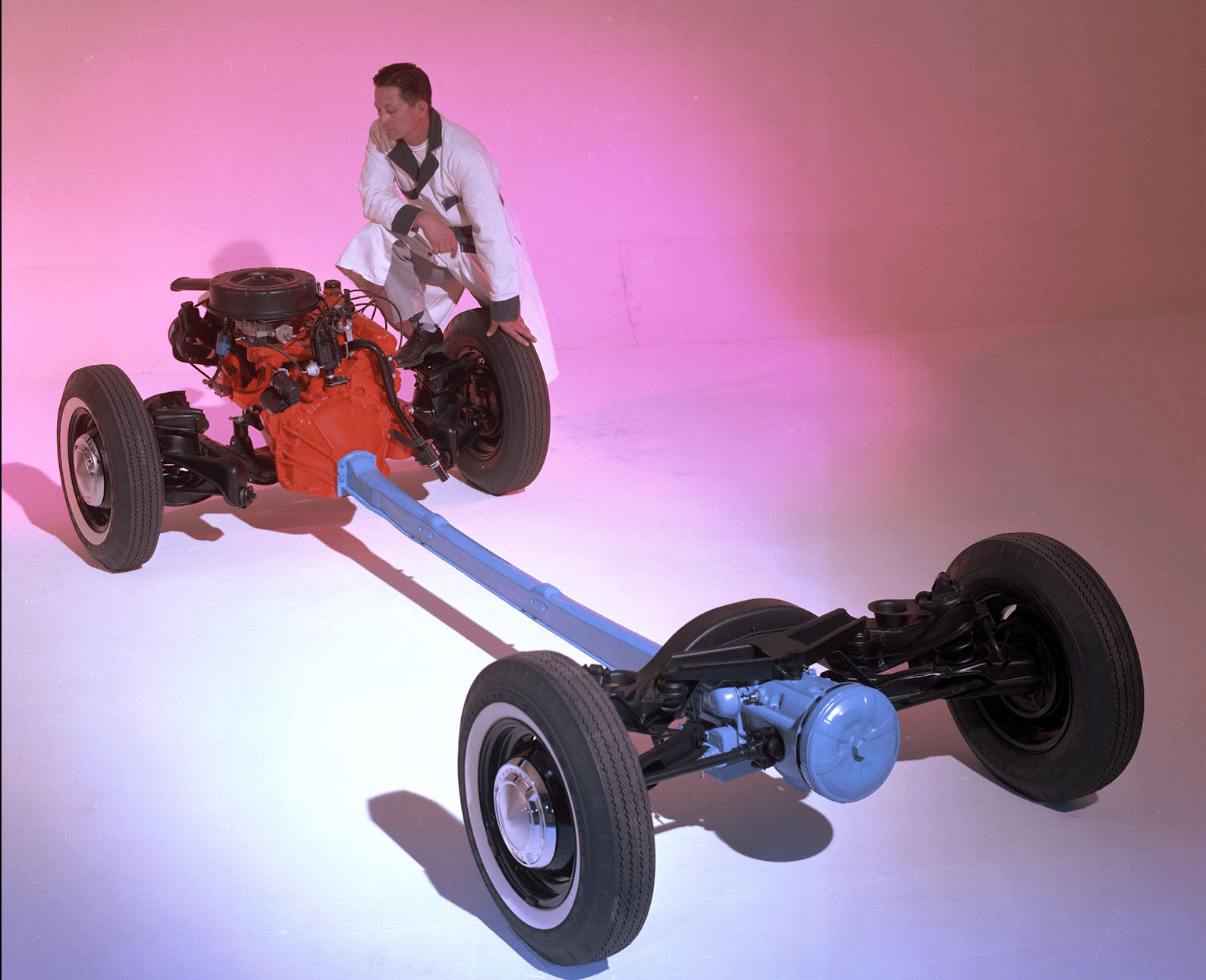
Engines for the Tempest were also far from ordinary. While even the Volkswagen-like Corvair didn’t offer a four-cylinder option, Pontiac wanted to go all European and give compact buyers that choice. The way DeLorean’s team went about it was rather odd; they took Pontiac’s 326 V8 and literally chopped it in half. This massive 3.1 liter “Trophy” four was actually economical to make since it was built on the same line as the “Trophy” V8, as Temu Bobby Deniro appears to be explaining below:

Power output ranged from 110 horsepower with a single-barrel carb up to a 155-horsepower four-barrel monster that claimed to be the most powerful four-cylinder you could get in any car; I’d believe it. Interestingly enough, the aluminum V8 from the Buick and Oldsmobile was an option, but it barely offered any more power than the “Trophy” four, so it was rarely selected (about one percent of production, based on estimates).
The 1962 got a rather bizarre nose job that was not really very Pontiac:

Thankfully, 1963 models returned to a much more Pontiac split-grille kind of look. This year, the unpopular Buick V8 was ditched for a Pontiac-built 326 eight, making a more respectable 260 horsepower. The rear suspension was also tweaked a bit to handle the power and reduce the dreaded “tuck under” tendency.

Want to hear the strangest part about the Tempest? There was a wagon, too.
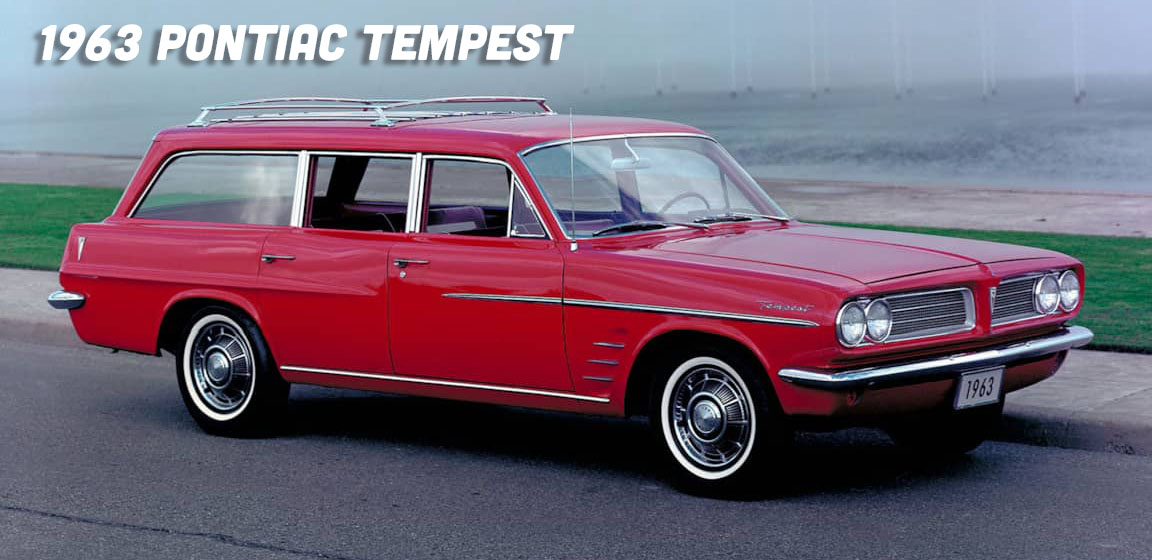
What’s so odd about that? Well, while some wagons have a more conventional layout than their sedan counterparts, that’s not what they did here. That’s right: Pontiac might have had the world’s only front-engine station wagon with a transaxle in back. I mean, it used much of the same body structure as the Corvair wagon of the time, so there was room under the floor, but what a strange layout.

One interesting note: in length and width, the trophy-powered Tempest wagon (and the related turbocharged Olds F-85 wagon and V8 Buick wagon) were exactly the same size as the Volvo 240 Turbo, so forget any claims you might have that the Swedish invented the sports long roof.
Still, the story gets even stranger.
Li’l Draggin Wagon
General Motors has had an odd relationship with motorsports, and in the early sixties, the powers that be didn’t see any advantages to having their cars turn wheels in anger on a track. In early 1963, a ban on internally building competition cars was issued, but a few Pontiac engineers became aware of the plan before it was too late.
A little while before, these engineers had created a monster motor called the “Super Duty” 421, a tweaked V8 with dual four-barrels and high-lift camshaft that was almost humorously listed as producing 405 horsepower; dyno testing indicated a figure of at least 50 more than that or even approaching 500. The powerplant had been used in the lightweight “Swiss cheese” Catalina coupe, which I don’t want to say too much more about right now: I’m running out of Pontiacs to write about, people!

Anyway, the big Pontiac with this motor was undeniably fast, but there was a limit to how much they could lighten this large car to make it faster. Clearly, a smaller car was needed for the 421 to achieve maximum speed, and the Tempest was it.

The team ordered six coupes to modify and, strange as it sounds, six station wagons to drop in 421s over the holiday break just before the end of 1962. While some independent drag racers used the Tempest to race with big motors, they ripped out the rear transaxle, kept the front gearbox, and just threw in a live axle. Pontiac engineers didn’t do that with the Super Duty wagons. The rope drive and perfect weight balance remained. They also installed a bizarre transaxle with four speeds made up of components from a pair of Powerglide two-speed automatics allowed for clutchless shifting.

You can already imagine that the 421-powered Tempest was blisteringly fast. This was possibly the quickest factory-built station wagon ever at that point and certainly the only one with a rear transaxle, capable of blasting out low 12-second quarter miles at well over 100 MPH. The car pictured here is reportedly the only one of the six wagons left, and it fetched $450,000 at a Mecum auction in 2010. It looks delightfully terrifying to drive.
Adapted By Other Compacts, But Only Expensive Ones
Like pearls before the swine, the typical compact car buyer of those days wasn’t an enthusiast, and they really didn’t care about such engineering sophistication and the cost or complexity associated with it. For the 1964 model year, the Tempest name switched to a more bog-simple front engine and rear drive mid-sized car that would ultimately form the basis for DeLorean’s famous GTO, a far more popular and faster car but a stone-age product by comparison. Later Pontiac compacts like the Ventura shared the platform of the bog-simple Chevy Nova. For maximum profits in a category where making money was tough, the more basic the better. Even today, rear-transmission Tempest values can lag below even many non-GTO later Tempest models.

Still, it was good to see the biggest car company in the nation that put a man on the moon actually trying to push the limits of automotive technology. Sure, there were issues with refinement, but what could you really expect from a three-liter four without balance shafts? Thirty years later, the new-for-1992 three-liter four Porsche 968 that actually did have balance shafts wasn’t perfectly smooth either. It had a rear transaxle as well; did you ever in a million years think that a Zuffenhausen creation would be copying an old Pontiac?
Pontiac Points: 86/ 100
Verdict: Say what you want about GM bean counter cars: this Tempest pulled out all the stops to make an advanced world-class enthusiast car.
Top graphic image: Exotic Motorsports of Oklahoma





Temu reference in an article about the ’60s? Keep it in the era… he’s a Sears-Roebuck Robert De Niro.
Temu implys a cheapo knockoff, Sears back then was nice, maybe a Five and Dime… Woolworth De Niro?
A Kreske James Coburn
The quality is so good I am assuming it’s De Niro’s uncle in the advert lol
“This bigass four rattles like a paint mixer.”
“Add some slosh to the mounts.”
“Did it. Now we’re getting through the driveline.”
“Add some slosh there too.”
“…okay.”
These are probably my favorite GM cars of all time. I love the look, I love the engineering insanity of them. And by most accounts they are one of the best driving cars of the day, combining European poise with some American grunt. If I had been a new car buyer seven-eight years before I was born, I could see myself ordering a high-zoot wagon with the V8 and a 4spd.
That aluminum V8 may have made barely more power than the big four, but it was a HELL of a lot smoother and made much nicer noises. Those Trophy 4s were as bad as the Iron Puke, if not worse.
I hadn’t given these much (any?) thought but after reading your post and looking at the pictures, I agree these were rather handsome cars. And, provided it was reliable, I’d see driving a Rube-Goldberg machine as a definite plus.
These had the advantages of the Corvair without the disadvantages. Better handling, more reliable engines, better heat in the winter, etc.
That wagon is gorgeous!
I was expecting to see an aircraft cable (or wire rope if you’re a Grey Poupon type) drive like that of an inexpensive string trimmer.
Chrysler had the patent.
The Buick 215 V8 had a very long afterlife, after Land Rover stopped offering it in 2006, the tooling went to a company in Weston-super-Mare, who continued production on a limited basis until at least 2011 or 2012, maybe a bit later.
The Fireball V8 created by lopping 2 cylinders off was initially cast in aluminum during the pilot production phase, before switching to cast iron, was sold to Kaiser-Jeep in the mid ’60s, discontinued by American Motors in 1970, after they bought K-J, then sold back to GM after the 1973 oil embargo and built in highly evolved and updated form up until the Buick 3800 was dropped in 2008
There was also a cast iron V8 derivative built by Buick through 1980. Quite a convoluted family tree
I’ve long wondered about the rope drive. I don’t think I’ve ever seen one of these Tempests in person.
Although, we’ve all heard the very comprehensive explanation of them from noted automotive expert Ms. Mona Lisa Vito. She was dead-on balls accurate, too.
I would never question the veracity of Ms. Vito’s testimony, but I would appreciate it if she could come over and set the timing on my Chevy 350.
While admirable, it’s a shame she chose to focus on supporting her partner’s mediocre lawyering. She’d have been quite successful as an expert witness.
Well, the movie leaves off before we see what the rest of her career looked like. Perhaps they went on to become New York’s newest and unlikeliest power couple.
What a hilariously bad sequel that would have been. I think power couple of all of New York is improbable but I can see them dominating Staten Island, Queens, or the Bronx. (I’m assuming they come from one of those boroughs).
Loved the article.
Actually, the Oldsmobille F85 and Cutlass wagons did not have turbocharged engines. Only the Jetfires had the turbocharged engines.
To me, GM hit its peak engineering, design, and styling from 1960ish through 1968ish, with some exceptions of course. By the late 60’s the new models were beginning to bloat.
Question for an engineer: Is there a parasitic loss penalty for doing this? In my head it seems like there would be additional force needed to be bending this thing with every rotation.
I’m worried about material fatigue from constantly being bent in all directions
I thought of that too. It seems like either the thing would snap within a few seconds, or be fine. As a non metallurgist, my prediction would have been toward the snapping outcome so I’m fascinated on the physics of how this works.
Are you worried about the material fatigue in coil and leaf springs? Those are probably deforming more than this shaft. Steel doesn’t fatigue if you stay within the elastic portion of the stress/strain curve. I’m sure the specific alloy was chosen because it meant they would never hit the yield point while being appropriately flexible enough.
My dad had one with a Powerglide that I used to cart my younger sisters around in the 70’s. The car would be a pile of rust before driveshaft fatigue would be a problem.
It was a roomy car that would seat 6 easily. 4 wheel independent suspension, 4 cylinder overhead cam engine, a transaxle, and a flat floor.
One Nixon lowered the speed limit to 55, you could speed on the highway (downhill only). Emergency stopping may have been possible by lifting the floor mats and dragging your feet.
Is the bending stress is below the unlimited fatigue life level for the steel used, there should be no issue with fatigue. The size of the curve on this drive line is very large so the bending stress is low.
There are some race series that require solid axles. In order to eek some camber out of the rear wheels, they will force the axles to bend just like this rope drive.
Yes, there is a loss. I’m not sure of the specifics here, but with flexible shaft drives you typically get some portion of that compressive bending force back on the opposite side of the shaft as it “springs” back, but not all. I’d imagine that shaft got warm and had some interesting harmonics. But you also have to remember U-Joints and CV joints also have parasitic losses, so I wonder how this compares to those.
Made famous in My Cousin Vinny.
Did you say utes?
No, he said yutes.
I wonder if the vertical strakes under the rear bumper on that red convertible in the topshot were a bit of a stylistic Easter egg linking the Poncho to its distant cousin, the Corvair, which had a similar set under its front bumper.
This article brought back memories of the ’61 Pontiac Tempest and ’62 Olds F85 I drove as a teenager. Not that I was a GM fan, these cars were cheap, available and fairly easy easy to wrench on.
The Tempest broke down one evening and by the time I came back with some buddies to drag it home, the authorities had snatched it. The Oldsmobile was sold to help finance the purchase of a new ’74 Capri.
And imagine my surprise to see a link in the article to a blog I kept up a long time ago. Yep, the Herald’s (and other’s) axles swing!
The 1963 Pontiac Tempest convertible was also the car that made those two, equal length tire marks outside the Sac’ O Suds, and not a 64 Buick Skylark convertible.
Both available in metallic mint green paint too!
Neither of which could be confused with the Corvette.
I didn’t know the early 60s tempest had a rear transaxle. Was it just the alloy of the shaft that allowed the bend in it? At what RPM did the shaft stop bending and explode?
I assume if this thing was known for blowing up it would be included in the article. Assuming it was reliable, tip of the hat to GM for coming up with this.
That wasn’t a reliability question. that was honest. did the RPM max of the driveshaft significantly exceed that of the engine? Did they blow up when abused while racing? I’m curious about the technical limits of the tech as they used it.
Ah. I just looked up another article which pointed out that, since it was before the transaxle (and therefore torque multiplication) it did not have as much stress as a typical driveshaft. I know this post mentioned the dimensions but seeing the picture of how skinny the “rope” was made me appreciate this is not your usual driveshaft. I realize none of that answers the question regarding its limitations. Then again, if it is just a solid skinny rod, I’m not sure it can “blow up” the way we typically think of it. But obviously, like everything, it would fail one way or another eventually.
I assume that what was holding the shaft at either end would fail before the shaft itself, rather intentionally. Probably splines.
Ultimately, its just a long spring being used in a funny way. But it was a costly solution to a problem that really didn’t exist. When they went to conventional driveshaft and live axle, they just put a tunnel in the floor like nearly every car has. Even FWD ones usually (need to run the exhaust somewhere anyway, and it stiffens the pan – bonus. Takes up a little more space, but nobody REALLY cares.
Re: problem that didn’t really exist. My thoughts exactly. It’s hard to believe they were faced with either modifying the floorpan or…this. And they went with this. What a wildly complicated way to gain a few inches of clearance.
Then again, they were smart people and wouldn’t have gone through the trouble if the costs didn’t outweigh the benefits vs other options. Maybe they realized it was a dead end or just not worth the trouble after a few years.
You underestimate the value of being able to market a unique solution. But ultimately, the production cost accountants probably overruled the marketing team. And I suspect the biggest reason it was dropped was the horsepower wars. There would have been no big-engine GTOs if they had stayed with the rope drive and transaxle – it likely had a relatively low power-handling ability when you had to put a warranty on it and not just run down a drag strip once in a while. And drag racing was much more important in the US in the late 60s than cornering ability was.
Great point. You tell people it has a one-of-a-kind driveline and you can make whatever amazing claims you want. Sounds exciting to the consumer! But that dies down once it gets released in the wild and word spreads that it is “good,” but decidedly not revolutionarily.
Ultimately, I suspect they had the same problem as the Corvair. They cost a little too much for the intended market (but that car had some unique headwinds, aka Ralph Nader’s crusade). And then they wanted to be able to put a LOT more horsepower in them. I think that was the real kiss of death for this platform.
No, all the problems were at the engine end, the Trophy 4’s vibrations had a tendency to tear apart its own timing chains, often at pretty low mileages. But, I believe the aftermarket has pretty much solved that, any still around and running after 60+ years are probably fine
Okay now I am going to see if I can find any of those wagons for sale locally (not that I have the money or space for one right now haha)
I suspect you will be lucky to find one for sale anywhere, nevermind anywhere nearby. They didn’t sell very many of these period, the wagons fewest of all, and the early 60s was a LONG time ago.
But if you find and buy one – I will be VERY jealous! This is one of very few American cars of that era I would cheerfully have in my garage.
Was this the original RopaDopa?
If you plan on using one of these as a getaway car for a robbery, trying to blame Ralph Macchio will ultimately not work.
was considering adding in that video clip
depends on whether his cousin (and, more importantly, his cousin’s fee–ahhhn–say) are available to take the case.
Guess you can’t blame this one on cocaine.
Cocaine? No, just a healthy, doctor recommended diet high in cigarettes and Scotch
Gotta take care of that T-Zone.
But, if you want cigarettes that taste like fine tobacco instead of medicine, than you need Old Gold, for a treat instead of a treatment
Darn, I was hoping for pictures of the shaft, he said innocently.
Obligatory: that’s what she said.
I’ll grant that it’s long, but far less girthy than I would have expected. Then again, as long as it gets the job done…
https://macsmotorcitygarage.com/secrets-of-the-1961-pontiac-tempest-rope-drive/
Thanks. An interesting but ultimately stupid design.
That was pretty good stuff, 80,000 psi yield and shot peened. I suspect the GM bean counters fainted when the quotes for that piece came in.
Also, I can say with equal innocence, I think most of us were hoping to see pics of the shaft. But, like, for real.
..waiting for the moon landing deniers to enter the chat lol – what a cool car, I would love one with a hopped up 421 woof.
I can’t articulate exactly why but categorizing the Quad4 as a “failure” doesn’t sit right with me, despite me having no particular love for that engine.
It certainly sold, and it was hardly Vega unreliable, so failure might be too harsh. Still, tach it up to 4500 revs and then do that with a same-year DOHC Honda or Toyota and what you’ll experience doesn’t speak “success” for what was the world’s largest car company.
Quad4 was definitely an interesting engine for its time. It was the first in-house developed DOHC 4-cyl for the General.
I think what really stands out regarding this engine is that these engines were producing hp and torque figures similar to what their OHV V6’s were doing at the time. The only problem is that most variants didn’t have a balance shaft so when you revved up the engine the sound it made quickly went from high-strung sewing machine to a swarm of angry murder hornets. That lack of refinement in the NVH department I think is what contributed to their wild character.
HOWEVER, these engines, with all their technological charm (for its time) had some serious issues with keeping them cool and so it wasn’t uncommon to see a 100,000 mile engine already on its 2nd or 3rd head gasket. Unlike a Honda K engine, these really weren’t built to last.
Right they weren’t paragons of refinement or longevity, they were the typical American big-hammer approach to a problem. 160 HP out of a 2.3L 4-cyl was kind of insane for the time.
Came here for this, I had a HO quad4 in my Grand AM GT, was fast, but hardly refined, and yes I had to change the head gasket!
Those Grand Am GT’s were quicker than they had every right to be compared to other American 4-cyls of the era. Dare I say, those Grand Am’s were the genesis of what became Big Altima Energy? It’s basically the same formula, just different manufacturers at different times.
could probably be argued lol tho I protest my serving BUE lol
“Rope drive” is such a hilarious idea. It gives me the mental image of a car powered by a Gilligan’s Island style coconut-shell waterwheel up front with a long rope-and-pulley to the rear wheels.
I can see The Professor with a clip board watching Gilligan test it in the quarter mile while Skipper is holding his hat.
I totally dug the bamboo Island Pedal Car.
“Tonight, on Trop Gear:”
When I read the headline I assumed it was some sort of long ass belt drive. Which means that’s probably what other people pictured when they first heard the name. Which sounds like an incredibly stupid and unappealing design.
Question is, who copied who on the half a V8 4 banger? International or Pontiac?
ive got a 1962 Scout 80 with the 152 commanche. it’ll barely get out of its own way, but its hammer dumb reliable. its my “street tractor” lol
They used a bigger half v8 later and even through a turbo on one or two as I recall, but yeah none of them had much power. Hell the actual 304 V8 in my 71 barely makes 150 HP, but they do manage tractor like duties without much fuss.
I have pondered this question and researched it as best as possible 60+ years later.
My conclusion is that both engines were developed completely independently, and neither team knew or cared about the other “half-an-eight”. They were introduced almost simultaneously.
My guess is that Pontiac (and most of GM) couldn’t be bothered to know what International was doing with its light trucks, as I-H was barely a blip on the radar in light trucks anyhow. At the same time, I-H wouldn’t have had access to any engineering info from GM.
By all appearances, two companies had the same idea at the same time, entirely independently of each other.
From the ad: “They’re all duck soup for the Tempest”
Now there’s an expression that should make a comeback.
I absolutely love ad copy from that era. It’s got such a Mad Men vibe. I just picture a bunch of guys around a conference table heavily downing scotch and pulling deeply on cigarettes.
The copy in that Buick Skylark ad is kind of nauseating…
That’s it, you’re banished from Dreamsville!
Not just any cigarettes, but Lucky Strikes: they’re toasted.
Gotta be the unfiltered ones too. Those build character… and cancer cells.
yup. Real men aren’t scared off by a little phlegm or emphysema.