

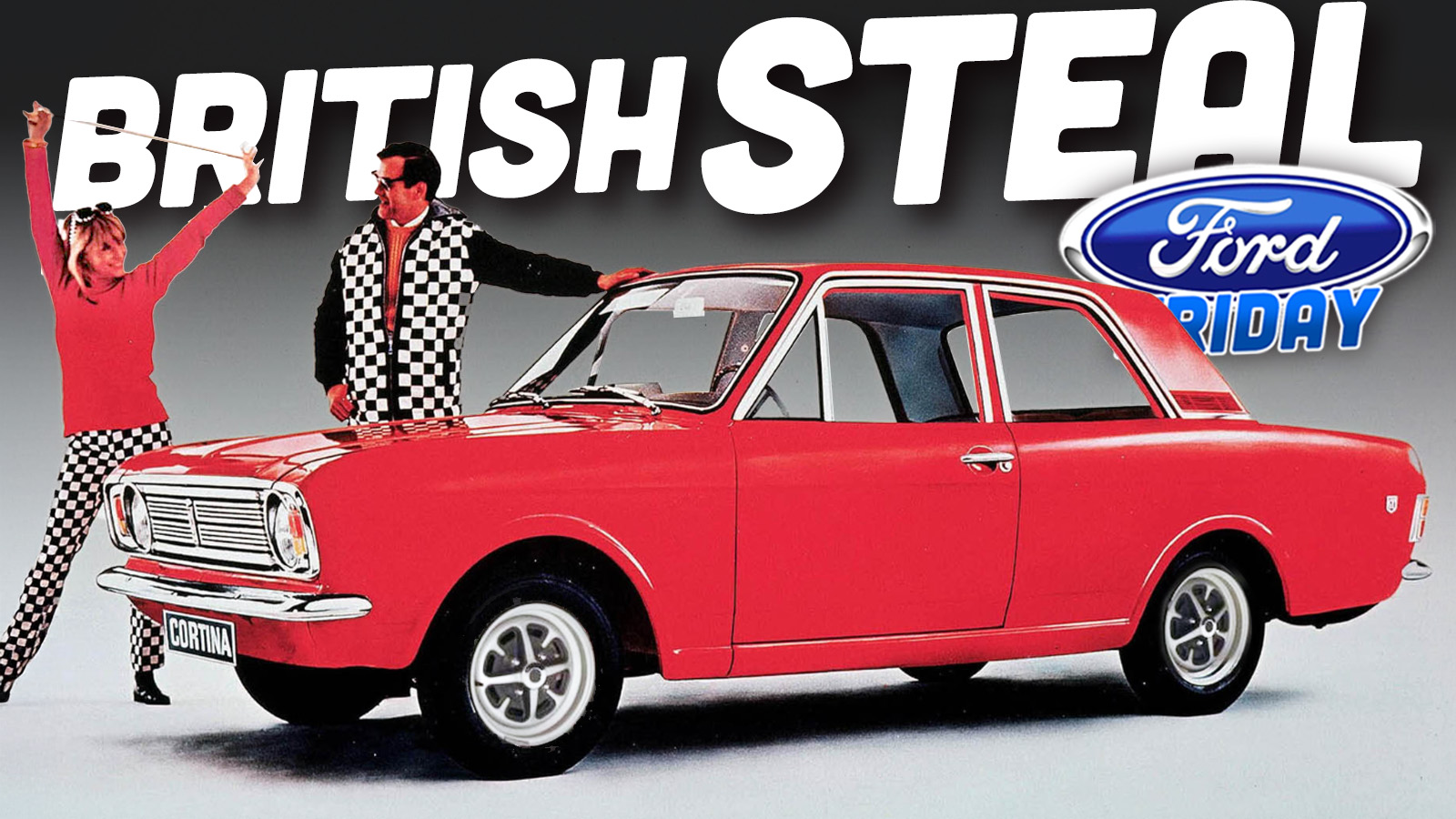
For over half a century, each of the Big Three American car makers have had European branches building products that were either competitive or even dominant in their markets. If you’re a business major, you’d naturally think that Ford, GM, and Chrysler could have easily just imported these things and kept their archrivals at bay on North American soil. Global domination, right? Wrong.
In reality, these under-the-same-umbrella imports were very much a hit-or-miss proposition; often, they were the more miss than hit even when all factors pointed to them being big successes. Ford had such a product in the late sixties that inexplicably bombed, and you’ve probably forgotten that it was ever sold here. Let’s revisit the second-generation Ford Cortina.


Also, The Merkur Name Was Dumb
Ford has had success over the years with products made by their divisions across the pond. The baby-Mustang Ford Capri was sold here in both Mark I and Mark II form, and for several years of its 1970-78 run, it was the second-best-selling imported car in the United States, right behind the VW Beetle.
The Fiesta was a decent seller as well, and I’ve written before about how this sprightly little car was one of the better cars offered at late seventies Ford dealerships (admittedly, a low bar).
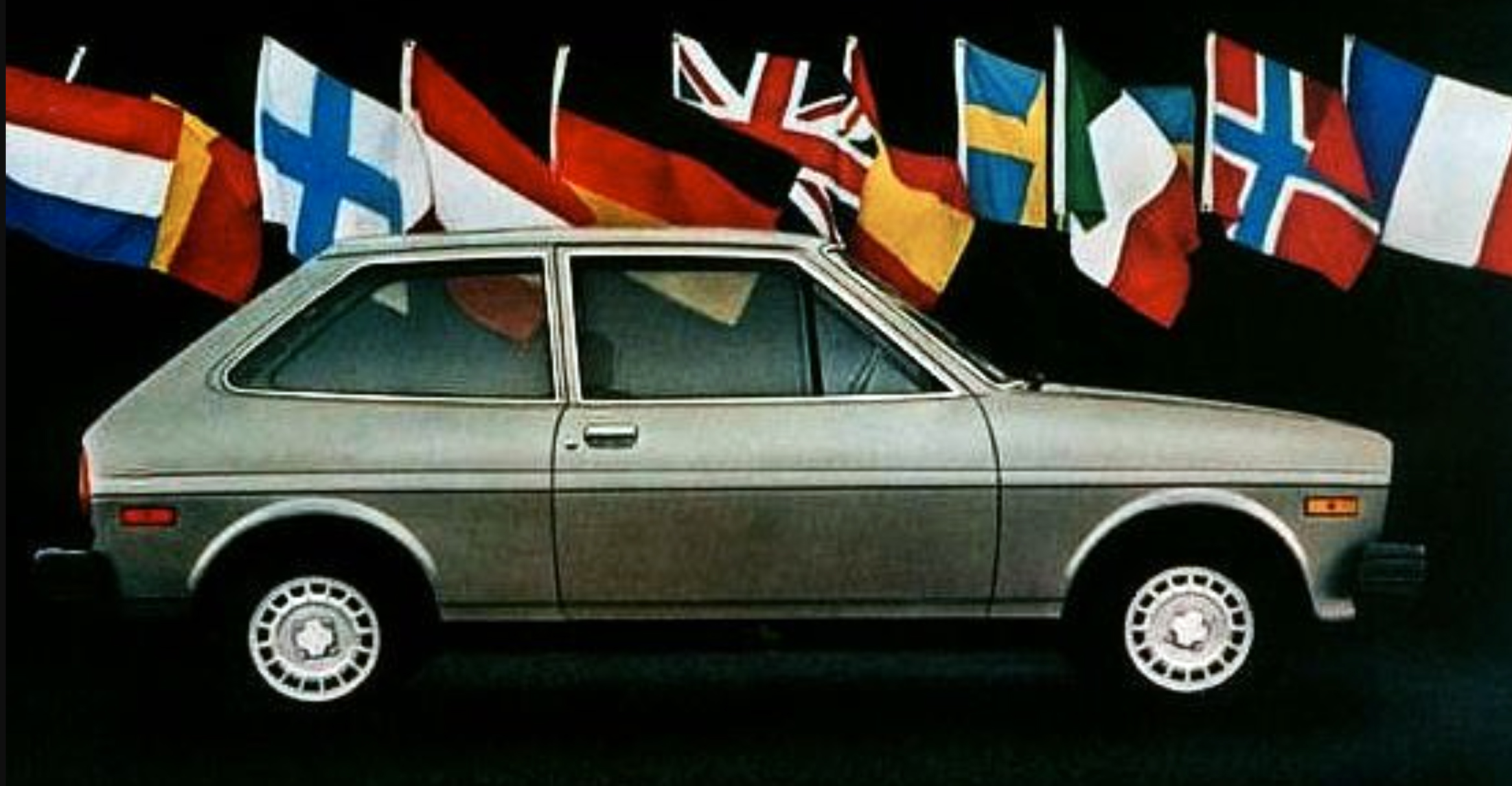
At the same time, Ford’s excellent Scorpio luxury sedan and cool Sierra XR4Ti seemed like they could have been left-field hits with late-eighties yuppies, but instead served mainly to keep the floor tiles secure at Lincoln-Mercury dealerships.

During the years it was built, the Ford Cortina was always near the top of the UK sales charts, if not at number one. A betting man would have put money on this small sedan succeeding in North America against other European rivals that had only a fraction of Ford’s dealer network. Well, it turned out that would have been a very bad bet.
From Dagenham To Detroit
In the years before stringent emissions and safety regulations, it seemed automakers could sell anything and everything with wheels in the North American market. Goggomobils and other strange machines could be hawked from gas station parking lots and the government really didn’t care, since only a few oddballs and cheapskates would buy those kinds of cars anyway. For a company like Ford, the Falcon was a “compact car,” and anything smaller wasn’t worth selling. Despite this, some dealers did offer a new compact from Ford’s European division (which was actually sold as a “mid-sized” car in Old Blighty).
Launched in 1962, the Cortina was actually styled by the person responsible for the Edsel, having been banished overseas after that car’s failure. While BMC (later British Leyland) was pushing the limits of car design with Mini-like front-drive and space-efficient designs on “Hydrolastic” suspensions, Ford went tried-and-true using a very basic design with a front four-cylinder engine driving a rear live axle on leaf springs. Despite being designed to be inexpensive for Ford to produce and consumers to buy, the Cortina was a good-looking, pleasant-driving car by the standards of the time, not a cheap-out.
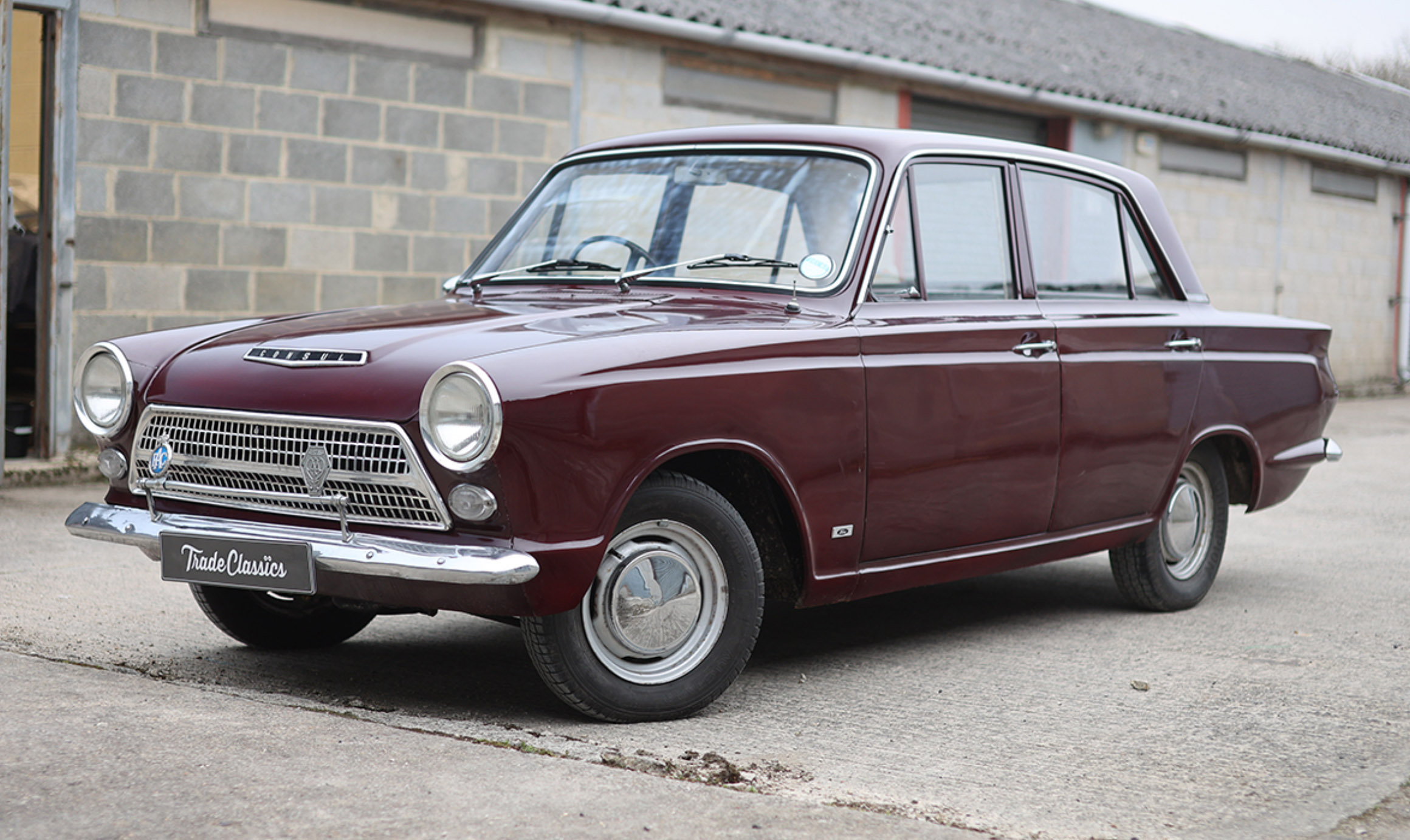

Ford even offered a version of the Cortina with a Lotus-modified twin-cam engine and heavily tweaked coil-spring suspension that got rave reviews and proved successful in racing, most famously driven by F1 great Jimmy Clark in touring car racing.

This first Cortina was sold in North America and actually became Canada’s second-best-selling import, but in the United States, most dealers and buyers didn’t know what to make of it. Introduced for 1964, dealers in the states only moved 4,100 Cortinas that year, eventually increasing to 7,932 sales by 1966.
By the late 1960s, however, American buyers were getting hip to the charms of small, economical European imports a notch or two below what the Big Three were offering as “compacts.” And Ford seemed to have just the car for the market.
Could 165,000 Brits Be Wrong?
For 1967, Ford of England launched the restyled Mark II Cortina, arguably one of the first truly “modern” looking British mainstream products. It would be hard to understate how important this car was for the UK and the excitement surrounding the upper models. Hell, even obnoxious, heartless Jezza almost breaks down crying when talking about it.
This Cortina seemed like the ideal car for American Ford stores to combat the rising import tide. Oddly enough, Ford marketing tried to pitch it as the Ford “Model C” to make it appear to be a revolutionary everyone’s car like the Models T and A from decades past.

Unlike a number of other compacts of the time, you could get a Cortina in anything from a two-door coupe to a four-door sedan and even a wagon with actual rear doors, unlike a Volkswagen Squareback or Opel Kadett.

The first 1967 American-market Cortinas looked virtually identical to the ones sold in the UK, but with the 1968 model year, the new NHTSA safety regulations kicked in requiring the Cortina to get side marker lights. For reasons that I don’t understand but am afraid to ask Jason lest we be here all day, giant domed amber turn signals were tacked onto the grille. They could have at least tried to make them look like fog lights or something. What is it with those things? The outer lights are all amber now, so why the extra Pep Boys-style lights?
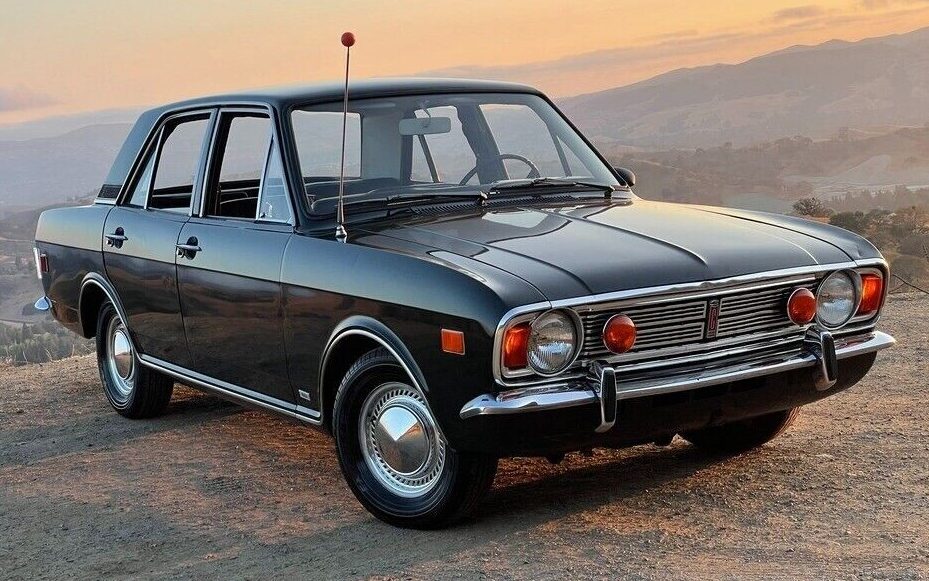
North American cars also got backup lights hanging off the rear bumper, and they all appear to have bumper guards.

By the way, I would very strongly not recommend driving your ’68 Cortina up to the wheel arches in salt water, as I will elaborate on a little later. What a strange brochure cover, implying that the cars were just tossed in the Atlantic and picked up around New Jersey.
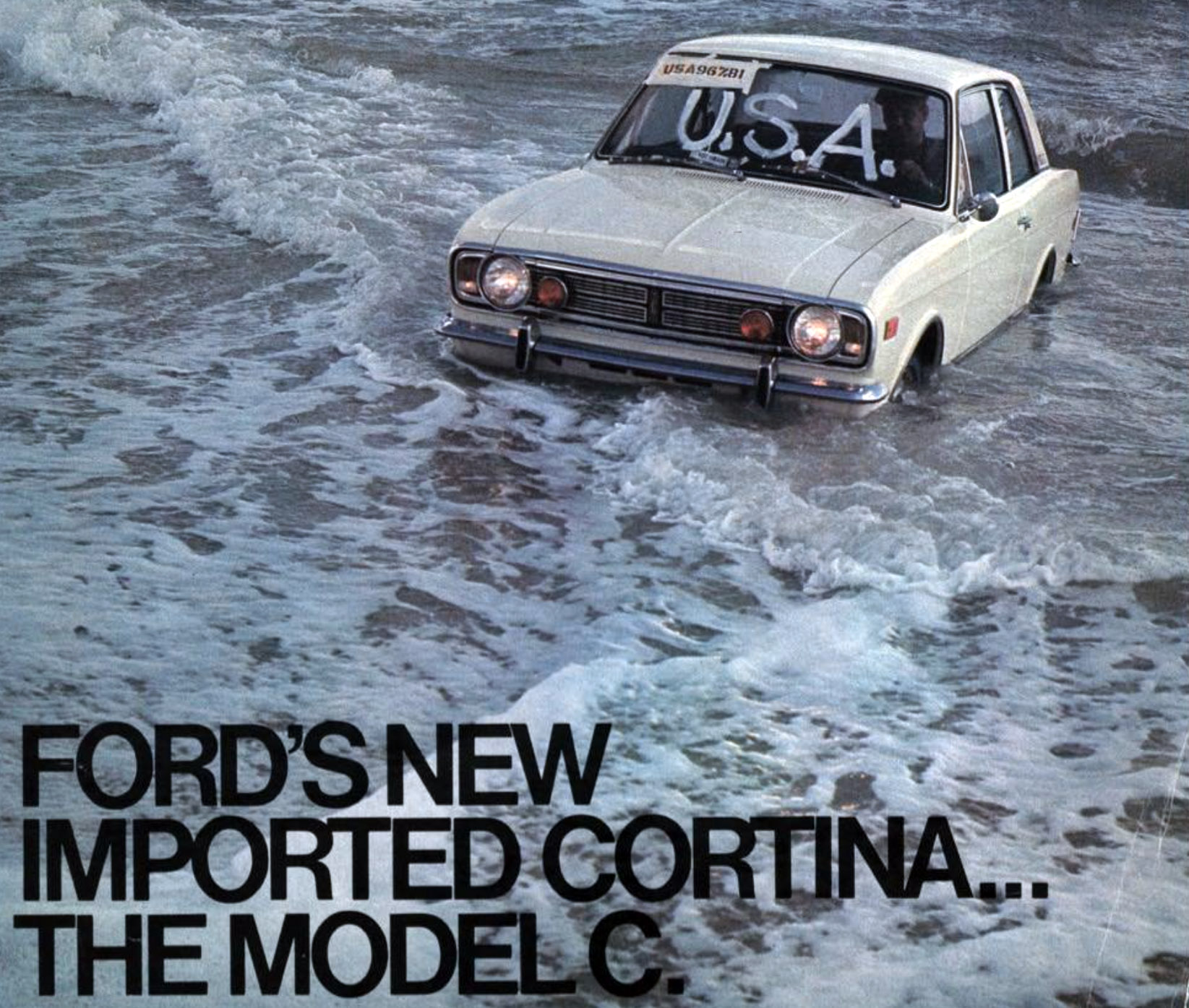
The boxy restyling of the Mark I model was quite contemporary and was more refined than close competitors like the BMW “Neue Klasse” 2002 or the Datsun 510. Now, despite the Cortina bearing a resemblance to the iconic BMW and Datsun, the little Ford couldn’t come close to matching those competitors in terms of refinement. The chassis was a modified version of the first-generation car that was hardly revolutionary when introduced in 1962. That’s not to say it wasn’t amusing to drive.
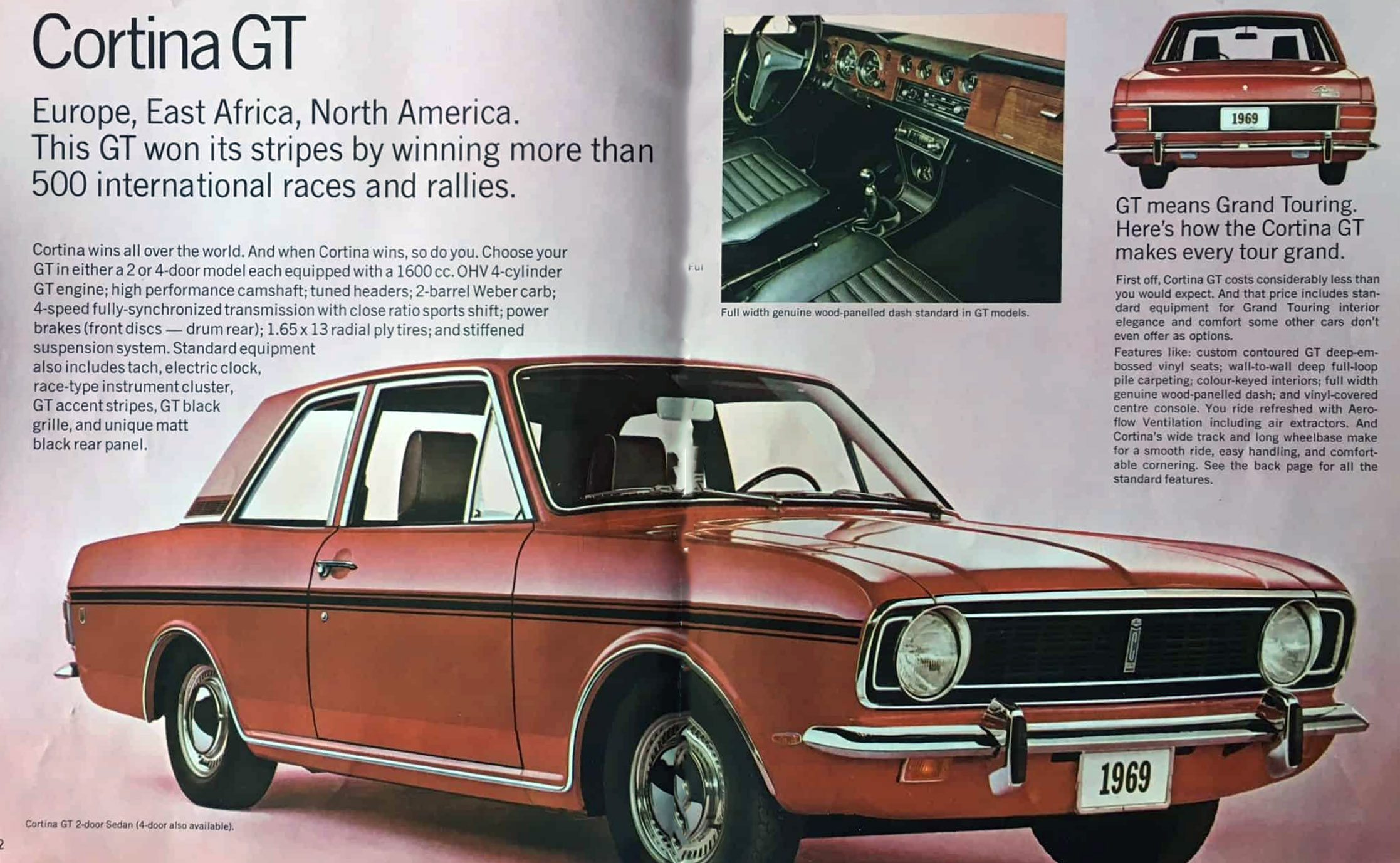
A 1968 Car and Driver test of the 1600 GT coupe version criticized the noisy engine and harsh ride that “hasn’t been traded for good handling” and “its cornering speeds are not what we would expect of a car with sporting flavor.” The magazine suggested more roll stiffness in the front suspension, and also mentioned that numerous aftermarket suppliers had the kit to make the thing into a “genuine pocket terror.”

Despite this, the GT version of the American Cortina had a two-barrel carb, higher compression ratio, and special exhaust manifold on the “Kent” 1600cc four. The engine’s 89 horsepower in a 2200-pound car created a car that Car and Driver said “feels tough, like a midget super stocker, so we treated it accordingly. It didn’t even flinch- it just kept coming back for more.” Zero to sixty in 12.2 seconds is laughable today, but it would beat any number of cars introduced a decade later in the teeth of the malaise era.
The interior is certainly quite sporting, with every gauge you can think of and even a console featuring a clock.

With the bigger marketing push, the new 1967 car more than doubled the earlier model with sales of 16,193 cars. Impressive, but still a far cry from the 165,000 sold in the UK that year, which made it the UK’s best-selling car. American dealers moved over 20,000 cars in each of the two years, before dropping off a cliff to around half that number for 1969. After a half-hearted 1970 model year, the Cortina disappeared from the United States. At least the 1969 model got rid of those odd extra turn signals in the grille and put them into the sheet metal below the bumper instead.
What caused the precipitous drop in sales? Well, I dread giving the pat, stereotypical answer, but sadly British Leyland wasn’t the only car maker perpetrating the stereotype of English cars from this era. The Dagenham-built Cortina suffered from quality issues as well as oil leaks and the dreaded electrical maladies immortalized by countless hackneyed jokes. Oh, and you thought that Datsun 510 and BMW 2002 rusted out in showrooms? They had nothing on the Cortina’s ability to rot its floors, sills, and front-clip sheet metal. It would seem those who bought Cortinas from Ford’s vast dealer network didn’t come back for a second one after their less-than-spectacular experience with their first.
Canada, however, didn’t give up on the small English Ford, and things got very weird.
Remember, They Bought Ladas Up There, Too
For 1971, Ford introduced the rather “Detroitized” Mark III Cortina with “Coke bottle” styling that was reminiscent of a shrunken-down Mercury Montego. Four inches wider than before and with a new all-coil suspension system, a larger two-liter was available as well.
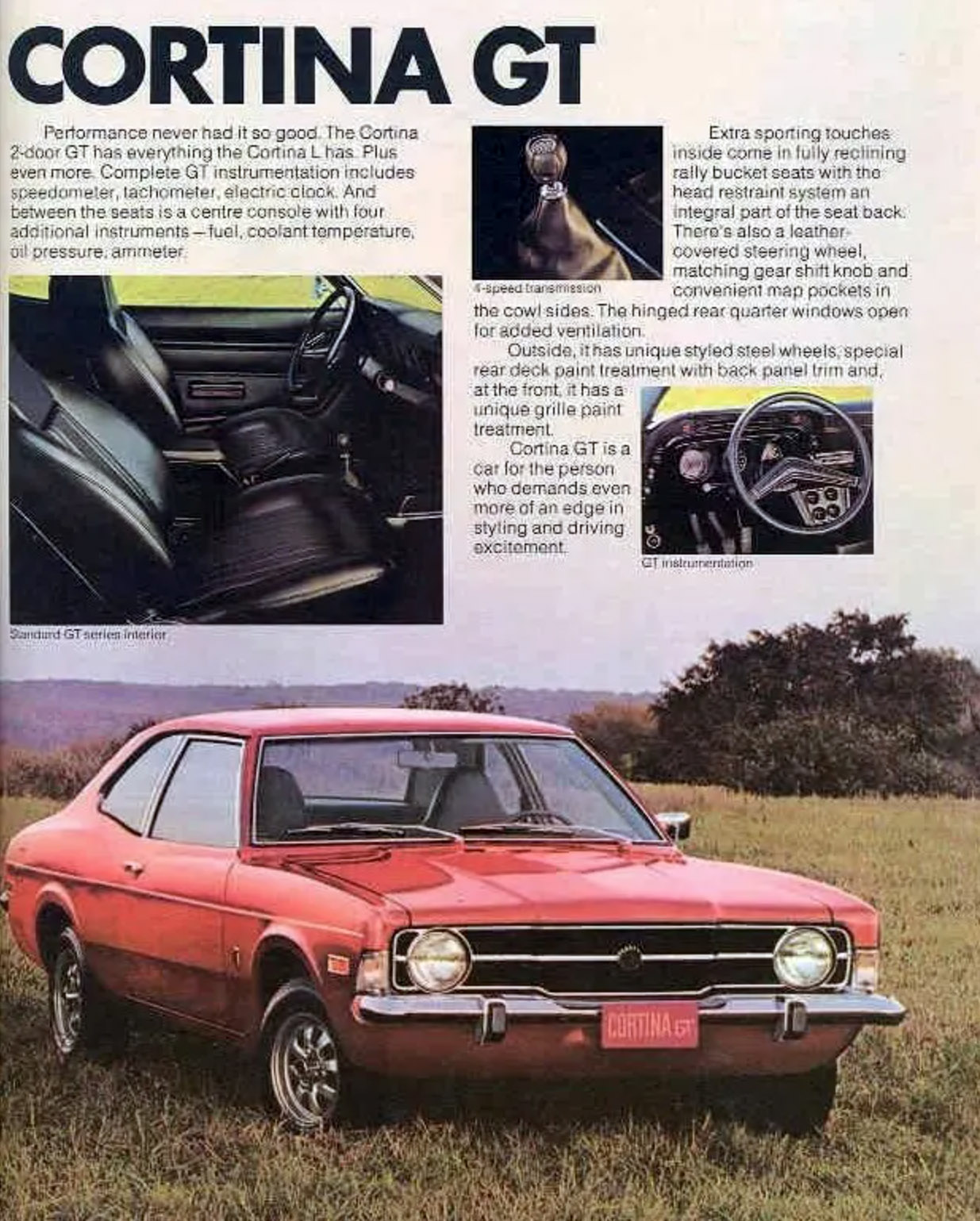
As a bigger and heavier car, you’d think it might have been a great fit for America, and at least Canada decided to give it a shot. Reportedly, around 12,000 were sold in 1972.

One very odd find in my research: this picture circulating from the Ford archives shows the nearly-identical German Taunus version of the Cortina wagon with Canada-spec marker lights and a CAPRI license plate. The car even has the same “Rostyle” wheels as the little mini-Mustang Capri. What in God’s name is this?
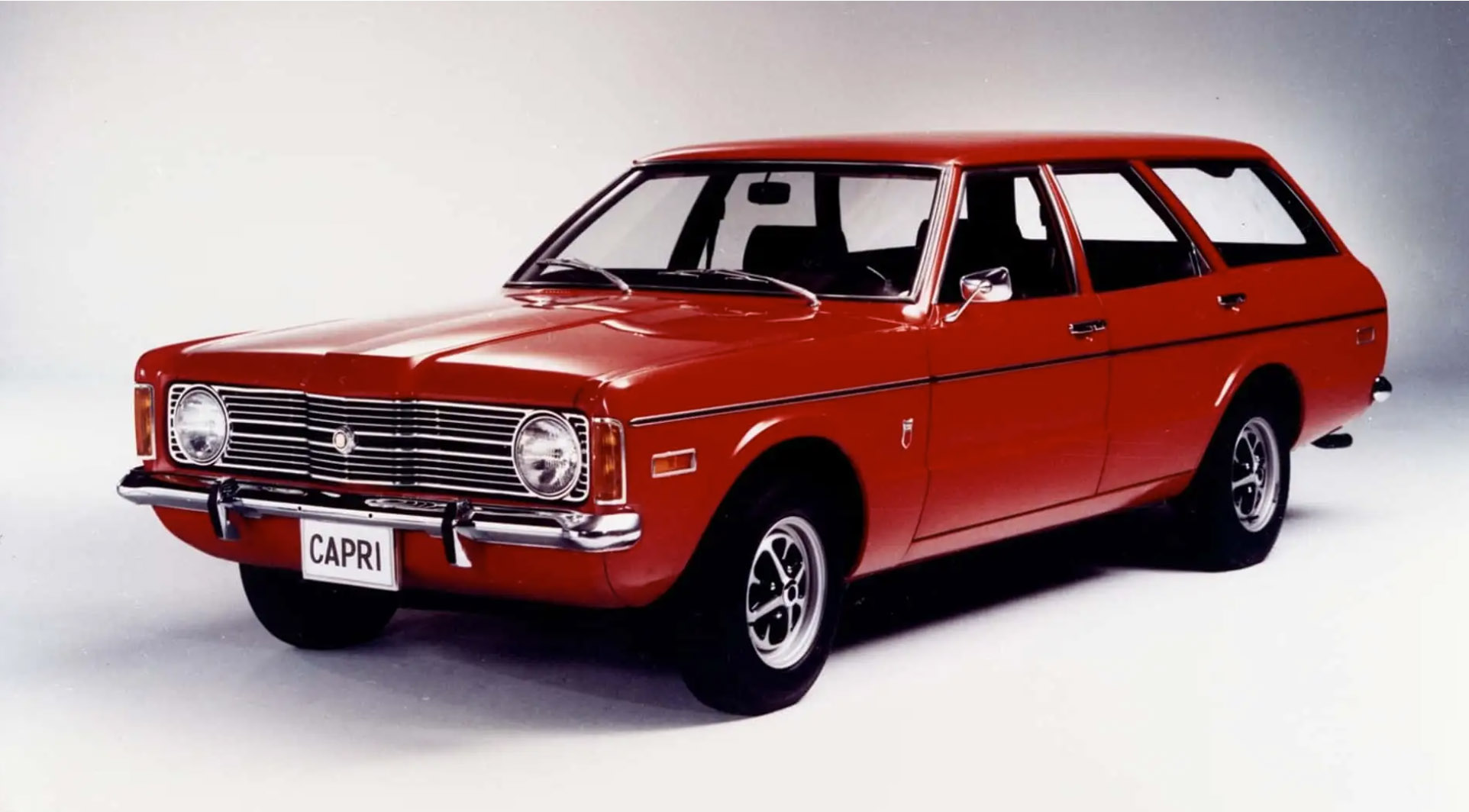
My only guess is that Ford of Canada decided to drop the Cortina but might have still wanted a small wagon to complement the Ford Maverick (that had no wagon version) and decided to import the better-built (sorry) German version to sell alongside the (also German-built) Capri coupe. I see no evidence of this thing existing other than this image, so it might have been a failed proposal. If you have any information, please spill the beans in the comments.

The Mark III Cortina ceased to be imported to Canada after 1973, ending yet another exercise in North American auto giants bringing in what should have been sure-fire hits from their foreign divisions. More proof, if you even need it, that a “World Car” is a hard thing to build.
You’d Rather Be Tailgated In The Cortina Than The Pinto, Right?
Ultimately, what did the Cortina in was not quality and reliability issues, but the same thing that killed the later US-market Fiesta. Just as that little hatchback was made redundant by the launch of the 1981 Escort, the Cortina was pushed aside by the Escort’s predecessor: the much-maligned 1971 Pinto and the Mercury Bobcat twin in Canada.
Please don’t make me say that’s like going from the frying pan into the fire.
Top graphic image: Ford





In the in-tray lots of work
But the boss at the firm always thinks he shirks
But he’s just like everyone
He got a Ford Cortina that just won’t run without fuel
Came for the Clash lyrics. Not disappointed.
The text mentions Jimmy Clark racing a Lotus Cortina – I expect that’s supposed to be him in the 101 in the ‘World Beater’ ad (dark helmet, white visor, bandana).
What’s with the laughing clown in the World Beater ad????? Who is he laughing at?!?
I thought he was not yawning, which is admittedly not better
I think ad execs in the ’60s were all drunk. Or high. Or both.
Sure is creepy – maybe its a mime? (even worse)
God I’d completely forgotten what a MK2 Cortina looked like. It’s been so long since I’ve seen one, and they just don’t stand out like the MK1 or the MK3. If it wasn’t in an article about Ford Cortinas, and I’d just glanced at the pic, I’d have assumed it was some kind of Hillman.
I think a combination of poor timing, and lack of dealer interest. Why sell this FLIMSY LIL EURO BOX when you could sell a Mustang? On the timing side, this was pre-oil crisis. Maybe would have been good to keep it around a few more years?
Man, that Cortina/Capri wagon looks like a baby Gran Torino. I dig it, so hopefully someone comes forth with more info.
I love the Cortina for being DCI Gene Hunt’s car of choice for blasting dangerously around the streets of Manchester in Life on Mars. Produced a similar yet distinctly British vibe to that of Starsky’s Gran Torino.
Loved Life on Mars and Ashes to Ashes. Big fan of Keeley Hawes.
Here is an article, with photos of contemporary MKIII Cortinas in Canada https://www.curbsideclassic.com/curbside-classics/they-sold-what-here-1973-ford-cortina-mkiii-in-canada/
As poorly built as these were, I would still love a Lotus Cortina. It is right there with the Nissan 510 and BMW 2002 as quirky classic cars I would love to own.
Some more fun facts:
Not all Mk 1 Ford Cortina Lotus cars had the A-Bracket coil-spring rear suspension; later Mk 1s (and all Mk 2s) reverted to the standard leaf springs. Mk 1 vehicle assembly was finished at the Lotus factory.
The only difference between the Mk 2 GT 2-door and the Mk 2 Ford Cortina Lotus is the Lotus-Ford Twincam engine. Mk 2 cars were built entirely on Ford assembly lines.
We had to share lockers when I was in high school. My locker-mate lived a couple of blocks away from us. I rode my bike over to his house one day after school and in their driveway sat a first gen Lotus Cortina. Turned out he autocrossed it every weekend he got the chance. It was a lot of fun tagging along. His dad DD’d a more pedestrian 1 G Cortina.
If Miguel Cortina over at Motor Trend ever has a daughter, it would criminal not to name her Lotus.
Pete, nice Judas Priest reference. I’d like to see the alternate-world Adrian version, wherein every section ties into the almost tailor-made tracklist:
Rapid Fire
Metal Gods
Breaking the Law
Grinder
United
You Don’t Have to Be Old to Be Wise
Living After Midnight
The Rage
Steeler
Yet as awful a failure as was the Ford Cortina – it was the basis for the successful Pinto.
Americans are weird.
How’d you get all the way through this article and not make a click-baity tie-in with the ongoing Milan Cortina Olympic Games?
All of the cars from that era had that issue. Zero rust protection. They were built to a certain price point…to be as cheap as possible.
I had a ’68 510 and being out in CA, rust wasn’t a big problem. That car’s biggest problem was that it was a wagon and didn’t have IRS. So, not as fun as it could have been but very practical. It was capable of holding and transporting all my worldly goods through college and a couple of years beyond.
I wanna be your Ford Cortina
I will never rust…
Apparently that was a lie.
In 1967, I went with my dad to the Ford dealer in Huntington Beach, CA to look at a four-door Cortina to serve as a second family car. I loved the Cortina (we had previously owned a 1963 Ford Anglia that we bought for $50 from a family that was moving and they just couldn’t sell it), and spent hours looking at the extensive options catalog–you could even buy a heater/defroster delete if you ordered the car in Hawaii. Alas, the price was too high on the Cortina, so no purchase.
I’ve always loved how Range Rover ripped off the Cortina MkII (estate) roof, right down to the side vent placement, but painted it black (or was it vinyl?) so not everybody would notice. But it worked very well on both cars! 🙂
That red ’71 MarkIII looks an awful lot like a mid ’70s Chevy Nova coupe.
Couple related facts:
Until 1965 (or so) “English Ford” was a separate franchise from “Ford”. A Ford dealer could choose to also get an “English Ford” franchise, or not. Anybody else who wanted an “English Ford” franchise could get one as well. Quite a few dealerships that sold other British marques also got “English Ford” franchises.
English Fords (and other captive British imports, like Vauxhall) sold better in Canada than the US because Canada was still a British territory until 1967(?) and there were not tariffs or other import restrictions up north, and because the anti-foreign car sentiment in the US wasn’t as prevalent in Canada, and on some level, British cars weren’t “foreign” at all.
Merkur was a bust not because they were bad cars, but because currency fluctuations in the era were brutal on anyone selling European cars. Volvo, SAAB, and BMW were forced to become “Yuppiemobiles” or fail, and Peugeot just gave up on the US because they couldn’t compete on price.
The Peugeot 505 did fairly well – it stood up well in the Yuppiemobile era due to the high-quality interior and Pininfarina styling.
Then the 405 came out in ’87 – which looked okay outside, thanks again to Pininfarina – but the interior looked and felt as cheap as a Nissan.
According to some US sales figures I found here, Peugeot never sold more than 20,000 units per year. Or approximately the number of Ford F-Series trucks sold on a decent Saturday.
Maybe if they would have offered it with a V6 here, it might have stood a fighting chance. People in the 60’s in the USA were well averse to 4-cyls.
There were several V6 models in Europe, usually with the Essex 3.0 engine. Ford Australia also built a straight 6 version of the Mk4 Cortina. I think it was the same 4.1l engine they used in the Falcon. Not sure if it was ever sold outside Australia and NZ, and not a big seller because most buyers preferred the bigger Falcon. Pretty collectible now.
I for one would love a Cortina with a 4 litre straight six.
A friend had a bunch of MK3 Cortinas, including one imported from South Africa that had the Kent 1600 motor. Most of the Australian models had the 2 litre OHC Pinto motor or the 3.3 or 4.1 litre six out of the Ford Falcon and a Borg Warner transmission – his favourite Cortina came from the factory with a 4.1 six backed by a Toploader 4 speed, and he ended up finding and fitting a 2V head, which was a factory option in Falcons. The original heads had a built-in ‘log’ style manifold, which restricted flow, and the 2V head used a separate alloy manifold – he fitted a 4 barrel carb and a Mr Gasket ‘Bug Catcher’ scoop sticking through the bonnet, which looked odd because of the extreme offset due to hanging off the side of a an inline six.
My dad came home from work one night with a new red 1968 Cortina like the one in the lead image (trading his ’62 VW Beetle), but it was the basiest of base so with none of the chrome trim (or all of those gauges), (or a radio). It did not have those auxiliary amber lights, btw. We lived in the region with the highest foreign car ownership, the SF Bay Area. I learned to drive stick on the car and occasionally was allowed to drive it with my friends.
Those skinny bias ply tires understeered like crazy. The red paint oxidized within months. After driving for a while, when shutting off the ignition it would Diesel (run on) for 20 seconds, backwards, with smoke coming out of the air cleaner. He had it for 6 years and traded it for a Pinto.
In 1972 I bought a new Fiat 128 which, believe it or not, was light years better in every way.
The 128 had a high-spinning SOHC, where the others were running tractor engines.
Yes, I know. I still have the X1/9 I bought in ’74.
Ooooh! A small-bumper X1/9!
American car manufactures will do anything they can think of except focus on quality.
That’s why it sold so well in the UK
Normally I’d agree but the Cortina wasn’t any better.
Just to be That Guy about microcars, it’s Goggomobil.
Just to be That Guy about BMC/BL/etc. suspensions, Hydragas didn’t come along until 1973. In the era under discussion the rather different Hydrolastic system was used.
Go ahead, be That Guy. You’d better be right since I changed it for you. Thanks!
You’re welcome! I’m pretty sure I’m right about all of that except the bit about calling the Hydrolastic and Hydragas systems “rather different.” I get the impression that most people who have been around both would consider that to be either a wild overstatement or a wild understatement. I’ve only owned and worked on the latter so I’m just going with my half-informed opinion here.
I got up and strolled over
Past a great big potted verbena
I asked the guy
Why he won’t try
A funky Ford Cortina
Great, now that song and the samples used in it (Foreigner’s “Hot Blooded” and BTO’s “Ain’t Seen Nothing Yet”) are stuck in my head.
I’m here to help 😀
Alternate version:
I got up and drove over
To a dealership in Gardena
I asked the guy
Why I can’t buy
A sporty Ford Cortina
(Fun fact: not a lot of words rhyme with Cortina)
Not even Patina, though close