

You know what’s great? A regular ol’ hybrid. You know why a hybrid is great? There are virtually no downsides other than a little extra cost, which, depending on what you drove before, you’ll potentially get back in fuel savings. It’s a true win-win-win situation. November car sales are coming in and, as expected, it’s going to be a meh month. However, it’ll also be a month where hybrids likely surge.
So that The Morning Dump isn’t entirely fixated on hybrids this morning, I’ll talk a little bit about Tesla and how one famous investor thinks the brand is overvalued, and I think he makes some good points. Because Tesla news tends to mess with the vibes around here, I’m going to end on something way more positive and important: Škoda!


Hybrids Rule In November Sales So Far

Because so many automakers don’t report sales monthly anymore, I’ll have to read into the data I do have. So far, though, the data strongly suggests the predicted fall in electric vehicle sales and the disproportionate rise in hybrids.
On a long enough time scale, sure, I think electric vehicles will recover from this credit-fueled rise and fall in sales. For the near- and medium-term, I think it’s all hybrids, all the way down.
At Hyundai, sales in the United States were down slightly to a 2% decrease, due in part to a cratering of EV sales. The flipside? Hybrid sales were up 42%
“Hyundai’s November sales highlighted the strength of our SUV lineup, with Tucson, Santa Fe, and the all-new Palisade each posting double-digit growth,” said Randy Parker, president and CEO, Hyundai Motor North America. “Hybrid demand remains strong, and we set a new all-time monthly record for hybrid vehicle sales. Through the first 11 months of the year, we’re on a record pace and fully expect to go ‘5 for 5 in 2025,’ achieving record annual retail sales for the fifth consecutive year.”
Sales were up 7% at Kia, setting a November record.
“As consumer demand shifts, Kia’s diverse product lineup and growing hybrid portfolio has us on the verge of our third consecutive annual sales record,” said Eric Watson, vice president, sales operations, Kia America. “At the recent Los Angeles Auto Show, we unveiled the second-generation Telluride SUV featuring a more upscale design, an enhanced X-Pro model for improved off-road capability, and an all-new hybrid variant. Interest in the all-new Telluride is expanding beyond our current customer base, and we expect this positive momentum to carry into next year.”
And the same is happening at Ford, where EV sales took a Chauncey Billups and dove by nearly 61%, while hybrids rose 13.6%. It’s all happening.
The ‘Big Short’ Guy Says Elon’s ‘Cult’ Company Is ‘Ridiculously Overvalued’

You only have to be right in a really big way once, and then people will, to some degree, listen to you forever. It’s a sweet gig, and definitely something I’m trying to do with this decade of the hybrid nonsense and all the Carlos Tavares stuff. I don’t want to be correct all the time and, frankly, I am not capable of it Just give me one, maybe 1.5 times, and I’ll milk it until I shuffle loose this mortal coil.
Michal Burry became famous for predicting the fall of the Mortgage Backed Securities (MBS) market, and Christian Bale even played him in a movie about it. He has not been correct about everything, or at least, the scale of time hasn’t been long enough for his predictions to always net out in his favor.
He’s got a post over on his Substack about what he sees as irrational exuberance over Tesla. It’s paywalled, but Business Insider got the good bits:
“Tesla’s market capitalization is ridiculously overvalued today and has been for a good long time,” Burry wrote, adding that he expects Musk’s $1 trillion dollar pay package to continue to dilute the company’s shares.
“As an aside, the Elon cult was all-in on electric cars until competition showed up, then all-in on autonomous driving until competition showed up, and now is all-in on robots — until competition shows up,” the legendary investor said.
It’s not an unfair point, but the market is not always about fundamentals, so it’s possible that Musk’s showmanship continues forever and people keep buying it forever, which makes betting against Musk a dangerous game to play.
Czech Out This Sweet Škoda 100
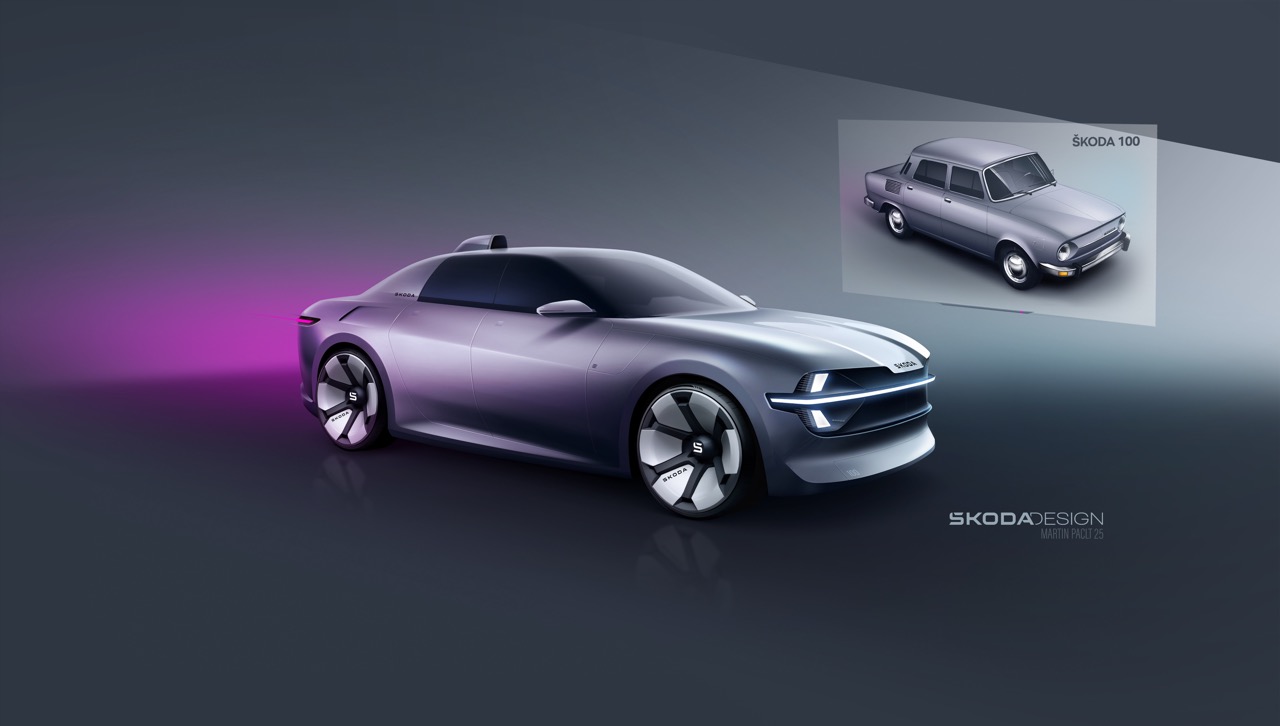
Škoda has a long and rich history of making cars that goes back 100 years, so the brand has been reaching into its archives and teasing us with reimaginings of various historic products. Today, it’s the 100.
The design study was developed by Škoda exterior designer Martin Paclt, and transforms the beloved 1960s original with contemporary proportions, clean surfacing and the brand’s Modern Solid design principles – offering a glimpse of how an icon could look in the 21st century. Admired at the time for its straightforward engineering, reliability and personality, the 100 remains a defining model in Škoda’s story and a long-standing favourite among classic-car fans.
From the beginning of the project, Paclt set out to avoid a retro-themed replica. Instead, the focus was on retaining the core spirit of the original through its overall stance, silhouette and character. The result is a contemporary saloon defined by elegant, uninterrupted surfaces and generous volumes that echo the simplicity of the classic model.
Cool.
What I’m Listening To While Writing TMD
Y’all seen the show Slow Horses? It’s on Apple TV, and it’s great. The theme is “Strange Game” by Mick Jagger, and it’s dark and weird. Perfect for the moment.
The Big Question
Pick the years: The year hybrids outsell ICE cars in the United States, and the year EVs outsell hybrids.
Top photo: Toyota; DepositPhotos.com




Slow Horses is terrific.
Can somebody who knows sportsball explain this?
> EV sales took a Chauncey Billups
Go Sports!
https://m.youtube.com/watch?v=XGbqGkS1c2w&pp=ygUPd2VpcmQgYWwgc3BvcnRz
Weird Al explains Sports!
Battery cars peaked a century ago when steam ruled the roads.
This makes zero sense to me. EV drivetrains are significantly less complicated than hybrids. I’ve owned 3 EVs in the last 9 years and the only maintenance ever needed was new tires. I wonder if the EV issues recorded are more around quirks with the typically more ambitious software stack?
In the US range=freedom. That’s it, that’s all. BEVs represent an unnecessary constraint on potential freedom of mobility, nevermind a large segment of the population never travels far enough for it to matter.
I’m not sure what vehicles you’re basing this off of, but at least on the EVs I’m working on professionally, there’s way more complexity than any hybrid I’ve worked on. The HVAC systems are a nightmare, since so many components are liquid cooled. Battery pack, power unit(s), inverter, charge port, HV-LV converter, charging module, and the list goes on.
Also, if you’re basing your experience on 3 vehicles, each owned for 3 years, assuming they were bought/leased new, it’s not shocking to have effectively zero maintenance in that time frame. Problems show up at the 5+ year mark, when suspension, cooling loop, and electrical problems start showing up.
Software, plus maturity (pure EVs are relatively new for most brands, and some of the designs ended up a bit rushed). Manufacturers have had something like a century of refinement put into ICE drivetrains, so they already know all the ways they can break. EV’s simpler, but they bring new failure modes.
There’s also a brand bias based on sales numbers. Toyota sells a lot of hybrids, and their hybrid drivetrain is super reliable. Tesla has historically sold the most EVs, especially prior to the last 3-4 years, and they’re, well, Tesla.
What’s with the little roof scoop on the Škoda? Is it functional? If so, what is its function?
And sure, if I ever buy another vehicle, it will be a hybrid. Maybe a PHEV.
Hold on, taking a slow cautious approach to new technology that requires a new slow to build infrastructure to support turned out to be the right call? Weird.
So much for all the MBAs and Business Analysts slamming Toyota for the last 3-5 years for not adopting EVs faster.
“There are virtually no downsides”…. unless, of course, you are at least reasonably intelligent and equally well informed, in which case you might think ‘just carrying on burning fossil fuels’ and continuing to wreck the entire planet’s environment is (actually) quite a significant ‘downside’. Meanwhile, some actual science based research shows that hybrids are some *139 times* more likely to catch fire than EVs (https://www.fleetnews.co.uk/news/tusker-fleet-data-reveals-the-truth-about-ev-fires).
On top of that you had Toyota, king of the hybrids (arguably), basing its advertising for their various Hybrid vehicles on the utterly cynically fraudulent notion that their hybrids, (at least) were ‘self-charging’ and ‘ no need to wait for them to charge up’ implying that the energy to drive them came from… pixie dust?! Most sensible countries have seen through this silliness (on behalf of their patently completely gormless populations) and have banned such advertising outright (e.g.Germany).
But, yeah, other than all that, nothing wrong with hybrids at all!
The energy to power hybrids does indeed come from dust – brake dust. Or rather the lack of it. I’m on my second hybrid now, and you know what I never have to do? Clean my wheels of brake dust, because there isn’t any.
The only purpose of battery powered vehicles, past bicycles, is to strip wealth and control from those that can’t make decisions for the rest of society.
How long will people be fooled?
“Clocks around the world are ticking”
2031
2037
I’ll try “Slow Horses” as soon as one of my wife’s Apple products (three at last count) need replacing.
Could they put more battery in the hybrids? Double the current (heh-heh) amount should do for now.
Wife’s keeps topping off when I go down the smallest of hills, which means I’m wasting all that potential energy.
I suspect “a little bit more” is a bit of an awkward middle ground. You can go denser with lithium instead of NiMH, but then you might as well just make it a plug-in hybrid.
Hybrids outsell ice by 2028, EVs don’t surpass hybrids till 2040.
I just know that VW has been waiting for my advice: So here goes: Take VW back to the peoples car and make money on volume. Bring us Skoda for all their cool midrange stuff and Seat for lower priced sport. You already have Audi, Lambo, Porsche and Bentley for the upper stratospheres. We want polos and golfs and Jettas, and lots of Skoda’s
I’d like a return to a cheaper/fun GTI. Ditch the turbo, give me a good 1.8/2 liter engine and manual transmission and I’m there. I owned 2, and while they weren’t the fastest cars in the world they were great fun and easy to maintain.
I had the 84 GTI and loved it too. It’s never about 0 to 60. It’s about good roads, curves and blacktop. My throwback car to that era is an 86 Cabriolet.
Absolutely fantastic show, Slow Horses
“Forever” is a looooong time.
From the moment the original Prius went on sale in 1997, skeptics have been fretting about hybrid reliability, battery life, unproven tech, etc. Seventeen years after the last 2nd-gen Prius rolled off the line, the comment sections are still full of people doubting the technology, even though tons of those early cars are still puttering along just fine.
I think it’s time to find something else to worry about.
This
In fairness, something like half of them have decided that actually, hybrids are the best bulwark against EVs, which are terrible because they apparently take an hour to charge, only go 100 miles, and need a new battery every 5 years.
Shortest TMD to date?
It’ll be a great Exhaust Leaks next week, potentially.
Oh you tease!
Honestly I was imagining and empathizing how manically busy you must be in the moment. You are rightfully earnestly proud of your product so I’m assuming, indeed possibly incorrectly, that you are absolutely getting hammered with other tasks today to publish such pithiness. You are one of my most respected people on the planet (seriously) so I always want life to be going well for you and thus notice any apparent deviations.
So next time I give you what seems like shit, it may actually be poorly phrased commiseration.
I mean, we all agree that Tesla is ridiculously overvalued, right? Even politics aside (which are of course a big contributor, as Elon has single-handedly destroyed any brand good-will Tesla may have had), what do they have? An aging model line-up, questionably build quality, a monster truck that no-one wants, and they can’t see in huge parts of the world, and a charger network that is no longer the advantage that it once was.
Meh.
And they may be upgrading the camera suite yet again…
As if cameras were enough. Which they are of course not.
Preach! The camera only choice was basically criminal negligence in my mind.
Don’t forget the vaporware robots! LOL.
Bless their hearts. That’s all I’ve got at this point.
{ taps the “Tesla needs an adult” sign } It’s a company that’s clearly capable of making good things when it tries, but good grief, it needs leadership who will stop overpromising and underdelivering all the time with new products and who can focus on what the company actually does: make cars. If Elon wants a human-controlled robot company, he should spin off and do his robot-themed ventriloquist schtick in a new company, but that’s not what Tesla does.
“The ‘Big Short’ Guy Says Elon’s ‘Cult’ Company Is ‘Ridiculously Overvalued’”
Anyone with a basic understanding of stock investing, stock valuations and basic understanding of accounting and reading financial statements (myself included) could have told you that.
And speaking of stock picks… if you asked me what stocks to put money into… it’s Coinbase and NVidia right now. And if you want to invest in automotive, for ‘the next Tesla’ with the most upside potential, I’d suggest Rivian shares. Or if you want something stable, Toyota or Ferrari.
“Pick the years: The year hybrids outsell ICE cars in the United States, and the year EVs outsell hybrids.”
That depends on which market you are speaking of or globally.
If you’re talking about China, EVs already outsell ICE vehicles right now.
And globally, EVs have been outselling hybrids for years.
And if we are talking about North America, I predict EVs will outsell ICE vehicles by 2045.
And it’s hard to predict hybrids because of the range of mild hybrids to plug-in hybrids. At some point, hybrids will become the default ‘automatic’ ICE vehicle. I’d take a modern Toyota style hybrid transmission over modern 8-10 speed automatics any day as the power delivery is way smoother and the real-world fuel economy better.
But I can tell you that BEV tech will keep getting better and cheaper and eventually it will be a no-brainer to buy a BEV for most people. The people buying the ICE and hybrids will eventually become the exception and not the norm.
The last ADAC “Pannenstatistik” didn’t paint such a rosy picture of hybrid Toyotas.
I simply don’t see how hybrids can be MORE reliable than EVs or ICE since they are more complicated than both. And not just a little more complicated, they are a lot more complicated than them.
Don’t get me wrong, I think hybrids are the best long-term solution for many buyers, but this has to be some kind of statistical fluke based on the fact that Toyota makes most hybrids and they consider them their crown jewels so there hasn’t been as much enshitification down to that drivetrain compared to others.
I always had the same feeling until I learned how Toyota’s hybrids work. In that case, the electric motors and battery completely replace the multi-ratio transmission. Honda’s system is similar. Add in how the Toyota/Honda hybrids use naturally aspirated engines on the Atkinson cycle instead of the high-strung turbo engines used in a lot of modern pure ICE models and you have another layer of reduced complexity.
That said, this is obviously not the case for all hybrids. A lot of the systems out there take a turbo engine with an 8 speed auto and then add electric motors and batteries on top of that.
Overall I think these reliability rankings lean too heavily on the new car ownership experience and not long-term reliability of the drivetrain. Which makes sense when their target audience is people who buy a new car every couple of years and just don’t want it in the shop frequently, but this method doesn’t really give you a picture of what reliability at 200k miles will be.
Thanks for that info. That does indeed make sense, and as you stated, not the case for all hybrids. I think if the hybrid market had more manufacturers, it would not show up to be more reliable since their systems won’t be as tightly integrated as the Toyota system. It does seem like hybrids will be the new hotness for the industry, so I think most cars will has some level of hybridization within 5 to 10 years. No way is that reliability level going to stay as high as it is now.
I think there are some risks of serious pitfalls, too.
Hyundai/Kia’s current lineup is really compelling, and I can see how a Telluride, Carnival, or Palisade getting 35mpg could be a smash hit with typical consumers. But I worry they’ll sell a bunch then face failures similar to their Theta engines and it will give a black eye to hybrids overall since most people don’t know the difference.
Or maybe that will loosen up the demand for Toyota hybrids and I’ll finally get a good deal on one, lol.
we have a Niro, rock solid so far, and this engine is used in a ton of Hyndai/Kia’s tho I bet the turbo versions might be less reliable.
My dad had an ’04 Elantra GT that currently has 300k miles in the hands of one of my cousins. That was a good little car and inspired some Hyundai brand loyalty in the family even before they upped their styling and materials game.
I like the Niro and some of the EVs, but am currently only in the market for a family hauler. I want to keep my daily as a manual for as long as possible which has eliminated any hybrid or EV options in the small car space.
makes complete sense! I miss my 6MT Veloster but we needed one car with a auto living in the city
What 4moremazdas said. ^^^
The eCVT, used by Toyota and Ford, is a big ol’ planetary gear set with a couple of electric motors. No clutches or bands or belts to wear out, way fewer moving parts than most multi-speed automatics. Add on the low-stress Atkinson cycle engine, and remember that batteries and controllers are pretty trouble-free, and a hybrid is a pretty simple and reliable proposition. Witness the Prius and Escape taxis that rack up 300-400k miles.
Not all hybrids use an eCVT. I’m still suspicious of belted CVTs. My Niro hybrid used an 6-speed dual-clutch automatic that was a little wonky at 120k miles – one of the reasons I traded it off on a Maverick.
On the ICE side, manufacturers are doing black magic with turbos, variable valve timing, and fuel injection to achieve remarkable power and fuel economy. But that’s a lot of complexity and potential fail points too.
Watch a video of a belted CVT teardown and you’ll immediately have more suspicions. All those little teeth “elements”…. shudders
what year Niro? something for us to watch out for, we have 20k miles on ours now so I think we have some time lol
2019 Niro. It was comfortable and got great fuel economy, but at 120k miles the engine was starting to use a bit of oil and the transmission was sometimes sluggish committing to a gear. Throw in some check engine codes that came and went, and I decided to move on before things got expensive.
makes sense will keep an eye on that!
The interesting thing about hybrids is that a lot of things which have to be mechanical on a pure ICE can be electrified and become nearly maintenance-free. And if you do need to replace an electrical part, it tends to be easier because everything doesn’t have to be crammed together where it can be driven by the accessory belt. In fact, I think most modern hybrids don’t even have belts anymore because everything is electrified.
It is a bit counterintuitive, but having both electrical and combustion power available allows you to choose the best one for a given application (heat comes from the engine, but AC is purely electric, for example), which can actually make parts more robust.
In our last house, the water heater went out and we had to replace it. We went with a middle tier unit with an expected lifespan of 8-10 years. We also had little kids, so we cranked the temp down to prevent scalding. And then we forgot about it.
Just shy of 20 years later, we sold the house. Our daughter’s then-fiance did HVAC for a living, and gave everything a once over. The water heater was in great shape, though he did crank the thermostat back up to where it was supposed to be. He concluded it was in such good shape because it had been undertaxed/ underutilized for those 20 years, so it greatly exceeded its design life because it hadn’t been producing the anticipated hot water all those years.
I mention that only because I think that’s what’s happening with today’s hybrids. The ICE isn’t burdened so much on the low end because the electric motor does a lot of the heavy lifting at low speeds and start/stop conditions, and similarly the ICE gets to spend most of its life at an optimal RPM for cruising and maintaining highway speeds.
Both systems get to operate mostly in conditions that don’t overtax each system, so they don’t break as often.
That’s my semi-engineering take on it, anyway.
The idea of a low-stressed, slower-spinning engine with few parts was championed by the American car makers for decades. Then our useless automotive press convinced everyone that they need some 9000 RPM redline screamer or they weren’t real car-guys.
Low-stressed parts will almost always last longer (within reason), and I find it ridiculous that it has taken people this long to rediscover that idea. A little bit of luck and having parts that are over-engineered to begin with helps a lot as well.
It wasn’t just the press. Fuel economy standards turned the standard high-displacement naturally aspirated engines into high-strung turbocharged sub-2-liter beehives that only perform acceptably at higher revs.
The treehugger in me applauds the improved fuel economy efforts, but the driver will cling to his 3.5+ liter naturally aspirated engines, because for some of us, there really is no replacement for displacement. Even if your 4-cyl turbo’s 0-60 time or top speed rival or beat mine, there’s something about the feel and sound of big engines that’s just irreplaceable if you’re into that sort of thing. I’ve never felt any desire to drive or own a WRX, Lancer Evo, riced out Civic, and similar. Maybe I’m too old.
I find the fuel economy improvements promised by high-strung turbo 4 cylinder engines to be suspect. I think most of the improvements are because of improvements in transmissions rather from the engine itself. And not even simply adding more gears like was all the rage a few years ago. Rather spacing out the gears and giving the engine a larger range of ratios to work with.
These companies are simply gaming the system at this point and offering few real world savings in my opinion. Especially if you factor in possible higher repair costs – great you saved $300 in gas last year, but this new transmission added $1000 to the purchase price of the car initially and died at 50k miles and needs $XXXX worth of repairs.
But I say all this and my favorite car I ever owned was still my OG bugeye WRX which was hella fun with it’s 9000 redline. But my second favorite car had a 6.6L V8. You aren’t wringing out that car to its redline, you are enjoying its endless torque.
What was that second favorite?
1. Loving my first hybrid (Civic) 2. Irrespective of the render, I admire Skoda all-around for making nice, no b.s. cars and would totally consider them were they available to me.
On paper hybrids sound terrible as it’s a more complication, but the technologies are complimentary, well known, and reduce load on each other, which increases longevity. Where ICE is weak, like urban driving, the EV is strong. Where EV is weak, like highway, the ICE is strong. When working in conjunction, the EV reduces the ICE’s load (also allowing it to run Atkinson cycle, which is even lower stress) and the ICE reduces the battery’s strain, allowing optimal charge/discharge cycles at all times. The PHEV’s significantly lower reliability I don’t get, though. Aren’t they basically a standard hybrid with a little bigger battery, a charge port, and some different management software?
If I’m getting the gist of Matt’s comments, it sounds like the hypothesis is that Toyota, Honda, and other mfgrs with high reliability reputations don’t make a lot of PHEVs, whereas Stellantis does.
It does seem like a dangerous misconception to assume that there is something inherently less reliable with PHEVs, since these have more potential to reduce guzzoline consumption that the traditional hybrid.
Uhhhh, is anyone out there selling more PHEVs than Toyota? If Toyota isn’t at the top, they have to be pretty dang close to it. The Prius, Rav4, NX, and TX all offer PHEV variants off the top of my head. Is BMW, Volvo, Jeep, Mazda, or Kia/Hyundai really selling more PHEVs?
Well, that is how I interpreted Matt’s comments.
That said, does Toyota breakout differences in sales between hybrid and PHEV? My understanding is that the non-plug-in Prius outsells the plug-in Prius, but I may citing old data.
I’d agree that the non-PHEV hybrids at Toyota vastly outsell the PHEV variants, but I think Toyota probably has not all that much lower market share in the PHEV segment vs non-PHEV hybrid segment. If Toyota has X% of the non-PHEV hybrids market share, I’d it isn’t that much lower for the PHEV market and both markets would therefore get similar pull from Toyota’s reliability.
I wonder if part of the issue for PHEVs and EVs is that people get frustrated with the public charging experience. I charge from home 99% of the time and have zero issues with that but charging my IONIQ 5 at public chargers has been really unpleasant. When I had a Tesla it was a lot easier. I now have an NACS adapter but have so far not found a Supercharger it works with.
So, people like their hybrids and hybrids are the best-sellers this month, and Tesla stock is over-valued. That’s a very odd definition of “most reliable”.
Cripes! 🙁 Yet another bit of pop culture that I’ve missed. I suppose I’ll download it off to an external hard drive and forget about it, per usual.
The Skoda concept is nice, and reminds me of this one from Nissan some years ago, which isn’t a surprise given that both pay homage to traditional, rectilinear, three-box designs: https://topcarspecs.com/manufacturers/nissan/nissan-510-concept/nissan-510-concept-3.jpg
Wish we had Skodas here. That’s just about the only thing that’d have me risk buying a VW product again.
Don’t sleep on Slow Horses.
While you’re at it, pirate Counterpart with JK Simmons.
Stop! I don’t have time. 😉